

An EMR system, or an electronic medical record system, is a digital platform that lets you securely manage patient records, clinical documentation, and practice workflows in one place. If you’re looking for the best EMR software, you’re probably balancing clinical outcomes, efficiency, and regulatory requirements—while trying to reduce tech headaches for your team. With so many options, finding the right fit for your medical practice can feel overwhelming. This guide will walk you through top EMR choices, show what sets each apart, and help you choose a system that meets your unique clinical and administrative needs.
Why Trust Our Software Recommendations
6,700+
Reviews
20
Industry experts
16+
Evaluation factors
14
Years
Our team has been testing and reviewing software since 2012. As medical practice leaders ourselves, we know how difficult—and important—it is to choose the right software.
For this guide, we evaluated tools using hands-on testing and independent research, scoring tools using our selection criteria.
Our reviews reflect our human editorial judgment, not a sales pitch.
Best EMR System Summary
This comparison chart summarizes pricing details for my EMR systems to help you find the best one for your budget and business needs.
| Tool | Best For | Trial Info | Price | ||
|---|---|---|---|---|---|
| 1 | Best for allied and behavioral health scheduling | 14-day free trial | From $19/month | Website | |
| 2 | Best for ambulatory care settings | Free demo available | Pricing upon request | Website | |
| 3 | Best for cloud-based access and mobile EHR app | Free demo available | Pricing upon request | Website | |
| 4 | Best for nutrition and wellness practices | 14-day free trial | From $19/month | Website | |
| 5 | Best for affordable EMR with e-prescribing and billing | Free demo available | From $118/month | Website | |
| 6 | Best for large hospitals and enterprise health systems | Free demo available | Pricing upon request | Website | |
| 7 | Best for affordable, customizable EHR workflows | Free demo available | From $25/month | Website | |
| 8 | Best for small practices needing simple clinical and admin tools. | Free demo available | Pricing upon request | Website | |
| 9 | Best for scalable hospital EMR and population health workflows | Free demo available | Pricing upon request | Website | |
| 10 | Best for mobile-friendly EMR and patient workflows | Free demo available | Pricing upon request | Website |


Best EMR Systems Reviews
Below are my detailed summaries of the best EMR software that made it onto my shortlist. My reviews offer a detailed look at the features, integrations, and best use cases of each platform to help you find the best one for you.
 Best for allied and behavioral health scheduling
- 14-day free trial
- From $19/month
Visit WebsiteCustomer Rating:4.7/5This rating combines scores from multiple user review sites to reflect overall customer sentiment about the product.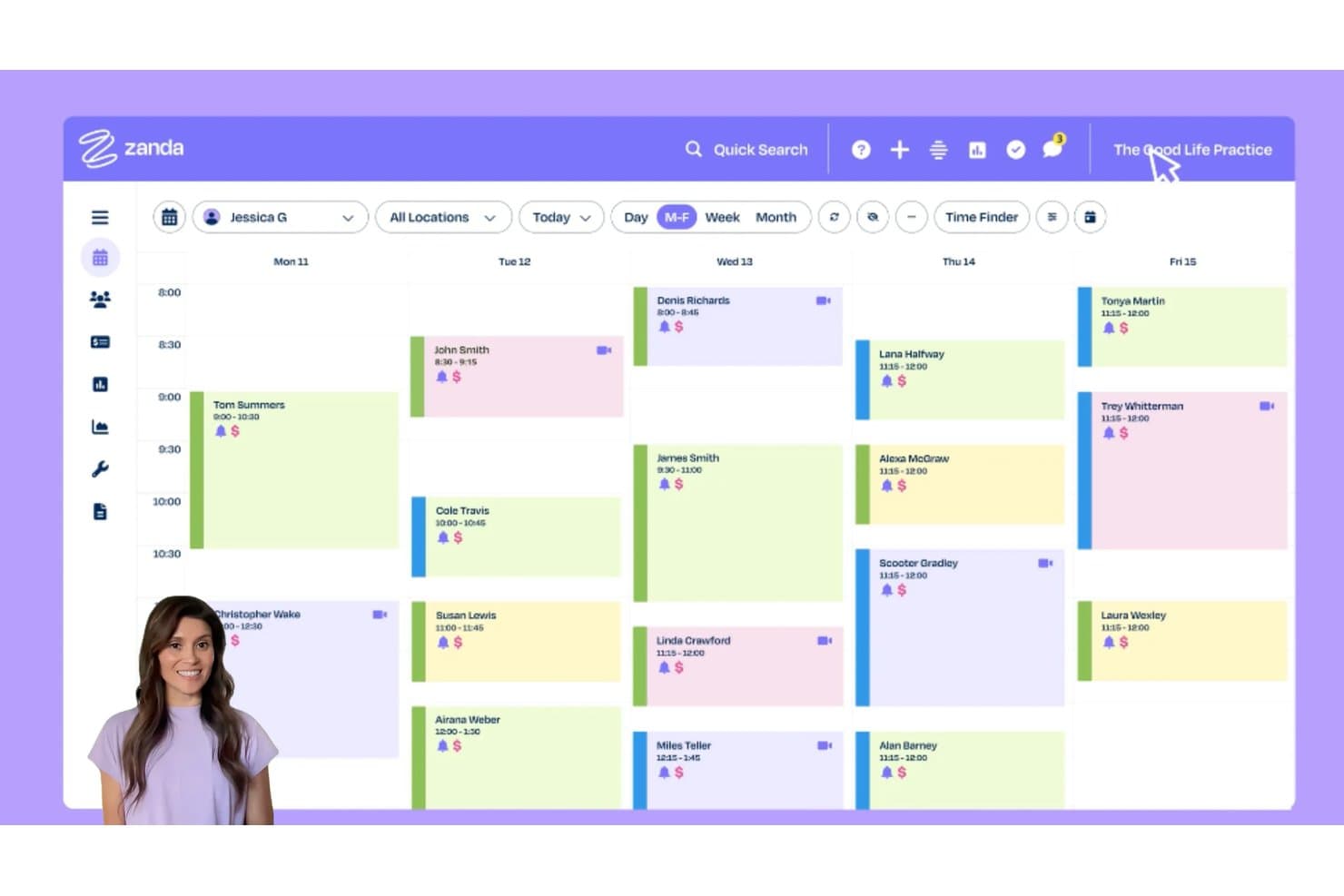
Zanda lets users view and manage weekly client appointments at a glance. Zanda is a practice management and EMR platform built for allied and behavioral health providers, with tools for clinical documentation, appointment scheduling, billing, client portal, and telehealth.
Who Is Zanda Best For?
Zanda is a strong fit for solo and small-group allied and behavioral health practitioners—think psychologists, counselors, physical therapists, and occupational therapists—who need scheduling, notes, and billing in one place.
Why I Picked Zanda
I picked Zanda as one of the best because its scheduling tools are genuinely built around how allied and behavioral health practices operate. The self-booking portal lets clients book, reschedule, and cancel on their own, and the waitlist automatically notifies clients the moment a slot opens. I also like that automated reminders support up to three touchpoints per appointment, cutting down on no-shows without any manual follow-up.
Zanda Key Features
- AI-assisted clinical notes: BizzyAI generates and edits session notes using AI Scribe, included on every plan with up to four AI Scribe appointments per month.
- Customizable note templates: The Growth plan gives you access to over 187 customizable templates with text fields, checkboxes, body charts, and auto-scored assessments.
- US insurance claims submission: Zanda integrates with the Ensora clearinghouse to handle CMS-1500 preparation, eligibility checks, and ERA/EOB posting directly inside the platform.
- Telehealth with group sessions: Zoom-powered video sessions run in the browser and support up to 20 participants, with unlimited 40-minute sessions included on every plan.
Zanda Integrations
Zanda integrates with Google Calendar, Outlook, Apple/iCal, Zoom, Stripe, Square, Xero, Mailchimp, Physitrack, and Ensora. A public API is in beta for custom integrations.
Pros and Cons
Pros:
- Behavioral health notes include scored assessments
- Automated reminders support fewer missed appointments
- Self-booking and waitlists reduce administrative messages
Cons:
- Notes lack structured medication lists
- No e-prescribing or EPCS support
Learn more about Zanda: Best for ambulatory care settings
- Free demo available
- Pricing upon request
Visit WebsiteCustomer Rating:5/5This rating combines scores from multiple user review sites to reflect overall customer sentiment about the product.
Nextgen EMR Systems Interface NextGen is a healthcare software that supports medical and dental providers in managing ambulatory care settings. With a suite of solutions, including electronic health records, practice management, and patient portal applications, NextGen simplifies many aspects of healthcare management. Its particular strength in ambulatory settings gives it a unique edge.
Why I Picked NextGen: I picked NextGen for its focus on ambulatory care settings, making it stand out among other healthcare software. The tool's design aligns with the specific workflows and data needs that characterize ambulatory care. I firmly believe it's the "best for" this use case because it offers customized solutions to address the unique challenges of outpatient care.
Standout features & integrations:
NextGen's most important features include appointment scheduling, medical billing, electronic health records, and a patient portal. These tools help to streamline processes, improve patient care, and boost productivity in an ambulatory care setting. It also offers important integrations with lab management systems and electronic prescription services to further enhance clinical workflows.
Pros and Cons
Pros:
- Provides important integrations with other healthcare systems
- Comprehensive suite of solutions
- Tailored for ambulatory care settings
Cons:
- Can be complex to customize without sufficient technical expertise
- The learning curve can be steep due to its breadth of features
- High starting price for smaller practices
Learn more about NextGEN: Best for cloud-based access and mobile EHR app
- Free demo available
- Pricing upon request
Visit WebsiteCustomer Rating:5/5This rating combines scores from multiple user review sites to reflect overall customer sentiment about the product.
Athenahealth's EMR system, athenaOne offers robust patient history documentation as well as other functions for medical records. Athenahealth is a suite of healthcare software tools designed to manage medical records, revenue cycles, patient engagement, and care coordination. It particularly stands out for its capabilities in facilitating coordinated care delivery, allowing healthcare providers to streamline workflows and improve patient outcomes.
Why I Picked Athenahealth: Athena Health's EMR system, athenaOne, stands out with its comprehensive and user-friendly features that significantly enhance clinical efficiency and patient care. One of the most notable features is its cloud-based architecture, which allows healthcare providers to access patient records and manage clinical workflows from any device with internet connectivity. The system also includes a mobile EHR app, enabling real-time updates and patient data access, which streamlines the documentation process and reduces administrative burdens.
Standout features & integrations:
Key features of athenaOne include electronic health records, practice management, patient engagement tools, and a care coordination platform. Together, these features provide a unified solution to improve healthcare delivery. As for integrations, athenaOne offers connectivity with a wide array of healthcare apps, devices, and other systems, further enabling comprehensive and coordinated care.
Pros and Cons
Pros:
- Cloud-based system for remote access
- Robust patient engagement tools
- Broad range of integrations with other healthcare systems and devices
Cons:
- Limited customization options for certain workflows
- Complexity of the system may result in a learning curve
Learn more about Athenahealth: Best for nutrition and wellness practices
- 14-day free trial
- From $19/month
Visit WebsiteCustomer Rating:4.4/5This rating combines scores from multiple user review sites to reflect overall customer sentiment about the product.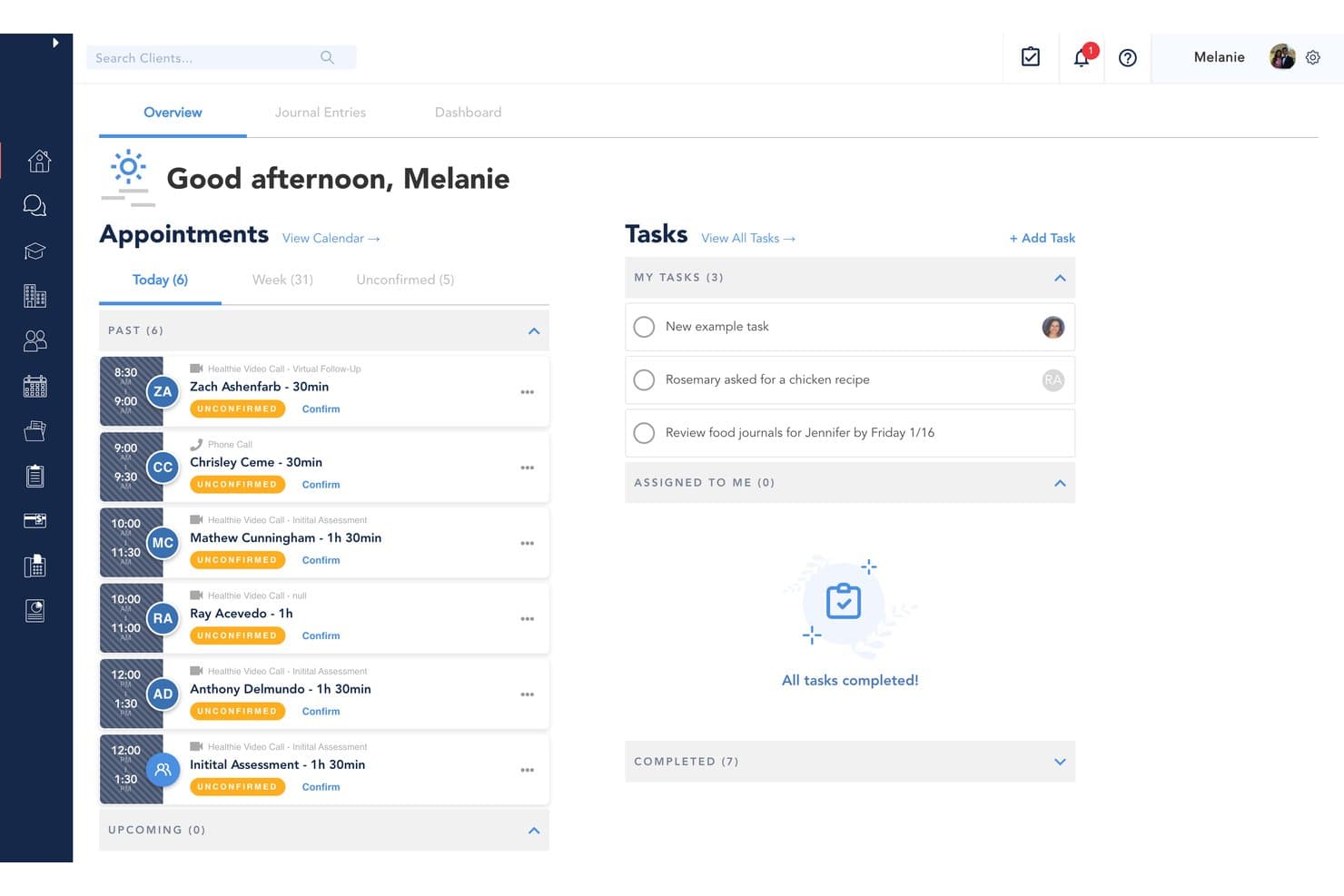
Healthie appointments and tasks dashboard Healthie is a cloud-based EHR and practice management platform that combines clinical documentation, scheduling, telehealth, billing, patient engagement, and online care programs in one system. Its customizable workflows and patient-facing tools make it particularly useful for nutrition, wellness, behavioral health, and virtual care organizations.
Who Is Healthie Best For?
Healthie is a strong fit for dietitians, nutritionists, wellness providers, behavioral health professionals, group practices, and digital health companies that want to manage both in-person and virtual care from a single platform.
Why I Picked Healthie
I picked Healthie because it brings together the clinical and business tools that nutrition and wellness practices typically need without forcing them to rely on several separate systems. I particularly like its customizable charting templates, which let providers tailor documentation to their specialty and care model. Its patient portal also supports self-scheduling, document submission, secure communication, and follow-up resources, helping practices keep clients engaged between appointments.
Healthie also stands out for its built-in telehealth, online programs, and automated billing workflows. Practices can offer individual or group virtual sessions, create recurring subscriptions or care packages, and securely collect credit card, insurance, and HSA/FSA information. Its API and white-labeling options also make it suitable for growing digital health organizations that need more control over the patient experience.
Healthie Key Features
- Customizable EHR templates: Lets providers create charting and intake workflows tailored to nutrition, wellness, behavioral health, and other care models.
- Integrated telehealth: Supports individual and group virtual visits directly through the platform.
- Patient scheduling: Allows clients to self-book appointments while supporting automated confirmations, reminders, multiple providers, locations, and appointment types.
- Billing and payments: Handles one-time payments, recurring subscriptions, packages, insurance workflows, superbills, and CMS-1500 forms.
- Patient portal: Gives clients access to appointments, forms, documents, secure messaging, care plans, and follow-up materials.
Healthie Integrations
Healthie integrates with tools such as Stripe, Fullscript, Change Healthcare, Quest Diagnostics, Labcorp, Office Ally, ClearStep, and Zoom for Healthcare. Its GraphQL API, SDKs, marketplace, and sandbox environment also support custom integrations across EHR, scheduling, billing, telehealth, and patient engagement workflows.
Pros and Cons
Pros:
- Supports packages, subscriptions, group programs, and virtual care
- Customizable charting and intake forms for different care models
- Combines EHR, scheduling, telehealth, billing, and patient engagement
Cons:
- May offer more functionality than small solo practices need
- Advanced customization and API features may require higher-tier plans
Learn more about Healthie: 5Best for affordable EMR with e-prescribing and billing
RXNT
- Free demo available
- From $118/month
Visit WebsiteCustomer Rating:4.3/5This rating combines scores from multiple user review sites to reflect overall customer sentiment about the product.
RXNT helps practices manage patient chart summaries, medications, allergies, problems, immunizations, procedures, lab results, notes, and clinical documentation workflows. Built for independent practices, RXNT is a modular healthcare software platform that combines EHR, e-prescribing, practice management, and medical billing tools in a single cloud-based system.
Who Is RXNT Best For?
RXNT works well for practice administrators and billing staff at independent outpatient clinics who manage both clinical documentation and revenue cycle in-house without dedicated IT support.
Why I Picked RXNT
I've included RXNT in my top picks because its e-prescribing module supports EPCS (electronic prescribing for controlled substances), which many small practices need but struggle to access. Real-time formulary checks also surface insurance-specific drug coverage during prescribing, so providers avoid sending patients to the pharmacy with unfillable prescriptions. The billing module handles claim submission, ERA posting, and denial management in the same system.
RXNT Key Features
- Patient portal: Patients can view records, request prescription refills, and message their care team directly through a web-based portal.
- Appointment scheduling: Manage provider calendars, patient check-ins, and resource booking from a single scheduling dashboard.
- Prior authorization tracking: Track prior auth requests and statuses inside the EHR without switching to a separate workflow tool.
- MIPS reporting: Monitor and submit MIPS quality measures from within the platform to meet value-based care requirements.
RXNT Integrations
RXNT integrates with Relay Exchange clearinghouse, Kno2 for TEFCA and QHIN connectivity, Surescripts for e-prescribing, state PDMP databases, Appriss Health, Change Healthcare, and Drummond-certified registries. It also supports clinical laboratory and radiology interfaces via HL7. RXNT offers an API for custom integrations.
Pros and Cons
Pros:
- Customizable charting templates across many specialties
- Bundled EMR, billing, and scheduling modules
- Controlled substance e-prescribing from mobile app
Cons:
- Separate accounts needed for multi-clinic providers
- Reporting lacks advanced analytics and customization
Learn more about RXNT: Best for large hospitals and enterprise health systems
- Free demo available
- Pricing upon request
Visit WebsiteCustomer Rating:4.3/5This rating combines scores from multiple user review sites to reflect overall customer sentiment about the product.
Epic physician practice dashboard for tracking visits, quality measures, and care summaries. Epic is a modular EMR/EHR platform that covers clinical documentation, inpatient and ambulatory care, revenue cycle management, population health, and patient engagement across large-scale health systems.
Who Is Epic Best For?
Epic is a strong fit for large hospitals, academic medical centers, and integrated health systems that manage high patient volumes across multiple departments or facilities.
Why I Picked Epic
Epic earns its spot as one of the best on my shortlist because it's built specifically for the scale and complexity that large hospitals and enterprise health systems actually deal with. I particularly like the Care Everywhere interoperability network, which lets clinicians view patient records across affiliated organizations without manual data transfers. The Healthy Planet module is also worth calling out: it tracks population trends and risk factors across patient cohorts, which is something a multi-facility health system running chronic care programs genuinely needs. Add in specialty-specific modules like Beacon for oncology and Cupid for cardiology, and Epic covers a level of clinical depth that few other platforms can match.
Epic Key Features
- MyChart patient portal: Gives patients access to health records, appointment scheduling, and secure messaging with care teams.
- Computerized physician order entry (CPOE): Lets clinicians place medication, lab, and imaging orders directly within the patient chart.
- Clinical decision support: Surfaces real-time alerts, dosage warnings, and care gap reminders during clinical workflows.
- Epic Haiku: A mobile app that gives clinicians access to patient charts, results, and secure messaging from their smartphones.
Epic Integrations
Epic's Showroom marketplace provides access to over 340 verified third-party applications spanning clinical, operational, and patient engagement categories. Epic supports integration via FHIR R4 APIs, HL7 v2 messaging, CCDA document exchange, and proprietary APIs, and its cornerstone partners include Microsoft and InterSystems. Microsoft Teams is also available through the marketplace. Open.Epic provides public API access for custom integrations.
Pros and Cons
Pros:
- Strong interoperability through Care Everywhere network
- Unified patient record across all facilities
- Specialty-specific modules for oncology and cardiology
Cons:
- Not practical for small or independent practices
- Implementation timelines often span multiple years
Learn more about Epic EMR Software: Best for affordable, customizable EHR workflows
- Free demo available
- From $25/month
Visit WebsiteCustomer Rating:4.2/5This rating combines scores from multiple user review sites to reflect overall customer sentiment about the product.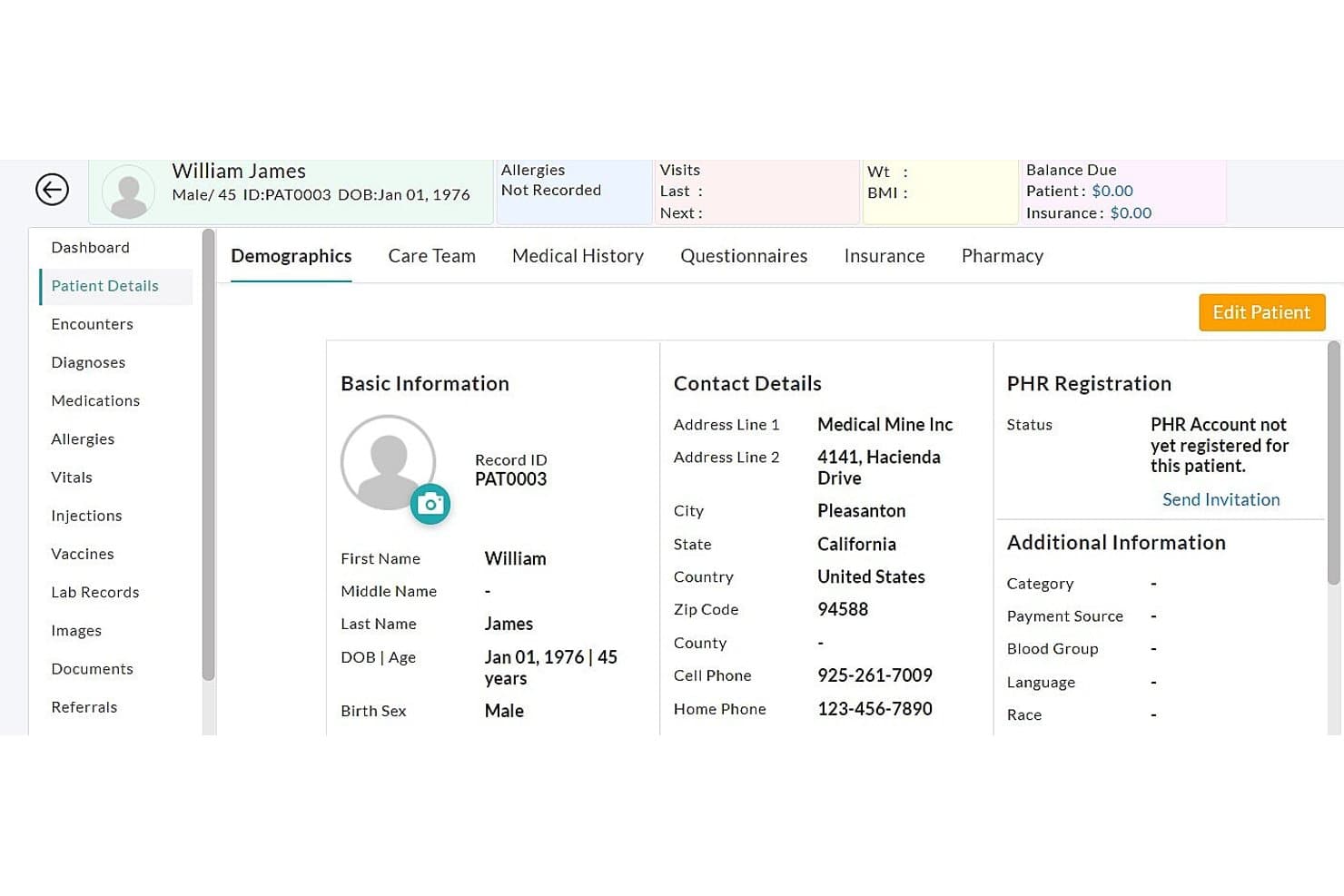
CharmHealth patient details dashboard CharmHealth is a cloud-based EHR and practice management platform that combines clinical charting, appointment scheduling, e-prescribing, telehealth, patient engagement, billing, and revenue cycle management. It also offers built-in tools such as CharmAI Scribe and CharmAssist to help providers prepare notes and complete documentation more efficiently.
Who Is CharmHealth Best For?
CharmHealth is a strong fit for solo providers, small-to-medium medical practices, multidisciplinary clinics, and growing healthcare organizations that want a flexible EHR with a free entry-level option. Its customizable templates and broad feature set make it suitable for primary care, behavioral health, wellness, and specialty practices.
Why I Picked CharmHealth
I picked CharmHealth because it provides a broad set of clinical and administrative tools without requiring practices to start with an expensive enterprise plan. Its free edition supports up to 50 encounters per month, making it especially appealing to solo providers and newer practices that want to test an EHR before committing to a paid plan.
I also like that CharmHealth combines configurable charting, appointment management, patient communication, telehealth, and billing in one platform. The patient portal lets patients request appointments, complete questionnaires, exchange secure messages, access medical records, and request prescription refills.
CharmHealth Key Features
- Customizable clinical charting: Lets providers create templates, document encounters, record diagnoses, manage medications, and tailor workflows to their specialty.
- CharmAI Scribe and CharmAssist: Supports automated note creation, chart suggestions, referral-letter drafting, and other documentation workflows.
- Appointment scheduling: Helps staff check provider availability, schedule appointments, track cancellations, collect payments, and manage rescheduled visits.
- Integrated telehealth: Enables video consultations through CharmHealth’s video platform or Zoom while allowing providers to document visits within the EHR.
- Patient portal: Gives patients access to appointments, questionnaires, secure messaging, health records, lab results, prescription updates, and refill requests.
- Billing and payment tools: Supports patient invoicing, insurance and self-pay billing, payment collection, fee schedules, recurring payments, and billing packages.
CharmHealth Integrations
CharmHealth supports REST and HL7 FHIR APIs for connecting external healthcare applications with patient, clinical, and operational data. It also supports electronic lab interfaces, Google Calendar synchronization, external medical devices, Zoom telehealth, scanners, PointClickCare, and MatrixCare.
Pros and Cons
Pros:
- Customizable templates and AI-assisted documentation features
- Combines EHR, scheduling, telehealth, portal, and billing tools
- Free edition supports up to 50 encounters per month
Cons:
- Extensive configuration options may require additional setup time
- Add-ons and transaction-based services can increase overall costs
Learn more about CharmHealth: Best for small practices needing simple clinical and admin tools.
- Free demo available
- Pricing upon request
Visit WebsiteCustomer Rating:3.9/5This rating combines scores from multiple user review sites to reflect overall customer sentiment about the product.
Tebra helps practices manage appointment reports, patient schedules, missed charges, notes, encounters, claims, and reporting workflows in one EHR platform. Built specifically for independent medical practices, Tebra brings together EHR charting, patient intake, telehealth, and practice management tools in a single cloud-based platform.
Who Is Tebra Best For?
Tebra is a natural fit for outpatient specialty and primary care practices that want to manage clinical documentation and patient scheduling without a dedicated IT team.
Why I Picked Tebra
Tebra earns its spot on my shortlist because it keeps clinical and administrative work in one place without requiring extra configuration to get there. I love that the scheduling and charting tools are connected, so when a patient checks in, the chart is ready to open. The built-in telehealth feature also lets you run a video visit and document it in the same workflow, which is exactly what a small practice needs to avoid juggling separate platforms.
Tebra Key Features
- Encounter-based charting: Document visits using specialty-specific note templates built directly into the chart.
- Claims management: Submit and track claim status without leaving the clinical dashboard.
- Care plan builder: Create patient-specific care plans with follow-up tasks and goal tracking.
- MIPS reporting: Track and submit quality measures for Medicare performance scoring from within the platform.
Tebra Integrations
Tebra integrates with labs, clearinghouses, and other third-party healthcare tools to support clinical workflows. You can connect your EHR with labs, imaging centers, supplement ordering, and other healthcare tools. PDMP integration is available through Appriss Health for controlled substance compliance checks. Tebra also offers a SOAP API that interacts with third-party applications, giving developers the ability to build custom integrations.
Pros and Cons
Pros:
- SALT charting pulls forward prior visits
- Patient portal handles refills and messaging
- AI Note Assist auto-generates visit documentation
Cons:
- Report filters often return incorrect results
- Mobile app calendar sync is unreliable
Learn more about Tebra: Best for scalable hospital EMR and population health workflows
- Free demo available
- Pricing upon request
Visit WebsiteCustomer Rating:4/5This rating combines scores from multiple user review sites to reflect overall customer sentiment about the product.
Oracle Health helps healthcare teams manage patient analytics, provider filters, visit metrics, diagnoses, procedures, encounter types, and clinical performance insights. Oracle Health is a cloud-native EMR platform that covers clinical documentation, inpatient and ambulatory care, revenue cycle management, and population health management for hospitals and health systems.
Who Is Oracle Health Best For?
Oracle Health is a strong fit for mid-to-large health systems and government or federal healthcare organizations that need a scalable EMR with built-in population health capabilities.
Why I Picked Oracle Health
I picked Oracle Health as one of the best because of how well it handles population health at scale. The Care Coordination Intelligence module uses AI to summarize longitudinal patient records and flag patients for proactive outreach, which is genuinely useful for managing chronic condition cohorts across a large health system. I also like the AI Data Platform, an EHR-agnostic enterprise data warehouse that pulls from clinical, financial, and operational sources to surface care gap and readmission risk insights in one place.
Oracle Health Key Features
- PowerChart: Oracle Health's core clinical workspace for reviewing patient histories, lab results, and active medication lists across care settings.
- FirstNet: An ED-specific workflow module that manages triage documentation, patient tracking boards, and order sets for emergency department teams.
- Revenue cycle management: Built-in charge capture, claim submission, coding, and denial management tools across inpatient and ambulatory encounters.
- Ambulatory scheduling: A scheduling and registration module that handles appointment booking, patient check-in, and waitlist management.
Oracle Health Integrations
Oracle Health supports integrations through its Oracle Healthcare Marketplace, where validated third-party apps like Zoom, Phreesia, CozevaConnect, and Nuance Dragon Medical One are available. The platform uses an open architecture with FHIR R4 APIs, HL7 v2 messaging, SMART on FHIR, CDS Hooks, and proprietary Millennium APIs for custom integrations, and it participates in the CommonWell Health Alliance and Carequality interoperability networks for cross-vendor health data exchange.
Pros and Cons
Pros:
- Founding member of CommonWell Health Alliance
- Clinical AI Agent covers 30+ specialties
- Deep configuration of screens and order sets
Cons:
- Support ticket resolution often requires escalation
- Too many clicks for routine charting tasks
Learn more about Oracle Health: Best for mobile-friendly EMR and patient workflows
- Free demo available
- Pricing upon request
Visit WebsiteCustomer Rating:3.9/5This rating combines scores from multiple user review sites to reflect overall customer sentiment about the product.
DrChrono helps practices manage patient profiles, future appointments, clinical records, referrals, billing status, and appointment notes in one EHR platform. DrChrono is an iOS-native EHR and practice management platform that combines clinical documentation, medical billing, scheduling, telehealth, and a patient portal in one mobile-first system.
Who Is DrChrono Best For?
DrChrono is a strong fit for independent and ambulatory practices that need a fully functional EHR accessible from an iPhone or iPad.
Why I Picked DrChrono
I picked DrChrono as one of the best because it's the only EHR I know of that was built mobile-first from the ground up, not retrofitted for mobile after the fact. The iOS app lets you open a chart, document using speech-to-text, and check a patient out, all from your iPhone or iPad. I also like the AI-powered no-show predictor, which flags high-risk appointments before the day starts so your front desk can act on them proactively.
DrChrono Key Features
- Specialty-specific template library: Access and customize pre-built templates across 20+ specialties, or build your own from scratch to match your documentation workflow.
- EverHealth Scribe: An AI ambient scribe that listens during patient visits and generates structured clinical notes directly in the chart.
- eRx with EPCS support: Send prescriptions electronically to any pharmacy, with real-time drug interaction checks and controlled substance prescribing built in.
- Electronic prior authorization: Submit and track prior authorization requests inside the prescribing workflow, powered by CoverMyMeds.
DrChrono Integrations
DrChrono partners with a variety of companies through its marketplace, offering integrations with tools like Box and Square Point of Sale, Birdeye and Weave, along with lab connections to LabCorp, Quest Diagnostics, Health Gorilla, and Lifepoint. The platform's API enables developers to create custom integrations tailored to specific practice needs.
Pros and Cons
Pros:
- Built-in telehealth with no extras
- iPad photos store directly in charts
- Native iPad and iPhone EHR app
Cons:
- Financial reports can show inaccurate data
- Support tickets often resolve slowly
Learn more about DrChrono EHR:
Other EMR Systems
Here are some additional EMR system options that didn’t make it onto my shortlist, but are still worth checking out:
- 11athenaOneBest for cloud EMR, billing, and patient engagement
- 12Practice FusionBest for small practices needing simple cloud-based EHR
- 13AdvancedMD EMRBest for independent practices needing EMR and billing automation
- 14CareCloudBest for customizable cloud EMR and revenue cycle tools
- 15NextGen HealthcareBest for specialty practices needing configurable EMR workflows
- 16CureMD EHRBest for specialty EMR with billing and practice management
- 17eClinicalWorksBest for ambulatory practices needing EMR and telehealth
- 18OpenEMRBest for free open-source EMR customization
- 19VeradigmBest for ambulatory EMR, analytics, and clinical data tools
- 20OSCAR EMRBest for open-source Canadian primary care
How I Evaluate EMR Software
I split my evaluation into baseline criteria—things like ONC-certified charting, EPCS, and HIPAA compliance—and differentiating factors like specialty templates, AI scribing, and pricing transparency.
Core Functionality (Table Stakes For This List)
When I'm selecting tools for my list, I rank each one on a scale from 0 (does not offer the functionality) to 5 (excels in this area) for each core functionality listed below. Then, I calculate the tool's total score into a percentage. Each tool needs to achieve a minimum total score of 65% to be considered for inclusion.
- Electronic Charting & Documentation: I check whether the platform supports structured SOAP notes, problem lists, medication histories, and specialty-specific templates rather than just free-text entry.
- E-Prescribing (eRx/EPCS): Providers need to send scripts directly to pharmacies, so I evaluate whether eRx includes controlled substance support, drug interaction checks, and formulary lookups.
- HIPAA-Compliant Data Security: Each platform should offer encryption, audit logs, role-based access controls, and a signed BAA—basics that protect patient data during storage and exchange.
- Practice Management Integration: I look at how tightly scheduling, demographics, billing, and ICD-10/CPT coding connect to the clinical side so front-desk and billing staff aren't toggling between systems.
- Lab & Interoperability Standards: The ability to send lab orders and pull results electronically matters, and I evaluate support for HL7, FHIR, and CCDA for sharing records across providers.
- Patient Portal & Telehealth: Patients expect online access to records and messaging, so I check whether each EMR includes a portal alongside integrated or native video visit capabilities.
Once I have a list of tools that meet this criteria, I consider what sets each platform apart.
Differentiating Factors (What Sets Vendors Apart)
Here's how I compare and contrast different vendors:
Standout Features
AI-powered ambient documentation is a big differentiator—platforms like athenahealth and eClinicalWorks offer AI scribes that generate notes from live patient conversations, cutting hours of after-visit charting. I also evaluate specialty-specific template libraries, since a dermatology practice and a cardiology group need very different documentation workflows out of the box. Built-in MIPS/MACRA reporting matters too, because quality measure dashboards help practices track performance and avoid reimbursement penalties without relying on third-party tools.
Beyond Features
ONC certification status is one of the first things I check—it determines whether a practice can participate in incentive programs and meet federal interoperability requirements. Implementation support also varies widely; vendors like Epic and NextGen offer dedicated migration teams for legacy chart conversion, while others leave practices to handle it largely on their own. Pricing transparency matters just as much. I evaluate whether vendors charge per provider, bundle telehealth and portal access into base plans, or tack on add-on fees that inflate total cost over time.
How to Choose EMR Systems
It’s easy to get bogged down in long feature lists and complex pricing structures. To help you stay focused as you work through your unique software selection process, here’s a checklist of factors to keep in mind:
| Factor | What to Consider |
| Scalability | Will the system handle your practice growth, new locations, or added specialties without major disruptions or expensive upgrades? |
| Integrations | Does the platform natively connect to your billing, lab, imaging, and referral management tools—or will you need costly workarounds or custom development? |
| Customizability | Can you tailor documentation templates, workflows, and reporting to your specialty and clinic processes, or are options locked down? |
| Ease of use | Is the interface intuitive for day-to-day clinical and administrative users? Consider staff training needs and previous experience with similar platforms. |
| Implementation and onboarding | What level of vendor support is provided for migration, setup, and staff training? Will transition planning avoid patient care disruptions? |
| Cost | Are all modules and support included in the quoted price, or do add-ons like telehealth, billing, or mobile access carry additional charges? |
| Security safeguards | Which privacy and security protections are in place—such as end-to-end encryption, audit logs, and multi-factor authentication? |
| Support availability | Is assistance available during clinic hours and after-hours? How quickly can you expect resolution for critical issues or outages? |
What Are EMR Systems?
An EMR system is a digital platform that manages and stores patient medical records, clinical notes, and care histories for healthcare providers. It supports clinicians with tools for charting, prescriptions, documentation, and information sharing within a practice. This software improves accuracy, compliance, and efficiency in managing patient care.
Features
When selecting EMR software, keep an eye out for the following key features:
- Clinical documentation: Enables providers to capture, store, and retrieve detailed patient notes, histories, and encounter records using standardized templates.
- E-prescribing: Lets clinicians send prescriptions electronically to pharmacies, reducing errors and improving medication tracking.
- Patient portal: Gives patients access to their health information through patient portal tools, with options for appointment scheduling and secure messaging with care teams.
- Appointment scheduling: Provides digital tools for booking, canceling, and rescheduling patient visits, managing provider calendars and reducing no-shows.
- Order and results management: Facilitates creating and tracking lab, imaging, and referral orders, with results automatically matched to patient charts.
- Billing and coding: Integrates with practice management to capture charges, streamline insurance claims, and manage payment reconciliation.
- Interoperability: Supports sharing health data with other systems and providers using industry standards, making care coordination easier.
- Compliance tools: Offers built-in audit trails, user permission controls, and support for regulatory reporting to meet privacy and healthcare standards.
- Customizable templates: Allows adaptation of documentation forms and workflows to better fit specialty- or clinic-specific needs.
- Reporting and analytics: Provides dashboards and reports to track clinical, financial, and operational performance for quality improvement.
Common EMR System AI Features
Beyond the standard EMR system features listed above, many of these solutions are incorporating AI with features like:
- Predictive analytics: Uses AI to identify patients at risk for complications or readmissions by analyzing trends in clinical data and flagging high-risk cases for early intervention.
- Automated coding assistance: AI reviews clinical notes and suggests accurate billing codes, reducing manual errors and speeding up the claims process.
- Speech-to-text documentation: Converts spoken provider notes into structured text within the patient chart, saving time and improving documentation accuracy.
- Clinical decision support: Delivers real-time, AI-driven alerts and recommendations based on patient data, helping providers make evidence-based care decisions.
- Intelligent appointment reminders: AI analyzes patient preferences and history to send personalized reminders, reducing no-shows and improving scheduling efficiency.
Benefits
Implementing an EMR system provides several benefits for your team and your business. Here are a few you can look forward to:
- Improved clinical accuracy: Digital charting and documentation reduce manual errors and keep patient records clear and up to date.
- Enhanced care coordination: Secure sharing and interoperability make it easy for teams to exchange patient data and support continuity of care.
- Faster billing cycles: Integrated e-prescribing and automated coding tools help speed up claims submission and payment collection.
- More efficient workflows: Appointment scheduling, task automation, and templated notes save time for both administrative and clinical staff.
- Better compliance and security: Audit trails, user permissions, and regulatory reporting tools make it easier to meet healthcare privacy and documentation standards.
- Increased patient engagement: Patient portals and communication tools keep patients informed, connected, and involved in their health decisions.
- Scalable growth: Cloud-based platforms and modular features support practices as they expand or add new specialties.
Costs and Pricing
Selecting EMR systems requires an understanding of the various pricing models and plans available. Costs vary based on features, team size, add-ons, and more. The table below summarizes common plans, their average prices, and typical features included in EMR software solutions:
Plan Comparison Table for EMR Systems
| Plan Type | Average Price | Common Features |
| Free Plan | $0 | Basic documentation, limited patient records, and minimal support. |
| Personal Plan | $20–$70/user/month | Full patient charting, e-prescribing, scheduling, and secure messaging. |
| Business Plan | $100–$300/provider/month | Advanced billing, integrated analytics, customizable templates, and interoperability tools. |
| Enterprise Plan | $400+/provider/month | Dedicated onboarding, priority support, compliance management, advanced integrations, and robust security. |
EMR System FAQs
Here are some answers to common questions about EMR systems:
How do EMR systems improve patient safety?
EMR software reduces medical errors by providing clear, up-to-date patient information, medication alerts, and clinical decision support tools right at the point of care.
Can EMR systems connect with labs and pharmacies?
Yes, most EMR systems offer integrations with labs, pharmacies, and imaging centers so test results and prescriptions are exchanged electronically and accurately.
What training do staff typically need for EMR systems?
Staff usually need training on charting, scheduling, and e-prescribing workflows, along with practice using patient portal features and security basics.
How do EMR platforms support regulatory compliance?
EMR platforms include audit trails, reporting features, and security controls that help users meet HIPAA, HITECH, and other healthcare data regulations.
Is it possible to migrate data from a previous EMR system?
Yes, many EMR vendors offer data migration services, but the process can vary in complexity depending on your current system and data formats.