

A psychiatry EMR is an electronic medical record platform built for psychiatric care, making it easier to chart, prescribe, and coordinate behavioral health treatments. If you’re searching for the best psychiatry EMR, you’re likely dealing with unique documentation, telehealth, and medication management needs—and you need a solution designed to handle those demands without slowing down your clinical workflow.
This list breaks down the top options, so you can quickly compare psychiatry-focused features, security safeguards, and tools that support better care for your patients.
Why Trust Our Software Recommendations
6,700+
Reviews
20
Industry experts
16+
Evaluation factors
14
Years
Our team has been testing and reviewing software since 2012. As medical practice leaders ourselves, we know how difficult—and important—it is to choose the right software.
For this guide, we evaluated tools using hands-on testing and independent research, scoring tools using our selection criteria.
Our reviews reflect our human editorial judgment, not a sales pitch.
Psychiatry EMR Comparison Table
This comparison table summarizes pricing details for my top psychiatry EMR selections:
| Tool | Best For | Trial Info | Price | ||
|---|---|---|---|---|---|
| 1 | Best for customizable behavioral health workflows | Free demo available | Pricing upon request | Website | |
| 2 | Best for therapy and psychiatry in one chart | 30-day free trial | From $69/month | Website | |
| 3 | Best for behavioral health documentation and billing | Free demo available | Pricing upon request | Website | |
| 4 | Best for psychiatry-specific charting and e-prescribing | 30-day free trial | From $55/month | Website | |
| 5 | Best for independent psychiatry and therapy practices | Free demo available | Pricing upon request | Website | |
| 6 | Best for customizable cloud EHR workflows | Free demo available | Pricing upon request | Website | |
| 7 | Best for integrated whole-person behavioral care | Free demo available | Price upon request | Website | |
| 8 | Best for scalable behavioral health workflows | Free demo available | Pricing upon request | Website | |
| 9 | Best for measurement-based care in psychiatric practice | 30-day free trial | From $10/month | Website | |
| 10 | Best for behavioral health agency-scale EMR | Free demo available | Pricing upon request | Website |


Best Psychiatry EMR Reviews
Below are my detailed summaries of the best psychiatry EMR that made it onto my shortlist. My reviews offer a detailed look at the features, best use cases, and pricing of each software to help you find the best one for you.
 Best for customizable behavioral health workflows
- Free demo available
- Pricing upon request
Visit WebsiteCustomer Rating:4.8/5
EHR Your Way helps practices manage appointment scheduling, provider calendars, blocked times, recurring visits, and group therapy appointments. EHR Your Way is a behavioral health EHR that covers clinical documentation, scheduling, billing, revenue cycle management, e-prescribing, and inpatient and outpatient care management in a single configurable platform.
Who Is EHR Your Way Best For?
EHR Your Way is a strong fit for behavioral health organizations, from small outpatient clinics to larger multi-site providers, that need to configure clinical documentation around their specific care workflows rather than adapt to a rigid system.
Why I Picked EHR Your Way
EHR Your Way earns its spot on my shortlist because the level of workflow configurability it offers is genuinely uncommon in behavioral health EHRs. I'm particularly impressed by the form-forwarding and compliance hold features, which let you build documentation routing rules that match how your clinical and compliance teams actually work. For psychiatry practices, the golden thread documentation ties presenting problems through treatment plans to progress notes, which keeps your records audit-ready without extra manual steps.
EHR Your Way Key Features
- E-prescribing with EPCS support: Send controlled substance prescriptions electronically, with built-in identity verification and audit logging to meet DEA requirements.
- Integrated billing and RCM: Submit claims, track remittances, and manage denials from within the same platform as your clinical documentation.
- Patient portal: Patients complete intake paperwork, sign consent forms, and access visit summaries directly through a self-service portal.
- Telehealth module: Conduct video visits from within the EHR without routing patients to a separate platform.
EHR Your Way Integrations
EHR Your Way is designed as a single-platform system that combines clinical documentation, billing, and practice management without requiring third-party integrations. That said, it does offer a handful of verified connections. EHR Your Way uses Google OAuth authentication to sync patient appointments with Google Calendar. For telehealth, it integrates with Zoom, Microsoft Teams, and Google Meet. It also connects with eClinicalWorks and PointClickCare for care coordination in integrated behavioral health settings, and with Inbox Health for patient collections. The EHR Your Way Clinical Web API is available as web services for custom integrations, and it supports FHIR-based data exchange and CCDA document exchange for interoperability with external health systems.
Pros and Cons
Pros:
- Tracks clinical KPIs through ad-hoc reporting
- Flat-rate pricing with no per-user fees
- Replicates your paper forms electronically
Cons:
- Patient portal emails often land in spam
- Mobile experience is limited and clunky
Learn more about EHR Your Way: Best for therapy and psychiatry in one chart
- 30-day free trial
- From $69/month
Visit WebsiteCustomer Rating:4.4/5
TherapyNotes helps practices manage patient payments, balances, payment methods, allocations, and billing workflows in one EHR platform. TherapyNotes is a behavioral health EMR built around clinical documentation, scheduling, billing, and practice management for mental health and psychiatry practices.
Who Is TherapyNotes Best For?
TherapyNotes is a strong fit for mental health and psychiatry practices of any size that need a dedicated, specialty-built EMR.
Why I Picked TherapyNotes
I picked TherapyNotes as one of the best because it's built around a tight connection between notes, scheduling, and billing that reduces duplicate data entry. When you schedule an appointment, those details pull directly into the corresponding note and claim, so your psychiatry practice isn't re-entering the same information three times. The billing module handles electronic claim submission, ERA posting, and auto-generated superbills, and it flags common errors before you submit. I also like that the to-do list auto-generates tasks tied to appointments, so nothing falls through the cracks between sessions.
TherapyNotes Key Features
- Telehealth: Built-in video sessions let you run telepsychiatry appointments without leaving the platform.
- Client portal: Patients can request appointments, complete intake paperwork, and exchange secure messages before their first session.
- Outcome measures: Built-in standardized assessments, including PHQ-9 and GAD-7, with automated scoring and progress tracking over time.
- ePrescribe: An add-on that lets prescribing psychiatrists send controlled and non-controlled substance prescriptions electronically from within a client's chart.
TherapyNotes Integrations
TherapyNotes focuses on built-in features rather than external integrations. The platform faces notable challenges when it comes to integration, including the absence of a native API, which prevents direct connections to external tools. One of its most prominent partnerships is with CLAIM.MD for electronic claims submission and ERA processing. The integration most frequently cited by reviewers is Google Calendar. Zapier and API support are not available.
Pros and Cons
Pros:
- No-cost HIPAA-compliant video telehealth
- Supervision workflows with note co-signing
- Unlimited 24/7 phone and email support
Cons:
- No group appointment scheduling option
- Limited reporting and analytics dashboards
Learn more about TherapyNotes: Best for behavioral health documentation and billing
- Free demo available
- Pricing upon request
Visit WebsiteCustomer Rating:4.1/5
Valant helps behavioral health practices manage billing, charges, insurance payments, patient balances, and financial workflows in one EHR platform. Valant is a behavioral health EHR that covers clinical documentation, e-prescribing, outcome measurement, scheduling, billing, and patient engagement tools across outpatient and IOP/PHP settings.
Who Is Valant Best For?
Valant is a strong fit for behavioral health group practices of any size, from solo psychiatrists and PMHNPs to large multi-provider organizations running outpatient or IOP/PHP programs.
Why I Picked Valant
I've included Valant in my top picks because the documentation and billing tools are built exclusively for behavioral health, not adapted from a general-purpose EHR. I particularly like how behavioral health-specific templates tie directly into billing workflows, with claims scrubbing and integrated ERA/EFT posting reducing denials before they reach the payer. The payer-specific AR dashboards also let billing teams isolate issues by payer and resolve them without digging through a generic report.
Valant Key Features
- AI Notes Assist: An AI scribe built into the EHR that generates structured draft notes in DAP, BIRP, narrative, and custom template formats from in-person or telehealth sessions, with CPT-aligned coding suggestions surfaced automatically.
- Auto Assign Measures: Automatically delivers the right outcome measures and assessments to patients at intake based on program type, without manual clinician setup.
- Group therapy documentation: A single-page workflow that auto-populates group session content into each participant's individual note, with configurable attendance-based billing codes and multi-participant telehealth support for up to 30 participants.
- MYIO patient portal: A patient-facing portal that handles digital intake forms, consent documents, appointment requests, and online bill payment within one system.
Valant Integrations
Valant integrates with Waystar for clearinghouse, claims management, and ERA workflows, and with Rcopia for electronic prescribing. Valant offers a smaller set of native integrations compared to other psychiatry EMRs, but it provides an API with inbound, outbound, and bi-directional endpoints for connecting external scheduling, billing, and EHR systems. Zapier support is not clearly documented.
Pros and Cons
Pros:
- Integrated outcome measures library with automation
- Claim Assist checks 100+ behavioral health billing rules
- Built-in PDMP lookups and EPCS prescribing
Cons:
- No ability to personalize note templates
- Recurring system crashes and slow performance reported
Learn more about Valant: Best for psychiatry-specific charting and e-prescribing
- 30-day free trial
- From $55/month
Visit WebsiteCustomer Rating:4.1/5
ICANotes helps behavioral health practices manage clinical documentation, note tracking, billing workflows, and practice reports in one EHR system. ICANotes is a psychiatry EMR built from the ground up for psychiatric workflows, combining menu-driven charting templates, integrated e-prescribing with EPCS, medication management, and built-in billing tools.
Who Is ICANotes Best For?
ICANotes is a strong fit for behavioral health group practices that need a dedicated psychiatric EMR covering both clinical documentation and billing in one system.
Why I Picked ICANotes
ICANotes earns its spot on my shortlist because the charting system is genuinely built around psychiatric workflows, not retrofitted from a general EMR. Menu-driven templates cover 90+ psychiatric and psychosocial concerns, generating complete narrative notes in under three minutes. On the prescribing side, PDMP checks run inside the note itself, alongside drug-drug and drug-allergy interaction checks, so I never have to leave the chart to verify a patient's controlled substance history before signing a prescription.
ICANotes Key Features
- Secure patient portal: Patients complete digital intake forms before their first visit, with information auto-populating directly into the initial psychiatric evaluation.
- Electronic lab ordering: Order labs and receive results electronically from within the chart, supporting medication monitoring without leaving the platform.
- Automated E&M coding: Notes are automatically assigned the highest reimbursable E&M code supported by your documentation, reducing undercoding and claim denials.
- Built-in rating scales: Access a library of 100+ electronic rating scales, including PHQ-9 and GAD-7, that feed directly into patient records for measurement-based care.
ICANotes Integrations
ICANotes integrates with Labcorp, Quest Diagnostics, Millennium Health, ClaimMD, Waystar, and Etactics and Kno2, among other labs and clearinghouses. ICANotes supports custom and prebuilt integrations with labs, clearinghouses, and HIEs using industry standards like HL7, FHIR, and SFTP.
Pros and Cons
Pros:
- Stores psychotherapy notes separately per HIPAA
- Bundled e-prescribing includes EPCS at no extra cost
- Menu-driven library with 75,000+ clinical phrases
Cons:
- Less flexible for non-prescribing psychologists
- Interface feels dated compared to newer competitors
Learn more about ICANotes: Best for independent psychiatry and therapy practices
- Free demo available
- Pricing upon request
Visit WebsiteCustomer Rating:3.9/5
Tebra helps healthcare practices manage electronic health records, prescriptions, labs, telehealth appointments, and patient information in one platform. Tebra is a cloud-based EHR platform built for independent practices, combining AI-assisted clinical documentation, ePrescribing, telehealth, scheduling, and integrated billing across mental health, psychiatry, and primary care specialties.
Who Is Tebra Best For?
Tebra is a strong fit for solo and small-group independent psychiatry and therapy practices that need a single system for charting, billing, and patient management.
Why I Picked Tebra
Tebra earns its spot on my shortlist because it's purpose-built for independent psychiatry and therapy practices in a way most general EHRs aren't. I particularly like AI Note Assist, which generates SOAP notes from visit content and lets you pull forward prior session details using SALT, cutting documentation time significantly. The documentation connects directly to eligibility checks and claims, so billing doesn't require a separate system or manual handoffs between staff.
Tebra Key Features
- Electronic prescriptions: Send prescriptions to the pharmacy directly from a patient's chart, with built-in drug interaction checks and refill tracking.
- Electronic labs: Order lab tests and view results inside the patient record, without switching between portals or managing paper.
- Patient intake: Patients complete intake forms digitally before their visit, so demographic and clinical information is ready when the appointment starts.
- Appointment reminders: Automated text, email, or phone reminders go out before visits to reduce no-shows and support MIPS reporting.
Tebra Integrations
Tebra's EHR acts as a central hub with an ecosystem of 60+ third-party integrations, including verified partners like Fullscript for supplement prescribing, DrFirst (RxInform) for prescription adherence notifications, and Appriss Health for PDMP compliance checks, along with connections to labs, imaging centers, and clearinghouses. Tebra also offers a SOAP API that lets developers build custom integrations with third-party applications. Zapier support is not clearly documented.
Pros and Cons
Pros:
- Quick onboarding with guided setup process
- Built-in ePrescribing with interaction checks
- AI Note Assist speeds up charting
Cons:
- Lacks common psychiatric rating scales
- Billing workflows are difficult to navigate
Learn more about Tebra: Best for customizable cloud EHR workflows
- Free demo available
- Pricing upon request
Visit WebsiteCustomer Rating:3.9/5
DrChrono helps practices manage patient profiles, appointments, clinical records, referrals, exercise programs, and client communications in one EHR platform. DrChrono is a cloud-based, mobile-first psychiatry EMR that covers clinical documentation, e-prescribing with EPCS, behavioral health scheduling, billing, telehealth, and a patient portal in one platform.
Who Is DrChrono Best For?
DrChrono is a strong fit for independent psychiatrists and psychiatric NPs who want a fully cloud-based, mobile-first platform that handles documentation, EPCS, scheduling, and billing in one place.
Why I Picked DrChrono
DrChrono earns its spot on my shortlist because of how far its customizable cloud workflows stretch across a psychiatric practice's daily needs. I like that persistent templates carry forward patient data from one session to the next, cutting repetitive documentation for chronic conditions like depression or bipolar disorder. The built-in EPCS via Surescripts handles Schedule II batch ordering and multi-state DEA schedule checks, which I find genuinely useful for psychiatrists prescribing across state lines.
DrChrono Key Features
- OnPatient portal: Patients schedule visits, complete intake forms, sign consent documents, and make payments through a self-service portal before they arrive.
- PDMP integration via Bamboo Health: The prescription drug monitoring report opens directly from the patient's Medication List, with no separate login and a full audit trail of every report access.
- Billing profiles with DSM-5 auto-fill: Pre-configured billing profiles for diagnoses like ADHD, anxiety, and bipolar disorder automatically populate DSM-5 codes into notes and superbills.
- EverHealth Scribe: An ambient AI scribe that listens during visits and drafts structured clinical notes for the clinician to review and finalize.
DrChrono Integrations
DrChrono integrates with Surescripts, ID.me, CoverMyMeds, Bamboo Health, Quest, LabCorp, RecordSync, Iron Bridge, eProvider Solutions, and iHCFA. It also provides an open FHIR API for custom integrations.
Pros and Cons
Pros:
- DSM-5 billing profiles reduce coding entry
- Reviewers praise customizable notes
- Persistent templates reduce repeat charting
Cons:
- No published scale-trend dashboards
- Support delays recur in user reviews
Learn more about DrChrono: Best for integrated whole-person behavioral care
- Free demo available
- Price upon request
Visit WebsiteCustomer Rating:3.7/5
NextGen Behavioral Health Suite helps practices manage patient referrals, diagnoses, clinical documentation, insurance details, and referral attachments in one EHR platform. Built for multi-service behavioral health organizations, NextGen Behavioral Health Suite is an EHR that spans psychiatric documentation, primary care, oral health, and addiction treatment records in a single platform.
Who Is NextGen Behavioral Health Suite Best For?
It's a good fit for mid-to-large behavioral health organizations that operate multiple service lines and need psychiatric, primary care, and substance use records under one system.
Why I Picked NextGen Behavioral Health Suite
NextGen Behavioral Health Suite earns its spot on my shortlist because it's the only psychiatry EHR I've found that natively connects behavioral health, primary care, oral health, and addiction treatment in one record. I particularly like the AI-generated SOAP notes through ambient listening, which cuts documentation time during psychiatric visits. The built-in population health tools also let me flag and monitor at-risk patients across all service lines without a separate analytics system.
NextGen Behavioral Health Suite Key Features
- Telehealth: Conduct video visits for remote psychiatric consultations within the EHR.
- E-prescribing: Send prescriptions electronically, including controlled substances, directly from the clinical record.
- Patient portal: Patients access health records, lab results, and secure messaging through a self-service portal.
- Revenue cycle management: Submit and track psychiatric billing claims from within the same platform as clinical documentation.
NextGen Behavioral Health Suite Integrations
NextGen Healthcare offers an API marketplace with third-party applications that integrate with the NextGen Enterprise platform. Marketplace integrations relevant to behavioral health include Commure for ambient AI documentation, ConnectOnCall for after-hours patient communication, Findhelp for social determinants of health referrals, Relaymed for point-of-care testing, Unite Us for social services referrals, Labcorp for lab results, and Surescripts for e-prescribing. The platform supports nationwide health information exchange through Carequality, and HL7 and FHIR interoperability standards are supported, with an API available for custom integrations.
Pros and Cons
Pros:
- Ambient AI documentation saves hours daily
- 26 specialty templates with tailored clinical content
- Unifies BH, medical, and oral health records
Cons:
- Support tickets often sit unresolved for days
- BH templates require excessive clicks to complete
Learn more about NextGen Behavioral Health Suite: Best for scalable behavioral health workflows
- Free demo available
- Pricing upon request
Visit WebsiteCustomer Rating:3.6/5
AdvancedMD helps practices manage patient schedules, clinical notes, prescriptions, orders, documents, messages, and review workflows in one EHR platform. AdvancedMD is a cloud-based EMR and practice management platform built for behavioral health, combining psychiatric documentation, ePrescribing, teletherapy, medical billing, and patient engagement tools in one system.
Who Is AdvancedMD Best For?
AdvancedMD suits mid-to-large behavioral health organizations that need to coordinate psychiatrists, therapists, and billing staff across multiple locations.
Why I Picked AdvancedMD
I picked AdvancedMD as one of the best because its billing infrastructure is genuinely built around behavioral health coding. The ICD-10 search pulls your most-used codes to the top, and every claim runs through automated scrubbing before it goes out, which cuts down on denials from simple errors. I also like the automated financial reporting, where you can schedule custom reports to hit stakeholder inboxes on a set cadence without any manual exports.
AdvancedMD Key Features
- Electronic prescribing for controlled substances (EPCS): Send controlled substance prescriptions, including Schedule II medications, directly from the patient chart.
- Integrated teletherapy: Run HIPAA-compliant video sessions from inside the platform without switching to a separate telehealth tool.
- Patient portal: Patients can request appointments, complete intake forms, and message their provider online.
- Insurance eligibility verification: Check a patient's coverage in real time before the appointment starts.
AdvancedMD Integrations
AdvancedMD offers 1,400+ integrations through its Partner Marketplace, including verified partners like Promptly, NextPatient, MD Coder, Officite, qbSolutioneers (for QuickBooks), InstaMed, Healthix, FalkonData, and Waystar. The AdvancedMD Open API provides a way to exchange data between AdvancedMD and other medical software systems, and AdvancedMD offers connectivity with a number of state and regional Health Information Exchanges (HIEs).
Pros and Cons
Pros:
- Automated claim scrubbing catches billing errors
- Modular add-ons scale with practice growth
- Behavioral health note templates per provider role
Cons:
- Telehealth video connections drop mid-session
- Onboarding typically takes 90 to 120 days
 Best for measurement-based care in psychiatric practice
- 30-day free trial
- From $10/month
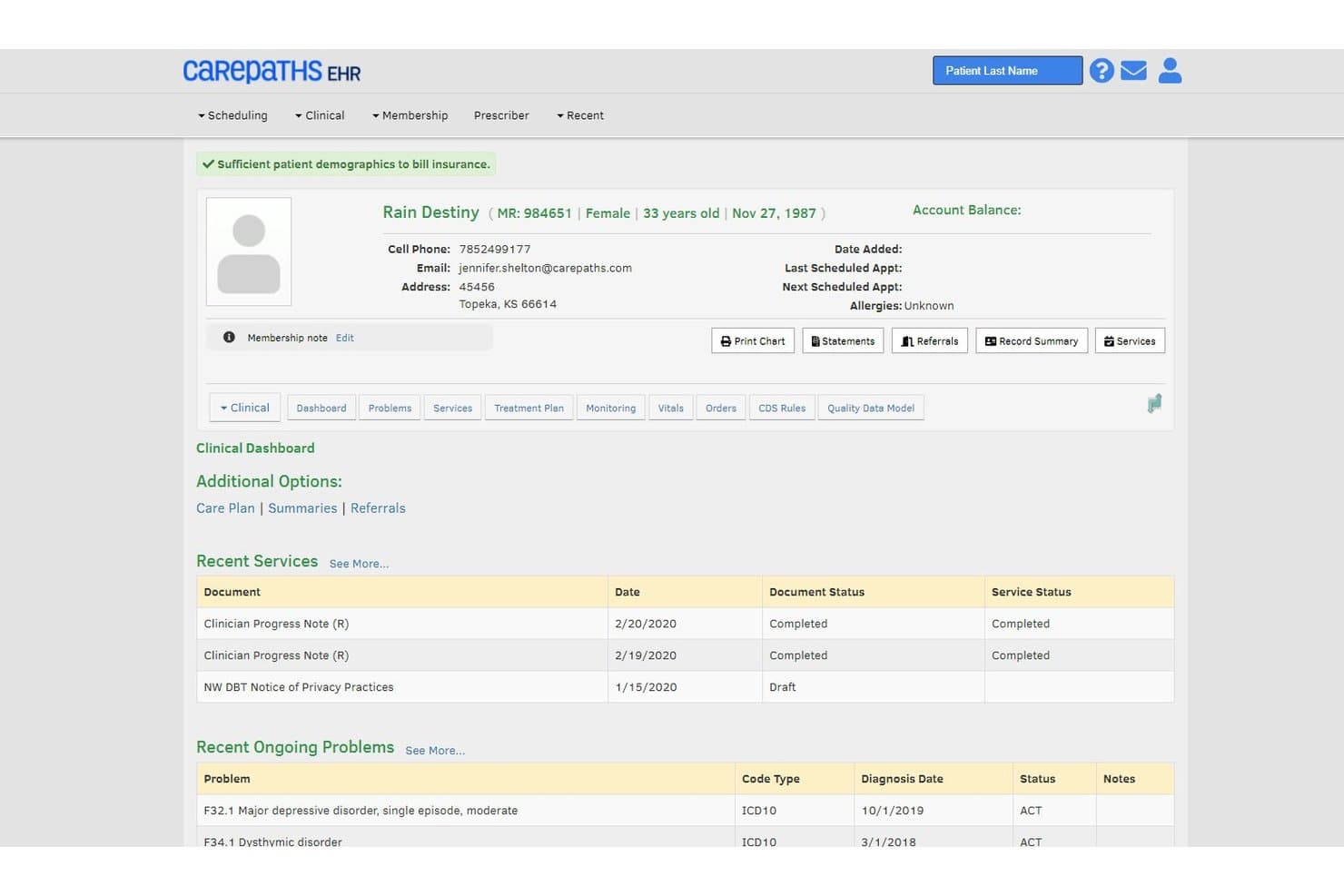
CarePaths displays patient records, diagnoses, and recent services in one view. CarePaths is a cloud-based behavioral health EHR and practice management platform that combines clinical documentation, e-prescribing with EPCS, measurement-based care tracking, scheduling, and integrated billing for mental health and psychiatric practices.
Who Is CarePaths Best For?
CarePaths suits behavioral health clinic owners and practice managers who want integrated measurement-based care tracking alongside billing and scheduling in a single, low-cost platform.
Why I Picked CarePaths
CarePaths earns its spot on my shortlist because its measurement-based care library is genuinely best-in-class: 40+ validated scales including the PHQ-9, YMRS, and Y-BOCS, delivered automatically to patients weekly and graphed longitudinally right in the chart. I also like that adherence and side-effect check-ins run through the CarePaths Connect app, giving prescribers a structured data stream between appointments. The Psychiatry EHR tier layers EPCS and PDMP integration via DrFirst on top of all of that, which covers the core prescribing workflow without requiring a separate annual contract.
CarePaths Key Features
- EPCS via DrFirst: CarePaths integrates with DrFirst to support controlled substance e-prescribing across states that require electronic prescriptions.
- Note-to-claim automation: Completing an appointment auto-generates the clinical document, posts the charge, and creates a ready-to-submit claim.
- Copy-forward progress notes: Each new note opens as a copy of the patient's previous note, letting clinicians edit rather than rebuild documentation from scratch.
- Supervisor review and sign-off workflow: Supervisors can review and co-sign notes directly in the platform, supporting training programs and credentialing requirements.
CarePaths Integrations
CarePaths has documented integrations with DrFirst, clearinghouses, payers, ERA services, NC HealthConnex, Minnesota ARMHS, VADATA, and Direct Trust. It also supports SMART on FHIR and ONC (g)(10) APIs for custom integrations.
Pros and Cons
Pros:
- Appointment completion creates claims automatically
- Copy-forward notes reduce repeat documentation
- Automated validated scales show symptom trends
Cons:
- No confirmed psychiatric evaluation or MSE templates
- Reviewers report dated screens and excess clicks
Learn more about CarePaths: Best for behavioral health agency-scale EMR
- Free demo available
- Pricing upon request
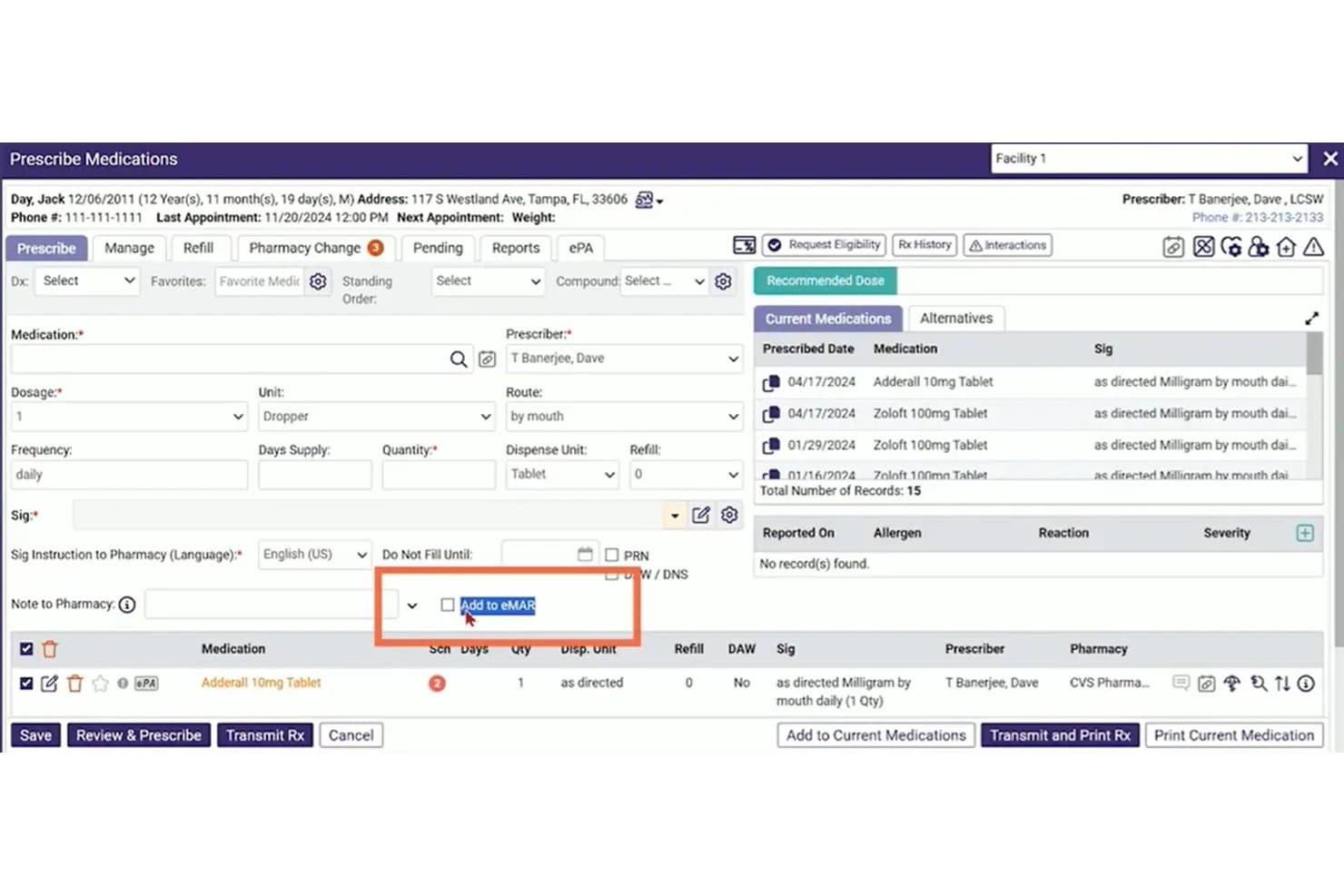
Qualifacts lets users prescribe and send medications directly to pharmacy. Qualifacts is a behavioral health-focused EMR platform that spans three distinct products—Credible, CareLogic, and InSync—covering e-prescribing with EPCS, configurable clinical documentation, behavioral health assessments, treatment plan management, and integrated telehealth.
Who Is Qualifacts Best For?
Qualifacts is a strong fit for behavioral health agencies and multi-clinician practices that need a purpose-built EMR with deep compliance, assessment, and e-prescribing capabilities across teams.
Why I Picked Qualifacts
Qualifacts earns its spot on my shortlist because it's the only platform here built exclusively for behavioral health agencies at scale, with e-prescribing, PDMP checks, and electronic prior authorization baked directly into every product. I also like that its built-in assessment library covers C-SSRS, PHQ-9, GAD-7, and more, with Greenspace MBC automating scoring and surfacing dashboards at the client and program level. For agencies running multiple programs, Credible's 35,000+ configurable form templates and cross-discipline treatment plan linking are genuinely hard to replicate.
Qualifacts Key Features
- AI ambient documentation: Records sessions and auto-drafts notes by pulling diagnoses, medications, and prior chart data into a clinician-reviewed draft.
- HIPAA-compliant telehealth: Supports group sessions of up to 50 participants with built-in chat, screen sharing, and immediate session transcription.
- Client engagement suite: Delivers a white-label portal for intake forms, eSignatures, appointment scheduling, reminders, and payments on web and mobile.
- Multi-platform configurability: Credible, CareLogic, and InSync each offer drag-and-drop form builders, macros, and workflow tools for custom documentation.
Qualifacts Integrations
Qualifacts offers 116+ marketplace integrations, including Greenspace Health, Inovalon, MethodOne by Computalogic, and ASAM Continuum. It supports HL7 and FHIR APIs, health information exchanges, Direct messaging, electronic lab orders, and results.
Pros and Cons
Pros:
- Configurable forms fit agency workflows
- PHQ-9 and C-SSRS scoring dashboards
- Built-in EPCS and PDMP checks
Cons:
- Psychiatric CPT guidance remains undocumented
- InSync medication sending can be slow
Learn more about Qualifacts:
Other Psychiatry EMR Tools
Here are some additional psychiatry EMR options that didn’t make it onto my shortlist, but are still worth checking out:
- 11PIMSYBest for behavioral health with PDMP-embedded eRx
- 12SimplePracticeBest for all-in-one telehealth and intake workflows
- 13OmniMDBest for CoCM billing and EPCS in one chart
- 14DocVillaBest for telemedicine, eRx, billing, and analytics
- 15athenaOneBest for multi-specialty billing and EPCS support
How I Evaluate Psychiatry EMR
I split my evaluation into three parts, with core functionality carrying most weight: document notes, manage medications and EPCS, and schedule visits. Next, I look for measurement-based care dashboards with PHQ-9 trends. Finally, I consider onboarding, support, training, and pricing.
Core Functionality (Table Stakes For This List)
When I'm selecting tools for my list, I score each one on a scale from 0 (does not offer the functionality) to 5 (excels in this area) for each core functionality listed below. I then convert the total into a percentage to help assess each tool's overall fit, with extra weight on any functionalities I’ve deemed essential.
- Psychiatric Documentation (Essential): I look for customizable evaluation, mental status exam, and progress-note templates for therapy and medication visits.
- E-Prescribing And EPCS (Essential): I check integrated prescribing, identity controls, and controlled-substance workflows for routine psychiatric medications.
- Medication Management: I assess dose history, allergies, interaction alerts, and medication reconciliation during follow-up visits.
- Behavioral Scheduling: I evaluate intake, therapy, medication-check, recurring, and multi-provider scheduling with distinct visit types.
- Outcome Tracking: I look for PHQ-9 and GAD-7 scoring, longitudinal trends, and reports supporting measurement-based care.
- Behavioral Billing: I assess psychiatric coding, claims submission, visit-specific billing, and reconciliation workflows.
Once I have a list of tools that meet the criteria, I consider what sets each platform apart.
Differentiating Factors (What Sets Vendors Apart)
Here's how I compare and contrast different vendors:
Standout Features
I look for direct PDMP integration so prescribers can check a patient's controlled-substance history at the point of prescribing rather than toggling to a separate portal. Measurement-based care dashboards matter just as much—I evaluate whether a platform can chart PHQ-9 and GAD-7 scores over time and surface those trends inside the visit note. Collaborative care model support is another separator; practices billing CoCM codes need workflows that coordinate psychiatry, therapy, and primary care within one shared record.
Beyond Features
I check whether a platform meets 42 CFR Part 2 requirements for substance use disorder records, since standard HIPAA compliance alone isn't enough for many behavioral health caseloads. Onboarding support matters too—I look for vendor-led template setup and EPCS configuration, because most psychiatric practices don't have dedicated IT staff to handle that alone. I also evaluate how licensing scales when you add providers or service lines like collaborative care.
How to Choose Psychiatry EMR
It’s easy to get bogged down in long feature lists and complex pricing structures. To help you stay focused as you work through your unique software selection process, here’s a checklist of factors to keep in mind:
| Factor | What to Consider |
| Ease of use | Can clinicians quickly navigate documentation and charting? Test common workflows for unnecessary steps or confusing design. |
| Integrations | Does the EMR connect bidirectionally with labs, pharmacies, billing software, and telehealth platforms you already use? |
| Customizability | Are you able to tailor templates and workflows to suit various psychiatric visit types, like therapy vs. med management? |
| Scalability | Will the EMR handle solo, group, and multi-location growth without costly upgrades or major retraining? |
| Implementation and onboarding | Does the vendor offer migration assistance, clear timelines, and training resources specific to psychiatry practices? |
| Cost | What are the hidden costs for things like e-prescribing, telehealth modules, or extra user seats? |
| Security safeguards | Are access controls, encryption, and audit logs robust enough for sensitive behavioral health information? |
| Compliance requirements | Does the EMR support HIPAA compliance, state privacy laws, and special psychiatric consent or documentation rules? |
What Is Psychiatry EMR?
Psychiatry EMR are electronic medical record systems designed specifically for mental health and behavioral health practices. They support psychiatric documentation, secure patient record management, prescribing, and billing for psychiatrists and psychiatric nurse practitioners. These systems include workflows and compliance safeguards tailored to the unique needs and regulations of psychiatric care settings.
Features
When selecting psychiatry EMR, keep an eye out for the following key features:
- Psychiatry-specific templates: Pre-built forms for intake assessments, mental status exams, treatment plans, and progress notes save time and standardize clinical documentation for psychiatric workflows.
- E-prescribing for controlled substances: Secure, compliant e-prescribing enables psychiatrists to send prescriptions—including Schedule II-V medications—directly to pharmacies while tracking renewals and monitoring prescription histories.
- Integrated appointment scheduling: Built-in scheduling tools support recurring visits, automatic appointment reminders, and calendar management for therapy sessions or medication checks.
- Patient portal: A secure portal lets patients view appointments, request refills, access clinical summaries, and communicate with their care team between visits.
- Billing and claims management: Psychiatry EMR systems automate CPT code selection, generate insurance claims, and track billable services specific to psychiatric care for simpler reimbursement.
- Outcome tracking tools: Embedded rating scales like PHQ-9, GAD-7, or clinician-created measures help monitor patient progress and support measurement-based psychiatric care.
- Role-based security controls: Fine-grained access permissions prevent unauthorized viewing or editing of sensitive mental health records and help meet privacy requirements.
- Multi-provider support: Shared chart access, internal messaging, and collaborative care plans allow psychiatrists, therapists, and prescribers to coordinate patient treatment securely.
- Customizable workflows: Practices can adapt templates, forms, and intake processes to reflect their unique documentation standards and clinical best practices.
- Telehealth integration: Direct video visit capabilities within the EMR enable secure remote care, letting providers chart, schedule, and prescribe without switching platforms.
Benefits
Implementing psychiatry EMR provides several benefits for your team and your business. Here are a few you can look forward to:
- Streamlined psychiatric documentation: Psychiatry-specific templates and automated note features reduce charting time so clinicians can focus on care.
- Improved care coordination: Shared records, secure messaging, and multi-provider access make it easier to collaborate and manage treatment as a team.
- Enhanced patient engagement: Patient portals, appointment reminders, and telehealth options help patients stay involved in their care between visits.
- Accurate billing and coding: Integrated billing, coding suggestions, and automated claims submission reduce administrative errors and support proper reimbursement.
- Greater data security: Role-based access controls, audit trails, and compliance safeguards protect sensitive psychiatric information from unauthorized access.
- Better outcome tracking: Built-in assessment tools and automated trend analysis help your team monitor patient progress and adjust treatment plans as needed.
- Scalability for growth: Cloud-based systems and flexible workflows enable your practice to expand service offerings or locations without overhauling your EMR infrastructure.
Costs and Pricing
Selecting psychiatry EMR requires an understanding of the various pricing models and plans available. Costs vary based on features, team size, add-ons, and more. The table below summarizes common plans, their average prices, and typical features included in psychiatry EMR solutions:
Plan Comparison Table for Psychiatry EMR
| Plan Type | Average Price | Common Features |
| Free Plan | $0 | Basic documentation, limited appointment scheduling, simple patient records, and minimal portal access. |
| Personal Plan | $25-$50/user/month | Psychiatry templates, e-prescribing, appointment reminders, and access to a patient portal. |
| Business Plan | $50-$100/user/month | Advanced scheduling, billing features, outcome tracking tools, telehealth integration, and enhanced security controls. |
| Enterprise Plan | $100-$250/user/month | Custom workflows, API access, multi-location support, priority support, advanced analytics, and compliance management. |
Psychiatry EMR FAQs
Here are some answers to common questions about psychiatry EMR:
Can psychiatry EMR integrate with other healthcare systems?
Yes, most psychiatry EMR solutions offer integration capabilities with other healthcare systems, like billing software, lab systems, and telehealth platforms. When choosing an EMR, check if it can connect with the tools your practice already uses to ensure seamless data flow and avoid redundant data entry.
How secure is patient data in psychiatry EMR systems?
Top vendors provide end-to-end encryption, role-based access, audit logs, and HIPAA compliance to protect sensitive mental health information.
What kind of training or support should I expect from the vendor?
Reputable vendors provide live training sessions, online resources, and ongoing technical support to help your team adapt quickly and use the system effectively.
Can I transfer my existing patient data into a new psychiatry EMR system?
Yes. Most vendors provide data migration support to import patient information, forms, and notes from your previous system into the new platform.
How can I tell if a psychiatry EMR system is easy for my staff to use?
During demos or trials, observe how quickly staff can navigate patient charts, schedule appointments, and record notes without extensive training.
Are there any free psychiatry EMR tool options?
While most psychiatry EMR tools come at a cost due to their complex and feature-rich nature, there are a few options that offer limited free versions or trials. Tools like OpenEMR offer free, open-source EMR software, but it may lack the specialized features necessary for a mental health practice and may require technical knowledge to set up and maintain.