


Athenahealth Review: Pros, Cons, Features, and Pricing



Athenahealth is an electronic health record (EHR) software that simplifies patient management and billing services for health care providers. It best serves small and midsized medical practices, such as family medicine and specialty clinics, by improving workflow efficiency and adding automation. Athenahealth offers a user-friendly interface and reliable support, making it ideal for health care providers.
Athenahealth addresses common scheduling and billing challenges for administrative teams. This article covers Athenahealth's features, pros and cons, use cases, pricing, and FAQs to help you determine whether it aligns with your practice's needs.
Athenahealth Evaluation Summary
- Pricing upon request
- Free demo available
Why Trust Our Software Reviews
We’ve been testing and reviewing medical software since 2023. As medical practice leaders ourselves, we know how critical and difficult it is to make the right decision when selecting software.
We invest in deep research to help our audience make better software purchasing decisions. We’ve tested more than 2,000 tools for different medical practice use cases and written over 1,000 comprehensive software reviews. Learn how we stay transparent & our software review methodology.
Athenahealth Overview
In my opinion, Athenahealth stands as a competent EHR solution with numerous features and integration capabilities. However, while the platform provides ample functionality, users often find the interface cumbersome compared to competitors such as AdvancedMD, and onboarding can be challenging due to the software's complexity. For practices that prioritize a wide range of features over simplicity, Athenahealth is a strong candidate. Value for money is generally favorable, especially for midsized practices. If your staff members can navigate its learning curve, Athenahealth can effectively meet your EHR needs.
pros
-
The user-friendly interface makes navigation easy for your team.
-
Reliable customer support helps resolve issues quickly.
-
Its efficient scheduling tools simplify appointment management.
cons
-
Some users find the initial setup process time-consuming.
-
Its limited customization options may not fit every practice's unique needs.
-
Occasional updates can temporarily disrupt your workflow.



How We Test & Score Tools
We’ve spent years building, refining, and improving our software testing and scoring system. The rubric is designed to capture the nuances of software selection and what makes a tool effective, focusing on critical aspects of the decision-making process.
Below, you can see exactly how our testing and scoring works across seven criteria. It allows us to provide an unbiased evaluation of the software based on core functionality, standout features, ease of use, onboarding, customer support, integrations, customer reviews, and value for money.
Core Functionality (25% of final scoring)
The starting point of our evaluation is always the core functionality of the tool. Does it have the basic features and functions that a user would expect to see? Are any of those core features locked to higher-tiered pricing plans? At its core, we expect a tool to stand up against the baseline capabilities of its competitors.
Standout Features (25% of final scoring)
Next, we evaluate uncommon standout features that go above and beyond the core functionality typically found in tools of its kind. A high score reflects specialized or unique features that make the product faster, more efficient, or offer additional value to the user.
We also evaluate how easy it is to integrate with other tools typically found in the tech stack to expand the functionality and utility of the software. Tools offering plentiful native integrations, 3rd party connections, and API access to build custom integrations score best.
Ease of Use (10% of final scoring)
We consider how quick and easy it is to execute the tasks defined in the core functionality using the tool. High scoring software is well designed, intuitive to use, offers mobile apps, provides templates, and makes relatively complex tasks seem simple.
Onboarding (10% of final scoring)
We know how important rapid team adoption is for a new platform, so we evaluate how easy it is to learn and use a tool with minimal training. We evaluate how quickly a team member can get set up and start using the tool with no experience. High scoring solutions indicate little or no support is required.
Customer Support (10% of final scoring)
We review how quick and easy it is to get unstuck and find help by phone, live chat, or knowledge base. Tools and companies that provide real-time support score best, while chatbots score worst.
Customer Reviews (10% of final scoring)
Beyond our own testing and evaluation, we consider the net promoter score from current and past customers. We review their likelihood, given the option, to choose the tool again for the core functionality. A high scoring software reflects a high net promoter score from current or past customers.
Value for Money (10% of final scoring)
Lastly, in consideration of all the other criteria, we review the average price of entry level plans against the core features and consider the value of the other evaluation criteria. Software that delivers more, for less, will score higher.
Core Features
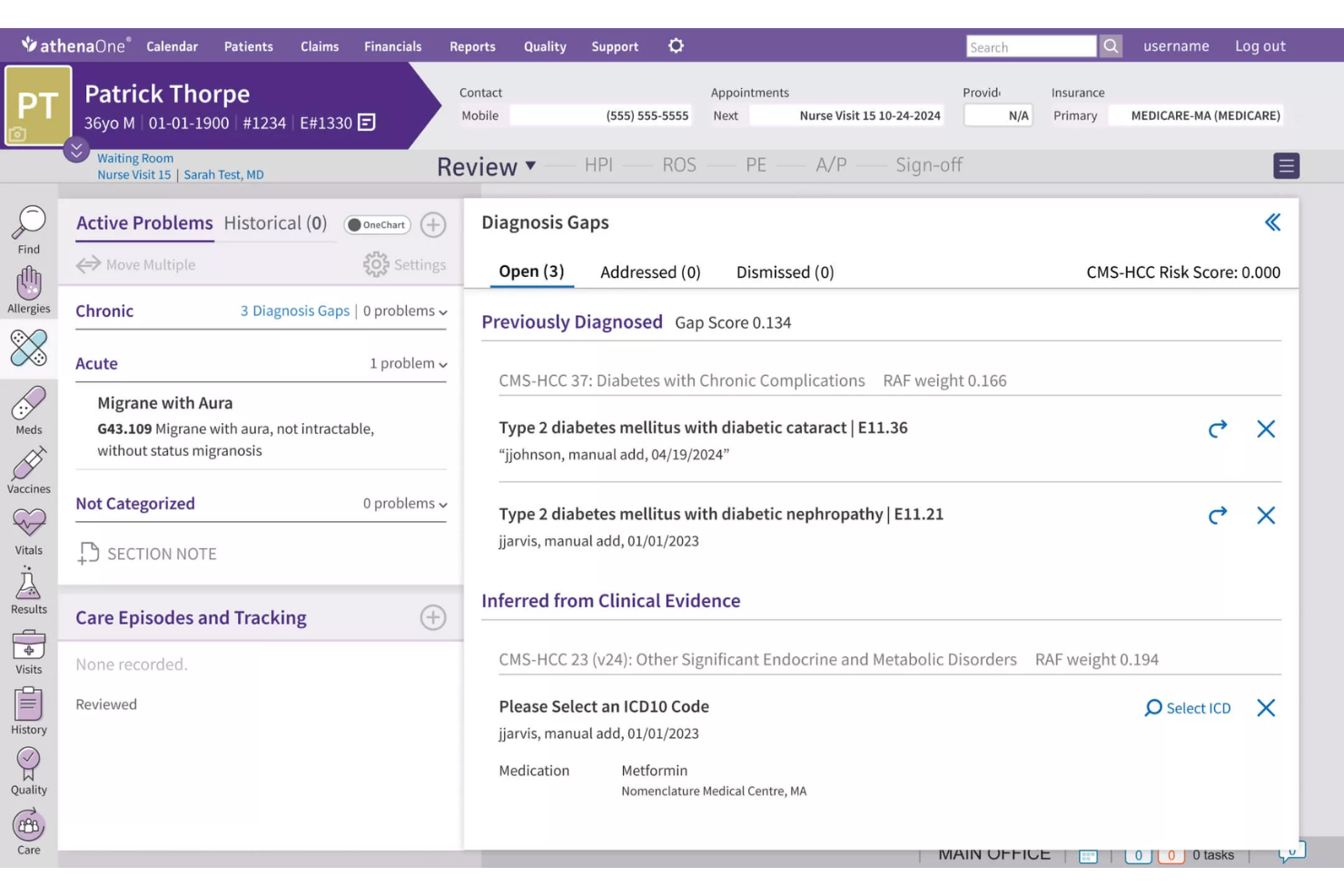
Patient Management: Athenahealth helps you organize electronic medical records (EMRs) efficiently, making it easy for you to access and update information.
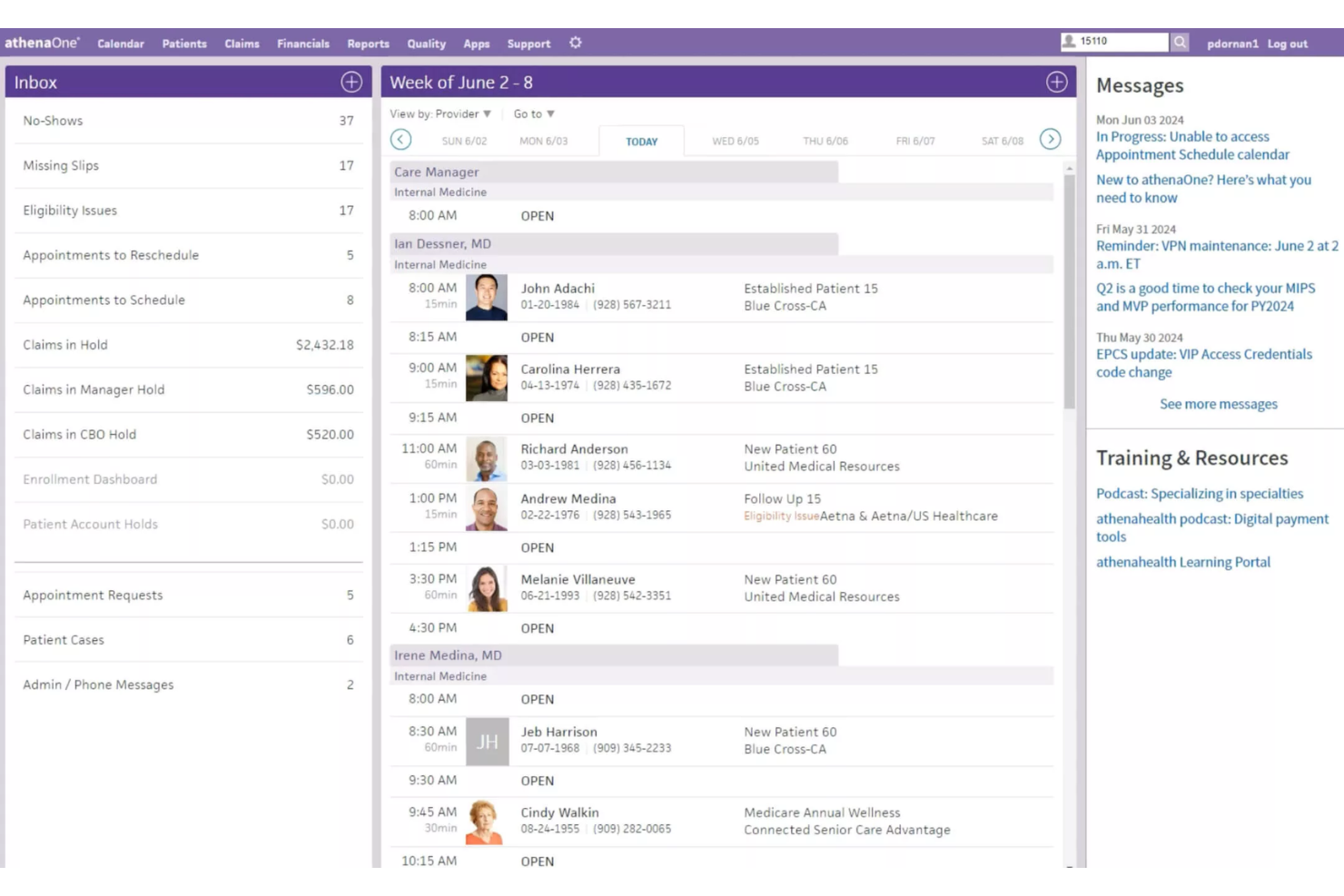
Appointment Scheduling: The scheduling tool allows you to manage appointments smoothly, reducing no-shows.
Billing and Invoicing: This feature simplifies billing through claims and invoice automation, meaning you get paid faster with fewer errors that may lead to denials.
E-Prescribing: You can send prescriptions directly to pharmacies, improving medication accuracy and saving your patients time.
Clinical Documentation: Athenahealth offers templates and voice recognition for quick note-taking, ensuring accurate and thorough patient records.
Patient Portal: The portal lets your patients access their EMRs and communicate with your team, improving patient engagement and satisfaction.
Ease of Use
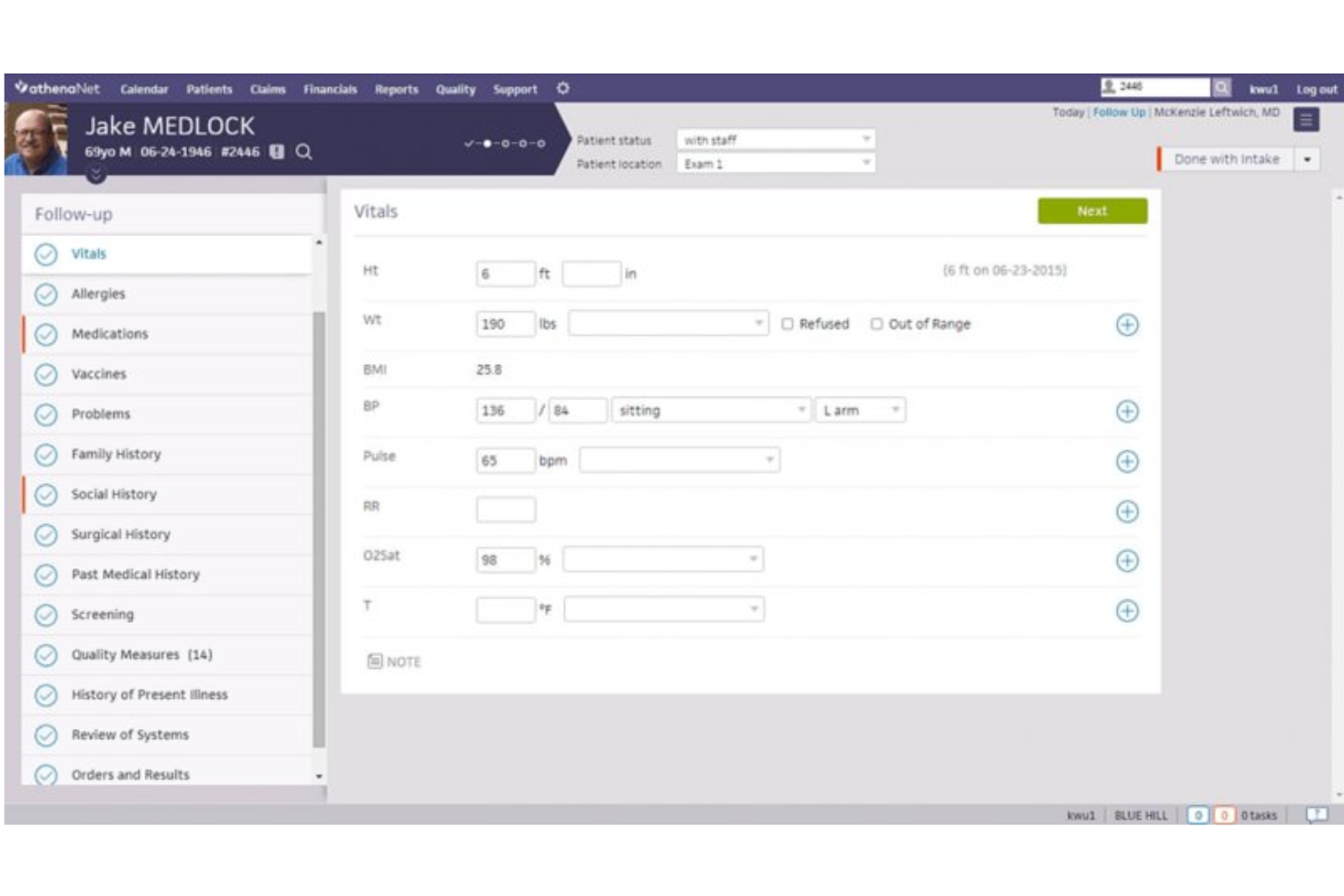
Athenahealth is a strong option for your team, with a user-friendly interface that can be navigated smoothly. Users often praise its straightforward design, which helps all team members complete tasks efficiently. Features such as appointment scheduling, eligibility, and patient management are simple to use, letting your team focus on patient care rather than software navigation. If ease of use is a priority, Athenahealth sets itself apart.
Integrations
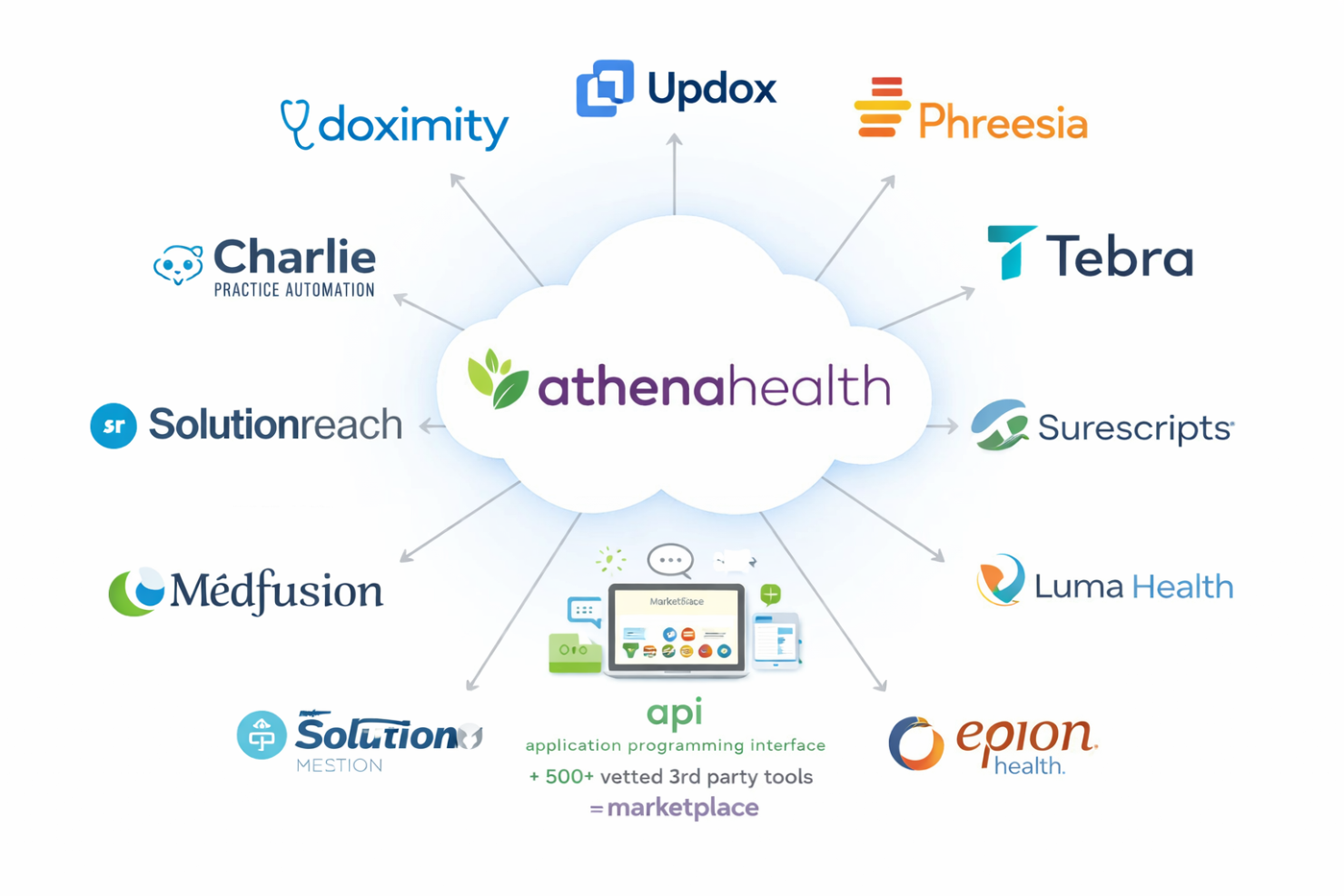
Athenahealth integrates with Doximity, Updox, Phreesia, Tebra, Charlie Practice Automation, Solutionreach, Surescripts, Medfusion, Luma Health, and Epion Health.
Athenahealth also offers an application programming interface and connects with third-party integration tools through its marketplace, which features over 500 vetted third-party tools.
Athenahealth Specs
- API
- Appointment Scheduling
- Athlete Management
- Audit Management
- Calendar Management
- Compliance Tracking
- Customer Management
- Dashboard
- Data Export
- Data Import
- Data Visualization
- Electronic Prescribing
- External Integrations
- File Sharing
- File Transfer
- Health Management
- HIPAA Compliance
- Inventory Tracking
- Multi-User
- Notifications
- Organization Management
- Patient Management
- Project Management
- Regulatory Alerts
- Risk Assessment
- Scheduling
- Supplier Management


