

O software de gestão de consultórios na nuvem é uma plataforma digital que permite à sua equipa de saúde gerir o agendamento, a faturação, os registos dos pacientes e as operações diárias a partir de qualquer local com acesso à Internet. Se procura um software fiável que reduza as dificuldades administrativas, mantenha a sua equipa organizada e o ajude a prestar cuidados de excelência aos pacientes, está no sítio certo. Escolher a solução adequada significa passar menos tempo a resolver problemas técnicos e mais tempo a concentrar-se nos pacientes. Vou apresentar-lhe as principais ferramentas disponíveis, explicar o que as distingue e mostrar-lhe como pode adequar as necessidades específicas do seu consultório à plataforma mais indicada.
Why Trust Our Software Recommendations
6,700+
Reviews
20
Industry experts
16+
Evaluation factors
14
Years
Our team has been testing and reviewing software since 2012. As medical practice leaders ourselves, we know how difficult—and important—it is to choose the right software.
For this guide, we evaluated tools using hands-on testing and independent research, scoring tools using our selection criteria.
Our reviews reflect our human editorial judgment, not a sales pitch.
Tabela comparativa de software de gestão de consultórios na nuvem
Esta tabela comparativa resume os detalhes de preços das minhas principais escolhas de software de gestão de consultórios na nuvem:
| Tool | Best For | Trial Info | Price | ||
|---|---|---|---|---|---|
| 1 | Best for allied health scheduling and client intake | 14-day free trial | From $29/month | Website | |
| 2 | Best for straightforward medical billing workflows | Free demo available | Pricing upon request | Website | |
| 3 | Best for affordable cloud-based management | Free demo available | From $199/user/month | Website | |
| 4 | Best for data-driven practice and management | Free demo available | Pricing upon request | Website | |
| 5 | Best for multi-specialty practice management | Free demo available | Pricing upon request | Website | |
| 6 | Best for growing independent healthcare practices | Free demo available | Pricing upon request | Website | |
| 7 | Best for mobile-first practice management | Free demo available | Pricing upon request | Website | |
| 8 | Best for integrated clinical and revenue workflows | Free demo available | Pricing upon request | Website | |
| 9 | Best for practices needing scalable workflows | Not available | Pricing upon request | Website | |
| 10 | Best for independent practice operations | Free demo available | Pricing upon request | Website |


Avaliações do melhor software de gestão de consultórios na nuvem
Apresento abaixo os meus resumos detalhados do melhor software de gestão de consultórios na nuvem que integrou a minha lista restrita. As minhas avaliações oferecem uma análise detalhada das funcionalidades, dos preços e das integrações de cada plataforma, para o ajudar a encontrar a melhor opção para si.
 Best for allied health scheduling and client intake
- 14-day free trial
- From $29/month
Visit WebsiteCustomer Rating:4.7/5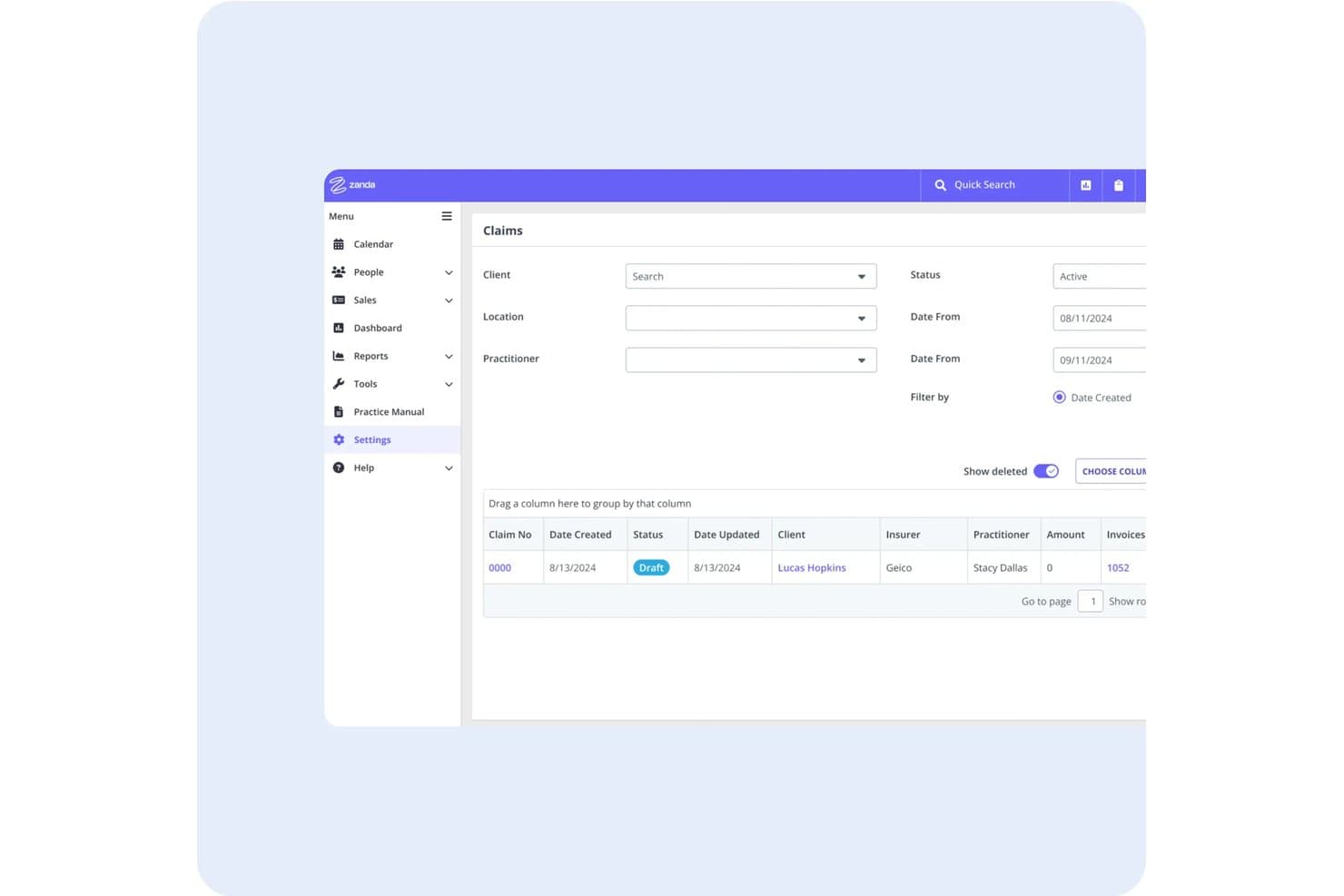
Zanda lets users track and filter insurance claims by status, date, and practitioner. Zanda is a cloud-based practice management platform built for allied health and mental health providers, offering scheduling, client intake, clinical notes, invoicing, and telehealth in one system.
Who Is Zanda Best For?
Zanda is a strong fit for allied health and mental health practitioners—such as psychologists, physiotherapists, and occupational therapists—who need scheduling and client intake in one cloud-based system.
Why I Picked Zanda
I've included Zanda in my top picks because it's one of the few cloud practice management platforms built specifically for allied health and mental health providers, and that focus shows in the scheduling tools. Its calendar handles multiple practitioners, room and equipment booking, and drag-and-drop appointment management across locations. I also like that the online self-booking portal runs 24/7 and pairs directly with automated intake forms, so new clients can book, pay, and complete consent forms before their first appointment.
Zanda Key Features
- BizzyAI session scribe: Automatically transcribes clinical sessions into structured notes, which can be reviewed, refined, and saved directly to the client profile.
- Customizable clinical note templates: Build note templates with body charts, diagrams, and visibility controls to suit different disciplines and multi-disciplinary team setups.
- ISO 27001-certified cloud hosting: Zanda runs on AWS with encrypted data storage, hourly backups, role-based access controls, 2FA, and audit logs.
- Xero and Stripe accounting integrations: Connect invoicing and payment processing to Xero for accounting reconciliation, with Stripe handling PCI Level 1-compliant online payments.
Zanda Integrations
Zanda offers integrations with Stripe, Square, Xero, Ensora Clearinghouse, Google Calendar, Outlook, Apple Calendar, Zoom, Mailchimp, and Physitrack. A read-only public API in beta supports custom integrations.
Pros and Cons
Pros:
- Reviewers praise responsive support and AI notes
- Client intake forms save directly to profiles
- Allied health scheduling handles rooms and resources
Cons:
- No native mobile app for field access
- Physician billing workflows lack deeper RCM tools
Learn more about Zanda: Best for straightforward medical billing workflows
- Free demo available
- Pricing upon request
Visit WebsiteCustomer Rating:4.1/5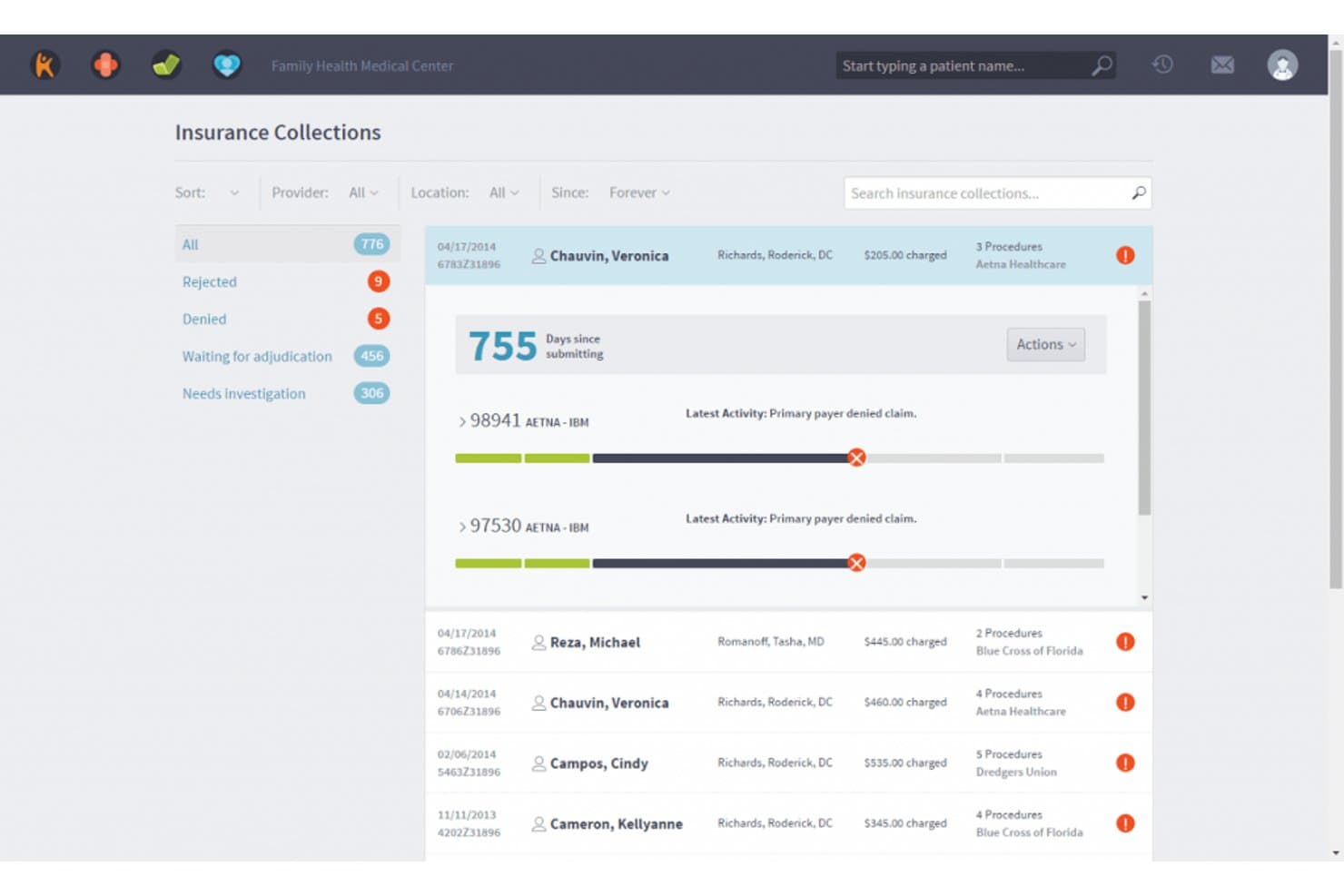
Kareo Billing offers an Insurance Collections dashboard that displays claim statuses, days since submission, and payer activity for efficient billing management. Kareo Billing is a cloud-based medical billing and practice management platform built for independent practices, combining electronic claims submission, insurance eligibility verification, revenue cycle management, patient scheduling, and EHR tools in one system.
Who Is Kareo Billing Best For?
Kareo Billing is a strong fit for small to mid-sized independent practices with 1–10 providers who manage billing in-house.
Why I Picked Kareo Billing
Kareo Billing earns its spot on my shortlist because of how cleanly it handles the claim lifecycle from submission to payment. I particularly like the automated claim scrubbing, which applies payer-specific rules before submission and flags errors before they trigger denials. The eligibility engine checks coverage against 2,700+ payers in seconds, and ERA auto-posting via RPA closes the loop by matching payments to claims without manual posting.
Kareo Billing Key Features
- Provider calendar and scheduling: Manage appointments, track provider availability, and coordinate multiple schedules in one interface.
- Patient portal: Offer patients secure access to records, appointment requests, and billing through a cloud-based portal.
- Integrated e-prescribing: Send prescriptions electronically to pharmacies with controlled substance and PDMP support.
- Automated patient statements: Generate digital or mailed billing statements with QR codes and payment links for patients.
Kareo Billing Integrations
Kareo Billing offers native integrations with WebPT, Stripe, Microsoft Excel, and QuickBooks Online Advanced. It also integrates with over 60 EHR systems and provides an API for custom integrations.
Pros and Cons
Pros:
- Connects billing with scheduling, EHR, and patient records
- Supports in-house and third-party medical billing teams
- Automates claims, payments, and patient billing workflows
Cons:
- Some features and fees depend on the selected Tebra package
- Kareo is now branded and sold as part of Tebra
Learn more about Kareo Billing: Best for affordable cloud-based management
- Free demo available
- From $199/user/month
Visit WebsiteCustomer Rating:3.7/5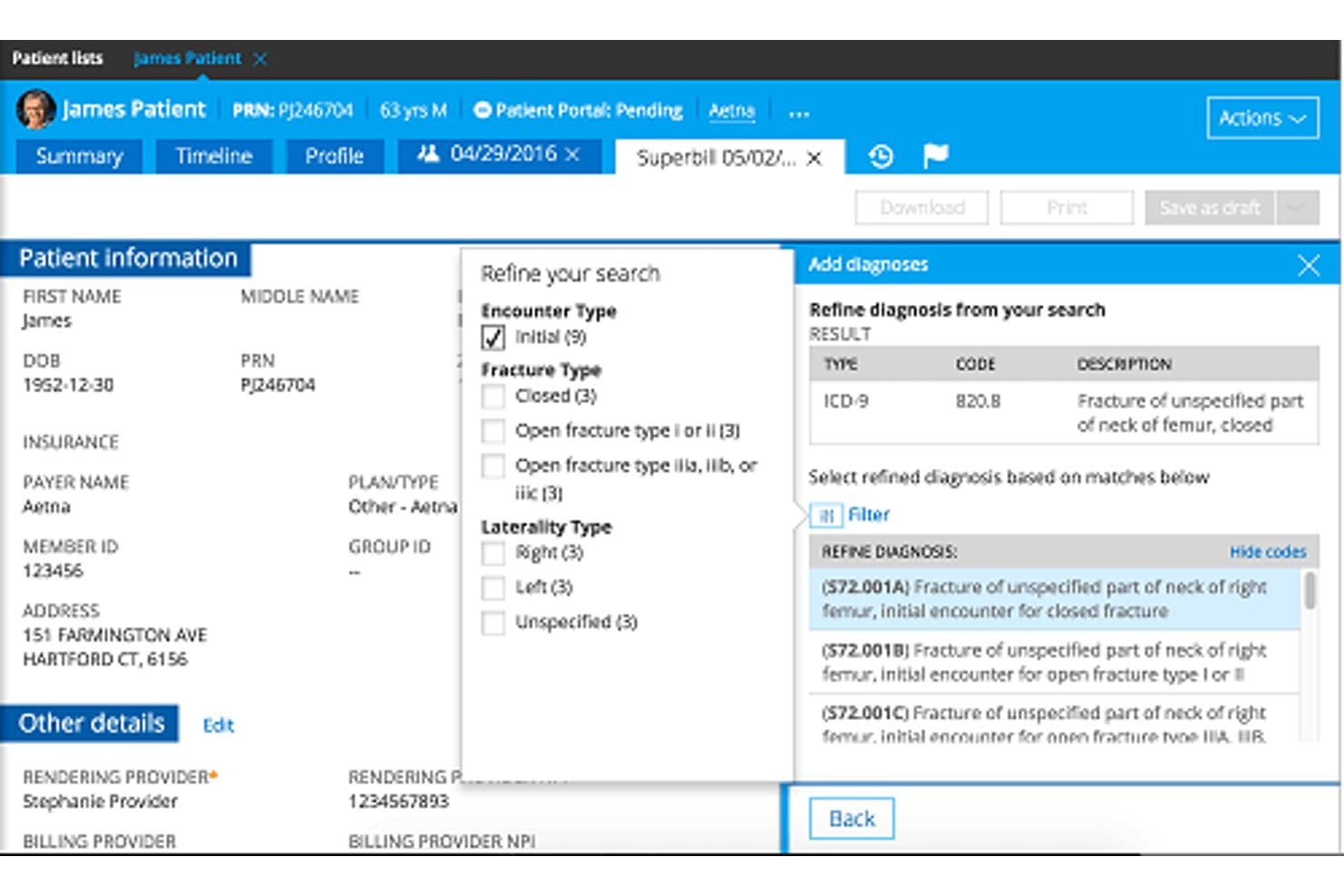
Practice Fusion offers a cloud-based superbill interface with diagnosis search, ICD-9 code selection, and patient insurance details for streamlined billing workflows. Practice Fusion is a cloud-based EHR and practice management platform for independent and small practices, combining charting, e-prescribing, patient scheduling, a patient portal, and medical billing services in one system.
Who Is Practice Fusion Best For?
Practice Fusion is a strong fit for independent physicians and small clinic teams who want a cloud-based EHR and billing system without heavy IT overhead.
Why I Picked Practice Fusion
Practice Fusion earns its spot as one of the best on my shortlist because the per-provider pricing bundles three signing staff licenses and unlimited non-signing staff into a single rate, which I think is genuinely rare in the EHR market. I like that the billing services layer includes same-day claims submission and denial management without requiring a separate RCM vendor. The free library of customizable charting templates also keeps documentation manageable for solo providers running high patient volumes.
Practice Fusion Key Features
- Cloud-based EHR platform: Access records, charting, and documentation from any web browser without on-premise servers.
- Integrated e-prescribing (including EPCS): Send electronic prescriptions for both regular and controlled substances directly to pharmacies.
- Patient portal and mobile access: Let patients view records, manage appointments, and complete intake forms online via the FollowMyHealth portal.
- Lab and imaging center integration: Receive structured results directly in the chart from major labs and imaging providers.
Practice Fusion Integrations
Practice Fusion offers native integrations with Quest Diagnostics, LabCorp, CGM LABDAQ, Updox, Medsender, Avalon Laboratory System, OpenPM, DeepScribe, Service Center, and QuickSlot Health. An API is available for custom integrations.
Pros and Cons
Pros:
- Transparent pricing and a 14-day free trial
- Customizable templates and connections with labs and imaging centers
- Cloud-based EHR with scheduling, charting, e-prescribing, and patient engagement tools
Cons:
- Advanced billing services may involve additional costs
- Requires an annual commitment
Learn more about Practice Fusion: Best for data-driven practice and management
- Free demo available
- Pricing upon request
Visit WebsiteCustomer Rating:3.6/5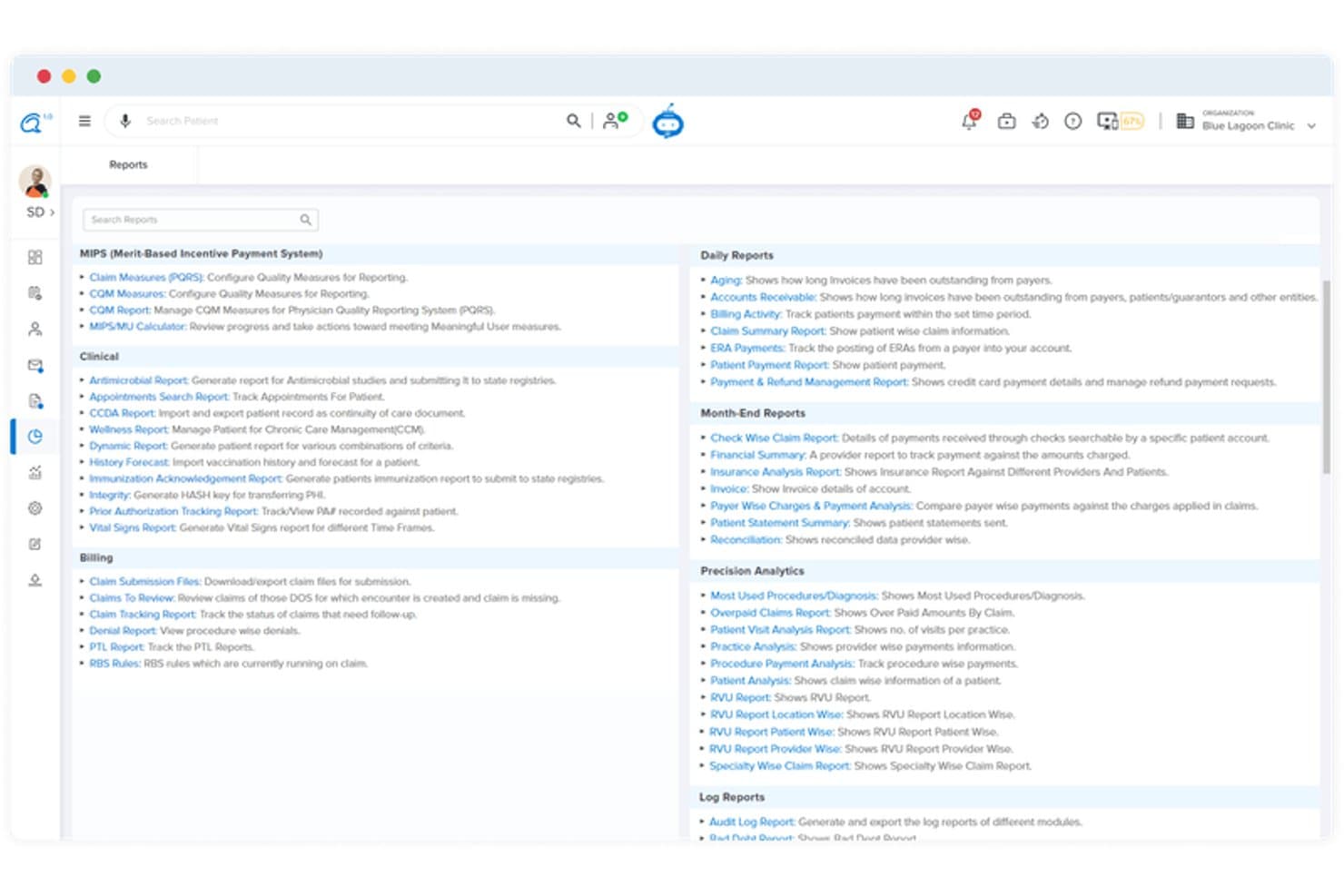
CareCloud offers a comprehensive Reports module with categorized reporting options including MIPS, Clinical, Billing, Daily, Month-End, Precision Analytics, and Log Reports. CareCloud is a cloud-based practice management platform that combines EHR, medical billing, patient scheduling, revenue cycle management, and AI-assisted clinical documentation in a single system.
Who Is CareCloud Best For?
CareCloud is a strong fit for independent and multi-location medical practices that need centralized billing, scheduling, and clinical workflows managed from a single platform.
Why I Picked CareCloud
I picked CareCloud because of how tightly its analytics layer connects clinical and financial performance in one view. The KPI dashboard surfaces billing bottlenecks and payer trends in real time, and the CollectiveIQ rules engine applies payer-specific edits before claims go out the door. I've found that combination especially useful when tracking denial patterns and identifying where A/R cycles are losing time.
CareCloud Key Features
- Integrated EHR: Manage patient records, charting, and e-prescribing within the same platform.
- Patient self-scheduling: Allow patients to book and manage their appointments online.
- Telehealth module: Conduct secure virtual visits and remote consultations with patients.
- Automated patient reminders: Send appointment reminders via SMS, email, or voice to reduce no-shows.
CareCloud Integrations
CareCloud offers native integrations with EHRYourWay, CodoniX EHR, ICANotes, MD Logic, Optivate, Praxis EMR, Sevocity, TeleVox, and Vital Interaction. An API is available for custom integrations.
Pros and Cons
Pros:
- Multi-location scheduling and centralized billing
- KPI dashboard for billing and clinical metrics
- Built-in claim scrubbing with payer-specific edits
Cons:
- Occasional system downtime interrupts workflows
- Support responsiveness is frequently reported as slow
Learn more about CareCloud: Best for multi-specialty practice management
- Free demo available
- Pricing upon request
Visit WebsiteCustomer Rating:3.7/5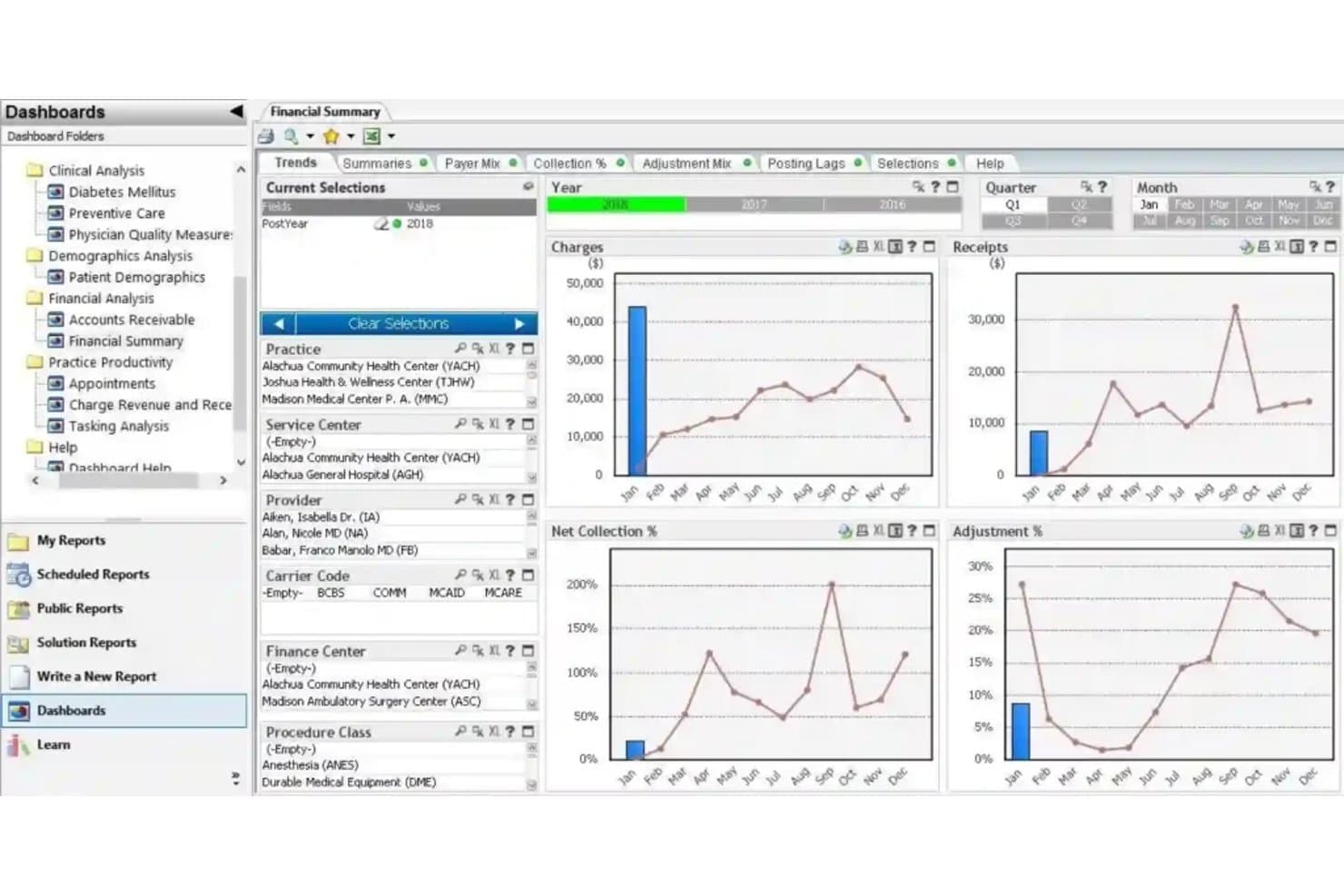
Greenway Health offers a comprehensive Financial Summary dashboard with trend charts for charges, receipts, net collection percentage, and adjustment percentage across monthly and quarterly views. Greenway Health is a cloud-based EHR and practice management platform that combines patient scheduling, medical billing, revenue cycle management, and clinical documentation tools for multi-specialty and multi-location medical practices.
Who Is Greenway Health Best For?
Practice administrators and billing managers at independent multi-specialty clinics will get the most out of Greenway Health's unified scheduling and RCM tools.
Why I Picked Greenway Health
Greenway Health earns its spot on my shortlist because its configurable specialty templates support how different clinical workflows can operate side by side. I like that a single Intergy instance handles OB/GYN charting, cardiology documentation, and pediatric scheduling without forcing each department into the same structure. Novare's AI-assisted coding also surfaces specialty-specific code suggestions and initiates prior authorizations in context.
Greenway Health Key Features
- Integrated patient portal: Lets patients view records, request appointments, and communicate with providers online.
- Automated eligibility verification: Checks insurance coverage in real time at scheduling and check-in.
- Multi-location scheduling: Handles appointments and provider calendars across several clinic sites.
- Built-in revenue cycle management: Supports claim submission, ERA/EOB processing, and payment posting within the platform.
Greenway Health Integrations
Greenway Health offers native integrations with Clearwave, CheckinAsyst, Charge Capture, Luma Health, MotionMD, PatientPop, Breg Vision, and InstaMed. Its Greenway Exchange platform supports data exchange via HL7 FHIR, Direct messaging, and Commonwell Health Alliance. An API is available for custom integrations.
Pros and Cons
Pros:
- Multi-location provider scheduling capabilities
- Real-time insurance verification at check-in
- Configurable templates for multiple specialties and workflows
Cons:
- Support response times are frequently delayed
- Cloud migration can disrupt legacy workflows
Learn more about Greenway Health: Best for growing independent healthcare practices
- Free demo available
- Pricing upon request
Visit WebsiteCustomer Rating:3.9/5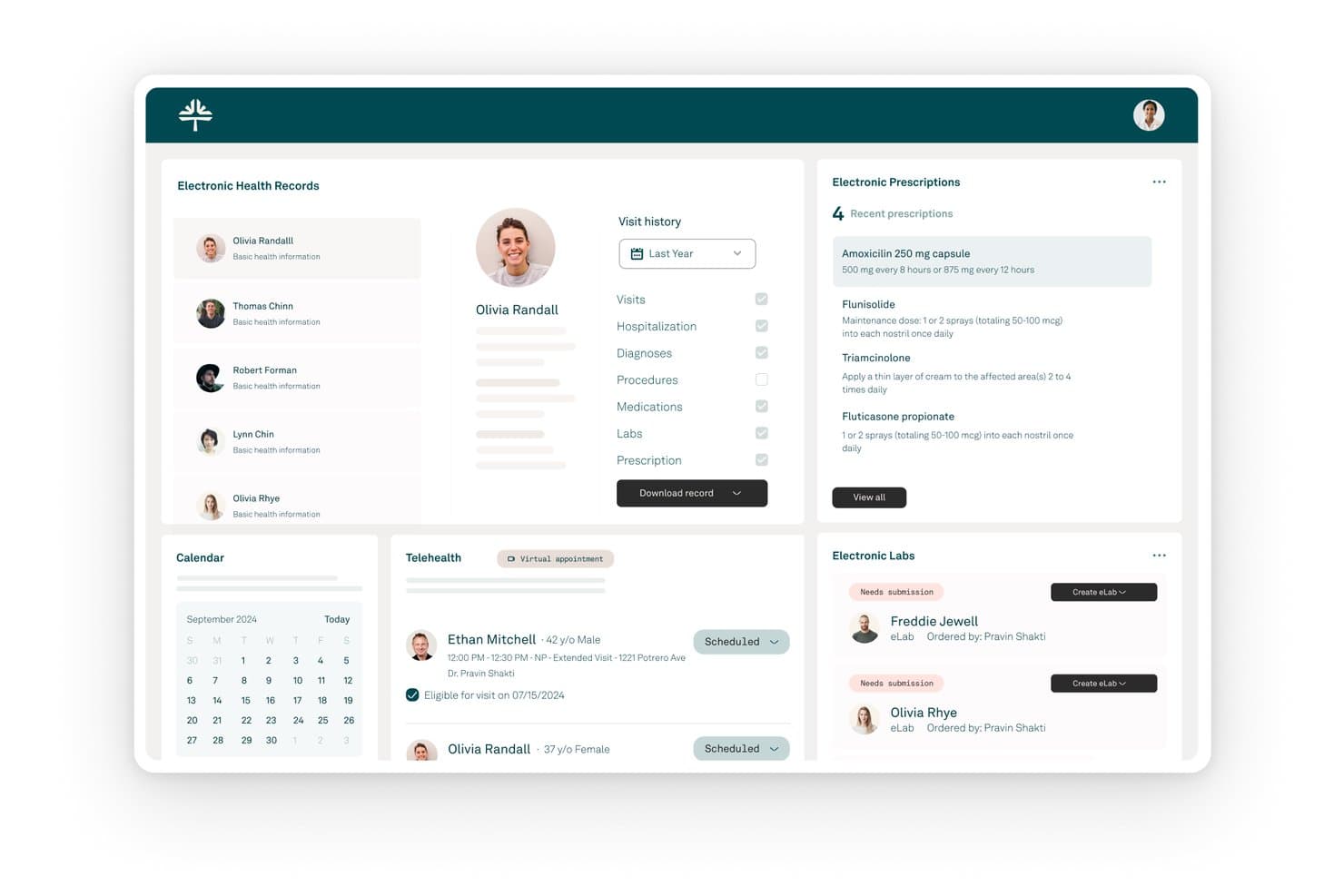
Tebra offers a unified cloud-based dashboard combining electronic health records, prescriptions, telehealth scheduling, labs, and a calendar in one interface. Tebra is a cloud-native practice management platform built for independent medical practices, combining EHR, patient scheduling, medical billing, revenue cycle management, and patient engagement tools in a single system.
Who Is Tebra Best For?
Tebra is a strong fit for small to mid-size independent practices, from solo providers to multi-provider clinics looking to manage growth without adding administrative headcount.
Why I Picked Tebra
I've included Tebra in my top picks because its per-provider pricing model is genuinely built around how independent practices grow. You pay per clinical provider, not per seat, so your entire front desk and billing team can work in the platform without adding to your monthly bill. I also like that Tebra bundles practice marketing tools, including reputation management and AI Review Replies across 80+ directories, inside the same platform where you manage scheduling and billing.
Tebra Key Features
- AI Note Assist: Creates clinical documentation from visit notes to speed up encounters.
- Automated eligibility checks: Verifies patient insurance coverage directly inside the workflow before appointments.
- Advanced telehealth: Hosts HIPAA-compliant virtual visits integrated with patient scheduling and charting.
- Digital intake forms: Lets patients complete and submit registration fields electronically before their appointment.
Tebra Integrations
Tebra offers native integrations with lab providers, imaging centers, Appriss Health for PDMP, EPCS providers, and Google Business Profile, and provides an API for custom integrations.
Pros and Cons
Pros:
- Real-time eligibility checks before appointments
- Built-in patient reputation management tools
- Unlimited non-provider staff seats per account
Cons:
- Built-in telehealth sometimes experiences minor glitches
- Occasional reports of slow customer support
Learn more about Tebra: Best for mobile-first practice management
- Free demo available
- Pricing upon request
Visit WebsiteCustomer Rating:3.9/5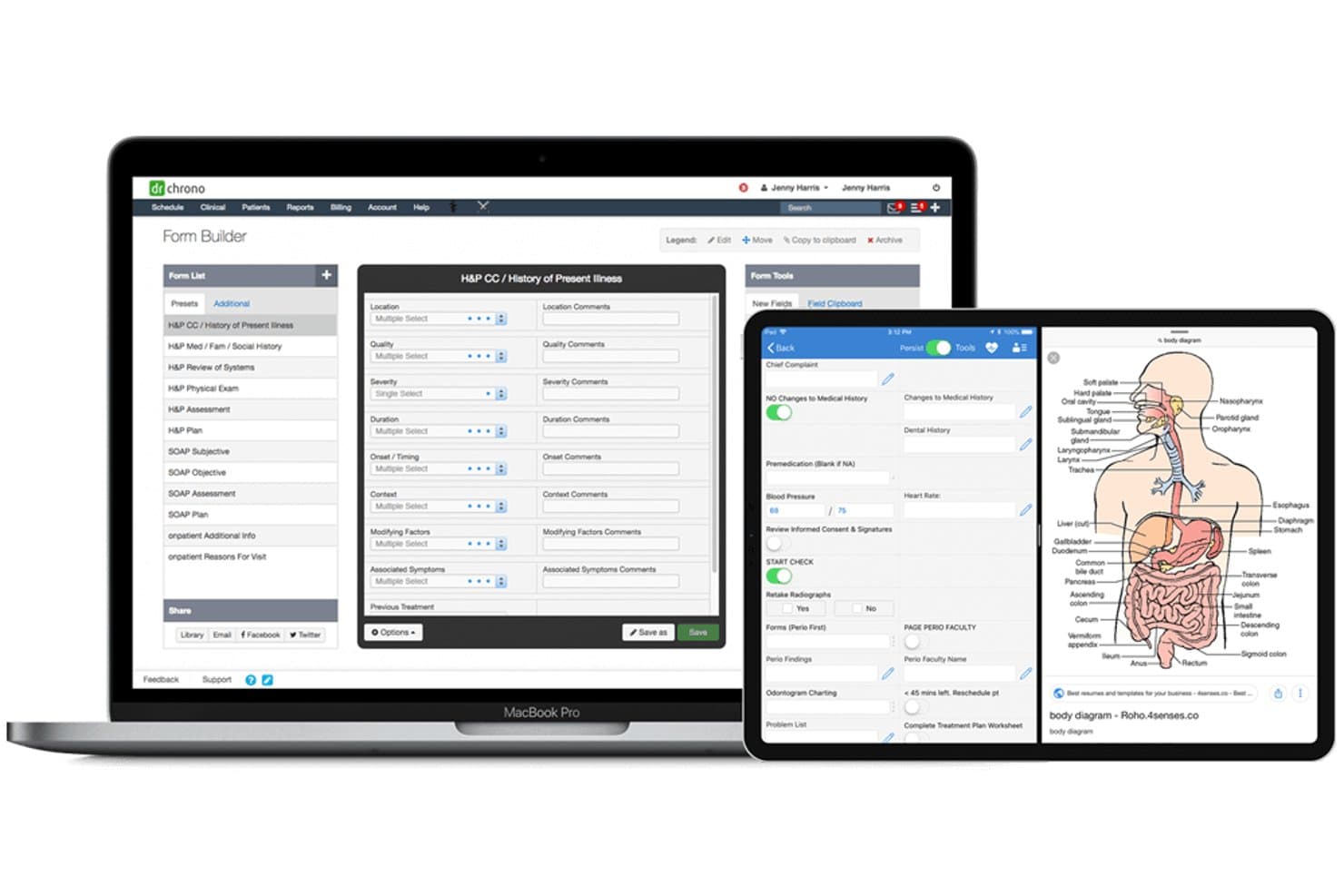
DrChrono offers a cloud-based Form Builder with customizable H&P templates, a mobile patient intake interface, and an anatomical body diagram tool across desktop and tablet devices. DrChrono is a cloud-native EHR and practice management platform that combines patient scheduling, medical billing, clinical charting, and revenue cycle management, built natively for Apple iOS devices alongside full browser-based access.
Who Is DrChrono Best For?
DrChrono is a strong fit for independent physician practices and specialty clinics that run Apple devices and want EHR, scheduling, and billing in one cloud platform.
Why I Picked DrChrono
I picked DrChrono as one of the best because it's built iOS-native from the ground up, not retrofitted for mobile after the fact. Charting on an iPad includes free-drawing directly on diagnostic images, and EverHealth Scribe captures notes hands-free during visits. I can complete a full clinical encounter from an iPhone without ever needing to open a desktop browser.
DrChrono Key Features
- Integrated telehealth: Hosts secure video visits with screen sharing and document upload directly inside the EHR.
- Real-time insurance eligibility checks: Verifies patient insurance coverage within the appointment workflow.
- Automated patient reminders: Sends SMS, email, and phone reminders to reduce no-shows and late cancellations.
- Practice chat: Enables secure in-app messaging between front office, clinical, and billing teams.
DrChrono Integrations
DrChrono offers native integrations with Fullscript, Square, Box, DeepScribe, CrelioHealth, Updox, Ambra Health, and Demandforce, plus marketplace integrations with Birdeye, Weave, Swell, rater8, Beam Health, and InvoiceSherpa. An open API is available for custom integrations.
Pros and Cons
Pros:
- Built-in check-in kiosk for patients
- AI-powered no-show and payment prediction
- Full clinical workflow from an iPad
Cons:
- Support response times can be inconsistent
- Occasional syncing delays with Apple devices
Learn more about DrChrono: Best for integrated clinical and revenue workflows
- Free demo available
- Pricing upon request
Visit WebsiteCustomer Rating:3.8/5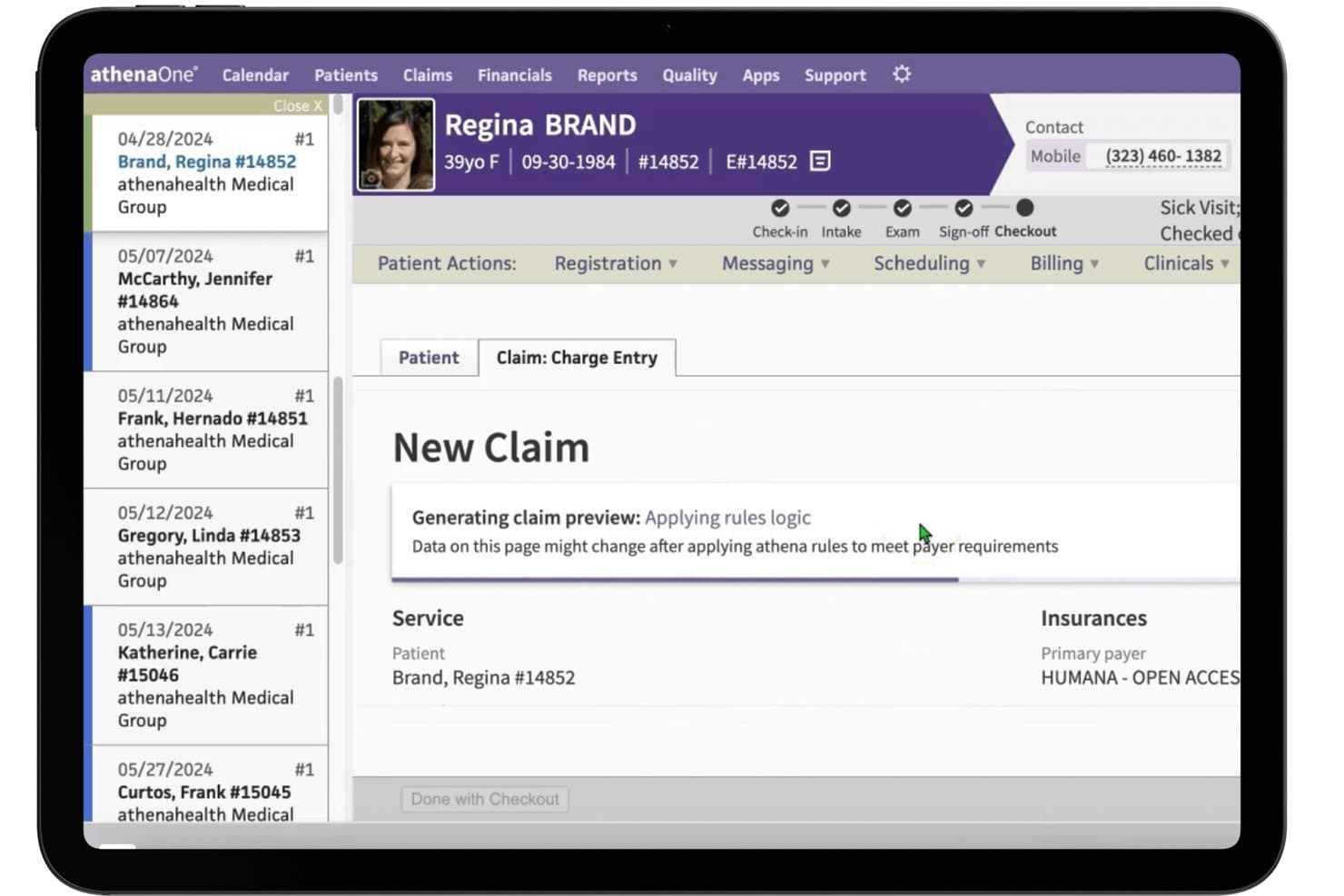
athenaOne offers automated claim scrubbing with rules logic applied during checkout to meet payer requirements before submission. athenaOne is a cloud-native platform that integrates EHR, practice management, medical billing, and patient engagement tools in a single suite built for ambulatory medical practices.
Who Is athenaOne Best For?
It's a strong fit for independent and small-to-mid-sized ambulatory practices that want clinical, billing, and patient engagement tools under one roof.
Why I Picked athenaOne
athenaOne earns its spot on my shortlist because the clinical and billing sides of the platform genuinely talk to each other. I like how Express Coding translates a completed encounter note into CPT and E&M codes in a single click, cutting the gap between documentation and claims submission. The automated claim scrubbing layer then catches errors before submission, which keeps denial rates low without requiring my billing team to manually review every claim.
athenaOne Key Features
- Patient portal: Patients can view lab results, request prescription refills, and message their provider online.
- Automated patient reminders: The system sends appointment reminders by SMS, email, or voice without manual effort.
- Eligibility verification: Insurance eligibility is checked automatically before each visit using data from card images.
- Executive summary dashboards: Management dashboards display revenue, claim status, and workflow bottlenecks in real time.
athenaOne Integrations
athenaOne offers 250+ native integrations through its Marketplace, including Surescripts, CommonWell Health Alliance, Carequality, Dulcian Health CCM Solution, Epion, GetWell Practice, PatientPop, Solutionreach, Experian Health, and esvyda. An API is available for custom integrations.
Pros and Cons
Pros:
- Built-in scheduling, telehealth, patient portal, and digital check-in tools
- AI-assisted billing workflows help reduce manual work and identify claim issues
- Combines practice management, EHR, medical billing, and patient engagement in one platform
Cons:
- The broad feature set may require more onboarding than simpler standalone tools
- Pricing is customized and based partly on practice collections
Learn more about athenaOne: Best for practices needing scalable workflows
- Not available
- Pricing upon request
Visit WebsiteCustomer Rating:3.7/5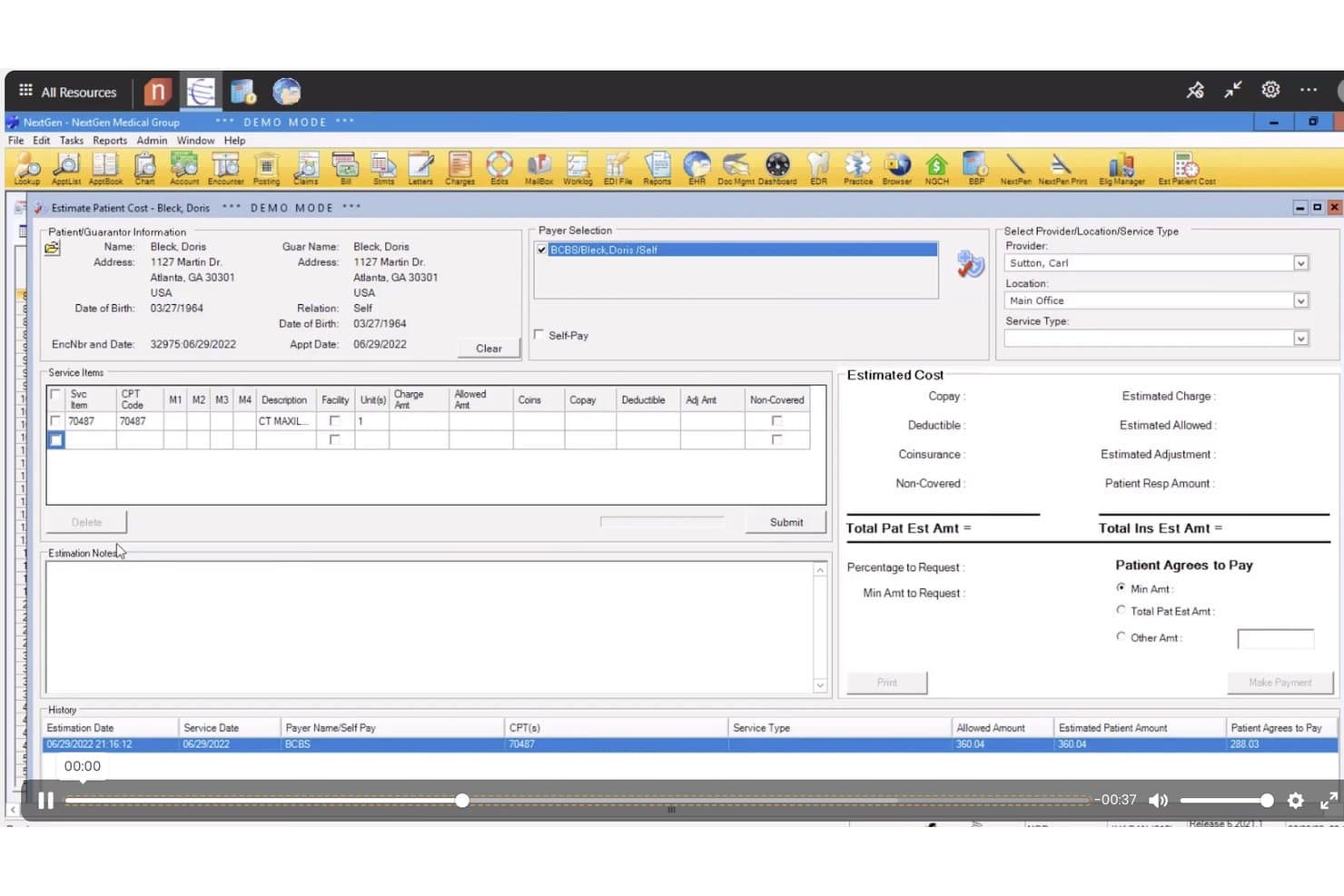
NextGen Office offers an Estimate Patient Cost tool that displays service items, payer selection, and estimated cost breakdowns including copay, deductible, and patient responsibility amounts. NextGen Office is a cloud-based EHR and practice management platform for small independent practices that combines clinical documentation, medical billing, patient scheduling, and revenue cycle management in a single system.
Who Is NextGen Office Best For?
NextGen Office is a strong fit for independent physicians and small practice administrators managing fewer than 10 providers who need an integrated clinical and billing platform.
Why I Picked NextGen Office
I picked NextGen Office as one of the best because the Closed Loop Experience links every patient touchpoint, from self-scheduling to billing, inside one cloud platform. The Clinical AI feature turns live provider-patient conversations into structured SOAP notes in seconds, cutting documentation time after visits. That means scaling your patient volume doesn't require reworking how your practice runs.
NextGen Office Key Features
- Integrated practice management system: Manage patient scheduling, billing workflows, and insurance eligibility checks in one interface.
- Specialty-specific EHR templates: Use prebuilt templates designed for a range of specialties and clinical documentation needs.
- Automated appointment reminders: Send customizable SMS and email reminders to reduce no-shows and keep appointment calendars up to date.
- Cloud-based patient portal: Let patients access their records, lab results, and financial statements securely from any device.
NextGen Office Integrations
NextGen Office offers native integrations with CoverMyMeds, Appriss Health, Surescripts, InstaMed, eFax/Consensus Cloud, Elsevier Infobutton, Waystar, TriZetto, and First Databank. An API is available for custom integrations.
Pros and Cons
Pros:
- Ambient AI auto-generates SOAP notes
- Specialty-specific templates for many practice types
- Closed Loop Experience links all workflows
Cons:
- Mobile app features are not comprehensive
- Reporting customization is limited for power users
Learn more about NextGen Office: Best for independent practice operations
- Free demo available
- Pricing upon request
Visit WebsiteCustomer Rating:3.6/5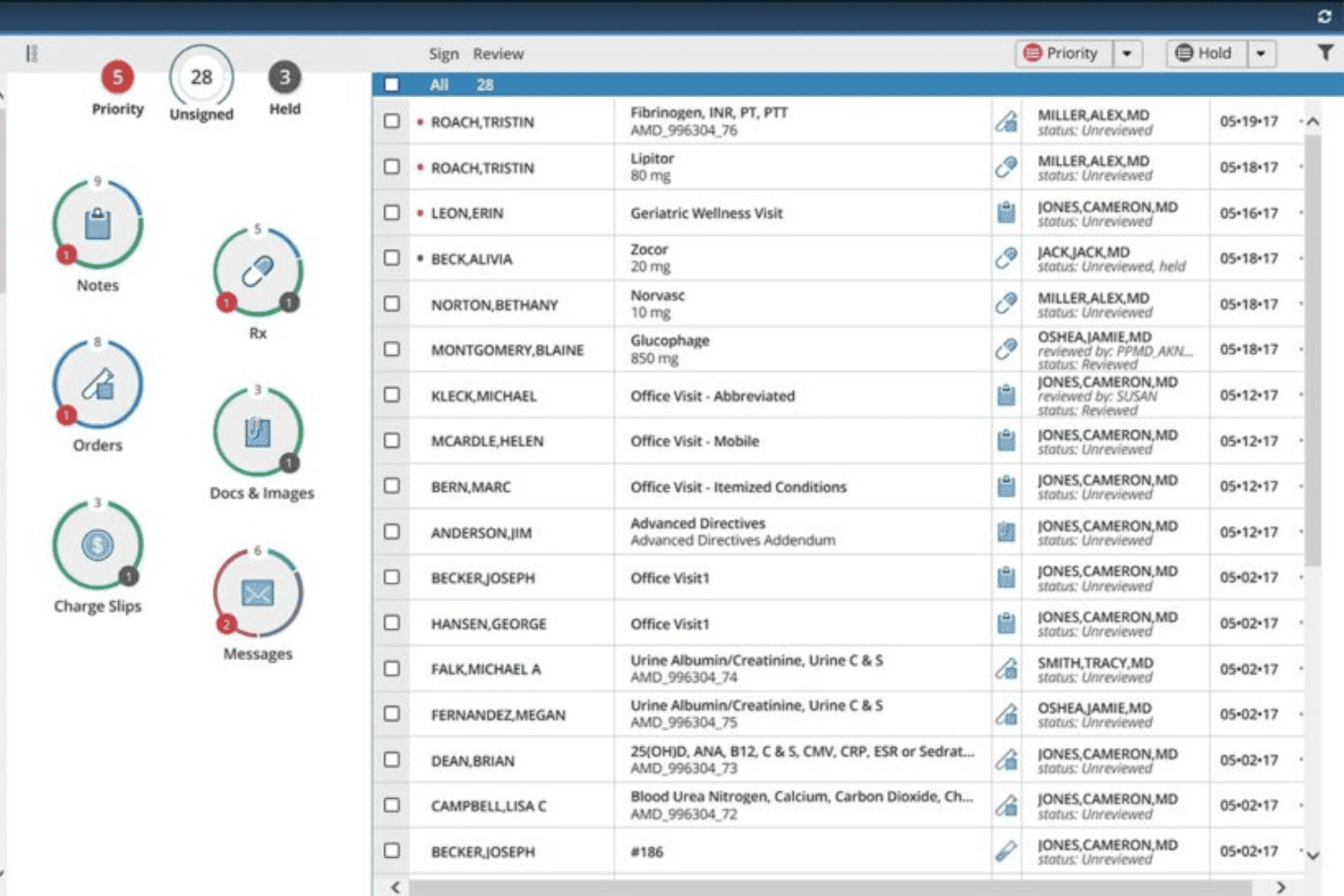
AdvancedMD dashboard for reviewing clinical notes, prescriptions, orders, documents, charge slips, and patient messages AdvancedMD is a cloud-based practice management platform combining EHR, scheduling, medical billing, RCM, and patient engagement in a single unified suite built for independent practices.
Who Is AdvancedMD Best For?
AdvancedMD is a strong fit for independent physician practices and specialty clinics that need a single platform covering clinical, billing, and front-office workflows.
Why I Picked AdvancedMD
I've included AdvancedMD in my top picks because independent practices get a genuinely unified operation, not a patchwork of tools. I particularly like the A/R Control Center, which gives billing staff a single dashboard for tracking outstanding claims, payment posting, and denial management. The AI Clinical Assistant is also worth noting, generating ambient visit notes in five formats directly from the patient encounter.
AdvancedMD Key Features
- Customizable chart templates: Lets you tailor clinical documentation to each provider’s workflow and specialty needs.
- Real-time insurance eligibility checks: Confirms patient coverage instantly before appointments or procedures.
- Integrated telehealth visits: Provides HIPAA-compliant video appointments from directly within the platform.
- Patient portal: Offers online access for patients to manage appointments, view records, and securely message your office.
AdvancedMD Integrations
AdvancedMD offers native integrations with QuickBooks, multiple lab providers, immunization registries, and PDMP registries. An integration marketplace is available, and an API supports custom integrations for group and enterprise practices.
Pros and Cons
Pros:
- Mobile EHR and practice management apps
- Granular A/R dashboard for billing staff
- Patient portal with customizable self-scheduling options
Cons:
- Frequent updates can disrupt user workflow
- Occasional delays with claims status updates
- 11CureMDBest for billing and administrative workflows
- 12eClinicalWorksBest for unified practice and patient management
- 13SimplePracticeBest for behavioral health and wellness practices
- 14RXNTBest for integrated practice management
- 15PracticeSuiteBest for flexible medical billing and RCM
Related Reviews
How I Evaluate Cloud Practice Management Software
I split my evaluation into baseline criteria—like cloud deployment, HIPAA compliance, and billing workflows—and the differentiating factors that separate good tools from great ones.
Core Functionality (Table Stakes for This List)
When I'm selecting tools for my list, I rank each one on a scale from 0 (does not offer the functionality) to 5 (excels in this area) for each core functionality listed below. Then, I calculate the tool's total score into a percentage. Each tool needs to achieve a minimum total score of 65% to be considered for inclusion.
- Cloud-Based Deployment: I check whether the platform runs entirely in a browser without requiring local server installs, and whether it offers mobile apps for providers who need chart access between exam rooms.
- Patient Scheduling & Appointments: Scheduling should include automated reminders, online self-booking, and waitlist management so your front desk isn't buried in phone calls confirming tomorrow's appointments.
- Medical Billing & Claims: I evaluate whether the platform supports electronic claims submission, CPT/ICD coding, ERA/EOB processing, and denial management—the full billing cycle from charge capture to payment posting.
- Patient Records & Demographics: Each tool should maintain patient demographics, insurance details, and chart data, ideally with integrated EHR/EMR functionality like e-prescribing and interoperability via HL7 or FHIR standards.
- HIPAA Compliance & Security: I look for documented HIPAA compliance with a signed BAA, role-based access controls, MFA, and audit trails that let you track exactly who accessed a patient record and when.
- Insurance Eligibility Verification: Real-time eligibility checks before a patient visit prevent claim denials down the line, so I evaluate whether verification is automated or requires manual lookups outside the system.
Once I have a list of tools that meet the criteria, I consider what sets each platform apart.
Differentiating Factors (What Sets Vendors Apart)
Here's how I compare and contrast different vendors:
Standout Features
A patient portal where individuals can book appointments, message providers, and view billing statements saves your front desk hours of phone time. Workflow automation matters too—I look for platforms that auto-assign tasks like pre-visit insurance checks or post-visit follow-ups based on appointment triggers. Reporting dashboards that show provider utilization, claim denial rates, and revenue trends help practice owners spot issues before they become costly.
Beyond Features
Practice size matters—a solo dermatologist needs a different setup than a multi-location primary care group, so I evaluate whether a platform scales from a handful of providers to dozens without requiring a costly tier jump. Integrations with lab systems, clearinghouses, and EHR platforms also factor heavily into my assessment. I look at onboarding support too, especially data migration help, since moving patient records from a legacy system mid-operations is one of the riskiest transitions a practice can make.
Como escolher um software de gestão de consultórios na nuvem
É fácil perder-se em listas extensas de funcionalidades e estruturas de preços complexas. Para o ajudar a manter o foco enquanto avalia as suas necessidades específicas e escolhe o software, apresentamos uma lista de fatores a ter em conta:
| Fator | O que deve considerar |
| Escalabilidade | A plataforma consegue lidar com o número atual e previsto de pacientes, o número de profissionais e o crescimento das localizações? Terá de migrar novamente à medida que expande a sua atividade? |
| Integrações | O software liga-se ao seu EMR, à câmara de compensação de faturação, aos sistemas laboratoriais ou a outras ferramentas essenciais? A falta de integrações pode criar problemas relacionados com a introdução duplicada de dados. |
| Personalização | Pode ajustar os fluxos de trabalho, os modelos e os relatórios às características do seu consultório e às necessidades da sua especialidade sem necessitar de um apoio informático significativo? |
| Facilidade de utilização | Com que rapidez podem os funcionários aprender o essencial e voltar a dedicar-se aos cuidados dos pacientes? Esteja atento a menus pouco intuitivos e definições ocultas que atrasem a sua equipa. |
| Implementação e integração inicial | Que calendário e apoio oferece o fornecedor para a configuração e a migração de dados? São disponibilizados recursos para formar novos funcionários e importar registos antigos? |
| Custo | Olhe para além das taxas base — os acessos ao portal do paciente, a prescrição eletrónica ou o volume de pedidos são cobrados como extras? Esteja atento a custos inesperados à medida que a utilização aumenta. |
| Medidas de segurança | A ferramenta disponibiliza autenticação multifator, permissões baseadas em funções, registos de auditoria e atualizações de segurança regulares para manter os PHI protegidos? |
| Disponibilidade do apoio | Quando surgem problemas, consegue obter ajuda rapidamente por chat, telefone ou e-mail? Se trabalha com uma equipa reduzida, o apoio em tempo real durante o horário de funcionamento do consultório é essencial. |
O que é um software de gestão de consultórios na nuvem?
Os softwares de gestão de consultórios na nuvem são plataformas baseadas na Web que ajudam as unidades de saúde a gerir com segurança o agendamento de pacientes, a faturação, os registos e as tarefas relacionadas com seguros a partir de qualquer dispositivo ligado à Internet. Estes sistemas permitem centralizar os fluxos de trabalho clínicos e administrativos sem manter servidores locais, suportam o acesso remoto da sua equipa e disponibilizam ferramentas integradas de segurança e conformidade para proteger informações de saúde sensíveis.
Funcionalidades do software de gestão de clínicas na cloud
Ao selecionar um software de gestão de clínicas na cloud, tenha em atenção as seguintes funcionalidades principais:
- Acessibilidade baseada na cloud: Os utilizadores podem aceder de forma segura a todos os dados e fluxos de trabalho essenciais da clínica através de qualquer navegador Web, sem necessidade de servidores ou hardware locais.
- Agendamento de consultas: Ferramentas para marcar, remarcar e confirmar consultas, gerir os calendários dos profissionais e enviar automaticamente lembretes aos pacientes para reduzir as faltas.
- Faturação médica e gestão de pedidos de reembolso: Suporta a codificação CPT/ICD, o envio eletrónico de pedidos de reembolso, o processamento de ERA/EOB e o registo de pagamentos para simplificar o ciclo de receitas.
- Integração com registos de saúde eletrónicos (EHR): Mantém registos completos dos pacientes, notas clínicas e históricos, permitindo simultaneamente a partilha segura de informações entre profissionais autorizados.
- Verificação da elegibilidade do seguro: As verificações em tempo real da cobertura dos pacientes antes das consultas ajudam a evitar recusas e a melhorar a eficiência do fluxo de trabalho da receção.
- Segurança em conformidade com a HIPAA: Garante a proteção dos dados sensíveis dos pacientes através de encriptação, registos de auditoria, controlos de acesso baseados em funções e documentação de conformidade obrigatória.
- Relatórios e análises: Painéis e relatórios personalizáveis que acompanham os principais indicadores de desempenho (KPI) clínicos, operacionais e financeiros ajudam os administradores da clínica a tomar decisões informadas.
- Portal do paciente: Um portal seguro e fácil de utilizar que permite aos pacientes aceder ao agendamento de consultas, aos registos de saúde e às informações de faturação, bem como enviar mensagens seguras à equipa.
- Gestão de documentos: Ferramentas digitais para armazenar, partilhar e organizar formulários digitalizados, referências, cartões de seguro e documentos de consentimento assinados num único local central.
- Automação de tarefas e fluxos de trabalho: Automatiza passos administrativos repetitivos, como lembretes de acompanhamento, monitorização de pedidos de reembolso e formulários de admissão, para que a equipa se possa concentrar na prestação de cuidados.
Funcionalidades comuns de IA do software de gestão de clínicas na cloud
Para além das funcionalidades padrão do software de gestão de clínicas na cloud indicadas acima, muitas destas soluções estão a incorporar IA com funcionalidades como:
- Agendamento preditivo de consultas: A IA analisa dados históricos de consultas e o comportamento dos pacientes para sugerir horários ideais, reduzindo as faltas e melhorando a utilização dos profissionais.
- Assistência automatizada à codificação: A IA analisa as notas clínicas e recomenda códigos CPT/ICD precisos, ajudando a reduzir erros nos pedidos de reembolso e a acelerar os fluxos de trabalho de faturação.
- Análise inteligente de recusas de pedidos de reembolso: A IA identifica padrões nos pedidos de reembolso recusados, assinala problemas comuns e sugere medidas corretivas para melhorar as taxas de aceitação futuras.
- Processamento de linguagem natural para documentação: A IA converte as notas dos profissionais, ditadas ou escritas, em registos estruturados, poupando tempo no registo manual de dados e melhorando a precisão dos registos.
- Análise do sentimento dos pacientes: A IA analisa as mensagens e os comentários dos pacientes para detetar insatisfação ou necessidades urgentes, ajudando a equipa a dar prioridade aos contactos e a melhorar a experiência dos pacientes.
Benefícios do software de gestão de clínicas na cloud
A implementação de um software de gestão de clínicas na cloud proporciona vários benefícios para a sua equipa e para a sua empresa. Eis alguns dos benefícios que pode esperar:
- Acesso a partir de qualquer lugar: A equipa e os profissionais podem gerir em segurança os horários, os registos dos pacientes e as tarefas de faturação a partir de qualquer dispositivo com acesso à Internet.
- Maior eficiência na faturação: Os fluxos de trabalho de faturação integrados, as ferramentas de codificação e a gestão de pedidos de reembolso minimizam os erros manuais e aceleram a cobrança de receitas.
- Agendamento simplificado: Os lembretes automáticos e as funcionalidades de marcação autónoma de consultas reduzem as faltas e libertam tempo administrativo para tarefas mais importantes.
- Maior conformidade e segurança dos dados: As medidas de segurança em conformidade com a HIPAA, os registos de auditoria e os controlos de acesso ajudam a proteger informações sensíveis e a simplificar os requisitos regulamentares.
- Maior autonomia dos pacientes: Os portais dos pacientes permitem consultar registos de saúde, pagar faturas em linha e comunicar de forma segura, melhorando o envolvimento e a satisfação.
- Menor carga de trabalho de TI: A eliminação de servidores locais e a redução da manutenção do software libertam tempo e recursos para a sua clínica.
- Tomada de decisões baseada em dados: Os painéis e relatórios personalizados revelam tendências nos fluxos de trabalho, nas finanças e no envolvimento dos pacientes, ajudando a otimizar as operações.
Custos e preços do software de gestão de clínicas na cloud
A seleção de software de gestão de consultórios baseado na nuvem requer uma compreensão dos vários modelos de preços e planos disponíveis. Os custos variam consoante as funcionalidades, o tamanho da equipa, os complementos, entre outros fatores. A tabela abaixo resume os planos comuns, os respetivos preços médios e as funcionalidades normalmente incluídas nas soluções de software de gestão de consultórios baseado na nuvem:
Tabela de comparação de planos de software de gestão de consultórios baseado na nuvem
| Tipo de plano | Preço médio | Funcionalidades comuns |
| Plano gratuito | $0 | Agendamento básico, registos de pacientes limitados, ferramentas de faturação restritas e suporte mínimo. |
| Plano pessoal | $25–$60/utilizador/mês | Agendamento normal, faturação básica, gestão de documentos e funcionalidades essenciais de elaboração de relatórios. |
| Plano empresarial | $65–$130/utilizador/mês | Agendamento avançado, gestão completa de pedidos de reembolso, portal de pacientes integrado, análises aprofundadas e automatização dos fluxos de trabalho do consultório. |
| Plano empresarial de grande escala | $140–$250/utilizador/mês | Integrações personalizadas, suporte premium, controlos de segurança avançados, gestão de várias localizações e assistência dedicada à integração inicial. |
Perguntas frequentes sobre software de gestão de consultórios baseado na nuvem
Eis algumas respostas a perguntas comuns sobre software de gestão de consultórios baseado na nuvem:
Qual é o nível de segurança do software de gestão de consultórios baseado na nuvem?
O software de gestão de consultórios baseado na nuvem utiliza encriptação, permissões baseadas em funções e registos de auditoria para proteger os dados dos pacientes. Muitas plataformas também disponibilizam autenticação multifator e atualizações regulares de conformidade para cumprir normas regulamentares como a HIPAA.
Posso migrar os dados dos meus pacientes existentes para um software de gestão de consultórios baseado na nuvem?
Sim, a maioria dos fornecedores disponibiliza assistência na migração de dados. Esta inclui ferramentas ou serviços profissionais para transferir consultas, registos de pacientes e dados de faturação do sistema anterior para a nova plataforma.
O software de gestão de consultórios baseado na nuvem funcionará com o meu sistema EHR ou de faturação atual?
Muitos fornecedores disponibilizam integrações com registos de saúde eletrónicos, sistemas laboratoriais e entidades de compensação de faturação através de ligações integradas ou APIs. Verifique sempre a compatibilidade com as suas ferramentas essenciais antes de efetuar a compra.
Que tipo de suporte posso esperar?
As opções de suporte variam, mas incluem frequentemente chat em direto, telefone, e-mail e acesso a centros de ajuda. Alguns fornecedores também atribuem um especialista dedicado à integração inicial para orientar a configuração e a formação da equipa.
Preciso de pessoal de TI para gerir o software de gestão de consultórios baseado na nuvem?
Não, os sistemas baseados na nuvem foram concebidos para reduzir a carga de trabalho de TI. Os fornecedores tratam da manutenção dos servidores, das atualizações de segurança e das cópias de segurança, permitindo que a sua equipa se concentre nos cuidados prestados aos pacientes em vez da manutenção técnica.
Posso aceder ao sistema quando trabalho à distância?
Sim, desde que disponha de uma ligação à Internet e das credenciais de início de sessão adequadas, pode aceder com segurança aos dados e aos fluxos de trabalho do seu consultório a partir de qualquer dispositivo, incluindo quando trabalha fora das instalações.