

O software de faturação médica e contabilidade é uma tecnologia que ajuda as equipas de saúde a gerir pedidos de reembolso, pagamentos dos pacientes, processamento de seguros e registos financeiros num único local. Quando procura as melhores opções, precisa de ferramentas que reduzam o trabalho administrativo manual, acompanhem os requisitos mais recentes e garantam que nenhum reembolso fica por receber.
Neste guia, encontrará plataformas avaliadas que respondem aos desafios específicos da faturação médica, apoiam a conformidade regulamentar e se adaptam a consultórios de todas as dimensões. Utilize esta lista para comparar funcionalidades, compreender as suas opções e escolher um software que apoie uma gestão de receitas eficiente e rigorosa.
Why Trust Our Software Recommendations
6,700+
Reviews
20
Industry experts
16+
Evaluation factors
14
Years
Our team has been testing and reviewing software since 2012. As medical practice leaders ourselves, we know how difficult—and important—it is to choose the right software.
For this guide, we evaluated tools using hands-on testing and independent research, scoring tools using our selection criteria.
Our reviews reflect our human editorial judgment, not a sales pitch.
Tabela de comparação de software de faturação médica e contabilidade
Esta tabela de comparação resume os detalhes de preços das minhas principais escolhas de software de faturação médica e contabilidade:
| Tool | Best For | Trial Info | Price | ||
|---|---|---|---|---|---|
| 1 | Best for batch eligibility verification tools | Free demo available | Pricing upon request | Website | |
| 2 | Best for mobile charge capture and billing | Free demo available | Pricing upon request | Website | |
| 3 | Best for connected EHR and billing workflows | Free demo available | From $199/user/month | Website | |
| 4 | Best for scalable multi-location revenue workflows | Free demo available | Pricing upon request | Website | |
| 5 | Best for payer enrollment support and training | Free demo available | Pricing upon request | Website | |
| 6 | Best for real-time ERA and EOB reconciliation | Free demo + free expert consultation available | Pricing upon request | Website | |
| 7 | Best for patient payment portal features | Free demo available | Pricing upon request | Website | |
| 8 | Best for customizable financial dashboards | Free demo available | Pricing upon request | Website | |
| 9 | Best for specialty-specific billing automation | Free demo available | Pricing upon request | Website | |
| 10 | Best for integrated clearinghouse connectivity | Free demo available | Pricing upon request | Website |


Avaliações do melhor software de faturação médica e contabilidade
Abaixo encontram-se os meus resumos detalhados do melhor software de faturação médica e contabilidade que entrou na minha lista restrita. As minhas avaliações apresentam uma análise detalhada das funcionalidades, dos melhores casos de utilização e dos preços de cada plataforma, para o ajudar a encontrar a melhor opção para si.
 Best for batch eligibility verification tools
- Free demo available
- Pricing upon request
Visit WebsiteCustomer Rating:4.1/5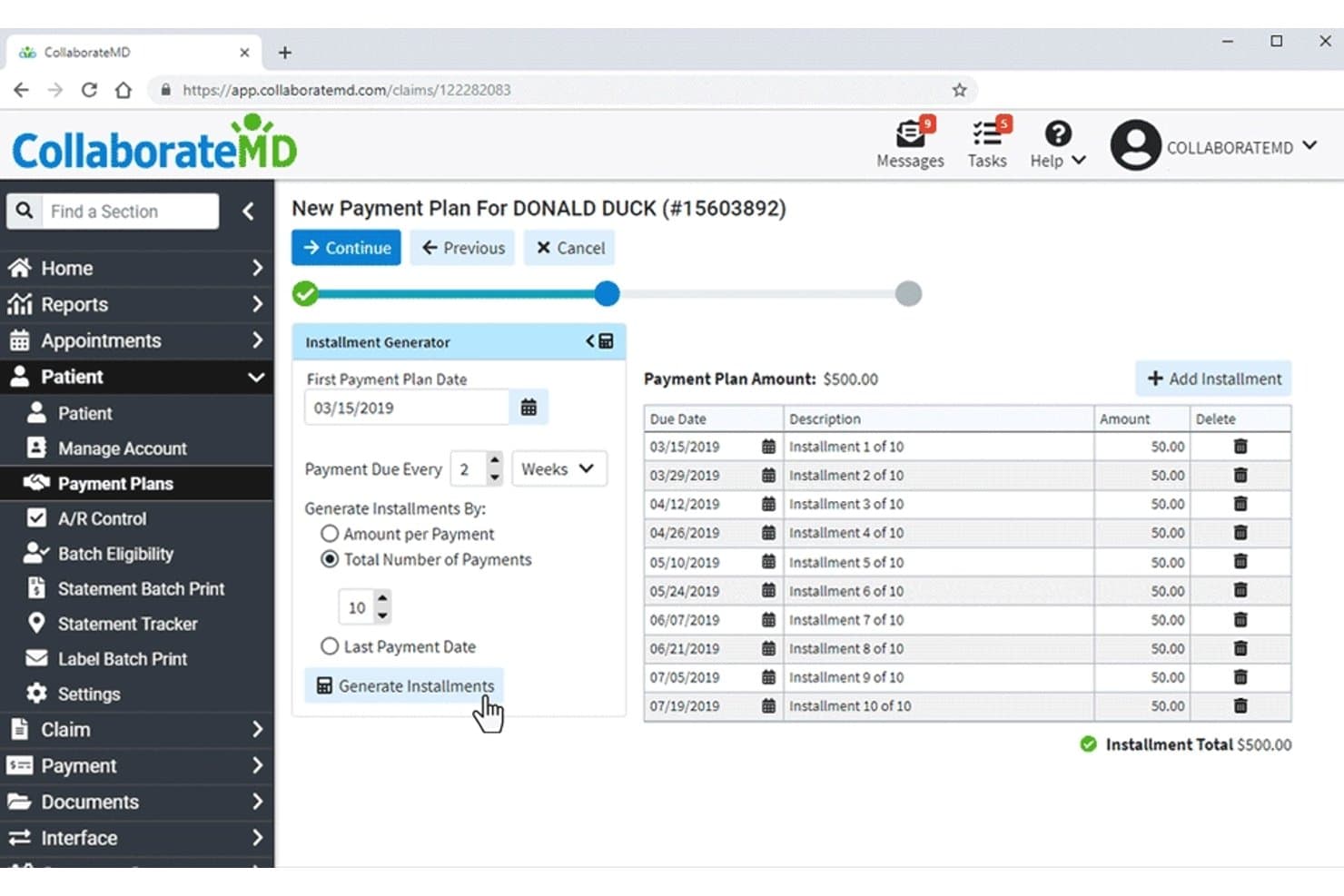
CollaborateMD offers a Payment Plans feature that allows users to generate installment schedules for patient balances with customizable payment frequency and amounts. CollaborateMD is a cloud-based medical billing and practice management platform with a built-in clearinghouse, claim scrubbing, ERA auto-posting, real-time eligibility verification, and patient billing tools designed for small to medium-sized practices.
Who Is CollaborateMD Best For?
CollaborateMD is a good fit for independent practices and small to medium-sized medical groups that handle their own billing in-house.
Why I Picked CollaborateMD
CollaborateMD earns its spot on my shortlist because of how it handles eligibility at scale. I like that it runs both real-time and batch eligibility checks within the same billing workflow, so my team can verify a full day's appointment list before patients arrive rather than scrambling at check-in. The Patient Responsibility Estimator pulls copay and deductible data directly from those checks, which means we can present accurate cost estimates at the point of care.
CollaborateMD Key Features
- Built-in clearinghouse: Submits claims directly with payer edits, tracking, denial management, and ERA processing in one platform.
- Level 2 claim scrubbing: Applies NCD/LCD, CCI, LMRP, and modifier checks before claim submission for cleaner claims.
- Customizable financial reporting: Offers 125+ reports and dashboards with filters for payer mix, collections, A/R aging, and CPT-level detail.
- Patient billing portal: Enables online bill payment, automated statement delivery, and flexible payment plans for patient balances.
CollaborateMD Integrations
CollaborateMD offers native integrations with Practice Fusion, Elation, Alleva, Quest Diagnostics, LabCorp, LabDAQ, MDTech, and MediMobile. An API is available for custom integrations.
Pros and Cons
Pros:
- Intelligent claim edits reduce denial rates
- ERA auto-posting with payer reconciliation
- Batch eligibility checks for all scheduled patients
Cons:
- Only supports a single built-in clearinghouse
- Patient payment portal incurs external processor fees
Learn more about CollaborateMD: Best for mobile charge capture and billing
- Free demo available
- Pricing upon request
Visit WebsiteCustomer Rating:3.9/5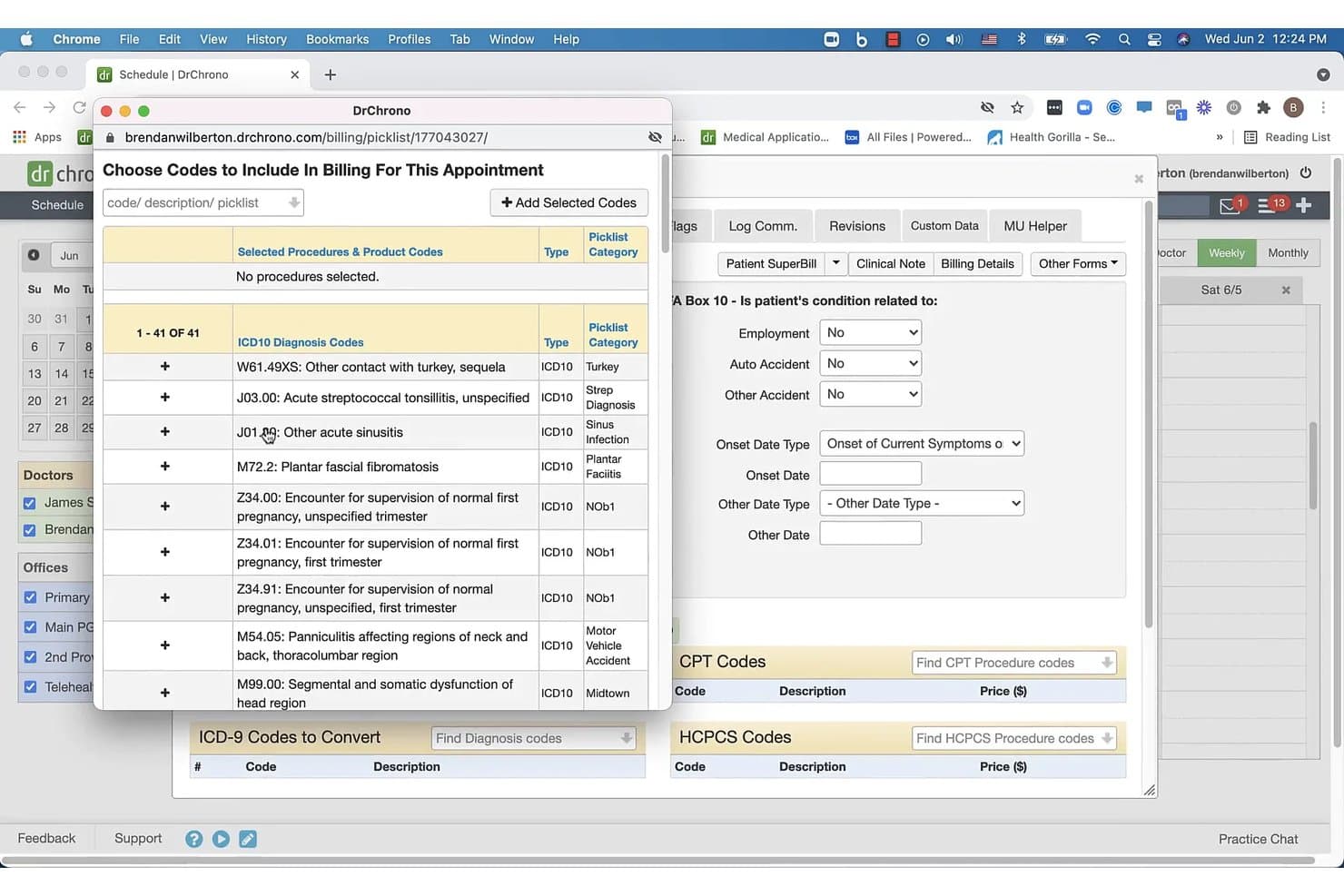
DrChrono offers a billing code picklist modal that allows providers to search and add ICD10 diagnosis codes to a patient appointment. DrChrono is a cloud-based EHR and medical billing platform that combines charge capture, claims management, ERA posting, eligibility verification, and revenue cycle management in a single, mobile-accessible system.
Who Is DrChrono Best For?
DrChrono works well for independent physicians and small to mid-sized practices that need an integrated EHR and billing system accessible from mobile devices.
Why I Picked DrChrono
DrChrono earns its spot on my shortlist because of how tightly its mobile charge capture connects directly to the billing workflow. I can capture charges from an iPad at the point of care, and those codes feed straight into claim generation without any re-entry. Billing Profiles let me store commonly used diagnoses and CPT codes upfront, so building a clean, submission-ready claim takes seconds rather than minutes.
DrChrono Key Features
- Integrated claim management tool: Centralizes electronic claims generation, scrubbing, tracking, and clearinghouse submission.
- Real-time insurance eligibility checks: Confirms insurance coverage and benefits at scheduling and check-in.
- Electronic remittance advice (ERA) auto posting: Automatically reconciles payer ERAs and EOBs to outstanding claims.
- Custom billing profiles and code sets: Lets users store specialty-specific ICD-10, CPT, and HCPCS codes for fast, accurate charge capture.
DrChrono Integrations
DrChrono offers native integrations with Quest Diagnostics, LabCorp, Surescripts, Iron Bridge immunization registries, CoverMyMeds for prior authorization, Stripe for payments, and Physitrack. An open API is available for custom integrations.
Pros and Cons
Pros:
- Real-time insurance eligibility verification
- Integrated EHR, billing, and revenue cycle tools
- Mobile charge capture with iPad-first workflow
Cons:
- No Android mobile app available
- Patient statements are difficult for patients to read
Learn more about DrChrono: Best for connected EHR and billing workflows
- Free demo available
- From $199/user/month
Visit WebsiteCustomer Rating:3.7/5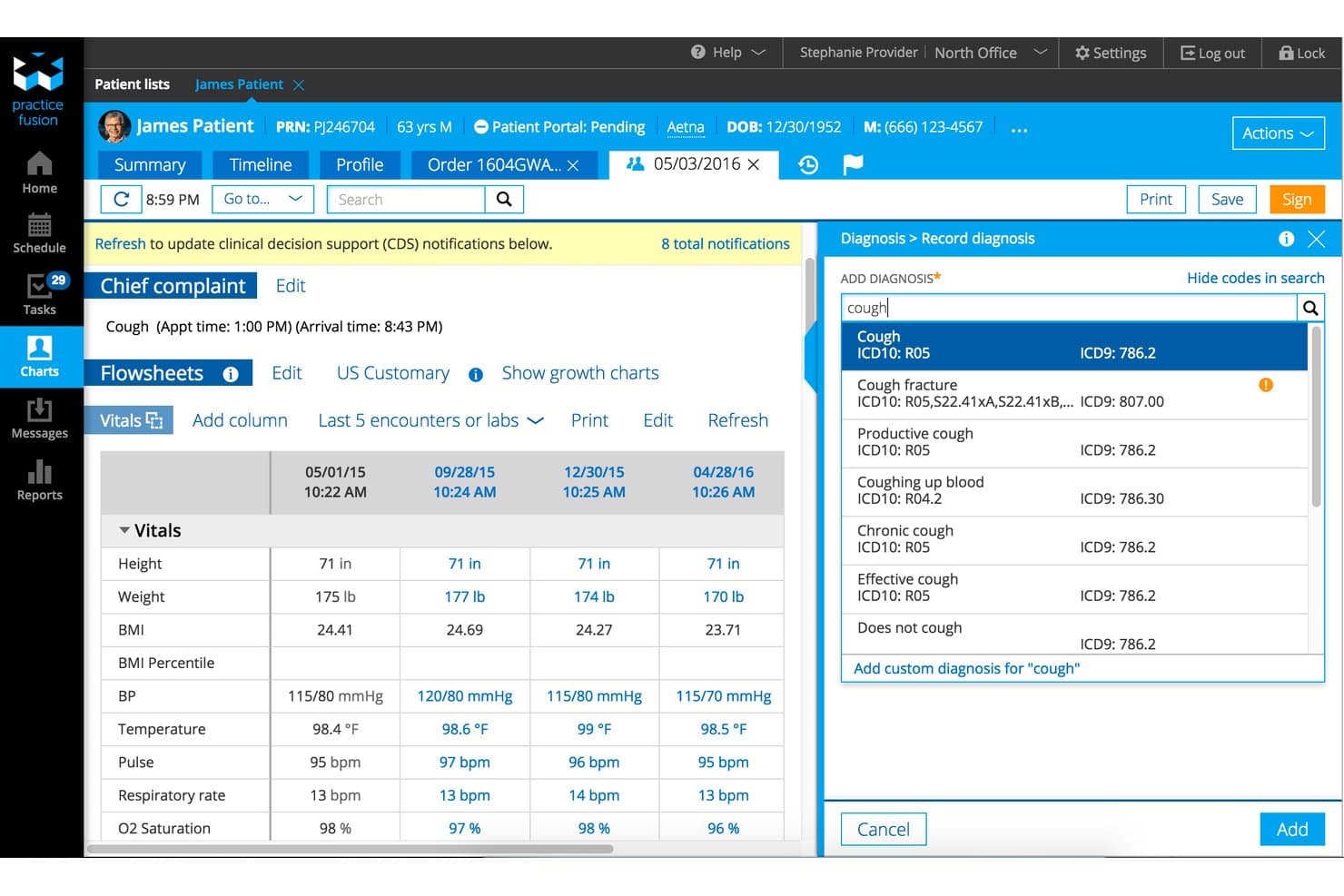
Practice Fusion displays a patient flowsheet with an integrated diagnosis search panel for recording ICD-10 and ICD-9 codes during an encounter. Practice Fusion is a cloud-based EHR platform with integrated medical billing services that covers claims scrubbing, denial management, payment posting, patient statements, and revenue cycle reporting for independent practices.
Who Is Practice Fusion Best For?
Practice Fusion is a strong fit for independent ambulatory practices that want a single vendor handling both clinical documentation and revenue cycle management.
Why I Picked Practice Fusion
Practice Fusion earns its spot on my shortlist because the EHR and billing workflow are genuinely connected, not just co-sold. When I document a visit, that chart data flows directly into the billing queue with AI-powered coding assistance, cutting the manual re-entry that causes most claim errors. I also like the same-day claims submission with automated scrubbing and built-in denial management, all operating within a single platform rather than across disconnected tools.
Practice Fusion Key Features
- Integrated patient payment portal: Lets patients view statements, pay balances online, and access billing history.
- Automated payer enrollment dashboard: Centralizes payer credentialing and real-time status for new contracts and revalidations.
- Patient call center support: Provides phone-based assistance for patient billing questions and payment processing.
- Customizable financial reports: Generates A/R aging, collections summaries, payer mix analytics, and practice-specific dashboards.
Practice Fusion Integrations
Practice Fusion has native integrations with labs and imaging centers, Updox, CareCloud, Tebra, Veradigm, CollaborateMD, and Cal-Med. An API is available for custom integrations.
Pros and Cons
Pros:
- Patient payment portal included for statements
- Automated claims scrubbing and denial management
- Connected EHR and billing in one platform
Cons:
- Some users report customer support delays
- Full accounting features not included
Learn more about Practice Fusion: Best for scalable multi-location revenue workflows
- Free demo available
- Pricing upon request
Visit WebsiteCustomer Rating:3.6/5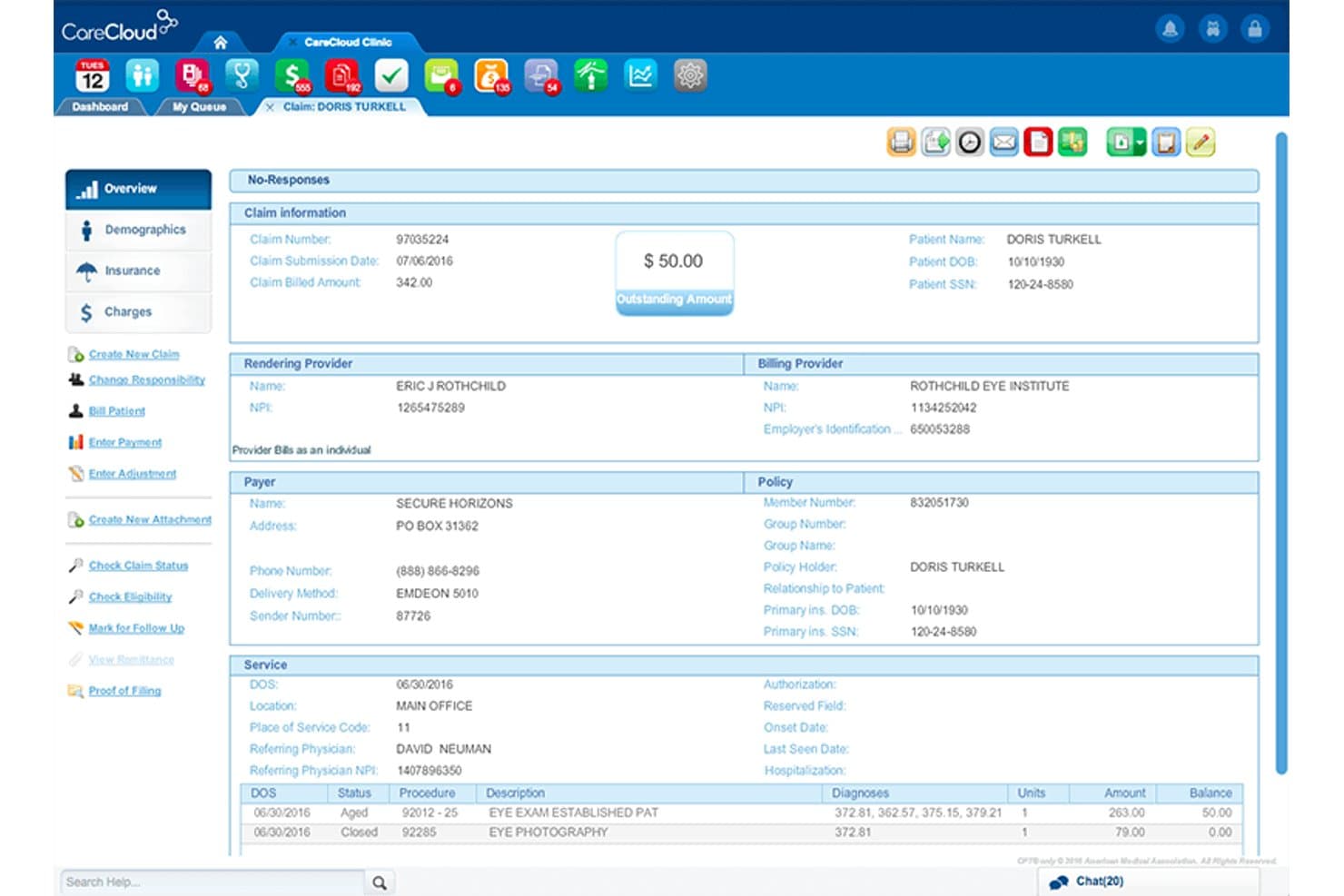
CareCloud displays a detailed claim overview screen with billing, provider, payer, and service information for patient collections management. CareCloud is a cloud-based medical billing platform that combines claims management, insurance eligibility verification, ERA posting, denial resolution, and revenue cycle management for healthcare practices.
Who Is CareCloud Best For?
CareCloud suits group practices and multi-location healthcare organizations that need centralized billing and revenue cycle management across multiple providers and sites.
Why I Picked CareCloud
I picked CareCloud as one of the best because its centralized billing interface lets you manage claims across every provider and location from a single queue. What I particularly like is the CollectiveIQ rule engine, which scrubs claims against payer-specific rules and state regulations before submission, hitting a reported 94% first-pass rate. That pre-submission intelligence scales well when you're managing billing across multiple sites with different payer mixes.
CareCloud Key Features
- Built-in clearinghouse connectivity: Send claims directly to payers without extra third-party clearinghouse software.
- Real-time eligibility verification: Instantly check patient insurance coverage at scheduling and check-in.
- Centralized payment posting: Automatically post ERAs and reconcile patient payments within a unified interface.
- Practice-specific financial reporting: Access dashboards with KPIs, A/R analytics, and detailed payer mix breakdowns.
CareCloud Integrations
CareCloud offers native integrations with CodoniX EHR, EHRYourWay, ICANotes, MD Logic, Optivate, Praxis EMR, Sevocity, TeleVox, and Vital Interaction. An API is available for custom integrations.
Pros and Cons
Pros:
- Real-time claim and denial status tracking
- Automated pre-visit insurance eligibility checks
- Centralized billing for multiple locations
Cons:
- Some features only in higher-tier plans
- Contract terms often require multi-year commitment
Learn more about CareCloud: Best for payer enrollment support and training
- Free demo available
- Pricing upon request
Visit WebsiteCustomer Rating:3.5/5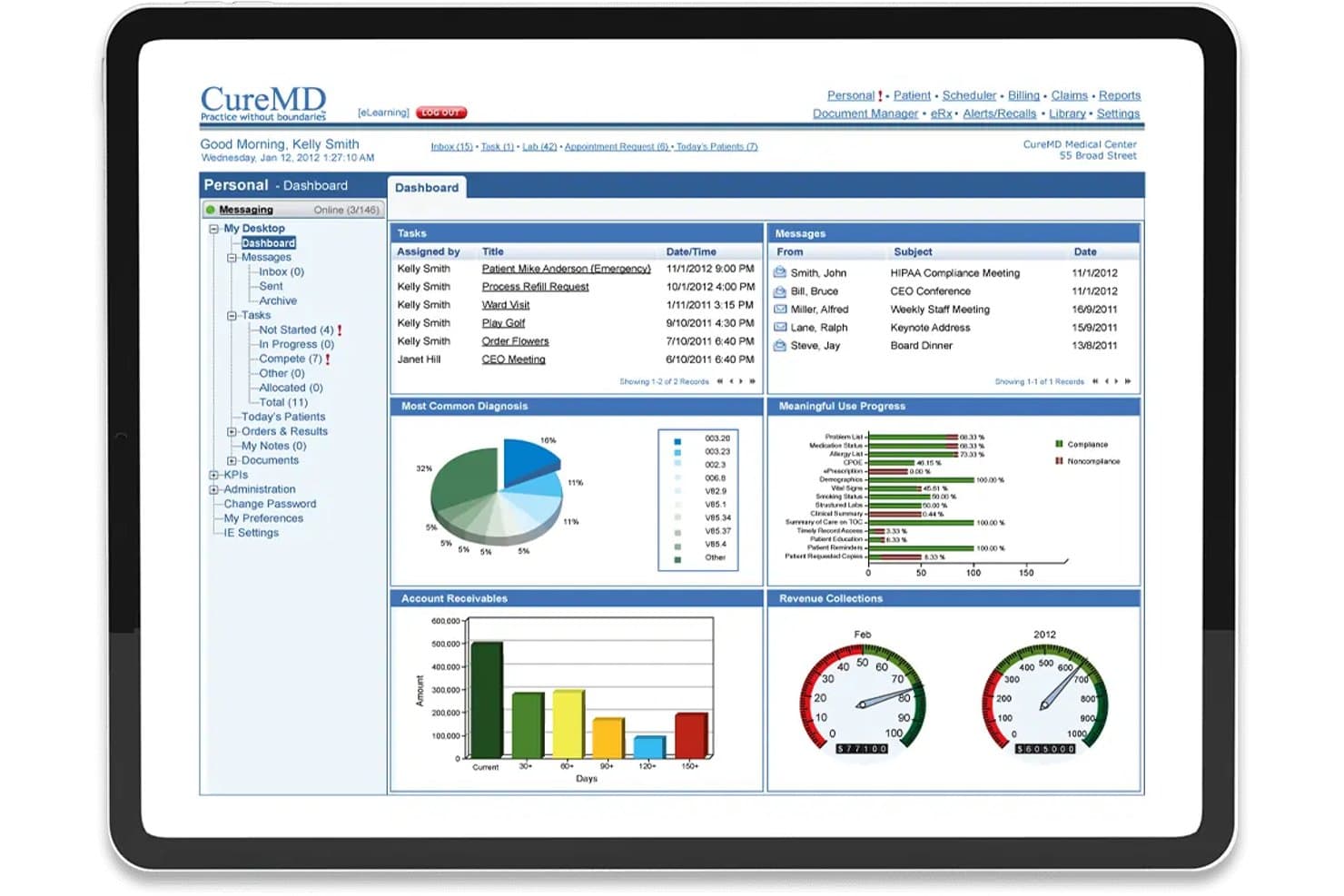
CureMD offers a comprehensive personal dashboard displaying tasks, messages, diagnosis charts, account receivables, and revenue collection metrics. CureMD is a cloud-based medical billing and RCM service that handles claims management, coding, eligibility verification, denial management, and payer enrollment under one platform.
Who Is CureMD Best For?
CureMD is a strong fit for independent and small-to-midsize practices across 32+ specialties that need a fully managed billing service.
Why I Picked CureMD
I've included CureMD in my top picks because of how it handles payer enrollment and staff training as built-in services, not add-ons. The team manages EDI implementation, provider credentialing, and payer enrollment from day one, which avoids the delays that typically stall new billing operations. CureMD also includes process coordination and training at no additional cost, so billing staff aren't left to navigate workflows independently after go-live.
CureMD Key Features
- Claims rules engine: More than four million rules for automated claim scrubbing and issue detection before submission.
- Real-time eligibility verification: Instant insurance eligibility checks at check-in or scheduling for fewer downstream denials.
- AI coding assistance: Embedded AI module provides real-time CPT/ICD-10 code suggestions and compliance checks.
- KPI dashboard and advanced reporting: Custom, prebuilt, and drill-down reports covering A/R, denials, payer mix, and cash flow.
CureMD Integrations
CureMD provides native integrations for electronic prescribing with over 40,000 pharmacies, electronic lab ordering and results, and EDI/ERA clearinghouse connectivity. An API is available for custom integrations.
Pros and Cons
Pros:
- Real-time eligibility and benefit verification at check-in
- Advanced claim scrubbing with AI coding suggestions
- Payer enrollment assistance and credentialing support included
Cons:
- Delay in support response during peak periods
- Reporting customizations can be limited for some specialties
Learn more about CureMD: 6Best for real-time ERA and EOB reconciliation
RXNT
- Free demo + free expert consultation available
- Pricing upon request
Visit WebsiteCustomer Rating:4.3/5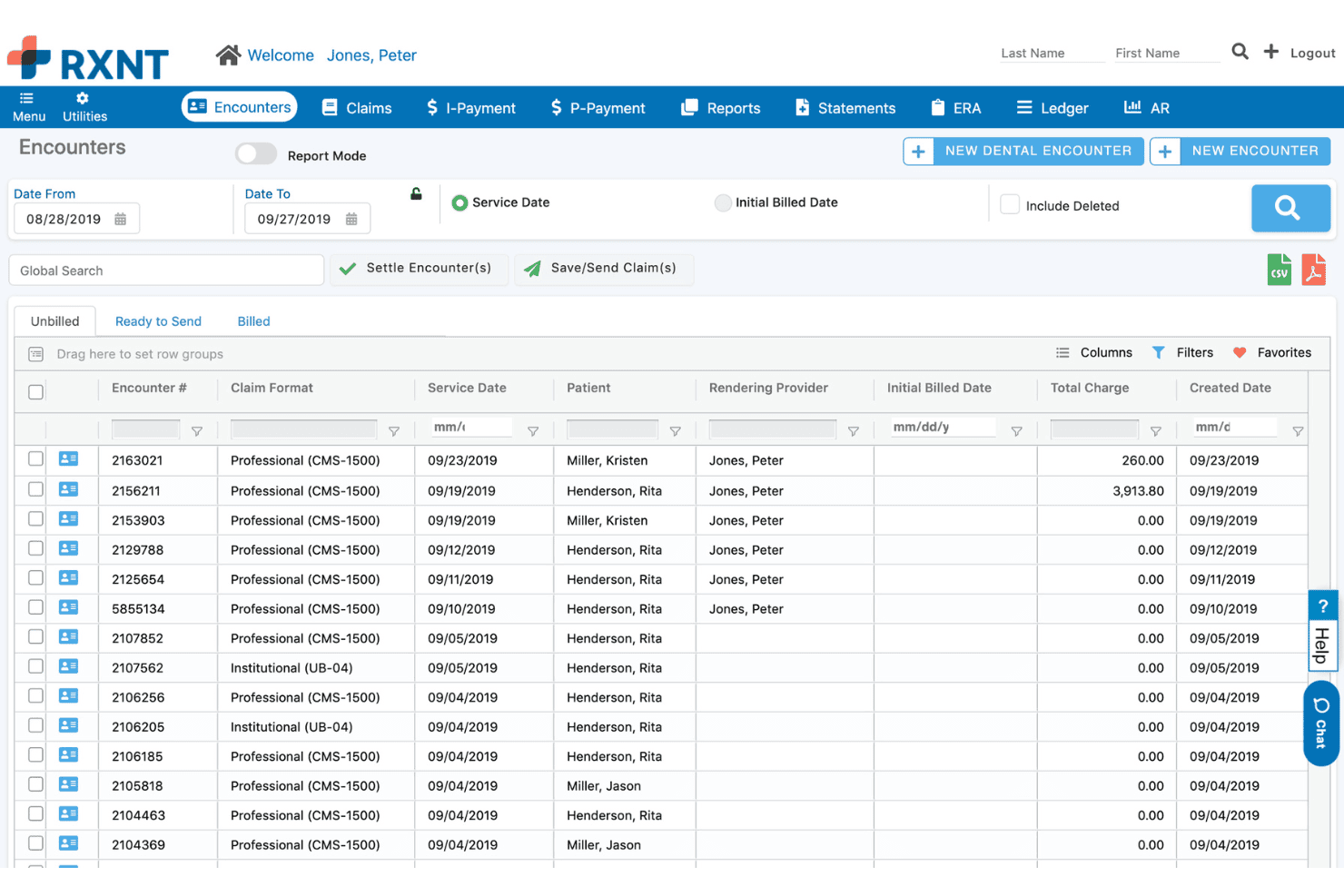
RXNT displays an Encounters dashboard where users can view, filter, and manage unbilled patient claims by service date, provider, and charge amount. RXNT is a cloud-based medical billing and practice management platform that handles claim submission, ERA/EOB reconciliation, eligibility verification, denial management, and patient payment collection.
Who Is RXNT Best For?
RXNT is a strong fit for small to mid-sized medical practices and independent billing companies that need an affordable, all-in-one RCM platform.
Why I Picked RXNT
RXNT earns its spot on my shortlist because of how it handles ERA and EOB reconciliation in real time. When a payer sends back an 835 file, RXNT matches it automatically against outstanding claims, so my team isn't manually hunting down payment discrepancies. I also like the built-in claim scrubbing before submission, which catches errors before they become denials. The denial management workflow then flags any rejections and queues them for follow-up, all within the same platform.
RXNT Key Features
- Customizable financial dashboards: Access 15+ dashboards for KPI and revenue analysis with drill-down options.
- Integrated patient payment portal: Collect payments online, manage balances, and deliver electronic statements.
- Mobile charge capture app: Enter charges and manage billing workflows from any device using native iOS and Android apps.
- Real-time eligibility verification: Verify patient insurance eligibility instantly during scheduling and check-in.
RXNT Integrations
RXNT offers native integrations with EHR, electronic prescribing, clearinghouses, and lab and imaging partners. It provides calendar sync with Gmail and Outlook, and an API is available for custom integrations.
Pros and Cons
Pros:
- Built-in denial and rejection tracking
- Centralized multi-location billing management
- Real-time payment reconciliation for ERA/EOBs
Cons:
- Annual contract auto-renewal policy frustrates users
- Financial reporting lacks advanced analytics
Learn more about RXNT: Best for patient payment portal features
- Free demo available
- Pricing upon request
Visit WebsiteCustomer Rating:3.9/5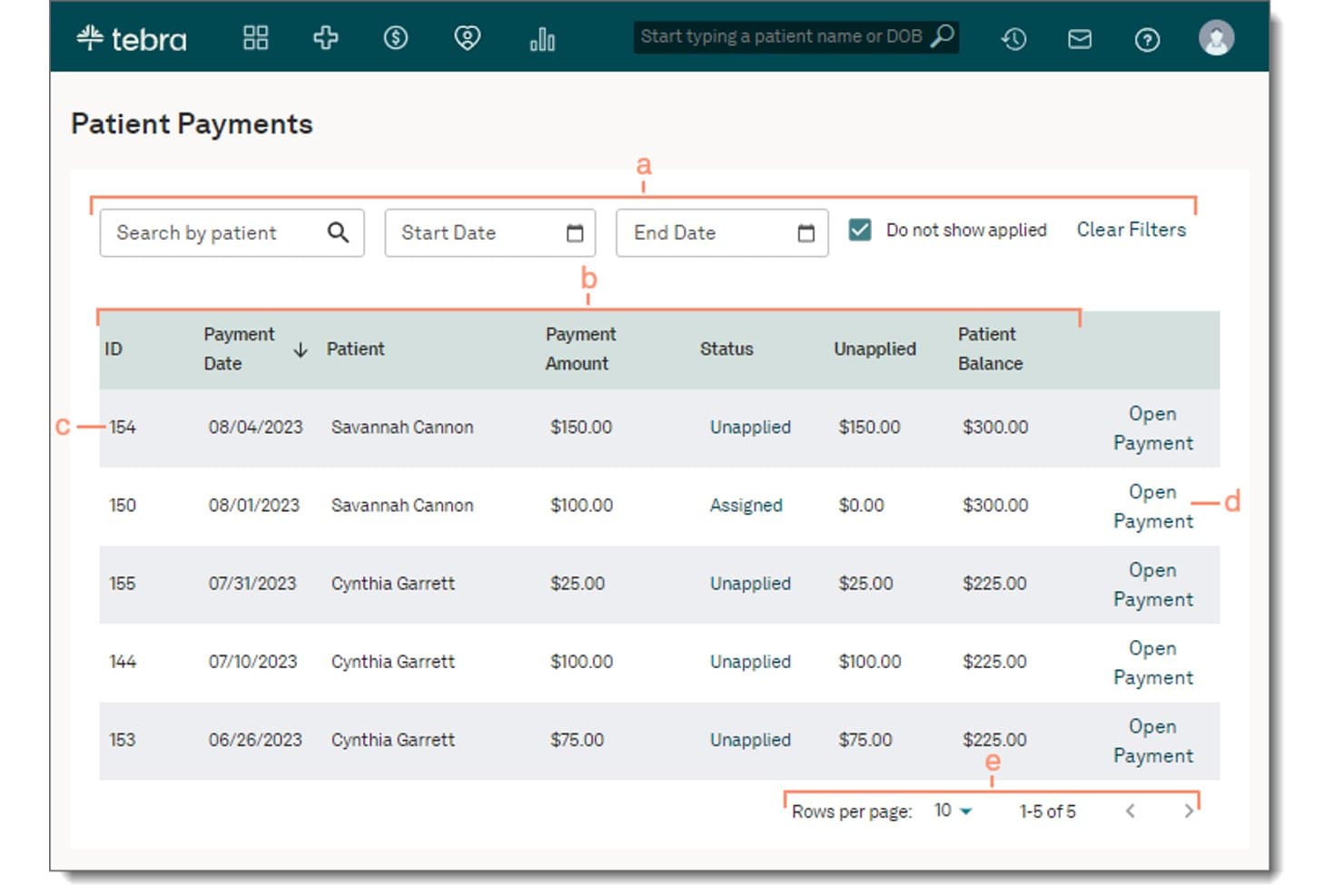
Tebra displays a Patient Payments screen where users can filter, view, and manage unapplied or assigned patient payments. Tebra is an all-in-one medical billing and EHR platform built for independent practices, covering electronic claim submission, insurance eligibility verification, ERA posting, denial management, and patient billing.
Who Is Tebra Best For?
Tebra is a strong fit for small to mid-sized independent practices where a single platform needs to handle both clinical documentation and the full billing cycle.
Why I Picked Tebra
I've included Tebra in my top picks because its patient payment portal goes well beyond a basic online pay button. I particularly like how it combines SMS and email payment links, QR codes on mailed statements, and card-on-file storage so patients can pay through whichever channel they actually use. Automated payment reminders reduce the manual follow-up my team would otherwise handle for outstanding balances.
Tebra Key Features
- Real-time eligibility verification: Check insurance coverage and benefits instantly for over 2,700 payers directly within scheduling workflows.
- Automated claim scrubbing: Identify coding and billing errors before submission to improve acceptance rates and reduce denials.
- Integrated clearinghouse connectivity: Submit and track electronic claims, attachments, and remittance advice through a unified interface.
- Customizable financial reporting: Access dashboards and reports with detailed KPIs like payer mix, denial rates, and collections trends.
Tebra Integrations
Tebra offers native integrations with TriZetto, Appriss Health, and numerous EHR systems. An API is available for custom integrations.
Pros and Cons
Pros:
- Strong automation for ERA payment posting
- Real-time insurance eligibility verification included
- Industry-leading patient payment portal features
Cons:
- Occasional lag in electronic claim submission
- Reporting customization can be limited
Learn more about Tebra: Best for customizable financial dashboards
- Free demo available
- Pricing upon request
Visit WebsiteCustomer Rating:3.7/5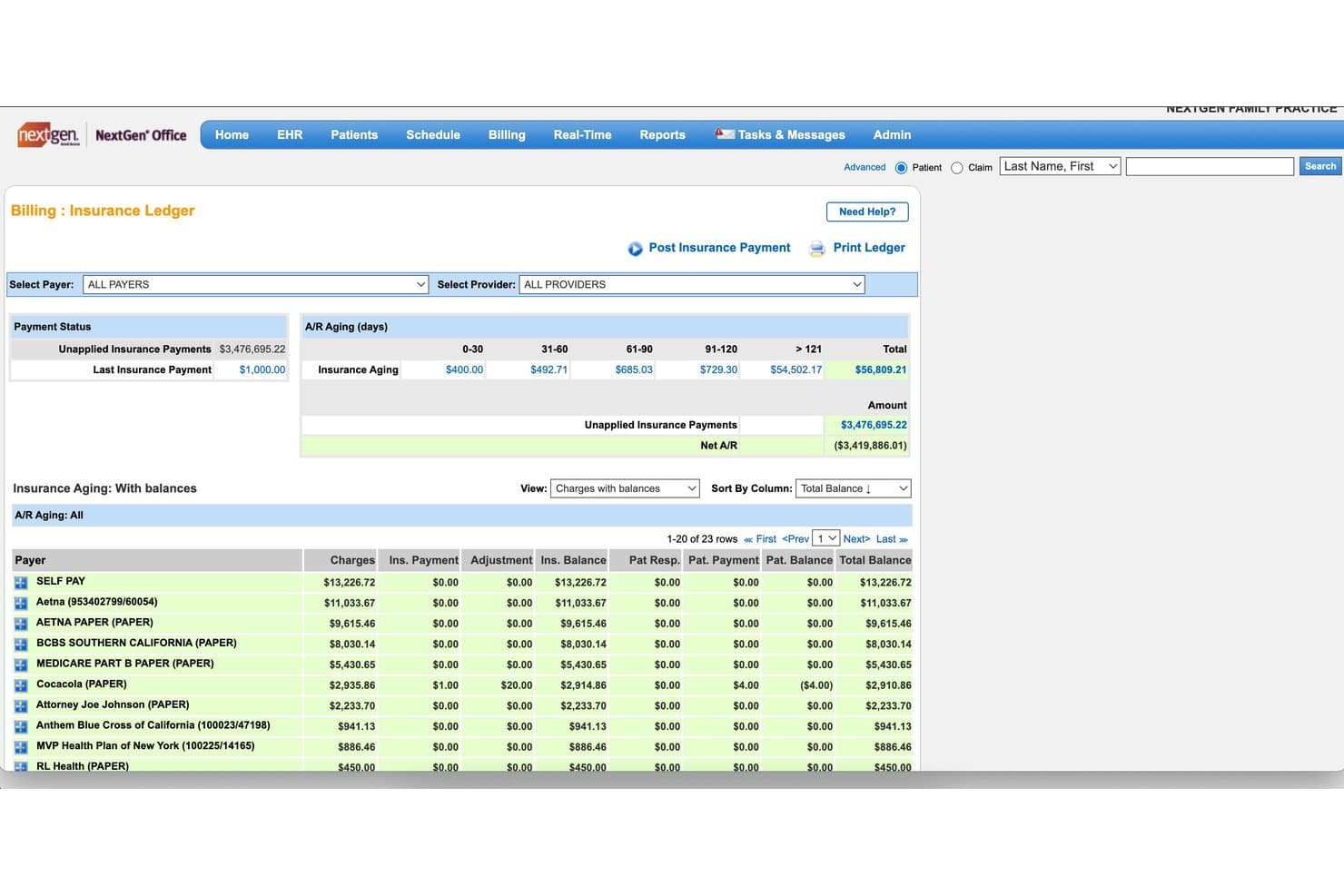
NextGen Healthcare offers an Insurance Ledger billing dashboard displaying A/R aging, unapplied insurance payments, and payer balances. NextGen Healthcare is a modular revenue cycle management platform for ambulatory practices that combines claims management, medical coding, eligibility verification, payment posting, and specialty-specific financial analytics.
Who Is NextGen Healthcare Best For?
It's a strong fit for ambulatory practices of any size that need a fully managed RCM service with specialty-specific billing workflows.
Why I Picked NextGen Healthcare
I picked NextGen Healthcare as one of the best because its financial dashboards go well beyond standard A/R reports. I can track more than 100 KPIs across every payer and specialty in a single view, then drill down into denial trends or payer mix breakdowns without exporting data to a separate tool. The consultative analytics layer also surfaces underperforming areas before they compound into larger collection shortfalls.
NextGen Healthcare Key Features
- Automated eligibility verification: Instantly checks patient insurance coverage in real time or batch mode at check-in.
- Specialty-specific coding services: Offers coding support and expertise tailored for various medical specialties and procedures.
- Integrated payment posting tools: Automates reconciliation of ERAs, EOBs, and direct patient payments.
- A/R recovery workflows: Supports dedicated processes for tracking and collecting outstanding accounts receivable.
NextGen Healthcare Integrations
NextGen Healthcare offers native integrations with Doctible, Solutionreach, Clearwave, and InstaMed, and connects to other health systems and EHRs through its Mirth Connect interoperability engine. An API is available for custom integrations.
Pros and Cons
Pros:
- Specialty-specific billing and coding expertise
- Automated eligibility and denial management tools
- Financial dashboards with 100+ KPIs and drilldowns
Cons:
- Some users report slow customer support
- Limited transparency on feature updates
Learn more about NextGen Healthcare: Best for specialty-specific billing automation
- Free demo available
- Pricing upon request
Visit WebsiteCustomer Rating:3.6/5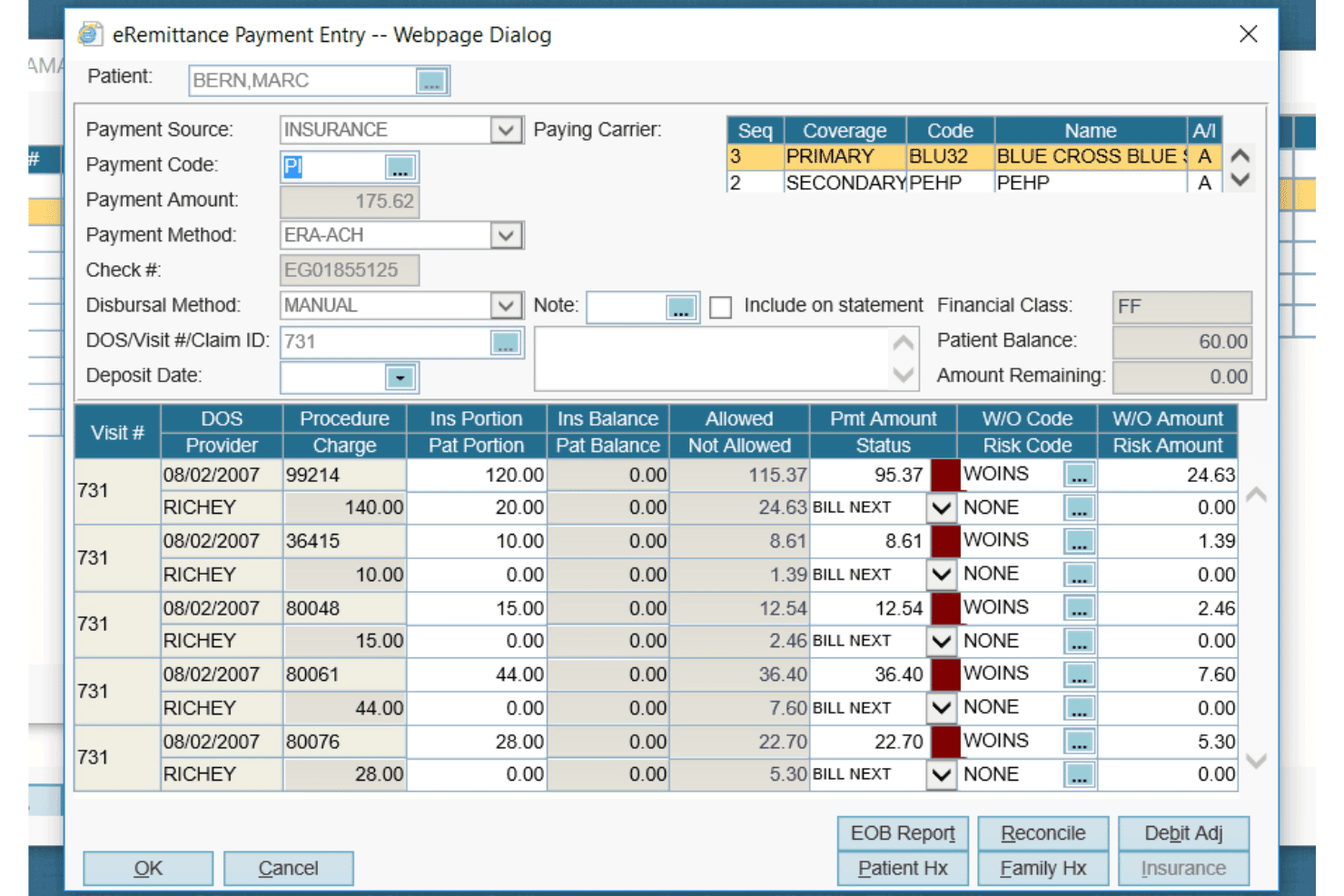
AdvancedMD offers a detailed eRemittance Payment Entry dialog for managing insurance billing, claim payments, and write-off codes per procedure. AdvancedMD is a cloud-based medical billing and practice management platform that handles claims submission, ERA processing, eligibility verification, denial management, and financial reporting across multiple medical specialties.
Who Is AdvancedMD Best For?
AdvancedMD is a strong fit for independent and multi-location practices billing across specialties like mental health, physical medicine, and addiction medicine.
Why I Picked AdvancedMD
AdvancedMD earns its spot on my shortlist because of how its ClaimInspector scrubs every claim against CCI, HIPAA, and LCD edits before submission, consistently hitting near-100% first-pass acceptance. I've found that invaluable when billing across specialties like mental health or addiction medicine, where payer rules vary widely. The Central Billing Office also lets my team manage multiple providers from a single login without juggling separate databases.
AdvancedMD Key Features
- A/R control center: Organizes staff worklists and tracks denials to help manage accounts receivable tasks in one place.
- Integrated clearinghouse: Connects directly to payers for electronic claim submission and remittance with no manual uploads.
- Batch insurance eligibility: Runs real-time or batch eligibility checks during intake and scheduling for all major payers.
- Customizable financial dashboards: Displays A/R aging, collections, and payer mix analytics with practice-specific drill-down filters.
AdvancedMD Integrations
AdvancedMD offers native integrations with ChartRequest, DAX Copilot, DeepScribe, Doctorsoft, InstaMed, LeadSquared, and NextPatient. It has an Integration Marketplace, supports HIE and interoperability, and provides an open API for custom integrations.
Pros and Cons
Pros:
- Real-time eligibility checks in scheduling workflow
- Automated claim scrubbing for specialty-specific coding
- Central Billing Office supports multi-location billing
Cons:
- No AI coding suggestions in core platform
- Advanced reporting options require add-on module
 Best for integrated clearinghouse connectivity
- Free demo available
- Pricing upon request
Visit WebsiteCustomer Rating:3.4/5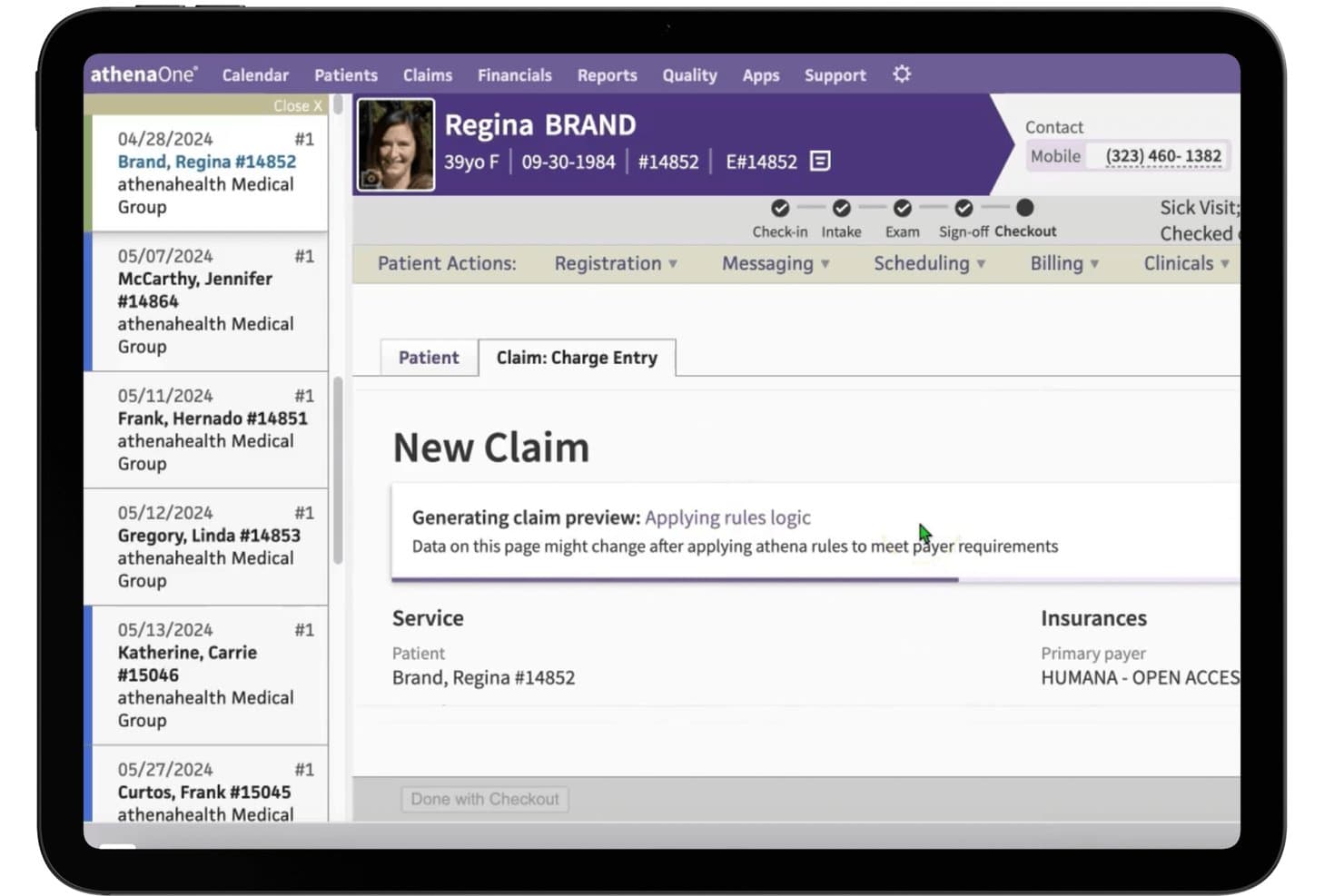
athenahealth displays a New Claim charge entry screen with real-time rules logic applied during patient checkout. athenaOne is a cloud-based EHR and practice management platform that combines medical billing, claims management, payment posting, eligibility verification, and financial reporting in a single integrated system.
Who Is athenahealth Best For?
athenaOne is a strong fit for independent ambulatory practices and physician groups that need a fully integrated RCM and EHR system under one roof.
Why I Picked athenahealth
athenahealth earns its spot on my shortlist because of how its clearinghouse connectivity actually works in practice. Rather than routing claims through a third-party intermediary, athenaOne connects directly to payers through a single integration covering 170,000+ providers nationwide. I especially like the rules engine, which draws on insights from across that provider network to scrub claims before submission, consistently hitting a 98.4% clean claim rate.
athenahealth Key Features
- Financial reporting dashboards: Track collections, denials, and payer mix with customizable, drill-down reports.
- Certified coder services: Access a team of medical coders for charge reviews, coding support, and reduced denials.
- Automated statement cycles: Generate and send patient statements on a set schedule, including electronic and print options.
- Real-time eligibility verification: Verify insurance eligibility and benefits during scheduling or check-in for efficient intake.
athenahealth Integrations
athenahealth offers native integrations with lab networks, pharmacies, major national and regional payers, CertifyOS, and Stanson Health. It also provides an API for custom integrations and supports interoperability through athenaConnect.
Pros and Cons
Pros:
- Network-driven rules engine for claim scrubbing
- Real-time eligibility and denial prediction tools
- Direct payer connections for claim submission
Cons:
- Outbound patient statement customization is limited
- Support response times can be inconsistent
Learn more about athenahealth:
Outro software de faturação médica e contabilidade
Eis algumas opções adicionais de software de faturação médica e contabilidade que não entraram na minha lista restrita, mas que vale a pena conhecer:
- 11eClinicalWorksBest for EHR and billing data integration
- 12SimplePracticeBest for automated claim scrubbing for therapists
- 13PrognoCIS Psychiatry EHRBest for customizable specialty billing templates
- 14PracticeSuiteBest for automated appointment-to-billing
- 15CharmHealthBest for built-in payment posting automation
- 16NueMDBest for rapid onboarding and implementation
- 17Elation HealthBest for streamlined physician-led charge capture
- 18WaystarBest for predictive denial management analytics
- 19EZClaimBest for intuitive batch claim entry workflows
How I Evaluate Medical Billing and Accounting Software
I break evaluation into two layers: the core claims, coding, and payment workflows every platform must handle, and the differentiators that actually matter to billing managers and practice admins.
Core Functionality (Table Stakes For This List)
When I'm selecting tools for my list, I rank each one on a scale from 0 (does not offer the functionality) to 5 (excels in this area) for each core functionality listed below. Then, I calculate the tool's total score into a percentage. Each tool needs to achieve a minimum total score of 65% to be considered for inclusion.
- Claims Management: I check whether claims can be scrubbed, submitted electronically, and tracked through clearinghouses without toggling between systems.
- Medical Coding Support: The platform should support ICD-10, CPT, and HCPCS lookups so billers can assign codes and catch modifier errors before submission.
- Payment Posting: I evaluate how the tool handles ERA/EOB reconciliation, including whether it auto-matches payments or requires manual line-item review.
- Patient Billing & Statements: Generating statements, offering online payment options, and supporting payment plans are what I look for in patient-facing billing.
- Eligibility Verification: Real-time and batch verification matter here, especially for front-desk staff confirming coverage and copay details before a visit.
- Financial Reporting: I look for reports covering A/R aging, denial rates, and payer mix so revenue cycle managers can spot collection issues quickly.
Once I have a list of tools that meet the criteria, I consider what sets each platform apart.
Differentiating Factors (What Sets Vendors Apart)
Here's how I compare and contrast different vendors:
Standout Features
Claim scrubbing paired with denial management is a major differentiator. I look for platforms that flag coding errors before submission and track denial root causes so your team can fix patterns, not just individual claims. A patient payment portal also matters. Text-to-pay, card-on-file, and payment plan options help collect balances after insurance without extra follow-up calls. I also evaluate financial reporting dashboards, specifically whether you can drill into metrics like first-pass acceptance rate or days in A/R at the provider or CPT level.
Beyond Features
Practice specialty fit is a big one. A mental health clinic and an orthopedic group need different code sets and claim rules, so I check whether the platform supports specialty-tuned workflows. Integration depth matters too—bi-directional EHR sync for charge capture saves billers from duplicate data entry. I also evaluate pricing transparency, especially whether clearinghouse fees, ERA transactions, and statement costs are clearly disclosed or buried in add-ons.
Como escolher um software de faturação médica e contabilidade
É fácil perder-se em listas extensas de funcionalidades e estruturas de preços complexas. Para o ajudar a manter o foco enquanto analisa o seu processo específico de seleção de software, eis uma lista de verificação dos fatores a ter em conta:
| Fator | O que considerar |
|---|---|
| FatorEscalabilidade | O que considerarO software consegue adaptar-se à medida que aumenta o volume de pacientes, o número de localizações ou a equipa de faturação? Informe-se sobre os limites relativos a utilizadores, ao volume de pedidos de reembolso e às especialidades abrangidas. |
| FatorIntegrações | O que considerarA plataforma liga-se ao seu EHR, às ferramentas de gestão do consultório ou de contabilidade? Avalie as opções de integração direta e de terceiros. |
| FatorPersonalização | O que considerarPode adaptar a faturação, os relatórios ou as regras dos pedidos de reembolso aos seus fluxos de trabalho? Tenha atenção aos modelos rígidos que não respondem às necessidades da sua especialidade. |
| FatorFacilidade de utilização | O que considerarCom que rapidez pode a sua equipa aprender os principais fluxos de trabalho, como a introdução de pedidos de reembolso, o lançamento ou as verificações de elegibilidade? Solicite demonstrações ou períodos de teste para avaliar por si próprio. |
| FatorImplementação e integração inicial | O que considerarQuanto tempo demora até estar operacional e pronto para faturar? Durante a integração inicial, informe-se sobre a migração de dados, a inscrição junto das entidades pagadoras e os recursos de formação incluídos. |
| FatorCusto | O que considerarPara além das taxas de subscrição, solicite uma estimativa discriminada dos custos da câmara de compensação, dos extratos, dos utilizadores e das transações, para evitar surpresas orçamentais. |
| FatorMedidas de segurança | O que considerarO sistema utiliza encriptação, acesso baseado em funções e registos de auditoria? Confirme a conformidade com a HIPAA e com quaisquer regulamentações locais relativas a dados de saúde. |
| FatorDisponibilidade do suporte | O que considerarQuando surgem problemas, o suporte responde de forma rápida e competente? Esclareça os horários, as vias de escalamento e o que está incluído no seu nível de plano. |
O que é o software de faturação médica e contabilidade?
O software de faturação médica e contabilidade consiste em plataformas concebidas para automatizar a criação, o envio e o acompanhamento de pedidos de reembolso de seguros, a faturação dos pacientes e os relatórios financeiros das equipas de saúde. Estes sistemas ligam os fluxos de trabalho clínicos, de faturação e de cobranças para apoiar reembolsos rigorosos, a conformidade e uma visão financeira clara do consultório — tudo numa solução centralizada.
Funcionalidades do software de faturação médica e contabilidade
Ao selecionar software de faturação médica e contabilidade, procure as seguintes funcionalidades essenciais:
- Gestão de pedidos de reembolso: Permite a criação, verificação, submissão e acompanhamento eletrónicos de pedidos de reembolso de seguros, ajudando as equipas a melhorar a precisão e a reduzir as rejeições.
- Suporte à codificação médica: Disponibiliza consultas de códigos ICD-10, CPT e HCPCS, com validação e assistência na utilização de modificadores, para garantir uma faturação precisa e em conformidade.
- Registo e reconciliação de pagamentos: Permite às equipas associar automaticamente os pagamentos dos pacientes e as remessas eletrónicas (ERAs/EOBs) aos pedidos de reembolso pendentes, de modo a atualizar os saldos das contas.
- Faturação e extratos dos pacientes: Automatiza a criação de faturas para os pacientes, envia extratos eletrónicos ou em papel e suporta planos de pagamento e a gestão de cobranças de saldos pendentes.
- Verificação de elegibilidade: Verifica a cobertura do seguro dos pacientes em tempo real ou em lote, permitindo aos funcionários confirmar os benefícios antes do agendamento ou tratamento, para evitar problemas posteriores.
- Relatórios financeiros: Disponibiliza painéis e relatórios sobre receitas, tendências dos pedidos de reembolso, antiguidade das contas a receber, rejeições e distribuição dos pagadores, para apoiar decisões financeiras mais informadas.
- Câmara de compensação integrada: Liga-se diretamente às câmaras de compensação para fornecer informações de estado e feedback sobre rejeições em tempo real, sem depender de carregamentos manuais ou portais de terceiros.
- Portal de pagamentos dos pacientes: Disponibiliza uma plataforma online segura para os pacientes consultarem saldos, efetuarem pagamentos, aderirem a planos de pagamento e guardarem os dados dos cartões para faturação futura.
Vantagens do software de faturação médica e contabilidade
A implementação de software de faturação médica e contabilidade proporciona várias vantagens para a sua equipa e para a sua empresa. Eis algumas das que pode esperar:
- Reembolso mais rápido dos pedidos: A automatização da criação, verificação e submissão dos pedidos ajuda a acelerar os pagamentos dos seguros e a minimizar atrasos causados por erros ou rejeições.
- Maior precisão na faturação: As ferramentas de codificação integradas e as funcionalidades de validação dos pedidos reduzem significativamente os dispendiosos erros de codificação e faturação.
- Informações financeiras mais sólidas: Os painéis em tempo real e os relatórios personalizáveis permitem às clínicas acompanhar as receitas, a distribuição dos pagadores e identificar proativamente as tendências de rejeição.
- Cobranças aos pacientes simplificadas: Os portais de pagamento, os extratos eletrónicos e as opções de pagamento por mensagem de texto aumentam a comodidade dos pacientes e ajudam as equipas a cobrar os saldos de forma mais eficiente.
- Gestão da conformidade simplificada: Os controlos de segurança, os registos de auditoria e as normas de codificação atualizadas facilitam a manutenção da conformidade com a HIPAA e das melhores práticas do setor.
- Redução da carga administrativa: As verificações de elegibilidade integradas, o registo de pagamentos e os fluxos de trabalho automatizados reduzem o trabalho manual repetitivo dos funcionários.
- Maior capacidade de expansão da clínica: Os sistemas que suportam várias especialidades, profissionais e localizações crescem com a sua empresa, eliminando a necessidade de migrações futuras.
Custos e preços do software de faturação médica e contabilidade
A seleção de software de faturação médica e contabilidade requer uma compreensão dos vários modelos de preços e planos disponíveis. Os custos variam consoante as funcionalidades, o tamanho da equipa, os complementos, entre outros fatores. A tabela abaixo resume os planos comuns, os respetivos preços médios e as funcionalidades normalmente incluídas nas soluções de software de faturação médica e contabilidade:
Tabela comparativa de planos de software de faturação médica e contabilidade
| Tipo de plano | Preço médio | Funcionalidades comuns |
|---|---|---|
| Tipo de planoPlano gratuito | Preço médio$0 | Funcionalidades comunsIntrodução básica de pedidos, submissões eletrónicas limitadas, registo manual de pagamentos e relatórios simples. |
| Tipo de planoPlano pessoal | Preço médio$30-$80/utilizador/mês | Funcionalidades comunsPedidos eletrónicos, ferramentas básicas de codificação, importações de ERA/EOB, faturação de pacientes e suporte limitado. |
| Tipo de planoPlano empresarial | Preço médio$100-$250/utilizador/mês | Funcionalidades comunsGestão completa de pedidos, verificação automatizada, portal de pagamentos dos pacientes, verificações de elegibilidade, integrações e relatórios padrão. |
| Tipo de planoPlano empresarial avançado | Preço médio$300+/utilizador/mês | Funcionalidades comunsSuporte para várias localizações e especialidades, fluxos de trabalho personalizados, integrações de API, painéis avançados, suporte premium e auditoria. |
Perguntas frequentes sobre software de faturação médica e contabilidade
Eis algumas respostas a perguntas frequentes sobre software de faturação médica e contabilidade:
Que tipos de organizações de saúde utilizam software de faturação médica e contabilidade?
Estes sistemas estão presentes em consultórios médicos, clínicas dentárias, grupos de fisioterapia, unidades ambulatórias e empresas de serviços de faturação — basicamente, em qualquer equipa de saúde que necessite de gerir pedidos de reembolso, a faturação dos pacientes e as cobranças.
O software de faturação médica e contabilidade pode integrar-se com o meu EHR existente?
Sim, a maioria das principais plataformas oferece integrações diretas ou APIs para estabelecer ligação ao seu sistema EHR ou EMR atual. Isto permite sincronizar dados demográficos, encargos e informações sobre consultas, reduzindo a introdução duplicada de dados e minimizando os erros.
Quão seguros estão os dados dos pacientes nestes sistemas?
Os dados dos pacientes são protegidos através de encriptação, controlos de acesso dos utilizadores, registos de auditoria e atualizações regulares de conformidade, de modo a cumprir os requisitos da HIPAA e de privacidade no setor da saúde. Confirme sempre se o seu fornecedor inclui acordos de associados empresariais e protocolos de segurança claros.
Preciso de pessoal especializado em faturação para utilizar este software?
Não, muitas plataformas foram concebidas para não especialistas, oferecendo fluxos de trabalho orientados, sugestões de códigos e alertas integrados. No entanto, os consultórios com maiores volumes de pedidos de reembolso ou requisitos de faturação complexos podem continuar a beneficiar de um especialista em faturação.
Que apoio está disponível se eu tiver problemas?
A maioria dos fornecedores disponibiliza integração inicial, recursos de formação e canais de apoio, como chat, telefone ou e-mail. Alguns planos incluem gestores de conta dedicados ou acesso a profissionais de faturação certificados para obter uma assistência mais personalizada.