

Surgery EMR software is a digital platform designed to document, manage, and streamline all aspects of surgical patient care and clinical workflows. If you’re searching for the best surgery EMR software, you likely want to improve operational efficiency, minimize errors, and support your team with tools that fit your specialty’s demands. With strict compliance requirements, high case volumes, and the need to coordinate care across clinical and administrative teams, choosing the right EMR can help you achieve safer, more consistent outcomes. This list will guide you through top-rated options so you can find software that matches your surgical practice’s unique needs.
Why Trust Our Software Recommendations
6,700+
Reviews
20
Industry experts
16+
Evaluation factors
14
Years
Our team has been testing and reviewing software since 2012. As medical practice leaders ourselves, we know how difficult—and important—it is to choose the right software.
For this guide, we evaluated tools using hands-on testing and independent research, scoring tools using our selection criteria.
Our reviews reflect our human editorial judgment, not a sales pitch.
Surgery EMR Software Comparison Table
This comparison table summarizes pricing details for my top surgery EMR software selections:
| Tool | Best For | Trial Info | Price | ||
|---|---|---|---|---|---|
| 1 | Best for plastic surgery EHR, scheduling | Free demo available | Pricing upon request | Website | |
| 2 | Best for enterprise surgical care | Not available | Pricing upon request | Website | |
| 3 | Best for coordinating perioperative care | Not available | Pricing upon request | Website | |
| 4 | Best for voice-enabled charting | Free demo available | Pricing upon request | Website | |
| 5 | Best for configurable surgical workflows | Free demo available | Pricing upon request | Website | |
| 6 | Best for specialty-specific surgical documentation | Free demo available | Pricing upon request | Website | |
| 7 | Best for managing plastic surgery | Free demo available | Pricing upon request | Website | |
| 8 | Best for integrated ASC scheduling | Free demo available | Pricing upon request | Website | |
| 9 | Best for end-to-end surgery center management | Free demo available | Pricing upon request | Website | |
| 10 | Best for cloud-based clinical documentation | Free demo available | Pricing upon request | Website |


Best Surgery EMR Software Reviews
Below are my detailed summaries of the best surgery EMR software that made it onto my shortlist. My reviews offer a detailed look at the features, best use cases, and integrations of each platform to help you find the best one for you.
 Best for plastic surgery EHR, scheduling
- Free demo available
- Pricing upon request
Visit WebsiteCustomer Rating:4.3/5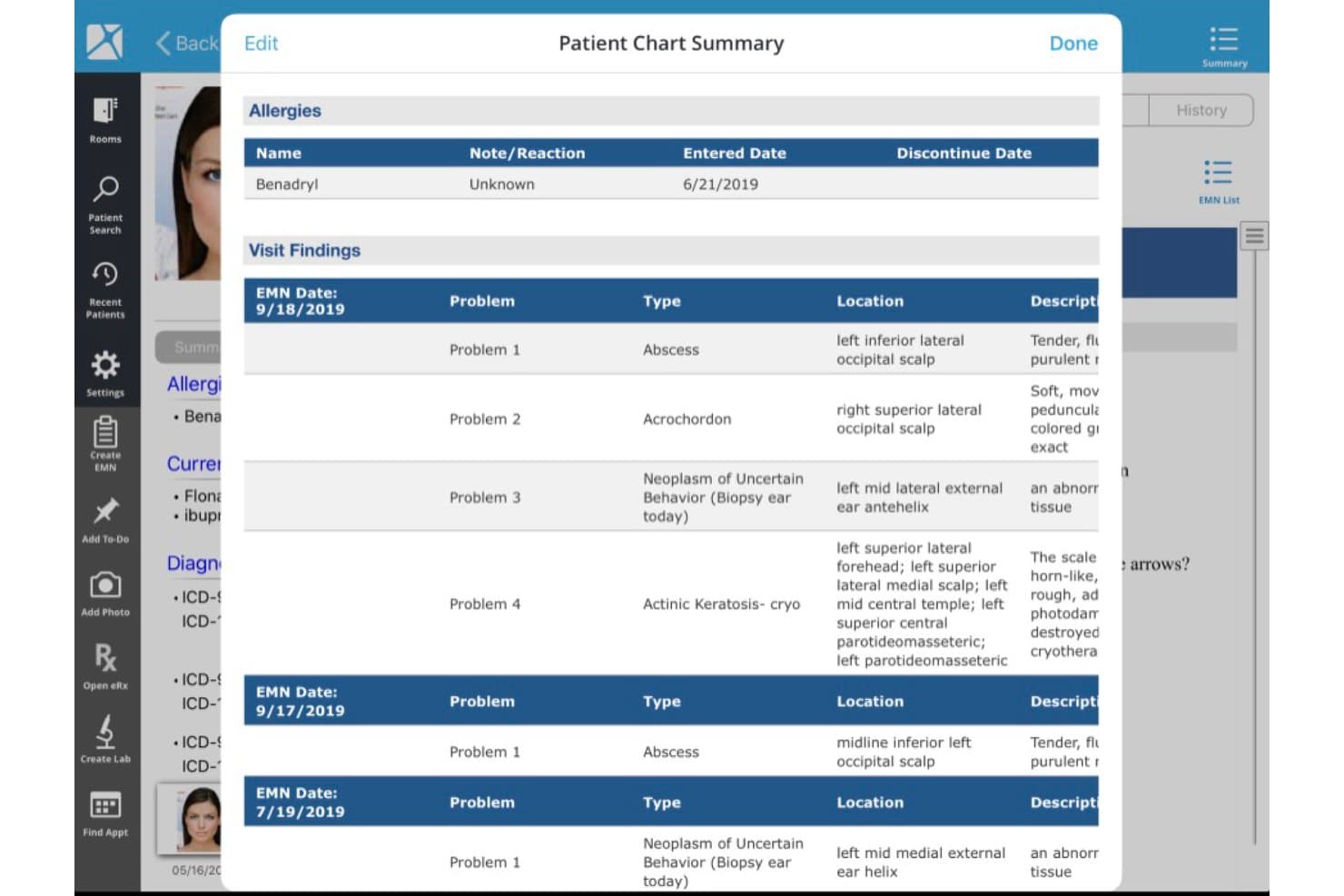
Nextech offers a Patient Chart Summary view that displays allergies, visit findings, problem types, locations, and descriptions across multiple EMN dates in a structured table format. Nextech is a cloud-based EHR and practice management platform built specifically for plastic surgery practices, combining customizable operative templates, integrated photo management, e-prescribing, and ASC billing in a single system.
Who Is Nextech Best For?
Nextech is a strong fit for plastic surgery practices and ASCs that need a specialty-specific clinical and billing system built around cosmetic and reconstructive workflows.
Why I Picked Nextech
I picked Nextech as one of the best because its plastic surgery EHR goes deeper than generic operative templates. The smart stamping tool lets me point-and-click directly onto anatomical diagrams to document injection sites and surgical markings, and the built-in photo management pulls before-and-after images directly into the chart. Scheduling ties directly to the patient record, so pre-op consults, procedure dates, and post-op follow-ups all live in one place.
Nextech Key Features
- Customizable surgical templates: Create specialty-driven documentation for a wide range of plastic surgery procedures.
- Integrated e-prescribing with EPCS: Manage pre-op and post-op prescriptions, including controlled substances, from within the EMR.
- Cloud-based access: Chart and review patient records securely from any web-enabled device at any location.
- ASC billing and membership management: Handle ambulatory surgery center claims, subscriptions, and payment plans directly in the platform.
Nextech Integrations
Nextech offers native integrations with Clearwave, DermoPRO, ConnectOnCall, Zocdoc, Affirm, Stripe, and TouchMD. It also supports integrations via its API and FHIR standards through the MyPatientVisit portal.
Pros and Cons
Pros:
- Fully integrated ASC and cosmetic billing workflows
- Built-in pre-op and post-op image management
- Plastic surgery-specific operative and charting tools
Cons:
- Less suitable for multi-specialty surgical practices
- Lacks intraoperative anesthesia and implant tracking
Learn more about Nextech: 2Best for enterprise surgical care
Epic
- Not available
- Pricing upon request
Visit WebsiteCustomer Rating:4.2/5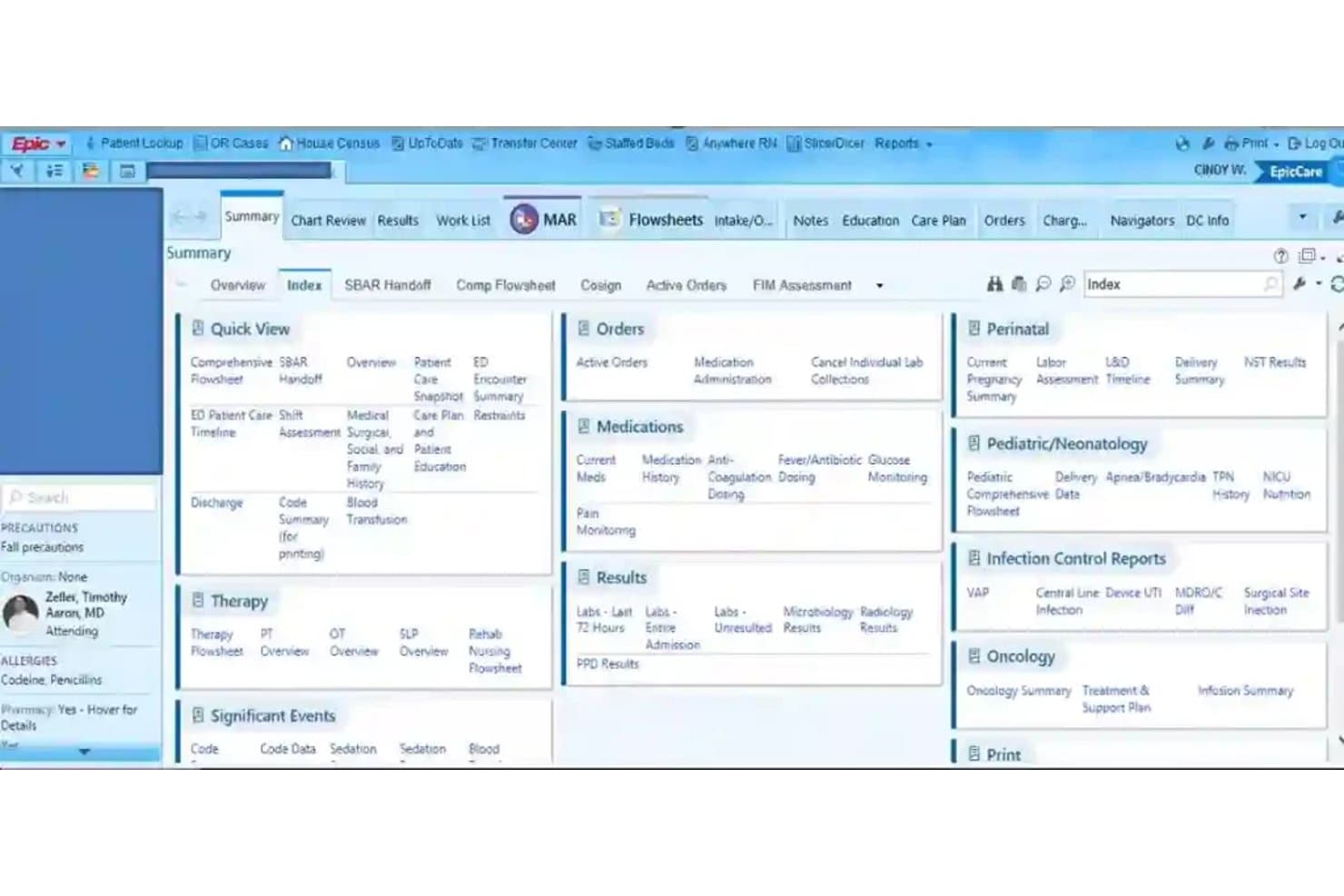
Epic offers a comprehensive patient summary dashboard with quick access to orders, medications, results, therapy, and infection control reports. Epic, delivered through CereCore's enterprise services, is a hospital-grade EHR platform covering perioperative documentation, OR scheduling, surgical coding, and revenue cycle management across inpatient and ambulatory surgical settings.
Who Is Epic Best For?
Epic is a strong fit for large hospital systems and integrated delivery networks managing surgical services across multiple facilities or care settings.
Why I Picked Epic
Epic earns its spot on my shortlist because no other EHR covers the full perioperative continuum at enterprise scale the way it does. OpTime handles OR/block scheduling, resource and staff assignment, and intra-operative documentation inside a single patient chart. I also like that surgical charge capture, CPT coding, and claims generation are all native to the platform, so surgical billing doesn't require a separate system.
Epic Key Features
- Anesthesia module: Lets you document anesthesia administration, capture vitals directly from monitors, and track time-stamped surgical events.
- Implant and supply tracking: Provides UDI-compliant implant logging and connects inventory changes directly to patient records.
- Surgical scheduling board: Offers visual OR block scheduling tools with support for staff, equipment, and turnover management.
- Interoperability tools: Supports HL7 and FHIR standards to connect with hospitals, labs, imaging, and referring providers.
Epic Integrations
Epic, as implemented by CereCore, supports integrations with systems like MEDITECH, Oracle Health (Cerner), and ServiceNow, and connects with third-party clinical applications through HL7 and FHIR standards. An API is available for custom integrations.
Pros and Cons
Pros:
- Native CPT-driven surgical charge capture and coding
- Supports large-scale multisite surgical coordination
- Offers end-to-end perioperative charting workflows
Cons:
- Designed primarily for hospital-based surgical settings
- Implementation timelines can be very lengthy
Learn more about Epic: Best for coordinating perioperative care
- Not available
- Pricing upon request
Visit WebsiteCustomer Rating:4/5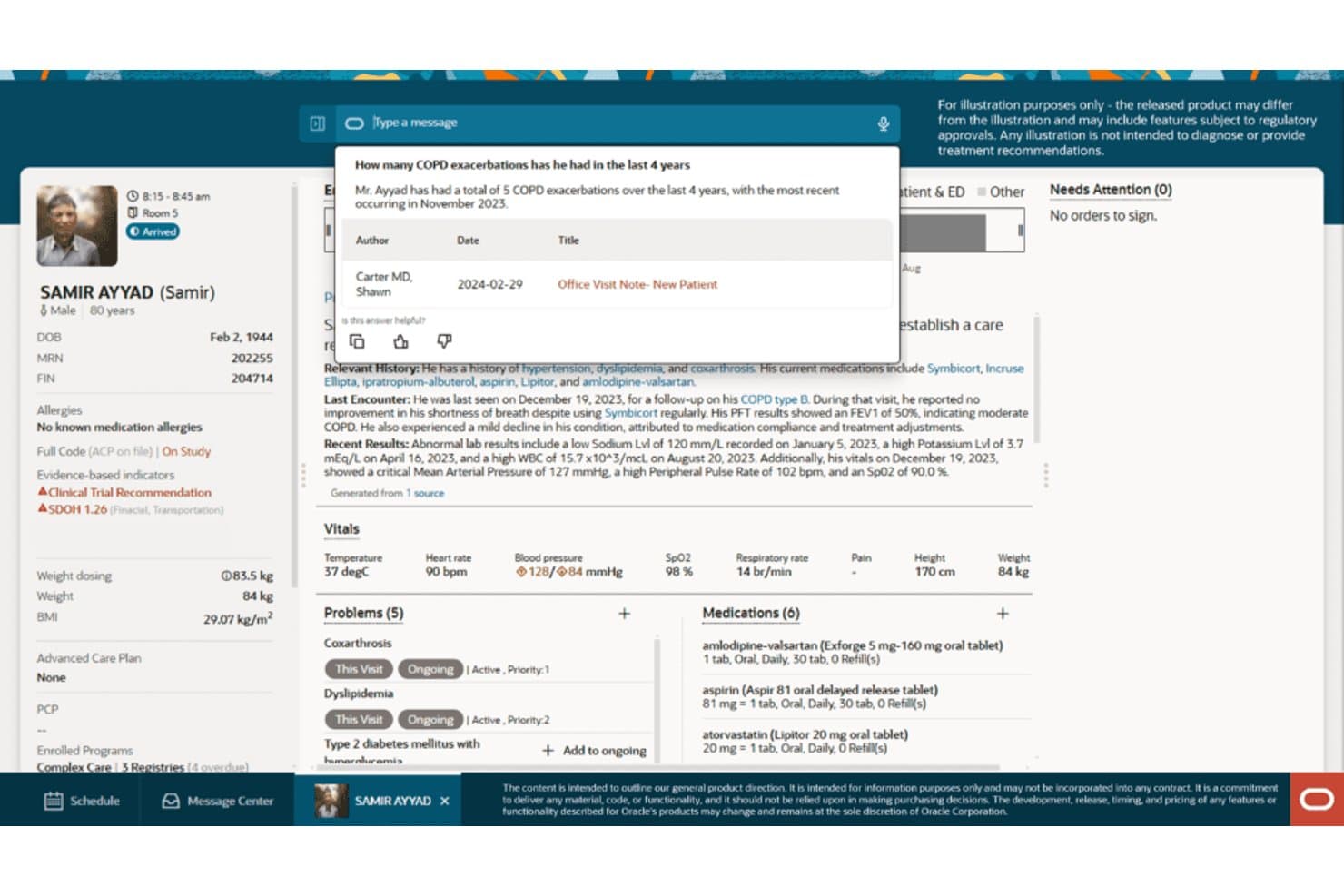
Oracle Health offers an AI-assisted patient summary interface that displays COPD exacerbation history, vitals, medications, and clinical notes within its EHR platform. Oracle Health is an enterprise EHR platform built for large health systems, covering perioperative documentation, anesthesia workflows, OR scheduling, surgical inventory management, and FHIR-based interoperability across the full surgical continuum.
Who Is Oracle Health Best For?
Oracle Health is a strong fit for large hospital systems and health networks that need a unified platform to manage surgical departments across multiple facilities.
Why I Picked Oracle Health
Oracle Health earns its spot on my shortlist because of how tightly it connects every phase of surgical care within one chart. I like that the Anesthesia module pulls device data and near real-time vitals directly into the EHR, keeping anesthesiologists and surgeons working from the same record. The built-in AORN Syntegrity documentation guidelines also mean surgical teams aren't manually building standardized perioperative workflows from scratch.
Oracle Health Key Features
- OR block scheduling board: Lets you assign rooms, equipment, and staff to cases with visual scheduling tools.
- Surgical inventory management: Tracks supply usage, device identifiers, and expiration alerts directly in the patient chart.
- HL7/FHIR-based interoperability: Connects with labs, imaging, anesthesia monitors, and referral networks for real-time data exchange.
- Customizable surgical note templates: Offers specialty-based documentation workflows for various procedures across multiple service lines.
Oracle Health Integrations
Oracle Health offers native integrations with Surescripts, Haemonetics BloodTrack, Oracle Cloud Infrastructure, and Multum Drug Database. It connects with medical devices such as infusion pumps and vital sign monitors, and provides FHIR and HL7 APIs for custom integrations.
Pros and Cons
Pros:
- Strong multi-facility OR scheduling coordination
- Advanced surgical inventory and implant tracking
- Comprehensive perioperative and anesthesia documentation
Cons:
- Limited fit for small or independent practices
- Configuration requires extensive professional services
Learn more about Oracle Health: Best for voice-enabled charting
- Free demo available
- Pricing upon request
Visit WebsiteCustomer Rating:3.9/5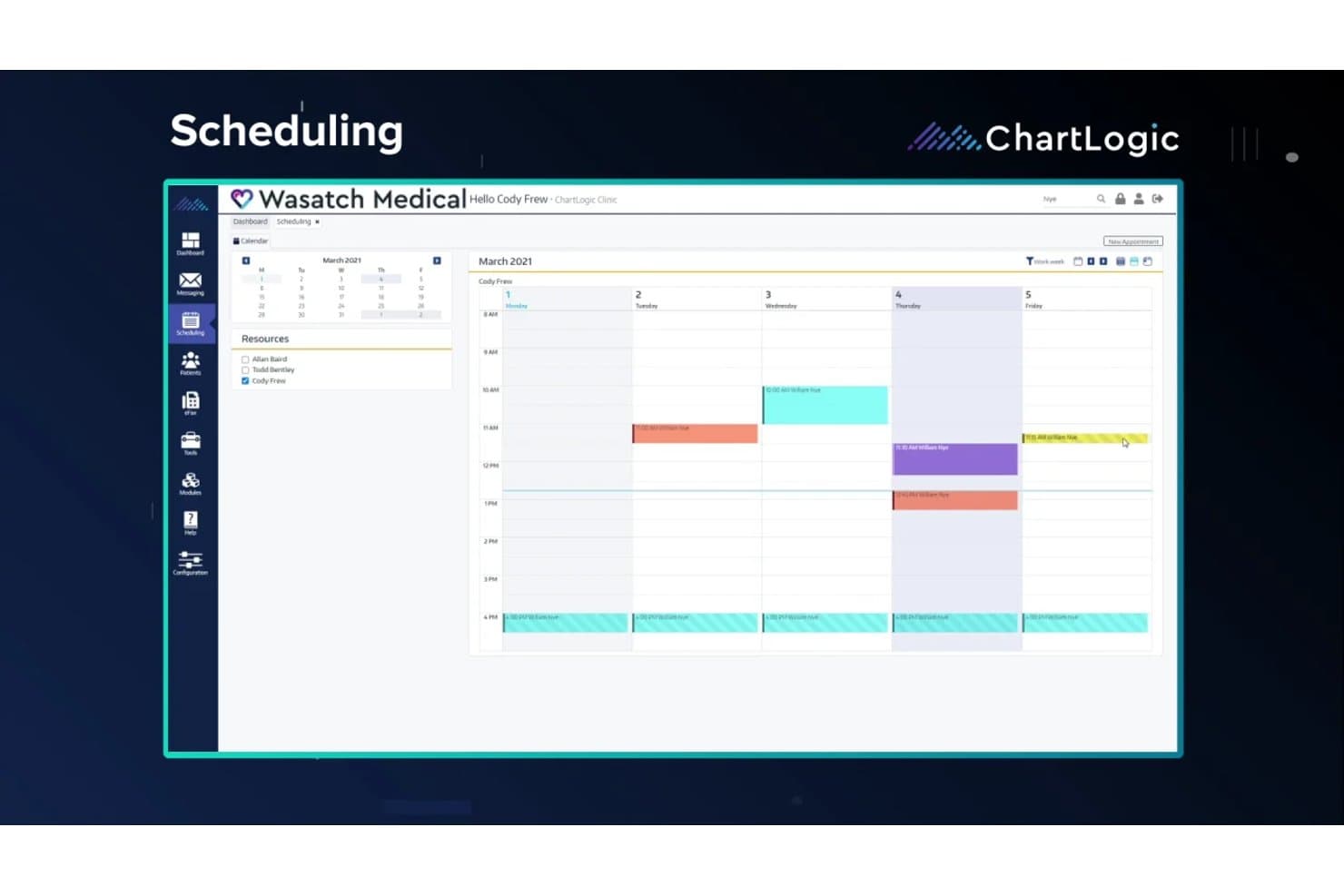
ChartLogic offers a weekly calendar scheduling view with color-coded appointments and resource filtering by provider. ChartLogic is an ambulatory EMR built for surgical specialties, combining voice-driven clinical documentation, customizable specialty templates, practice management, and integrated RCM into a single platform.
Who Is ChartLogic Best For?
ChartLogic is a strong fit for solo and small-to-mid-sized surgical practices where physicians handle their own documentation and need fast, voice-driven charting.
Why I Picked ChartLogic
I've included ChartLogic in my top picks because its PrecisionVoice technology goes beyond basic dictation. Surgeons can navigate the entire note, insert sub-templates, and enter data using voice commands alone, without touching a keyboard. That means a complete surgical note in under 90 seconds. ChartLogic also displays the entire patient note on a single screen, so there's no clicking through pop-ups or drop-downs mid-documentation.
ChartLogic Key Features
- Specialty-specific templates: Pre-built templates for general, orthopedic, podiatry, ophthalmology, and pain management surgery charting.
- Integrated practice management: Scheduling, billing, and reporting tools are unified within the EMR platform.
- Lab and imaging connectivity: Direct connections to national lab networks and radiology systems for fast data exchange.
- ONC-certified clinical compliance: Meets federal certification requirements and supports MIPS participation for value-based programs.
ChartLogic Integrations
ChartLogic offers native integrations with CGM LABDAQ, FlexScanMD, and Change Healthcare's Clinical Network for labs and radiology. An API is available for custom integrations.
Pros and Cons
Pros:
- ONC-certified with MIPS support
- Specialty templates for multiple surgical fields
- Voice-driven note creation for surgeons
Cons:
- Limited OR scheduling and resource management
- Weak perioperative workflow features
Learn more about ChartLogic: Best for configurable surgical workflows
- Free demo available
- Pricing upon request
Visit WebsiteCustomer Rating:3.7/5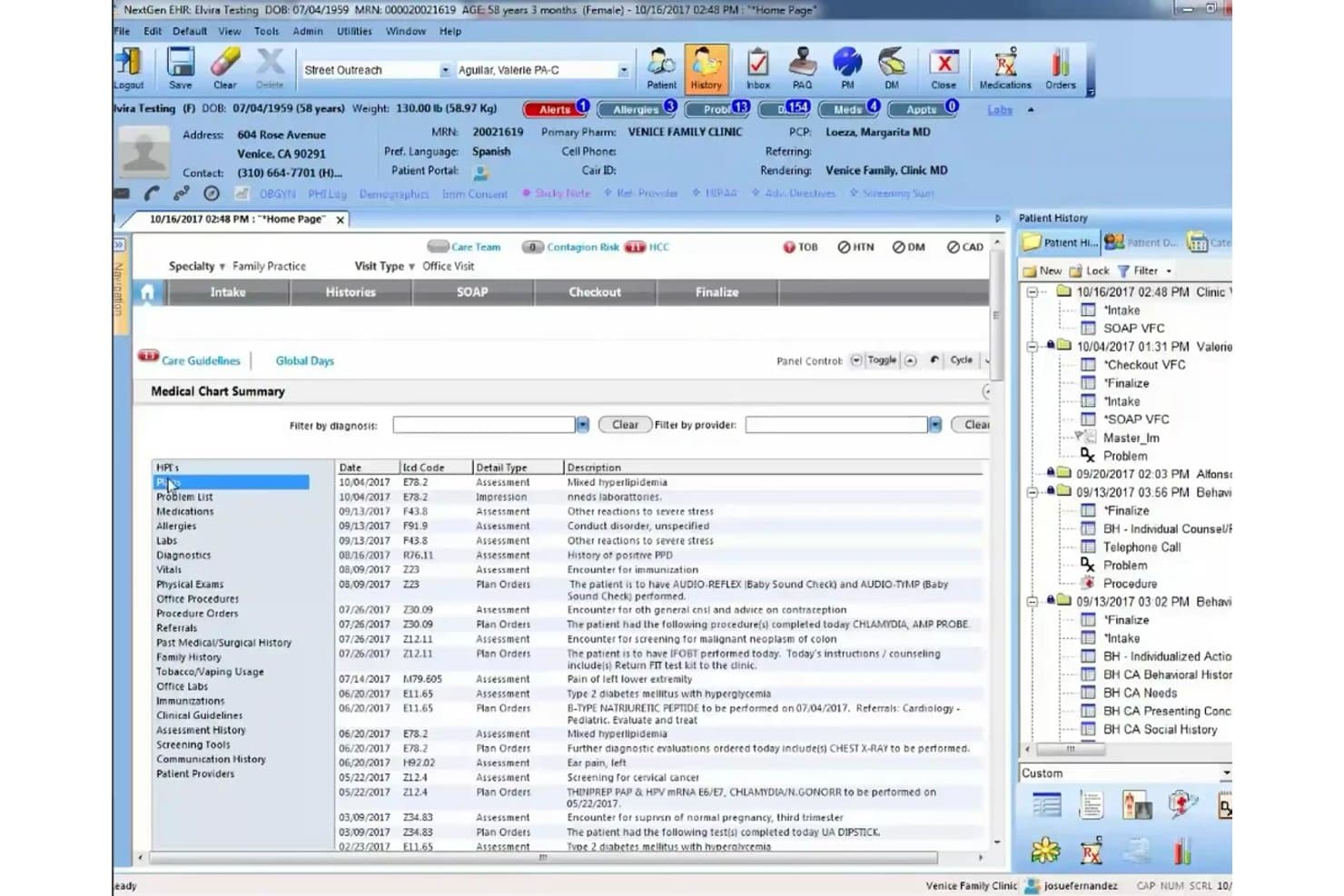
NextGen Healthcare offers a Medical Chart Summary view displaying patient history, diagnoses, ICD codes, and assessment details within its EHR interface. NextGen Healthcare is an ambulatory EHR platform built for surgical and specialty practices, combining specialty-specific clinical templates, surgical scheduling, charge capture, and HL7/FHIR interoperability in a single system.
Who Is NextGen Healthcare Best For?
It's a strong fit for ambulatory surgery centers and multi-provider surgical specialty practices that need configurable clinical workflows without a hospital-grade system.
Why I Picked NextGen Healthcare
I picked NextGen Healthcare as one of the best because of how deeply you can configure its surgical workflows without needing a hospital-grade system. I like that surgery scheduling is built directly into the clinical chart, so my team can link OR resources, staff assignments, and pre-op documentation in one place. The Ambient Assist AI also captures structured SOAP notes and suggests ICD-10 codes and charges on the fly, which cuts a lot of manual steps out of post-op documentation.
NextGen Healthcare Key Features
- Specialty-specific surgical templates: Provides orthopedic, plastic, ophthalmic, and multiple other surgical note layouts with CPT and procedure linking.
- Integrated e-prescribing with EPCS support: Allows electronic management of controlled substance prescriptions for surgical patients within the workflow.
- ONC-certified interoperability tools: Includes HL7 and FHIR connectivity to hospital systems, labs, imaging, and referring providers.
- Revenue cycle management integration: Supports charge capture, surgical coding with modifiers, and direct connection to PM and clearinghouse platforms.
NextGen Healthcare Integrations
NextGen Healthcare offers native integrations with Mirth Connect, Waystar, CoverMyMeds, InstaMed, HST Case Coordination, HST Price Transparency, and NextGen Share Diagnostic Hub for lab connectivity. An API is available for custom integrations.
Pros and Cons
Pros:
- Ambulatory and ASC workflows managed in one chart
- Embedded surgery scheduling links resources and documentation
- Highly configurable surgical templates for multiple specialties
Cons:
- Reported slower response times during peak hours
- Limited intraoperative nursing and anesthesia charting
Learn more about NextGen Healthcare: Best for specialty-specific surgical documentation
- Free demo available
- Pricing upon request
Visit WebsiteCustomer Rating:4.5/5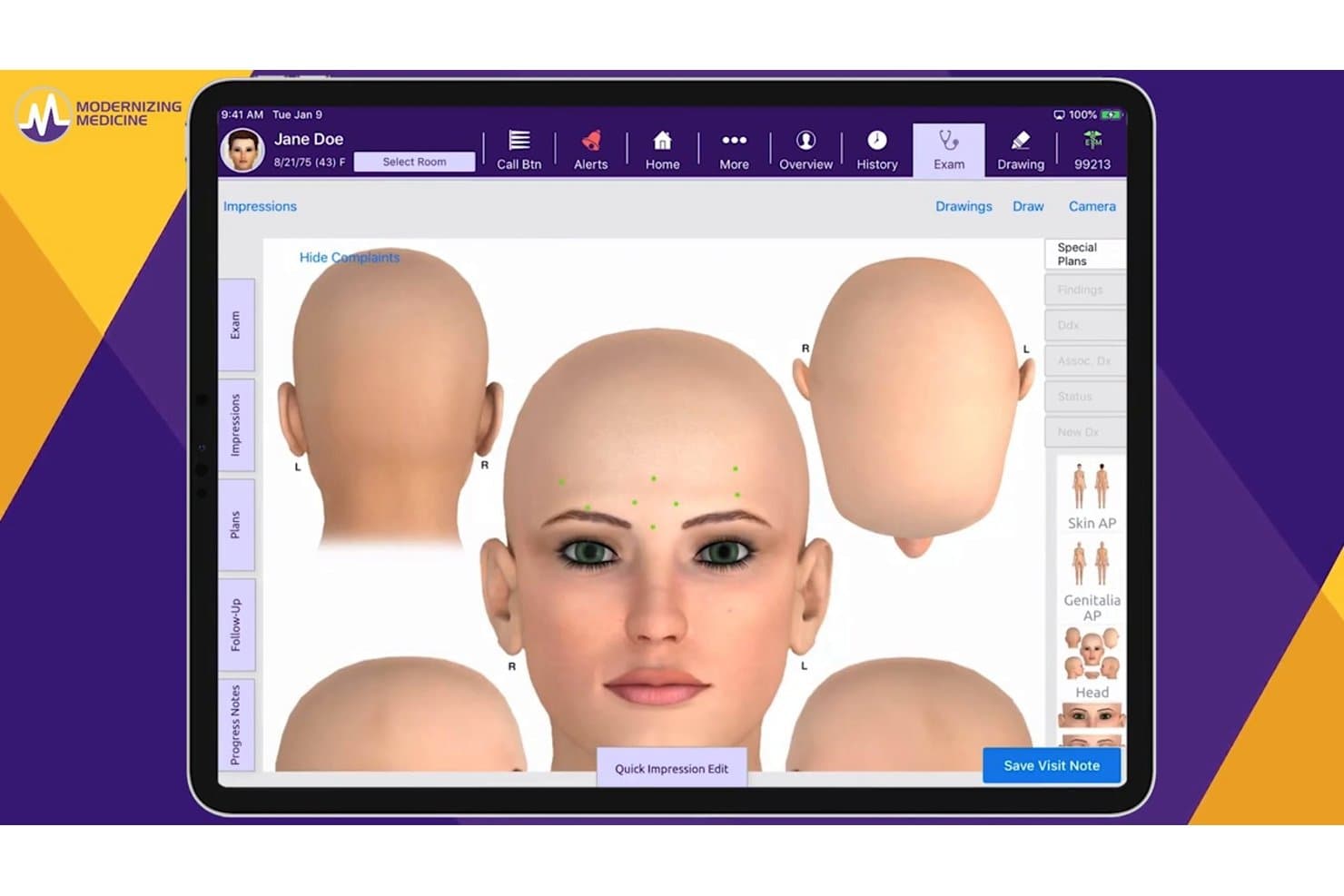
ModMed offers a 3D anatomical body diagram tool within its EHR platform, allowing providers to visually map patient complaints directly on a rendered head model during the exam. ModMed is a specialty-specific EHR platform that combines surgical documentation, perioperative charting, CPT-driven coding, e-prescribing, and practice management across multiple surgical disciplines.
Who Is ModMed Best For?
ModMed is a strong fit for specialty surgical practices and ambulatory surgery centers operating across disciplines like orthopedics, plastic surgery, ophthalmology, ENT, and urology.
Why I Picked ModMed
ModMed earns its spot on my shortlist because of how deeply it bakes surgical specialty into the documentation layer itself. The ModMed ASC module comes with built-in specialty-specific surgical narratives that nurses, anesthesiologists, and surgeons can complete simultaneously during a procedure. I also like the adaptive CPT coding engine, which learns each surgeon's documentation patterns and surfaces relevant codes and modifiers automatically.
ModMed Key Features
- Surgical scheduling board: Lets staff visually manage OR block scheduling with specific room, staff, and equipment assignments.
- Integrated anesthesia module: Captures real-time vitals and drug administration events directly from anesthesia workflows.
- UDI-compliant implant tracking: Tracks implants and supplies by barcode for each case, linking usage to patient records.
- Accreditation-ready reporting: Delivers built-in ASC certification, MIPS/MACRA, and CMS ASCQR quality reporting tools.
ModMed Integrations
ModMed offers native integrations with Surescripts, Klara, Relatient, TouchMD, and has a certified FHIR API for custom integrations. HL7 connectivity supports hospital, lab, and imaging system integrations.
Pros and Cons
Pros:
- Unified perioperative charting for entire surgical team
- Adaptive CPT coding engine learns physician style
- Specialty-driven surgical templates for multiple disciplines
Cons:
- No public pricing for quick evaluation
- ASC scheduling board lacks advanced multi-site features
Learn more about ModMed: Best for managing plastic surgery
- Free demo available
- Pricing upon request
Visit WebsiteCustomer Rating:3/5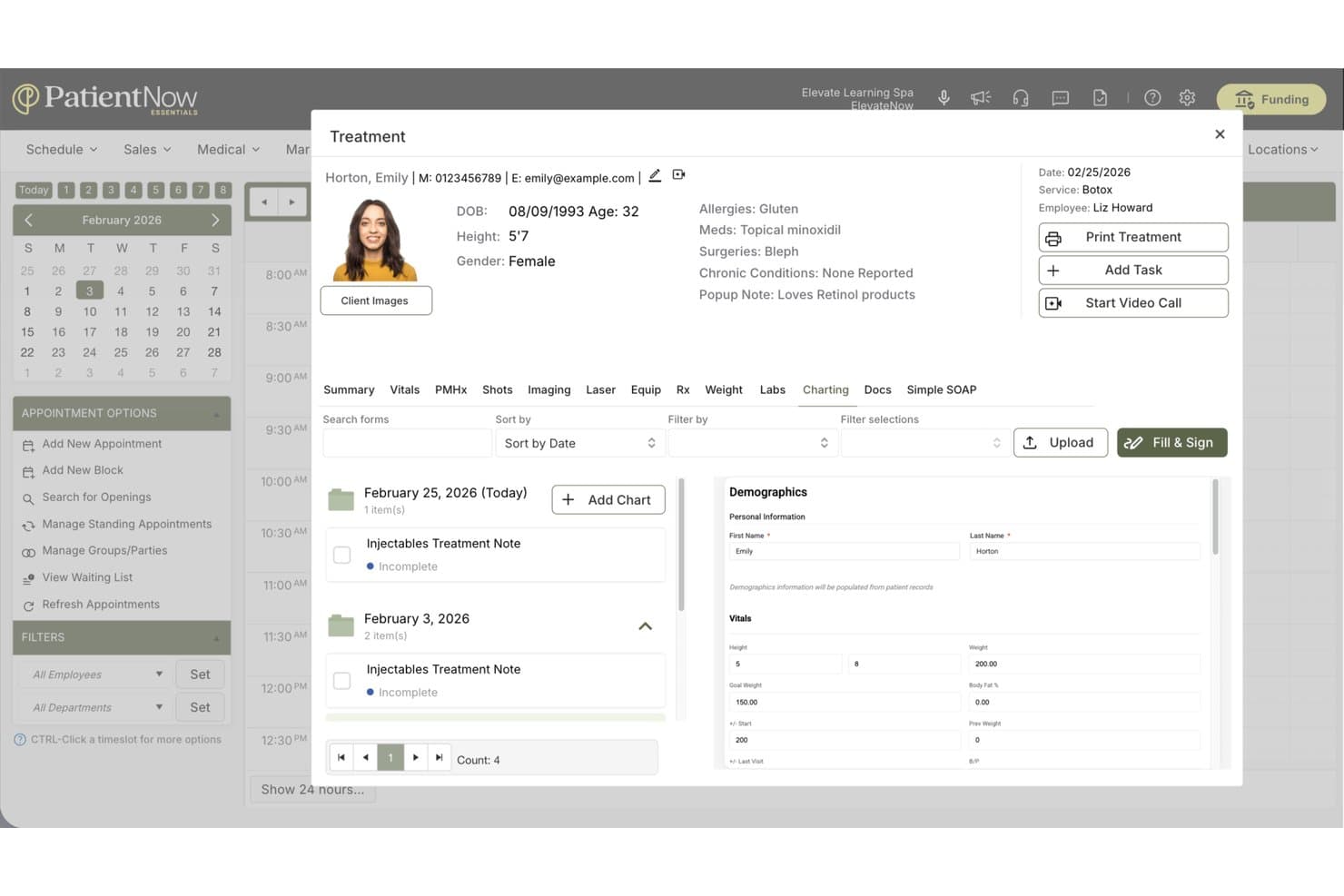
PatientNow offers a charting tab within its treatment modal, displaying patient demographics, vitals, and injectable treatment notes organized by date. PatientNow is an aesthetic and wellness EMR platform with clinical charting templates, AI-assisted documentation, digital intake, photo-based recordkeeping, ePrescribing, and practice management tools built specifically for plastic surgery and cash-pay practices.
Who Is PatientNow Best For?
PatientNow is a good fit for plastic surgeons and aesthetic practice owners running office-based, cash-pay practices who need specialty-specific charting tools.
Why I Picked PatientNow
I picked PatientNow as one of the best because its plastic surgery charting goes deeper than what you'd get from a general surgical EMR. The built-in RxPhoto module lets me annotate before-and-after photos directly inside the patient record, linking images to consents and treatment notes in a single chart. On top of that, the AI Scribe drafts structured visit notes from the same encounter, which I can review and sign without toggling between systems.
PatientNow Key Features
- Customizable surgical charting templates: Choose from specialty templates for injectables, surgery, weight loss, or wellness and adapt them to your workflow.
- Digital patient intake and consent capture: Deliver forms and consents by SMS or email and store completed files in the patient record automatically.
- Integrated ePrescribing and lab orders: Access 120+ e-prescribing and lab vendors directly within the patient chart for streamlined medication and order management.
- Practice management and scheduling tools: Centralize appointment booking, staff management, and payments in one platform built for office-based surgical practices.
PatientNow Integrations
PatientNow offers native integrations with QuickBooks Online, Optum for insurance processing, Swell Reputation Management, WooCommerce, Yext, and Tippy, and provides API access for custom integrations.
Pros and Cons
Pros:
- Digital intake forms and consent management
- Photo management for before-and-after documentation
- Specialty templates for aesthetic and plastic surgery
Cons:
- Limited intraoperative and anesthesia charting
- No ASC or hospital facility workflows
Learn more about PatientNow:
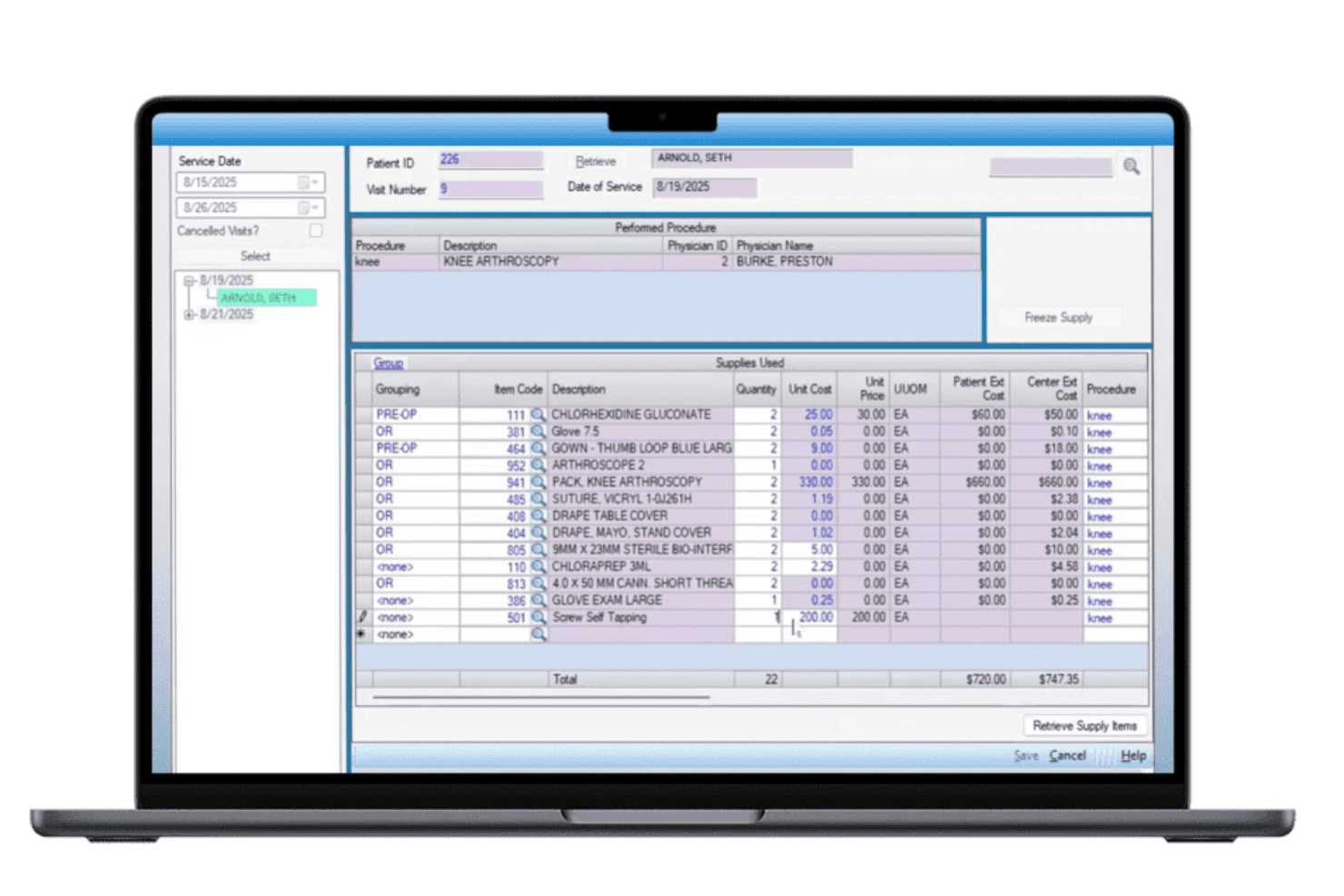
HST Pathways supports ASC claims, RCM, estimates, implant billing and contracts. HST Pathways is a cloud-based EMR and practice management platform built exclusively for ambulatory surgery centers, covering perioperative charting, OR scheduling, surgical billing, and patient engagement in a single suite.
Who Is HST Pathways Best For?
HST Pathways is a strong fit for ASC directors and administrators managing multi-specialty surgery centers who need scheduling, charting, and billing under one platform.
Why I Picked HST Pathways
HST Pathways earns its spot on my shortlist because the connection between Case Coordination and eChart is genuinely built for how surgery centers run cases. I like that block scheduling ties directly to the patient chart, so staff assignments, equipment needs, and clinical documentation all live in one place. LiveEdit™ lets multiple clinicians update the same chart simultaneously during a case, which cuts down on post-case documentation catch-up.
HST Pathways Key Features
- Tablet-optimized charting: Allows clinical staff to document perioperative care on mobile devices at the point of care.
- Patient estimates module: Generates automated, procedure-specific out-of-pocket estimates and integrates with eligibility verification tools.
- Raw ASC Data analytics: Provides customizable business intelligence dashboards for case costing, operational metrics, and clinical reporting.
- Integrated e-signature capture: Enables providers to collect patient and staff signatures on consents and chart entries directly within the EMR.
HST Pathways Integrations
HST Pathways offers native integrations with Waystar for revenue cycle and claims management, Advantien for implant purchasing and inventory, and supports HL7 interfaces with hospital and physician office EHR systems. An API is available for custom integrations.
Pros and Cons
Pros:
- OR scheduling links directly to patient charts
- Strong perioperative documentation with chart completion tracking
- Purpose-built for ambulatory surgery center workflows
Cons:
- Data feeds often flow one way only
- E-prescribing for controlled substances not included
Learn more about HST Pathways: Best for end-to-end surgery center management
- Free demo available
- Pricing upon request
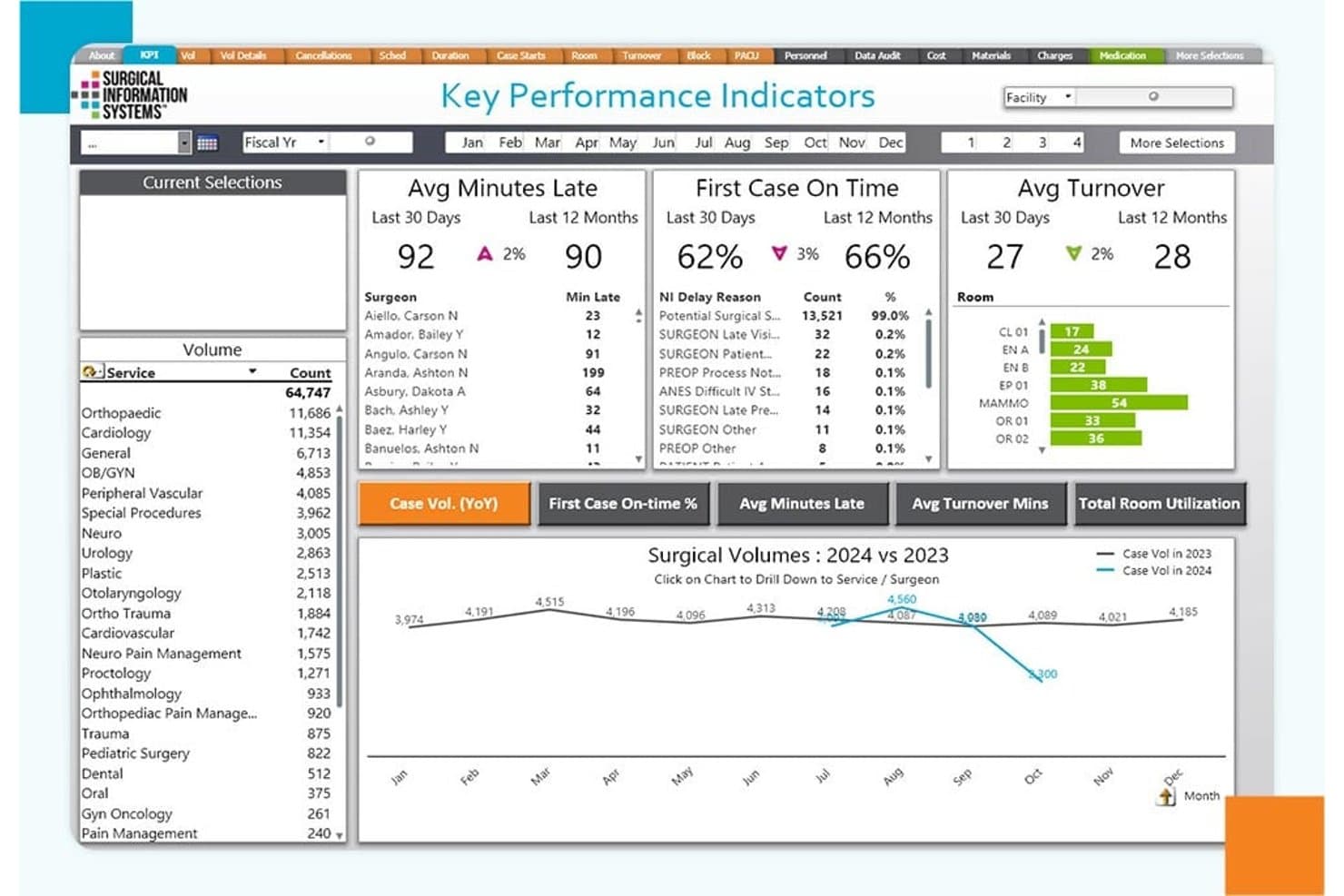
Surgical Information Systems (SIS) offers a robust Key Performance Indicators dashboard displaying surgical volumes, first case on-time rates, average turnover minutes, and minutes late metrics for surgery EMR analytics. SIS is a cloud-based perioperative EMR and ASC management platform built exclusively for surgical environments, combining clinical documentation, OR scheduling, anesthesia records, patient engagement, and revenue cycle management in one system.
Who Is Surgical Information Systems (SIS) Best For?
SIS is purpose-built for ambulatory surgery centers and surgical hospitals that need a single platform to manage both clinical and operational workflows.
Why I Picked Surgical Information Systems (SIS)
SIS earns its spot on my shortlist because it's built exclusively for the perioperative environment, unlike general ambulatory EMRs that treat surgery as an afterthought. I like how SIS Charts links electronic tracking boards across Preop, OR, Recovery, and Waiting Rooms into one unified patient chart. The built-in Revenue Cycle Services module, covering coding, claims, and transcription, means surgical teams manage the full case lifecycle without a separate billing vendor.
Surgical Information Systems (SIS) Key Features
- Anesthesia information management system: Captures anesthesia events, vitals, and drug administration directly from monitors during the case.
- Implant and inventory tracking: Records UDI-compliant implant usage and updates inventory with automatic reorder alerts.
- ONC-certified interoperability: Supports HL7 and FHIR connections for secure data exchange with hospitals, labs, and referring providers.
- Customizable specialty templates: Includes configurable documentation templates for various surgical specialties, pre-op, and post-op workflow.
Surgical Information Systems (SIS) Integrations
SIS offers native integrations with Surescripts for medication reconciliation, anesthesia monitoring devices, and over 130 third-party healthcare vendors. An API is available for custom integrations.
Pros and Cons
Pros:
- Supports procedure-level templates for multiple specialties
- Real-time anesthesia data capture and charting
- Built specifically for ambulatory surgery centers
Cons:
- Limited flexibility when using outside billing vendors
- Extensive configurations can prolong initial setup
Learn more about Surgical Information Systems (SIS): Best for cloud-based clinical documentation
- Free demo available
- Pricing upon request
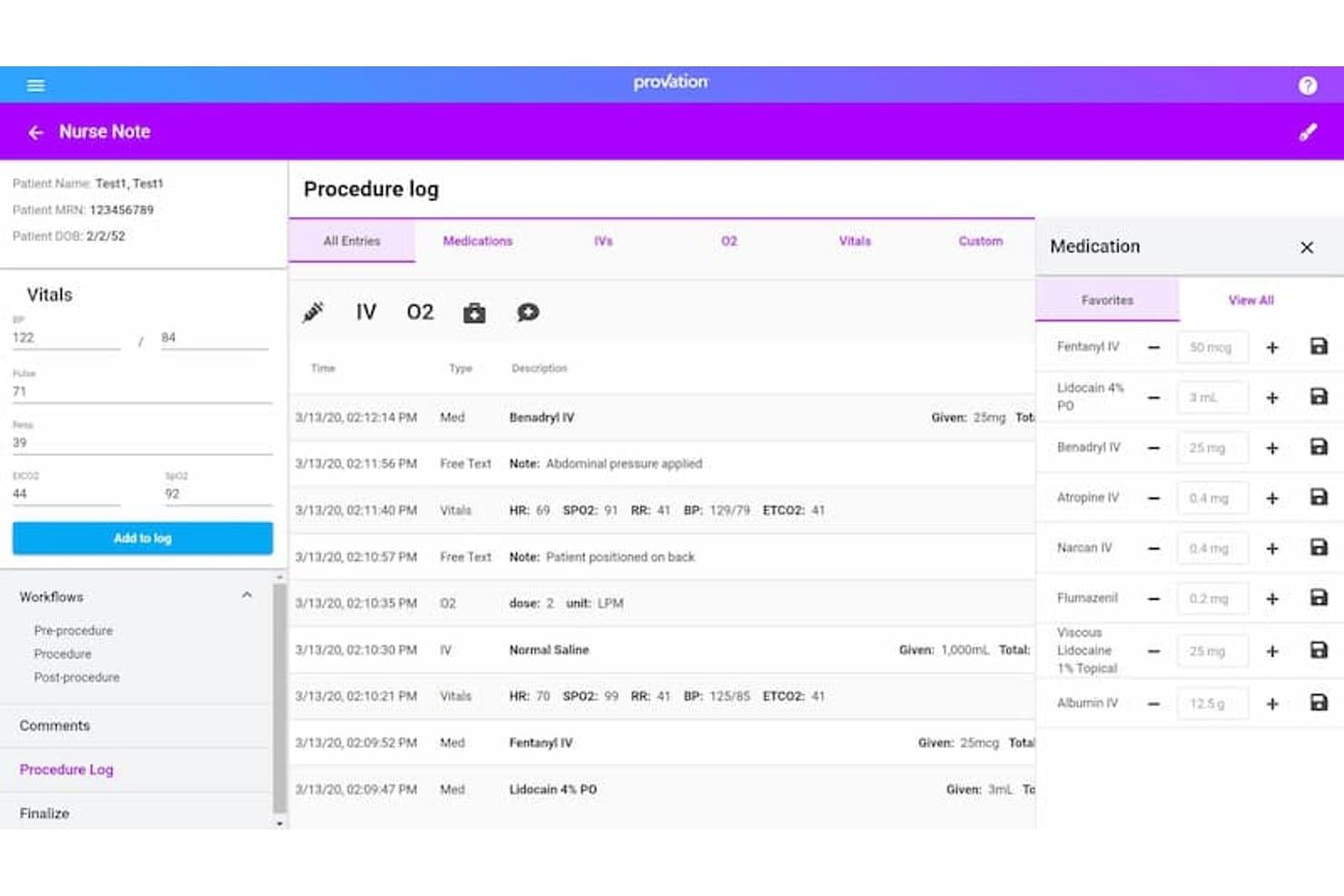
Provation Apex offers a detailed procedure log with a medication drawer showing drug names, dosages, and administration controls for surgical documentation. Provation Apex is a cloud-based ASC EMR built around structured procedure documentation, specialty-specific clinical templates, automated CPT/ICD-10 coding, and integrated physician, nursing, and anesthesia charting modules.
Who Is Provation Apex Best For?
Provation Apex is a strong fit for ambulatory surgery centers running GI, pulmonology, or orthopedic service lines that need structured, cloud-native procedure documentation.
Why I Picked Provation Apex
I've included Provation Apex in my top picks because of how it handles structured, cloud-native procedure documentation at the specialty level. Each specialty gets its own CPT-linked template set, so physicians document a colonoscopy or arthroscopic procedure with pre-populated diagnosis codes rather than free-text notes. The Provation Apex Data Suite, included at no extra cost, turns that structured documentation into reportable clinical data across the facility.
Provation Apex Key Features
- Anesthesia module: Captures real-time anesthesia events, drug doses, and vitals within its own charting interface.
- Nursing and patient charting: Allows nurses to document vitals, medications, and specimens directly into the electronic chart.
- Real-time patient tracking: Digital whiteboard displays patient status and room assignment updates as cases progress.
- EHR integrations: Connects with platforms like Epic, Cerner, and MEDITECH for data exchange between systems.
Provation Apex Integrations
Provation Apex offers native integrations with Epic, Cerner, MEDITECH, Oracle Health Ambulatory Suite, and supports HL7 and DICOM connectivity for data exchange with hospital and ASC systems.
Pros and Cons
Pros:
- Dedicated anesthesia charting module
- Real-time patient and room tracking
- CPT-linked templates for procedure documentation
Cons:
- Limited coverage for non-GI surgical specialties
- Lacks integrated e-prescribing functionality
Learn more about Provation Apex:
Other Surgery EMR Software
Here are some additional surgery EMR software options that didn’t make it onto my shortlist, but are still worth checking out:
- 11AdvancedMDBest for integrated scheduling and EHR tools
- 12SymplastBest for mobile-first plastic surgery
- 13OmniMDBest for customizable EHR and billing tools
- 14Praxis EMRBest for template-free surgical documentation
- 15EyeMD EMRBest for ophthalmology-specific charting
- 16Picis Experior SuiteBest for perioperative documentation
- 17Ambula EMRBest for cloud-based ambulatory surgery center
How I Evaluate Surgery EMR Software
I split my evaluation into core requirements—like perioperative workflow support and surgical coding—and differentiators that set one platform apart from another.
Core Functionality (Table Stakes For This List)
When I'm selecting tools for my list, I rank each one on a scale from 0 (does not offer the functionality) to 5 (excels in this area) for each core functionality listed below. Then, I calculate the tool's total score into a percentage. Each tool needs to achieve a minimum total score of 65% to be considered for inclusion.
- Surgical Documentation Templates: I look for procedure-specific templates across specialties like orthopedics, ophthalmology, and plastics—not just generic SOAP notes.
- Perioperative Workflow Support: The platform should link pre-op assessments, intra-op notes, and post-op documentation within one unified patient chart.
- Surgical Scheduling Integration: I check whether the tool supports OR/block scheduling with room, staff, and equipment assignments tied to the patient record.
- Surgical Coding & Billing: CPT/ICD-10 support with charge capture, modifier logic, and claims generation should be built in or tightly integrated with a PM system.
- E-Prescribing & EPCS: I evaluate whether the EMR handles controlled substance prescribing for post-op pain management alongside standard e-prescribing.
- ONC Certification & Interoperability: Each tool should be ONC-certified and support HL7/FHIR connections to hospitals, labs, imaging systems, and referring providers.
Once I have a list of tools that meet the criteria, I consider what sets each platform apart.
Differentiating Factors (What Sets Vendors Apart)
Here's how I compare and contrast different vendors:
Standout Features
Intraoperative charting with barcode scanning is a major differentiator. It lets your team capture implants and supplies in real time during a case, which reduces manual logging errors. I also look for a dedicated anesthesia module that pulls vitals directly from monitors and timestamps drug administration automatically. Implant and inventory tracking matters here too, especially for practices that need UDI-compliant logging tied to patient records with automatic stock updates and reorder alerts.
Beyond Features
Facility type fit matters a lot. A platform built for ASCs handles OR turnover and case volumes differently than one designed for hospital ORs or office-based suites. I also evaluate regulatory support, specifically whether the system includes built-in reporting for AAAHC, Joint Commission, or CMS ASC Quality Reporting requirements. Revenue cycle alignment is another key factor—I look for prior authorization workflows and case-costing analytics that help you track profitability by procedure and payer.
How to Choose Surgery EMR Software
It’s easy to get bogged down in long feature lists and complex pricing structures. To help you stay focused as you work through your unique software selection process, here’s a checklist of factors to keep in mind:
| Factor | What to Consider |
| Scalability | Will the platform support a growing case volume, new specialties, or expanded facilities in the coming years? |
| Integrations | Does the EMR connect with your practice management, billing, anesthesia monitors, labs, and imaging systems? |
| Customizability | Can you tailor workflows, templates, and schedules to suit your surgical specialties and documentation needs? |
| Ease of use | Will clinicians, nurses, and admin staff be able to adopt the system quickly? Are training resources included? |
| Implementation and onboarding | What does the onboarding timeline look like? Will you get migration help and ASC-specific training for your team? |
| Cost | Are there hidden costs for interfaces, support, or extra modules? Does the pricing model match your budget and caseload? |
| Security safeguards | How does the vendor handle HIPAA, user permissions, audit logs, and regular security patches? |
| Compliance requirements | Do you need support for ONC certification, MIPS/MACRA reporting, or ASC accreditation and quality metrics? |
What Are Surgery EMR Software?
Surgery EMR software are digital solutions designed to document, manage, and coordinate the clinical and administrative workflows for surgical care. These systems support pre-op, intra-op, and post-op documentation, surgical scheduling, billing, and compliance requirements. They unify patient charts, streamline perioperative tasks, and help surgical practices maintain regulatory standards across a range of specialties and facility types.
Features of Surgery EMR Software
When selecting surgery EMR software, keep an eye out for the following key features:
- Surgical documentation templates: Pre-built, specialty-specific templates for pre-op, intra-op, and post-op notes let your team capture vital details efficiently and consistently.
- Perioperative workflow management: End-to-end workflows link assessments, operative reports, and post-op care in a single record, reducing information gaps and duplicative entry.
- OR and resource scheduling: Calendar and resource management tools coordinate procedure times, staff, equipment, and room usage, helping prevent scheduling conflicts and bottlenecks.
- E-prescribing with EPCS: Allows clinicians to prescribe medications—including controlled substances—electronically, meeting compliance requirements and improving patient safety.
- Integrated surgical billing: Automated CPT/ICD-10 coding, charge capture, and claims workflows help capture revenue accurately and minimize denials or delays.
- Implant and inventory tracking: Barcode-based logging ties every supply or implant to the case, updating inventory in real-time and supporting regulatory compliance.
- Anesthesia record module: Dedicated anesthesia documentation captures vitals, medications, and events directly from connected monitors, ensuring accuracy and completeness.
- Patient portal: Provides patients with access to instructions, forms, and updates before and after procedures, improving engagement and satisfaction.
- Interoperability and integrations: Supports HL7 or FHIR connections with hospital systems, labs, imaging, and billing, so data moves smoothly between every part of the surgical care team.
- Regulatory compliance tools: Features and reporting built for HIPAA, ONC, and ASC accreditation keep your practice prepared for audits and quality measurements.
Common Surgery EMR Software AI Features
Beyond the standard surgery EMR software features listed above, many of these solutions are incorporating AI with features like:
- Automated operative note generation: AI analyzes intraoperative data and voice dictation to draft detailed operative notes, saving time and reducing documentation errors.
- Predictive scheduling optimization: AI reviews historical case durations and resource usage to suggest optimal OR block assignments and minimize delays or turnover gaps.
- Intelligent coding assistance: AI scans documentation to recommend CPT and ICD-10 codes, flagging missing details and helping ensure accurate, compliant billing.
- Clinical decision support: AI surfaces alerts for drug interactions, allergy risks, or guideline-based care gaps during surgical planning and post-op management.
- Anomaly detection in vitals: AI monitors real-time anesthesia and patient vitals, alerting staff to trends or deviations that may require immediate intervention.
Benefits of Surgery EMR Software
Implementing surgery EMR software provides several benefits for your team and your business. Here are a few you can look forward to:
- Streamlined surgical workflows: Unified documentation and perioperative management reduce duplicative data entry and improve team coordination.
- Improved scheduling efficiency: Integrated OR and resource scheduling tools help minimize conflicts and support optimal room turnover.
- Greater billing accuracy: Automated coding, charge capture, and claims support reduce errors and shorten revenue cycles.
- Enhanced compliance readiness: Built-in regulatory reporting and audit trails keep your practice aligned with HIPAA, ONC, and ASC standards.
- Better patient safety: Features like e-prescribing with EPCS and real-time vitals monitoring support safer care at every surgical stage.
- Increased patient engagement: Patient portals and communication tools keep individuals informed before and after their procedures.
- Detailed inventory control: Barcode tracking for supplies and implants ties utilization to cases and supports automatic reorder alerts.
Costs and Pricing of Surgery EMR Software
Selecting surgery EMR software requires an understanding of the various pricing models and plans available. Costs vary based on features, team size, add-ons, and more. The table below summarizes common plans, their average prices, and typical features included in surgery EMR software solutions:
Plan Comparison Table for Surgery EMR Software
| Plan Type | Average Price | Common Features |
| Free Plan | $0 | Limited charting tools, basic scheduling, basic support, and minimal reporting. |
| Personal Plan | $100-$300/user/month | Core clinical documentation, scheduling, e-prescribing, email support, and limited integrations. |
| Business Plan | $350-$800/user/month | Full charting, perioperative workflows, inventory tracking, custom templates, integration options, and analytics. |
| Enterprise Plan | $900+/user/month | Multi-site deployment, advanced integrations, customizations, dedicated account management, and compliance tools. |
Surgery EMR Software FAQs
Here are some answers to common questions about surgery EMR software:
How is surgery EMR software different from general EMR systems?
Surgery EMR software is purpose-built for perioperative care, offering dedicated modules for pre-op, intra-op, and post-op workflows, surgical scheduling, and implant tracking. General EMRs often lack these specialized tools and templates required by surgical teams.
What integrations should I prioritize with a surgery EMR?
You should look for integrations with practice management systems, billing/RCM vendors, anesthesia monitors, PACS for imaging, and labs. These connections reduce duplicate entry, ensure accurate surgical documentation, and support a more unified patient record.
Is it hard to migrate existing surgical records into a new EMR?
No, most vendors offer data migration services, including converting legacy operative notes, patient files, and implant logs. Clear data mapping and specialist onboarding help ensure a smooth transition with minimal disruption to surgical operations.
Can surgery EMR software help with regulatory compliance?
Yes, most solutions include features for HIPAA security, ONC certification, ASC accreditation reporting, and MIPS/MACRA dashboards. These tools help practices stay on top of changing compliance requirements and prepare for audits.
How long does implementation typically take?
Implementation can range from a few weeks to several months, depending on your OR size, whether you use custom templates, and if you require complex integrations. Planning for training and data migration helps keep your go-live on track.