

A psychiatry EHR is an electronic health record platform designed for the unique needs of psychiatric care—helping you document, manage, and bill for mental health services with accuracy. If you’re searching for the best psychiatry EHR, you’re likely navigating documentation requirements, privacy safeguards, and the need for flexible charting and prescribing.
This guide breaks down where today’s top psychiatry EHRs fit, key features to watch for, and the unique strengths of each option so you can invest confidently and keep both your practice and your patients supported.
Why Trust Our Software Recommendations
6,700+
Reviews
20
Industry experts
16+
Evaluation factors
14
Years
Our team has been testing and reviewing software since 2012. As medical practice leaders ourselves, we know how difficult—and important—it is to choose the right software.
For this guide, we evaluated tools using hands-on testing and independent research, scoring tools using our selection criteria.
Our reviews reflect our human editorial judgment, not a sales pitch.
Psychiatry EHR Comparison Table
The table below compares pricing details for my top psychiatry EHR selections.
| Tool | Best For | Trial Info | Price | ||
|---|---|---|---|---|---|
| 1 | Best for addiction treatment workflows | Free demo available | Pricing upon request | Website | |
| 2 | Best for enterprise behavioral health | Free demo available | Pricing upon request | Website | |
| 3 | Best for addiction treatment programs | Free plan available | Pricing upon request | Website | |
| 4 | Best for independent psychiatry practices | Free demo available | Pricing upon request | Website | |
| 5 | Best for mobile psychiatry charting | Free demo available | Pricing upon request | Website | |
| 6 | Best for solo psychiatry practices | 30-day free trial | From $49/month | Website | |
| 7 | Best for therapy notes and billing | 30-day free trial | From $69/month | Website | |
| 8 | Best for interventional psychiatry | Free demo available | From $249/month | Website | |
| 9 | Best for behavioral health workflows | Free demo available | Pricing upon request | Website | |
| 10 | Best for psychiatry-specific charting | 30-day free trial | From $55/month | Website |


Best Psychiatry EHR Reviews
Below are my detailed summaries of the best psychiatry EHR that made it onto my shortlist. My reviews offer a detailed look at the features, best use cases, and pricing of each platform to help you find the best one for you.
 1Best for addiction treatment workflows
Kipu
- Free demo available
- Pricing upon request
Visit WebsiteCustomer Rating:4.7/5
Kipu offers an Executive Dashboard with real-time census, occupancy, admissions, and clinical metrics for psychiatric facility management. Kipu is a behavioral health EHR built for addiction treatment and dual-diagnosis programs, combining clinical documentation, medication management, integrated billing, telehealth, and outcomes tracking in a single platform.
Who Is Kipu Best For?
Kipu is a strong fit for group behavioral health clinics, residential treatment centers, and dual-diagnosis programs that need a facility-scale EHR.
Why I Picked Kipu
I picked Kipu as one of the best because its MAT workflow tools are genuinely built for addiction psychiatry. The medication management module covers Suboxone, Methadone, and Sublocade prescribing with built-in diversion control and patient call-back tracking, which I haven't seen handled this specifically in other EHRs. KIP AI also automatically generates progress notes from session transcriptions, cutting the documentation burden on clinicians running high-volume SUD programs.
Kipu Key Features
- Outcomes library: Includes PHQ-9, GAD-7, BAM, DASS-21, and other standardized screening tools for tracking symptom trends.
- Integrated telehealth: HIPAA-compliant video visits are accessible directly from the patient portal for seamless remote care.
- Automated benefits verification: Instant insurance eligibility checks are built into the admissions and intake workflow.
- Scheduler with waitlist management: Supports staff scheduling, automated reminders, waitlists, and configurable appointment types.
Kipu Integrations
Kipu offers marketplace integrations through the Kipu Consolidated Integrations platform, connecting with tools like Recovery.com, R1 Learning, Huml Health, Further, Braided, and AveaOffice. An API is available for custom integrations.
Pros and Cons
Pros:
- HiTRUST-certified with 42 CFR Part 2 compliance
- KIP AI auto-generates progress notes from sessions
- Built-in MAT workflows for SUD prescribing
Cons:
- Not suited for solo psychiatry practices
- Complex treatment plan tool frustrates clinical users
Learn more about Kipu: Best for enterprise behavioral health
- Free demo available
- Pricing upon request
Visit WebsiteCustomer Rating:4.4/5
Qualifacts CareLogic offers a comprehensive client dashboard displaying patient demographics, diagnosis, treatment plans, payer information, and scheduled appointments for psychiatric care management. Qualifacts CareLogic is an enterprise behavioral health EHR that combines configurable clinical documentation, e-prescribing with EPCS, behavioral health billing, scheduling, telepsychiatry, and outcomes tracking in a single platform.
Who Is Qualifacts CareLogic Best For?
It's a strong fit for multi-location behavioral health agencies and large group psychiatric practices that need configurable workflows and state reporting compliance.
Why I Picked Qualifacts CareLogic
CareLogic earns its spot on my shortlist because it's built for the compliance complexity that large behavioral health organizations face. I particularly like how it handles 42 CFR Part 2 alongside HIPAA, which matters for psychiatric practices treating patients with co-occurring substance use disorders. The configurable documentation system lets clinical teams build MSE templates, treatment plans, and outcome tracking using PHQ-9 and GAD-7 without relying on IT support.
Qualifacts CareLogic Key Features
- Customizable clinical forms: Teams can tailor psychiatric intake, progress, and discharge notes to specific workflows.
- Patient portal with screening tools: Clients complete PHQ-9, GAD-7, and C-SSRS scales before appointments for easy tracking.
- Multi-provider scheduling: Coordinate recurring psychiatric sessions and med-checks for large clinical teams.
- Secure messaging: Providers and clients exchange HIPAA-compliant messages through the online portal.
Qualifacts CareLogic Integrations
Qualifacts CareLogic offers native integrations with DrFirst Rcopia for e-prescribing, OnCall Health for telehealth, and connects to labs, HIEs, and third-party behavioral health solutions. An API is available for custom integrations.
Pros and Cons
Pros:
- Built-in PHQ-9, GAD-7, and C-SSRS tracking
- Configurable MSE and treatment plan templates
- Handles 42 CFR Part 2 SUD compliance
Cons:
- Interface feels dated compared to newer EHRs
- Implementation can take up to 18 months
Learn more about Qualifacts CareLogic: Best for addiction treatment programs
- Free plan available
- Pricing upon request
Visit WebsiteCustomer Rating:4.8/5
Opus EHR offers a home dashboard with patient counts, monthly admissions chart, and a recent documents table showing treatment plans and session notes. Opus EHR is a cloud-based EHR, CRM, and RCM platform built specifically for behavioral health and psychiatry group practices, combining clinical documentation, e-prescribing with EPCS, telehealth, and integrated billing in one system.
Who Is Opus EHR Best For?
Opus EHR is a strong fit for group behavioral health practices and multi-provider treatment facilities running teams of five or more clinicians.
Why I Picked Opus EHR
I picked Opus EHR as one of the best because it's purpose-built for behavioral health from the ground up, not adapted from a general medical EHR. I particularly like the Copilot AI Scribe, which auto-drafts progress notes from both telehealth and in-person sessions without leaving the platform. The built-in EPCS e-prescribing, with drug interaction checking and cross-team medication history, is genuinely useful for psychiatry teams prescribing controlled substances across multiple providers.
Opus EHR Key Features
- Customizable assessment library: Choose from over 100 psychiatric and behavioral health assessment templates to fit various clinical workflows.
- Integrated lab ordering: Order lab tests and receive results directly within patient charts, eliminating the need for separate systems.
- Patient outcomes measurement tool: Track treatment progress and outcomes with built-in standardized scales and analytics.
- Multi-provider scheduling: Manage appointments for large clinical teams, including recurring therapy and med-check visits.
Opus EHR Integrations
Opus EHR offers native integrations with PracticeSuite for billing, Collect Rx for revenue cycle management, and supports lab integration for electronic lab ordering and results. An API is available for custom integrations.
Pros and Cons
Pros:
- Structured 90-day onboarding with dedicated support team
- 100+ customizable clinical assessment templates
- Built specifically for behavioral health, not adapted
Cons:
- Some workflows require multiple steps across screens
- Mobile access is difficult and not fully functional
Learn more about Opus EHR: Best for independent psychiatry practices
- Free demo available
- Pricing upon request
Visit WebsiteCustomer Rating:3.9/5
Tebra offers an integrated e-prescribing workflow that allows providers to send and refill prescriptions with real-time formulary benefits directly from the dashboard. Tebra is an all-in-one EHR platform built exclusively for independent practices, combining psychiatric documentation, integrated EPCS and PDMP e-prescribing, behavioral health billing, telehealth, and patient scheduling in a single system.
Who Is Tebra Best For?
Tebra is a strong fit for solo and small-group psychiatrists or PMHNPs who handle their own billing and want one platform instead of separate EHR, billing, and scheduling tools.
Why I Picked Tebra
Tebra earns its spot on my shortlist because it's purpose-built for independent psychiatry practices, not retrofitted from a general EHR. I particularly like that EPCS and PDMP monitoring are bundled natively into the platform, so prescribing controlled substances doesn't require a separate vendor or a bolt-on workflow. The AI Note Assist also captures MSE and risk assessment details in real time during a session, cutting note-taking time by up to 50% for psychiatrists running back-to-back appointments.
Tebra Key Features
- Integrated telehealth: Built-in HIPAA-compliant video visits let you provide care without switching platforms.
- Customizable mental health templates: Use templates designed for psychiatric intakes, MSEs, and progress notes that fit your workflow.
- Automated patient appointment reminders: Reduce no-shows with text, email, and phone reminders sent directly from the scheduling system.
- Patient portal with digital intake: Patients can complete intake forms and screening tools online before their visit.
Tebra Integrations
Tebra offers native integrations with First Databank, Appriss Health for PDMP checks, and Google Business Profile. An API is available for custom integrations.
Pros and Cons
Pros:
- Telehealth syncs directly to encounter notes
- AI Note Assist reduces documentation time
- EPCS and PDMP bundled natively
Cons:
- ERA support frustrates behavioral health billers
- Note templates are rigid and limited
Learn more about Tebra: Best for mobile psychiatry charting
- Free demo available
- Pricing upon request
Visit WebsiteCustomer Rating:3.9/5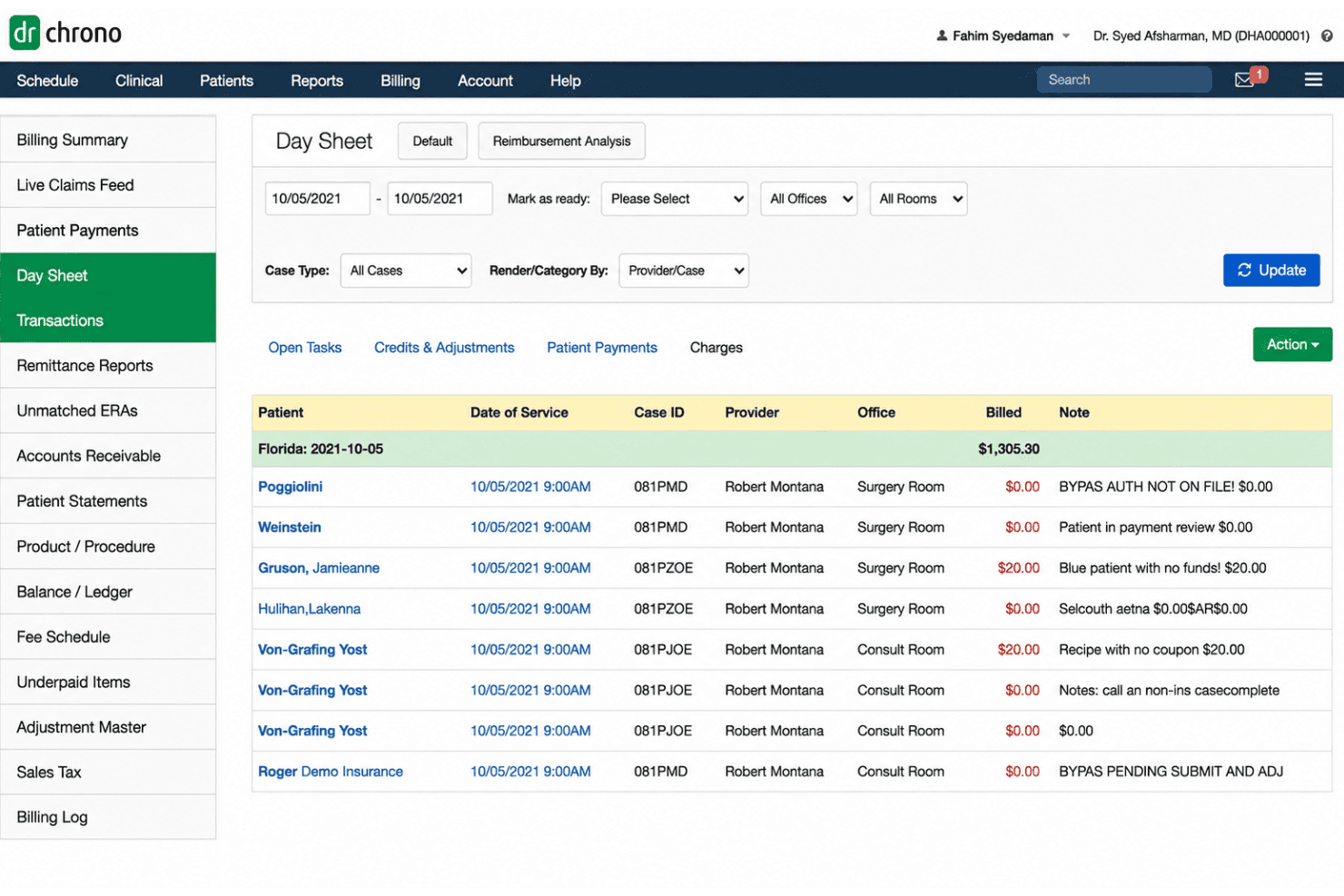
DrChrono processes claims, eligibility, ERA/EOB posting, denials, and billing. DrChrono is a cloud-based EHR built for independent and group practices, combining mobile-first psychiatric charting, EPCS e-prescribing, behavioral health billing, and integrated telepsychiatry in a single platform.
Who Is DrChrono Best For?
DrChrono is a strong fit for solo psychiatrists and small-to-mid-size behavioral health practices that rely heavily on iPad or iPhone-based workflows.
Why I Picked DrChrono
DrChrono earns its spot on my shortlist because no other psychiatry EHR matches its iOS-native charting experience. I can complete a full psychiatric note on an iPad using speech-to-text, pre-programmed macro buttons that drop in entire clinical phrases, and pre-built behavioral health forms including the PHQ-9. I've also found the EPCS functionality genuinely useful, letting me prescribe controlled substances directly from an iPhone without switching devices or systems.
DrChrono Key Features
- Real-time insurance eligibility checks: Instantly verify patient benefits and coverage status before every appointment.
- Integrated telehealth video visits: Schedule and launch secure, HIPAA-compliant video sessions from within the EHR platform.
- Configurable billing profiles: Set up behavioral health-specific billing codes and modifiers that auto-populate claim forms.
- Patient portal with intake forms: Patients can complete psychiatric screening tools, update information, and message securely through a digital portal.
DrChrono Integrations
DrChrono offers native integrations with Quest Diagnostics, LabCorp, and Surescripts, and provides a Healthcare App Directory for selecting additional apps. An API is available for custom integrations.
Pros and Cons
Pros:
- Pre-built behavioral health billing profiles
- Built-in EPCS for controlled substances
- Runs natively on iPhone and iPad
Cons:
- Long-term contracts with limited flexibility
- Slow customer support response times reported
Learn more about DrChrono:

SimplePractice offers an ePrescribe access management modal where admins can add or manage prescribing permissions for individual clinicians. SimplePractice is a cloud-based EHR and practice management platform for mental health and wellness providers that combines clinical documentation, ePrescribing with EPCS, behavioral health billing, integrated telehealth, and a client portal.
Who Is SimplePractice Best For?
Solo psychiatrists and PMHNPs running independent practices who need an all-in-one system with ePrescribing, documentation, and billing in a single platform.
Why I Picked SimplePractice
I picked SimplePractice as one of the best because its ePrescribe add-on handles controlled substance prescriptions natively, including EPCS registration and PDMP integration for tracking high-risk prescribing patterns. I also like the AI Care Aide suite, which puts an AI Note Taker and Session Sidekick directly in the chart for in-session psychiatric notes. Customizable treatment plans and psychiatric intake templates mean I'm not building documentation from scratch for every new patient.
SimplePractice Key Features
- Customizable intake forms: Collect psychiatric intake and demographic information using templates tailored to practice needs.
- Integrated client portal: Clients can access intake forms, appointment details, and secure messages from a central HIPAA-compliant portal.
- Recurring appointment scheduling: Set up and manage ongoing psychiatric or therapy appointments directly within the platform.
- Screening tool library: Access and administer standardized assessments like PHQ-9 and GAD-7 from within client records.
SimplePractice Integrations
SimplePractice offers native integrations with Stripe for payment processing, Wiley Treatment Planners, Experian for identity proofing, and state PDMP systems for controlled substance monitoring. Native integration with personal calendar apps is also supported.
Pros and Cons
Pros:
- PHQ-9 and GAD-7 available within charts
- AI Note Taker assists in-session documentation
- EPCS and PDMP support built in
Cons:
- Less depth than dedicated psychiatry platforms
- Telehealth reliability issues reported by users
Learn more about SimplePractice:

TherapyNotes offers a comprehensive Documents tab displaying organized clinical notes, evaluations, and treatment plans with status tracking for psychiatry patients. TherapyNotes is a behavioral health EHR with psychiatry-specific documentation templates, integrated ePrescribing, behavioral health billing, telehealth, outcome measures, and a patient portal built for mental health practices.
Who Is TherapyNotes Best For?
TherapyNotes is a strong fit for solo psychiatrists and small behavioral health group practices that want a structured, all-in-one system without heavy configuration overhead.
Why I Picked TherapyNotes
I picked TherapyNotes as one of the best because its psychiatry progress notes automatically carry forward medications and pull diagnoses from the most recent note. On the billing side, it handles BH CPT codes, real-time eligibility verification, ERA, and secondary claim submission natively. The TherapyFuel AI suite also generates progress notes directly from session transcripts, with options to customize clinical voice and writing tone within the same interface.
TherapyNotes Key Features
- Outcome measures library: Track symptom changes over time with automated scoring for PHQ-9, GAD-7, and other psychiatric screening tools.
- Patient portal: Give patients secure access to intake forms and allow secure messaging between client and practice.
- Role-based permissions: Configure granular access controls for clinical and non-clinical team members.
- Supervisor co-sign workflow: Allow clinical supervisors to review and sign off on trainee or intern documentation within the platform.
TherapyNotes Integrations
TherapyNotes offers native integrations with Google Calendar and Outlook Calendar, and supports ePrescribing via DrFirst. An API is available for custom integrations.
Pros and Cons
Pros:
- Built-in PHQ-9 and GAD-7 with auto-scoring
- Psychiatry progress notes carry forward medications automatically
- Automated BH billing with ERA and eligibility
Cons:
- Telehealth module lacks group session depth
- Psychiatric note templates aren't user-customizable
Learn more about TherapyNotes: Best for interventional psychiatry
- Free demo available
- From $249/month
Visit WebsiteCustomer Rating:4.6/5
Osmind offers a day-view scheduling interface that displays multiple providers, exam rooms, and color-coded appointment types like Ketamine infusion and Spravato. Osmind is a psychiatry-specific EHR built around interventional treatment workflows, combining psychiatric charting, e-prescribing with EPCS, integrated billing, patient engagement, and measurement-based care tools in one platform.
Who Is Osmind Best For?
Osmind is a strong fit for psychiatry practices offering interventional treatments like TMS, ketamine, or SPRAVATO alongside traditional medication management.
Why I Picked Osmind
I picked Osmind as one of the best because no other psychiatry EHR handles interventional treatment workflows as natively. I use it to manage automated SPRAVATO REMS submissions and pull from ketamine and TMS-specific charting templates built directly into the EHR. On top of that, I like that 30+ validated rating scales can be scheduled automatically to patients, giving me longitudinal outcome data tied directly to the treatment record.
Osmind Key Features
- Customizable psychiatry templates: Create intake, progress, and treatment notes tailored to specific mental health workflows.
- Patient engagement app: Patients can complete intake forms, rating scales, journaling, and secure messaging through a connected mobile app.
- Integrated lab ordering: Order and receive lab results electronically from LabCorp and Quest within the EHR.
- Recurring appointment scheduling: Manage multi-location calendars, enable self-scheduling, and send automated reminders for psychiatric visits.
Osmind Integrations
Osmind offers native integrations with DrFirst/iPrescribe for e-prescribing, LabCorp and Quest for labs, ClaimMD and OfficeAlly for insurance claims, Stripe for payments, Google Calendar, and state PDMPs. An API is available for custom integrations.
Pros and Cons
Pros:
- Integrated telehealth with automatic patient-facing session access
- Native interventional workflows for TMS, ketamine, and SPRAVATO
- Built-in outcome tracking across 30+ validated rating scales
Cons:
- Higher price point makes it less suitable for solo cash-pay practices
- Billing tools feel clunky compared to dedicated RCM platforms
Learn more about Osmind: Best for behavioral health workflows
- Free demo available
- Pricing upon request
Visit WebsiteCustomer Rating:4.1/5
Valant offers structured treatment planning with problems, goals, objectives, and interventions organized in a clear, hierarchical layout within the EHR. Valant is a behavioral health EHR built exclusively for mental health practices, combining psychiatric documentation, ePrescribing with EPCS, measurement-based care, integrated telepsychiatry, and practice management in a single platform.
Who Is Valant Best For?
Valant fits psychiatrists, PMHNPs, and group behavioral health practices that need prescriber-focused workflows, including EPCS and TMS management, across multiple providers or locations.
Why I Picked Valant
Valant earns its spot on my shortlist because it's built from the ground up for behavioral health, not adapted from a primary-care platform. I particularly like the measurement-based care workflow: the PHQ-9 and GAD-7 automatically send to patients before appointments and feed directly into the clinical note. The DrFirst ePrescribing with PDMP lookup sits inside the same workflow, so prescribers aren't toggling between systems during a med-check.
Valant Key Features
- Outcome measures automation: Schedule and automatically deliver standardized rating scales like PHQ-9 and GAD-7 to patients through the portal.
- Group therapy support: Run group therapy sessions with up to 30 participants using integrated telehealth and documentation tools.
- Customizable note templates: Access over 100 configurable templates for psychiatric intakes, MSEs, and therapy progress notes.
- Integrated practice management: Manage scheduling, insurance eligibility, billing, and claims submission from within the same platform.
Valant Integrations
Valant offers native integrations with DrFirst for ePrescribing (including EPCS and PDMP), an integrated clearinghouse for claims submission, and provides an API for custom integrations.
Pros and Cons
Pros:
- Strong fit for multi-provider and TMS-focused practices
- Clinical, billing, and scheduling data unified in one system
- Pre-session outcome measures auto-sent through patient portal
Cons:
- Note templates require significant setup and feel click-heavy
- System outages reported during business hours
Learn more about Valant: 10Best for psychiatry-specific charting
ICANotes
- 30-day free trial
- From $55/month
Visit WebsiteCustomer Rating:4.1/5
ICANotes offers a detailed Review of Systems (ROS) interface that allows providers to document respiratory and other system findings directly within psychiatric progress notes. ICANotes is a cloud-based EHR built exclusively for behavioral health, offering psychiatry-specific documentation templates, EPCS e-prescribing, behavioral health billing, telehealth, and a patient portal.
Who Is ICANotes Best For?
ICANotes is a strong fit for psychiatrists, PMHNPs, and behavioral health practices that need a prescribing-capable EHR built around psychiatric workflows.
Why I Picked ICANotes
ICANotes earns its spot on my shortlist because of its proprietary clinical content engine, which covers over 90 psychiatric and psychosocial concerns using 75,000+ pre-built clinical phrases. I particularly like how it generates full narrative psychiatric evaluations, mental status exams, and progress notes through menu-driven templates. That means a prescriber can complete a detailed medication management note in minutes without free-typing every line.
ICANotes Key Features
- Integrated e-prescribing with EPCS: Enables DEA-certified electronic prescribing for controlled substances, including PDMP checks.
- Behavioral health billing tools: Supports CPT codes for psychiatric services with built-in claim submission and ERA posting.
- HIPAA-compliant patient portal: Lets patients access intake forms, upload documents, complete screening tools, and send secure messages.
- Recurring appointment scheduling: Makes it easy to book therapy and medication management visits on a repeating basis for each client.
ICANotes Integrations
ICANotes offers native integrations with Inovalon, electronic lab systems, e-prescribing networks, clearinghouses, and health information exchanges. An API is available for custom integrations.
Pros and Cons
Pros:
- Scorable psychiatric rating scales auto-populate notes
- Menu-driven charting reduces free-text documentation time
- Pre-built MSE and psychiatric evaluation templates
Cons:
- Limited mobile app functionality for clinicians
- Dated interface compared to newer EHR competitors
Learn more about ICANotes:
Other Psychiatry EHR
Here are some additional psychiatry EHR options that didn’t make it onto my shortlist, but are still worth checking out:
- 11Practice FusionBest for affordable psychiatry EHR
- 12AdvancedMDBest for psychiatry billing automation
- 13CharmHealthBest for flexible psychiatry workflows
- 14BestNotesBest for psychiatry EHR and CRM
- 15NetsmartBest for large behavioral organizations
- 16SunwaveBest for behavioral health management
How I Evaluate Psychiatry EHR
I split my evaluation into baseline requirements—like EPCS support and psychotherapy note separation—and the differentiators that set one platform apart from another.
Core Functionality (Table Stakes For This List)
When I'm selecting tools for my list, I rank each one on a scale from 0 (does not offer the functionality) to 5 (excels in this area) for each core functionality listed below. Then, I calculate the tool's total score into a percentage. Each tool needs to achieve a minimum total score of 65% to be considered for inclusion.
- Psychiatry-Specific Documentation: I check whether each platform offers pre-built templates for psychiatric intakes, mental status exams, and treatment plans rather than generic SOAP notes repurposed for behavioral health.
- E-Prescribing With EPCS: DEA-certified EPCS matters here because psychiatrists prescribe controlled substances regularly. I look for drug interaction checks and PDMP connectivity baked into the prescribing workflow.
- Behavioral Health Billing: I evaluate how each EHR handles codes like 90837 or psychotherapy add-ons, including whether claims scrubbing and ERA posting are built in or require a separate billing tool.
- HIPAA-Compliant Records: Separating psychotherapy notes from the main chart is a key HIPAA requirement. I look for granular access controls and audit logging that make this separation easy to manage.
- Integrated Telepsychiatry: I consider whether video visits are native to the platform or require a third-party add-on, and whether session documentation syncs directly into the encounter note.
- Scheduling and Patient Portal: Recurring appointment support is essential for med-check cadences. I also evaluate whether the portal delivers screening tools like the PHQ-9 or GAD-7 before a visit.
Once I have a list of tools that meet the criteria, I consider what sets each platform apart.
Differentiating Factors (What Sets Vendors Apart)
Here's how I compare and contrast different vendors:
Standout Features
A built-in psychiatric assessment library with scorable scales like the PHQ-9, GAD-7, and C-SSRS saves real time when you need to track symptom trends across visits instead of scoring by hand. I also look at medication management tools—specifically whether a platform offers longitudinal medication history views and side-effect tracking tailored to psychopharmacology. Customizable note templates with smart phrases and macros make a big difference during back-to-back med checks.
Beyond Features
Practice size matters a lot here. A solo psychiatrist doesn't need the same role-based permissions and supervisory workflows that a group practice with residents or LCSWs requires. I also evaluate interoperability—whether a platform connects to labs, pharmacies via Surescripts, and state PDMPs through HL7/FHIR APIs. Pricing transparency is another factor I consider, especially around add-on fees for EPCS or telehealth that can inflate total cost as you scale providers.
How to Choose Psychiatry EHR
It’s easy to get bogged down in long feature lists and complex pricing structures. To help you stay focused as you work through your unique software selection process, here’s a checklist of factors to keep in mind:
| Factor | What to Consider |
| Scalability | Will the tool support your practice as you add more clinicians, locations, or new specialties? |
| Integrations | Can it connect with labs, state PDMPs, e-prescribing networks, and outcome tracking tools you already use? |
| Customizability | Are intake forms, note templates, and workflows easily adapted for your psychiatry workflows and documentation preferences? |
| Ease of use | Can clinicians and staff learn it quickly without a huge learning curve or reliance on manuals and training videos? |
| Implementation and onboarding | What support and resources does the vendor offer for migrating data, training, and getting your staff comfortable? |
| Cost | Does pricing include essentials like EPCS, telehealth, or billing, or are there hidden or scaling fees as you grow? |
| Security safeguards | Does the platform offer role-based permissions, audit trails, and HIPAA/42 CFR compliance out of the box? |
| Support availability | When you have questions or problems, is help available quickly by phone, email, or chat, or will you wait days? |
What Are Psychiatry EHR?
Psychiatry EHR are a specialized type of mental health EHR, offering documentation, prescribing, billing, and privacy features tailored to psychiatric workflows. They help psychiatrists and behavioral health teams manage medication, document psychotherapy notes, maintain compliance with specific regulations, and deliver telepsychiatry services. These EHR software platforms are designed to fit the daily realities of psychiatric evaluation, treatment planning, and ongoing patient management.
Features
When selecting psychiatry EHR, keep an eye out for the following key features:
- Psychiatry-specific templates: Built-in assessment and progress note forms designed for evaluations, mental status exams, and therapy sessions, tailored to mental health workflows.
- E-prescribing with EPCS: Secure, DEA-compliant tools for prescribing controlled psychiatric medications, including PDMP checks and medication history.
- Integrated telepsychiatry: HIPAA-compliant video visit features that allow providers to see patients remotely, document sessions, and support ongoing care.
- Behavioral health billing: Automated claims submission and support for behavioral health CPT codes, psychotherapy add-ons, and insurance workflows.
- Separated psychotherapy notes: Tools that allow clinicians to store and restrict access to psychotherapy notes, ensuring compliance and greater patient privacy.
- Patient portal: Secure online access for patients to book appointments, complete intake forms, and message providers or view educational resources.
- Screening and outcome tools: Digital delivery and scoring of validated measures like PHQ-9 or GAD-7 that auto-populate into the chart and track patient progress over time.
- Medication management: Features for tracking meds, reviewing medication history, handling drug-drug interaction alerts, and monitoring side effects in psychiatric patients.
- Recurrence scheduling: Support for recurring med-checks or therapy visits, helping practices manage regular follow-ups and reduce patient no-shows.
- Role-based permissions: Ability to grant or restrict access to patient records based on user roles to safeguard sensitive behavioral health information.
Benefits
Implementing psychiatry EHR provides several benefits for your team and your business. Here are a few you can look forward to:
- Streamlined documentation: Psychiatry-specific templates and notes speed up intake, progress, and treatment planning while reducing repetitive data entry.
- Enhanced medication safety: Integrated e-prescribing with EPCS and drug interaction alerts help you manage psychotropic medication safely and efficiently.
- Improved billing accuracy: Automated behavioral health coding and claims submission reduce errors and speed up reimbursement for psychiatric services.
- Increased patient privacy: Separated psychotherapy notes and granular access controls protect sensitive mental health information in line with HIPAA requirements.
- Easier care coordination: Portal access, messaging, and telepsychiatry tools support communication with patients and make it easier to track outcomes and share relevant information.
- Better clinical insights: Automated scoring of rating scales and longitudinal tracking allow you to monitor symptom changes and treatment response over time.
- Scalable operations: Recurring scheduling, role-based permissions, and customizable workflows help your practice grow and adapt with less administrative burden.
Costs and Pricing
Selecting psychiatry EHR requires an understanding of the various pricing models and plans available. Costs vary based on features, team size, add-ons, and more. The table below summarizes common plans, their average prices, and typical features included in psychiatry EHR solutions:
Plan Comparison Table for Psychiatry EHR
| Plan Type | Average Price | Common Features |
| Free Plan | $0 | Limited documentation templates, basic scheduling, and email support. |
| Personal Plan | $30-$80/user/month | Psychiatry assessment templates, e-prescribing (may exclude EPCS), basic billing, scheduling, and limited patient portal. |
| Business Plan | $90-$180/user/month | EPCS, integrated telepsychiatry, separated psychotherapy notes, advanced billing, reports, and a full-featured portal. |
| Enterprise Plan | $200+/user/month | Custom workflows, enterprise integrations, role-based permissions, dedicated account management, and prioritized support. |
Psychiatry EHR FAQs
Here are some answers to common questions about psychiatry EHR:
Do psychiatry EHR platforms support e-prescribing of controlled substances?
Yes, most psychiatry EHR platforms include EPCS to handle controlled substances and psychotropic medications securely, often with integrated PDMP checks for compliance and safety.
How do these systems help with note security and privacy?
Psychiatry EHR solutions offer options to keep psychotherapy notes separate from the general record, using granular access controls so only authorized users can view highly sensitive documentation.
Can I use psychiatry EHR for telepsychiatry sessions?
Yes, many psychiatry EHR systems offer built-in, HIPAA-compliant video tools for telepsychiatry, allowing you to run remote sessions, record documentation directly in the chart, and sometimes include group visit support.
Are there psychiatry EHR options suitable for solo practitioners?
Yes, you’ll find lightweight options designed for solo providers, with straightforward documentation, affordable monthly plans, and minimal IT setup, while still supporting e-prescribing and secure telepsychiatry.
How does billing work in psychiatry EHR platforms?
These EHRs typically support behavioral health CPT codes, automate claim submissions, and offer features like claims scrubbing, ERA posting, and prior authorization tracking, reducing administrative workload for providers.