

TherapyNotes Review: Pros, Cons, Features and Pricing
I judge TherapyNotes by how well it brings clinical work and practice admin together—not by the longest feature list. Here’s where its focused behavioral-health EMR shines, and where it may fall short.

We review tools independently, and commissions help fund our testing. See our transparency policy, our methodology, or suggest a tool.
TherapyNotes is EMR software for behavioral health practices that need clinical documentation, scheduling, and insurance billing in one system. If you’re comparing it with SimplePractice, I’d choose TherapyNotes when integrated insurance workflows—such as electronic claims, ERA posting, and eligibility checks—are a priority.
TherapyNotes Evaluation Summary
4.4/5
- From $69/user/month
- 30-day free trial + demo available
Why Trust Our Software Recommendations
6,700+
Reviews
20
Industry experts
16+
Evaluation factors
14
Years
Our team has been testing and reviewing software since 2012. As medical practice leaders ourselves, we know how difficult—and important—it is to choose the right software.
For this guide, we evaluated tools using hands-on testing and independent research, scoring tools using our selection criteria.
Our reviews reflect our human editorial judgment, not a sales pitch.
TherapyNotes Overview
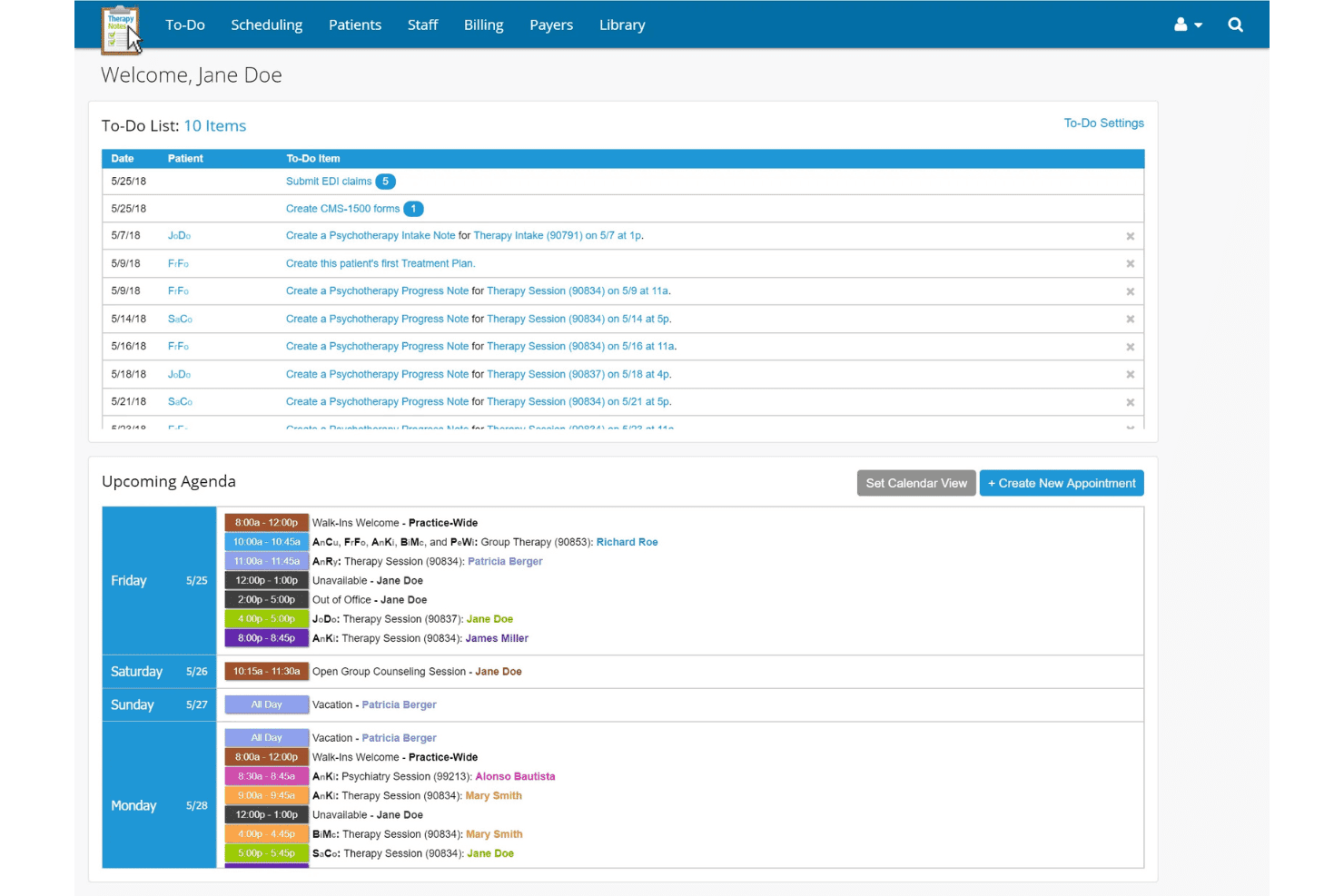
When choosing a behavioral health EMR, I’d rate TherapyNotes highly for keeping clinical notes, scheduling, client messaging, basic telehealth, and insurance billing together. For example, claims, ERA posting, and eligibility checks support a connected billing workflow, though its emphasis is more on built-in tools than a broad third-party integration ecosystem. The interface is practical and focused, if less polished than some newer platforms.
Solo plans cost $69 monthly, while group plans start at $79 monthly for the first clinician, with an additional $50 per clinician and optional add-on fees to consider. A 30-day free trial, free client data import, and 24/7 phone and email support make onboarding approachable. I’d select it for solo or group behavioral health practices prioritizing documentation and insurance billing.
Pros
- Structured behavioral-health documentation organizes notes, plans, and assessments.
- Integrated claims, ERAs, and eligibility checks support insurance billing.
- Users praise responsive 24/7 phone and email support.
Cons
- The mobile app omits notes, billing, reports, and portal tools.
- Reviewers report intermittent glitches during telehealth sessions.
- Some reviewers cite limited reporting and secondary-insurance billing.


How We Test & Score Tools
We’ve spent years building, refining, and improving our software testing and scoring system. The rubric is designed to capture the nuances of software selection and what makes a tool effective, focusing on critical aspects of the decision-making process.
Below, you can see exactly how our testing and scoring works across seven criteria. It allows us to provide an unbiased evaluation of the software based on core functionality, standout features, ease of use, onboarding, customer support, integrations, customer reviews, and value for money.
Core Functionality (25% of final scoring)
The starting point of our evaluation is always the core functionality of the tool. Does it have the basic features and functions that a user would expect to see? Are any of those core features locked to higher-tiered pricing plans? At its core, we expect a tool to stand up against the baseline capabilities of its competitors.
Standout Features (25% of final scoring)
Next, we evaluate uncommon standout features that go above and beyond the core functionality typically found in tools of its kind. A high score reflects specialized or unique features that make the product faster, more efficient, or offer additional value to the user.
We also evaluate how easy it is to integrate with other tools typically found in the tech stack to expand the functionality and utility of the software. Tools offering plentiful native integrations, 3rd party connections, and API access to build custom integrations score best.
Ease of Use (10% of final scoring)
We consider how quick and easy it is to execute the tasks defined in the core functionality using the tool. High scoring software is well designed, intuitive to use, offers mobile apps, provides templates, and makes relatively complex tasks seem simple.
Onboarding (10% of final scoring)
We know how important rapid team adoption is for a new platform, so we evaluate how easy it is to learn and use a tool with minimal training. We evaluate how quickly a team member can get set up and start using the tool with no experience. High scoring solutions indicate little or no support is required.
Customer Support (10% of final scoring)
We review how quick and easy it is to get unstuck and find help by phone, live chat, or knowledge base. Tools and companies that provide real-time support score best, while chatbots score worst.
Customer Reviews (10% of final scoring)
Beyond our own testing and evaluation, we consider the net promoter score from current and past customers. We review their likelihood, given the option, to choose the tool again for the core functionality. A high scoring software reflects a high net promoter score from current or past customers.
Value for Money (10% of final scoring)
Lastly, in consideration of all the other criteria, we review the average price of entry level plans against the core features and consider the value of the other evaluation criteria. Software that delivers more, for less, will score higher.
Core Features
Clinical Documentation
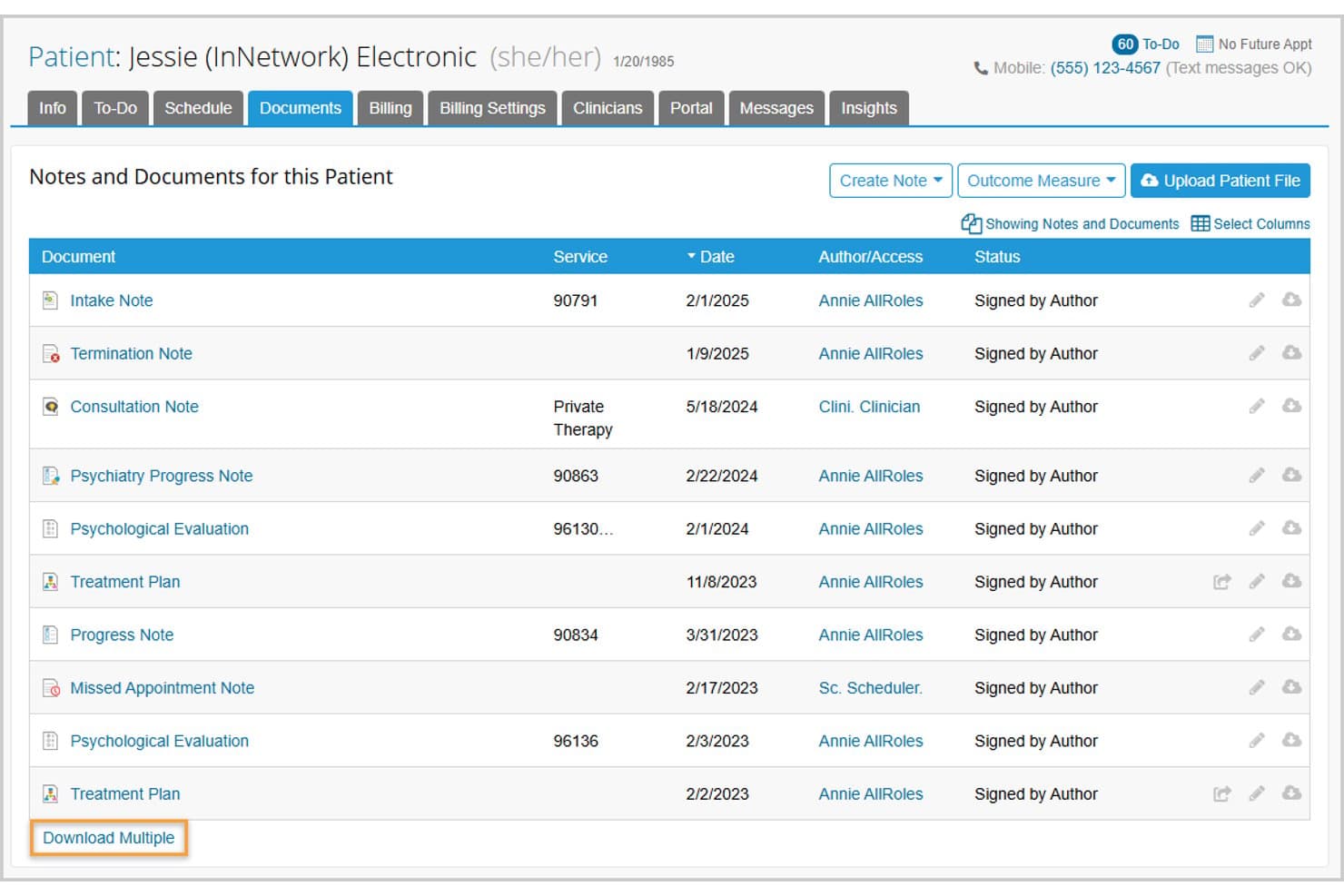
TherapyNotes offers clinical note templates, treatment plans, assessments, administrative notes, and a secure document library. Built-in diagnosis code search and behavioral-health-focused forms help you document sessions and keep records organized in one place.
Scheduling
You can schedule one-time or recurring appointments, block clinician unavailability, and use calendar filters and appointment reminders. Appointment-related notes and billing are accessible from the schedule, connecting calendar tasks with client records.
Insurance Billing
TherapyNotes supports electronic claims, claim scrubbing, eligibility checks, ERA posting, client statements, and superbills. These tools let your team check coverage, submit claims, and record payer payments within the same system as clinical records.
Client Portal
TherapyPortal gives clients secure access to intake forms, appointments, messages, and online bill pay. Clients can complete paperwork and self-schedule, reducing the need to handle each task by phone or email.
Telehealth
TherapyNotes includes secure video appointments through its client portal. You can meet with clients remotely from the practice system, keeping telehealth sessions alongside appointment and client record workflows.
Secure Messaging
TherapyNotes provides HIPAA-compliant messaging for communication with clients and staff through one inbox. Keeping those conversations within the platform gives your team a central place to manage practice messages.
Ease of Use
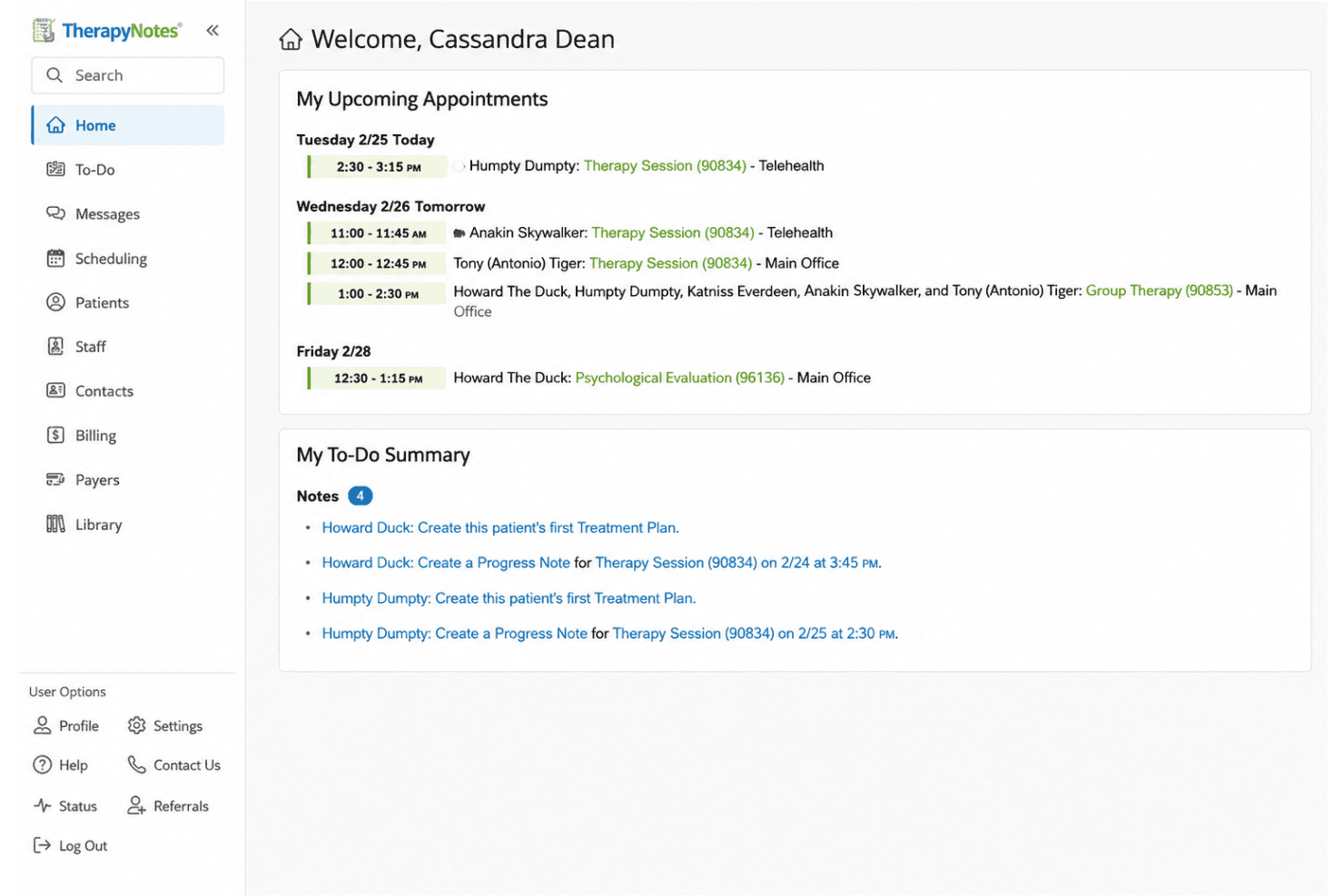
TherapyNotes is more approachable than many broad EMRs, with a focused workflow for scheduling, clinical documentation, and billing in one system. I find its structured templates, straightforward navigation, and links between appointments and client records practical for daily work. Its organized interface also makes it easier for new staff to learn essential tasks like scheduling and managing patient information. However, limited customization, occasional technical glitches, and restricted mobile app functionality may affect practices that need greater flexibility.
Integrations
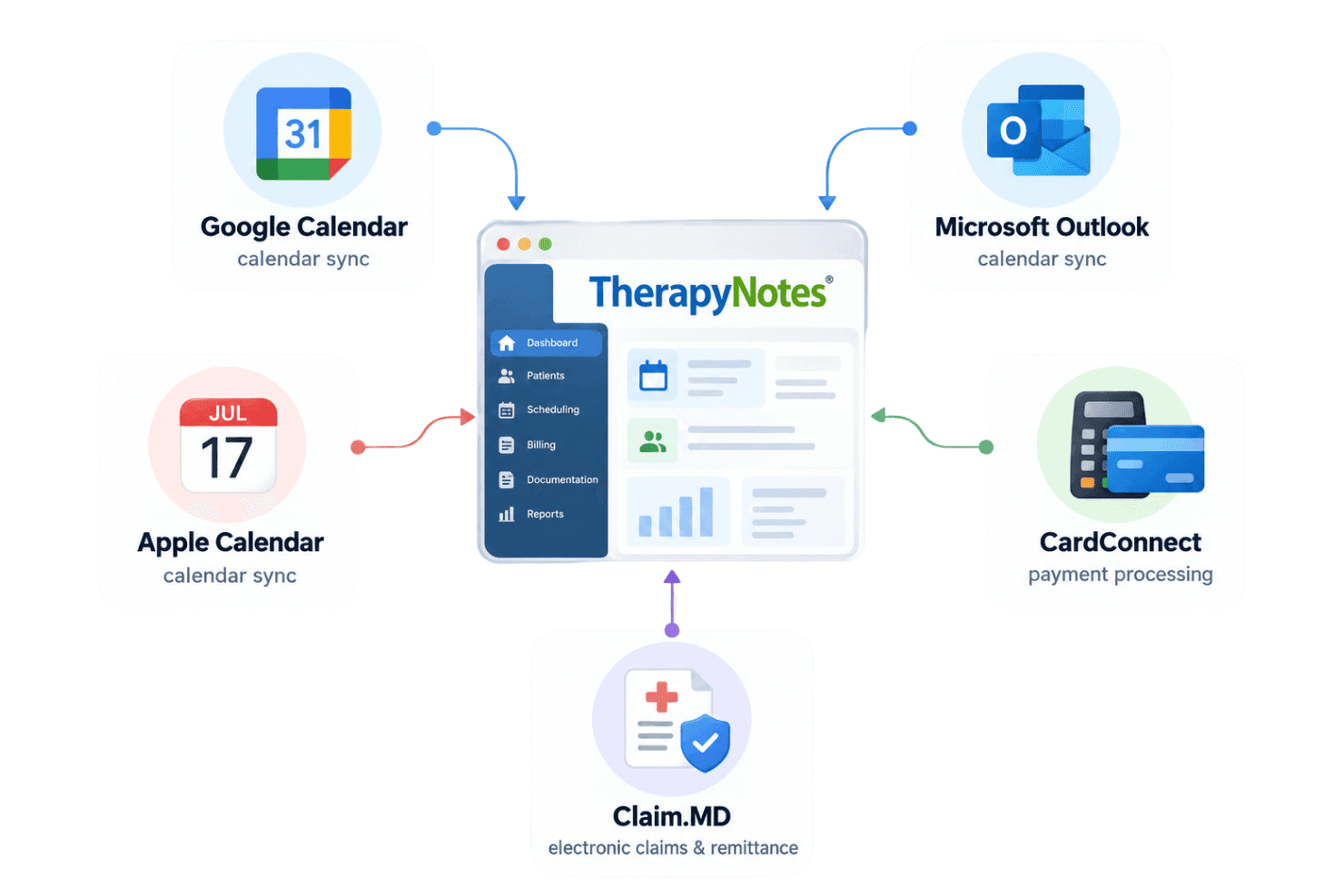
TherapyNotes integrates with Google Calendar, Microsoft Outlook, Apple Calendar, CardConnect for payment processing, and Claim.MD for electronic claims and remittance processing. TherapyNotes doesn’t offer a public API or native connections to third-party integration platforms.
TherapyNotes Specs
- API: No
- Appointment Scheduling: No
- Athlete Management: No
- Audit Management: No
- Calendar Management: No
- Compliance Tracking: No
- Customer Management: No
- Dashboard: No
- Data Export: No
- Data Import: No
- Data Visualization: No
- Electronic Prescribing: No
- External Integrations: No
- File Sharing: No
- File Transfer: No
- Health Management: No
- HIPAA Compliance: No
- Inventory Tracking: No
- Multi-User: No
- Notifications: No
- Organization Management: No
- Patient Management: No
- Project Management: No
- Regulatory Alerts: No
- Risk Assessment: No
- Scheduling: No
- Supplier Management: No


