
SimplePractice Healthcare Practice Management Software Review for 2026
SimplePractice centralizes scheduling, billing, and client communication to reduce administrative burden and enhance patient engagement, making it ideal for small to mid-sized healthcare practices.

We review tools independently, and commissions help fund our testing. See our transparency policy, our methodology, or suggest a tool.
SimplePractice is a free EHR software built for solo and small-group health and wellness practices that need scheduling, clinical documentation, billing, and telehealth in one place. I'd consider it if you're a therapist, counselor, or wellness provider who's outgrown paper-based systems or disconnected tools. Compared to TherapyNotes, for example, SimplePractice offers a more polished client-facing experience, including a branded client portal and built-in telehealth, making it the stronger pick if the patient experience matters as much to you as the clinical workflow.
SimplePractice Evaluation Summary
4.6/5
- From $49/month
- 30-day free trial
Why Trust Our Software Recommendations
6,700+
Reviews
20
Industry experts
16+
Evaluation factors
14
Years
Our team has been testing and reviewing software since 2012. As medical practice leaders ourselves, we know how difficult—and important—it is to choose the right software.
For this guide, we evaluated tools using hands-on testing and independent research, scoring tools using our selection criteria.
Our reviews reflect our human editorial judgment, not a sales pitch.
SimplePractice Overview
SimplePractice is a healthcare practice management software that helps mental health professionals manage scheduling, billing, and client records. It’s particularly well-suited for solo practitioners and small group practices, such as therapists and counselors, who need streamlined operations. SimplePractice offers value by simplifying administrative tasks, allowing you to focus more on client care.
Pros
- You can easily manage client scheduling and billing.
- The user interface is intuitive and user-friendly.
- It offers excellent telehealth capabilities for virtual sessions.
Cons
- You might find the reporting features somewhat limited.
- The mobile app could use more functionality for on-the-go management.
- Some users experience occasional glitches with the calendar syncing.
Is SimplePractice Right For Your Needs?
Who Would be a Good Fit for SimplePractice?
SimplePractice is ideal for solo practitioners and small group practices in mental health, like therapists, counselors, and psychologists. Its intuitive interface and robust scheduling features make it easy for you to manage appointments and client records. The telehealth capabilities are a boon for those offering virtual sessions, allowing you to seamlessly connect with clients. If your work involves frequent client interactions and requires efficient billing and documentation, SimplePractice provides the tools you need to keep your practice organized and focused on client care.
- Solo TherapistsSimplePractice offers everything you need to manage appointments and billing efficiently.
- Small Group PracticesYou can streamline operations with its user-friendly scheduling and client management tools.
- CounselorsThe intuitive interface makes managing client records and notes straightforward.
- Telehealth ProvidersIts telehealth capabilities allow you to conduct virtual sessions easily.
- PsychologistsYou can keep client documentation organized with its robust features.
- Mental Health ClinicsSimplePractice supports efficient client management and billing for small clinics.
Who Would be a Bad Fit for SimplePractice?
Large healthcare organizations and practices with complex multi-department needs might find SimplePractice lacking. Its features are tailored for simpler operations, and it may not support the intricate workflows required by big hospitals or clinics with various specialties. If your team needs advanced reporting or extensive mobile functionality, SimplePractice might not meet your demands. It’s designed for small to medium-sized practices, so larger teams might struggle to adapt to its limited scalability.
- Large HospitalsSimplePractice doesn’t offer the extensive features needed for managing large-scale operations in hospitals.
- Enterprise HealthcareThe software lacks the customization and scalability required for enterprise-level healthcare organizations.
- Specialized DepartmentsDepartments needing specialized features may find SimplePractice’s generalist approach insufficient.
- High Patient Volume ClinicsClinics with high patient turnover may struggle with SimplePractice’s limited capacity for handling large datasets.
- Medical Research TeamsResearch teams requiring detailed data analytics might find SimplePractice’s offerings too basic.
- Inpatient Care FacilitiesFacilities focusing on inpatient care may need more robust tools than what SimplePractice provides.
How We Test & Score Tools
We’ve spent years building, refining, and improving our software testing and scoring system. The rubric is designed to capture the nuances of software selection and what makes a tool effective, focusing on critical aspects of the decision-making process.
Below, you can see exactly how our testing and scoring works across seven criteria. It allows us to provide an unbiased evaluation of the software based on core functionality, standout features, ease of use, onboarding, customer support, integrations, customer reviews, and value for money.
Core Functionality (25% of final scoring)
The starting point of our evaluation is always the core functionality of the tool. Does it have the basic features and functions that a user would expect to see? Are any of those core features locked to higher-tiered pricing plans? At its core, we expect a tool to stand up against the baseline capabilities of its competitors.
Standout Features (25% of final scoring)
Next, we evaluate uncommon standout features that go above and beyond the core functionality typically found in tools of its kind. A high score reflects specialized or unique features that make the product faster, more efficient, or offer additional value to the user.
We also evaluate how easy it is to integrate with other tools typically found in the tech stack to expand the functionality and utility of the software. Tools offering plentiful native integrations, 3rd party connections, and API access to build custom integrations score best.
Ease of Use (10% of final scoring)
We consider how quick and easy it is to execute the tasks defined in the core functionality using the tool. High scoring software is well designed, intuitive to use, offers mobile apps, provides templates, and makes relatively complex tasks seem simple.
Onboarding (10% of final scoring)
We know how important rapid team adoption is for a new platform, so we evaluate how easy it is to learn and use a tool with minimal training. We evaluate how quickly a team member can get set up and start using the tool with no experience. High scoring solutions indicate little or no support is required.
Customer Support (10% of final scoring)
We review how quick and easy it is to get unstuck and find help by phone, live chat, or knowledge base. Tools and companies that provide real-time support score best, while chatbots score worst.
Customer Reviews (10% of final scoring)
Beyond our own testing and evaluation, we consider the net promoter score from current and past customers. We review their likelihood, given the option, to choose the tool again for the core functionality. A high scoring software reflects a high net promoter score from current or past customers.
Value for Money (10% of final scoring)
Lastly, in consideration of all the other criteria, we review the average price of entry level plans against the core features and consider the value of the other evaluation criteria. Software that delivers more, for less, will score higher.
Core Features
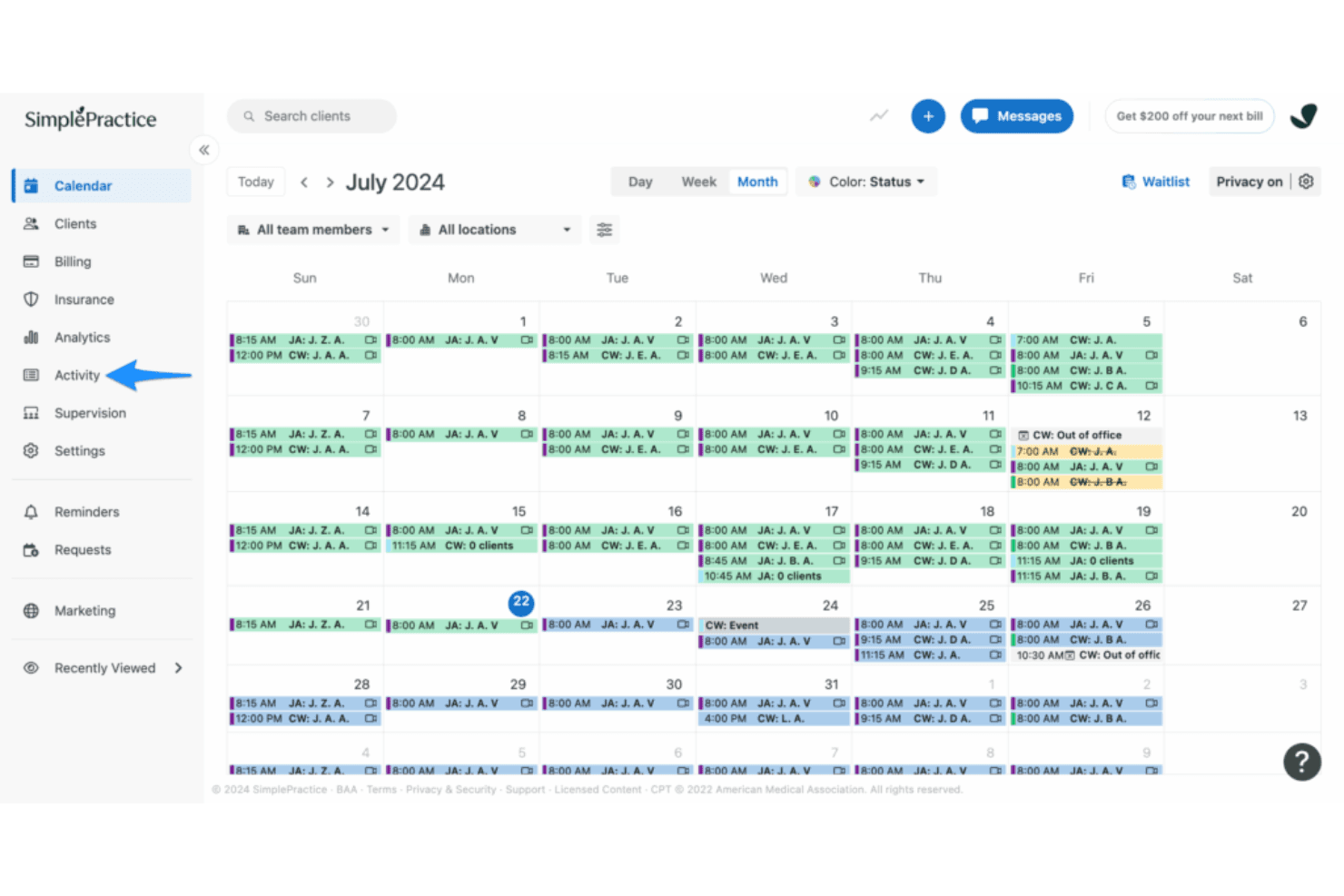
Scheduling Management: You can easily manage your appointments with a drag-and-drop calendar. It allows you to set recurring appointments and send automated reminders to reduce no-shows.
Billing and Invoicing: The software simplifies billing with customizable templates and integrated payment processing. You can track payments and manage invoices directly from the platform.
Client Portal: Clients can schedule appointments, fill out intake forms, and access documents through a secure portal. It enhances client engagement and streamlines communication.
Telehealth: Conduct virtual sessions with high-quality video conferencing built into the platform. It's a convenient option for remote consultations with your clients.
Documentation and Notes: Create and store client notes and documentation securely. The platform offers templates to help you maintain consistent and thorough records.
Reporting: Generate basic reports to track your practice's financial health and client data. While not extensive, it provides essential insights for small practices.

Ease of Use
SimplePractice stands out for its intuitive design and user-friendly interface, making it easy for you to navigate and manage your practice. Users appreciate the drag-and-drop calendar, which simplifies scheduling, and the straightforward billing process. The client portal enhances usability by allowing clients to handle their appointments and documents effortlessly. Compared to other software, SimplePractice’s streamlined features and clear layout make it accessible even for those not tech-savvy, helping you focus more on client care.

Integrations
Integrations include Stripe, Medsender, Microsoft Outlook, Google Calendar, iCloud, Stripe Billing, Braintree, Nexa, Optiimus, PayPal, Dazos CRM, and CareSource.

SimplePractice Specs
- API: No
- Appointment Scheduling: No
- Athlete Management: No
- Audit Management: No
- Calendar Management: No
- Compliance Tracking: No
- Customer Management: No
- Dashboard: No
- Data Export: No
- Data Import: No
- Data Visualization: No
- Electronic Prescribing: No
- External Integrations: No
- File Sharing: No
- File Transfer: No
- Health Management: No
- HIPAA Compliance: No
- Inventory Tracking: No
- Multi-User: No
- Notifications: No
- Organization Management: No
- Patient Management: No
- Project Management: No
- Regulatory Alerts: No
- Risk Assessment: No
- Scheduling: No
- Supplier Management: No
Alternatives to SimplePractice


SimplePractice FAQs
What's Next?
To stay updated on the latest trends, best practices, and solutions related to your medical practice, subscribe to The Medical Practice newsletter.