

AI EMR software uses artificial intelligence to automate clinical documentation, streamline charting, and help you manage patient records faster. If you’re overwhelmed by notes, compliance demands, and complex EHR interfaces, the right AI-EHR software can free up more time for care. Below, I’ll help you compare the top options so you can find a solution that fits the way you practice, meets your documentation needs, and supports better outcomes for your patients.
Why Trust Our Software Recommendations
6,700+
Reviews
20
Industry experts
16+
Evaluation factors
14
Years
Our team has been testing and reviewing software since 2012. As medical practice leaders ourselves, we know how difficult—and important—it is to choose the right software.
For this guide, we evaluated tools using hands-on testing and independent research, scoring tools using our selection criteria.
Our reviews reflect our human editorial judgment, not a sales pitch.
AI EMR Software Comparison Table
This comparison table summarizes pricing details for my top AI EMR software.
| Tool | Best For | Trial Info | Price | ||
|---|---|---|---|---|---|
| 1 | Best for specialty-specific AI documentation | Free demo available | Pricing upon request | Website | |
| 2 | Best for EHR-compatible, trained scribing | Free demo available | From $249/user/month | Website | |
| 3 | Best for customizable, multilingual AI scribing | Free demo available | From $25/month | Website | |
| 4 | Best for ambient charting and automated workflows | Free demo available | Pricing upon request | Website | |
| 5 | Best for AI-generated SOAP notes | Free demo available | Pricing upon request | Website | |
| 6 | Best for AI-assisted primary care documentation | Free demo available | Pricing upon request | Website | |
| 7 | Best for growing independent practices | Free demo available | Pricing upon request | Website | |
| 8 | Best for automating charting and billing | Free demo available | Pricing upon request | Website | |
| 9 | Best for AI scribing and 24/7 communication | Free demo available | From $499/user/month | Website | |
| 10 | Best for mobile ambient clinical notes | Free demo available | Pricing upon request | Website |


 Best for specialty-specific AI documentation
- Free demo available
- Pricing upon request
Visit WebsiteCustomer Rating:4.4/5This rating combines scores from multiple user review sites to reflect overall customer sentiment about the product.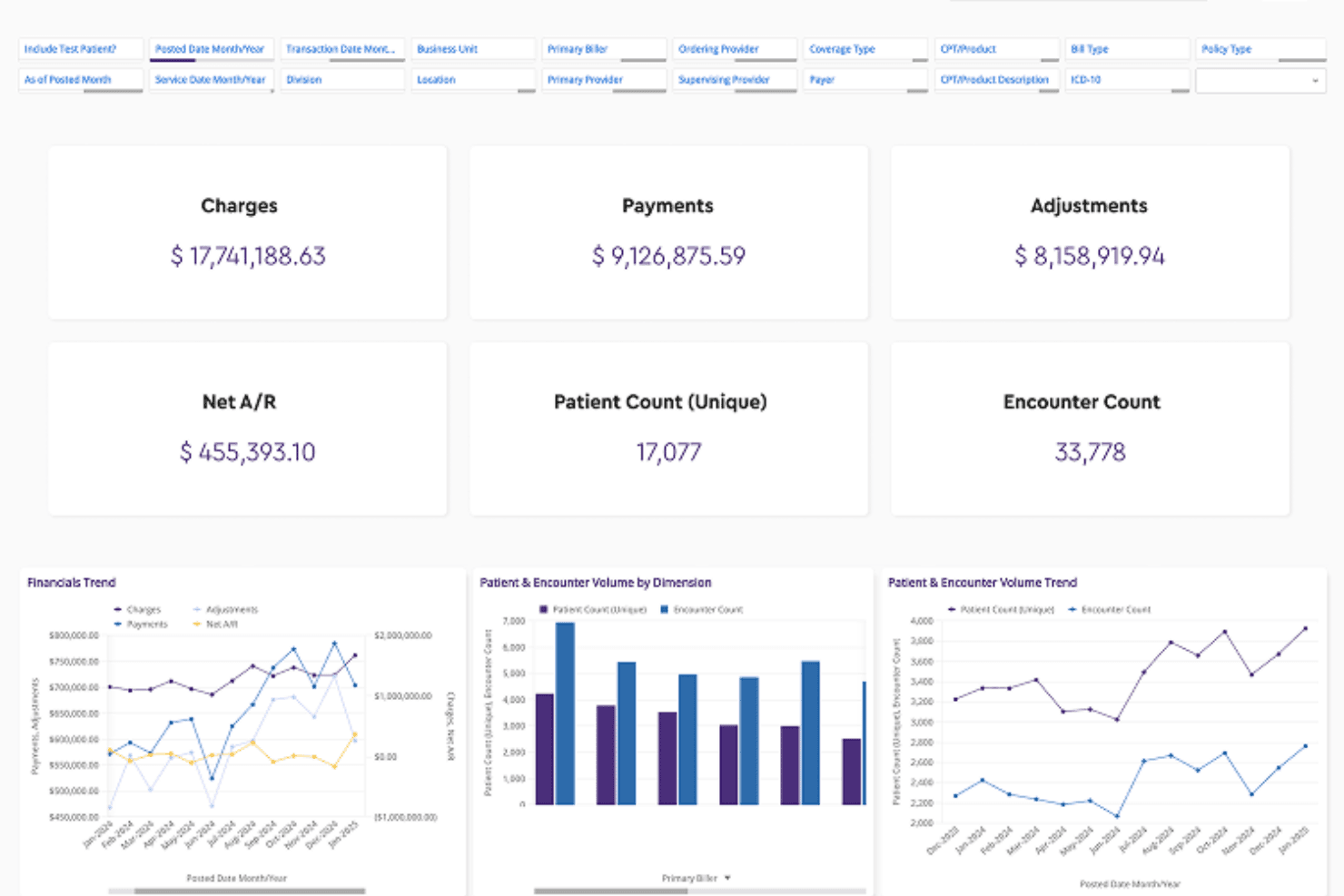
ModMed productivity dashboard showing charges, payments, adjustments, patient counts, encounter totals, and financial trends ModMed is a specialty-focused AI EMR platform built around EMA® and gGastro®, combining ambient clinical documentation, e-prescribing, practice management, and AI-assisted coding across 11 medical specialties.
Who Is ModMed Best For?
ModMed is a strong fit for specialty ambulatory practices in fields like dermatology, podiatry, OBGYN, and gastroenterology that need an EMR built around their specific clinical workflows.
Why I Picked ModMed
ModMed earns its spot as one of the best on my shortlist because its AI documentation is built specifically for each specialty, not retrofitted onto a generic framework. ModMed Scribe 2.0 listens to the patient-provider conversation and auto-populates the chart with structured notes, suggested ICD-10 codes, and lab orders. For GI practices, gScribe goes even further, trained on gastroenterology-specific language to suggest HPIs and care plans that actually reflect how GI physicians document.
ModMed Key Features
- Integrated practice management: Offers scheduling, billing, claims, and reporting all within the same platform as the EMR.
- Customizable specialty templates: Provides structured templates tailored to workflows for 11 distinct medical specialties.
- Certified ePrescribing with drug interaction checks: Supports secure transmission of prescriptions along with real-time medication safety alerts.
- Extensive lab and pathology interfaces: Connects to over 150 pathology labs and major clinical labs for order entry and result retrieval.
ModMed Integrations
ModMed offers native integrations with Labcorp, Quest Diagnostics, and over 150 pathology labs, supports HL7/FHIR interfaces with practice management systems, and provides an API for custom integrations.
Pros and Cons
Pros:
- Customizable structured charting templates
- Ambient scribe captures multi-provider encounters
- AI notes tuned for 11 specialties
Cons:
- Training and onboarding can be time-intensive
- Specialty focus limits use outside supported fields
Learn more about ModMed: Best for EHR-compatible, trained scribing
- Free demo available
- From $249/user/month
Visit WebsiteCustomer Rating:4.4/5This rating combines scores from multiple user review sites to reflect overall customer sentiment about the product.
OmniMD offers an AI Medical Scribe interface that lets clinicians create clinical encounter notes with dictation, audio upload, and patient appointment management. OmniMD is an ONC-certified, AI-powered EMR platform built for ambulatory care practices, combining ambient clinical documentation, AI medical coding, RCM, and remote patient monitoring in a single system.
Who Is OmniMD Best For?
OmniMD fits independent and multi-specialty ambulatory practices looking for a single-vendor system that handles charting, coding, and billing without third-party add-ons.
Why I Picked OmniMD
I've included OmniMD in my top picks because its AI Medical Scribe isn't bolted on after the fact. It's natively built into the EHR, so ambient recordings auto-populate directly into the patient chart without any third-party middleware. I especially like the specialty-trained templates: a cardiology encounter produces a different structured SOAP note than a wound care visit, and the speaker identification feature keeps documentation clean when multiple providers are in the room.
OmniMD Key Features
- AI front desk automation: Handles appointment scheduling, insurance verification, and phone interactions using artificial intelligence.
- AI medical coder: Suggests ICD, CPT, and HCPCS codes in real time based on chart content.
- Remote patient monitoring module: Captures and organizes patient vitals and biometric data from integrated devices.
- Customizable specialty templates: Offers templates for over 20 specialties, supporting various workflows and structured documentation requirements.
OmniMD Integrations
OmniMD offers native integrations with Multum Drug Database, HAPI FHIR Server, HL7 lab systems, and e-Prescribing networks like DirectTrust. FHIR API access is available for custom integrations.
Pros and Cons
Pros:
- Supports remote patient monitoring device data
- Real-time specialty-specific AI coding suggestions
- Charting and scribing are native and unified
Cons:
- Some users report lag during peak hours
- Reporting customization options are somewhat limited
Learn more about OmniMD: Best for customizable, multilingual AI scribing
- Free demo available
- From $25/month
Visit WebsiteCustomer Rating:4.2/5This rating combines scores from multiple user review sites to reflect overall customer sentiment about the product.
CharmHealth offers an AI-powered Charm Assist panel within its EHR that provides clinical decision support, such as listing symptoms of primary peritoneal carcinoma, directly alongside patient chart notes. CharmHealth is a cloud-based AI EMR platform that combines electronic health records, practice management, and revenue cycle management with a built-in ambient AI scribe and multilingual clinical documentation.
Who Is CharmHealth Best For?
CharmHealth is a strong fit for independent and small-to-medium practices across primary care, integrative medicine, and behavioral health specialties.
Why I Picked CharmHealth
I picked CharmHealth as one of the best because the AI Scribe's Care Type selection is genuinely useful in practice. Selecting "Mental Health and Behavioral Care" as a Care Type generates notes tailored to that specialty's structure, not a generic SOAP format. For non-English-speaking patients, the scribe outputs patient instructions in the patient's language while keeping the clinical note in English, which removes a manual documentation step without creating a consistency gap across the chart.
CharmHealth Key Features
- Customizable SOAP templates: Create and modify specialty-specific SOAP templates to fit your clinical workflow.
- Integrated lab interfaces: Connect directly with LabCorp, Quest, and custom labs using HL7 for electronic orders and results.
- e-Prescribing with EPCS: Send prescriptions electronically, including controlled substances, to over 70,000 pharmacies.
- Patient portal access: Give patients online access to records, appointment scheduling, and secure messaging.
CharmHealth Integrations
CharmHealth offers native integrations with LabCorp, Quest Diagnostics, Surescripts, Bluefin, QuickBooks Online, Fullscript, and Optum for eClaims, with additional marketplace integrations and an API for custom connectivity.
Pros and Cons
Pros:
- Automated coding suggestions from transcriptions
- Customizable clinical decision support templates
- Multilingual AI scribe for encounter notes
Cons:
- Telehealth video is browser-based only
- No autonomous CPT or E/M code generation
Learn more about CharmHealth: Best for ambient charting and automated workflows
- Free demo available
- Pricing upon request
Visit WebsiteCustomer Rating:3.6/5This rating combines scores from multiple user review sites to reflect overall customer sentiment about the product.
AdvancedMD dashboard for managing appointments, clinical notes, prescriptions, orders, charge slips, and messages AdvancedMD is a cloud-based AI EMR platform that combines ambient clinical documentation, practice management, medical billing, and patient engagement tools in a unified suite built for independent medical practices.
Who Is AdvancedMD Best For?
It's a strong fit for independent practices and small-to-mid-size medical groups that need a single platform to handle clinical, billing, and administrative workflows.
Why I Picked AdvancedMD
AdvancedMD earns its spot on my shortlist because of how tightly its ambient AI connects to actual charting. I love that the AI Clinical Assistant generates notes in five formats, including SOAP and Psychiatric Evaluation, not just a raw transcript. It also auto-populates action items like lab orders, medication updates, and allergy changes directly into the patient record after each visit, which is a level of downstream automation you don't get from a standalone scribe tool.
AdvancedMD Key Features
- Customizable physician dashboard: Gives clinicians a centralized view for managing notes, prescriptions, lab results, and encounter documentation.
- Integrated patient portal: Lets patients schedule, message, complete intake forms, and view documents securely online.
- Automated insurance eligibility verification: Checks coverage automatically ahead of scheduled appointments and flags issues for staff.
- Built-in telehealth: Supports HIPAA-compliant video visits and includes tools for scheduling, documentation, and ePrescribing within one workflow.
AdvancedMD Integrations
AdvancedMD offers marketplace integrations with over 1,400 healthcare solutions, including Surescripts for ePrescribing, and provides an API, HL7, and ODBC support for custom integrations and data access.
Pros and Cons
Pros:
- Built-in telehealth and patient engagement features reduce reliance on separate tools
- Integrated billing and eligibility tools streamline administrative workflows
- Customizable dashboard centralizes notes, prescriptions, orders, and messages
Cons:
- Pricing may increase with add-ons and advanced features
- The interface can feel complex for new users
 Best for AI-generated SOAP notes
- Free demo available
- Pricing upon request
Visit WebsiteCustomer Rating:3.7/5This rating combines scores from multiple user review sites to reflect overall customer sentiment about the product.
NextGen Healthcare offers a clinical note interface displaying patient history, problem list, and visit documentation within its EHR system. NextGen Healthcare is an AI-powered EMR platform covering clinical documentation, e-prescribing, revenue cycle management, and patient engagement across both small practices and mid-size to enterprise healthcare organizations.
Who Is NextGen Healthcare Best For?
NextGen Healthcare is a strong fit for independent and specialty practices that need a full EMR with built-in AI documentation tools.
Why I Picked NextGen Healthcare
I picked NextGen Healthcare as one of the best because its Ambient Assist feature genuinely stands out for clinical documentation. It listens to live patient-physician conversations and auto-generates structured SOAP notes in real time, populating them directly into the chart. I also like the NextGen Intelligent Agent, which lets providers pull up patient charts or surface clinical data using voice commands mid-visit, keeping physicians focused on the patient rather than the screen.
NextGen Healthcare Key Features
- Customizable specialty templates: Offers over 2,000 templates tuned for specific medical specialties and workflows.
- ONC-certified interoperability: Supports HL7 and FHIR standards for data exchange across health systems.
- Integrated e-prescribing and CPOE: Enables electronic prescribing, drug interaction checks, and direct order entry in the platform.
- Revenue cycle management tools: Includes automated claims processing, eligibility checks, and reporting for billing staff.
NextGen Healthcare Integrations
NextGen Healthcare offers native integrations with Labcorp Diagnostic Assistant, Innovaccer, Arcadia, Clearwave, Assort Health Voice AI, RemetricHealth, Medsien, and ActX Genomic Decision Support. An API is available for custom integrations.
Pros and Cons
Pros:
- Integrated EHR, practice management, and revenue cycle tools
- Supports specialty-specific workflows across more than 40 markets
- AI-generated clinical notes help reduce manual charting
Cons:
- Pricing is not publicly available and may vary by practice size
- Extensive features may require more training and onboarding
Learn more about NextGen Healthcare: Best for AI-assisted primary care documentation
- Free demo available
- Pricing upon request
Visit WebsiteCustomer Rating:4.4/5This rating combines scores from multiple user review sites to reflect overall customer sentiment about the product.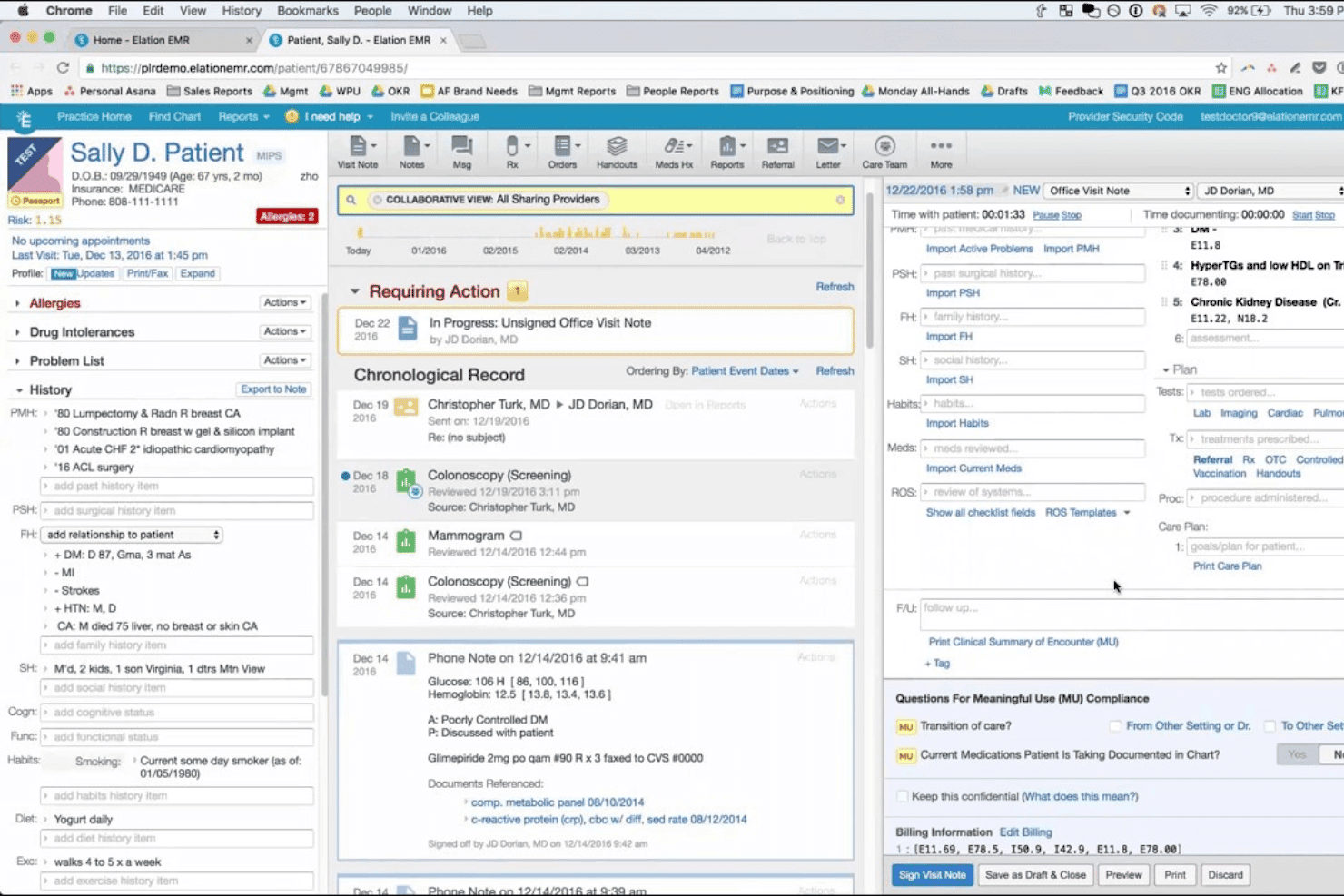
Elation Health EHR dashboard showing patient records, clinical notes, orders, and care history. Elation Health is a clinical-first AI EHR platform built for independent primary care that combines ambient AI documentation, integrated billing, e-prescribing, and longitudinal patient charting.
Who Is Elation Health Best For?
Elation Health is a strong fit for independent primary care physicians and small-to-medium practice administrators looking for a purpose-built AI EHR.
Why I Picked Elation Health
I picked Elation Health as one of the best because Note Assist with Actions does something most AI scribes don't: it listens for clinical intent mid-encounter and automatically queues prescriptions, lab orders, and referrals without the physician leaving the chart. It supports 14 languages and works with a practice's existing note templates. On top of that, Clinical Insights surfaces patient context and chart summaries directly in the encounter view.
Elation Health Key Features
- Three-panel chart console: Lets you manage patient history, notes, and orders from a single interface.
- Integrated e-prescribing: Send prescriptions, including controlled substances, directly to pharmacies from within the EHR.
- Open developer platform: Connect with 300+ third-party apps and national lab networks using FHIR APIs and webhooks.
- Patient portal access: Gives patients secure access to their records, communication tools, and online scheduling.
Elation Health Integrations
Elation Health offers over 10 native integrations, including PracticeSuite, Spruce, AdvancedMD, DeepScribe, Fullscript, RingRx, Suki, Tebra, Updox, and IntakeQ. An open API and webhook platform are available for custom integrations.
Pros and Cons
Pros:
- Specialty note templates for primary care workflows
- Built-in AI triggers orders and prescriptions mid-note
- Native ambient AI scribe supports 14 languages
Cons:
- Note Assist feature may cost extra
- Does not support full hospital system needs
Learn more about Elation Health: Best for growing independent practices
- Free demo available
- Pricing upon request
Visit WebsiteCustomer Rating:3.9/5This rating combines scores from multiple user review sites to reflect overall customer sentiment about the product.
Tebra offers a comprehensive Electronic Health Records dashboard with patient profiles, visit history, electronic prescriptions, telehealth scheduling, and lab management. Tebra is an AI EMR platform built for independent practices that combines AI-powered clinical documentation, medical billing, patient engagement, e-prescribing, and practice marketing in a single system.
Who Is Tebra Best For?
Tebra is a strong fit for physicians and practice administrators running independent or small group practices across specialties like primary care, mental health, pediatrics, and dermatology.
Why I Picked Tebra
I've included Tebra in my top picks because its AI Note Assist generates structured SOAP notes directly from patient conversations, with providers reporting charting time dropping from over 30 minutes to under five. The AI Billing Assistant catches coding gaps and eligibility mismatches before claims reach the payer, which reduces the manual review burden on small billing teams. I also like that AI Review Insights surfaces patient sentiment trends from online reviews, giving a growing practice visibility into its reputation alongside its clinical workflow.
Tebra Key Features
- Digital patient intake forms: Collects patient demographics and health history electronically before visits.
- Provider calendar and scheduling: Lets you manage appointments, recurring visits, and provider availability in a unified view.
- Integrated telehealth module: Offers secure, compliant video visits without add-on software.
- eLabs and results management: Allows you to order labs electronically and receive structured results directly into the patient chart.
Tebra Integrations
Tebra offers native integrations with Appriss Health for PDMP, electronic prescribing (EPCS), electronic labs, Google Business Profile, and payment processors. An API is available for custom integrations.
Pros and Cons
Pros:
- Automated pre-submission billing and coding checks
- Integrated patient sentiment review analytics
- AI Note Assist generates SOAP notes instantly
Cons:
- Interoperability with other EMRs can be difficult
- Limited AI features for medical coding
Learn more about Tebra: Best for automating charting and billing
- Free demo available
- Pricing upon request
Visit WebsiteCustomer Rating:3.9/5This rating combines scores from multiple user review sites to reflect overall customer sentiment about the product.
DrChrono offers a detailed Schedule Appointment modal with fields for patient info, billing, vitals, eligibility, and consent forms within its EMR platform. DrChrono is a cloud-based AI EMR platform for independent medical practices that combines ambient clinical documentation, AI-assisted billing, e-prescribing, scheduling, and revenue cycle management in one system.
Who Is DrChrono Best For?
DrChrono suits small to mid-sized specialty practices—including family medicine, orthopedics, psychiatry, and podiatry—that run primarily on Apple devices.
Why I Picked DrChrono
I picked DrChrono as one of the best because its two AI layers, EverHealth Scribe and AI Billing Assist, handle both ends of the documentation-to-payment loop. EverHealth Scribe records the encounter and generates a structured SOAP note (HPI, Assessment, Plan, and ICD-10 codes) directly inside the chart without switching tools. AI Billing Assist then reviews that same note to suggest CPT codes with billing-rule-aware logic, catching sequencing errors and payer compliance issues before a claim goes out.
DrChrono Key Features
- Customizable charting templates: Build and modify templates for different specialties or visit types within the EMR.
- Integrated telehealth module: Schedule and conduct secure video appointments from inside the patient record.
- OnPatient portal: Let patients view records, fill forms, message providers, and manage appointments securely online.
- Apple device optimization: Access and use clinical tools from iPhone, iPad, or M-Series Mac devices with native app support.
DrChrono Integrations
DrChrono offers 20+ native integrations, including Box, Ambra, Curogram, DeepScribe, Demandforce, ClearGage, Collectly, Square Point of Sale, Fullscript, and Holly, and provides an API for custom integrations.
Pros and Cons
Pros:
- Strong native support for iPhone, iPad, and Mac workflows
- AI Billing Assist recommends CPT codes and flags potential billing issues
- AI scribe creates structured SOAP notes and suggests ICD-10 codes
Cons:
- Pricing is not publicly listed and may increase with add-ons
- Mobile functionality is more limited for Android users
Learn more about DrChrono: Best for AI scribing and 24/7 communication
- Free demo available
- From $499/user/month
Visit WebsiteCustomer Rating:3.4/5This rating combines scores from multiple user review sites to reflect overall customer sentiment about the product.
eClinicalWorks offers a mobile tablet interface with patient encounter details, hub navigation, and telephone/web encounter management for streamlined clinical workflows. eClinicalWorks is an AI-powered EHR platform that combines ambient clinical documentation, practice management, e-prescribing, revenue cycle management, and patient engagement tools across a single cloud-based system.
Who Is eClinicalWorks Best For?
It's a strong fit for independent and multi-specialty practices that want a fully integrated EHR, billing, and AI documentation system without stitching together separate tools.
Why I Picked eClinicalWorks
I picked eClinicalWorks as one of the best because Sunoh.ai, its native ambient scribe, listens to live patient encounters and auto-populates structured SOAP notes across ten-plus specialties without any post-visit cleanup. On the communication side, healow Genie handles inbound patient calls around the clock using AI, freeing front desk staff from after-hours phone coverage. I also like that both tools run natively inside the EHR, so there's no toggling between separate apps.
eClinicalWorks Key Features
- In-place editing: Edit patient notes, orders, and documentation directly within the encounter screen.
- Customizable specialty templates: Build and modify chart templates to match different specialty workflows.
- Integrated e-prescribing with formulary checks: Manage new prescriptions, refills, EPCS, and drug interactions from within the patient chart.
- Value-based care analytics dashboard: Track MIPS, HEDIS, and risk adjustment metrics in real time for ongoing compliance.
eClinicalWorks Integrations
eClinicalWorks offers native integrations with Sunoh.ai for AI ambient scribing and the healow suite of patient engagement tools. It supports national interoperability networks through PRISMA, and provides an API for custom integrations.
Pros and Cons
Pros:
- 24/7 AI-powered patient communication tools
- Built-in value-based care analytics dashboard
- Native ambient AI clinical documentation
Cons:
- Custom report design can require vendor support
- Limited third-party app marketplace options
Learn more about eClinicalWorks: Best for mobile ambient clinical notes
- Free demo available
- Pricing upon request

AthenaOne offers a structured patient encounter workflow with dropdown reason-for-visit selection, follow-up condition tracking, and a comprehensive clinical checklist. AthenaOne is an AI-native EHR platform that combines ambient clinical documentation, medical billing, revenue cycle management, and patient engagement in a single cloud-based system built for independent and specialty practices.
Who Is AthenaOne Best For?
AthenaOne is a strong fit for independent physicians and small-to-mid-size practices that need a fully integrated clinical and billing platform without managing separate systems.
Why I Picked AthenaOne
AthenaOne earns its spot on my shortlist because its Ambient Notes feature is built directly into the athenaOne Mobile app, not tethered to a desktop. I can record an entire patient visit, and generative AI drafts a structured note and populates it straight into the encounter. What I also like is the ability to choose from multiple ambient AI models to match my specialty and documentation style.
AthenaOne Key Features
- AI-powered chart review: Automatically gathers and summarizes key patient data before each encounter.
- Integrated billing workflows: Captures charges and manages claims with a built-in authorization determination engine.
- ONC-certified specialty workflows: Customizable clinical templates and protocols are available for different specialties, including behavioral health.
- Direct clinical integrations: Connects instantly with labs, pharmacies, other EHRs, and the Carequality and CommonWell networks.
AthenaOne Integrations
AthenaOne offers more than 277,000 native clinical integrations, including labs, pharmacies, imaging centers, and other EHRs through CommonWell and Carequality. An API is available for custom integrations, and a marketplace provides additional partner app connections.
Pros and Cons
Pros:
- Built-in RCM with automated real-time claim edits
- AI chart assistant summarizes patient history quickly
- Mobile-native ambient note capture on iOS and Android
Cons:
- Occasional AI note errors require manual correction
- Limited template flexibility for specialty workflows
Learn more about AthenaOne:
- 11CureMDBest for AI charting, coding, and insights
- 12Praxis EMRBest for self-learning clinical documentation
- 13Epic EHRBest for enterprise healthcare systems
- 14Cerbo EHRBest for functional and integrative practices
How I Evaluate AI EMR Software
I evaluate every AI EMR in two layers: the core requirements a tool must meet to qualify, and the differentiators like specialty tuning and coding accuracy that determine what makes my list.
Core Functionality (Table Stakes For This List)
When I'm selecting tools for my list, I rank each one on a scale from 0 (does not offer the functionality) to 5 (excels in this area) for each core functionality listed below. Then, I calculate the tool's total score into a percentage. Each tool needs to achieve a minimum total score of 65% to be considered for inclusion.
- AI Clinical Documentation: I look for ambient scribe or generative AI that produces structured SOAP notes from live encounters, not just basic voice-to-text transcription.
- Structured EMR Core: The platform should offer full charting with problem lists, medication lists, allergies, vitals, and encounter history in a longitudinal patient record.
- AI Coding Assistance: I evaluate whether the tool auto-suggests ICD-10, CPT, and E/M codes from encounter content, since accurate coding directly affects reimbursement.
- E-Prescribing & Orders: I check for eRx with EPCS support, drug interaction alerts, and the ability to manage lab and imaging orders within the chart.
- Interoperability & Integrations: HL7 and FHIR support matters here, along with lab interfaces and connections to practice management or billing systems.
- HIPAA-Compliant AI: Every AI feature should operate under a signed BAA with clear PHI safeguards, since ambient recording and note generation handle sensitive data.
Once I have a list of tools that meet the criteria, I consider what sets each platform apart.
Differentiating Factors (What Sets Vendors Apart)
Here's how I compare and contrast different vendors:
Standout Features
Specialty-specific models make a big difference. A cardiology practice needs AI that understands murmur grading, while a behavioral health provider needs notes structured around session goals and treatment plans. I also look for agentic task automation, where AI drafts referrals, prior authorizations, or patient messages directly from encounter context. Predictive clinical insights like HCC coding suggestions and care gap alerts add real value when they surface during the visit rather than after.
Beyond Features
HIPAA compliance goes deeper than a checkbox. I look for signed BAAs, SOC 2 or HITRUST certification, and clear policies on how AI models handle PHI during ambient recording. Implementation support matters just as much. A solo practice switching from paper charts needs a very different onboarding path than a multi-site group migrating from another EMR. I also consider deployment fit, including whether the platform works on mobile for telehealth or house calls and scales across different care settings.
How to Choose AI EMR Software
It’s easy to get bogged down in long feature lists and complex pricing structures. To help you stay focused as you work through your unique software selection process, here’s a checklist of factors to keep in mind:
| Factor | What to Consider |
| Scalability | Will the platform grow with your practice size, add locations, or support provider turnover as your team evolves? |
| Integrations | Does the software connect with your billing, labs, payers, or other EMRs? Can it maintain existing workflows? |
| Customizability | Can templates, workflows, and notes be tailored for your specialty, provider preferences, and regulatory needs? |
| Ease of use | How steep is the learning curve? Would even the least tech-savvy user on your team adapt quickly? |
| Implementation and onboarding | What support exists during migration and training? Are there resources for both superusers and less-experienced staff? |
| Cost | Is pricing transparent and predictable? Understand what’s included, what’s an add-on, and if there are minimums. |
| Security safeguards | Are there up-to-date certifications, ongoing monitoring practices, and workflows to respond to suspected breaches? |
| Vendor transparency | How open is the vendor about data use, model training, downtime alerts, and future roadmap plans? |
What Is AI EMR Software?
AI EMR software are electronic medical record platforms that use artificial intelligence to automate clinical note-taking, coding, and documentation tasks. These systems capture patient encounters, suggest billing codes, and generate structured notes to cut down on manual charting. By integrating with e-prescribing, lab orders, and practice management, AI EMR tools help streamline patient care and administrative workflows for healthcare teams.
Features of AI EMR Software
When selecting AI EMR software, keep an eye out for the following key features:
- Patient charting: Enables comprehensive documentation of a patient’s medical history, exams, treatments, allergies, and encounter notes in one organized record.
- E-prescribing: Allows clinicians to submit prescriptions electronically to pharmacies, check for drug interactions, and manage medication histories directly from the platform.
- Lab and imaging order management: Facilitates electronic ordering of diagnostic tests and tracks results, creating a streamlined workflow for follow-ups and chart updates.
- Patient portal: Gives patients secure access to their medical records, lab results, appointment scheduling, and direct communication with providers online.
- Appointment scheduling: Offers tools for managing provider calendars, sending appointment reminders, reserving blocks, and reducing scheduling conflicts.
- Task and workflow management: Supports creating, assigning, and tracking clinical and administrative tasks to ensure nothing slips through the cracks.
- Billing and coding tools: Helps manage medical billing, insurance claim submission, and reconciliation within the EMR, improving front- and back-office efficiency.
- Interoperability standards: Supports connections with other EMRs, labs, and health systems through HL7 or FHIR to enable smooth data exchange and care coordination.
- Compliance management: Provides features that help practices comply with healthcare regulations, maintain audit logs, and manage user permissions and access controls.
- Customizable templates: Lets users tailor clinical forms, notes, and workflows to match specific specialties, visit types, and provider preferences.
Common AI EMR Software AI Features
Beyond the standard AI EMR software features listed above, many of these solutions are incorporating AI with features like:
- Ambient scribe capability: Uses AI to capture and transcribe in-room conversations, automatically generating structured clinical notes without manual typing or dictation.
- AI coding assistance: Analyzes encounter documentation to suggest or assign ICD-10, CPT, and E/M codes, helping improve billing accuracy and reduce claim denials.
- Predictive clinical insights: Surfaces real-time risk scores, care gap alerts, and HCC coding suggestions at the point of care to support proactive decision-making.
- Agentic task automation: Employs AI agents to draft referrals, prior authorizations, and patient messages based on encounter context, reducing administrative workload.
- Specialty-specific note generation: Leverages AI models trained on specialty workflows to produce notes that reflect domain-specific terminology and clinical structures.
- Multilingual documentation: Translates patient-provider conversations and clinical notes in real time, supporting care delivery across multiple languages.
Benefits of AI EMR Software
Implementing AI EMR software provides several benefits for your team and your business. Here are a few you can look forward to:
- Faster clinical documentation: AI-powered scribing and note generation minimize manual charting time, letting clinicians focus more on patient care.
- Improved billing accuracy: AI coding assistance suggests the right codes and supports proper reimbursement, reducing denied claims and revenue leakage.
- Streamlined workflows: Agentic AI automates repetitive tasks like referrals and authorizations, helping staff manage workloads more efficiently.
- Enhanced patient engagement: Patient portals, multilingual tools, and automated follow-ups keep patients informed and involved in their care journey.
- Better compliance and security: Built-in regulatory safeguards and audit controls help maintain HIPAA and regional privacy requirements.
- Scalable practice operations: Cloud-based and mobile-friendly features let practices expand, add sites, and support care delivery in different settings.
- Actionable clinical insights: Predictive AI analytics surface risks, care gaps, and recommendations at the point of care to support better clinical decisions.
Costs and Pricing of AI EMR Software
Selecting AI EMR software requires an understanding of the various pricing models and plans available. Costs vary based on features, team size, add-ons, and more. The table below summarizes common plans, their average prices, and typical features included in AI EMR software solutions:
Plan Comparison Table for AI EMR Software
| Plan Type | Average Price | Common Features |
| Free Plan | $0 | Basic charting, limited document storage, and access for a single provider. |
| Personal Plan | $30-$80/user/month | Full patient charting, e-prescribing, scheduling, and basic billing and coding support. |
| Business Plan | $100-$250/user/month | Integration with labs, billing systems, team collaboration tools, and HIPAA compliance features. |
| Enterprise Plan | $300+/user/month | Advanced AI features, customization, API access, dedicated support, analytics, and audit controls. |
AI EMR Software FAQs
Here are some answers to common questions about AI EMR software: