

Why Trust Our Software Recommendations
6,700+
Reviews
20
Industry experts
16+
Evaluation factors
14
Years
Our team has been testing and reviewing software since 2012. As medical practice leaders ourselves, we know how difficult—and important—it is to choose the right software.
For this guide, we evaluated tools using hands-on testing and independent research, scoring tools using our selection criteria.
Our reviews reflect our human editorial judgment, not a sales pitch.
Sammenligningstabell for EDI-programvare for helsetjenester
Denne sammenligningstabellen oppsummerer prisdetaljene for mine beste utvalgte EDI-programvarer for helsetjenester:
| Tool | Best For | Trial Info | Price | ||
|---|---|---|---|---|---|
| 1 | Best for cloud-based claims and billing workflows | Free demo available | Pricing upon request | Website | |
| 2 | Best for independent practice claims management | Free demo available | Pricing upon request | Website | |
| 3 | Best for EDI-enabled medical billing automation | Free demo available | Pricing upon request | Website | |
| 4 | Best for affordable clearinghouse | Free plan available | From $44.95/user/month | Website | |
| 5 | Best for fast electronic claims submission | Free demo available | From $30/month | Website | |
| 6 | Best for automated claims and payment workflows | Free demo available | Pricing upon request | Website | |
| 7 | Best for payer connectivity and eligibility checks | Not available | Pricing upon request | Website | |
| 8 | Best for healthcare transaction management | Free demo available | Pricing upon request | Website | |
| 9 | Best for payer-provider EDI connectivity | Free demo available | Pricing upon request | Website | |
| 10 | Best for claim validation | Free demo available | Pricing upon request | Website |


Anmeldelser av den beste EDI-programvaren for helsetjenester
Nedenfor finner du mine detaljerte oppsummeringer av den beste EDI-programvaren for helsetjenester som kom med på kortlisten. Anmeldelsene mine gir et detaljert innblikk i funksjonene, integrasjonene og de beste bruksområdene for hver plattform, slik at du kan finne den som passer best for deg.
 Best for cloud-based claims and billing workflows
- Free demo available
- Pricing upon request
Visit WebsiteCustomer Rating:4.1/5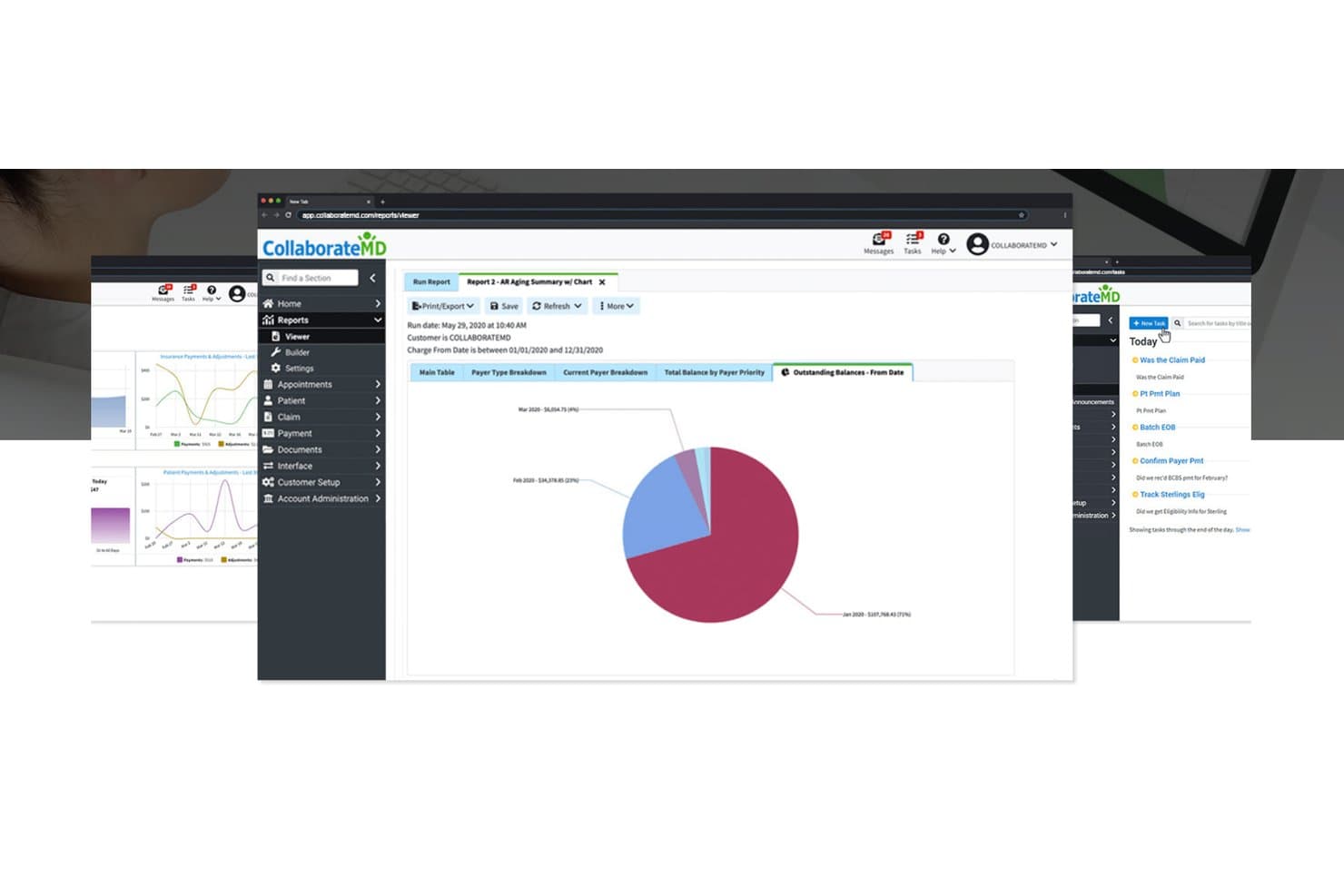
CollaborateMD offers an AR Aging Summary report with interactive pie charts and task management panels for healthcare billing workflows. CollaborateMD is a cloud-based medical billing and practice management platform with a built-in clearinghouse that handles electronic claims submission, real-time eligibility verification, ERA auto-posting, and denial management.
Who Is CollaborateMD Best For?
CollaborateMD is a strong fit for small to mid-sized medical practices and independent billing companies managing claims across multiple providers.
Why I Picked CollaborateMD
I picked CollaborateMD as one of the best because its built-in clearinghouse removes the need for a separate clearinghouse subscription entirely. I particularly like the Level 2 claim scrubbing, which checks CCI, NCD/LCD, and modifier rules before transmission, catching errors that would otherwise result in denials. On top of that, the AI-powered rejection explanations translate payer denial codes into plain language, so my team spends less time decoding rejections and more time correcting and resubmitting claims.
CollaborateMD Key Features
- Real-time eligibility verification: Instantly check patient insurance coverage with batch and individual 270/271 EDI transactions.
- Automated ERA auto-posting: Receive and auto-post 835 remittances directly to the practice management system.
- EHR and lab integrations: Connect with EHR partners, diagnostic labs, and mobile charge capture via standard interfaces or API.
- Customizable analytics and reporting: Access 125+ customizable financial and operational reports within the platform.
CollaborateMD Integrations
CollaborateMD offers native integrations with Practice Fusion, Nexus Clinical, Alleva, PBO MD, Stride, The Tree, Amazing Charts, Praxis, PrognoCIS, KIPU, Hello Health, Quest Diagnostics, LabCorp, LabDAQ, MDTech, and MediMobile, and provides an API for custom integrations.
Pros and Cons
Pros:
- Batch eligibility checks for multiple patients
- Real-time claim status and ERA posting
- Built-in clearinghouse for direct payer connections
Cons:
- Lacks built-in root-cause analytics for denials
- No automated scheduled eligibility runs
Learn more about CollaborateMD: Best for independent practice claims management
- Free demo available
- Pricing upon request
Visit WebsiteCustomer Rating:3.9/5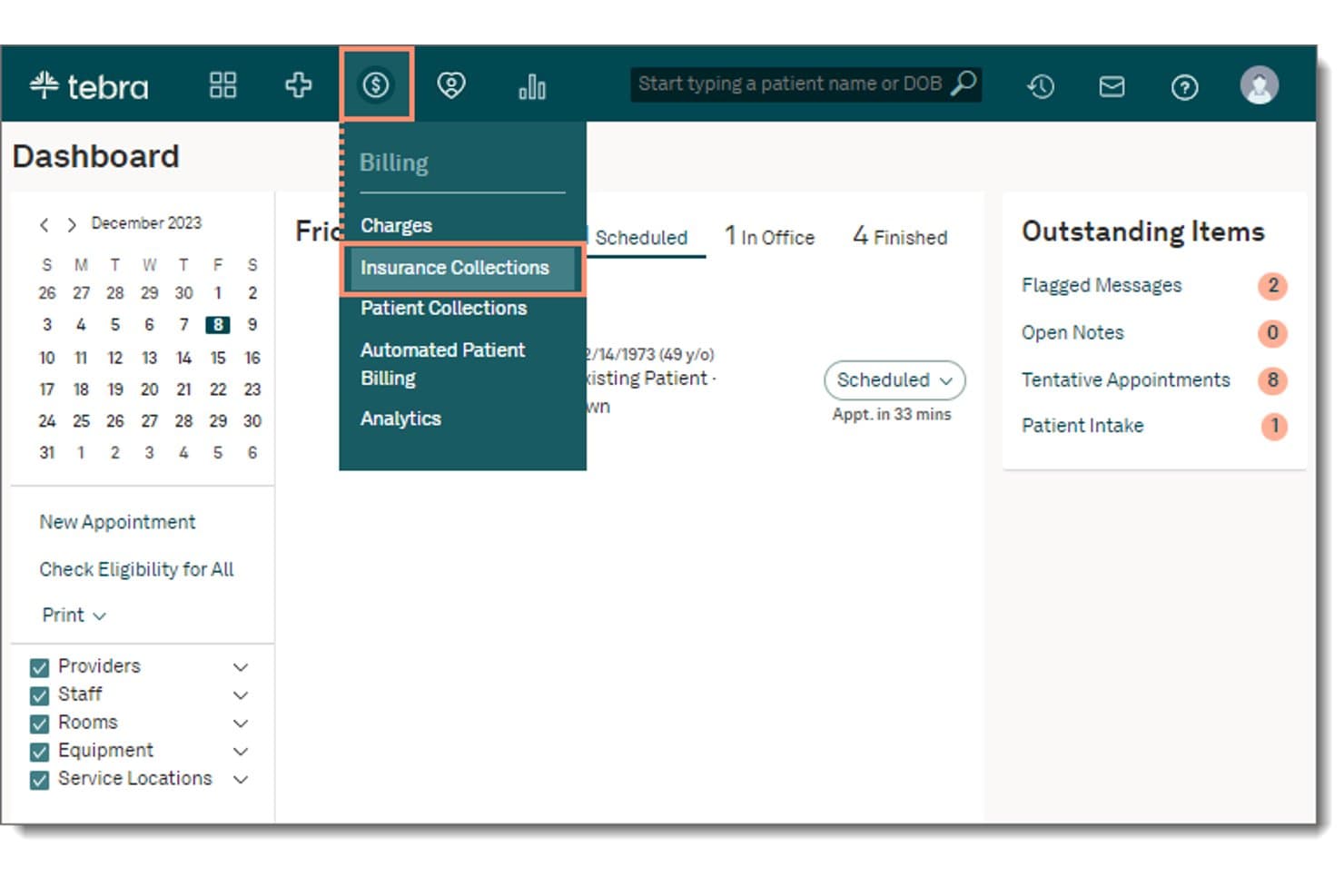
Tebra offers an Insurance Collections navigation option within its Billing dropdown menu, accessible from the main dashboard. Tebra is a cloud-based practice management and EDI platform that handles electronic claims submission, real-time eligibility verification, ERA auto-posting, and denial management for independent medical practices.
Who Is Tebra Best For?
Tebra is a strong fit for small independent practices that manage billing in-house and need a single platform to handle claims, eligibility, and remittance.
Why I Picked Tebra
I picked Tebra as one of the best because its claim scrubbing engine applies payer-specific rules before EDI transmission via TriZetto, catching errors that would otherwise trigger rejections. I like that real-time 270/271 eligibility checks run against 2,700+ payers before a claim ever reaches the clearinghouse. The RPA-driven ERA auto-posting then closes the loop, matching remittance against submitted claims without manual entry.
Tebra Key Features
- HL7 and FHIR interoperability: Connects with most major EHRs using HL7 or FHIR protocols for data exchange.
- Custom fee schedule management: Lets you tailor billing rates and rules at the payer, plan, or provider level.
- Advanced reporting dashboards: Provides detailed analytics on claim status, remittance posting, and payer performance.
- Patient payment automation: Sends digital statements and payment links by email or SMS for faster collections.
Tebra Integrations
Tebra offers native integrations with TriZetto and Jopari for clearinghouse and claims processing, and supports interoperability with over 60 EHR systems using HL7 or FHIR protocols. An API is available for custom integrations.
Pros and Cons
Pros:
- Denial management workflow with instant appeal
- Automated claim scrubbing before EDI submission
- Real-time eligibility checks for 2,700+ payers
Cons:
- Payer library lacks workers’ comp depth
- Limited root-cause denial analytics
Learn more about Tebra: Best for EDI-enabled medical billing automation
- Free demo available
- Pricing upon request
Visit WebsiteCustomer Rating:3.6/5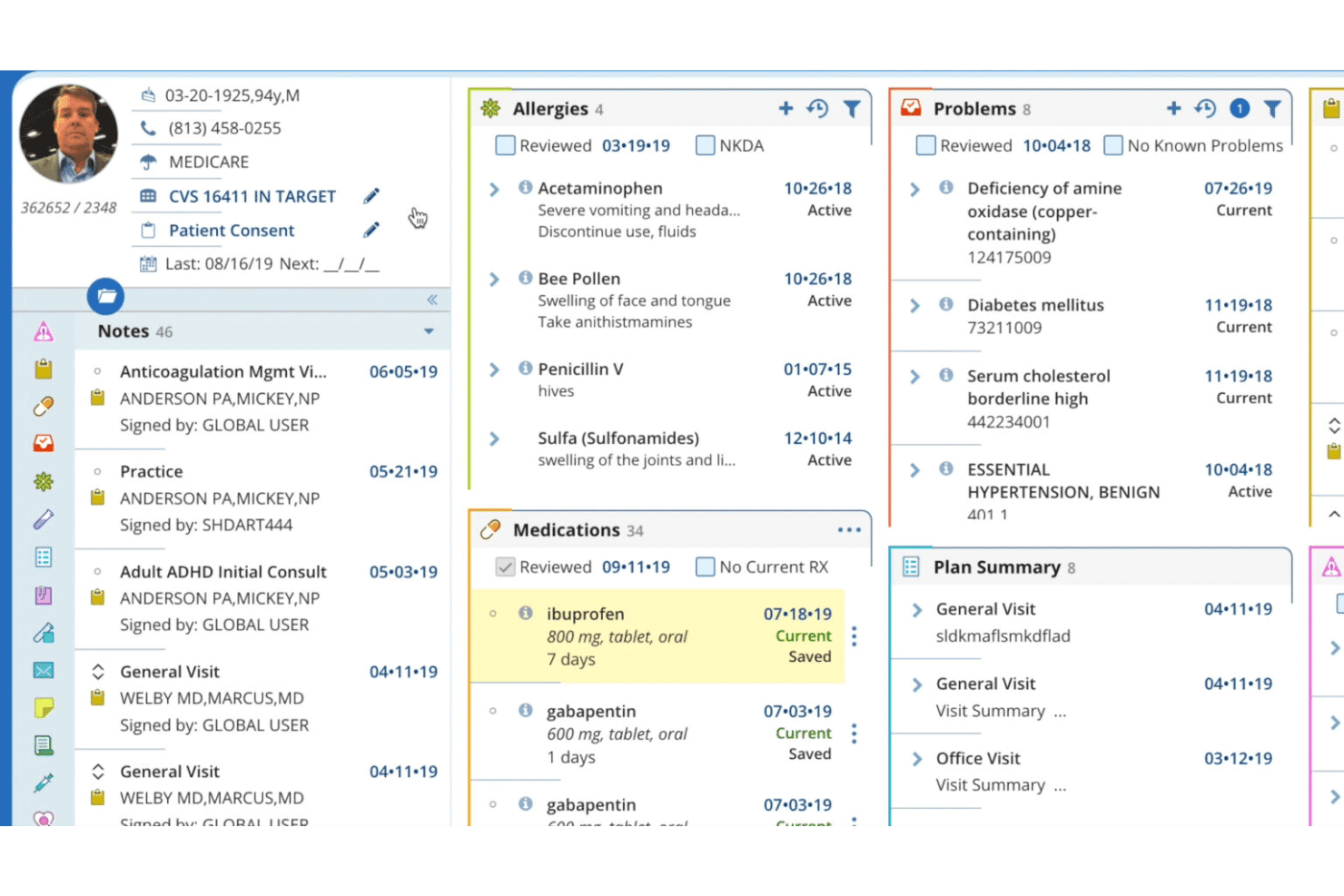
AdvancedMD patient record view with allergies, medications, and care plans. AdvancedMD is a cloud-based medical billing and practice management platform that handles EDI claims submission, automated remittance processing, eligibility verification, and denial management through a built-in multi-clearinghouse connection.
Who Is AdvancedMD Best For?
AdvancedMD is a strong fit for independent medical practices with in-house billing teams managing high claim volumes across multiple providers or locations.
Why I Picked AdvancedMD
I picked AdvancedMD as one of the best because its ClaimInspector tool scrubs every claim against CCI, HIPAA, and LCD rules before transmission, catching errors that would otherwise return as denials. I also like that the platform operates as its own clearinghouse, with Waystar as the preferred payment network, connecting to 1,800+ payers without a separate clearinghouse subscription. ERA posting is automatic, so my team isn't manually matching 835 files to open claims.
AdvancedMD Key Features
- A/R Control Center: Centralized dashboards and worklists help teams manage accounts receivable and track outstanding balances.
- Central Billing Office: Manage billing for multiple providers or locations within a single unified database and login.
- Batch eligibility verification: Process eligibility checks for groups of patients simultaneously to save staff time.
- Customizable financial reporting: Create financial dashboards and reports that update in real time across your practice.
AdvancedMD Integrations
AdvancedMD offers native integrations with Dragon Medical One, Inbox Health, MedXCom, Falkondata, LeadSquared, ChartRequest, DAX Copilot, DeepScribe, Doctorsoft, and InstaMed. An Open API is available for custom integrations.
Pros and Cons
Pros:
- Built-in batch eligibility verification tool
- Centralized dashboards for A/R and claim tracking
- ClaimInspector stops preventable denials pre-submission
Cons:
- Multi-entity support setup can be complex
- Appeals and root-cause denial analytics limited
 Best for affordable clearinghouse
- Free plan available
- From $44.95/user/month
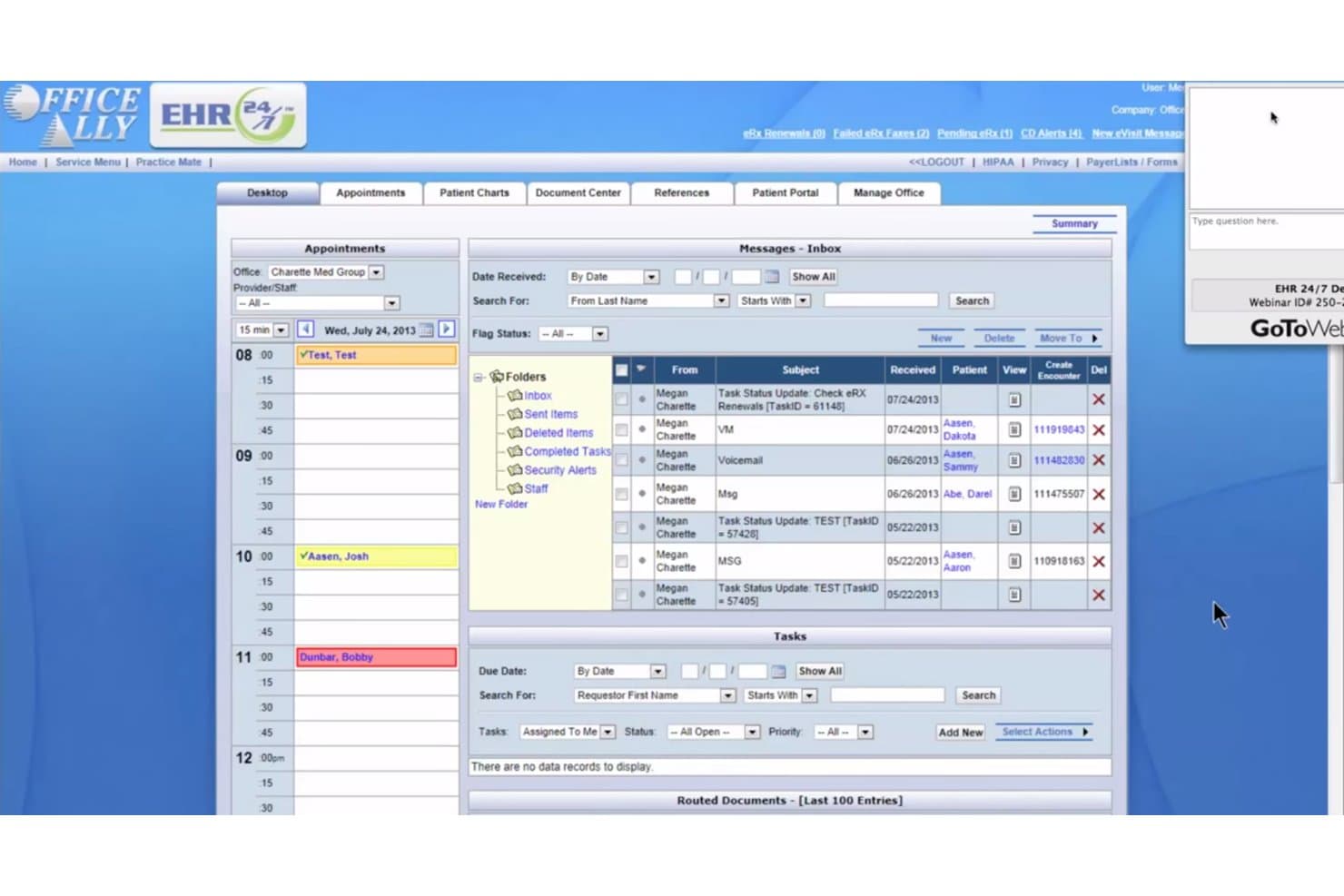
Office Ally EHR offers a comprehensive desktop dashboard with appointment scheduling, inbox messaging, and task management for healthcare providers. Office Ally EHR is a cloud-based all-payer clearinghouse and EHR platform that handles EDI claims submission, real-time eligibility verification, electronic remittance processing, and claim status tracking across a broad payer network.
Who Is Office Ally EHR Best For?
It's a strong fit for independent practices and medical billing teams that need a low-cost EDI clearinghouse without sacrificing payer reach or HIPAA transaction support.
Why I Picked Office Ally EHR
I picked Office Ally EHR as one of the best because its Service Center clearinghouse starts free and still reaches 6,100+ payers, spanning commercial, Medicare, Medicaid, and workers' comp claims. I like that it covers the core HIPAA X12 transaction sets, including 837 claim submission, 835 ERA parsing, and real-time 270/271 eligibility checks. Its CAQH CORE Phase III certification adds weight, confirming it handles both batch and real-time transactions at a level that holds up under payer scrutiny.
Office Ally EHR Key Features
- All-payer claim portal: Lets you submit, track, and edit claims across commercial, Medicare, Medicaid, and workers’ compensation payers.
- Insurance discovery tool: Identifies potential patient coverage options to reduce eligibility-related claim rejections.
- Customizable superbill builder: Enables creation and management of diagnosis and procedure codes tailored to your specialty workflow.
- Integrated patient ledger: Tracks patient balances, payments, and account history in one place for audit or review.
Office Ally EHR Integrations
Office Ally EHR offers integrations with external systems via SFTP and secure API, supports HL7 lab interfaces, connects with HIE organizations and immunization registries, and is compatible with most practice management software through print-image file uploads.
Pros and Cons
Pros:
- Provides real-time 270/271 eligibility uploads
- Covers all major payer types nationwide
- No per-claim transaction fees for most payers
Cons:
- Limited 278 and 820/834 transaction support
- Batch claim uploads require manual workarounds
Learn more about Office Ally EHR:
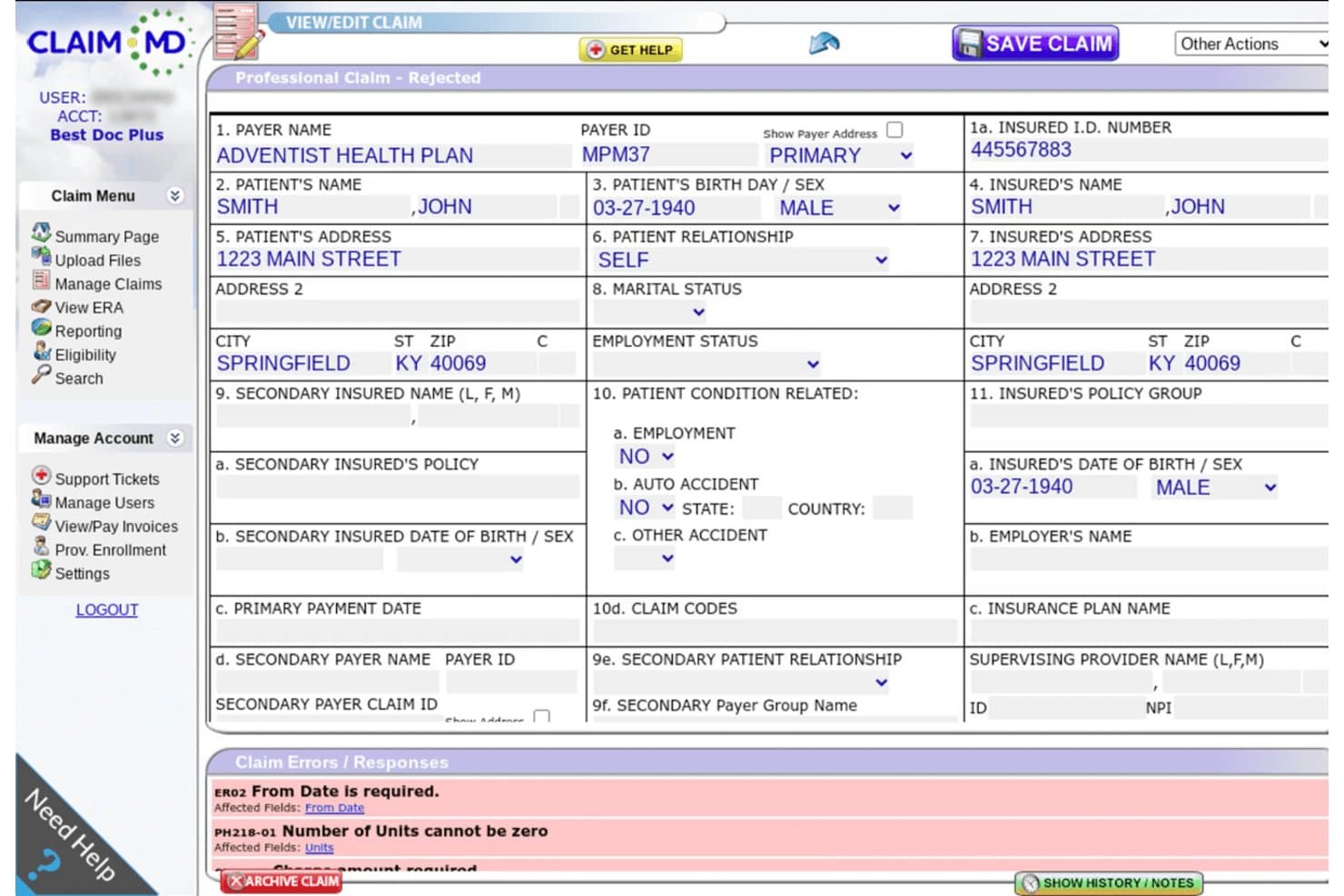
Claim.MD offers a detailed View/Edit Claim form with fields for payer, patient, and insured information, along with visible claim errors and rejection status. Claim.MD is a healthcare EDI clearinghouse that handles electronic claims submission, ERA processing, real-time eligibility verification, and rejection management across a broad network of commercial, Medicare, and Medicaid payers.
Who Is Claim.MD Best For?
Claim.MD works well for independent practices and billing services that need a direct clearinghouse connection without the overhead of a full practice management platform.
Why I Picked Claim.MD
I picked Claim.MD because no other clearinghouse I've used comes as close to true real-time claims transmission. Most clearinghouses batch and send claims overnight, but Claim.MD gets payer acknowledgments back in minutes. When a claim does come back rejected, the interactive editing workflow lets me correct it directly and resubmit with the payer's Original Claim ID attached, keeping the claim's history intact.
Claim.MD Key Features
- Eligibility transaction bundling: Plans include bundled eligibility transactions for efficient patient coverage checks without extra setup.
- ERA/835 remittance parsing: Download, print, or view electronic remittance in spreadsheet, XML, PDF, or standard 835 formats.
- Integration marketplace: Connect to a range of EHR and practice management systems using supported data formats and APIs.
- Multi-format claim support: Upload and process 837P/837I, CSV, XLS, XML, NSF, and print image file types for flexible claim submission.
Claim.MD Integrations
Claim.MD offers native integrations with Jane, NowMD, and Office Puzzle, and provides an API for custom integrations. It connects to thousands of payers, including Medicare, Medicaid, and Blue Cross Blue Shield.
Pros and Cons
Pros:
- Fast rejection visibility for immediate action
- Interactive claim correction and resubmission workflow
- Real-time claim submission and payer acknowledgment
Cons:
- Auto-posting of ERAs depends on integrations
- Does not support 278 authorization transactions
Learn more about Claim.MD: Best for automated claims and payment workflows
- Free demo available
- Pricing upon request
Visit WebsiteCustomer Rating:4.4/5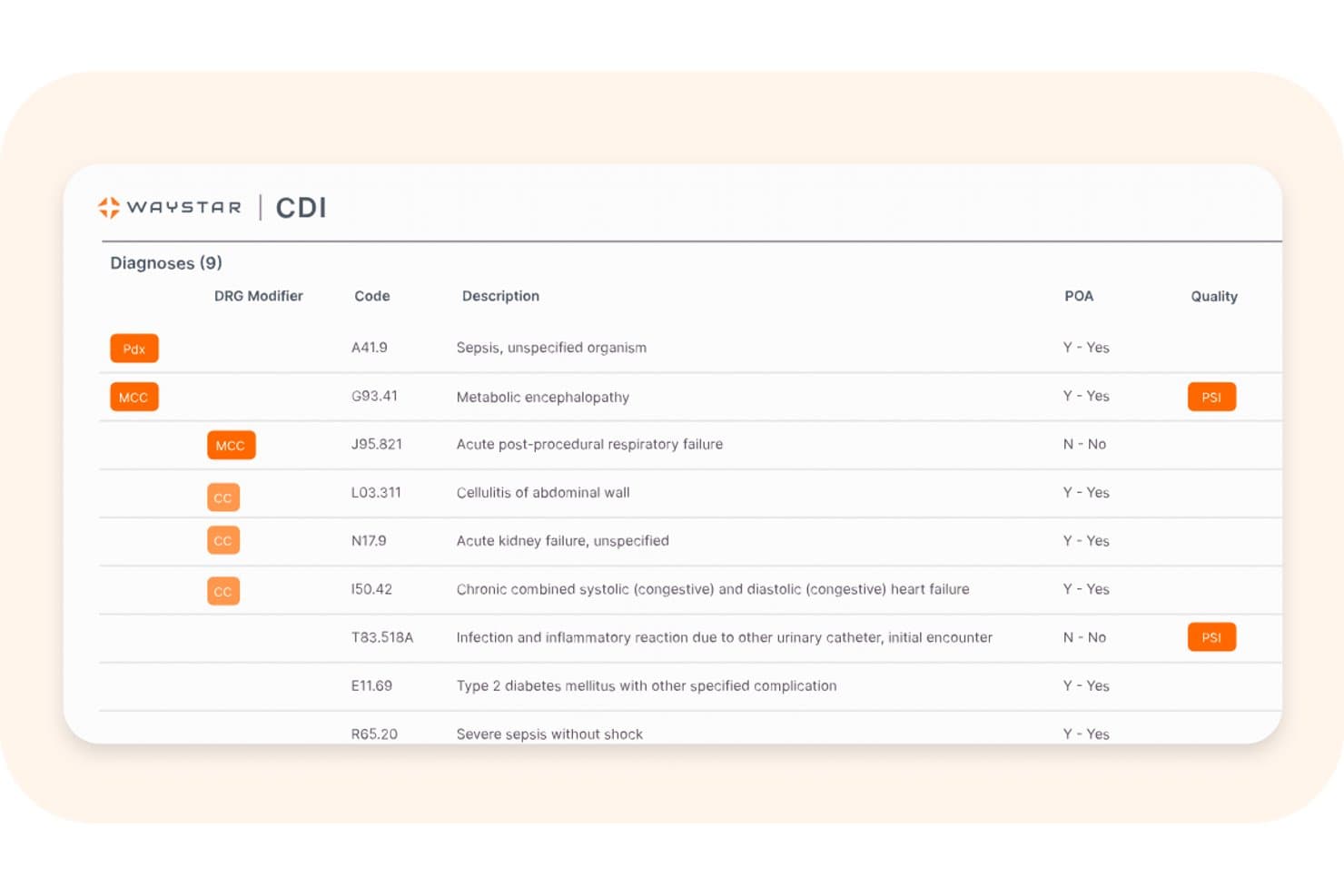
Waystar offers a CDI (Clinical Documentation Integrity) interface that displays a list of nine diagnoses with DRG modifiers, ICD-10 codes, descriptions, POA status, and quality flags like PSI. Waystar is a healthcare payments and EDI clearinghouse platform that handles claims submission, eligibility verification, remittance processing, and denial management across commercial, Medicare, and Medicaid payers.
Who Is Waystar Best For?
Waystar is a strong fit for revenue cycle teams at hospitals, health systems, and large group practices managing high claim volumes across multiple payers.
Why I Picked Waystar
Waystar earns its spot on my shortlist because of how far it takes claims automation before a claim ever reaches a payer. Its Claim Manager applies payer-specific edits and crowdsourced scrubbing rules that catch errors pre-submission, which is how it consistently hits a 98.5% first-pass clean claims rate. I also like how AltitudeAI handles the denial side, routing appeals automatically and batching up to 100 at a time to the same payer.
Waystar Key Features
- Eligibility verification dashboard: Lets staff run real-time and batch 270/271 eligibility checks across hundreds of payers.
- Integrated remit manager: Parses and auto-posts 835 ERA files for payment reconciliation and audit tracking.
- Pre-built payer connection library: Includes thousands of commercial payer, Medicare, and Medicaid connections out of the box.
- Quality and compliance reporting: Tracks X12 EDI acceptance, turnaround time, and HIPAA transaction compliance with customizable analytics.
Waystar Integrations
Waystar offers native integrations with Epic, Cerner, Athenahealth, NextGen, and Allscripts, supports all major practice management systems, and provides an API for custom integrations.
Pros and Cons
Pros:
- Deep payer connectivity across commercial and government payers
- Automated denial routing and appeals batching
- Extremely high first-pass clean claims rate
Cons:
- Contract terms may be difficult to negotiate
- Customer support response times can be slow
Learn more about Waystar: Best for payer connectivity and eligibility checks
- Not available
- Pricing upon request
Visit WebsiteCustomer Rating:3.7/5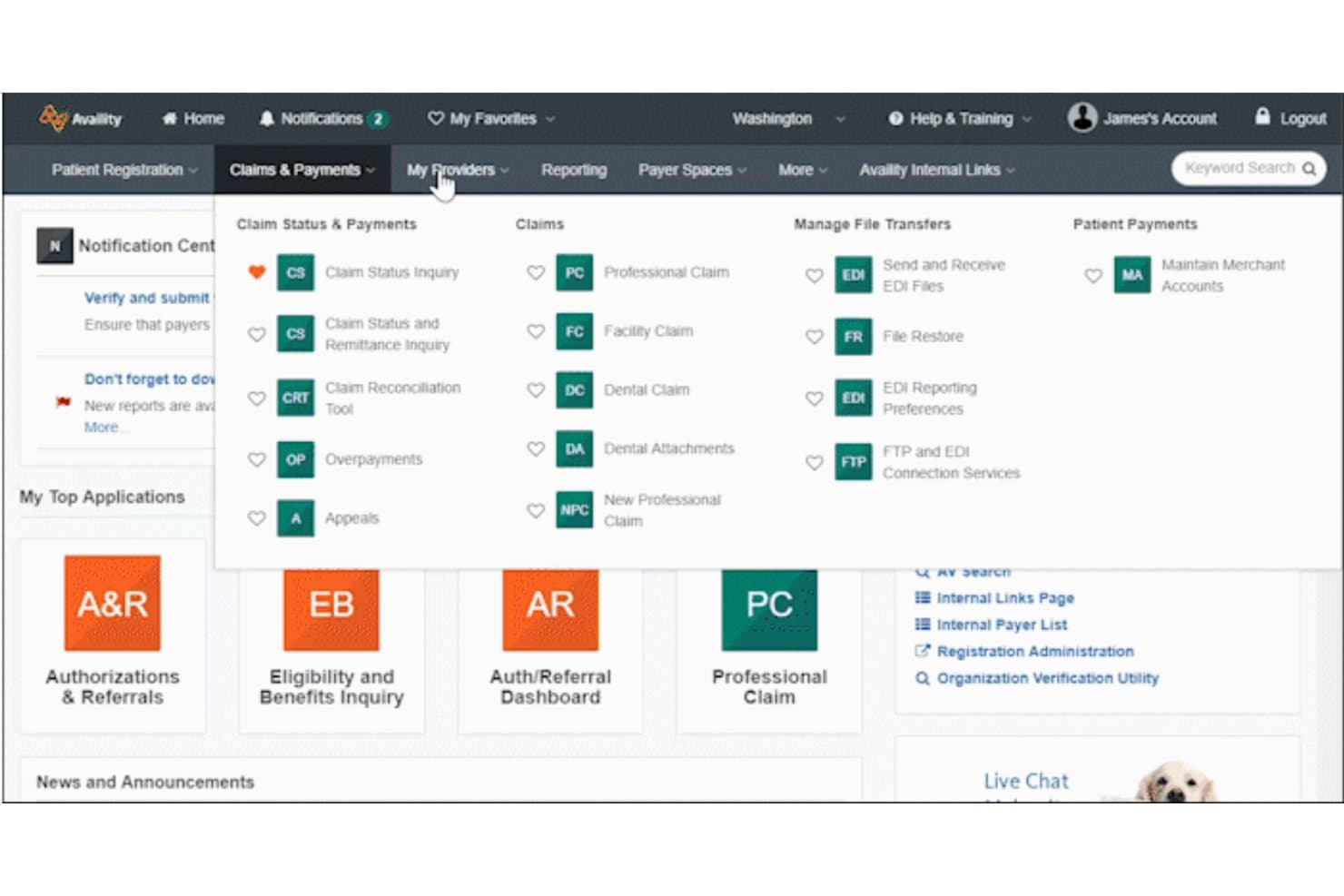
Availity offers a comprehensive Claims & Payments menu with EDI file management, claim submission, and remittance inquiry tools for healthcare providers. Availity is a healthcare EDI clearinghouse and payer connectivity network that supports HIPAA X12 transactions for claims submission, real-time eligibility verification, remittance processing, and prior authorization across a nationwide all-payer network.
Who Is Availity Best For?
Availity is a strong fit for medical billing teams and revenue cycle staff at provider organizations that need direct, multi-payer EDI connectivity without managing separate payer portal logins.
Why I Picked Availity
Availity earns its spot on my shortlist because of the scale and depth of its payer network. I love that real-time 270/271 eligibility checks return copay, deductible, and coinsurance breakdowns, not just a basic yes/no coverage confirmation. I also rely on the self-pay eligibility discovery tool, which surfaces potential Medicaid coverage for uninsured patients before a claim is ever submitted.
Availity Key Features
- Claim status tracking: Monitor 276/277 claim status updates directly within the portal for timely information on every submission.
- API connectivity for EHRs and PMS: Connect EHR and practice management systems using X12, SOAP, REST, or FHIR APIs for seamless data exchange.
- 835 remittance parsing and delivery: Receive and parse electronic remittance advice files for easy integration into payment workflows.
- Provider enrollment management: Manage provider credentials, NPI, and trading partner enrollments within a single interface.
Availity Integrations
Availity offers native integrations with Epic and other leading EHR and practice management systems, supports direct connections using X12, SOAP, REST, and FHIR APIs, and provides API access for custom integrations.
Pros and Cons
Pros:
- Automated claims scrubbing with payer-specific edits
- Real-time eligibility response with detailed breakdown
- Nationwide all-payer clearinghouse network
Cons:
- Limited denial analytics and appeals workflows
- ERA auto-posting issues with some payers
Learn more about Availity: Best for healthcare transaction management
- Free demo available
- Pricing upon request
Visit WebsiteCustomer Rating:3.9/5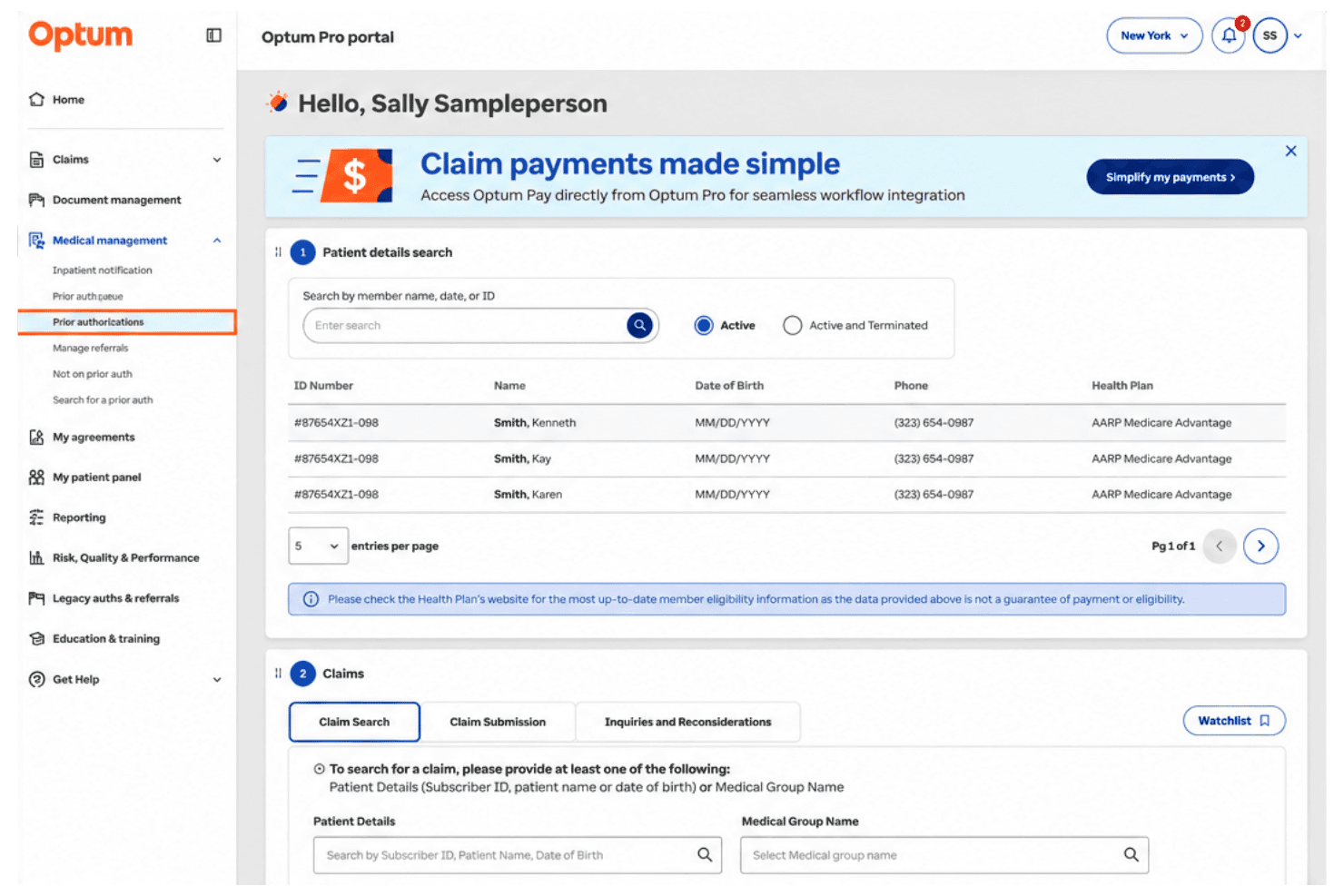
Optum (Change Healthcare) offers a Pro portal dashboard with prior authorization search, patient details lookup, and claims management tools for billing workflows. Optum (Change Healthcare) is a healthcare clearinghouse that processes HIPAA X12 transactions—including 837 claims, 835 remittance, 270/271 eligibility, 276/277 claim status, and 278 authorizations—across a payer network of 5,500+ connections via SFTP, REST APIs, and web portals.
Who Is Optum (Change Healthcare) Best For?
It's a strong fit for hospitals, large physician groups, and RCM billing companies that process high claim volumes across multiple payers.
Why I Picked Optum (Change Healthcare)
I picked Optum (Change Healthcare) as one of the best because its 5,500+ payer network is genuinely unmatched in the U.S. clearinghouse market. I also like the Enhanced Eligibility API, which applies a customer-specific rules engine and payer-specific benefit normalization in real time, so 271 responses reflect actual payer benefit structures. The AI-driven claim scrubbing layer applies payer-specific edits before transmission, which cuts rejection rates at the source.
Optum (Change Healthcare) Key Features
- Advanced claim routing: Directs transactions to payers with customizable logic for different claim types and adjudicator requirements.
- API-first architecture: Offers RESTful APIs for real-time and batch X12 transactions, accessible in JSON format.
- EDI transaction dashboards: Visualizes metrics like submission status, turnaround time, and payer response rates for multiple transaction sets.
- Payer enrollment support: Provides onboarding assistance with trading partner setup and payer enrollment for practices and billing companies.
Optum (Change Healthcare) Integrations
Optum (Change Healthcare) offers native integrations with Epic, Oracle Health (Cerner), MEDITECH, athenahealth, NextGen Healthcare, and eClinicalWorks, and provides an API for custom integrations.
Pros and Cons
Pros:
- Robust support for high-volume enterprise transactions
- Real-time benefit response normalization for 271 files
- Largest payer network in the clearinghouse market
Cons:
- Payer-adjacent ownership may raise neutrality concerns
- Outages and downtime reported after major cyberattack
Learn more about Optum (Change Healthcare): Best for payer-provider EDI connectivity
- Free demo available
- Pricing upon request
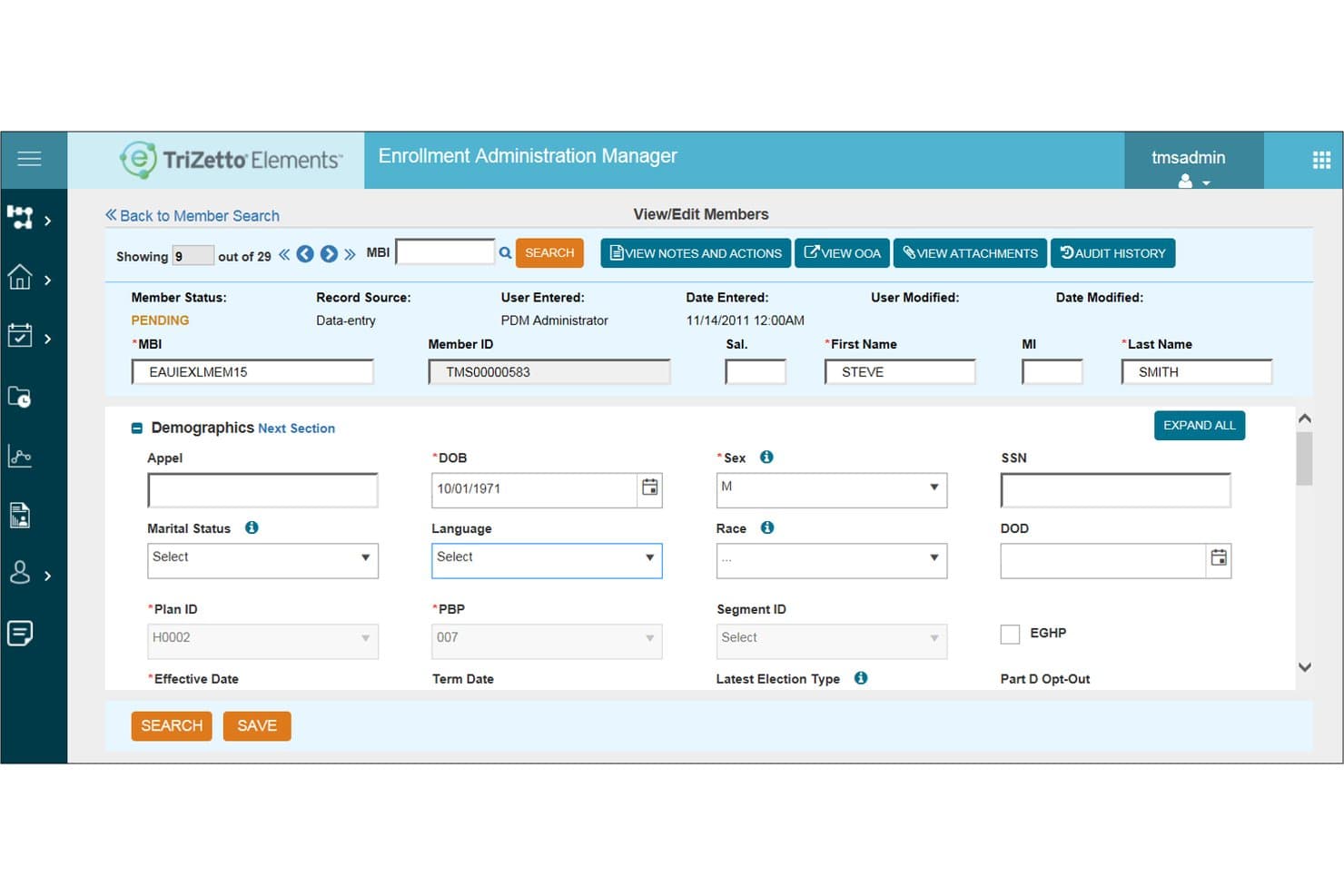
Cognizant TriZetto Provider Solutions offers an Enrollment Administration Manager interface for viewing and editing member demographics, plan details, and enrollment status. Cognizant TriZetto Provider Solutions is a healthcare clearinghouse and revenue cycle platform that handles electronic claims submission, eligibility verification, remittance processing, and denial management across professional, institutional, and dental claims.
Who Is Cognizant TriZetto Provider Solutions Best For?
It's a strong fit for revenue cycle teams at physician practices, billing services, and health systems that need enterprise-grade clearinghouse connectivity at scale.
Why I Picked Cognizant TriZetto Provider Solutions
Cognizant TriZetto Provider Solutions earns its spot on my shortlist because of the sheer depth of its payer network. With over 11,000 payer connections spanning commercial, Medicare, Medicaid, and workers' comp, I've found it covers virtually every payer my billing team encounters. I also like the AI-powered Advanced Claim Editing, which applies payer-specific edits before transmission to catch errors that generic scrubbing misses.
Cognizant TriZetto Provider Solutions Key Features
- Real-time eligibility checks: Instantly verify patient insurance details using 270/271 inquiry and response transactions.
- 835 remittance auto-posting: Automatically apply electronic remittance advices to patient accounts through PMS/EHR integrations.
- Denial workflow tools: Track, categorize, and resolve claim rejections and denials with configurable management workflows.
- HIPAA and SOC 2 compliance: Maintain regulatory standards through end-to-end encryption and certified data handling protocols.
Cognizant TriZetto Provider Solutions Integrations
Cognizant TriZetto Provider Solutions offers native integrations with over 650 practice management systems and electronic health record platforms, including Epic, Cerner, NextGen, Athenahealth, and Greenway Health. An API is available for custom integrations.
Pros and Cons
Pros:
- Supports high-volume multi-entity organizations
- Advanced denial and rejection workflow tools
- Extensive national payer connectivity
Cons:
- Claims setup and onboarding can be complex
- Customer service response times can be slow
Learn more about Cognizant TriZetto Provider Solutions: Best for claim validation
- Free demo available
- Pricing upon request
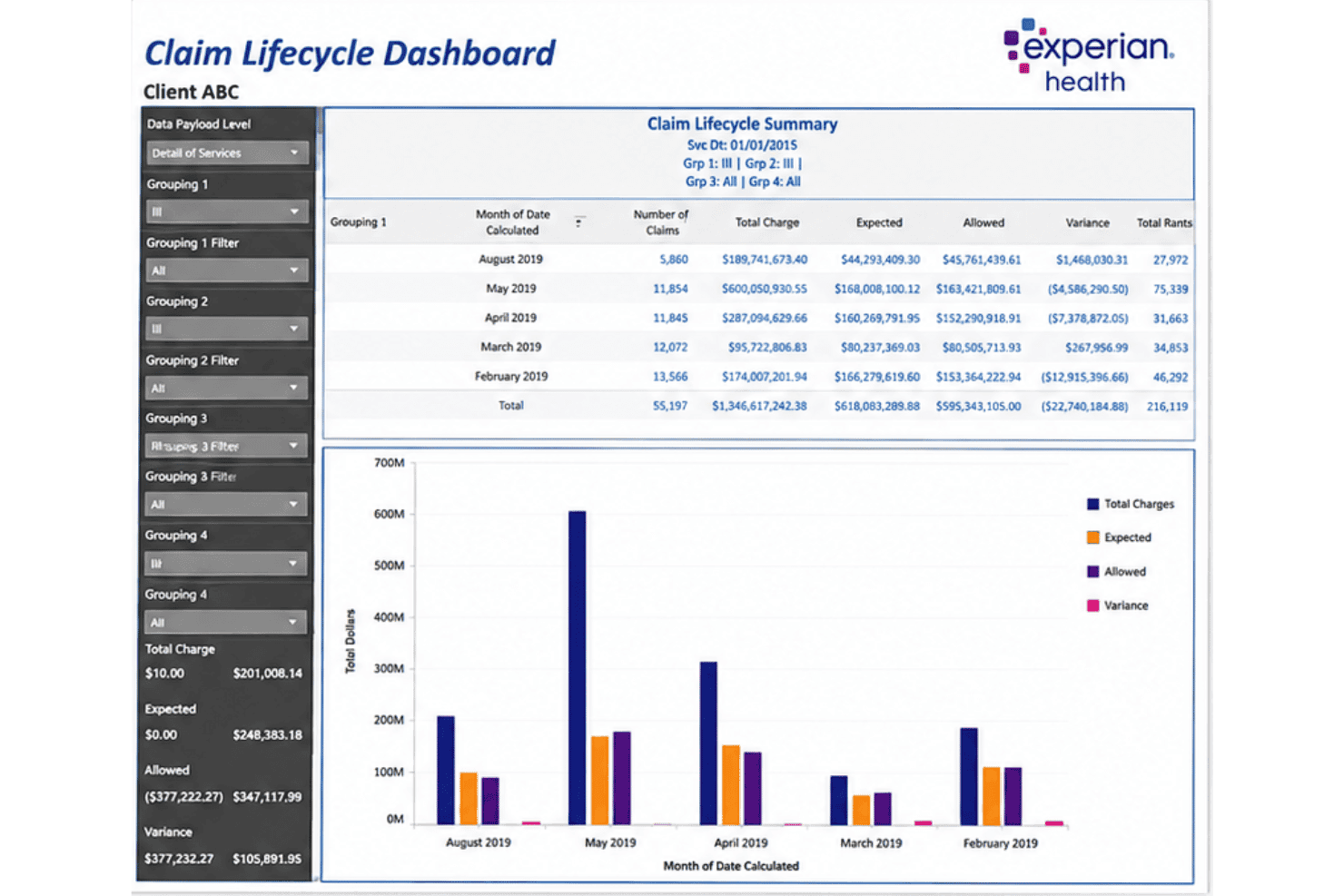
Experian Health ClaimSource handles claims, edits, tracking, denials, and ERA. Experian Health ClaimSource is a claims management platform that handles EDI claim submission, automated pre-submission scrubbing, payer-specific edits, remittance processing, eligibility verification, and denial workflow management for healthcare providers.
Who Is Experian Health ClaimSource Best For?
ClaimSource is a strong fit for mid-to-large health systems and hospitals with high claims volume that need automated, enterprise-grade editing and denial management.
Why I Picked Experian Health ClaimSource
ClaimSource earns its spot on my shortlist because of how seriously it approaches pre-submission claim validation. It combines a national payer edits library with custom provider-specific edits, so claims are validated against real payer rules before submission. The AI Advantage Predictive Denials module goes further, flagging likely denials before my team even sends a claim out. That kind of upstream error-catching is where ClaimSource genuinely separates itself from standard clearinghouse tools.
Experian Health ClaimSource Key Features
- ERA and remit processing: Handles electronic remittance advice (835) files with parsing and automated posting workflows.
- Payer connectivity library: Connects directly to thousands of commercial, Medicare, and Medicaid payers.
- Real-time eligibility and benefits verification: Supports 270/271 eligibility checks against payer databases within the claims workflow.
- Denial workflow manager: Centralizes denial categorization, correction, appeals routing, and automated resubmission tracking.
Experian Health ClaimSource Integrations
ClaimSource offers native integrations with Epic, athenahealth, Oracle Health, FollowMyHealth, and NextGate. An API is available for custom integrations.
Pros and Cons
Pros:
- Automated workflows for denial management
- Predictive denials with AI root-cause analysis
- National payer and custom claim edits
Cons:
- Limited presence on public review platforms
- No self-service training resources available
Learn more about Experian Health ClaimSource:
Annen EDI-programvare for helsetjenester
Her er noen flere alternativer for EDI-programvare for helsetjenester som ikke kom med på kortlisten min, men som likevel er verdt å se nærmere på:
- 11SSI GroupBest for high-volume claims
- 12AthenahealthBest for integrated claims and practice workflows
- 13RXNTBest for integrated EDI and medical billing
- 14DrChronoBest for EDI billing within practice workflows
- 15EZClaimBest for simple electronic claims submission
- 16InovalonBest for healthcare data exchange
- 17Veradigm PayerpathBest for claims and remittance workflows
- 18Zelis PaymentsBest for electronic healthcare payment processing
- 19AppVerifyBest for insurance eligibility verification
How I Evaluate Healthcare EDI Software
I split my evaluation into two layers: whether a platform handles core HIPAA X12 transactions reliably, and what sets it apart for billing managers chasing fewer denials and faster ERA reconciliation.
Core Functionality (Table Stakes For This List)
When I'm selecting tools for my list, I rank each one on a scale from 0 (does not offer the functionality) to 5 (excels in this area) for each core functionality listed below. Then, I calculate the tool's total score into a percentage. Each tool needs to achieve a minimum total score of 65% to be considered for inclusion.
- HIPAA X12 Transaction Support: I check whether a platform handles the full range of X12 sets—837, 835, 270/271, 276/277, and 278—not just claims and remittance.
- Claims Submission & Scrubbing: Pre-submission scrubbing matters most here. I look for payer-specific edit libraries that catch errors before claims leave your system.
- Payer Connectivity: I evaluate the breadth of payer connections, including commercial, Medicare, and Medicaid networks, and whether setup requires manual enrollment.
- Eligibility Verification: Real-time 270/271 lookups at the front desk prevent surprises at billing. I look for batch and scheduled options alongside single-patient checks.
- ERA & Remittance Processing: I look for 835 parsing with auto-posting to your practice management system, plus variance flagging when payments don't match expected amounts.
- Denial & Rejection Management: Beyond displaying raw rejection codes, I evaluate whether a tool offers denial categorization, resubmission workflows, and root-cause tracking.
Once I have a list of tools that meet the criteria, I consider what sets each platform apart.
Differentiating Factors (What Sets Vendors Apart)
Here's how I compare and contrast different vendors:
Standout Features
EDI transaction analytics make a real difference at high volumes. Dashboards that track acceptance rates and turnaround times by payer help you spot bottlenecks before they become revenue problems. Denial management is another area where I look for depth. Platforms with root-cause analytics and appeals routing give billing teams a clear path to recover revenue. A broad payer connectivity library also matters—pre-built connections save your IT team from manually configuring trading partner agreements.
Beyond Features
Compliance goes beyond checking a HIPAA box. I look for signed BAAs, SOC 2 Type II certification, and end-to-end encryption for PHI—especially if you're handling high claim volumes across multiple entities. Integration matters just as much. Native connectors to your EHR and practice management system determine whether ERA auto-posting actually works or creates manual workarounds. I also evaluate pricing transparency, since hidden per-transaction fees or payer connection charges can erode margins as your volume scales.
Slik velger du EDI-programvare for helsetjenester
Det er lett å gå seg vill i lange funksjonslister og komplekse prisstrukturer. For å hjelpe deg med å holde fokus når du går gjennom den unike prosessen for valg av programvare, finner du her en sjekkliste over faktorer du bør ha i tankene:
| Faktor | Hva bør vurderes |
| Skalerbarhet | Kan plattformen håndtere økte kravvolumer, flere NPI-er eller nye lokasjoner over tid uten forstyrrende kostnader eller forsinkelser? |
| Integrasjoner | Integreres programvaren med EHR-, PM- eller faktureringssystemet ditt – eller trenger du omveier og manuell registrering for arbeidsflyter knyttet til krav og ERA? |
| Brukervennlighet | Hvor intuitivt er brukergrensesnittet for kundemottaks-, fakturerings- og administrasjonsteamene dine? Oppstår det ofte feil eller hoppes det over trinn i reelle prosesser? |
| Implementering og oppstart | Hvilken opplæring, innmelding hos betalere og støtte får du under oppsettet? Trenger teamet ditt praktisk hjelp for å sette løsningen i drift, eller må dere gjøre alt selv? |
| Tilpasningsmuligheter | Kan du tilpasse valideringsregler, arbeidsflyter og rapportering til spesialiteten eller betalersammensetningen din, eller er du bundet til rigide maler som skal passe for alle? |
| Sikkerhetstiltak | Tilbyr plattformen ende-til-ende-kryptering, revisjonsspor og signerte BAA-er, slik at du trygt kan håndtere PHI og svare på revisjoner eller sikkerhetsbrudd? |
| Kostnad | Er priser og gebyrer fra oppgjørssentralen transparente, eller finnes det skjulte gebyrer per krav eller for oppsett av betalere som kan overraske deg når kravvolumet øker? |
| Tilgjengelig kundestøtte | Når det oppstår problemer under behandling av krav eller ERA, kan du få kontakt med kompetent kundestøtte i sanntid, eller er du begrenset til sakskøer og automatiske svar? |
Hva er EDI-programvare for helsetjenester?
EDI-programvare for helsetjenester er en digital plattform som automatiserer sikker utveksling av medisinske transaksjoner – som krav, kontroll av berettigelse og betalingsmeldinger – mellom behandlere, betalere og oppgjørssentraler. Disse systemene hjelper faktureringsteam med å redusere manuelle feil, sikre samsvar med HIPAA-standarder for transaksjoner og fremskynde hele inntektssyklusen, fra pasientregistrering til refusjon fra betaleren.
Funksjoner i EDI-programvare for helsetjenester
Når du velger EDI-programvare for helsetjenester, bør du se etter følgende viktige funksjoner:
- Støtte for HIPAA X12-transaksjoner: Muliggjør standardiserte elektroniske overføringer av krav, betalingsanvisninger, kvalifikasjon, status og autorisasjoner mellom behandlere og betalere, samtidig som regelverksetterlevelse sikres.
- Innsending og kontroll av krav: Validerer og korrigerer krav før de sendes til betalere, identifiserer manglende eller feilaktige data for å redusere avvisninger og fremskynde refusjoner.
- Sanntidsverifisering av kvalifikasjon: Kontrollerer pasientens forsikringsdekning og ytelser umiddelbart på behandlingsstedet, forebygger uventede avvisninger av krav og gir et bedre grunnlag for faktureringssamtaler fra starten av.
- Automatisert bokføring av betalingsanvisninger: Tolker elektroniske betalingsanvisninger og bokfører betalinger automatisk i faktureringssystemet, noe som reduserer manuell registrering og fremskynder avstemmingen av inntekter.
- Bibliotek for betalertilgang: Tilbyr en samling forhåndsbygde direkteforbindelser eller forbindelser via oppgjørssentraler til nasjonale, regionale og offentlige betalere, slik at registrering og ruting av krav blir enklere.
- Håndtering av avvisninger og avslag: Merker krav som er avvist eller avslått, kategoriserer problemene og tilbyr arbeidsflyter for korrigering og ny innsending, slik at tapte inntekter begrenses.
- Funksjoner for satsvis behandling: Gjør det mulig å behandle flere krav, kvalifikasjonskontroller eller betalingsanvisninger samlet, slik at gjentakende faktureringsoppgaver effektiviseres.
- Tilpassbare rapporteringsverktøy: Genererer handlingsrettet innsikt i status for krav, nøkkeltall for inntektssyklusen og betalerytelse for å veilede driftsforbedringer.
- Sikker datahåndtering: Krypterer data under overføring og ved lagring, slik at pasientinformasjon beskyttes og kravene til sikkerhet i helsetjenesten oppfylles.
- Revisjonslogging og sporing: Opprettholder en detaljert historikk over innsendinger av krav, redigeringer, betalinger og brukeraktivitet for å støtte internkontroller og revisjoner hos betalere.
Vanlige AI-funksjoner i EDI-programvare for helsetjenesten
I tillegg til standardfunksjonene i EDI-programvare for helsetjenesten som er nevnt ovenfor, tar mange av disse løsningene i bruk AI med funksjoner som:
- Prediktiv analyse av avvisninger: Bruker maskinlæring til å analysere historiske kravdata og forutsi hvilke krav som mest sannsynlig vil bli avslått, slik at faktureringsteam kan prioritere oppfølgingen.
- Automatiserte forslag til koding: AI gjennomgår klinisk dokumentasjon og anbefaler de mest nøyaktige faktureringskodene, noe som reduserer manuelle kodefeil og fremskynder klargjøringen av krav.
- Intelligent dokumentuthenting: Henter ut viktige data fra skannede dokumenter, fakser eller PDF-filer ved hjelp av naturlig språkbehandling, slik at dataregistreringen for krav og betalingsanvisninger effektiviseres.
- Avviksdeteksjon for betalinger: AI merker uvanlige betalingsmønstre eller underbetalinger ved å sammenligne data fra betalingsanvisninger med forventet refusjon, noe som støtter raskere løsning av avvik.
- Smarte kvalifikasjonskontroller: Lærer kontinuerlig av svarmønstre hos betalere for å optimalisere kvalifikasjonskontroller, redusere unødvendige forespørsler og forbedre andelen verifiseringer som lykkes ved første forsøk.
Fordeler med EDI-programvare for helsetjenesten
Implementering av EDI-programvare for helsetjenesten gir flere fordeler for teamet og virksomheten din. Her er noen av fordelene du kan se frem til:
- Raskere behandling av krav: Automatisert innsending av krav og kvalifikasjonskontroller i sanntid betyr færre forsinkelser og raskere refusjoner fra betalere.
- Lavere avslagsrate: Kontroll av krav og AI-drevet analyse av avvisninger hjelper deg med å oppdage feil og korrigere problemer før de fører til avslag.
- Bedre oversikt over kontantstrømmen: Sanntidsdashbord og rapporter gir oversikt over utestående krav, betalinger og avvisninger hos alle betalere.
- Redusert manuelt arbeid: Automatisert bokføring av betalingsanvisninger, dokumentuthenting og satsvis behandling reduserer gjentakende dataregistrering for faktureringspersonalet.
- Større trygghet for regelverksetterlevelse: Innebygde sikkerhetstiltak, revisjonslogger og overholdelse av HIPAA-standarder bidrar til å beskytte pasientdata og forenkle regulatoriske revisjoner.
- Forenklede relasjoner til betalere: Forhåndsbygde biblioteker for betalertilgang og støtte ved oppstart fjerner bryderiet med å konfigurere eller vedlikeholde individuelle forbindelser til betalere.
- Forbedret inntektsinnhenting: Arbeidsflyter for håndtering av avvisninger og analyser av grunnleggende årsaker gjør det enklere å identifisere, klage på og hente inn igjen inntekter fra avviste krav.
Kostnader og priser for EDI-programvare for helsetjenesten
Ved valg av EDI-programvare for helsetjenesten er det nødvendig å forstå de ulike prismodellene og abonnementene som er tilgjengelige. Kostnadene varierer avhengig av funksjoner, teamstørrelse, tillegg og mer. Tabellen nedenfor oppsummerer vanlige abonnementer, gjennomsnittsprisene deres og typiske funksjoner som er inkludert i EDI-programvareløsninger for helsetjenesten:
Sammenligningstabell for EDI-programvare for helsetjenester
| Plantype | Gjennomsnittlig pris | Vanlige funksjoner |
| Gratisabonnement | $0 | Begrenset antall refusjonskrav, grunnleggende kvalifikasjonskontroller og minimal støtte. |
| Personlig abonnement | $50-$150/måned | Tilgang for én bruker, verktøy for innsending av refusjonskrav, grunnleggende tilkobling til betalere og manuell kontroll av kvalifisering. |
| Forretningsabonnement | $300-$900/måned | Støtte for flere brukere, innsending av flere refusjonskrav i grupper, tilgang til betalerbibliotek, kvalifikasjonskontroller i sanntid, rapporteringsdashbord og standardstøtte. |
| Abonnement for større virksomheter | $1200-$3500/måned | Tilpassede integrasjoner, dedikert kundeansvarlig, samsvarssertifiseringer, avansert analyse og prioritert oppstart og støtte. |
Vanlige spørsmål om EDI-programvare for helsetjenester
\u003cspan style=\u0022font-weight: 400;\u0022\u003eHer er noen svar på vanlige spørsmål om EDI-programvare for helsetjenester:\u003c/span\u003e
Hvor sikker er EDI-programvare for helsetjenester?
\u003cspan style=\u0022font-weight: 400;\u0022\u003eDe fleste plattformer bruker ende-til-ende-kryptering, følger HIPAA- og HITECH-retningslinjer og tilbyr revisjonslogging for å beskytte pasientopplysninger. Bekreft alltid at leverandøren tilbyr en signert BAA og oppfyller organisasjonens spesifikke krav til samsvar.\u003c/span\u003e
Kan EDI-programvare for helsetjenester kobles til alle EHR- eller faktureringssystemer?
\u003cspan style=\u0022font-weight: 400;\u0022\u003eAlle løsninger tilbyr ikke samme integrasjonsnivå. Noen har ferdigbygde koblinger til ledende EHR- og PM-systemer, mens andre baserer seg på API-er eller manuell eksport. Sjekk med leverandøren om løsningen er kompatibel med de nåværende systemene dine, og om det kreves ytterligere oppsett.\u003c/span\u003e
Hvor lang tid tar implementeringen vanligvis?
\u003cspan style=\u0022font-weight: 400;\u0022\u003eTidsrammen varierer avhengig av systemets kompleksitet, registrering hos betalere og opplæringsbehov. Små praksiser kan komme i drift i løpet av noen uker, mens større organisasjoner eller de som trenger tilpassede integrasjoner, kan forvente en lengre prosess med flere trinn.\u003c/span\u003e
Hvilke typer medisinske transaksjoner kan håndteres?
\u003cspan style=\u0022font-weight: 400;\u0022\u003eTypiske plattformer støtter innsending av refusjonskrav (837), kvalifikasjonskontroller (270/271), betalingsoversikter (835), status for refusjonskrav (276/277) og forhåndsgodkjenning (278). Kontroller at løsningen dekker EDI-transaksjonssettene du bruker oftest.\u003c/span\u003e
Bidrar EDI-programvare til å redusere avviste refusjonskrav?
Ja. Kontroll av refusjonskrav fanger opp feil før innsending, kvalifikasjonskontroller i sanntid avdekker dekningsproblemer på forhånd, og arbeidsflyter for avvisninger hjelper ansatte med å reagere raskt på avviste krav — samlet sett reduserer dette avvisningsandelen og fremskynder innbetalingene.
Hvilken støtte er tilgjengelig hvis det oppstår et problem med overføringen av refusjonskrav?
Støtten varierer fra leverandør til leverandør. Noen tilbyr telefonsupport eller chat i sanntid, mens andre baserer seg på e-post eller supportsystemer. Velg et støttenivå som passer teamets behov, særlig i perioder med stort volum eller driftsavbrudd hos betalere.