

Programvare for medisinsk fakturering innen psykisk helse er spesialisert teknologi som hjelper deg med å administrere forsikringskrav, pasientfakturering og betalinger for terapi og psykiatriske tjenester. Hvis du leter etter slike løsninger, balanserer du sannsynligvis mye papirarbeid, skiftende regelverk og et konstant behov for å kreve inn betalinger på en smidig måte – ofte med et lite team.
Riktig programvare utgjør en forskjell for praksisens kontantstrøm og din egen sinnsro. I denne veiledningen får du vite mer om ledende faktureringsplattformer for fagpersoner innen psykisk helse, se hvordan de ulike løsningene gjør det, og sitte igjen med kunnskap om hvilke alternativer som passer best for dine behov.
Why Trust Our Software Recommendations
6,700+
Reviews
20
Industry experts
16+
Evaluation factors
14
Years
Our team has been testing and reviewing software since 2012. As medical practice leaders ourselves, we know how difficult—and important—it is to choose the right software.
For this guide, we evaluated tools using hands-on testing and independent research, scoring tools using our selection criteria.
Our reviews reflect our human editorial judgment, not a sales pitch.
Sammenligningstabell for programvare for medisinsk fakturering innen psykisk helse
Denne sammenligningstabellen viser priser for mine beste utvalgte programmer for medisinsk fakturering innen psykisk helse:
| Tool | Best For | Trial Info | Price | ||
|---|---|---|---|---|---|
| 1 | Best for treatment billing | Free demo available | Pricing upon request | Website | |
| 2 | Best for psychiatric billing services | Free demo available | From $249/month | Website | |
| 3 | Best for enterprise behavioral billing | Free demo available | Pricing upon request | Website | |
| 4 | Best for independent practice billing | Free demo available | Pricing upon request | Website | |
| 5 | Best for automated claims management | Free demo available | Pricing upon request | Website | |
| 6 | Best for solo mental health billing | 30-day free trial | From $49/month | Website | |
| 7 | Best for therapy billing and claims | 30-day free trial | From $69/month | Website | |
| 8 | Best for integrated therapy billing | 21-day free trial | From $29/user/month | Website | |
| 9 | Best for behavioral health RCM | Free demo available | Pricing upon request | Website | |
| 10 | Best for psychiatry billing workflows | 30-day free trial | From $55/month | Website |


Anmeldelser av den beste programvaren for medisinsk fakturering innen psykisk helse
\u003cspan style=\u0022font-weight: 400\u0022\u003eNedenfor finner du mine detaljerte sammendrag av den beste programvaren for medisinsk fakturering innen psykisk helse som kom med på kortlisten min. Anmeldelsene mine gir en detaljert oversikt over funksjonene, prisene og de beste bruksområdene for hver programvare, slik at du kan finne den som passer best for deg.\u003c/span\u003e
 1Best for treatment billing
Kipu
- Free demo available
- Pricing upon request
Visit WebsiteCustomer Rating:4.7/5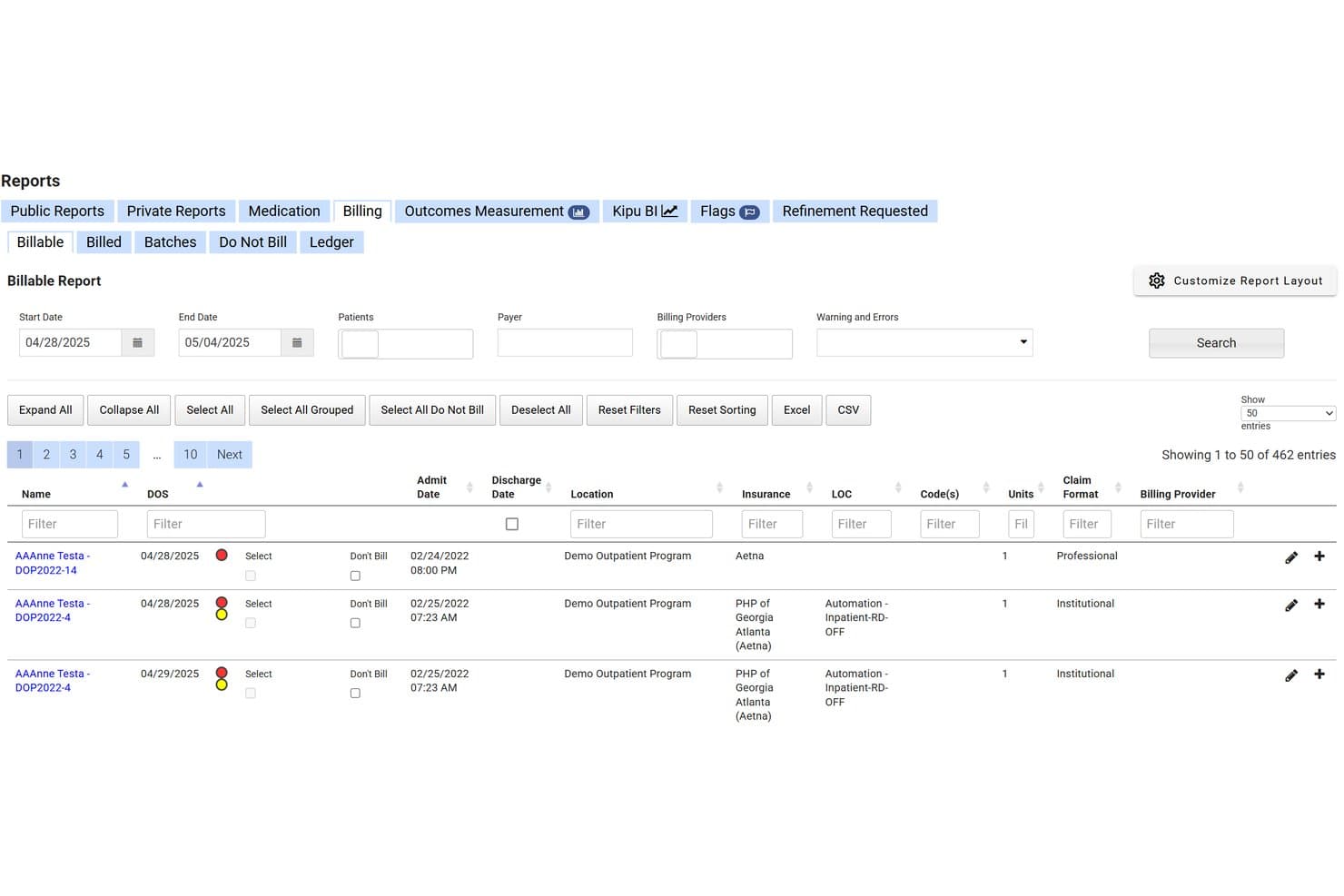
Kipu offers a detailed Billable Report within its Billing module, allowing mental health providers to filter, review, and manage claims by date, patient, payer, and insurance before submission. Kipu is a behavioral health EMR and RCM platform built specifically for addiction treatment and mental health providers, combining clinical documentation, claims submission, eligibility verification, and denial management in one system.
Who Is Kipu Best For?
Kipu is a strong fit for mid-size to large addiction treatment centers and residential behavioral health programs that manage high claim volumes across multiple payers.
Why I Picked Kipu
I picked Kipu as one of the best because its RCM module is built specifically around addiction treatment billing workflows, including utilization review, VOB at intake, and payer-specific claim scrubbing. The billing sweeps feature is what stands out to me: it surfaces outstanding claims automatically so nothing falls through. I've seen it report clearinghouse rejection rates as low as 0.44%, which reflects how tightly the scrubbing rules are tuned to behavioral health payer requirements.
Kipu Key Features
- Utilization review module: Tracks session authorizations, remaining visits, and expiration dates per payer.
- Real-time eligibility verification: Lets you instantly check mental health benefits during patient intake.
- Automated patient portal: Offers secure statement delivery, copay management, and payment collection online.
- Occupancy and census management: Monitors bed availability and tracks patient movement across residential programs.
Kipu Integrations
Kipu offers 40+ native integrations, including Waystar for claims clearinghouse processing, multiple certified laboratory providers, e-prescribing with pharmacy partners, and telehealth solutions. An API is available for custom integrations.
Pros and Cons
Pros:
- Detailed occupancy and census management tools
- Advanced payer-specific billing and claim scrubbing
- Built for behavioral health and addiction workflows
Cons:
- Initial setup and onboarding can be lengthy
- Overly complex for solo therapists
Learn more about Kipu: Best for psychiatric billing services
- Free demo available
- From $249/month
Visit WebsiteCustomer Rating:4.6/5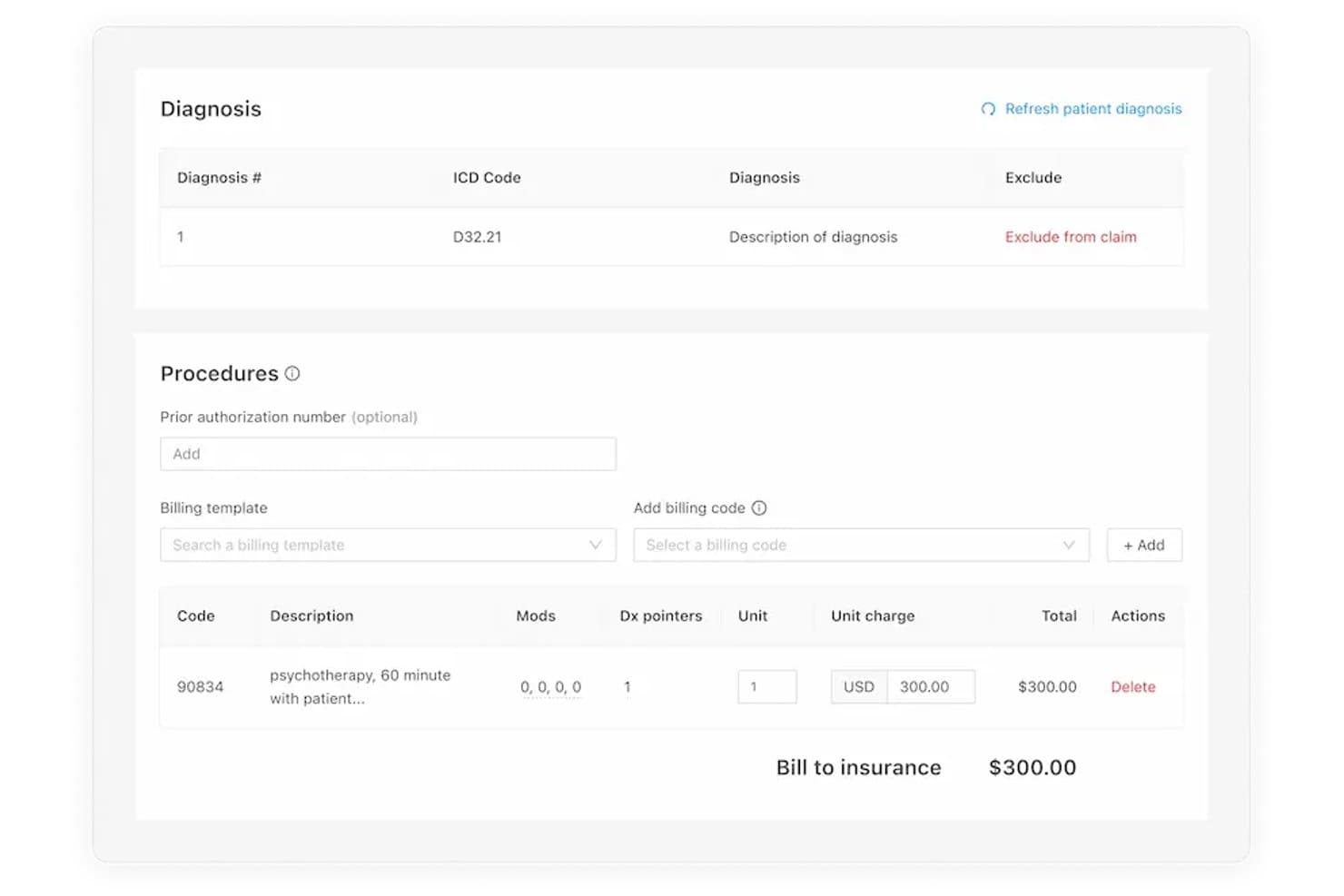
Osmind offers a structured medical billing interface with diagnosis ICD codes, procedure codes, billing templates, and insurance claim totals for mental health providers. Osmind is a psychiatry-specific EHR and revenue cycle management platform built for practices offering interventional treatments like TMS, Spravato, and ketamine, combining claims submission, prior authorization, and denials management in one system.
Who Is Osmind Best For?
Osmind fits psychiatric practices that bill for interventional treatments, particularly growing or multi-provider groups that need both specialized coding support and full RCM services.
Why I Picked Osmind
I've included Osmind in my top picks because no other billing platform I've found handles interventional psychiatry coding with this level of depth. The prior authorization service assigns specialists who organize by payer, complete documentation, and follow up, so I'm not chasing auth status manually across treatments like TMS or ketamine. I also appreciate that Spravato REMS submissions are automated directly from the platform, which removes a time-consuming manual step that generic billing tools simply don't account for.
Osmind Key Features
- Psychiatry-specific EHR workflows: Custom-built templates support TMS, Spravato, ketamine, and psychiatric E/M documentation.
- Integrated e-prescribing with PDMP: Sends electronic prescriptions for controlled substances and checks prescription drug monitoring program data in-app.
- Real-time insurance eligibility verification: Verifies patient mental health benefits and coverage before appointments.
- Automated CMS-1500 claim generation: Generates and submits CMS-1500 claims with pre-loaded mental health CPT codes.
Osmind Integrations
Osmind offers native integrations with ClaimMD, OfficeAlly, DrFirst (including iPrescribe), LabCorp, Quest, PDMP, and Stripe. An API is available for custom integrations.
Pros and Cons
Pros:
- Automated Spravato REMS and compliance workflows
- Dedicated prior authorization and denial team
- Built-in templates for psychiatric interventions
Cons:
- Limited sliding scale billing support
- Not designed for non-psychiatry practices
Learn more about Osmind: Best for enterprise behavioral billing
- Free demo available
- Pricing upon request
Visit WebsiteCustomer Rating:4.4/5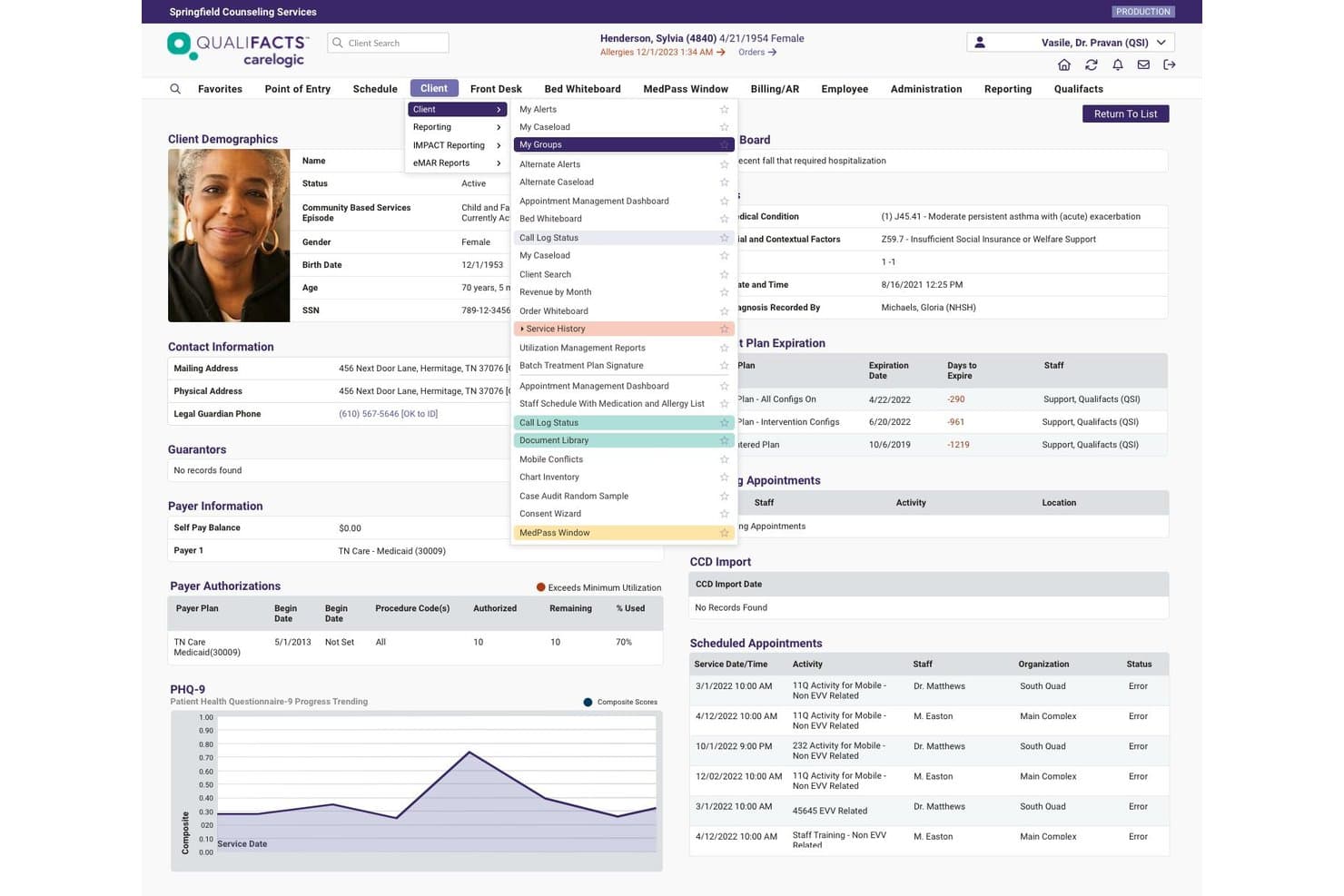
Qualifacts CareLogic offers a comprehensive client dashboard with navigation menus, demographic details, payer information, scheduled appointments, and clinical data for behavioral health management. Qualifacts CareLogic is an enterprise behavioral health EHR with integrated revenue cycle management, covering claims submission, prior authorization tracking, eligibility verification, and ERA processing for large multi-location behavioral health agencies.
Who Is Qualifacts CareLogic Best For?
CareLogic is a strong fit for mid-to-large behavioral health agencies, including CMHCs and CCBHCs, that operate across multiple locations and bill through publicly funded payer systems.
Why I Picked Qualifacts CareLogic
I picked CareLogic as one of the best because its rules-driven claim validation engine is built specifically for publicly funded behavioral health billing. It flags incomplete services before submission, which keeps denial rates low across high-volume claim cycles. I also appreciate that CareLogic's state reporting integration handles the complex, state-specific mandates that enterprise CMHCs and CCBHCs navigate daily, covering compliance requirements that general medical billing tools simply aren't built to support.
Qualifacts CareLogic Key Features
- Full behavioral health CPT code library: Maintains all standard mental health and psychiatric CPT codes, including modifiers and add-ons, for accurate billing.
- Session authorization tracking: Monitors prior authorizations, session limits, and expiration dates within each patient’s record.
- Automated ERA processing: Imports, auto-posts, and tracks electronic remittance advice and payer responses in a centralized RCM workflow.
- Patient portal with e-statements: Lets patients view balances, download billing info, and pay fees online through a secure, integrated portal.
Qualifacts CareLogic Integrations
CareLogic offers native integrations with labs, state reporting systems, health information exchanges, and third-party measurement-based care tools. An API is available for custom integrations.
Pros and Cons
Pros:
- Tracks prior authorization session limits
- Rules-driven claim validation for behavioral health
- Built-in state mental health reporting
Cons:
- Complex initial setup and configuration process
- Not designed for solo or small practices
Learn more about Qualifacts CareLogic: Best for independent practice billing
- Free demo available
- Pricing upon request
Visit WebsiteCustomer Rating:3.9/5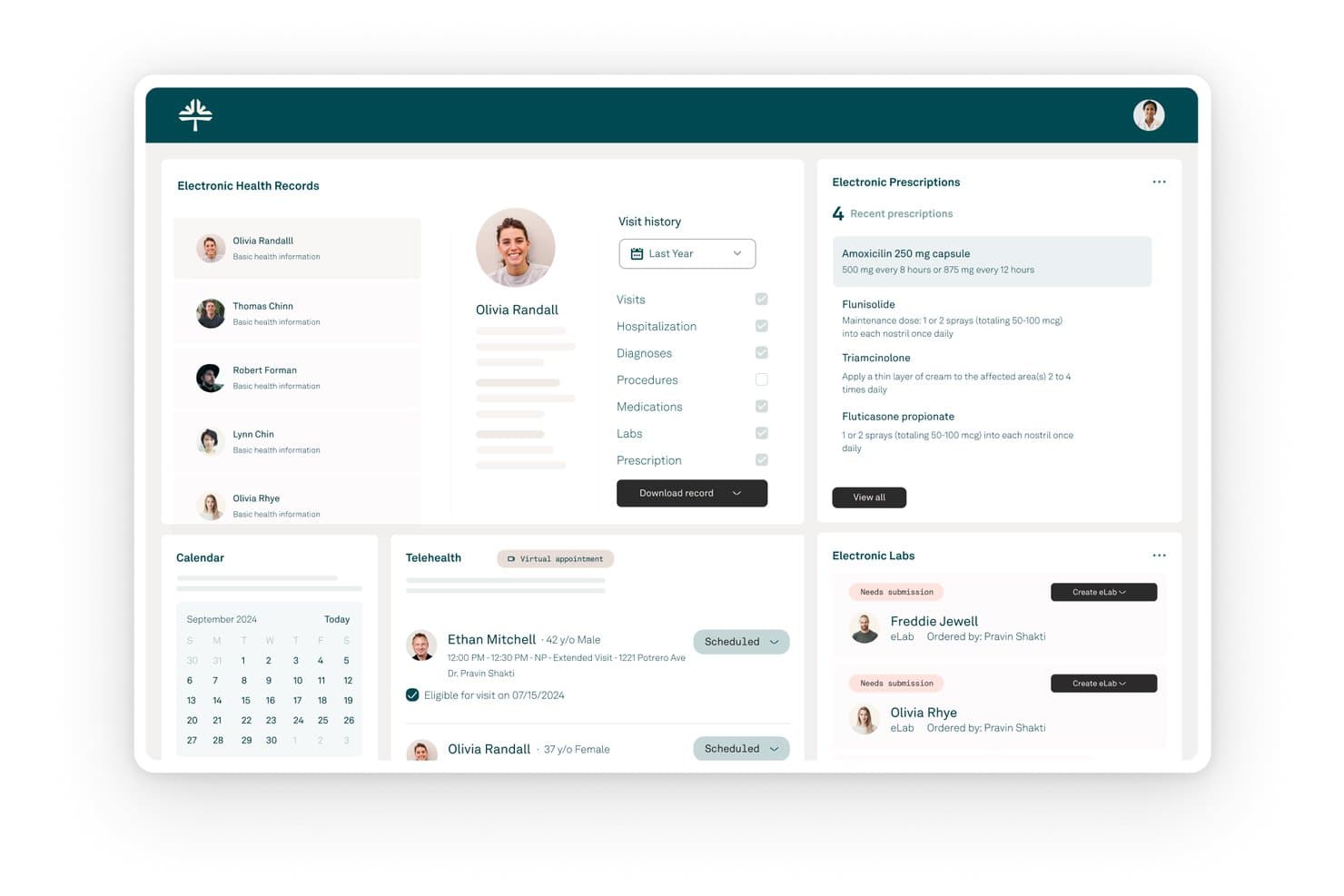
Tebra offers a unified dashboard displaying electronic health records, prescriptions, telehealth appointments, and electronic labs for streamlined patient management. Tebra is an integrated EHR and practice management platform built for independent practices, combining medical billing, claims management, eligibility verification, and patient engagement tools in a single system.
Who Is Tebra Best For?
Tebra is a strong fit for solo and small independent mental health practices that want a single platform for EHR, billing, and scheduling without managing multiple systems.
Why I Picked Tebra
Tebra earns its spot on my shortlist because its billing infrastructure is built around the realities of independent practice operations. I particularly like the TriZetto-powered claim scrubbing, which catches coding and payer errors before submission, and the RPA-driven ERA auto-posting that handles payment reconciliation automatically. The Track Claims Status tool actively flags rejections and unpaid claims, which I find genuinely useful for a small billing team managing a full patient load.
Tebra Key Features
- E-prescribing with EPCS support: Send electronic prescriptions for controlled substances directly from the EHR, including required multi-factor authentication.
- Real-time insurance eligibility verification: Instantly check behavioral health insurance coverage, copays, and deductibles across over 2,700 payers.
- Patient portal and digital intake: Allow patients to review statements, pay balances, and complete intake forms online before appointments.
- Integrated telehealth scheduling: Schedule and launch HIPAA-compliant video visits from the same system used for clinical notes and billing.
Tebra Integrations
Tebra offers native integrations with TriZetto for claim scrubbing and ERA processing, Appriss Health for PDMP, supports HL7/FHIR interoperability with most major EHRs, and provides an API for custom integrations.
Pros and Cons
Pros:
- Patient portal supports online statements and intake
- Built-in e-prescribing with EPCS for psychiatrists
- Automated claims tracking flags unpaid claims
Cons:
- Limited behavioral health-specific coding rules
- No native prior authorization session tracking
Learn more about Tebra: Best for automated claims management
- Free demo available
- Pricing upon request
Visit WebsiteCustomer Rating:3.6/5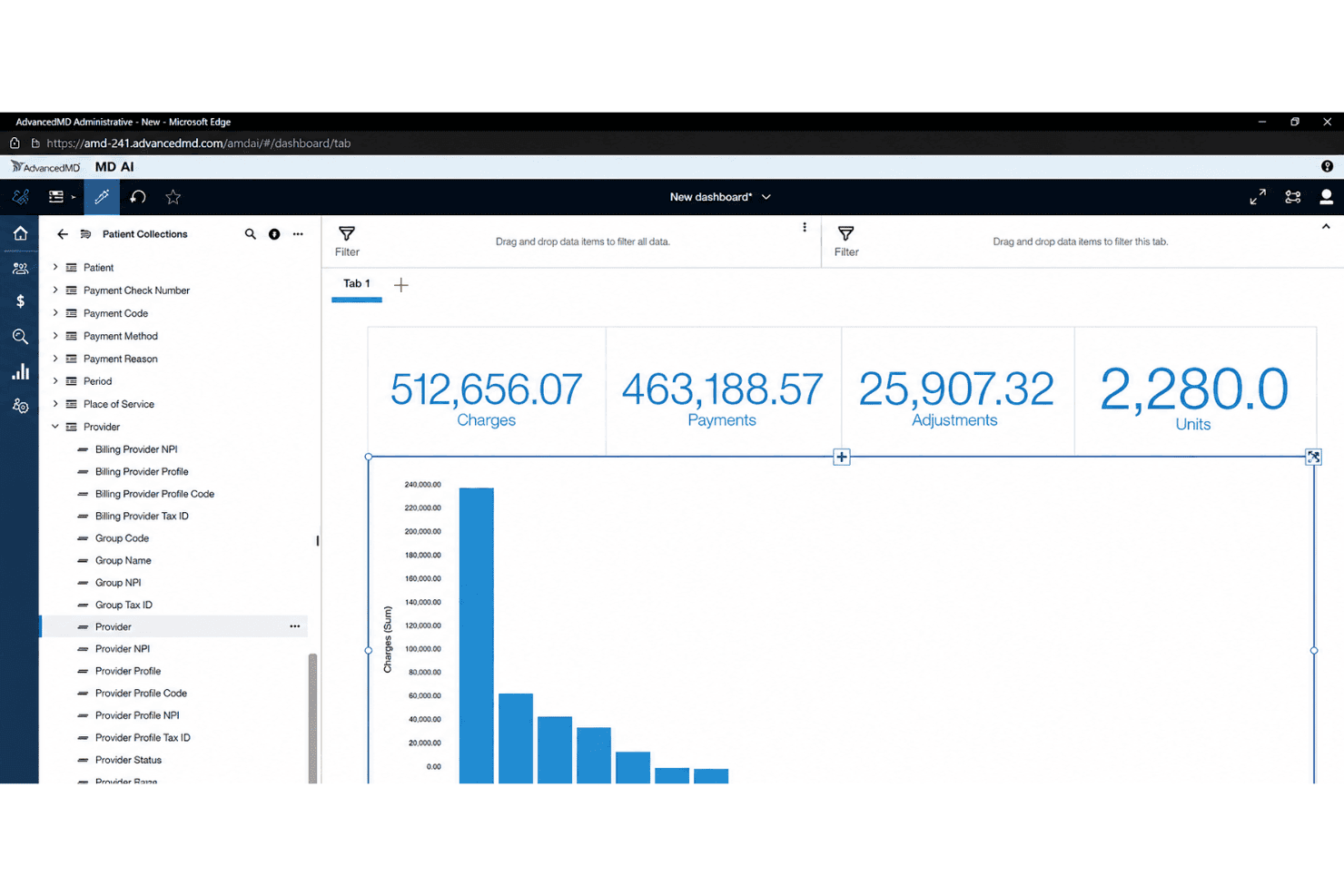
AdvancedMD centralizes EHR, billing, claims, eligibility, and patient payments. AdvancedMD is a unified medical billing and practice management platform with purpose-built behavioral health workflows, DSM-5-aligned charting templates, automated claims scrubbing, and integrated eligibility verification and patient billing tools.
Who Is AdvancedMD Best For?
It's a strong fit for solo and small group behavioral health practices that need a dedicated billing, EHR, and practice management system in one place.
Why I Picked AdvancedMD
AdvancedMD earns its spot on my shortlist because of how it handles claims before they ever reach a payer. The platform filters 72,000+ ICD-10 codes down to behavioral health-relevant codes only, cutting a major source of coding errors at the point of entry. Then, automated claim scrubbing reviews every claim pre-submission, flagging missing data and inaccurate patient information before it hits the clearinghouse.
AdvancedMD Key Features
- DSM-5-aligned charting templates: Lets you document behavioral health sessions using templates mapped to DSM-5 criteria.
- Teletherapy session billing integration: Connects secure video visits with billing so time-based codes are applied automatically after each session.
- Group and family therapy billing support: Handles split claims for group, family, or couples therapy sessions without manual calculation.
- Automated ERA and denial management: Automatically posts electronic remittance advice, flags underpayments, and queues denial claims for review.
AdvancedMD Integrations
AdvancedMD offers native integrations with OpenEdge, Swell, HIPAA One, Vital Interaction, PatientTrak, and Healthjump, and provides an API for custom integrations.
Pros and Cons
Pros:
- Native DSM-5 and CPT code templates
- Prior authorization tracking with session counters
- Automated claim scrubbing for mental health codes
Cons:
- Reporting dashboards require additional configuration
- Authorization alerts not fully automated
 Best for solo mental health billing
- 30-day free trial
- From $49/month
Visit WebsiteCustomer Rating:4.6/5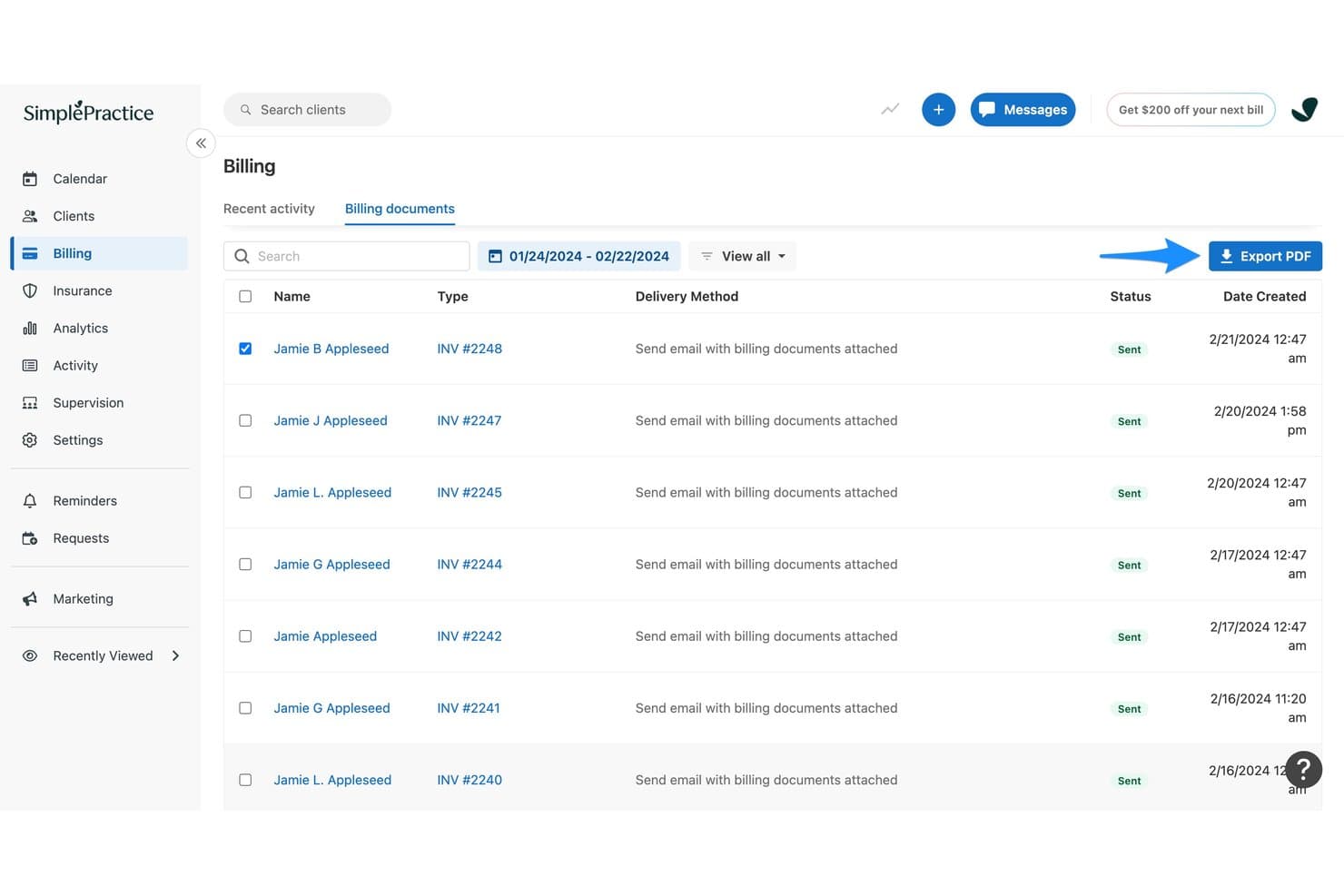
SimplePractice offers a Billing Documents view where users can export PDF invoices, filter by date range, and track delivery status for each client. SimplePractice is an all-in-one practice management and medical billing platform built specifically for mental health practitioners, combining insurance claim submission, ERA processing, eligibility verification, scheduling, and clinical documentation.
Who Is SimplePractice Best For?
SimplePractice is a strong fit for solo therapists and small mental health practices that handle their own insurance billing without a dedicated billing department.
Why I Picked SimplePractice
I picked SimplePractice as one of the best because it's one of the few platforms where solo therapists can submit insurance claims directly through a built-in clearinghouse, without needing a separate billing service or external vendor. I particularly like the integrated ERA processing, which auto-posts payments and surfaces denials right inside the platform. On the Plus plan, 35 free claims per month are included, which typically covers the caseload of a solo therapist billing insurance.
SimplePractice Key Features
- Real-time eligibility verification: Check mental health insurance benefits and copay amounts directly from the patient record.
- Client portal with payment collection: Collect client payments, send statements, and share billing documents online through a secure portal.
- Integrated superbill creation: Generate detailed superbills for out-of-network reimbursement using mental health-specific CPT codes.
- Appointment-based authorization tracking: Track session counts and authorization numbers for each client tied to individual appointments.
SimplePractice Integrations
SimplePractice offers native integrations with Google Calendar, Microsoft Outlook, and iCal for calendar sync. An API is available for custom integrations.
Pros and Cons
Pros:
- Integrated ERA and payment posting workflows
- Includes mental health CPT code library
- Solo therapists can submit claims directly
Cons:
- Reporting features limited for larger practices
- Authorization tracking lacks automated alerts
Learn more about SimplePractice: Best for therapy billing and claims
- 30-day free trial
- From $69/month
Visit WebsiteCustomer Rating:4.4/5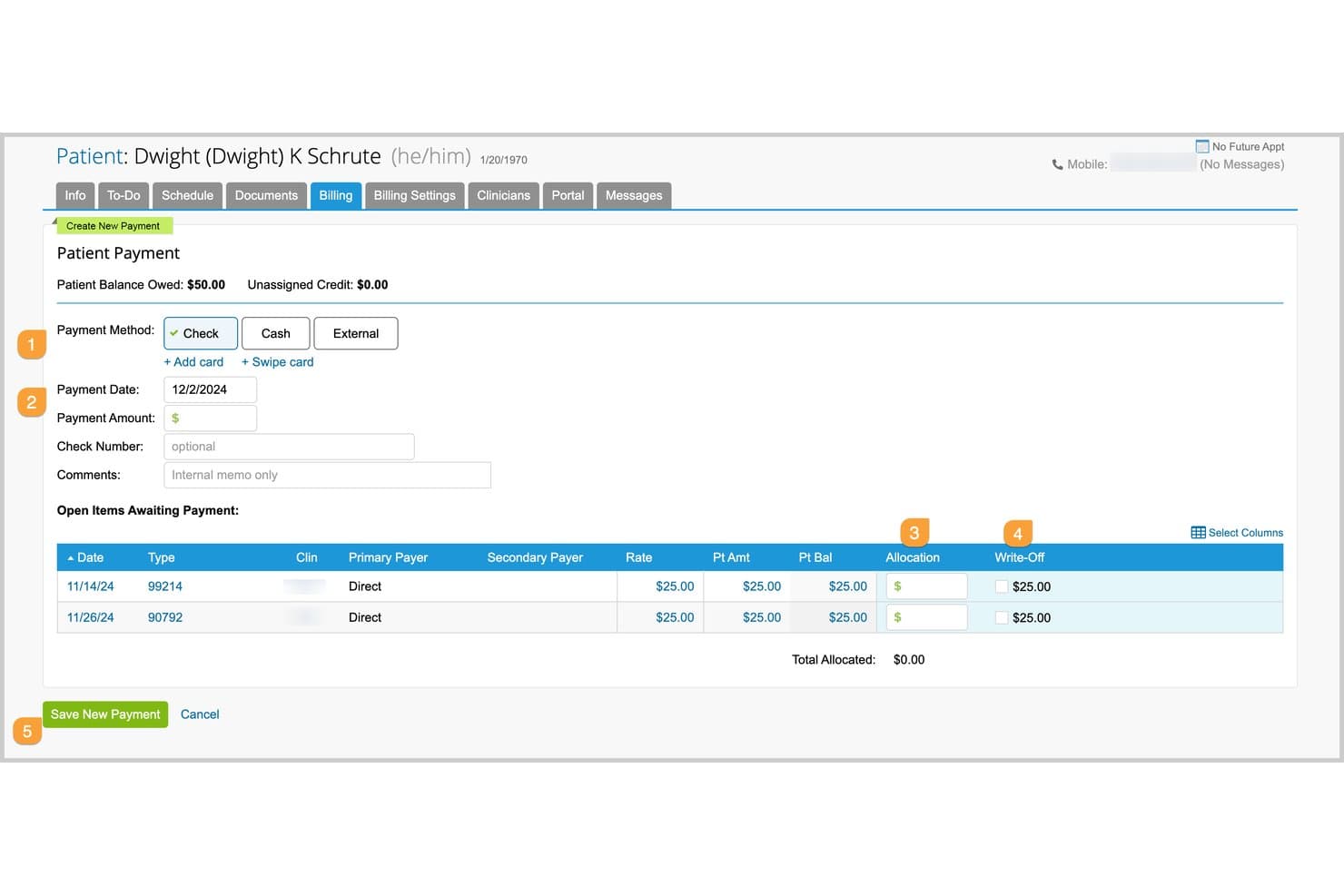
TherapyNotes offers a structured patient payment screen where staff can record payment method, date, amount, and allocate funds across open billing items. TherapyNotes is a behavioral health EHR and practice management platform built specifically for mental health clinicians, combining insurance billing, electronic claims submission, ERA processing, eligibility verification, and patient payment collection.
Who Is TherapyNotes Best For?
TherapyNotes suits solo therapists and small-to-mid-size group practices that handle their own billing in-house rather than outsourcing to a managed RCM service.
Why I Picked TherapyNotes
TherapyNotes earns its spot as one of the best on my shortlist because of how tightly its billing workflow is built around therapy-specific claim cycles. I particularly like that denied claims surface automatically in a built-in to-do list, keeping nothing buried in a general report queue. ERA auto-posting cuts down manual payment reconciliation, and the 2025 addition of secondary claim submission means practices billing multiple payers don't need a workaround.
TherapyNotes Key Features
- Insurance eligibility verification: Check real-time or batch insurance eligibility for behavioral health benefits before appointments or claims.
- Secure client portal: Share statements, bill copies, intake forms, and client payment options through a HIPAA-compliant online portal.
- Multi-location scheduling: Manage provider calendars, appointment types, and availability for solo, group, or multi-site practices.
- Telehealth integration: Launch HIPAA-compliant video sessions from within the platform with notes and billing workflows connected.
TherapyNotes Integrations
TherapyNotes offers native integrations with Google Calendar, Microsoft Outlook, and iCloud. An API is available for custom integrations.
Pros and Cons
Pros:
- Session and authorization tracking by patient
- Automated to-do lists for denied claims
- Built-in behavioral health CPT code templates
Cons:
- Authorization alerts not fully automated
- No appeals management workflow for denied claims
Learn more about TherapyNotes: Best for integrated therapy billing
- 21-day free trial
- From $29/user/month
Visit WebsiteCustomer Rating:4.5/5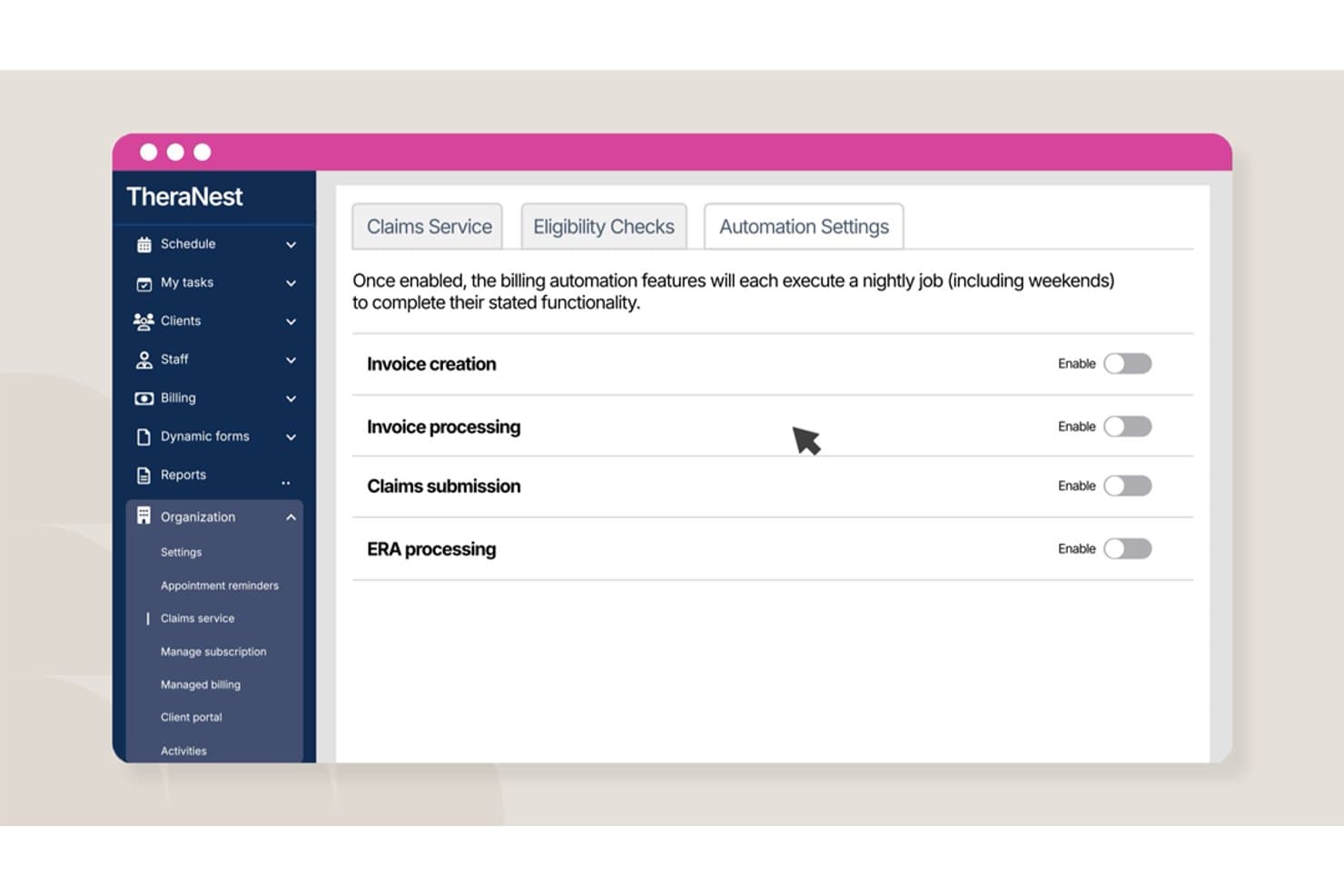
Ensora Health TheraNest offers billing automation settings including invoice creation, invoice processing, claims submission, and ERA processing toggles under the Organization Claims Service section. TheraNest by Ensora Health is a behavioral health EHR and practice management platform that combines insurance billing automation, ERA posting, eligibility verification, clinical documentation, and scheduling in one system built specifically for mental health providers.
Who Is TheraNest Best For?
TheraNest fits solo therapists and small-to-mid-size group practices that want billing and clinical documentation in one system rather than managing separate tools.
Why I Picked TheraNest
TheraNest earns its spot on my shortlist because the billing engine lives natively inside the EHR. I like that you can configure billing rules per payer and per clinician, so rejected claims surface in a dedicated exception queue rather than failing silently. The Ensora RCM add-on then layers in denial management and appeals filing, keeping the entire revenue cycle inside one platform.
TheraNest Key Features
- AI session assistant: An AI scribe automatically generates session notes from telehealth and in-person visits.
- Custom form builder: Lets you create tailored intake forms, progress notes, and consent documents.
- Real-time eligibility verification: Instantly checks behavioral health benefit details for insurance coverage.
- Multi-provider scheduling: Manages group sessions, recurring appointments, and calendar coordination across clinicians.
TheraNest Integrations
TheraNest offers native integrations with clearinghouse partners for electronic claims, Wiley Treatment Planner, calendar sync with Google Calendar, and integrated credit card payment processing. An API is available for custom integrations.
Pros and Cons
Pros:
- Real-time eligibility verification for mental health benefits
- Exception queue for rejected insurance claims
- Built-in behavioral health CPT/DSM code library
Cons:
- Limited built-in reporting customization options
- Authorization tracking lacks advanced automation
Learn more about Ensora Health TheraNest: Best for behavioral health RCM
- Free demo available
- Pricing upon request
Visit WebsiteCustomer Rating:4.1/5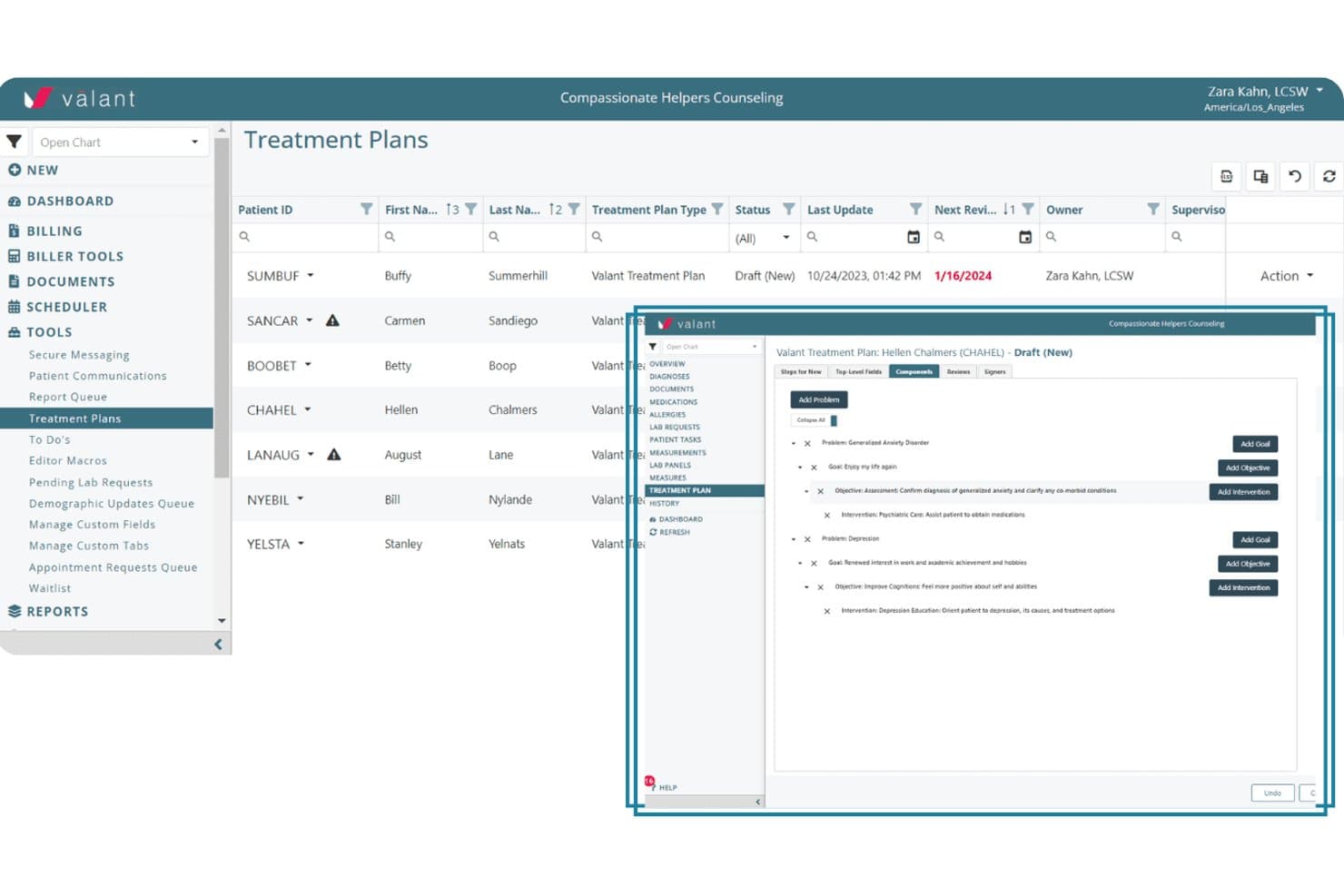
Valant offers a structured treatment planning module where clinicians can document problems, goals, objectives, and interventions for each patient. Valant is a behavioral health EHR and billing platform that combines claims submission, ERA posting, eligibility verification, and revenue cycle management tools built specifically for mental health and psychiatric practices.
Who Is Valant Best For?
Valant fits solo therapists, group practices, and multi-provider behavioral health organizations running outpatient, IOP, or PHP programs.
Why I Picked Valant
Valant earns its spot on my shortlist because it's one of the few mental health billing platforms with native 837i institutional claim bundling for IOP and PHP programs. I also like the Pending Transactions Queue, which catches coding errors before submission, and the Automated Charge Review that flags and auto-fixes issues without manual intervention. On top of that, Valant offers an optional RCM service team that works directly inside your EHR to manage claims and denials on your behalf.
Valant Key Features
- Rule-based eligibility checks: Run automated eligibility verification for scheduled mental health appointments using payer and appointment data.
- Superbill statement generator: Create patient-ready billing statements that include all required codes for insurance reimbursement.
- Multi-tax ID billing support: Bill across multiple locations or business entities without clearinghouse workarounds.
- Role-based billing access: Set detailed permissions for staff members to access specific billing functions and sensitive financial data.
Valant Integrations
Valant offers native integrations with Waystar for clearinghouse and ERA processing, Rcopia for e-prescribing, credit card processing tools, PDMP databases, and its MYIO patient portal. An API is available for custom integrations.
Pros and Cons
Pros:
- Specialized workflows for behavioral health programs
- Automated charge review and error flagging
- Institutional and professional claim support built-in
Cons:
- No instant insurance eligibility verification for all payers
- Onboarding process is frequently described as difficult
Learn more about Valant: 10Best for psychiatry billing workflows
ICANotes
- 30-day free trial
- From $55/month
Visit WebsiteCustomer Rating:4.1/5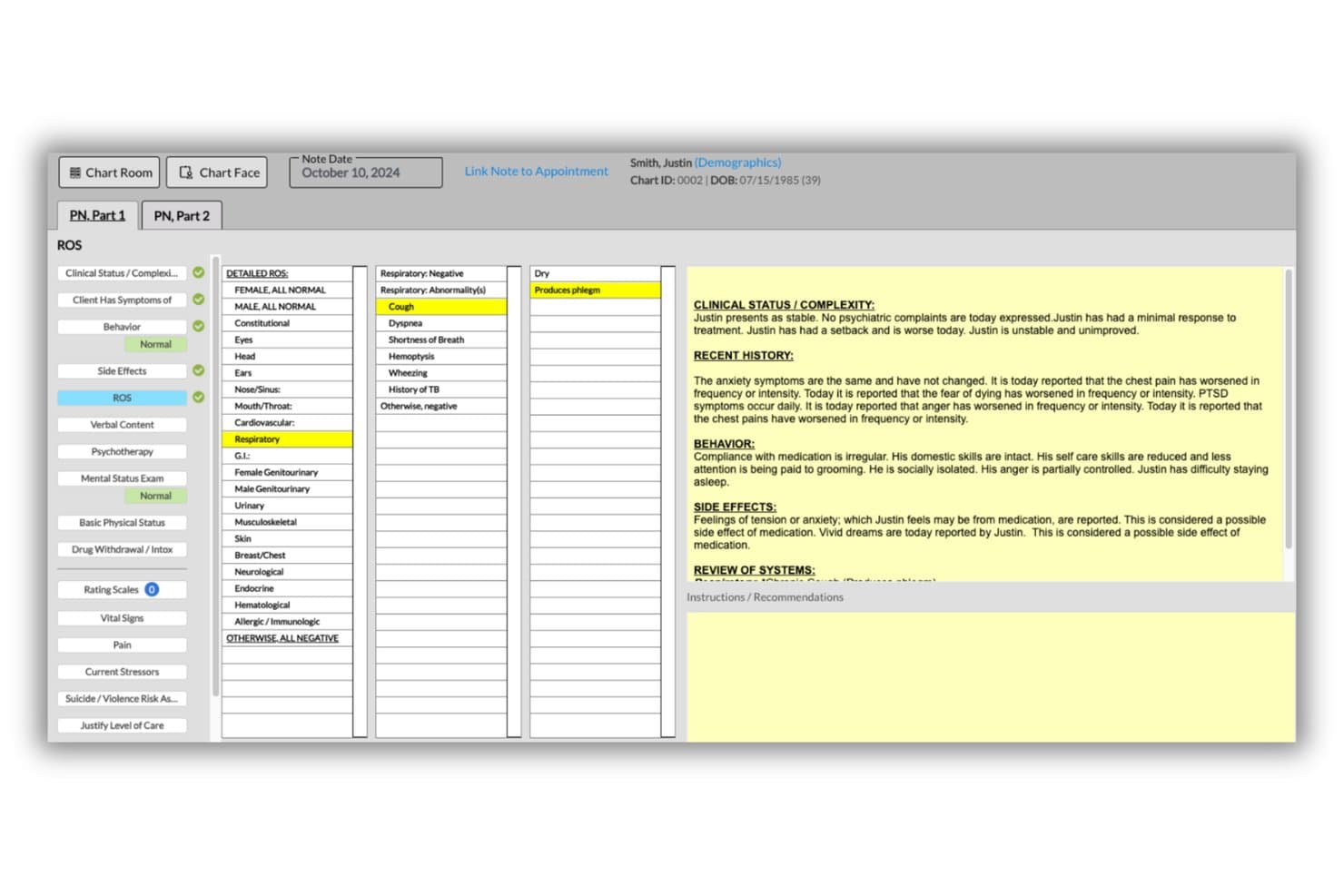
ICANotes offers a detailed Review of Systems (ROS) interface that allows clinicians to document respiratory and other system findings alongside auto-generated clinical notes. ICANotes is a behavioral health EHR with integrated billing tools that cover claims submission, eligibility verification, authorization tracking, ERA auto-posting, and patient billing — built specifically for psychiatric and mental health practices.
Who Is ICANotes Best For?
ICANotes is a strong fit for psychiatrists, prescribing clinicians, and behavioral health group practices that need billing tightly connected to clinical documentation.
Why I Picked ICANotes
ICANotes earns its spot on my shortlist because of how tightly its billing workflows are built around psychiatric practice. I particularly like the automatic medical-necessity coding, which flags notes as audit-ready at the point of documentation, before a claim ever leaves the system. The built-in authorization tracking also keeps session limits and expiration dates visible alongside the clinical record, which matters when you're billing for psychiatric services that frequently require prior auth renewals.
ICANotes Key Features
- Superbill and CMS-1500 automation: Generates and submits claims with pre-loaded mental health CPT codes and modifiers.
- Telehealth-integrated billing: Connects HIPAA-compliant video sessions directly to billing codes for streamlined reimbursement.
- Measurement-based care tools: Links built-in clinical scales like PHQ-9 and GAD-7 to billable CPT codes.
- Group and family session billing: Supports group therapy and multi-provider billing without manual workarounds.
ICANotes Integrations
ICANotes offers native integrations for electronic claims submission and auto-posting with clearinghouses, lab ordering and results through its prescribing plan, and built-in telehealth and a HIPAA-compliant patient portal. An API is available for custom integrations.
Pros and Cons
Pros:
- Auto-posts ERAs and coordinates secondary claims
- Tracks authorizations and session limits by client
- Native DSM-5 and behavioral health coding
Cons:
- Limited payer-specific claim scrubbing options
- Clearinghouse integration issues cause claim delays
Learn more about ICANotes:
Annen programvare for medisinsk fakturering innen psykisk helse
\u003cspan style=\u0022font-weight: 400\u0022\u003eHer er noen flere alternativer for programvare for medisinsk fakturering innen psykisk helse som ikke kom med på kortlisten min, men som likevel er verdt å undersøke:\u003c/span\u003e
- 11CarePaths EHRBest for behavioral health billing
- 12NetsmartBest for complex behavioral health billing
- 13DrChronoBest for mobile medical billing
- 14LuminelloBest for psychiatry billing and payments
- 15Owl PracticeBest for therapist billing workflows
- 16NextGen Behavioral Health SuiteBest for large behavioral practices
- 17SunwaveBest for addiction treatment billing
- 18TherabillBest for therapy claims and invoicing
How I Evaluate Mental Health Medical Billing Software
I split my evaluation into baseline criteria every tool must meet—like BH-specific CPT coding and ERA auto-posting—and differentiating factors that set the best options apart.
Core Functionality (Table Stakes For This List)
When I'm selecting tools for my list, I rank each one on a scale from 0 (does not offer the functionality) to 5 (excels in this area) for each core functionality listed below. Then, I calculate the tool's total score into a percentage. Each tool needs to achieve a minimum total score of 65% to be considered for inclusion.
- Behavioral Health Coding: I look for native support for mental health CPT codes like 90834, 90837, and 90853, plus proper modifier handling for add-on and psychiatric E/M codes.
- Claims Submission & Scrubbing: Each tool should offer electronic CMS-1500 submission with pre-submission scrubbing tuned to behavioral health payer rules, not just generic edits.
- Session Authorization Tracking: I check whether the platform tracks prior authorizations, remaining session counts, and expiration dates per patient and payer combination.
- ERA/EOB & Payment Posting: Automated remittance processing and payment posting matter here, along with denial management workflows that help you act on rejected claims fast.
- Patient Billing & Copay Handling: I evaluate how each tool manages recurring therapy billing, sliding scale fees, copay collection, and patient-facing statements or superbills.
- Eligibility Verification: Real-time or batch insurance verification specific to mental and behavioral health benefits is what I look for, including deductible and copay detail.
Once I have a list of tools that meet the criteria, I consider what sets each platform apart.
Differentiating Factors (What Sets Vendors Apart)
Here's how I compare and contrast different vendors:
Standout Features
Telehealth-integrated billing is a major differentiator—I look for platforms that auto-attach place-of-service modifiers and time-based codes to claims right after a video session ends. Group and family session billing also matters, especially when a practice runs 90853 group therapy or concurrent multi-provider sessions that require complex splits. I also evaluate whether a tool links built-in outcome assessments like PHQ-9 or GAD-7 to billable codes such as 96127, which supports value-based reimbursement models.
Beyond Features
Payer mix matters—I check whether a platform includes clearinghouse access or charges per-claim fees, and whether it supports EAP and out-of-network billing. Practice size fit is another key factor, since solo therapists need self-serve simplicity while group practices require multi-provider credentialing and role-based access. I also evaluate whether a vendor offers full-service RCM alongside the software, which can save a growing practice from hiring dedicated billing staff.
Slik velger du programvare for medisinsk fakturering innen psykisk helse
Det er lett å gå seg vill i lange funksjonslister og kompliserte prisstrukturer. For å hjelpe deg med å holde fokus mens du går gjennom den unike prosessen med å velge programvare, får du her en sjekkliste over faktorer du bør ha i tankene:
| Faktor | Hva du bør vurdere |
| Skalerbarhet | Vil programvaren fortsatt passe hvis praksisen din vokser, får flere behandlere eller utvider til flere spesialområder? |
| Integrasjoner | Kan verktøyet kobles toveis til EPJ-en, kalenderen, regnskaps- eller betalingsbehandlingssystemene dine? |
| Tilpasningsmuligheter | Kan du tilpasse arbeidsflyter, kravmaler eller rapportvisninger slik at de samsvarer med praksisens faktureringsprosesser? |
| Brukervennlighet | Hvor bratt er læringskurven? Kan de kliniske teamene og faktureringsteamene dine ta det i bruk raskt uten ekstra opplæring? |
| Implementering og innføring | Hvordan foregår innføringen? Er datamigrering og støtte til oppsett inkludert, eller må teamet ditt klare seg på egen hånd? |
| Kostnad | Hvordan fungerer prisingen – per behandler, per krav eller som et månedlig abonnement? Kommer avgifter for oppgjørssentral eller kundestøtte i tillegg? |
| Sikkerhetstiltak | Er leverandøren HIPAA-kompatibel, og tilbyr de databehandleravtaler samt sterk kryptering? |
| Tilgjengelig kundestøtte | Kan du nå fakturerings- og teknisk kundestøtte i arbeidstiden din – og via den kanalen du foretrekker? |
Hva er programvare for medisinsk fakturering innen psykisk helse?
Programvare for medisinsk fakturering innen psykisk helse er spesialisert teknologi utviklet for å håndtere forsikringskrav, pasientfakturering og innkreving av betalinger for atferds- og psykiatriske tjenester. Den støtter arbeidsflyter som håndtering av CPT-koder for terapi, forhåndsgodkjenninger, føring av ERA og pasientoppgjør – og hjelper praksiser med å navigere i reglene fra betalere innen psykisk helse, gjentakende fakturering av timer og samsvarskrav som er unike for feltet.
Funksjoner i programvare for medisinsk fakturering innen psykisk helse
Se etter følgende viktige funksjoner når du velger programvare for medisinsk fakturering innen psykisk helse:
- CPT-koding for atferdshelse: Lar deg velge og fakturere med riktige koder for terapi, vurderinger og psykiatri, inkludert tilleggskoder og modifikatorer, tilpasset psykisk helse.
- Innsending og kontroll av krav: Sender inn krav elektronisk og kontrollerer vanlige feil i krav til betalere innen psykisk helse før innsending for å redusere avslag.
- Oppfølging av godkjenning av timer: Følger opp forhåndsgodkjenninger, gjenværende godkjente timer og utløpsdatoer for hver pasient, slik at du kan administrere godkjenninger fra betalere.
- Registrering av elektronisk betalingsoversikt (ERA): Importerer betalingsfiler, registrerer betalinger automatisk og markerer avslag for rask oppfølging.
- Pasientfakturering og kontoutskrifter: Genererer kontoutskrifter for pasienter med korrekte saldoer, beregninger av egenandeler og justeringer etter glidende skala for regelmessig behandling.
- Kontroll av forsikringsberettigelse: Kontrollerer dekning og ytelser for psykisk helse i sanntid eller i grupper, slik at du kan kontrollere pasientens berettigelse før hver time.
- Integrert fakturering av fjernhelsetjenester: Kobler fullførte virtuelle konsultasjoner til riktige modifikatorer og koder og sender dem direkte til krav eller samlede regninger.
- Administrasjon av betalingsplaner: Gir mulighet til å opprette, overvåke og følge opp betalingsplaner for pasienter med utestående saldoer.
- Rapportering og analyse: Tilbyr oversikter over krav, utestående fordringer og betalingstrender, slik at du kan følge opp resultatene i inntektsprosessen.
- Verktøy for samsvar: Omfatter HIPAA-sikkerhet, revisjonsspor og maler i samsvar med regler for fakturering og personvern innen psykisk helse.
Fordeler med programvare for medisinsk fakturering innen psykisk helse
Implementering av programvare for medisinsk fakturering innen psykisk helse gir flere fordeler for teamet og virksomheten din. Her er noen av fordelene du kan se frem til:
- Færre avviste krav: Automatisert kontroll og intelligent CPT-koding hjelper deg med å sende inn mer korrekte krav og unngå kostbare feil knyttet til reglene til betalere innen atferdshelse.
- Raskere betalingssykluser: Registrering av ERA i sanntid, pasientfakturering og automatiserte kontoutskrifter fremskynder innbetalingene og reduserer tiden som brukes på å vente på betalinger.
- Forenklede forsikringsprosesser: Innebygd kontroll av forsikringsberettigelse og oppfølging av godkjenninger gjør de kompliserte kravene til regelmessige terapi- og psykiatritimer enklere.
- Bedre samsvar: HIPAA-sikkerhet, revisjonsspor og regelsett spesifikt for psykisk helse hjelper praksiser med å opprettholde samsvar med regelverket med mindre manuell oppfølging.
- Enklere fakturering av fjernhelsetjenester: Integrerte fjernhelsetimer bruker automatisk riktige koder og modifikatorer, slik at du får korrekt betaling for virtuell behandling.
- Tydelig økonomisk oversikt: Sentraliserte oversikter og analyser gjør det enkelt å se utestående saldoer, timebegrensninger og trender hos betalere på et øyeblikk.
- Bedre pasientopplevelse: Kontoutskrifter for pasienter, betalingsplaner og tilgang til pasientportal hjelper klienter med å forstå og håndtere sitt økonomiske ansvar for behandlingen.
Kostnader og priser for programvare for medisinsk fakturering innen psykisk helse
Valg av programvare for medisinsk fakturering innen psykisk helse krever en forståelse av de ulike prismodellene og abonnementene som er tilgjengelige. Kostnadene varierer basert på funksjoner, teamstørrelse, tillegg og mer. Tabellen nedenfor oppsummerer vanlige abonnementer, gjennomsnittsprisene deres og typiske funksjoner som inngår i programvareløsninger for medisinsk fakturering innen psykisk helse:
Sammenligningstabell for programvareabonnementer for medisinsk fakturering innen psykisk helse
| Abonnementstype | Gjennomsnittspris | Vanlige funksjoner |
| Gratisabonnement | $0 | Begrenset innsending av krav, grunnleggende CPT-kodebibliotek, manuell pasientfakturering og minimal brukerstøtte. |
| Personlig abonnement | $20-$50/bruker/måned | Elektroniske krav, kontroller av forsikringsberettigelse, oppfølging av forhåndsgodkjenninger, registrering av ERA og enkle kontoutskrifter. |
| Forretningsabonnement | $60-$120/bruker/måned | Fakturering av gruppe- og familiesamtaler, pasientportal, integrert fakturering av fjernhelsetjenester, regelmessig fakturering og betalingsplaner. |
| Enterprise-abonnement | $130-$250/bruker/måned | Avansert analyse, støtte for flere lokasjoner, tilpassede arbeidsprosesser, API-integrasjoner og avanserte verktøy for samsvar. |
Vanlige spørsmål om medisinsk faktureringsprogramvare for psykisk helse
Her er noen svar på vanlige spørsmål om medisinsk faktureringsprogramvare for psykisk helse:
Hvilke typer praksiser har størst nytte av medisinsk faktureringsprogramvare for psykisk helse?
Enkeltpraktiserende terapeuter, gruppepraksiser, lokale sentre for psykisk helse og psykiatriklinikker har alle nytte av programvare som håndterer gjentakende behandlingstimer, flere typer behandlere, telehelsefakturering og spesialiserte krav fra betalere.
Kan medisinsk faktureringsprogramvare for psykisk helse bidra til å holde oversikt over behandlingsgodkjenninger og utløpsdatoer?
Ja, de fleste plattformer har verktøy for å holde oversikt over forhåndsgodkjenninger, antall godkjente behandlingstimer og utløpsdatoer, slik at du unngår å behandle pasienter utover antallet besøk som er godkjent av betaleren.
Støtter disse verktøyene graderte honorarmodeller for klienter?
Ja, mange løsninger tillater tilpasset gradering av honorarer eller tilskuddsbasert fakturering, som kan angis for hver klient basert på inntekt, finansieringskilde eller behandlingsplan.
Er telehelsefakturering integrert i disse plattformene?
Ja, integrerte telehelsefunksjoner kan automatisk kode virtuelle besøk, legge til riktige modifikatorer og føye behandlingstimene til faktureringsarbeidsflyten så snart de er fullført.
Hvordan ivaretar disse systemene datasikkerhet og overholdelse av HIPAA?
Leverandører tilbyr vanligvis kryptering, revisjonslogger og en avtale med forretningsforbindelse (BAA), med funksjoner for overholdelse som er tilpasset standarder for personvern og beskyttelse av helsedata.
Hva slags implementering og støtte kan jeg forvente?
De fleste leverandører tilbyr veiledet implementering, datamigrering og løpende faktureringsstøtte – men kvaliteten på støtten og responstidene kan variere mellom leverandører og abonnementer.