

Et EMR-system for psykiatri er en elektronisk pasientjournalplattform utviklet for psykiatrisk behandling, som gjør det enklere å dokumentere, forskrive og koordinere behandling innen psykisk helse. Hvis du ser etter det beste EMR-systemet for psykiatri, håndterer du sannsynligvis spesielle behov knyttet til dokumentasjon, telehelse og legemiddelhåndtering – og du trenger en løsning som er utviklet for å møte disse kravene uten å bremse den kliniske arbeidsflyten din.
Denne listen gir en oversikt over de beste alternativene, slik at du raskt kan sammenligne psykiatrirelaterte funksjoner, sikkerhetstiltak og verktøy som støtter bedre behandling for pasientene dine.
Hvorfor du kan stole på våre programvareanbefalinger
6,700+
Reviews
20
Industry experts
16+
Evaluation factors
14
Years
Teamet vårt har testet og anmeldt programvare siden 2012. Vi leder selv legekontorer, så vi vet hvor vanskelig og hvor viktig det er å velge riktig programvare.
I denne guiden har vi vurdert verktøyene gjennom praktisk testing og uavhengig research og gitt dem poeng ut fra våre utvelgelseskriterier.
Anmeldelsene våre bygger på vår egen redaksjonelle vurdering. De er ikke et salgsargument.
Sammenligningstabell for psykiatri-EMR
Denne sammenligningstabellen oppsummerer prisdetaljene for mine beste utvalgte EMR-systemer for psykiatri:
Score legend (out of 5)
- Excellent4.5–5
- Good4–4.4
- Average3–3.9
- Below average2–2.9
- Poor1–1.9
Sorted by: Default
| Tool | Starting Price | Website | |||||||
|---|---|---|---|---|---|---|---|---|---|
Best for therapy clinics coordinating rooms | 2.3 out of 5 | 1 | 1 | 4 | 3 | 3 | 2 | $29/user/month 14-day free trial + free demo available | Website |
Best for customizable behavioral health workflows | 4.0 out of 5 | 4 | 4 | 4 | 4 | 4 | 4 | Pricing upon request Free demo available | Website |
Best for therapy and psychiatry in one chart | 3.5 out of 5 | 4 | 3 | 4 | 2 | 4 | 4 | $69/user/month 30-day free trial + free demo available | Website |
Best for behavioral health documentation and billing | 4.2 out of 5 | 4 | 3 | 5 | 4 | 4 | 5 | Pricing upon request Free demo available | Website |
Best for psychiatry-specific charting and e-prescribing | 3.7 out of 5 | 4 | 3 | 3 | 4 | 4 | 4 | $35/month 30-day free trial + free demo available | Website |
Best for independent psychiatry and therapy practices | 3.5 out of 5 | 4 | 3 | 4 | 3 | 3 | 4 | Pricing upon request Free demo available | Website |
Best for customizable cloud EHR workflows | 3.3 out of 5 | 4 | 2 | 4 | 2 | 4 | 4 | Pricing upon request Free demo available | Website |
Best for integrated whole-person behavioral care | 3.5 out of 5 | 4 | 3 | 4 | 2 | 4 | 4 | Pricing upon request Free demo available | Website |
Best for scalable behavioral health workflows | 3.7 out of 5 | 4 | 3 | 4 | 3 | 4 | 4 | $130/user/month Free demo available | Website |
Best for behavioral health agency-scale EMR | 3.7 out of 5 | 4 | 3 | 4 | 4 | 4 | 3 | Pricing upon request Free demo available | Website |


Omtaler av de beste EMR-systemene for psykiatri
\u003cspan style=\u0022font-weight: 400\u0022\u003eNedenfor finner du mine detaljerte oppsummeringer av de beste EMR-systemene for psykiatri som kom med på kortlisten min. Omtalene mine gir et detaljert innblikk i funksjonene, de beste bruksområdene og prisene for hver programvare, slik at du kan finne den som passer best for deg.\u003c/span\u003e
 Best for therapy clinics coordinating rooms
- 14-day free trial + free demo available
- From $29/user/month
Visit WebsiteCustomer Rating:4.7/5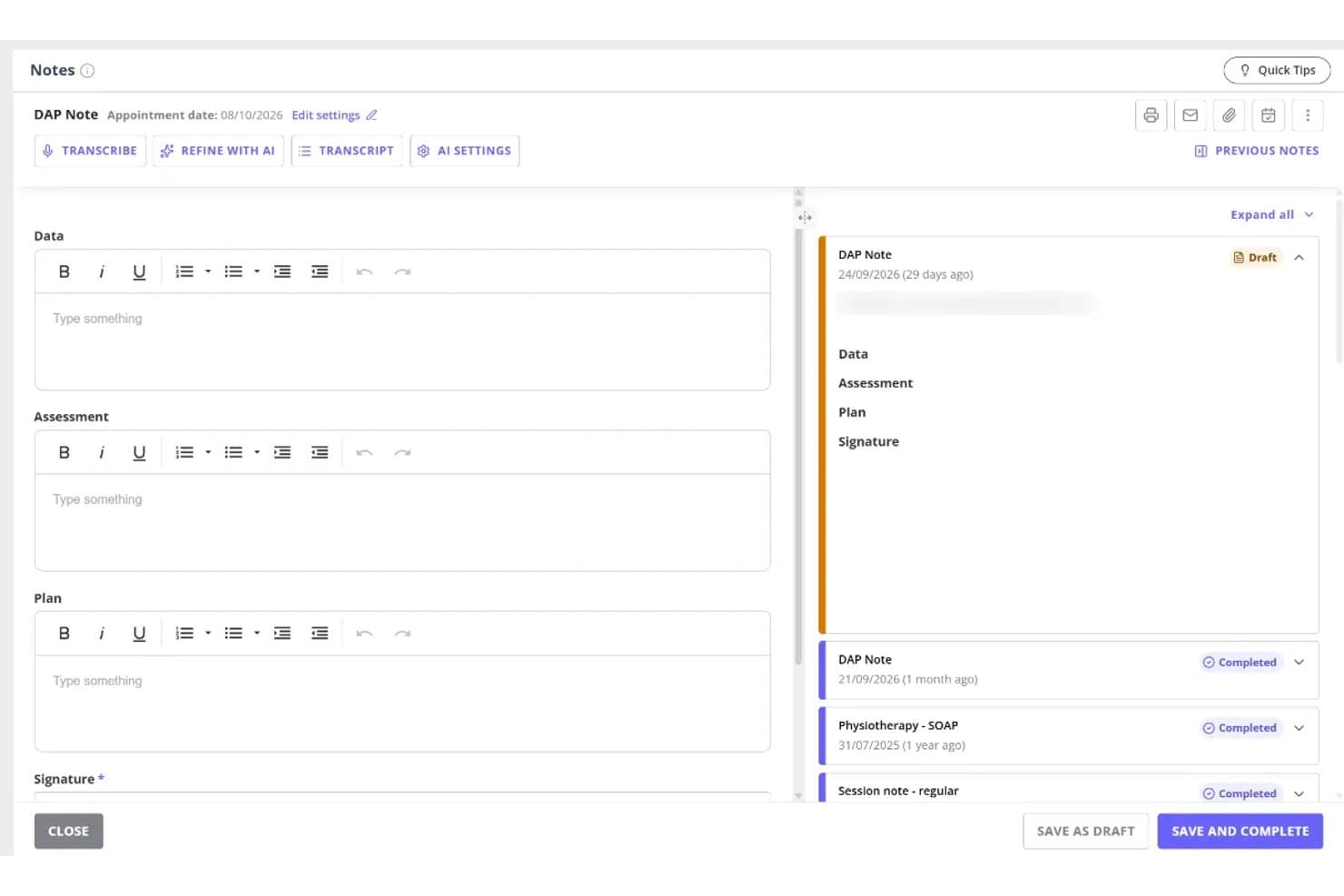
Zanda displays DAP notes alongside a previous notes history panel. Zanda is a cloud-based practice management platform for allied health and mental health providers that covers scheduling, clinical notes, telehealth, online intake forms, billing, and client communications.
Who Is Zanda Best For?
Zanda fits therapy clinics and allied health practices that need to coordinate multiple rooms, practitioners, and locations under one scheduling system.
Why I Picked Zanda
I've included Zanda in my top picks because its room and resource management makes it one of the few practice management platforms where therapy clinics can coordinate practitioners, physical rooms, and equipment in a single calendar view. When you're running a multi-room clinic with overlapping appointments, Zanda's Growth plan lets you reserve specific rooms alongside bookings and filter by location, so double-booking a space becomes much harder to do. Its group appointment tools also give each participant their own record, reminders, and invoicing within one session.
Zanda Key Features
- Scored assessment forms: Run validated measures like PHQ-9, GAD-7, and PCL-5 directly within the platform, with automatic score calculation and version retention.
- Client Progress Reports: View a client's scored-form results over time in a graph and table, with score totals and interpretations across a selectable date range.
- BizzyAI Scribe: Record or dictate a session and receive a drafted clinical note saved to the client file for practitioner review before signing.
- Configurable user permissions: Set role-based and user-based access controls to restrict calendar, billing, clinical, and reporting features by team member.
Zanda Integrations
Zanda offers native integrations with Parchment for Australian e-prescribing, Stripe, Xero, Zoom, Google Calendar, Apple Calendar, and Outlook Calendar. Its public API is read-only and currently unavailable to new beta applicants.
Pros and Cons
Pros:
- Reviewers praise customizable notes and forms
- Group visits support individual reminders and invoices
- Room and equipment scheduling
Cons:
- No documented controlled-substance prescribing workflow
- No built-in psychiatric assessment templates
Learn more about Zanda: Best for customizable behavioral health workflows
- Free demo available
- Pricing upon request
Visit WebsiteCustomer Rating:4.8/5
EHR Your Way helps practices manage appointment scheduling, provider calendars, blocked times, recurring visits, and group therapy appointments. EHR Your Way is a behavioral health EHR that covers clinical documentation, scheduling, billing, revenue cycle management, e-prescribing, and inpatient and outpatient care management in a single configurable platform.
Who Is EHR Your Way Best For?
EHR Your Way is a strong fit for behavioral health organizations, from small outpatient clinics to larger multi-site providers, that need to configure clinical documentation around their specific care workflows rather than adapt to a rigid system.
Why I Picked EHR Your Way
EHR Your Way earns its spot on my shortlist because the level of workflow configurability it offers is genuinely uncommon in behavioral health EHRs. I'm particularly impressed by the form-forwarding and compliance hold features, which let you build documentation routing rules that match how your clinical and compliance teams actually work. For psychiatry practices, the golden thread documentation ties presenting problems through treatment plans to progress notes, which keeps your records audit-ready without extra manual steps.
EHR Your Way Key Features
- E-prescribing with EPCS support: Send controlled substance prescriptions electronically, with built-in identity verification and audit logging to meet DEA requirements.
- Integrated billing and RCM: Submit claims, track remittances, and manage denials from within the same platform as your clinical documentation.
- Patient portal: Patients complete intake paperwork, sign consent forms, and access visit summaries directly through a self-service portal.
- Telehealth module: Conduct video visits from within the EHR without routing patients to a separate platform.
EHR Your Way Integrations
EHR Your Way is designed as a single-platform system that combines clinical documentation, billing, and practice management without requiring third-party integrations. That said, it does offer a handful of verified connections. EHR Your Way uses Google OAuth authentication to sync patient appointments with Google Calendar. For telehealth, it integrates with Zoom, Microsoft Teams, and Google Meet. It also connects with eClinicalWorks and PointClickCare for care coordination in integrated behavioral health settings, and with Inbox Health for patient collections. The EHR Your Way Clinical Web API is available as web services for custom integrations, and it supports FHIR-based data exchange and CCDA document exchange for interoperability with external health systems.
Pros and Cons
Pros:
- Tracks clinical KPIs through ad-hoc reporting
- Flat-rate pricing with no per-user fees
- Replicates your paper forms electronically
Cons:
- Patient portal emails often land in spam
- Mobile experience is limited and clunky
Learn more about EHR Your Way: Best for therapy and psychiatry in one chart
- 30-day free trial + free demo available
- From $69/user/month
Visit WebsiteCustomer Rating:4.4/5
TherapyNotes helps practices manage patient payments, balances, payment methods, allocations, and billing workflows in one EHR platform. TherapyNotes is a behavioral health EMR built around clinical documentation, scheduling, billing, and practice management for mental health and psychiatry practices.
Who Is TherapyNotes Best For?
TherapyNotes is a strong fit for mental health and psychiatry practices of any size that need a dedicated, specialty-built EMR.
Why I Picked TherapyNotes
I picked TherapyNotes as one of the best because it's built around a tight connection between notes, scheduling, and billing that reduces duplicate data entry. When you schedule an appointment, those details pull directly into the corresponding note and claim, so your psychiatry practice isn't re-entering the same information three times. The billing module handles electronic claim submission, ERA posting, and auto-generated superbills, and it flags common errors before you submit. I also like that the to-do list auto-generates tasks tied to appointments, so nothing falls through the cracks between sessions.
TherapyNotes Key Features
- Telehealth: Built-in video sessions let you run telepsychiatry appointments without leaving the platform.
- Client portal: Patients can request appointments, complete intake paperwork, and exchange secure messages before their first session.
- Outcome measures: Built-in standardized assessments, including PHQ-9 and GAD-7, with automated scoring and progress tracking over time.
- ePrescribe: An add-on that lets prescribing psychiatrists send controlled and non-controlled substance prescriptions electronically from within a client's chart.
TherapyNotes Integrations
TherapyNotes focuses on built-in features rather than external integrations. The platform faces notable challenges when it comes to integration, including the absence of a native API, which prevents direct connections to external tools. One of its most prominent partnerships is with CLAIM.MD for electronic claims submission and ERA processing. The integration most frequently cited by reviewers is Google Calendar. Zapier and API support are not available.
Pros and Cons
Pros:
- No-cost HIPAA-compliant video telehealth
- Supervision workflows with note co-signing
- Unlimited 24/7 phone and email support
Cons:
- No group appointment scheduling option
- Limited reporting and analytics dashboards
Learn more about TherapyNotes: Best for behavioral health documentation and billing
- Free demo available
- Pricing upon request
Visit WebsiteCustomer Rating:4.1/5
Valant helps behavioral health practices manage billing, charges, insurance payments, patient balances, and financial workflows in one EHR platform. Valant is a behavioral health EHR that covers clinical documentation, e-prescribing, outcome measurement, scheduling, billing, and patient engagement tools across outpatient and IOP/PHP settings.
Who Is Valant Best For?
Valant is a strong fit for behavioral health group practices of any size, from solo psychiatrists and PMHNPs to large multi-provider organizations running outpatient or IOP/PHP programs.
Why I Picked Valant
I've included Valant in my top picks because the documentation and billing tools are built exclusively for behavioral health, not adapted from a general-purpose EHR. I particularly like how behavioral health-specific templates tie directly into billing workflows, with claims scrubbing and integrated ERA/EFT posting reducing denials before they reach the payer. The payer-specific AR dashboards also let billing teams isolate issues by payer and resolve them without digging through a generic report.
Valant Key Features
- AI Notes Assist: An AI scribe built into the EHR that generates structured draft notes in DAP, BIRP, narrative, and custom template formats from in-person or telehealth sessions, with CPT-aligned coding suggestions surfaced automatically.
- Auto Assign Measures: Automatically delivers the right outcome measures and assessments to patients at intake based on program type, without manual clinician setup.
- Group therapy documentation: A single-page workflow that auto-populates group session content into each participant's individual note, with configurable attendance-based billing codes and multi-participant telehealth support for up to 30 participants.
- MYIO patient portal: A patient-facing portal that handles digital intake forms, consent documents, appointment requests, and online bill payment within one system.
Valant Integrations
Valant integrates with Waystar for clearinghouse, claims management, and ERA workflows, and with Rcopia for electronic prescribing. Valant offers a smaller set of native integrations compared to other psychiatry EMRs, but it provides an API with inbound, outbound, and bi-directional endpoints for connecting external scheduling, billing, and EHR systems. Zapier support is not clearly documented.
Pros and Cons
Pros:
- Integrated outcome measures library with automation
- Claim Assist checks 100+ behavioral health billing rules
- Built-in PDMP lookups and EPCS prescribing
Cons:
- No ability to personalize note templates
- Recurring system crashes and slow performance reported
Learn more about Valant: Best for psychiatry-specific charting and e-prescribing
- 30-day free trial + free demo available
- From $35/month
Visit WebsiteCustomer Rating:4.1/5
ICANotes helps behavioral health practices manage clinical documentation, note tracking, billing workflows, and practice reports in one EHR system. ICANotes is a psychiatry EMR built from the ground up for psychiatric workflows, combining menu-driven charting templates, integrated e-prescribing with EPCS, medication management, and built-in billing tools.
Who Is ICANotes Best For?
ICANotes is a strong fit for behavioral health group practices that need a dedicated psychiatric EMR covering both clinical documentation and billing in one system.
Why I Picked ICANotes
ICANotes earns its spot on my shortlist because the charting system is genuinely built around psychiatric workflows, not retrofitted from a general EMR. Menu-driven templates cover 90+ psychiatric and psychosocial concerns, generating complete narrative notes in under three minutes. On the prescribing side, PDMP checks run inside the note itself, alongside drug-drug and drug-allergy interaction checks, so I never have to leave the chart to verify a patient's controlled substance history before signing a prescription.
ICANotes Key Features
- Secure patient portal: Patients complete digital intake forms before their first visit, with information auto-populating directly into the initial psychiatric evaluation.
- Electronic lab ordering: Order labs and receive results electronically from within the chart, supporting medication monitoring without leaving the platform.
- Automated E&M coding: Notes are automatically assigned the highest reimbursable E&M code supported by your documentation, reducing undercoding and claim denials.
- Built-in rating scales: Access a library of 100+ electronic rating scales, including PHQ-9 and GAD-7, that feed directly into patient records for measurement-based care.
ICANotes Integrations
ICANotes integrates with Labcorp, Quest Diagnostics, Millennium Health, ClaimMD, Waystar, and Etactics and Kno2, among other labs and clearinghouses. ICANotes supports custom and prebuilt integrations with labs, clearinghouses, and HIEs using industry standards like HL7, FHIR, and SFTP.
Pros and Cons
Pros:
- Stores psychotherapy notes separately per HIPAA
- Bundled e-prescribing includes EPCS at no extra cost
- Menu-driven library with 75,000+ clinical phrases
Cons:
- Less flexible for non-prescribing psychologists
- Interface feels dated compared to newer competitors
Learn more about ICANotes: Best for independent psychiatry and therapy practices
- Free demo available
- Pricing upon request
Visit WebsiteCustomer Rating:3.9/5
Tebra helps healthcare practices manage electronic health records, prescriptions, labs, telehealth appointments, and patient information in one platform. Tebra is a cloud-based EHR platform built for independent practices, combining AI-assisted clinical documentation, ePrescribing, telehealth, scheduling, and integrated billing across mental health, psychiatry, and primary care specialties.
Who Is Tebra Best For?
Tebra is a strong fit for solo and small-group independent psychiatry and therapy practices that need a single system for charting, billing, and patient management.
Why I Picked Tebra
Tebra earns its spot on my shortlist because it's purpose-built for independent psychiatry and therapy practices in a way most general EHRs aren't. I particularly like AI Note Assist, which generates SOAP notes from visit content and lets you pull forward prior session details using SALT, cutting documentation time significantly. The documentation connects directly to eligibility checks and claims, so billing doesn't require a separate system or manual handoffs between staff.
Tebra Key Features
- Electronic prescriptions: Send prescriptions to the pharmacy directly from a patient's chart, with built-in drug interaction checks and refill tracking.
- Electronic labs: Order lab tests and view results inside the patient record, without switching between portals or managing paper.
- Patient intake: Patients complete intake forms digitally before their visit, so demographic and clinical information is ready when the appointment starts.
- Appointment reminders: Automated text, email, or phone reminders go out before visits to reduce no-shows and support MIPS reporting.
Tebra Integrations
Tebra's EHR acts as a central hub with an ecosystem of 60+ third-party integrations, including verified partners like Fullscript for supplement prescribing, DrFirst (RxInform) for prescription adherence notifications, and Appriss Health for PDMP compliance checks, along with connections to labs, imaging centers, and clearinghouses. Tebra also offers a SOAP API that lets developers build custom integrations with third-party applications. Zapier support is not clearly documented.
Pros and Cons
Pros:
- Quick onboarding with guided setup process
- Built-in ePrescribing with interaction checks
- AI Note Assist speeds up charting
Cons:
- Lacks common psychiatric rating scales
- Billing workflows are difficult to navigate
Learn more about Tebra: Best for customizable cloud EHR workflows
- Free demo available
- Pricing upon request
Visit WebsiteCustomer Rating:3.9/5
DrChrono helps practices manage patient profiles, appointments, clinical records, referrals, exercise programs, and client communications in one EHR platform. DrChrono is a cloud-based, mobile-first psychiatry EMR that covers clinical documentation, e-prescribing with EPCS, behavioral health scheduling, billing, telehealth, and a patient portal in one platform.
Who Is DrChrono Best For?
DrChrono is a strong fit for independent psychiatrists and psychiatric NPs who want a fully cloud-based, mobile-first platform that handles documentation, EPCS, scheduling, and billing in one place.
Why I Picked DrChrono
DrChrono earns its spot on my shortlist because of how far its customizable cloud workflows stretch across a psychiatric practice's daily needs. I like that persistent templates carry forward patient data from one session to the next, cutting repetitive documentation for chronic conditions like depression or bipolar disorder. The built-in EPCS via Surescripts handles Schedule II batch ordering and multi-state DEA schedule checks, which I find genuinely useful for psychiatrists prescribing across state lines.
DrChrono Key Features
- OnPatient portal: Patients schedule visits, complete intake forms, sign consent documents, and make payments through a self-service portal before they arrive.
- PDMP integration via Bamboo Health: The prescription drug monitoring report opens directly from the patient's Medication List, with no separate login and a full audit trail of every report access.
- Billing profiles with DSM-5 auto-fill: Pre-configured billing profiles for diagnoses like ADHD, anxiety, and bipolar disorder automatically populate DSM-5 codes into notes and superbills.
- EverHealth Scribe: An ambient AI scribe that listens during visits and drafts structured clinical notes for the clinician to review and finalize.
DrChrono Integrations
DrChrono integrates with Surescripts, ID.me, CoverMyMeds, Bamboo Health, Quest, LabCorp, RecordSync, Iron Bridge, eProvider Solutions, and iHCFA. It also provides an open FHIR API for custom integrations.
Pros and Cons
Pros:
- DSM-5 billing profiles reduce coding entry
- Reviewers praise customizable notes
- Persistent templates reduce repeat charting
Cons:
- No published scale-trend dashboards
- Support delays recur in user reviews
Learn more about DrChrono: Best for integrated whole-person behavioral care
- Free demo available
- Pricing upon request
Visit WebsiteCustomer Rating:3.7/5
NextGen Behavioral Health Suite helps practices manage patient referrals, diagnoses, clinical documentation, insurance details, and referral attachments in one EHR platform. Built for multi-service behavioral health organizations, NextGen Behavioral Health Suite is an EHR that spans psychiatric documentation, primary care, oral health, and addiction treatment records in a single platform.
Who Is NextGen Behavioral Health Suite Best For?
It's a good fit for mid-to-large behavioral health organizations that operate multiple service lines and need psychiatric, primary care, and substance use records under one system.
Why I Picked NextGen Behavioral Health Suite
NextGen Behavioral Health Suite earns its spot on my shortlist because it's the only psychiatry EHR I've found that natively connects behavioral health, primary care, oral health, and addiction treatment in one record. I particularly like the AI-generated SOAP notes through ambient listening, which cuts documentation time during psychiatric visits. The built-in population health tools also let me flag and monitor at-risk patients across all service lines without a separate analytics system.
NextGen Behavioral Health Suite Key Features
- Telehealth: Conduct video visits for remote psychiatric consultations within the EHR.
- E-prescribing: Send prescriptions electronically, including controlled substances, directly from the clinical record.
- Patient portal: Patients access health records, lab results, and secure messaging through a self-service portal.
- Revenue cycle management: Submit and track psychiatric billing claims from within the same platform as clinical documentation.
NextGen Behavioral Health Suite Integrations
NextGen Healthcare offers an API marketplace with third-party applications that integrate with the NextGen Enterprise platform. Marketplace integrations relevant to behavioral health include Commure for ambient AI documentation, ConnectOnCall for after-hours patient communication, Findhelp for social determinants of health referrals, Relaymed for point-of-care testing, Unite Us for social services referrals, Labcorp for lab results, and Surescripts for e-prescribing. The platform supports nationwide health information exchange through Carequality, and HL7 and FHIR interoperability standards are supported, with an API available for custom integrations.
Pros and Cons
Pros:
- Ambient AI documentation saves hours daily
- 26 specialty templates with tailored clinical content
- Unifies BH, medical, and oral health records
Cons:
- Support tickets often sit unresolved for days
- BH templates require excessive clicks to complete
Learn more about NextGen Behavioral Health Suite: Best for scalable behavioral health workflows
- Free demo available
- From $130/user/month
Visit WebsiteCustomer Rating:3.6/5
AdvancedMD helps practices manage patient schedules, clinical notes, prescriptions, orders, documents, messages, and review workflows in one EHR platform. AdvancedMD is a cloud-based EMR and practice management platform built for behavioral health, combining psychiatric documentation, ePrescribing, teletherapy, medical billing, and patient engagement tools in one system.
Who Is AdvancedMD Best For?
AdvancedMD suits mid-to-large behavioral health organizations that need to coordinate psychiatrists, therapists, and billing staff across multiple locations.
Why I Picked AdvancedMD
I picked AdvancedMD as one of the best because its billing infrastructure is genuinely built around behavioral health coding. The ICD-10 search pulls your most-used codes to the top, and every claim runs through automated scrubbing before it goes out, which cuts down on denials from simple errors. I also like the automated financial reporting, where you can schedule custom reports to hit stakeholder inboxes on a set cadence without any manual exports.
AdvancedMD Key Features
- Electronic prescribing for controlled substances (EPCS): Send controlled substance prescriptions, including Schedule II medications, directly from the patient chart.
- Integrated teletherapy: Run HIPAA-compliant video sessions from inside the platform without switching to a separate telehealth tool.
- Patient portal: Patients can request appointments, complete intake forms, and message their provider online.
- Insurance eligibility verification: Check a patient's coverage in real time before the appointment starts.
AdvancedMD Integrations
AdvancedMD offers 1,400+ integrations through its Partner Marketplace, including verified partners like Promptly, NextPatient, MD Coder, Officite, qbSolutioneers (for QuickBooks), InstaMed, Healthix, FalkonData, and Waystar. The AdvancedMD Open API provides a way to exchange data between AdvancedMD and other medical software systems, and AdvancedMD offers connectivity with a number of state and regional Health Information Exchanges (HIEs).
Pros and Cons
Pros:
- Automated claim scrubbing catches billing errors
- Modular add-ons scale with practice growth
- Behavioral health note templates per provider role
Cons:
- Telehealth video connections drop mid-session
- Onboarding typically takes 90 to 120 days
 Best for behavioral health agency-scale EMR
- Free demo available
- Pricing upon request
Visit WebsiteCustomer Rating:3.5/5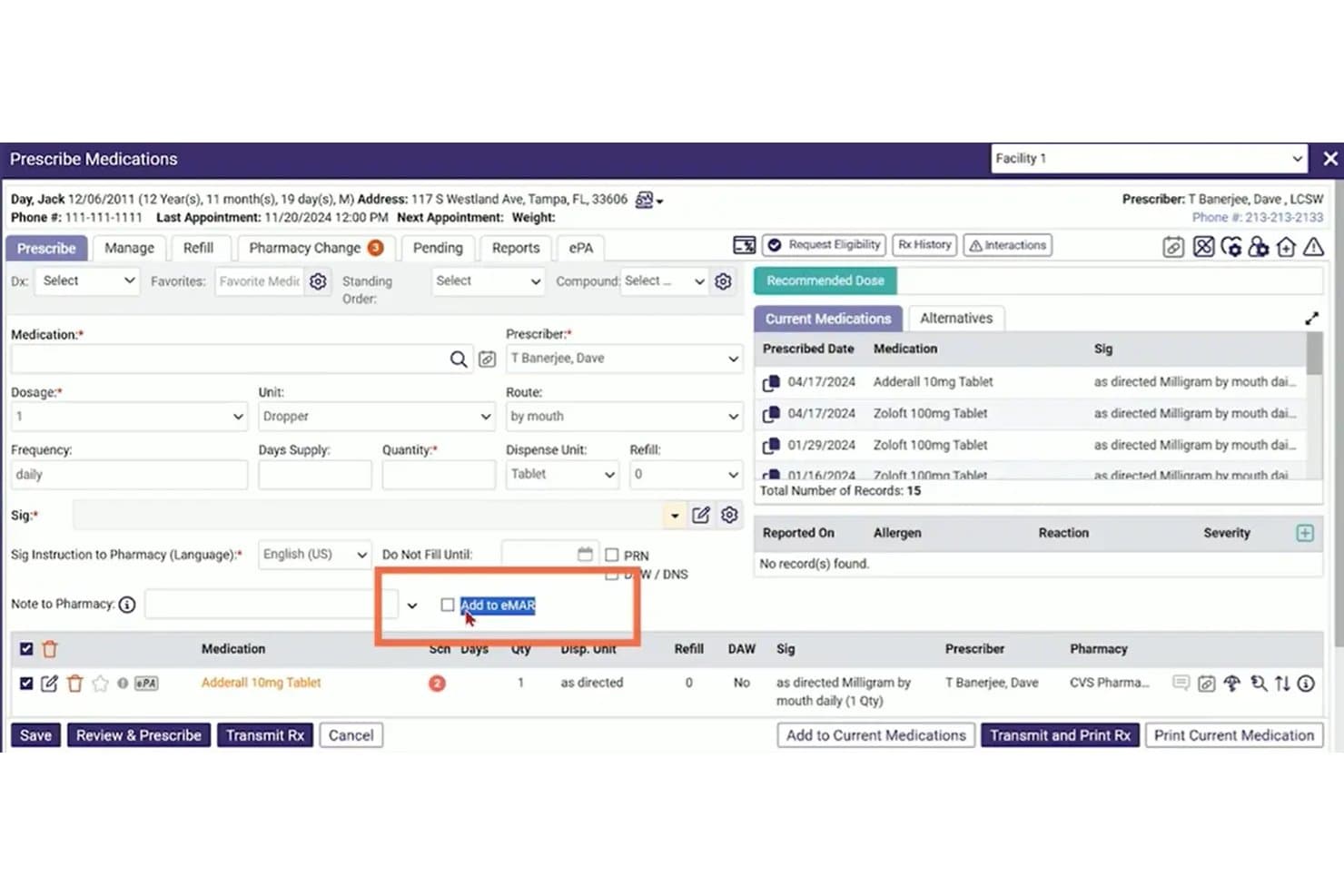
Qualifacts lets users prescribe and send medications directly to pharmacy. Qualifacts is a behavioral health-focused EMR platform that spans three distinct products—Credible, CareLogic, and InSync—covering e-prescribing with EPCS, configurable clinical documentation, behavioral health assessments, treatment plan management, and integrated telehealth.
Who Is Qualifacts Best For?
Qualifacts is a strong fit for behavioral health agencies and multi-clinician practices that need a purpose-built EMR with deep compliance, assessment, and e-prescribing capabilities across teams.
Why I Picked Qualifacts
Qualifacts earns its spot on my shortlist because it's the only platform here built exclusively for behavioral health agencies at scale, with e-prescribing, PDMP checks, and electronic prior authorization baked directly into every product. I also like that its built-in assessment library covers C-SSRS, PHQ-9, GAD-7, and more, with Greenspace MBC automating scoring and surfacing dashboards at the client and program level. For agencies running multiple programs, Credible's 35,000+ configurable form templates and cross-discipline treatment plan linking are genuinely hard to replicate.
Qualifacts Key Features
- AI ambient documentation: Records sessions and auto-drafts notes by pulling diagnoses, medications, and prior chart data into a clinician-reviewed draft.
- HIPAA-compliant telehealth: Supports group sessions of up to 50 participants with built-in chat, screen sharing, and immediate session transcription.
- Client engagement suite: Delivers a white-label portal for intake forms, eSignatures, appointment scheduling, reminders, and payments on web and mobile.
- Multi-platform configurability: Credible, CareLogic, and InSync each offer drag-and-drop form builders, macros, and workflow tools for custom documentation.
Qualifacts Integrations
Qualifacts offers 116+ marketplace integrations, including Greenspace Health, Inovalon, MethodOne by Computalogic, and ASAM Continuum. It supports HL7 and FHIR APIs, health information exchanges, Direct messaging, electronic lab orders, and results.
Pros and Cons
Pros:
- Configurable forms fit agency workflows
- PHQ-9 and C-SSRS scoring dashboards
- Built-in EPCS and PDMP checks
Cons:
- Psychiatric CPT guidance remains undocumented
- InSync medication sending can be slow
Learn more about Qualifacts:
Andre EMR-verktøy for psykiatri
\u003cspan style=\u0022font-weight: 400\u0022\u003eHer er noen flere EMR-alternativer for psykiatri som ikke kom med på kortlisten min, men som likevel er verdt å se nærmere på:\u003c/span\u003e
- 11CarePathsBest for measurement-based care in psychiatric practice
- 12PIMSYBest for behavioral health with PDMP-embedded eRx
- 13SimplePracticeBest for all-in-one telehealth and intake workflows
- 14OmniMDBest for CoCM billing and EPCS in one chart
- 15DocVillaBest for telemedicine, eRx, billing, and analytics
- 16athenaOneBest for multi-specialty billing and EPCS support
How I Evaluate Psychiatry EMRs
I split my evaluation into three parts, giving core functions the most weight: document psychiatric evaluations and progress notes, and prescribe controlled medications electronically. Next, I consider differentiators like PDMP access or measurement-based care dashboards. Finally, I weigh onboarding, compliance support, and growth-friendly pricing.
Core Functionality (Table Stakes For This List)
When I'm selecting tools for my list, I score each one on a scale from 0 (does not offer the functionality) to 5 (excels in this area) for each core functionality listed below. I then convert the total into a percentage to help assess each tool's overall fit, with extra weight on any functionalities I’ve deemed essential.
- Psychiatric Notes (Essential): I look for adaptable templates for evaluations, mental status exams, and progress notes across intake and follow-up visits.
- E-Prescribing & EPCS (Essential): I check for electronic prescribing with certified controlled-substance capability and a clear workflow for routine psychiatric prescriptions.
- Medication Tracking: I assess how the system records medication history and dosage changes, and whether it flags relevant interactions or allergies.
- Visit Scheduling: I look for distinct workflows for intakes, therapy sessions, and medication checks, including support for recurring appointments.
- Outcome Measures: I check for common scales such as PHQ-9 and GAD-7, with scoring and a way to review results over time.
- Behavioral Health Billing: I assess support for psychiatric coding and claims across different visit types, including how much information staff must enter manually.
Once I have a list of tools that meet the criteria, I consider what sets each platform apart.
Differentiating Factors (What Sets Vendors Apart)
Here's how I compare and contrast different vendors:
Standout Features
I look for direct PDMP integration so prescribers can check a patient's controlled substance history without leaving the chart. Measurement-based care dashboards matter just as much—I evaluate whether PHQ-9 and GAD-7 scores plot over time, giving clinicians a visual trend line to guide medication adjustments. I also check for collaborative care model support, including built-in CoCM billing codes, since practices coordinating with primary care need those workflows baked in rather than improvised.
Beyond Features
I evaluate each platform's regulatory alignment, especially 42 CFR Part 2 compliance for practices treating substance use disorders alongside general psychiatry. Onboarding support matters just as much—smaller behavioral health teams rarely have dedicated IT staff, so vendor-provided psychiatric templates and EPCS setup assistance shorten the path to a working system. I also check whether pricing scales with added providers or new service lines like CoCM, since a flat per-provider fee that balloons when you grow can quietly erode margins.
Slik velger du et EMR-system for psykiatri
Det er lett å gå seg vill i lange funksjonslister og kompliserte prismodeller. For å hjelpe deg med å holde fokus mens du går gjennom den unike prosessen med å velge programvare, får du her en sjekkliste over faktorer du bør ha i tankene:
| Faktor | Hva du bør vurdere |
| Brukervennlighet | Kan klinikere raskt navigere i dokumentasjon og journalføring? Test vanlige arbeidsflyter for unødvendige trinn eller forvirrende design. |
| Integrasjoner | Kan EMR-systemet koble seg toveis til laboratorier, apotek, faktureringsprogramvare og telehelseplattformer du allerede bruker? |
| Tilpasningsmuligheter | Kan du tilpasse maler og arbeidsflyter til ulike typer psykiatriske konsultasjoner, for eksempel terapi kontra legemiddelhåndtering? |
| Skalerbarhet | Vil EMR-systemet håndtere vekst for enkeltpraksiser, grupper og flere lokasjoner uten kostbare oppgraderinger eller omfattende opplæring på nytt? |
| Implementering og oppstart | Tilbyr leverandøren hjelp med migrering, tydelige tidsplaner og opplæringsressurser som er spesifikke for psykiatripraksiser? |
| Kostnad | Hvilke skjulte kostnader finnes for ting som elektronisk forskrivning, telehelsemoduler eller ekstra brukerplasser? |
| Sikkerhetstiltak | Er tilgangskontroller, kryptering og revisjonslogger robuste nok for sensitiv informasjon om psykisk helse? |
| Etterlevelseskrav | Støtter EMR-systemet HIPAA-etterlevelse, delstatlige personvernlover og særlige regler for samtykke eller dokumentasjon innen psykiatrien? |
Hva er et EMR-system for psykiatri?
Psykiatriske EMR-systemer er elektroniske pasientjournalsystemer som er utviklet spesielt for virksomheter innen psykisk helse og atferdshelse. De støtter psykiatrisk dokumentasjon, sikker håndtering av pasientjournaler, forskrivning og fakturering for psykiatere og psykiatriske sykepleiere. Disse systemene omfatter arbeidsflyter og samsvarsbeskyttelse som er tilpasset de unike behovene og regelverkene i psykiatriske behandlingsmiljøer.
Funksjoner
Ved valg av psykiatriske EMR-systemer bør du se etter følgende viktige funksjoner:
- Psykiatrispesifikke maler: Ferdiglagde skjemaer for inntaksvurderinger, undersøkelser av mental status, behandlingsplaner og fremdriftsnotater sparer tid og standardiserer klinisk dokumentasjon for psykiatriske arbeidsflyter.
- Elektronisk forskrivning av kontrollerte legemidler: Sikker og samsvarende elektronisk forskrivning gjør det mulig for psykiatere å sende resepter – inkludert legemidler i klasse II–V – direkte til apotek, samtidig som fornyelser spores og resepthistorikk overvåkes.
- Integrert timeplanlegging: Innebygde planleggingsverktøy støtter tilbakevendende besøk, automatiske timepåminnelser og kalenderstyring for terapitimer eller legemiddelkontroller.
- Pasientportal: En sikker portal lar pasienter se avtaler, be om reseptfornyelser, få tilgang til kliniske sammendrag og kommunisere med behandlingsteamet mellom besøkene.
- Fakturering og kravhåndtering: Psykiatriske EMR-systemer automatiserer valg av CPT-koder, oppretter forsikringskrav og sporer fakturerbare tjenester som er spesifikke for psykiatrisk behandling, for enklere refusjon.
- Verktøy for resultatsporing: Innebygde vurderingsskalaer som PHQ-9, GAD-7 eller mål opprettet av klinikeren bidrar til å følge pasientens fremgang og støtter målingsbasert psykiatrisk behandling.
- Rollebaserte sikkerhetskontroller: Finmaskede tilgangstillatelser hindrer uautorisert visning eller redigering av sensitive psykiske helseopplysninger og bidrar til å oppfylle personvernkrav.
- Støtte for flere behandlere: Delt tilgang til journaler, intern meldingsutveksling og samarbeidende behandlingsplaner gjør det mulig for psykiatere, terapeuter og forskrivere å koordinere pasientbehandlingen på en sikker måte.
- Tilpassbare arbeidsflyter: Virksomheter kan tilpasse maler, skjemaer og inntaksprosesser slik at de gjenspeiler deres unike dokumentasjonsstandarder og kliniske beste praksis.
- Integrasjon med telehelse: Direkte videobesøk i EMR-systemet muliggjør sikker behandling på avstand, slik at behandlere kan dokumentere, planlegge avtaler og forskrive uten å bytte plattform.
Fordeler
Implementering av psykiatriske EMR-systemer gir flere fordeler for teamet og virksomheten din. Her er noen av fordelene du kan se frem til:
- Effektivisert psykiatrisk dokumentasjon: Psykiatrispesifikke maler og automatiserte notatfunksjoner reduserer tiden som brukes på journalføring, slik at klinikere kan fokusere på behandlingen.
- Bedre koordinering av behandlingen: Delte journaler, sikker meldingsutveksling og tilgang for flere behandlere gjør det enklere å samarbeide og håndtere behandlingen som et team.
- Større pasientengasjement: Pasientportaler, timepåminnelser og telehelsealternativer hjelper pasientene med å holde seg involvert i behandlingen mellom besøkene.
- Nøyaktig fakturering og koding: Integrert fakturering, kodingsforslag og automatisert innsending av krav reduserer administrative feil og støtter riktig refusjon.
- Bedre datasikkerhet: Rollebaserte tilgangskontroller, revisjonsspor og samsvarsbeskyttelse beskytter sensitive psykiatriske opplysninger mot uautorisert tilgang.
- Bedre resultatsporing: Innebygde vurderingsverktøy og automatisert trendanalyse hjelper teamet med å følge pasientens fremgang og justere behandlingsplanene etter behov.
- Skalerbarhet for vekst: Skybaserte systemer og fleksible arbeidsflyter gjør det mulig for virksomheten å utvide tjenestetilbudet eller antallet lokasjoner uten å gjøre omfattende endringer i EMR-infrastrukturen.
Kostnader og priser
Valg av psykiatriske EMR-systemer krever en forståelse av de ulike prismodellene og abonnementene som er tilgjengelige. Kostnadene varierer basert på funksjoner, teamstørrelse, tillegg og mer. Tabellen nedenfor oppsummerer vanlige abonnementer, gjennomsnittsprisene deres og typiske funksjoner som er inkludert i psykiatriske EMR-løsninger:
Sammenligningstabell for abonnementer for psykiatriske EMR-systemer
| Plantype | Gjennomsnittlig pris | Vanlige funksjoner |
| Gratisplan | $0 | Grunnleggende dokumentasjon, begrenset timebestilling, enkle pasientjournaler og minimal tilgang til pasientportal. |
| Personlig plan | $25-$50/bruker/måned | Psykiatrimaler, elektronisk reseptforskrivning, timepåminnelser og tilgang til pasientportal. |
| Bedriftsplan | $50-$100/bruker/måned | Avansert timebestilling, faktureringsfunksjoner, verktøy for resultatsporing, integrasjon med telehelse og forbedrede sikkerhetskontroller. |
| Virksomhetsplan | $100-$250/bruker/måned | Tilpassede arbeidsflyter, API-tilgang, støtte for flere lokasjoner, prioritert brukerstøtte, avansert analyse og samsvarsadministrasjon. |
Vanlige spørsmål om EMR for psykiatri
Her er noen svar på vanlige spørsmål om EMR for psykiatri:
Kan EMR-systemer for psykiatri integreres med andre helsesystemer?
Ja, de fleste EMR-løsninger for psykiatri tilbyr integrasjonsmuligheter med andre helsesystemer, for eksempel faktureringsprogramvare, laboratoriesystemer og telehelseplattformer. Når du velger et EMR-system, bør du undersøke om det kan kobles til verktøyene praksisen din allerede bruker, slik at du sikrer sømløs dataflyt og unngår overflødig dataregistrering.
Hvor sikkert er pasientdata i EMR-systemer for psykiatri?
Ledende leverandører tilbyr ende-til-ende-kryptering, rollebasert tilgang, revisjonslogger og HIPAA-samsvar for å beskytte sensitiv informasjon om psykisk helse.
Hva slags opplæring eller brukerstøtte bør jeg forvente fra leverandøren?
Anerkjente leverandører tilbyr direkte opplæringsøkter, nettressurser og løpende teknisk brukerstøtte for å hjelpe teamet ditt med å tilpasse seg raskt og bruke systemet effektivt.
Kan jeg overføre eksisterende pasientdata til et nytt EMR-system for psykiatri?
Ja. De fleste leverandører tilbyr støtte for datamigrering, slik at pasientinformasjon, skjemaer og notater kan importeres fra det tidligere systemet ditt til den nye plattformen.
Hvordan kan jeg vite om et EMR-system for psykiatri er enkelt for personalet mitt å bruke?
Under demonstrasjoner eller prøveperioder bør du se hvor raskt personalet kan navigere i pasientjournaler, bestille timer og registrere notater uten omfattende opplæring.
Finnes det gratis EMR-verktøy for psykiatri?
Selv om de fleste EMR-verktøy for psykiatri koster penger på grunn av den komplekse og funksjonsrike utformingen, finnes det noen alternativer som tilbyr begrensede gratisversjoner eller prøveperioder. Verktøy som OpenEMR tilbyr gratis EMR-programvare med åpen kildekode, men den kan mangle de spesialiserte funksjonene som er nødvendige for en praksis innen psykisk helse, og det kan kreves teknisk kunnskap for å konfigurere og vedlikeholde den.