

Psychiatry billing software is a specialized tool that helps mental health practices manage insurance claims, billing codes, patient balances, and revenue cycle tasks with accuracy. If you’re comparing options, your goal is clear: find a billing system that reduces payment delays, minimizes errors, and keeps your practice compliant and organized. This guide covers what you need to know to confidently choose the right psychiatry billing platform for your team, no matter your practice size or billing complexity.
Why Trust Our Software Recommendations
6,700+
Reviews
20
Industry experts
16+
Evaluation factors
14
Years
Our team has been testing and reviewing software since 2012. As medical practice leaders ourselves, we know how difficult—and important—it is to choose the right software.
For this guide, we evaluated tools using hands-on testing and independent research, scoring tools using our selection criteria.
Our reviews reflect our human editorial judgment, not a sales pitch.
Psychiatry Billing Software Comparison Table
This comparison table summarizes pricing details for my top psychiatry billing software selections:
| Tool | Best For | Trial Info | Price | ||
|---|---|---|---|---|---|
| 1 | Best for enterprise behavioral health billing | Free demo available | Pricing upon request | Website | |
| 2 | Best for integrated therapy billing | 21-day free trial | From $29/user/month | Website | |
| 3 | Best for behavioral health billing workflows | Free demo available | Pricing upon request | Website | |
| 4 | Best for independent mental health practices | Free demo available | Pricing upon request | Website | |
| 5 | Best for mobile behavioral health billing | Free demo available | Pricing upon request | Website | |
| 6 | Best for solo mental health billing | 30-day free trial | From $49/month | Website | |
| 7 | Best for therapy billing and claims | 30-day free trial | From $69/month | Website | |
| 8 | Best for psychiatric billing and prior auths | Free demo available | From $249/month | Website | |
| 9 | Best for behavioral health RCM | Free demo available | Pricing upon request | Website | |
| 10 | Best for psychiatry billing workflows | 30-day free trial | From $35/user/month | Website |


Best Psychiatry Billing Software Reviews
Below are my detailed summaries of the best psychiatry billing software that made it onto my shortlist. My reviews offer a detailed look at the features, pricing, and capabilities of each software to help you find the best one for you.
 Best for enterprise behavioral health billing
- Free demo available
- Pricing upon request
Visit WebsiteCustomer Rating:4.4/5This rating combines scores from multiple user review sites to reflect overall customer sentiment about the product.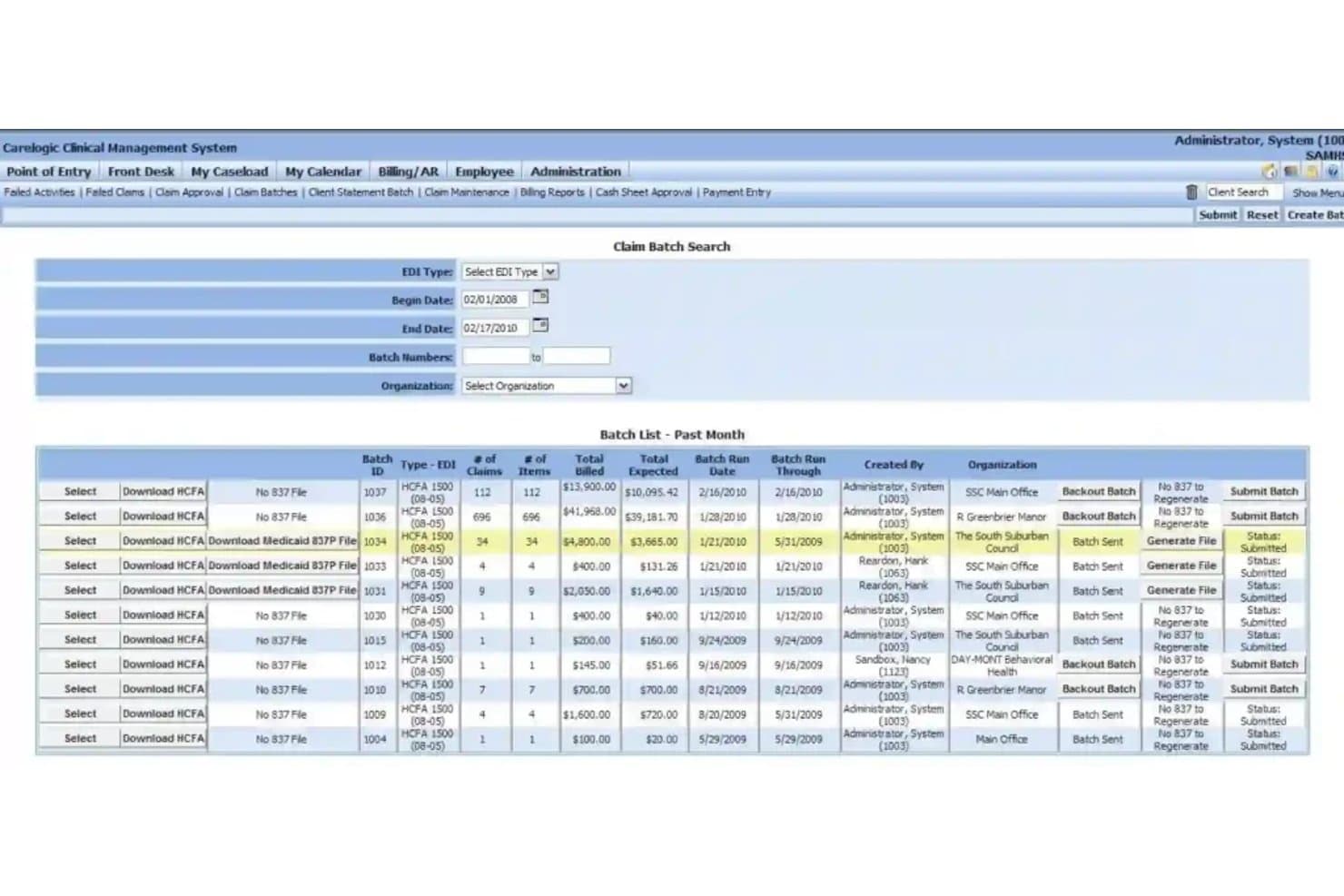
Qualifacts CareLogic offers a Claim Batch Search interface that allows billing staff to filter, review, and submit insurance claim batches with detailed EDI tracking. Qualifacts CareLogic is an enterprise behavioral health EHR with built-in billing, claims management, psychiatric documentation, ePrescribing, and state-specific reporting for mid-market and large multi-location behavioral health organizations.
Who Is Qualifacts CareLogic Best For?
It's a strong fit for mid-market and enterprise behavioral health agencies, CMHCs, and multi-location group psychiatric practices managing complex, publicly funded billing environments.
Why I Picked Qualifacts CareLogic
CareLogic earns its spot on my shortlist because its billing infrastructure is genuinely built around behavioral health payer complexity. I particularly like the pre-submission alert engine, which flags issues before a claim leaves the queue, and the bulk claim update tool, which lets billing teams correct and resubmit at scale. These aren't bolt-on features; they're core to how the platform operates, making CareLogic a serious option when your organization is running high claim volumes across multiple publicly funded payers.
Qualifacts CareLogic Key Features
- Psychiatric EHR documentation: Built-in charting for mental health, psychiatric evaluations, treatment planning, and progress notes.
- EPCS-certified e-prescribing: Integrated controlled substance and medication management tailored for psychiatry workflows.
- State reporting compliance: Native modules for submitting mandated data to state behavioral health agencies and Medicaid systems.
- Measurement-based care workflows: Embedded assessment tools like PHQ-9 and GAD-7 with scores captured directly in the clinical record.
Qualifacts CareLogic Integrations
Qualifacts CareLogic offers native integrations with DrFirst for e-prescribing, state Medicaid and behavioral health data systems, and Greenspace Health for measurement-based care. An API is available for custom integrations.
Pros and Cons
Pros:
- State-level behavioral health reporting available
- Native e-prescribing for controlled substances
- Bulk claim tools support high-volume billing
Cons:
- Prior authorization tracking is limited
- Not built for solo psychiatry practices
Learn more about Qualifacts CareLogic: Best for integrated therapy billing
- 21-day free trial
- From $29/user/month
Visit WebsiteCustomer Rating:4.5/5This rating combines scores from multiple user review sites to reflect overall customer sentiment about the product.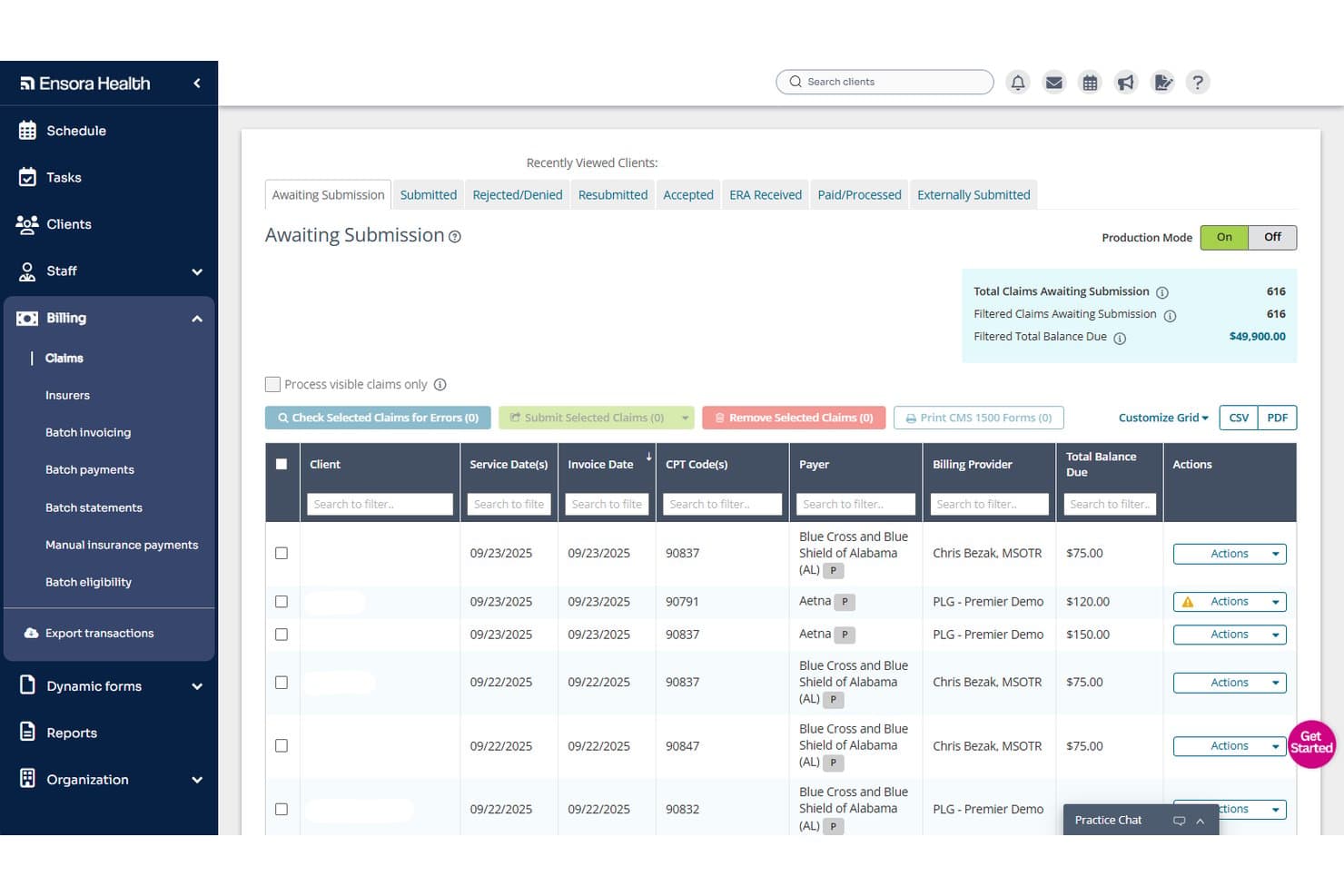
Ensora Health TheraNest offers a Claims Awaiting Submission dashboard displaying 616 pending claims totaling $49,900 with filtering, submission, and error-checking tools for psychiatry billing. Ensora Health TheraNest is a behavioral health EHR and practice management platform with built-in insurance billing, claims submission, ERA posting, eligibility verification, e-prescribing, and scheduling tailored for mental health and psychiatric practices.
Who Is Ensora Health TheraNest Best For?
It's a strong fit for solo psychiatrists and small-to-mid-size behavioral health group practices that bill insurance and need integrated clinical documentation alongside claims management.
Why I Picked Ensora Health TheraNest
I've included Ensora Health TheraNest in my top picks because its billing workflow lives inside the same platform as clinical documentation, which matters when you're running psychiatric sessions back-to-back. I like that batch invoicing pulls directly from the appointment schedule, so claims don't slip through after recurring medication management visits. The automated ERA posting with a configurable exception queue also means denials surface quickly rather than sitting unresolved in a clearinghouse.
Ensora Health TheraNest Key Features
- AI Session Assistant: Autogenerates progress notes and case summaries using telehealth or in-person session data.
- Wiley Treatment Planner integration: Provides structured treatment planning tools and clinical content prebuilt for behavioral health.
- Real-time insurance eligibility checks: Lets you confirm patient benefits and session limits for mental health services before appointments.
- Integrated e-prescribing (eRx + PDMP): Supports electronic medication orders and prescription monitoring directly from patient records.
Ensora Health TheraNest Integrations
Ensora Health TheraNest offers native integrations with clearinghouse partners for insurance claim submission, supports calendar sync with Google Calendar and Outlook, and provides integrated e-prescribing (eRx + PDMP). An API is available for custom integrations.
Pros and Cons
Pros:
- ERA auto-posting with denial categorization
- Auto-generates claims from recurring appointments
- Psychiatric CPT code library included for billing
Cons:
- E-prescribing adds monthly cost per provider
- Prior authorization tracking is not built in
Learn more about Ensora Health TheraNest: Best for behavioral health billing workflows
- Free demo available
- Pricing upon request
Visit WebsiteCustomer Rating:4.1/5This rating combines scores from multiple user review sites to reflect overall customer sentiment about the product.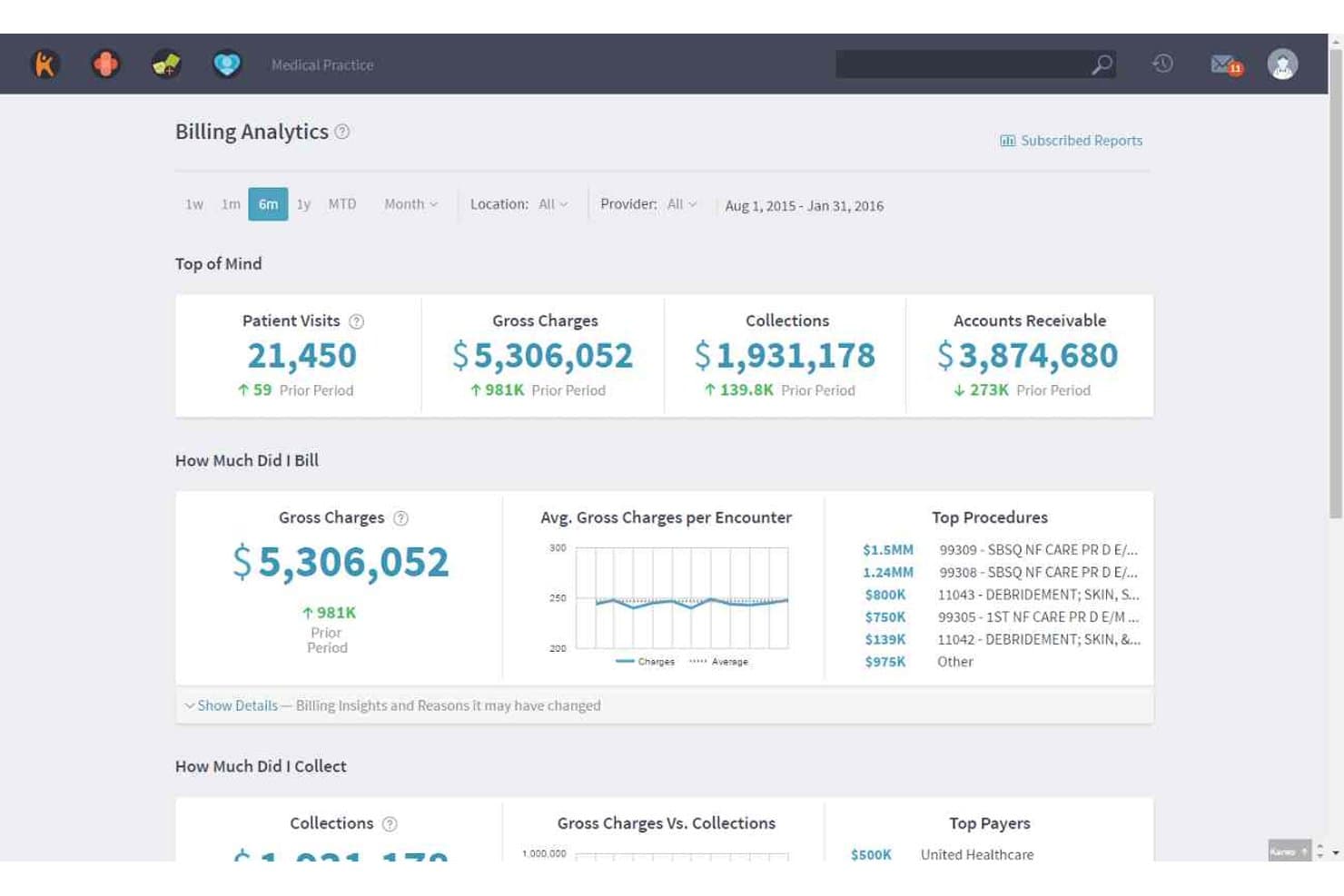
Kareo Billing offers a comprehensive Billing Analytics dashboard displaying patient visits, gross charges, collections, accounts receivable, and top procedures for medical practices. Kareo Billing (now Tebra) is a medical billing and practice management platform that combines e-claims submission, denial management, real-time eligibility verification, and EHR integration for behavioral health and psychiatric practices.
Who Is Kareo Billing Best For?
Kareo Billing works well for solo practitioners and small independent behavioral health practices that need billing and clinical documentation in a single system.
Why I Picked Kareo Billing
Kareo Billing earns its spot on my shortlist because its clearinghouse connections to Availity, Waystar, and Change Healthcare address the denial-heavy payer relationships behavioral health billers face. I also like the built-in EPCS and PDMP monitoring, which keeps psychiatric prescribers compliant with controlled substance rules without a separate tool. The denial management workflow lets my team track, resubmit, and analyze rejected claims by payer in one place.
Kareo Billing Key Features
- Real-time eligibility verification: Check mental health insurance benefits before every visit directly within the platform.
- Automated ERA payment posting: Automatically reconcile remittance advice and apply payments to psychiatric accounts.
- Patient statement and online payments: Generate patient statements and accept payments through a secure, integrated portal.
- EHR with integrated PDMP and EPCS: Document medication management visits while monitoring controlled substance prescribing in compliance with regulations.
Kareo Billing Integrations
Kareo Billing offers native integrations with clearinghouse partners Availity, Waystar, Trizetto, and Change Healthcare. It also integrates with Appriss Health for PDMP and EPCS compliance and supports an API for custom integrations.
Pros and Cons
Pros:
- Denial management workflow tuned for behavioral health
- Built-in EPCS and PDMP support for prescribers
- Handles psychiatric codes and modifiers well
Cons:
- No batch mental health authorization tracking
- Lacks built-in assessment code automation
Learn more about Kareo Billing: Best for independent mental health practices
- Free demo available
- Pricing upon request
Visit WebsiteCustomer Rating:3.9/5This rating combines scores from multiple user review sites to reflect overall customer sentiment about the product.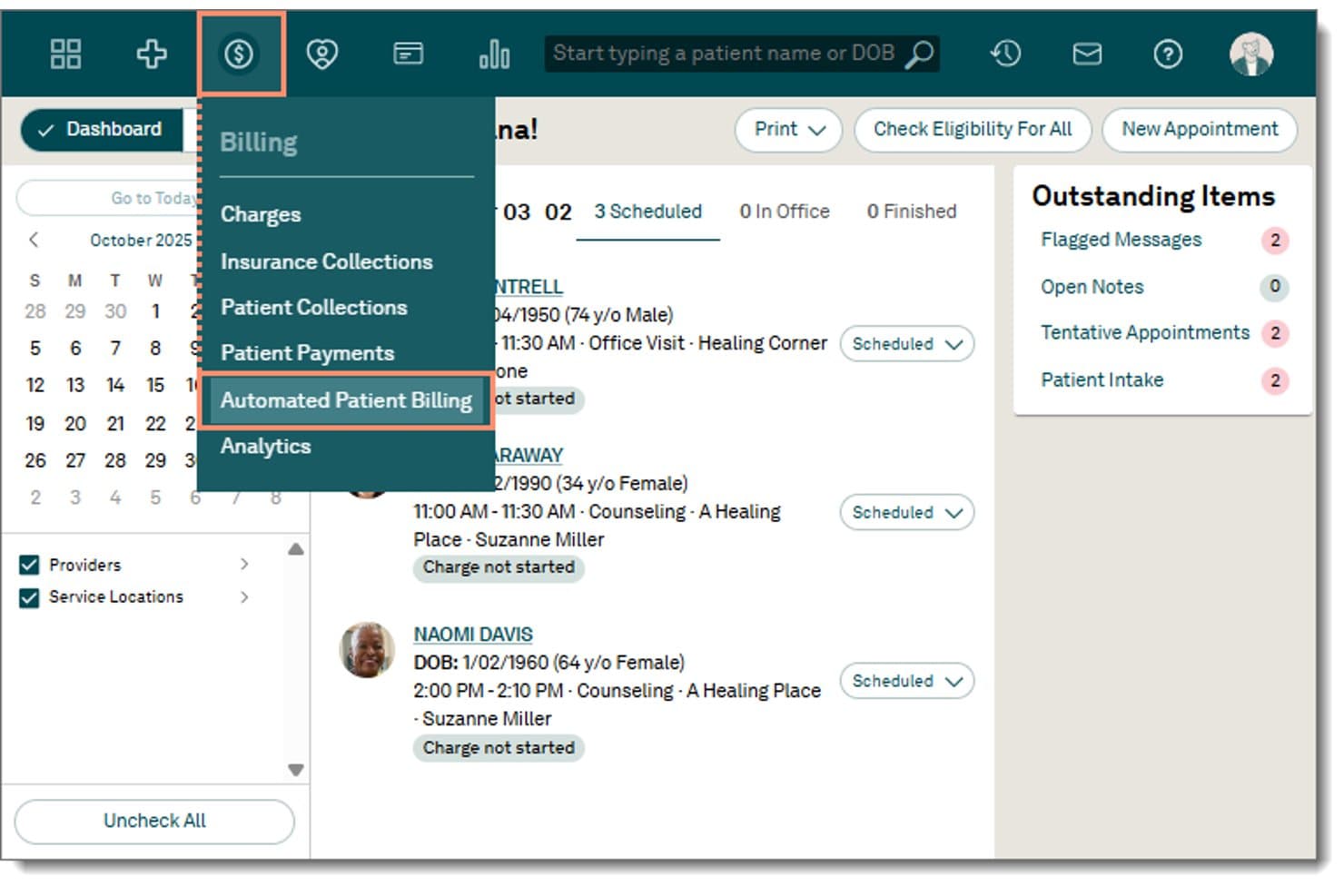
Tebra offers an Automated Patient Billing option within its Billing menu, streamlining psychiatric practice revenue management. Tebra is an all-in-one practice management platform for independent practices that combines a built-in EHR, electronic claims management, insurance eligibility verification, automated patient billing, and EPCS/PDMP-integrated e-prescribing.
Who Is Tebra Best For?
Tebra is a strong fit for solo and small independent mental health practices that need a single platform for both clinical documentation and billing without a large administrative team.
Why I Picked Tebra
I picked Tebra as one of the best because its built-in EPCS and PDMP integration handles controlled-substance prescribing inside the same platform used for claims and clinical documentation. For a solo psychiatrist running medication management visits, that means prescription monitoring and charge capture share a single workflow rather than two separate systems. I also like that the per-provider licensing includes unlimited non-clinical staff access, so a solo practice can add a dedicated biller without paying an extra seat fee.
Tebra Key Features
- Batch electronic claim submission: Submit multiple psychiatric and behavioral health claims at once with error detection and payer-specific rules.
- Real-time insurance eligibility checks: Instantly verify insurance coverage, copays, and deductibles across thousands of payers.
- Customizable progress note templates: Create and adapt documentation templates for therapy visits, medication checks, and clinical workflows.
- Telehealth appointment management: Schedule and track HIPAA-compliant virtual sessions directly in the platform.
Tebra Integrations
Tebra supports integrations with third-party EHRs using HL7, FHIR, and an API for custom integrations. It also integrates with Appriss Health for PDMP compliance and clearinghouses for claims submission.
Pros and Cons
Pros:
- PDMP and EPCS built into clinical workflow
- Unlimited non-clinical staff billing access included
- Real-time insurance eligibility checks for psychiatry
Cons:
- Telehealth billing modifiers require manual setup
- No embedded behavioral health CPT code logic
Learn more about Tebra: Best for mobile behavioral health billing
- Free demo available
- Pricing upon request
Visit WebsiteCustomer Rating:3.9/5This rating combines scores from multiple user review sites to reflect overall customer sentiment about the product.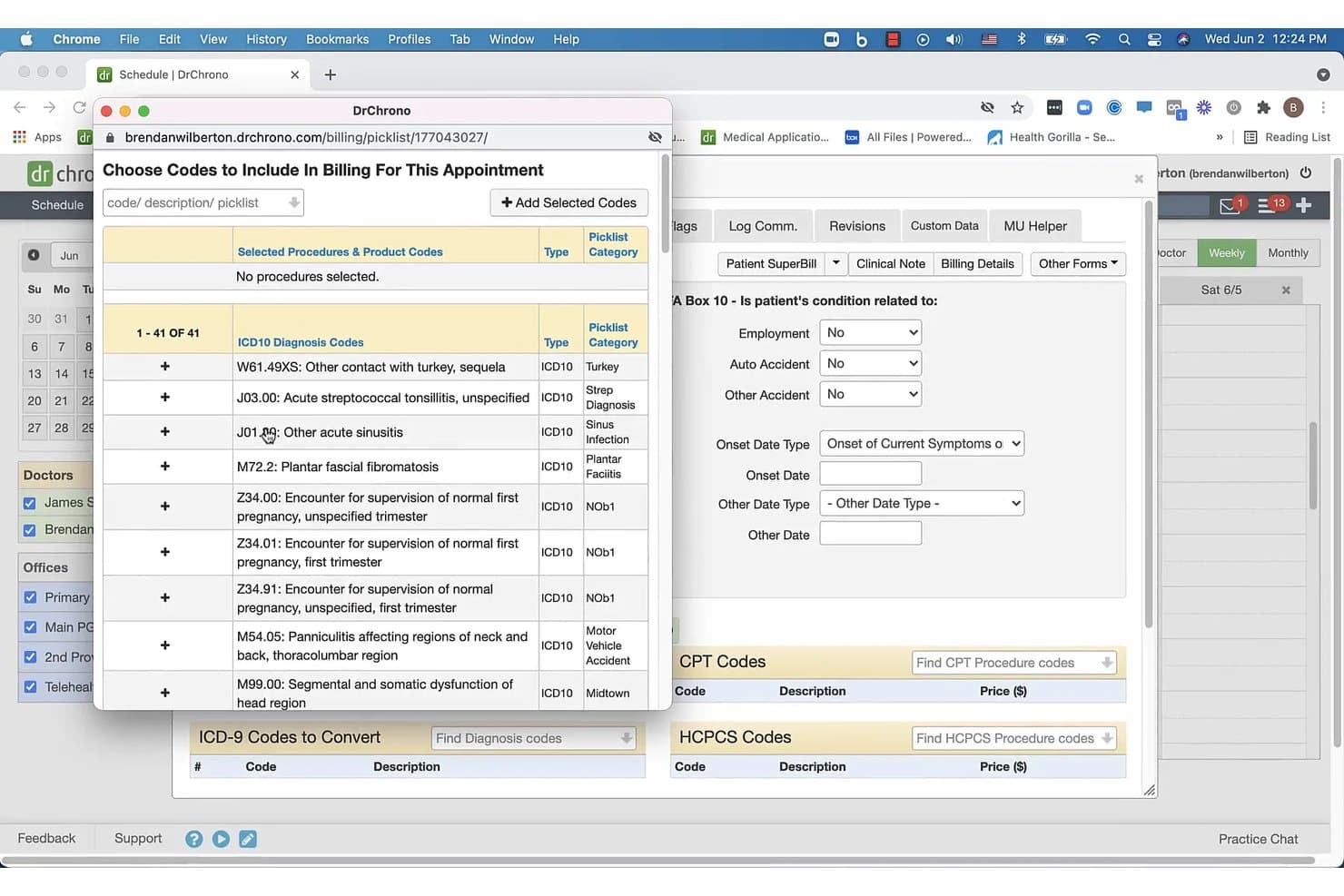
DrChrono offers a billing code picklist modal that allows providers to search and add ICD10 diagnosis codes to a patient appointment. DrChrono is a cloud-based EHR and medical billing platform with built-in practice management, psychiatric charting templates, real-time eligibility verification, claims management, and revenue cycle tools designed for independent and group mental health practices.
Who Is DrChrono Best For?
DrChrono suits independent psychiatrists and small-to-mid-size behavioral health practices that need a combined EHR and billing solution accessible from iPhone or iPad.
Why I Picked DrChrono
DrChrono earns its spot on my shortlist because it's genuinely built around the iPad as a primary device, not as an afterthought. I can document a session using medical speech-to-text or macro buttons, then push a claim using billing profiles pre-built for diagnoses like depression or ADHD, all from mobile. The EPCS feature for controlled substances is also fully accessible on-device, which matters considerably in a psychiatry billing workflow.
DrChrono Key Features
- Real-time insurance eligibility verification: Check mental health benefits, session limits, and authorization needs before every appointment.
- Psychiatric-specific charting templates: Access PHQ-9 and other behavioral health screens with score capture tied to claim codes.
- Integrated electronic claim management: Track, scrub, and submit claims to behavioral health payers with built-in denial workflow tools.
- Automated patient statements and payment collection: Generate statements, post ERAs, and offer card-on-file billing through the patient portal.
DrChrono Integrations
DrChrono offers native integrations with Labcorp, Quest Diagnostics, Lifepoint, Health Gorilla, Surescripts, Iron Bridge, FullScript, Bamboo Health, Stripe, and Collectly. An open API is available for custom integrations.
Pros and Cons
Pros:
- In-app patient scheduling and copay collection
- Pre-built profiles for common psychiatric codes
- Mobile-first EHR and billing experience
Cons:
- Automated time-based code selection missing
- Android app lacks core billing features
Learn more about DrChrono: Best for solo mental health billing
- 30-day free trial
- From $49/month
Visit WebsiteCustomer Rating:4.6/5This rating combines scores from multiple user review sites to reflect overall customer sentiment about the product.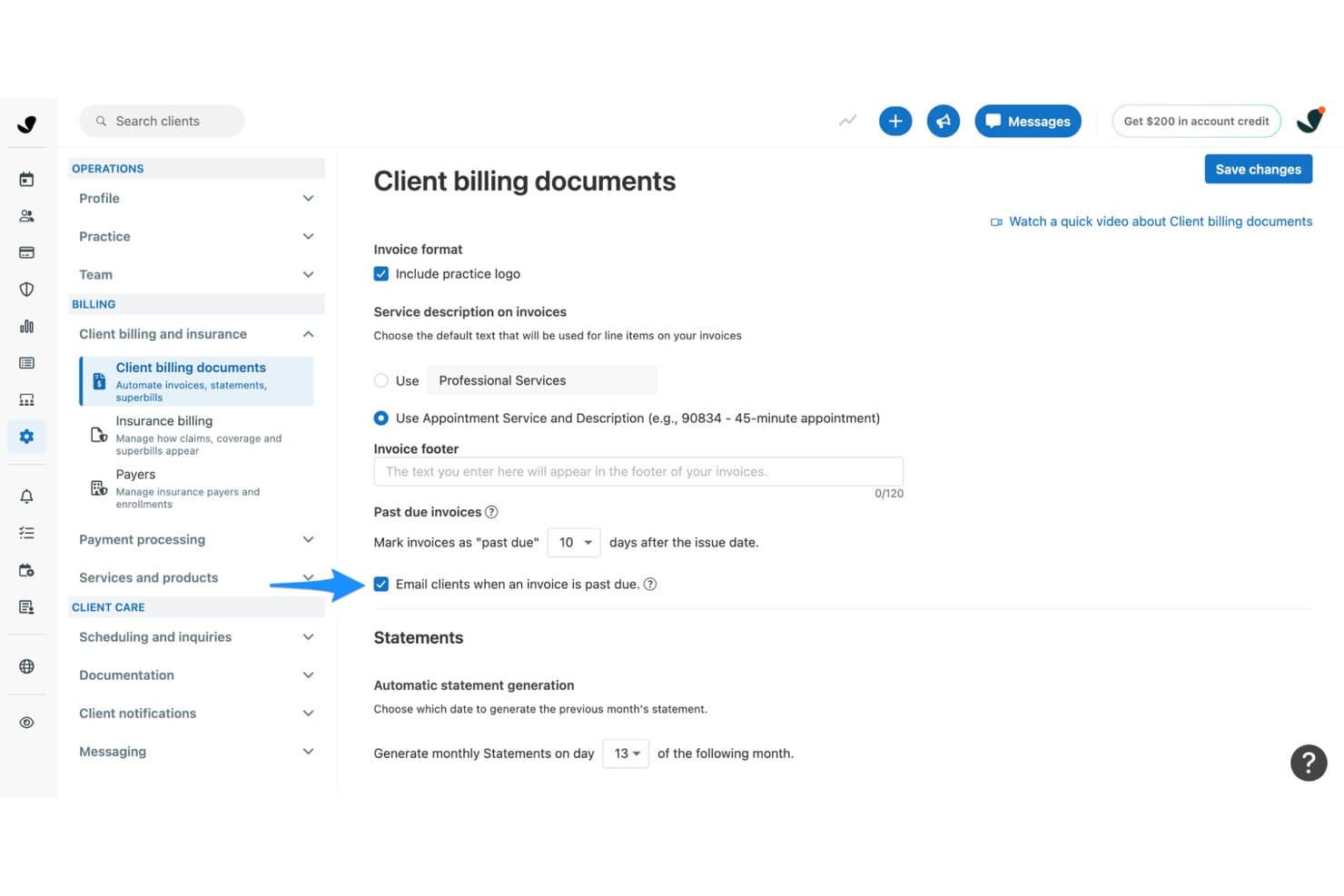
SimplePractice offers automated client billing document settings including invoice format, past due invoice notifications, and monthly statement generation. SimplePractice is a practice management and EHR platform for mental health providers that combines insurance billing, electronic claims filing, eligibility verification, scheduling, clinical documentation, and native ePrescribe for psychiatric medication management.
Who Is SimplePractice Best For?
SimplePractice is a strong fit for solo and small-group mental health practitioners, including psychiatrists and PMHNPs who need integrated prescribing alongside billing.
Why I Picked SimplePractice
SimplePractice earns its spot on my shortlist because it's built specifically around the solo mental health billing workflow. I like that it includes native ePrescribe (powered by DrFirst) with EPCS support for controlled substances and PDMP integration, so psychiatrists handle medication management and billing from a single chart. The Plus plan includes 35 free insurance claims per month, which aligns with the lower claim volumes typical of a solo practice without triggering per-claim overage charges immediately.
SimplePractice Key Features
- Automated ERA and EOB posting: Handles remittance advice and insurance payments, matching them to claims for efficient reconciliation.
- Real-time insurance eligibility checks: Verifies mental health benefits before appointments, including details about coverage and copays.
- Customizable behavioral health templates: Offers pre-built and editable templates for psychiatric assessment, progress notes, and treatment plans.
- Integrated telehealth session billing: Supports coding and billing for virtual visits with dedicated telehealth modifiers and POS codes.
SimplePractice Integrations
SimplePractice offers native integrations with DrFirst for ePrescribe, Google Calendar, Microsoft Outlook, iCal, Stripe for payment processing, and Smartlink Health. An API is available for custom integrations.
Pros and Cons
Pros:
- Automated insurance eligibility verification for appointments
- Pre-loaded psychiatry CPT and E/M code templates
- Built-in ePrescribe with controlled substances support
Cons:
- No real-time authorization or session tracking
- Limited denial management and claim appeal tools
Learn more about SimplePractice: Best for therapy billing and claims
- 30-day free trial
- From $69/month
Visit WebsiteCustomer Rating:4.4/5This rating combines scores from multiple user review sites to reflect overall customer sentiment about the product.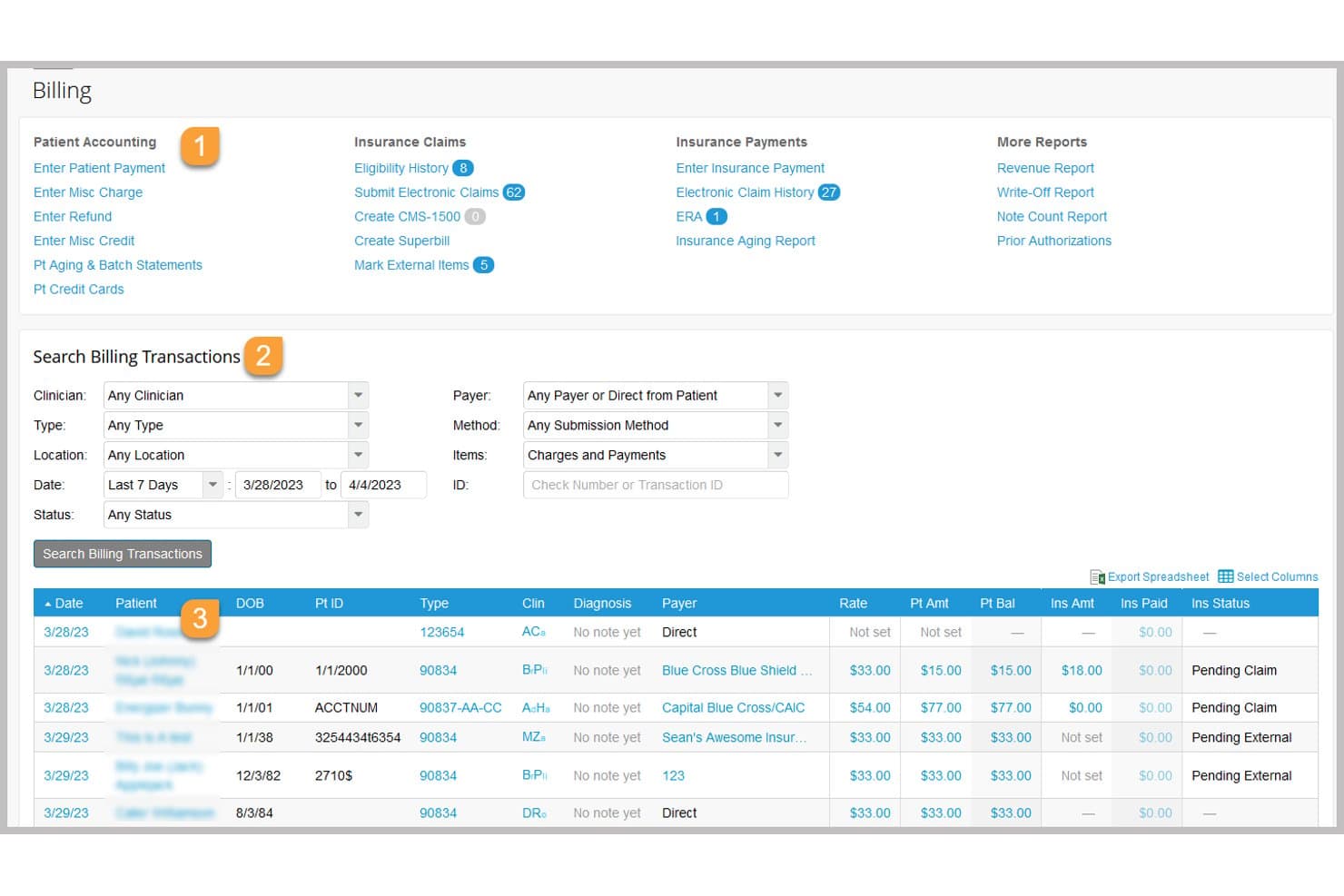
TherapyNotes offers a comprehensive billing dashboard with searchable transaction records, insurance claim management, and payment tracking tools for psychiatry practices. TherapyNotes is a behavioral health EHR and practice management platform built specifically for mental health providers, combining psychiatric note templates, ePrescribe, scheduling, and end-to-end billing with electronic claims submission and ERA posting.
Who Is TherapyNotes Best For?
TherapyNotes suits solo and small-to-mid-sized behavioral health practices that include prescribing clinicians, such as psychiatrists and psychiatric nurse practitioners, who need documentation and billing in one system.
Why I Picked TherapyNotes
TherapyNotes earns its spot on my shortlist because the billing workflow is built directly around behavioral health clinical documentation. I love that a psychiatrist's completed progress note feeds directly into the claim, eliminating duplicate data entry between charting and claims submission. I also rely on the ERA auto-posting feature, which reconciles insurance payments against open claims automatically, and the payer-specific reporting to track exactly where revenue is stalling across providers or insurers.
TherapyNotes Key Features
- Psychiatric CPT code templates: Pre-configured evaluation, psychotherapy, and medication management codes specific to psychiatry billing workflows.
- EPCS-certified e-prescribing: Electronic prescribing for controlled substances directly connected with Surescripts and DrFirst.
- Real-time insurance eligibility verification: Instantly check mental health benefit details, carve-outs, and session limits before appointments.
- Patient portal with online payments: Clients can access statements and make payments securely through a self-service interface.
TherapyNotes Integrations
TherapyNotes offers native integrations with DrFirst for e-prescribing, Surescripts for medication history and pharmacy benefits, GreenPointMed for credentialing, and DUO Mobile for two-factor authentication on controlled substance prescribing. Native calendar integration is available with Google Calendar and Outlook Calendar.
Pros and Cons
Pros:
- EPCS-certified e-prescribing for controlled substances
- ERA auto-posting reconciles claims and payments
- Psychiatric CPT codes and modifiers preloaded
Cons:
- Prior authorization workflow not fully automated
- Clearinghouse transmission failures can delay payments
Learn more about TherapyNotes: Best for psychiatric billing and prior auths
- Free demo available
- From $249/month
Visit WebsiteCustomer Rating:4.6/5This rating combines scores from multiple user review sites to reflect overall customer sentiment about the product.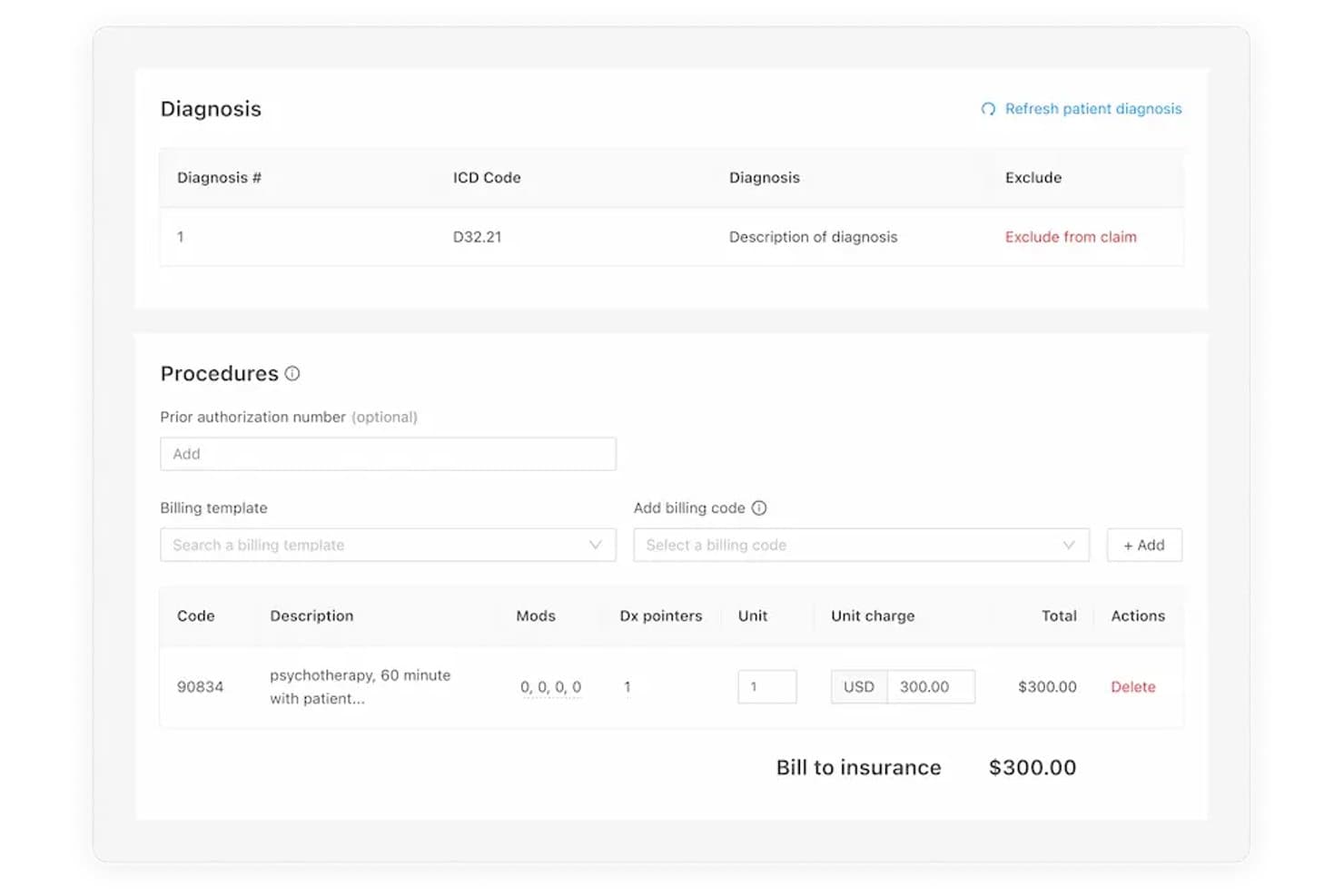
Osmind offers a structured claims billing interface with diagnosis codes, procedure codes, billing templates, and insurance billing totals for psychiatry practices. Osmind is a psychiatry-native EHR and billing platform that combines insurance claims management, prior authorization workflows, ERA reconciliation, and real-time eligibility verification with clinical charting built for interventional psychiatric treatments.
Who Is Osmind Best For?
Osmind is a strong fit for interventional psychiatry practices—particularly those offering TMS, ketamine, or Spravato—that are navigating insurance billing for the first time or scaling their RCM operations.
Why I Picked Osmind
I picked Osmind as one of the best because no other billing platform handles Spravato and TMS prior authorizations with this level of specialization. When a payer denies a ketamine infusion claim, Osmind's psychiatry-specialized billing team steps in to manage the appeal using the largest psychiatry billing dataset available. I also like that co-pays collect automatically at booking, which removes one of the most time-consuming manual steps in psychiatric practice billing.
Osmind Key Features
- Spravato REMS automation: Supports digital compliance and built-in documentation for every Spravato visit.
- Measurement-based care tracking: Automates outcomes collection with 30+ psychiatric rating scales linked to each encounter.
- Integrated e-prescribing (EPCS): Includes DrFirst integration for controlled substance and standard medication prescribing.
- Multi-calendar scheduling: Allows flexible appointment management and color-coded scheduling for large teams and multiple provider locations.
Osmind Integrations
Osmind offers native integrations with ClaimMD, OfficeAlly, DrFirst, LabCorp, Quest, Stripe, Acuity Scheduling, Vagaro, Google Calendar, Square Payments, and Wave. An API is available for custom integrations.
Pros and Cons
Pros:
- Automated Spravato REMS documentation and tracking
- Psychiatry-specific prior authorization management included
- Dedicated workflows for interventional psychiatry billing
Cons:
- Advanced psychotherapy billing logic less emphasized
- Not tailored for multi-specialty behavioral health groups
Learn more about Osmind: Best for behavioral health RCM
- Free demo available
- Pricing upon request
Visit WebsiteCustomer Rating:4.1/5This rating combines scores from multiple user review sites to reflect overall customer sentiment about the product.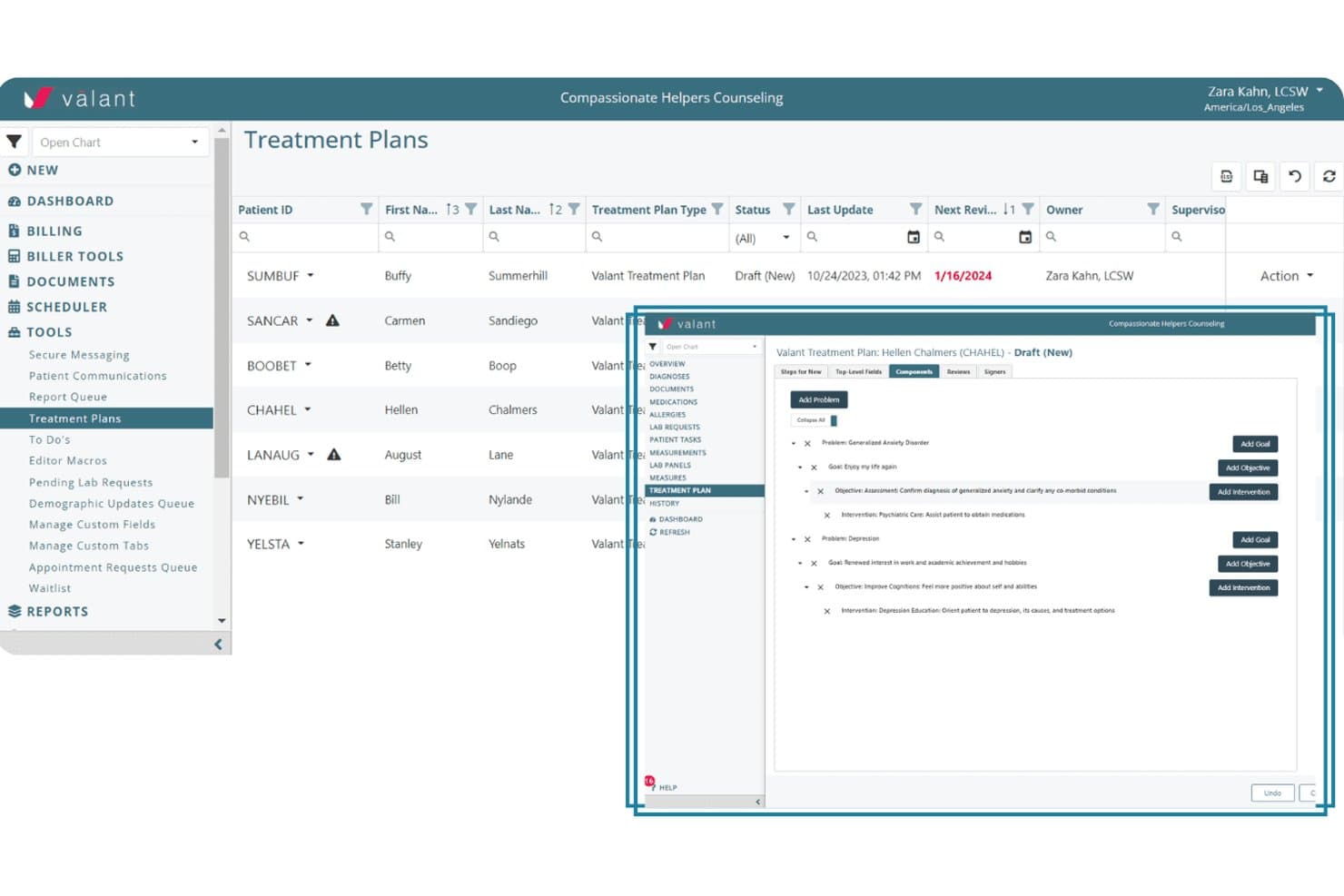
Valant offers structured treatment plan components including problems, goals, objectives, and interventions within its EHR platform. Valant is a behavioral health-exclusive EHR and practice management platform that combines psychiatric clinical documentation, scheduling, billing automation, and a dedicated revenue cycle management service built specifically for mental health providers.
Who Is Valant Best For?
Valant fits behavioral health practices of all sizes—from solo PMHNPs to multi-provider group practices managing complex insurance billing and intensive outpatient programs.
Why I Picked Valant
I picked Valant as one of the best because its RCM service goes beyond standard billing software. Valant pairs a dedicated behavioral health billing team with automated claim processing, denial management, and claim appeal filing, all built around psychiatric payer rules. I like that accounts receivable reporting sits directly inside the same system as clinical documentation, so billing performance is visible without switching platforms.
Valant Key Features
- Native behavioral health CPT library: Offers pre-loaded psychiatric CPT and add-on code templates designed for common therapy and medication management scenarios.
- ePrescribing with PDMP integration: Lets providers send controlled substance prescriptions electronically with state database checks from within the EHR.
- Integrated telehealth session billing: Ties video sessions directly to billing codes, supporting POS 02/10 and relevant telemedicine modifiers.
- Outcome measure-driven billing: Supports automatic scoring and documentation of PHQ-9, GAD-7, and other mental health assessments linked to claims.
Valant Integrations
Native integrations include DrFirst for e-prescribing and PDMP checks, an integrated clearinghouse for claims, and credit card processing. An EHR API is available for custom integrations.
Pros and Cons
Pros:
- Automated denial management with appeal filing
- Specialty templates for psychotherapy and E/M codes
- Built-in RCM service for psychiatry practices
Cons:
- Reported outages during critical billing periods
- No contract flexibility after one year
Learn more about Valant: 10Best for psychiatry billing workflows
ICANotes
- 30-day free trial
- From $35/user/month
Visit WebsiteCustomer Rating:4.1/5This rating combines scores from multiple user review sites to reflect overall customer sentiment about the product.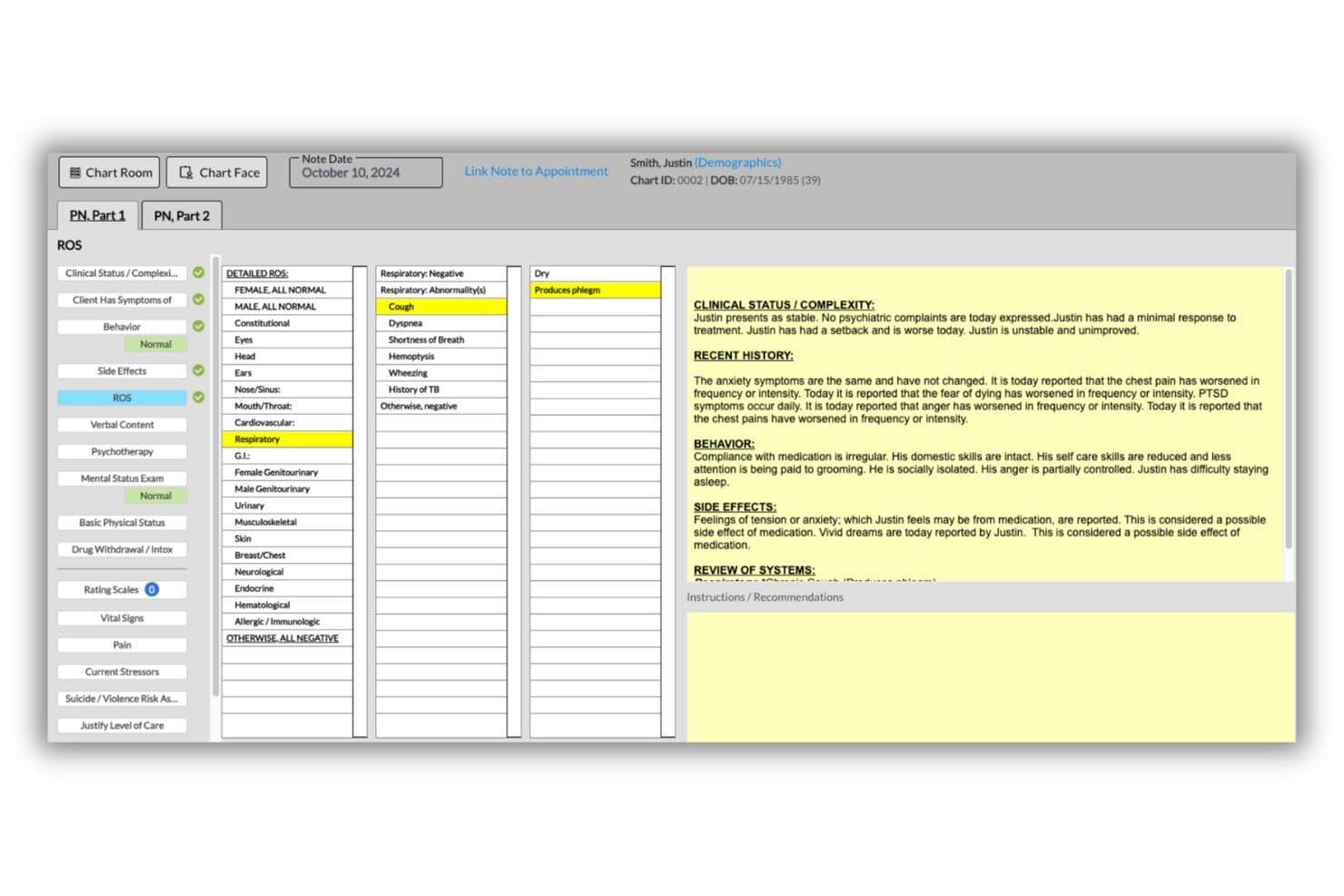
ICANotes offers a detailed Review of Systems (ROS) module within its psychiatric progress note interface, streamlining clinical documentation for billing accuracy. ICANotes is a behavioral health-native EHR and practice management platform built specifically for mental health clinicians, combining psychiatric documentation, e-prescribing, insurance eligibility verification, claims submission, and integrated RCM tools.
Who Is ICANotes Best For?
ICANotes is a strong fit for solo and small group psychiatric practices where prescribing clinicians handle both clinical documentation and billing in one system.
Why I Picked ICANotes
ICANotes earns its spot on my shortlist because its self-coding feature automatically selects the highest reimbursable E/M code directly from the clinical note, which is something most generic billing tools can't do. I also like that prescribing plans include ePrescribing with PDMP checks tied directly to the billing workflow. For practices that need more hands-off support, there's an optional full RCM outsourcing service staffed by behavioral-health billing specialists who understand psychiatry-specific denial patterns.
ICANotes Key Features
- Psychiatric CPT code library: Includes pre-loaded codes for E/M, psychotherapy add-ons, and interactive complexity unique to psychiatry billing.
- Insurance eligibility checks: Verifies mental health benefits and authorizations before claims submission using real-time integrations.
- ERA auto-reconciliation: Automatically posts electronic remittance advice and flags behavioral health-specific denials.
- Measurement-based care billing: Links scores from tools like PHQ-9 and GAD-7 to claim generation for assessment-based codes.
ICANotes Integrations
ICANotes offers native integrations with select labs, clearinghouses, and HIEs, including Inovalon for revenue cycle management. An API is available for custom integrations.
Pros and Cons
Pros:
- Behavioral health-specific payer denial tracking
- Integrated e-prescribing with PDMP workflow
- Automated psychiatric E/M and psychotherapy coding
Cons:
- Incomplete telehealth support for group therapy
- Limited advanced analytics or custom reporting
Learn more about ICANotes:
Other Psychiatry Billing Software
Here are some additional psychiatry billing software options that didn’t make it onto my shortlist, but are still worth checking out:
- 11NextGen Behavioral Health SuiteBest for large behavioral health practices
- 12AdvancedMDBest for automated mental health billing
- 13CollaborateMDBest for cloud-based behavioral health billing
- 14KipuBest for addiction treatment billing
- 15AZZLY RizeBest for addiction and behavioral health billing
- 16TherabillBest for therapy claims and invoicing
- 17CarePathsBest for behavioral health claims management
How I Evaluate Psychiatry Billing Software
I split my evaluation into baseline criteria every tool must meet—like psychiatric CPT code support and claims scrubbing—and the differentiators that separate a good fit from a great one.
Core Functionality (Table Stakes For This List)
When I'm selecting tools for my list, I rank each one on a scale from 0 (does not offer the functionality) to 5 (excels in this area) for each core functionality listed below. Then, I calculate the tool's total score into a percentage. Each tool needs to achieve a minimum total score of 65% to be considered for inclusion.
- Behavioral Health Coding: I check for native psychiatric CPT code libraries—90832 through 90838, group codes like 90853, and add-on support for interactive complexity with E/M.
- Claims Management: End-to-end claim scrubbing matters, especially for behavioral health payers where denials often stem from lapsed authorizations or exceeded session limits.
- Eligibility Verification: Real-time benefit checks should surface mental health carve-outs, session caps, and prior auth requirements before a patient's first appointment.
- Time-Based Session Billing: I evaluate how each tool handles duration-based psychotherapy codes and recurring billing for weekly or biweekly medication management visits.
- Payment Posting & Patient Billing: Automated ERA posting paired with card-on-file collection and patient payment plans matters when you're managing dozens of recurring weekly sessions.
- EHR/PM Integration: I look for built-in psychiatric charting or bi-directional EHR sync that ties progress notes and treatment plans directly to claim generation.
Once I have a list of tools that meet the criteria, I consider what sets each platform apart.
Differentiating Factors (What Sets Vendors Apart)
Here's how I compare and contrast different vendors:
Standout Features
Telepsychiatry billing support is a big differentiator—I look for native POS 02/10 code handling and GT/95 modifier logic built into claim scrubbing so telehealth visits don't create extra manual work. EPCS-certified e-prescribing that syncs with billing is another feature I evaluate, since medication management encounters should auto-generate charges without duplicate data entry. Measurement-based care billing also matters: tools that link PHQ-9 or GAD-7 scores to codes like 96127 help practices capture revenue they'd otherwise miss.
Beyond Features
Behavioral health payer expertise is a major factor—I check whether a platform has pre-built connections to carve-out payers like Optum and Magellan and can handle split billing between prescribers and therapists. Compliance matters too, especially 42 CFR Part 2 support for practices treating substance use disorders alongside psychiatric conditions. I also evaluate how well each tool scales across practice models, from solo outpatient psychiatrists to multi-provider groups running IOP or PHP programs.
How to Choose Psychiatry Billing Software
It’s easy to get bogged down in long feature lists and complex pricing structures. To help you stay focused as you work through your unique software selection process, here’s a checklist of factors to keep in mind:
| Factor | What to Consider |
| Scalability | Can the software grow with your practice? Assess if it meets the needs of solo prescribers, group practices, or clinics with expanding service lines. |
| Integrations | What EHR, clearinghouse, and payment integrations are supported? Confirm compatibility with your existing clinical tools and preferred partners. |
| Customizability | Can you configure workflows, templates, or billing rules for your unique care model, such as recurring therapy or split prescriber/therapist billing? |
| Ease of use | Will your clinical and billing team pick it up quickly? Look for intuitive navigation and clear workflows that don’t require lengthy training. |
| Implementation and onboarding | How long will it take to get up and running? Ask about data migration from legacy systems and whether dedicated onboarding support is included. |
| Cost | What’s included in pricing—claims, user seats, support? Clarify hidden charges like payer enrollment, additional users, or rate increases at renewal. |
| Security safeguards | Does the software offer HIPAA and 42 CFR Part 2 compliance? Ensure it has strong access controls and data protections appropriate for sensitive data. |
| Support availability | What support channels are offered? Check for live chat, phone, or after-hours help—especially if your practice works across different time zones. |
What Is Psychiatry Billing Software?
Psychiatry billing software is a specialized system designed to handle the unique medical coding, claim filing, and patient billing needs of mental health practices. It automates tasks like psychiatric CPT code management, insurance verification, and payment tracking. This software helps practices reduce claim denials, manage recurring therapy sessions, track outstanding balances, and stay compliant with behavioral health regulations.
Features of Psychiatry Billing Software
When selecting psychiatry billing software, keep an eye out for the following key features:
- Psychiatric CPT code support: Enables accurate billing by supporting specific psychiatric codes, including E/M services and add-on psychotherapy codes, for all mental health scenarios.
- Claims management automation: Handles electronic claim scrubbing, submission, and tracking to reduce errors, prevent denials, and accelerate reimbursement from insurers.
- Insurance eligibility verification: Checks patient mental health benefits, session limits, and prior authorizations in real time before appointments to prevent surprise denials.
- Time-based session billing: Calculates charges based on appointment duration and recurring therapy schedules, ensuring proper payment for each service delivered.
- Payment posting and patient billing: Automates ERA/EOB posting, generates patient statements, tracks copays and deductibles, and supports payment plans for ongoing care.
- Integration with psychiatric EHRs: Connects billing systems directly with electronic health records for seamless sharing of treatment notes and charge data.
- Telepsychiatry billing tools: Includes built-in support for telehealth claim codes and modifiers, letting practices bill accurately for virtual patient sessions.
- Denial management workflows: Flags, categorizes, and tracks denied claims with tools for follow-up, appeals, and analysis of payer trends.
- Compliance and security features: Maintains HIPAA and behavioral health confidentiality standards, with access controls and data protection for sensitive psychiatric information.
Benefits of Psychiatry Billing Software
Implementing psychiatry billing software provides several benefits for your team and your business. Here are a few you can look forward to:
- Fewer claim denials: Automated claims scrubbing and payer-specific coding help reduce costly rejections and speed up reimbursement.
- Improved patient billing clarity: Integrated payment posting and patient billing features make it easier to track copays, deductibles, and outstanding balances for ongoing care.
- Streamlined prior authorization: Real-time mental health insurance verification highlights authorization and session limit requirements before care, reducing headaches later.
- More efficient recurring billing: Time-based and recurring appointment billing enables quick, accurate charging for ongoing psychotherapy or medication management.
- Enhanced regulatory compliance: Built-in HIPAA safeguards and support for confidentiality regulations keep sensitive behavioral health information protected.
- Simplified EHR integration: Bi-directional links with psychiatric EHRs tie clinical documentation and billing, helping ensure accurate coding with less manual entry.
- Faster onboarding for new staff: Intuitive workflows and clear navigation shorten training time so new team members can get up to speed quickly.
Costs and Pricing of Psychiatry Billing Software
Selecting psychiatry billing software requires an understanding of the various pricing models and plans available. Costs vary based on features, team size, add-ons, and more. The table below summarizes common plans, their average prices, and typical features included in psychiatry billing software solutions:
Plan Comparison Table for Psychiatry Billing Software
| Plan Type | Average Price | Common Features |
| Free Plan | $0 | Basic claim entry, manual posting, limited CPT support, and single-user access. |
| Personal Plan | $30-$80/user/month | Claims management, psychiatric CPT library, basic insurance verification, and solo provider support. |
| Business Plan | $100-$300/month | Advanced claims scrubbing, eligibility checks, recurring billing, ERA posting, and group practice management. |
| Enterprise Plan | $400+/month | Full EHR/PM integration, robust reporting, telepsychiatry tools, customized workflows, and dedicated support. |
Psychiatry Billing Software FAQs
Here are some answers to common questions about psychiatry billing software:
Does psychiatry billing software support telehealth services?
Yes, most psychiatry billing platforms support telehealth by providing built-in code and modifier support for virtual sessions, such as POS 02/10 and GT/95, so you can accurately bill for remote psychiatric care.
Can psychiatry billing software handle split billing for therapy and medication management?
Yes, many platforms let you bill separately for prescriber and therapist services, making it easier to manage collaborative care and ensure accurate insurance billing for each provider.
What security measures should I expect in psychiatry billing software?
You should expect HIPAA compliance, audit trails, access controls, data encryption, and support for additional rules like 42 CFR Part 2 for substance use disorder confidentiality.
How long does it take to implement psychiatry billing software?
Implementation timelines vary, but most vendors offer onboarding support that includes data migration, payer enrollment, and staff training, allowing practices to go live in a few weeks.
Is psychiatry billing software only for insurance-based practices?
No, psychiatry billing software can support cash-pay, insurance, and hybrid models, often letting you create custom fee schedules and handle various payment types for different patient needs.