

Denial management software helps healthcare teams track, analyze, and resolve denied insurance claims to protect revenue and improve payment rates. If you’re looking for the best denial management software, you’re likely wrestling with rising denial rates, time-consuming appeals, and scattered data.
Getting the right tool is more than just checking a box for compliance—it’s about making sure your workflow supports timely, accurate reimbursement without adding another layer of hassle. In this guide, you’ll get a side-by-side overview of top denial management platforms, practical insights on their strengths, and the clarity you need to pick the right fit for your team.
Why Trust Our Software Recommendations
6,700+
Reviews
20
Industry experts
16+
Evaluation factors
14
Years
Our team has been testing and reviewing software since 2012. As medical practice leaders ourselves, we know how difficult—and important—it is to choose the right software.
For this guide, we evaluated tools using hands-on testing and independent research, scoring tools using our selection criteria.
Our reviews reflect our human editorial judgment, not a sales pitch.
Denial Management Software Comparison Table
This comparison table summarizes pricing details for my denial management software:
| Tool | Best For | Trial Info | Price | ||
|---|---|---|---|---|---|
| 1 | Best for all-in-one workflow and claims billing | Free demo available | Pricing upon request | Website | |
| 2 | Best for simple practice management integration | Free demo available | Pricing upon request | Website | |
| 3 | Best for transparent revenue recovery insights | Free demo available | Pricing upon request | Website | |
| 4 | Best for clearinghouse-integrated denial workflows | Not available | Pricing upon request | Website | |
| 5 | Best for machine learning-based claim automation | Free demo available | Pricing upon request | Website | |
| 6 | Best for automated cross-payer appeals tracking | Free demo available | Pricing upon request | Website | |
| 7 | Best for advanced denial trend analytics | Free demo available | Pricing upon request | Website | |
| 8 | Best for integrated payer rules intelligence | Free demo available | Pricing upon request | Website | |
| 9 | Best for real-time denial root cause visualization | Free demo available | Pricing upon request | Website | |
| 10 | Best for AI-driven denial prediction and analytics | Not available | Pricing upon request | Website |


Best Denial Management Software Reviews
Below are my detailed summaries of the best denial management software that made it onto my shortlist. My reviews offer a detailed look at the features, capabilities, and integrations of each platform to help you find the best one for you.
 Best for all-in-one workflow and claims billing
- Free demo available
- Pricing upon request
Visit WebsiteCustomer Rating:3.6/5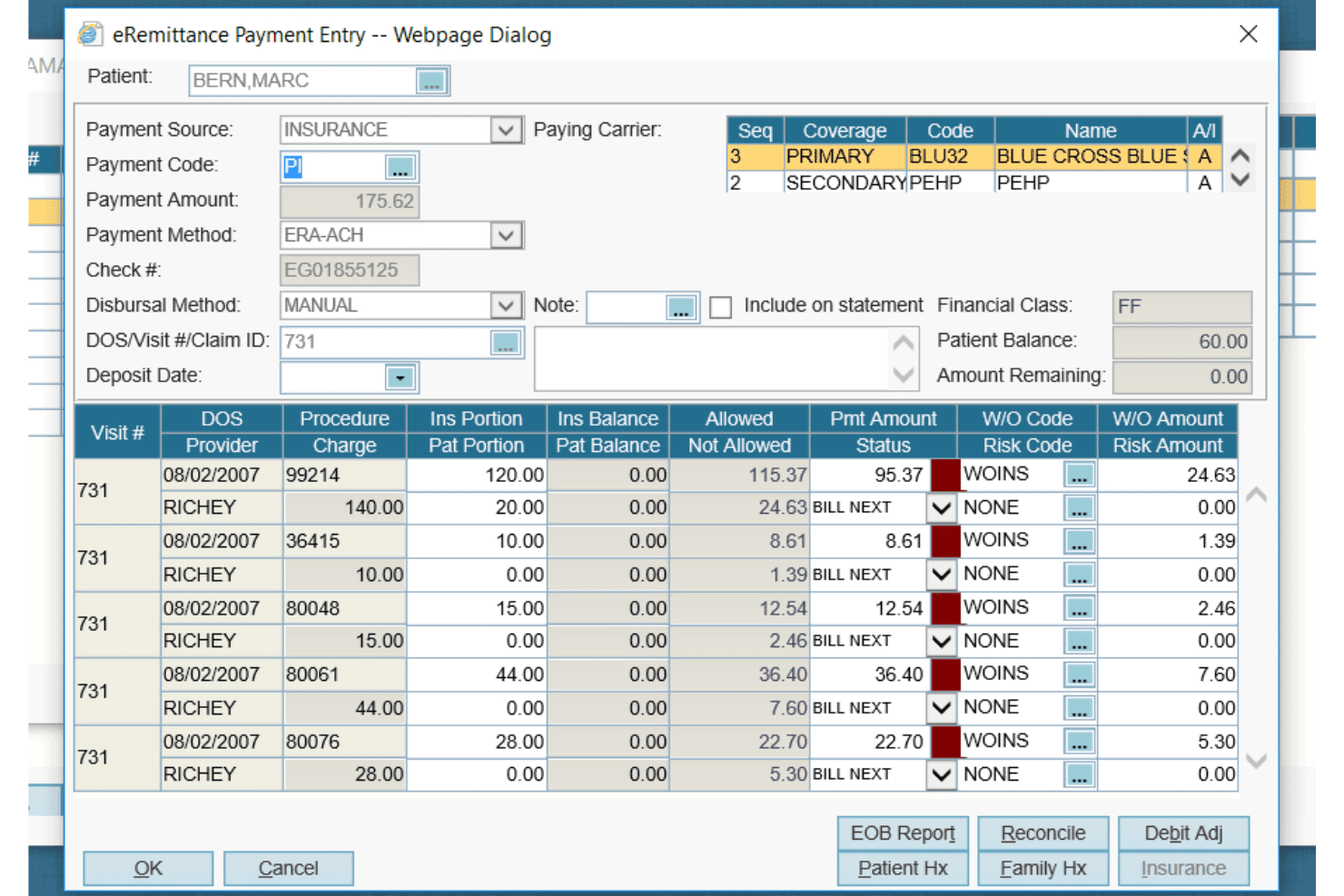
AdvancedMD offers a detailed eRemittance Payment Entry dialog for managing insurance billing, claim payments, and write-off codes per procedure. AdvancedMD is a cloud-based medical billing and practice management platform that combines claim scrubbing, ERA-based denial capture, A/R worklist management, and integrated revenue cycle management tools for independent practices.
Who Is AdvancedMD Best For?
It's a strong fit for independent and small-to-mid-size medical practices that want billing, claims management, and denial follow-up handled in a single platform.
Why I Picked AdvancedMD
I picked AdvancedMD because its ClaimInspector module runs nearly 3.5 million edits per claim before submission, catching HIPAA, CCI, and LCD errors that would otherwise generate denials. When a claim does get denied, ERA capture feeds directly into A/R worklists, so my team can assign, correct, and resubmit without leaving the platform. I also like that the built-in clearinghouse connects to over 1,800 payers, meaning payer-specific rules are factored in during scrubbing.
AdvancedMD Key Features
- Integrated clearinghouse: Transmits claims and remits electronically to over 1,800 payers with ERA auto-posting.
- A/R worklist management: Lets teams track, assign, and follow up on denied claims within customizable queues.
- Customizable reporting dashboards: Enables denial trend analysis by payer, procedure, and provider for deeper revenue cycle insights.
- RESTful API and FHIR support: Provides connections for syncing claim, remit, and patient data with external EHRs, labs, and registries.
AdvancedMD Integrations
AdvancedMD offers native integrations with Waystar, Dragon Medical One, Inbox Health, MedXCom, Falkondata, and LeadSquared. It also provides a RESTful API and FHIR R4 APIs for custom integrations with EHRs, labs, and registries.
Pros and Cons
Pros:
- Reporting dashboards surface denial trends by payer
- ERA auto-posting feeds directly into A/R worklists
- Pre-submission claim scrubbing prevents avoidable denials
Cons:
- Customer support response times frustrate billing teams
- No dedicated appeal letter generation module
 Best for simple practice management integration
- Free demo available
- Pricing upon request
Visit WebsiteCustomer Rating:3.9/5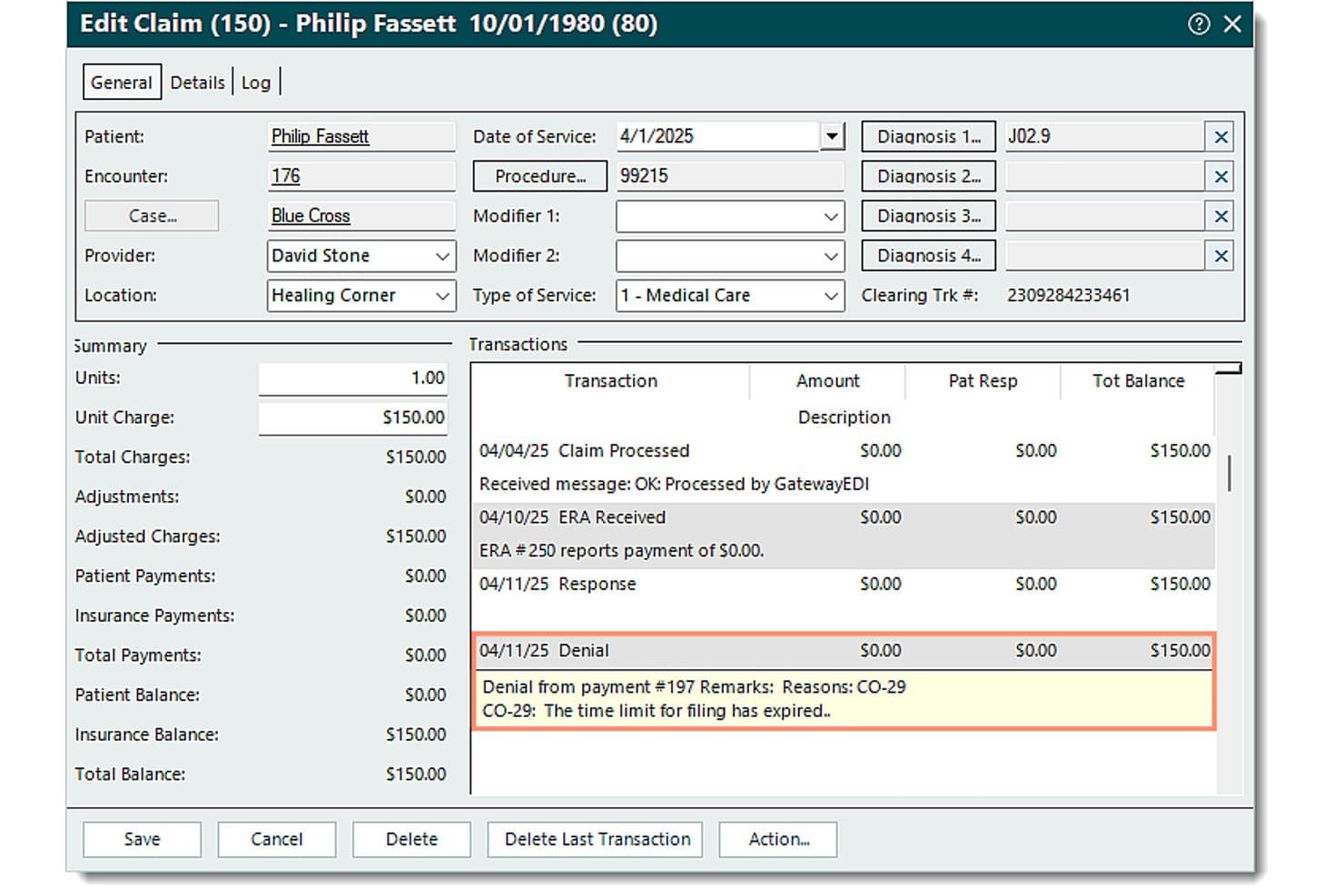
Kareo (Tebra) displays a claim denial detail screen showing a CO-29 denial reason with transaction history and balance summary. Tebra (formerly Kareo) is an all-in-one practice management and billing platform that handles claim submission, eligibility verification, ERA auto-posting, and denial tracking within a single integrated system built for independent practices.
Who Is Kareo (Tebra) Best For?
Tebra is a strong fit for small-to-mid-sized independent practices whose billing managers and practice admins need PM, EHR, and billing in one place.
Why I Picked Kareo (Tebra)
I've included Kareo (Tebra) in my top picks because denial tracking sits natively inside the same platform your team uses for scheduling, charting, and billing. I like how automated eligibility verification runs directly within intake and scheduling workflows, catching coverage issues before claims go out. The ERA auto-posting via RPA and the dedicated rejected-claims list mean billers can see denied claims and act on them without toggling between separate systems.
Kareo (Tebra) Key Features
- Electronic claim scrubbing: Automatically checks claims for errors and missing details using payer-specific rules before submission.
- Real-time insurance eligibility verification: Instantly verifies patient insurance coverage with over 2,700 payers from within the workflow.
- Automated ERA posting: Uses robotic process automation to auto-post electronic remittance advice for faster reconciliation.
- Billing dashboard with denial tracking: Centralized dashboard lets staff track claim statuses, denials, and rejections in one place.
Kareo (Tebra) Integrations
Kareo (Tebra) offers native integrations with most major EHRs via HL7 and FHIR connections, supports more than 2,700 payer integrations for real-time eligibility verification, and connects with clearinghouse partners. An API is available for custom integrations.
Pros and Cons
Pros:
- Automated ERA posting via robotic process automation
- Pre-submission scrubbing catches claim errors early
- Native PM, EHR, and billing in one
Cons:
- No built-in appeal letter generation tools
- Denial analytics lack configurable drill-down reporting
Learn more about Kareo (Tebra): Best for transparent revenue recovery insights
- Free demo available
- Pricing upon request
Visit WebsiteCustomer Rating:4.2/5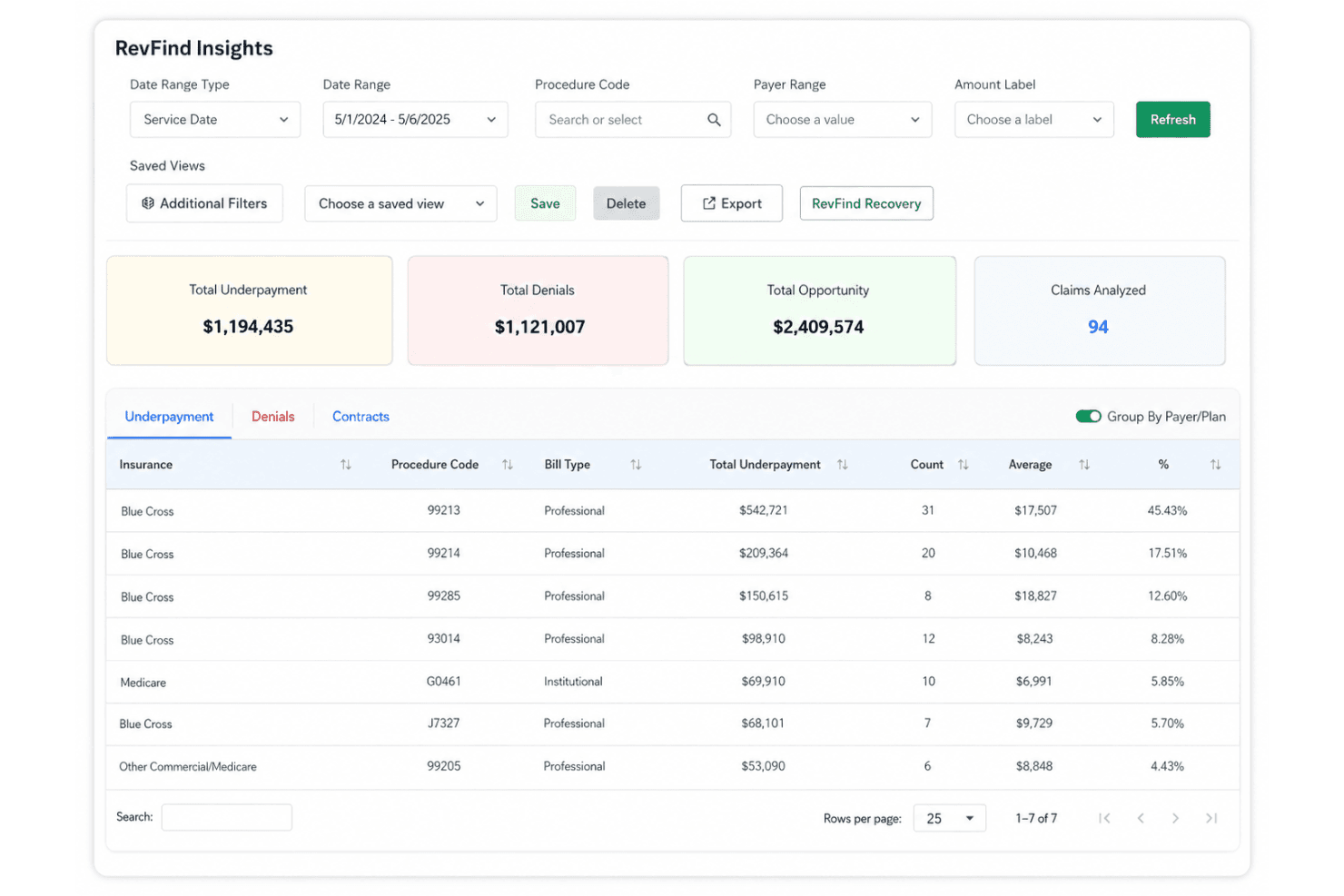
RevFind captures denials and underpayments, then guides contract-based recovery. RevFind by MD Clarity is a denial management and underpayment detection platform that automatically captures denied claims from remittances, categorizes them by payer and procedure code, and routes them through configurable recovery worklists tied directly to payer contract terms.
Who Is MD Clarity (RevFind) Best For?
RevFind is a strong fit for specialty provider groups and MSOs whose revenue cycle teams manage high claim volumes across multiple payer contracts.
Why I Picked MD Clarity (RevFind)
I picked RevFind as one of the best because it connects denial activity directly to the underlying payer contract terms that triggered the underpayment. When a denial lands, I can see the specific CPT code, contracted rate, and exact variance in one view. The drill-down dashboards let me trace patterns by payer, procedure code, and denial reason, so I know precisely where recovery dollars are sitting and why each one was lost.
MD Clarity (RevFind) Key Features
- Centralized contract repository: Store all payer contracts in one place for reference during denial review.
- Configurable recovery worklists: Automatically route denied and underpaid claims to customized queues based on payer, provider, or facility.
- Pre-built integrations with major PM/EHRs: Connect directly with Epic, Cerner, athenahealth, NextGen, and others to ingest remittance and claim files.
- Drill-down denial analysis: Filter and analyze denials by CPT code, payer, site of service, and specific denial reason code.
MD Clarity (RevFind) Integrations
RevFind offers native integrations with Epic, Cerner, athenahealth, NextGen, eClinicalWorks, ModMed, Compulink, Nextech, and Experity. It also supports HL7, FHIR, and X12 EDI file formats, with an API available for custom integrations.
Pros and Cons
Pros:
- Configurable worklists auto-route denials to staff
- Drill-down analytics by payer, CPT, and reason
- Ties denial recovery to payer contract terms
Cons:
- Dashboard configuration requires significant upfront setup
- No automated appeal letter generation
Learn more about MD Clarity (RevFind): Best for clearinghouse-integrated denial workflows
- Not available
- Pricing upon request
Visit WebsiteCustomer Rating:3.7/5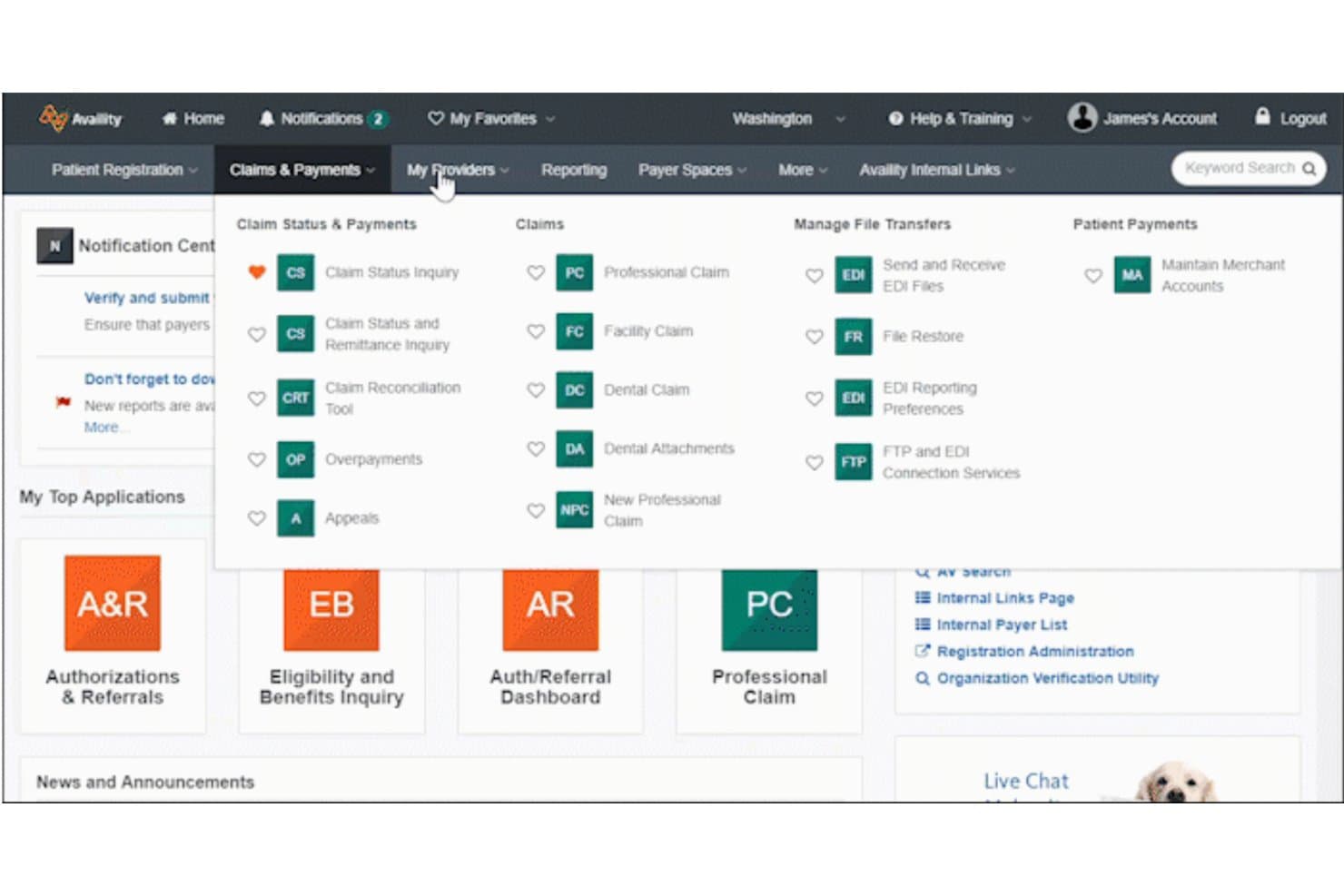
Availity offers a comprehensive Claims & Payments menu with EDI file management, claim submission, and remittance inquiry tools for healthcare providers. Availity is a clearinghouse-native denial management platform that combines AI-powered predictive claim editing, denial correction queues, ERA processing, and denial pattern analytics across a multi-payer provider network.
Who Is Availity Best For?
Availity is a strong fit for revenue cycle teams at hospitals and large provider organizations that process high claim volumes across multiple payers.
Why I Picked Availity
Availity earns its spot on my shortlist because no other denial management tool I've used is as tightly integrated with its own clearinghouse. I like how the Predictive Editing engine flags claims likely to be denied before they ever reach the payer, using AI trained on historical claim data with 97% precision. In practice, that means my team can catch and correct errors in a live queue tied directly to the same network that processes the claim.
Availity Key Features
- Denial correction queue: Lets users review and correct denied claims in an online worklist grouped by payer and denial reason.
- Built-in CARC/RARC mapping: Auto-populates denial reason codes using data from payer remittances for standardized tracking.
- Custom edit configuration: Allows revenue cycle teams to build organization-specific claim edits and policy rules directly in the platform.
- Epic EHR connectivity: Syncs claims, denials, and remittances with Epic for seamless revenue cycle data exchange.
Availity Integrations
Availity offers native integrations with Epic and 600+ payers through its clearinghouse, and provides REST APIs for custom integrations with practice management systems and EHRs.
Pros and Cons
Pros:
- Real-time correction queue within payer network
- Denial pattern analytics across multiple payers
- AI flags claims before payer submission
Cons:
- No payer-specific appeal letter templates available
- Denial detail depth inconsistent across payers
Learn more about Availity: Best for machine learning-based claim automation
- Free demo available
- Pricing upon request
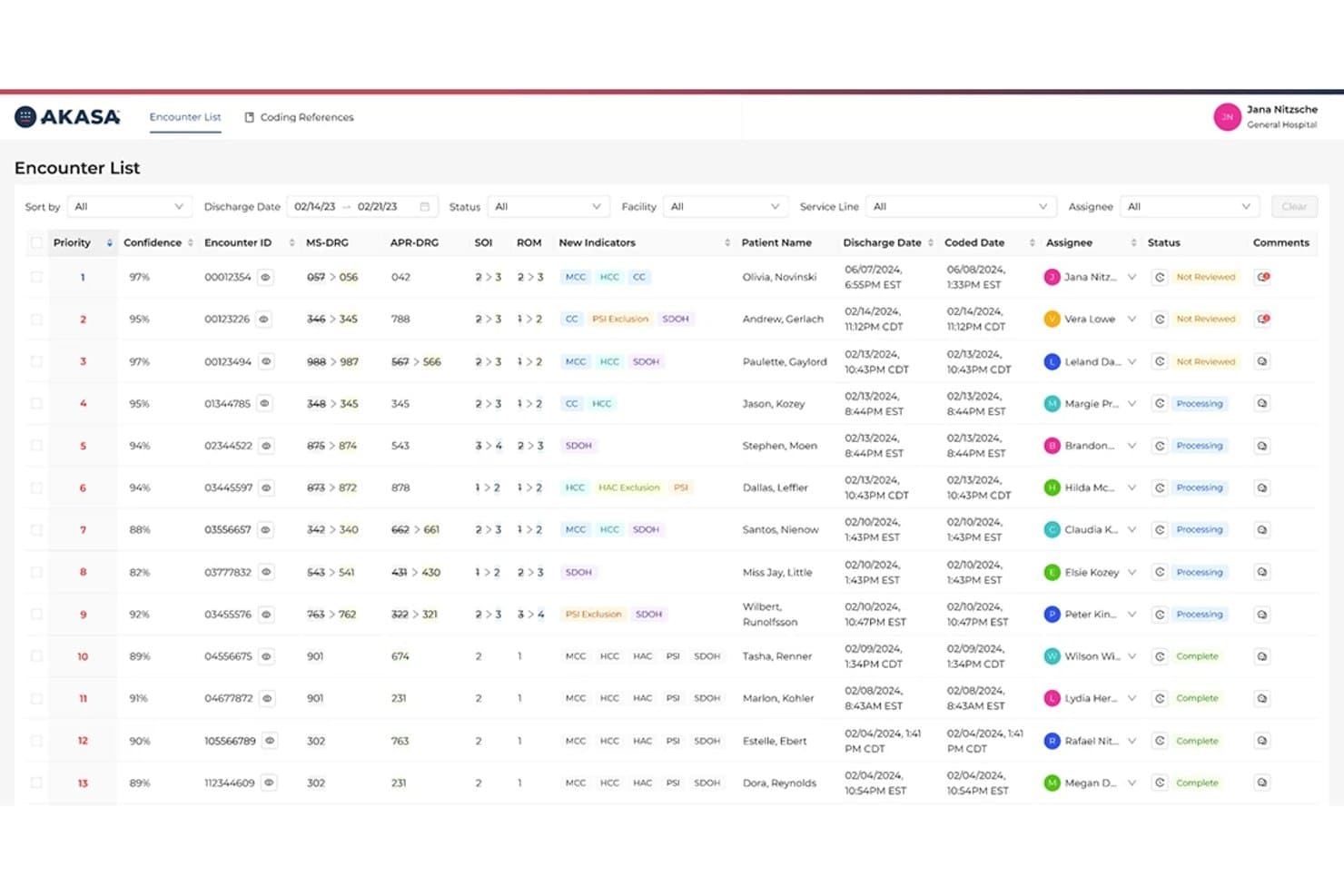
AKASA offers an Encounter List dashboard that displays patient coding encounters with priority, confidence scores, MS-DRG changes, assignees, and processing statuses to help manage billing workflows. AKASA is a generative AI revenue cycle platform that uses machine learning to automate claim status tracking, denial identification and categorization, appeal workflow routing, and pre-bill claim auditing across payer portals.
Who Is AKASA Best For?
AKASA is a strong fit for large health systems and hospital networks with high claim volumes and dedicated revenue cycle teams managing multi-payer denial workflows at scale.
Why I Picked AKASA
I picked AKASA as one of the best because its ML models do something most denial tools don't: they predict whether a payer will deny a claim before it's even submitted, flagging it for correction at the source. I also like the automated work queue routing, which assigns denied claims to the right staff based on denial type and payer without manual triage. In practice, my team can focus queued work on high-dollar, time-sensitive denials rather than manually sorting hundreds of accounts each day.
AKASA Key Features
- Automatic CARC/RARC mapping: Categorizes denied claims by official reason codes directly from payer remittances.
- Prebill optimization suite: Identifies documentation and coding gaps before claims are submitted.
- Integrated EHR connectivity: Syncs claim and remit data bi-directionally with Epic, Cerner, and MEDITECH.
- Claim status automation: Checks and updates claim statuses across payer portals without manual intervention.
AKASA Integrations
AKASA offers native integrations with Epic, Cerner (Oracle Health), and MEDITECH. An API is available for custom integrations.
Pros and Cons
Pros:
- AI-driven work queue routing by denial type
- Automated claim status checks across payer portals
- Pre-submission denial flagging via ML models
Cons:
- Implementation complexity for non-Epic health systems
- Not suited for small independent practices
Learn more about AKASA: Best for automated cross-payer appeals tracking
- Free demo available
- Pricing upon request
Visit WebsiteCustomer Rating:4.4/5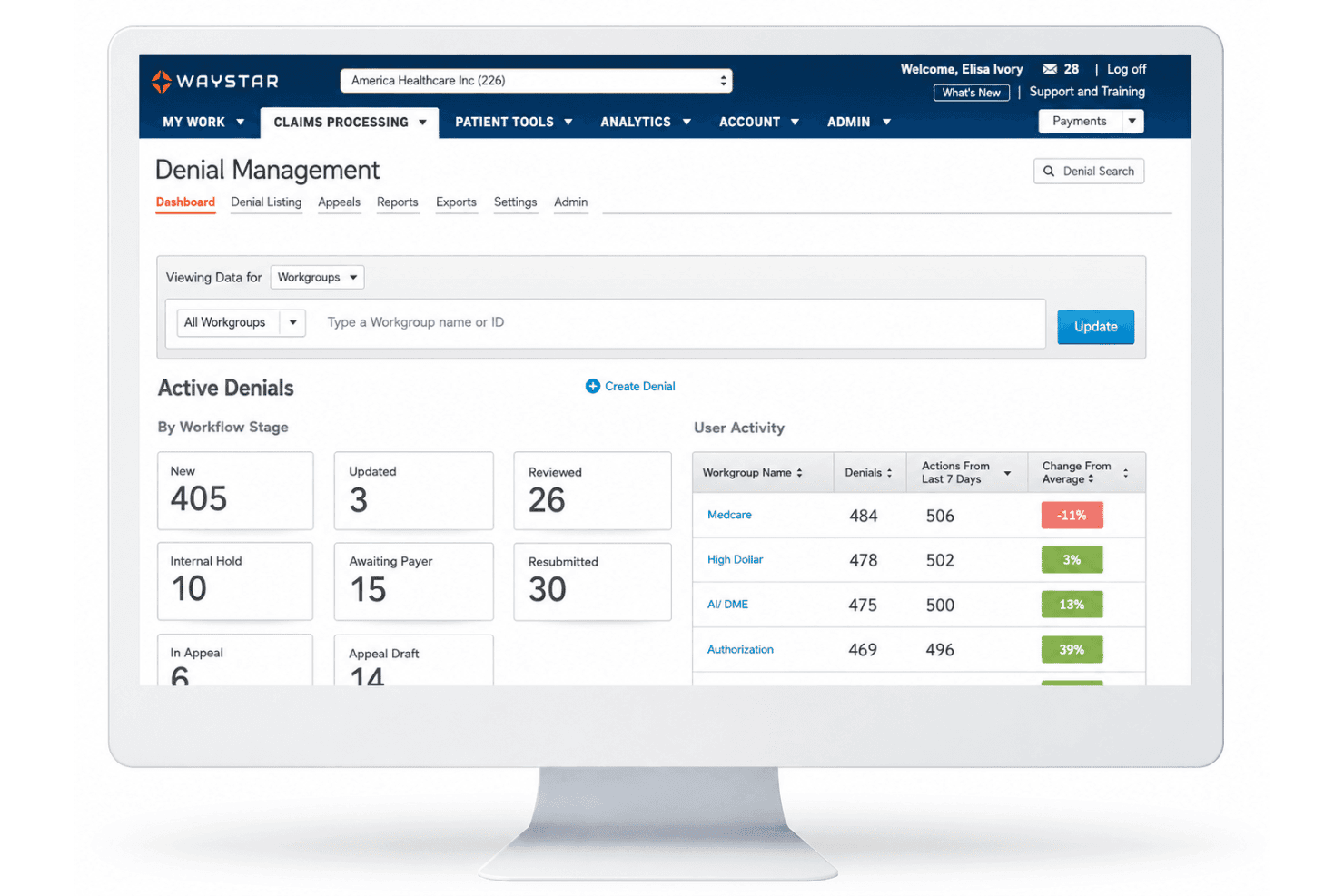
Waystar offers a Denial Management dashboard that tracks active denials by workflow stage and user activity across workgroups Waystar is an AI-powered denial management platform that combines cross-payer appeals tracking, automated appeal letter generation, and root-cause denial analytics within a broader revenue cycle suite.
Who Is Waystar Best For?
Waystar is a strong fit for mid-market and enterprise health systems with high claim volumes and complex, multi-payer revenue cycle operations.
Why I Picked Waystar
Waystar earns its spot as one of the best on my shortlist because of how it handles cross-payer appeal automation at scale. I particularly like the 1,100+ payer-specific templates that auto-populate with remit and claim data, cutting the manual work out of building each appeal package. The batch submission feature lets my team send up to 100 appeals to the same payer at once, and built-in proof of delivery tracking closes the loop on exactly what was sent and when.
Waystar Key Features
- Predictive denial analytics: Uses AI to flag claims likely to be denied before submission for proactive intervention.
- Root-cause reporting: Provides dashboards to analyze denial trends by payer, provider, code, and reason.
- Integrated clearinghouse connectivity: Syncs remittance, claims, and patient data bi-directionally with EHR and billing systems.
- Exception-based workflow routing: Automates task assignment to staff based on denial type, payer, or claim value.
Waystar Integrations
Waystar offers native integrations with major EHR and practice management platforms, including Epic, Cerner, Athenahealth, and NextGen, plus direct clearinghouse connectivity. An API is available for custom integrations.
Pros and Cons
Pros:
- Predictive analytics flag high-recovery denials first
- Payer-specific templates auto-populate with claim data
- AI-driven batch appeal submission at scale
Cons:
- Better suited to large, multi-payer operations
- Contract terms reported as rigid by reviewers
Learn more about Waystar: Best for advanced denial trend analytics
- Free demo available
- Pricing upon request
Visit WebsiteCustomer Rating:4.5/5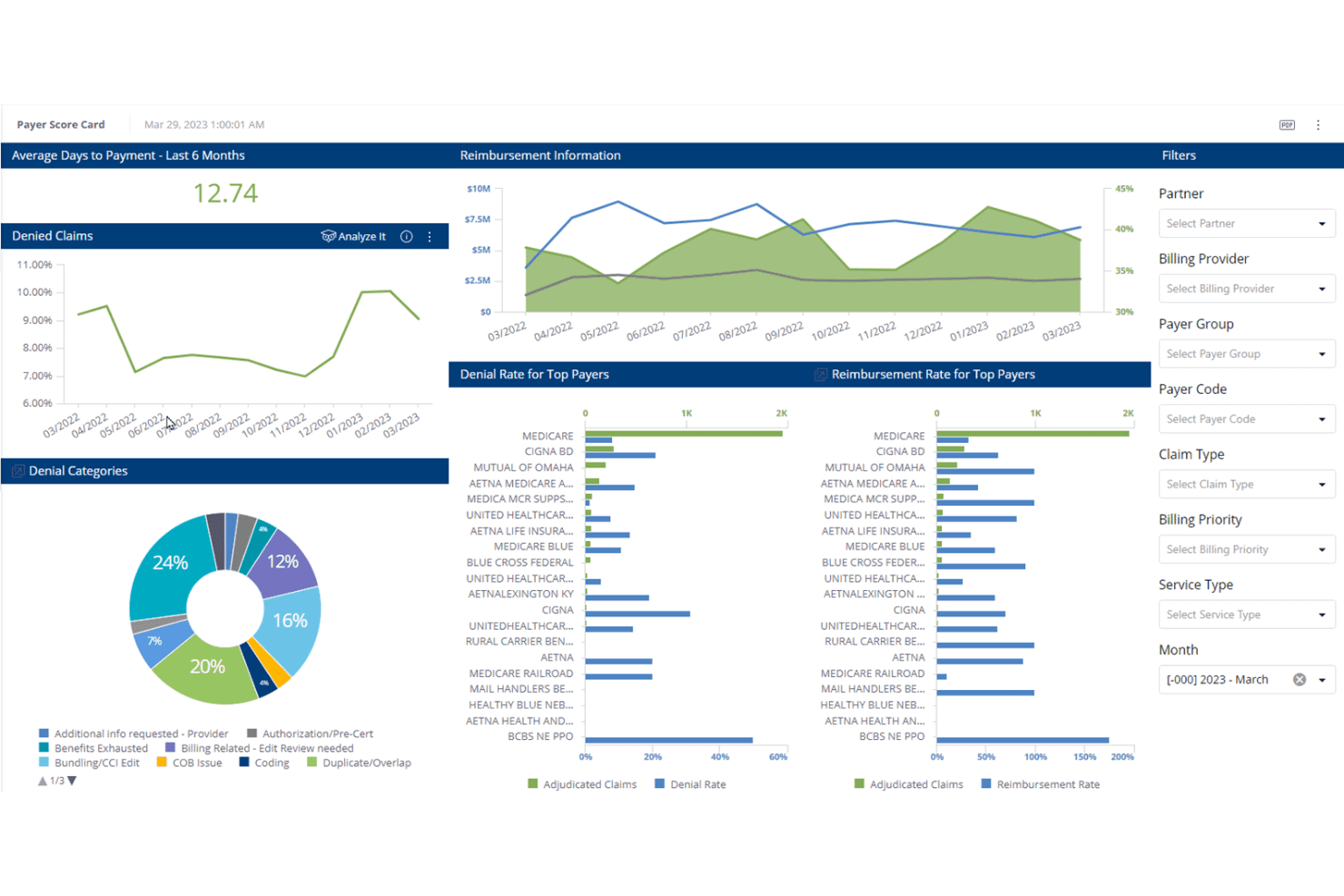
Inovalon RCM Intelligence maps denials, benchmarks payers, and predicts trends. Inovalon RCM Intelligence is a cloud-based analytics platform that captures ERA/remittance data, categorizes denials by CARC/RARC codes, and surfaces denial trends through dashboards with payer benchmarking and predictive reporting.
Who Is Inovalon Best For?
Inovalon RCM Intelligence is a strong fit for revenue cycle directors and analytics teams at large health systems or multi-site provider organizations.
Why I Picked Inovalon
Inovalon earns its spot on my shortlist because of how deep the denial trend analytics actually go. I can drill into denials by payer, CPT code, provider, and CARC/RARC reason code all in one dashboard, which makes spotting a systemic billing pattern far faster than manual reporting. I also like the payer benchmarking feature, which lets my team compare our denial rates against peer organizations to pressure-test payer contract positions before negotiations.
Inovalon Key Features
- Payer trends and benchmarking: Compare your organization's denial metrics and reimbursement rates against peers and payer benchmarks.
- Performance management scorecards: Access detailed dashboards tracking revenue cycle and denial KPIs for executives and operational teams.
- Automation opportunity identification: Spot repetitive denial correction tasks that can be targeted for process automation.
- Multi-system and clearinghouse connectivity: Integrate with major clearinghouses, EHRs, and practice management systems for seamless claims and remittance data exchange.
Inovalon Integrations
Inovalon RCM Intelligence offers native integrations with Epic, MedEZ, PointClickCare, Brightree, MatrixCare, KanTime, HealthVerity, and Claims Management Pro, and supports connectivity with major clearinghouses. An API is also available for custom integrations.
Pros and Cons
Pros:
- Predictive analytics flags likely denials before submission
- CARC/RARC categorization at enterprise claim scale
- Deep payer-level denial benchmarking across organizations
Cons:
- Work queues not available within this module
- No built-in appeals workflow or case management
Learn more about Inovalon: Best for integrated payer rules intelligence
- Free demo available
- Pricing upon request
FinThrive predicts denials, tracks outcomes, finds causes, and manages appeals. FinThrive is an enterprise revenue cycle management platform that combines AI-powered pre-submission denial prediction, post-adjudication denial tracking, root cause analytics, and appeals workflow automation across payer and provider types.
Who Is FinThrive Best For?
FinThrive is built for large hospitals and multi-facility health systems with high-volume claims environments and dedicated revenue cycle teams.
Why I Picked FinThrive
FinThrive earns its spot on my shortlist because of how its Denials Prevention Manager builds payer-specific prediction models that adapt as payer adjudication behavior changes, rather than relying on static rule sets. I like that the AI flags denial risks at the line level in milliseconds during claim validation, so my team can correct coding errors or add missing documentation before submission. The Denials and Underpayments Analyzer then captures what slips through post-adjudication, creating a continuous pre-to-post feedback loop.
FinThrive Key Features
- 835 denial code auto-categorization: Automatically sorts denied claims by CARC and RARC codes from ERAs for fast identification and action.
- Customizable denial management worklists: Enables teams to configure claim queues by payer, value, deadline, or custom rules.
- Integrated post-adjudication analytics: Provides dashboards that break down denial patterns by payer, procedure, and provider.
- Native clearinghouse and PM/EHR integration: Syncs real-time claim and remit data across Navicure, EHRs, and practice management systems.
FinThrive Integrations
FinThrive offers native integrations with Navicure for claims clearinghouse connectivity, Epic, Cerner, and Meditech EHR systems, and leading practice management platforms. An API is available for custom integrations.
Pros and Cons
Pros:
- Covers pre- and post-adjudication denial workflows
- Payer-specific denial models adapt over time
- AI predicts denials before claim submission
Cons:
- Implementation timeline can extend several months
- Not suited for small practice settings
Learn more about FinThrive: Best for real-time denial root cause visualization
- Free demo available
- Pricing upon request
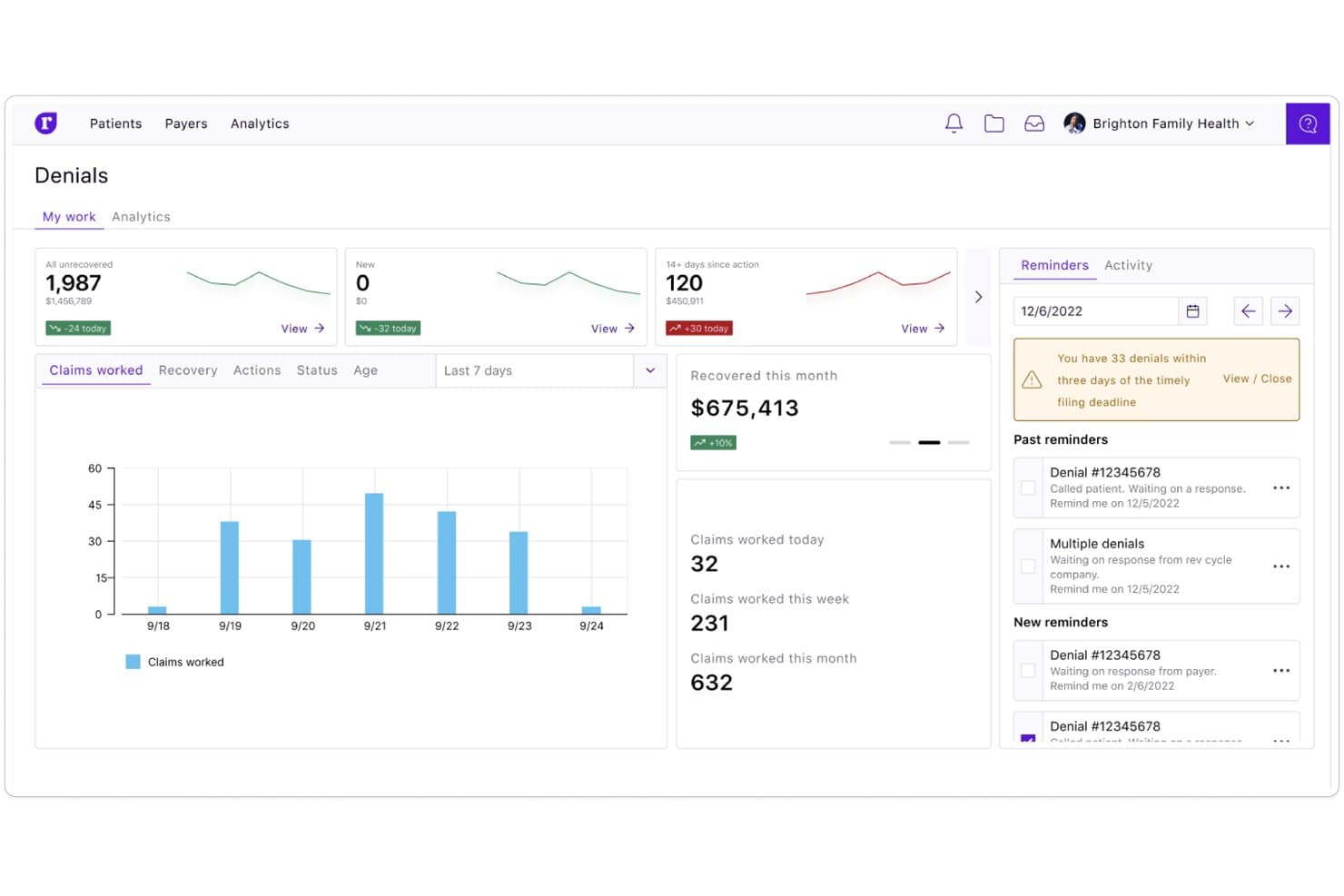
Rivet Health offers a denial management dashboard with claim recovery tracking, reminders, and timely filing alerts. Rivet Resolve is a denial management platform built for specialty practices that combines denial tracking, appeals workflow automation, root cause analytics, and AI-powered prevention across 30+ PM, EHR, and clearinghouse integrations.
Who Is Rivet Health Best For?
Rivet Resolve is a strong fit for revenue cycle teams at specialty practices, including orthopedics, cardiology, dermatology, and ambulatory surgical centers.
Why I Picked Rivet Health
Rivet Resolve earns its spot on my shortlist because of how it surfaces denial root causes in real time across payer, provider, and CPT dimensions. I like that the analytics layer doesn't just report on what's already been denied. The AI-powered prevention engine identifies patterns before they compound into write-offs. I've found the drill-down dashboards especially useful for isolating whether a denial spike is payer-specific or tied to a particular procedure code.
Rivet Health Key Features
- Batch denial appeals: Generate and export appeals in bulk to streamline large-scale appeals processing.
- Configurable worklists: Build tailored denial queues to distribute cases by payer, dollar value, or timely filing priority.
- Integrated payer portal automation: Fill forms and submit data directly to major payer websites such as Availity within the platform.
- Multi-system integration: Connect with 30+ PM, EHR, and clearinghouse partners to sync claims, remits, and patient data.
Rivet Health Integrations
Rivet Resolve offers native integrations with Epic, Cerner Millennium, athenaOne, eClinicalWorks, NextGen, ModMed, AdvancedMD, Waystar, Veradigm Practice Management, and Change Healthcare, with an API available for custom integrations.
Pros and Cons
Pros:
- Availity plugin accelerates payer portal appeals
- AI flags high-risk claims before submission
- Drill-down analytics by payer and CPT
Cons:
- Best suited to specialty practices only
- Few public user reviews available online
Learn more about Rivet Health: Best for AI-driven denial prediction and analytics
- Not available
- Pricing upon request
Experian Health edits claims, predicts denials, guides appeals, and tracks payers. Experian Health is a claims management and denial management platform that combines clearinghouse-level claim editing and submission with AI-driven denial prediction, post-denial workflow, and payer-specific analytics.
Who Is Experian Health (ClaimSource / AI Advantage) Best For?
It's a strong fit for revenue cycle teams at hospitals and large health systems running high claim volumes across multiple payers.
Why I Picked Experian Health (ClaimSource / AI Advantage)
I picked Experian Health as one of the best because its AI Advantage modules target denials at two distinct stages. The Predictive Denials module scans payer adjudication patterns, including undocumented payer rules, to flag high-risk claims before they're submitted. Denial Triage then segments post-submission denials by recovery potential, so AR teams are working the highest-value accounts first rather than oldest or easiest.
Experian Health (ClaimSource / AI Advantage) Key Features
- Automated CARC/RARC categorization: Instantly classifies denials by ANSI and payer-specific reason codes for easier reporting.
- Custom workflow queues: Lets users create and manage work lists based on denial type, payer, or dollar amount.
- Integrated clearinghouse connectivity: Connects with over 2,700 payers and leading EHR and practice management systems.
- Remittance and status tracking: Aggregates electronic remittance advice and claim status updates for centralized denial visibility.
Experian Health (ClaimSource / AI Advantage) Integrations
Experian Health offers native integrations with Epic, Oracle Health, Athena Health, FollowMyHealth, and NextGate, as well as its own ClaimSource clearinghouse. An API is available for custom integrations.
Pros and Cons
Pros:
- Strong analytics across multiple payer rule sets
- Denial Triage ranks denials by recovery value
- AI flags high-risk claims before submission
Cons:
- Appeal letter generation not clearly documented
- Complex setup for small physician practices
Learn more about Experian Health (ClaimSource / AI Advantage):
Other Denial Management Software
Here are some additional denial management software options that didn’t make it onto my shortlist, but are still worth checking out:
- 11Innovaccer (Flow)Best for unified analytics across workflows
- 12EvidenceCare (AdmissionCare)Best for admission and medical necessity checks
- 13athenahealthBest for embedded denial analytics in RCM
- 14NextGen HealthcareBest for integrating with enterprise EHR workflows
- 15VeradigmBest for integrated AR cycle and claims automation
- 16QuadaxBest for customizable denial workflows
- 17AptarroBest for customizable multi-entity billing support
- 18Thoughtful AIBest for robotic claims workflow automation
- 19RapidClaimsBest for rapid AI-generated batch appeals
- 20AspirionBest for complex claim recovery support services
How I Evaluate Denial Management Software
I split my evaluation into two layers: the baseline features a tool needs—like ERA capture and CARC/RARC categorization—and the differentiators that separate a good tool from a great one.
Core Functionality (Table Stakes For This List)
When I'm selecting tools for my list, I rank each one on a scale from 0 (does not offer the functionality) to 5 (excels in this area) for each core functionality listed below. Then, I calculate the tool's total score into a percentage. Each tool needs to achieve a minimum total score of 65% to be considered for inclusion.
- Denial Tracking & Categorization: I check whether the tool auto-captures ERAs and maps denials to CARC/RARC codes, so your team isn't manually logging each rejected claim.
- Root Cause Analytics: Dashboards should let you drill into denial patterns by payer, provider, and CPT code to spot systemic issues before they compound.
- Appeals Workflow Management: I look for case creation, assignment, status tracking, and aging alerts so appeals don't slip past timely filing deadlines.
- Work Queue Prioritization: The tool should rank denied claims by recoverable value, filing deadline, or payer so collectors focus on the highest-impact items first.
- Appeal Letter Generation: I evaluate whether templates auto-populate with claim data and support payer-specific formats to cut down on manual rework.
- PM/EHR & Clearinghouse Integration: Bi-directional syncing with systems like Epic, Cerner, or Availity matters here so claim and remit data flows without manual uploads.
Once I have a list of tools that meet the criteria, I consider what sets each platform apart.
Differentiating Factors (What Sets Vendors Apart)
Here's how I compare and contrast different vendors:
Standout Features
Predictive denial analytics is a big differentiator. I look for AI/ML models that flag at-risk claims before submission so your team can fix coding or documentation gaps upfront. A payer rules library adds real prevention value here, giving billers access to continuously updated medical necessity and coverage policies. I also evaluate automated appeal generation beyond basic templates, checking whether the tool pulls in clinical documentation and relevant policy citations to build a submission-ready appeal package.
Beyond Features
Deployment scope matters. I check whether a platform works as a standalone module or only within a broader RCM suite, and whether it supports multi-entity billing for health systems with multiple TINs. HIPAA compliance is another area I evaluate closely—I look for HITRUST CSF or SOC 2 Type II certification, documented BAAs, and role-based access controls. Pricing structure also shapes the decision. Some vendors charge per claim while others take a percentage of recovered revenue, so I consider which model aligns with your volume and denial rate.
How to Choose Denial Management Software
It’s easy to get bogged down in long feature lists and complex pricing structures. To help you stay focused as you work through your unique software selection process, here’s a checklist of factors to keep in mind:
| Factor | What to Consider |
|---|---|
| FactorScalability | What to ConsiderCan the platform handle your claim volume as you grow, or support consolidation across locations and specialties? |
| FactorIntegrations | What to ConsiderDoes the tool natively connect to your EHR, PM system, and clearinghouse? Look for bi-directional and real-time data sync. |
| FactorCustomizability | What to ConsiderCan you tailor workflows, denial categories, or user permissions to match your internal processes or unique payer mix? |
| FactorEase of use | What to ConsiderAre dashboards, worklists, and reports accessible to non-technical users? Would new staff need extensive training? |
| FactorImplementation and onboarding | What to ConsiderHow long does it typically take to go live? Are there clear resources and support to manage data migration and staff training? |
| FactorCost | What to ConsiderAre there hidden fees for users, integrations, or payers? Do you understand if pricing is flat, by claim, or based on recoveries? |
| FactorSecurity safeguards | What to ConsiderDoes the vendor offer HIPAA, SOC 2, or HITRUST compliance? Ask about audit logs, access controls, and breach history. |
| FactorSupport availability | What to ConsiderWhat are standard support hours? Can you reach a dedicated contact during critical denial spikes or system outages? |
What Is Denial Management Software?
Denial management software is a specialized platform that helps healthcare teams identify, track, and resolve denied insurance claims throughout the revenue cycle. These tools automate denial categorization, appeal workflows, and analytics to reveal the reasons behind claim denials.
By organizing claim data and surfacing actionable insights, denial management software supports faster payment resolution and ongoing denial prevention for billing and revenue cycle teams.
Features of Denial Management Software
When selecting denial management software, keep an eye out for the following key features:
- Denial tracking and categorization: Automatically captures denied claims from payer remittances and sorts them by CARC or RARC codes to speed up root cause identification.
- Appeals workflow management: Lets you create, assign, and monitor appeal cases, updating statuses and aging, so no denied claim gets overlooked.
- Work queue prioritization: Configurable worklists help staff focus on claims by dollar value, payer, or deadline, maximizing productivity and recovery potential.
- Appeal letter generation: Generates customized payer-specific appeal letters using claim and patient data, reducing manual effort and mistakes in resubmissions.
- Root cause reporting: Produces clear reports and dashboards identifying denial patterns by payer, provider, procedure, and code to inform prevention strategies.
- Remittance and EOB management: Ingests electronic remittance advice (ERAs) and explanations of benefits (EOBs) directly, reducing manual entry and reconciliation.
- Claim status monitoring: Provides real-time updates on where claims are in the appeals or resolution process to prevent missed deadlines.
- Integration with EHR/PM systems: Syncs claim, patient, and payment data across your existing electronic health record and practice management platforms to reduce duplicate data entry.
- Audit trails and compliance tracking: Maintains logs of all denial and appeal activities, supporting internal reviews and regulatory compliance needs.
Common Denial Management Software AI Features
Beyond the standard denial management software features listed above, many of these solutions are incorporating AI with features like:
- Predictive denial analytics: Uses AI models to analyze claim data and flag submissions likely to be denied, allowing teams to correct issues before sending claims to payers.
- Automated root cause identification: AI scans denial patterns across payers and codes, surfacing underlying trends and suggesting targeted process improvements.
- Smart worklist prioritization: AI ranks denied claims by recovery likelihood, dollar value, and appeal deadlines, helping staff focus on the most actionable cases first.
- AI-driven appeal letter drafting: Automatically generates customized, payer-specific appeal letters using claim details, denial reasons, and relevant policy language.
- Continuous payer rule updates: AI monitors payer policy changes and denial trends, updating internal rules libraries to keep billing teams ahead of shifting requirements.
Benefits of Denial Management Software
Implementing denial management software provides several benefits for your team and your business. Here are a few you can look forward to:
- Faster payment resolution: Automated tracking, categorization, and appeal workflows speed up claim correction and resubmission.
- Reduced write-offs: Proactive analytics and root cause reporting help your team prevent denials from repeating and minimize lost revenue.
- Improved staff productivity: Work queue prioritization and automated letter generation let team members focus on the highest-value tasks.
- Actionable insights: Detailed dashboards and reports uncover denial trends, payer issues, and bottlenecks, guiding informed process improvements.
- Consistent compliance: Integrated audit trails, role permissions, and secure data handling make it easier to stay aligned with healthcare regulations.
- Stronger payer relationships: Faster, organized responses and data-driven appeals can improve communication and contract negotiations with insurance payers.
- Easier onboarding and oversight: Intuitive interfaces and integrated systems make it simpler to train staff and monitor denial resolution progress.
Costs and Pricing of Denial Management Software
Selecting denial management software requires an understanding of the various pricing models and plans available. Costs vary based on features, team size, add-ons, and more. The table below summarizes common plans, their average prices, and typical features included in denial management software solutions:
Plan Comparison Table for Denial Management Software
| Plan Type | Average Price | Common Features |
|---|---|---|
| Plan TypeFree Plan | Average Price$0 | Common FeaturesLimited claim tracking, basic denial categorization, standard reports, and email support. |
| Plan TypePersonal Plan | Average Price$50-$150/user/month | Common FeaturesDenial tracking, single-user access, simple appeals workflow, basic integrations, and email support. |
| Plan TypeBusiness Plan | Average Price$200-$500/user/month | Common FeaturesMulti-user workflow, advanced analytics, claim worklists, standard integrations, compliance tracking, and chat support. |
| Plan TypeEnterprise Plan | Average Price$700-$1500+/month | Common FeaturesScalable user roles, custom integrations, robust security, audit trails, dedicated account management, and API access. |
Denial Management Software FAQs
Here are some answers to common questions about denial management software:
How does denial management software interact with EHR and PM systems?
Denial management software typically integrates directly with your EHR and practice management systems to automate the flow of claim, patient, and remittance data. This reduces manual data entry, helps avoid errors, and ensures your records are always up to date.
Can denial management software help prevent future denials, or is it just for appeals?
Yes, most tools include features for analyzing denial trends and root causes—like dashboards and reporting—that help your team identify patterns and address recurring issues proactively. This supports prevention, not just appeals or corrections.
How long does it take to implement denial management software?
Implementation timelines vary by vendor and complexity, but many modern platforms offer onboarding within a few weeks. Factors like integrating with your EHR, migrating claim history, and training staff can influence the total time needed.
What security standards should denial management software meet?
Look for solutions with HIPAA compliance as a baseline, but vendors offering SOC 2 or HITRUST certification, PHI encryption, and role-based access controls provide added confidence for protecting sensitive healthcare data.
Is it possible to customize denial codes and workflows for our organization?
Yes, most platforms let you customize denial categories, worklists, notification rules, and user permissions to reflect your specific payers, departments, and internal processes. This level of flexibility supports unique revenue cycle needs.