
Veradigm EHR Review: Pros, Cons, Features, and Pricing
Veradigm EHR helps healthcare providers manage clinical workflows, patient records, charting, and practice operations with tools designed to support efficiency and care coordination.

We review tools independently, and commissions help fund our testing. See our transparency policy, our methodology, or suggest a tool.
Veradigm EHR is a free EHR software built for ambulatory and physician practices that need clinical documentation, e-prescribing, and patient data management without the cost barrier of enterprise platforms. I'd consider it seriously if your practice wants specialty-configurable charting with a lighter implementation lift than athenahealth, which tends to require more setup time and deeper vendor dependency to get fully operational.
Veradigm EHR Evaluation Summary
3.4/5
- Pricing upon request
- Free demo available
Why Trust Our Software Recommendations
6,700+
Reviews
20
Industry experts
16+
Evaluation factors
14
Years
Our team has been testing and reviewing software since 2012. As medical practice leaders ourselves, we know how difficult—and important—it is to choose the right software.
For this guide, we evaluated tools using hands-on testing and independent research, scoring tools using our selection criteria.
Our reviews reflect our human editorial judgment, not a sales pitch.
Veradigm EHR Overview
In my opinion, Veradigm EHR stands out for its modern interface, specialty templates, and reliable lab integrations. While pricing can be higher than some alternatives, you get responsive support and streamlined onboarding. When judging usability, it’s easier to train staff on Veradigm than many others. You’ll notice strong clinical decision tools, but might wish for broader third-party integrations.
If you’re determining the best fit for a midsize outpatient clinic wanting efficient charting and reporting, Veradigm is a smart pick. It’s especially well-suited for providers who value a clean workflow and responsive customer support.
Pros
- Specialty-specific templates support multiple practice types.
- Built-in analytics deliver actionable quality and performance insights.
- Responsive live customer support available by phone and chat.
Cons
- Pricing is not transparent and requires direct quotes.
- Mobile app features are limited compared to desktop version.
- Complex reporting setup for custom regulatory requirements.
Is Veradigm EHR Right For Your Needs?
Who Would be a Good Fit for Veradigm EHR?
Veradigm is a strong fit for specialty practices, midsize clinics, and organizations seeking regulatory compliance and analytics. It stands out where structured documentation, integrated e-prescribing, and personalized provider workflows are priorities.
Large clinics and groups with complex reporting or value-based care needs will appreciate built-in MIPS tools and customizable templates. Offices wanting patient engagement features and a support-rich onboarding process also benefit from its comprehensive help resources and dedicated guidance.
- Cardiology PracticesSpecialty-driven templates and advanced imaging workflows support cardiology-specific documentation and reporting needs.
- Multispecialty ClinicsConfigurable workflows and analytics make it easy to coordinate care across diverse provider groups.
- Behavioral HealthTailored workflows and privacy-compliant patient notes help behavioral health teams document and manage sensitive information.
- Large Ambulatory GroupsAutomated MIPS and population health reporting support compliance needs and quality initiatives for multi-physician organizations.
- Medical DirectorsAccess to deep practice analytics and custom reporting helps medical directors drive quality improvements and monitor clinician performance.
- New PracticesGuided onboarding and setup assistance helps new practices establish compliant workflows with minimal hassle.
Who Would be a Bad Fit for Veradigm EHR?
Veradigm generally isn’t a good choice for solo providers prioritizing cost above all, organizations requiring highly specialized lab device integrations, or small practices with simple charting needs. Businesses in rural areas with unreliable internet may struggle with its cloud-based access.
Hospital-based inpatient workflows, dental practices, and teams that demand the most customizable user interface controls won’t find it ideal. High-touch specialty clinics with non-standard workflow configurations may also find customizations limiting compared to niche solutions.
- Solo PractitionersHigher pricing and feature set may be more than needed for providers who want only basic charting and e-prescribing.
- Inpatient HospitalsThe software is designed for ambulatory and outpatient care, lacking core inpatient workflow support.
- Dental PracticesVeradigm EHR does not include dental-specific charting, billing, or imaging modules.
- Rural ClinicsCloud-based access can pose challenges for teams with unreliable broadband or limited connectivity.
- Highly Custom WorkflowsOrganizations needing deeply tailored interfaces or bespoke data fields will find customization options limited.
- Walk-in Retail ClinicsHigh-demand for rapid patient intake and minimal charting is not Veradigm EHR’s core strength.
How We Test & Score Tools
We’ve spent years building, refining, and improving our software testing and scoring system. The rubric is designed to capture the nuances of software selection and what makes a tool effective, focusing on critical aspects of the decision-making process.
Below, you can see exactly how our testing and scoring works across seven criteria. It allows us to provide an unbiased evaluation of the software based on core functionality, standout features, ease of use, onboarding, customer support, integrations, customer reviews, and value for money.
Core Functionality (25% of final scoring)
The starting point of our evaluation is always the core functionality of the tool. Does it have the basic features and functions that a user would expect to see? Are any of those core features locked to higher-tiered pricing plans? At its core, we expect a tool to stand up against the baseline capabilities of its competitors.
Standout Features (25% of final scoring)
Next, we evaluate uncommon standout features that go above and beyond the core functionality typically found in tools of its kind. A high score reflects specialized or unique features that make the product faster, more efficient, or offer additional value to the user.
We also evaluate how easy it is to integrate with other tools typically found in the tech stack to expand the functionality and utility of the software. Tools offering plentiful native integrations, 3rd party connections, and API access to build custom integrations score best.
Ease of Use (10% of final scoring)
We consider how quick and easy it is to execute the tasks defined in the core functionality using the tool. High scoring software is well designed, intuitive to use, offers mobile apps, provides templates, and makes relatively complex tasks seem simple.
Onboarding (10% of final scoring)
We know how important rapid team adoption is for a new platform, so we evaluate how easy it is to learn and use a tool with minimal training. We evaluate how quickly a team member can get set up and start using the tool with no experience. High scoring solutions indicate little or no support is required.
Customer Support (10% of final scoring)
We review how quick and easy it is to get unstuck and find help by phone, live chat, or knowledge base. Tools and companies that provide real-time support score best, while chatbots score worst.
Customer Reviews (10% of final scoring)
Beyond our own testing and evaluation, we consider the net promoter score from current and past customers. We review their likelihood, given the option, to choose the tool again for the core functionality. A high scoring software reflects a high net promoter score from current or past customers.
Value for Money (10% of final scoring)
Lastly, in consideration of all the other criteria, we review the average price of entry level plans against the core features and consider the value of the other evaluation criteria. Software that delivers more, for less, will score higher.
Core Features
Clinical Documentation
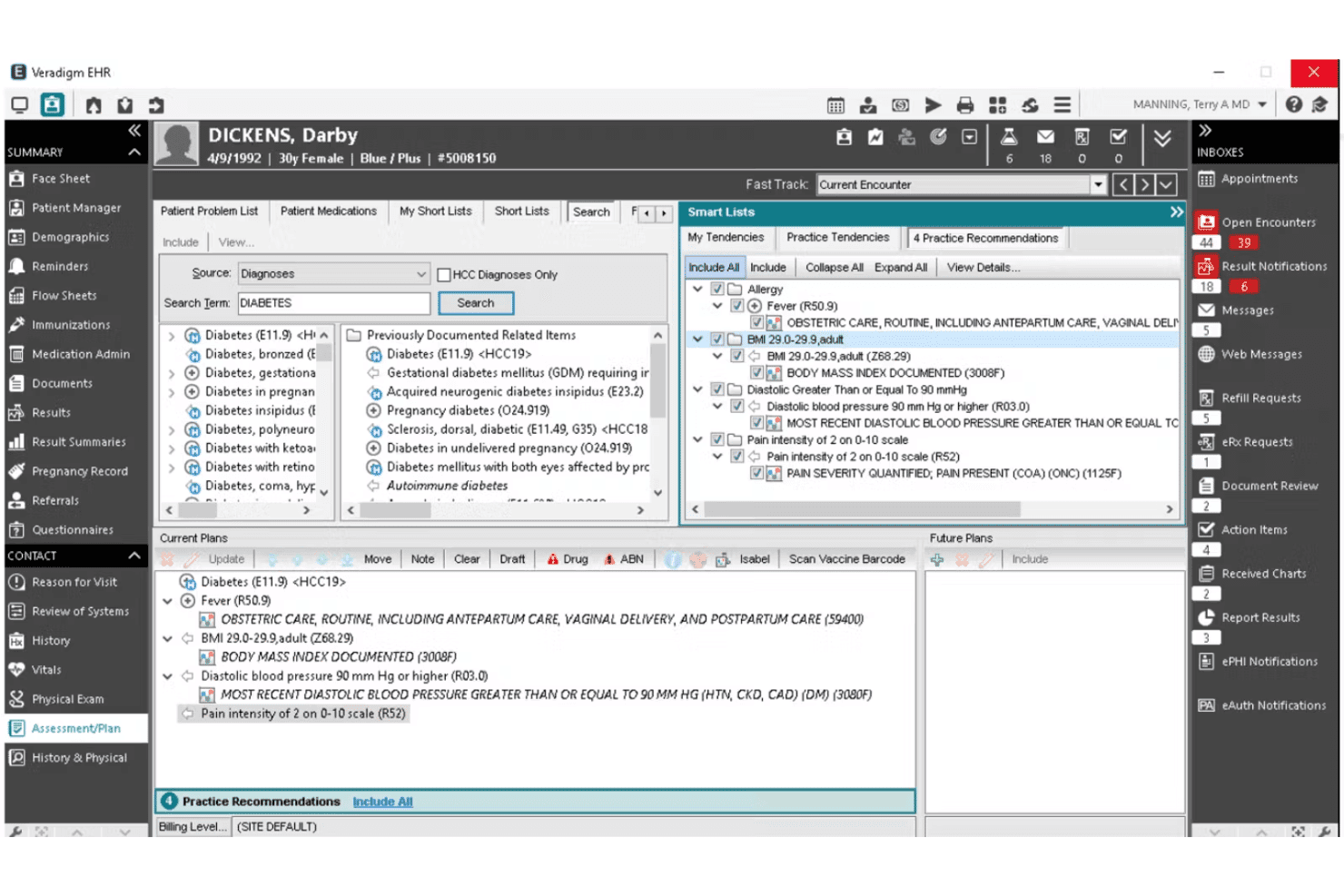
Quickly create patient charts using specialty-driven templates and clinical decision support. Structured workflows help you reduce documentation time while maintaining accuracy.
e-Prescribing
Send prescriptions electronically to most US pharmacies in seconds. Real-time checks for formulary, allergies, and interactions help avoid medication errors.
Patient Portal
Allow patients to view records, communicate securely, and request refills online. The portal improves patient engagement by giving them self-service access to their health data.
Appointment Scheduling
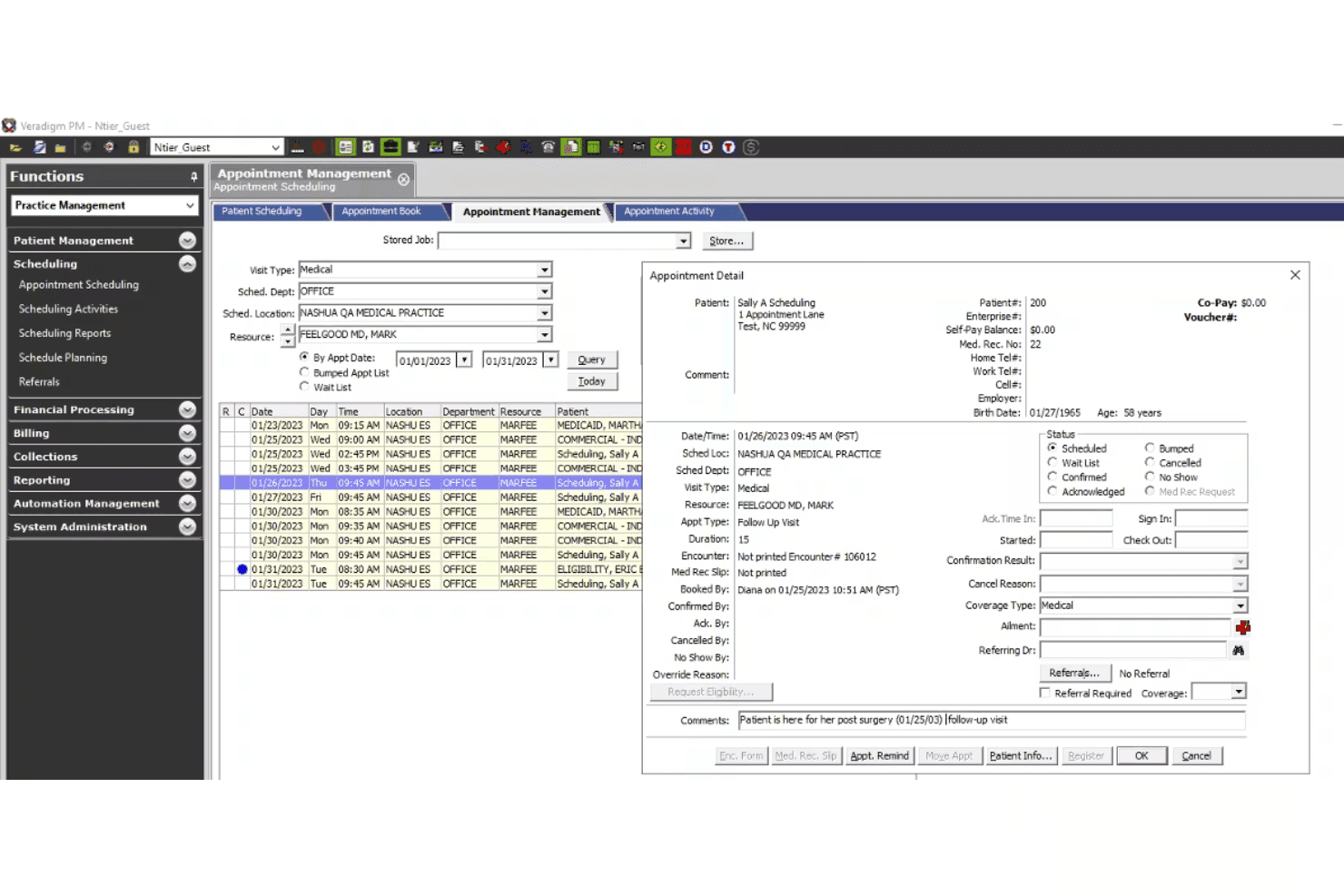
Easily manage provider calendars and send automated reminders to patients. Color-coded views and rule-driven slot management reduce no-shows and scheduling bottlenecks.
Integrated Analytics and Reporting
Access dashboards that track clinical quality, value-based care, and key practice metrics. Generate configurable reports to monitor population health and compliance in just a few clicks.
Secure Messaging
Enable HIPAA-compliant communication between providers and care teams within the platform. Team members can send attachments or patient updates directly through the EHR for streamlined collaboration.
Ease of Use
Veradigm EHR earns high marks for user-friendliness, thanks to clear navigation and intuitive, specialty-driven templates. In my experience, customizable workflows, drag-and-drop scheduling, and direct chart access noticeably reduce clicks. Most users say onboarding is refreshingly smooth and staff pick up daily tasks quickly, reflecting thoughtful interface design..
Integrations
Veradigm EHR integrates with LabCorp, Quest Diagnostics, Surescripts, CoverMyMeds, eRx, Updox, DrFirst, MedAllies, Change Healthcare, and CommonWell Health Alliance, among others.
Veradigm EHR also offers an API for custom integrations and can connect with select third-party interoperability networks.
Veradigm EHR Specs
- 2-Factor Authentication: Yes
- API: Yes
- Appointment Scheduling: Yes
- Approval Workflows: Yes
- Audit Management: No
- Audit Trail: Yes
- Batch Permissions & Access: Yes
- Billing/Invoicing: Yes
- Compliance Tracking: Yes
- Customer Management: No
- Data Export: Yes
- Data Import: Yes
- Document Management: Yes
- Electronic Prescribing: Yes
- External Integrations: Yes
- HIPAA Compliance: Yes
- Incident Management: No
- Multi-User: Yes
- Notifications: Yes
- Patient Management: Yes
- Regulatory Alerts: Yes
- Report & Compliance: Yes
- Risk Assessment: Yes
- Self-service Portal: Yes
- Task Scheduling/Tracking: Yes
- Workflow Management: Yes


