

DSCSA compliance software helps you manage prescription drug traceability, serialization, and trading partner verification so your pharmacy operation stays compliant with the Drug Supply Chain Security Act.
Whether you run a single-location practice or oversee multiple locations, choosing the right DSCSA compliance solution is key to meeting regulatory requirements without adding unnecessary work.
In this guide, you’ll find the best DSCSA compliance software for 2026, with a focus on tools that fit medical practices—covering everything from integration with your pharmacy system to long-term DSCSA data management and outsourced compliance options.
Why Trust Our Software Recommendations
6,700+
Reviews
20
Industry experts
16+
Evaluation factors
14
Years
Our team has been testing and reviewing software since 2012. As medical practice leaders ourselves, we know how difficult—and important—it is to choose the right software.
For this guide, we evaluated tools using hands-on testing and independent research, scoring tools using our selection criteria.
Our reviews reflect our human editorial judgment, not a sales pitch.
DSCSA Compliance Software Comparison Table
This comparison table summarizes pricing details for my DSCSA compliance software:
| Tool | Best For | Trial Info | Price | ||
|---|---|---|---|---|---|
| 1 | Best for upstream DSCSA EPCIS interoperability | Not available | Pricing upon request | Website | |
| 2 | Best for DSCSA pharmaceutical traceability | Free demo available | Pricing upon request | Website | |
| 3 | Best for enterprise-grade pharma serialization | Not available | Pricing upon request | Website | |
| 4 | Best for enterprise pharma supply chain traceability | Free demo available | Pricing upon request | Website | |
| 5 | Best for enterprise pharma network traceability | Free demo available | Pricing upon request | Website | |
| 6 | Best for independent pharmacy DSCSA tracking | Not available | Pricing upon request | Website | |
| 7 | Best for pharmacy DSCSA with PMS integrations | Not available | Pricing upon request | Website | |
| 8 | Best for enterprise-level ATP and VRS verification | Not available | Pricing upon request | Website | |
| 9 | Best for pharmacies tracking T3 data long-term | Not available | Pricing upon request | Website | |
| 10 | Best for free trading partner onboarding at scale | Free demo available | Pricing upon request | Website |


DSCSA Compliance Software Reviews
Below are my detailed summaries of the best DSCSA compliance software that made it onto my shortlist. My reviews offer a detailed look at the features, best use cases, and integrations of each software to help you find the best one for you.
 Best for upstream DSCSA EPCIS interoperability
- Not available
- Pricing upon request
Visit WebsiteCustomer Rating:4.4/5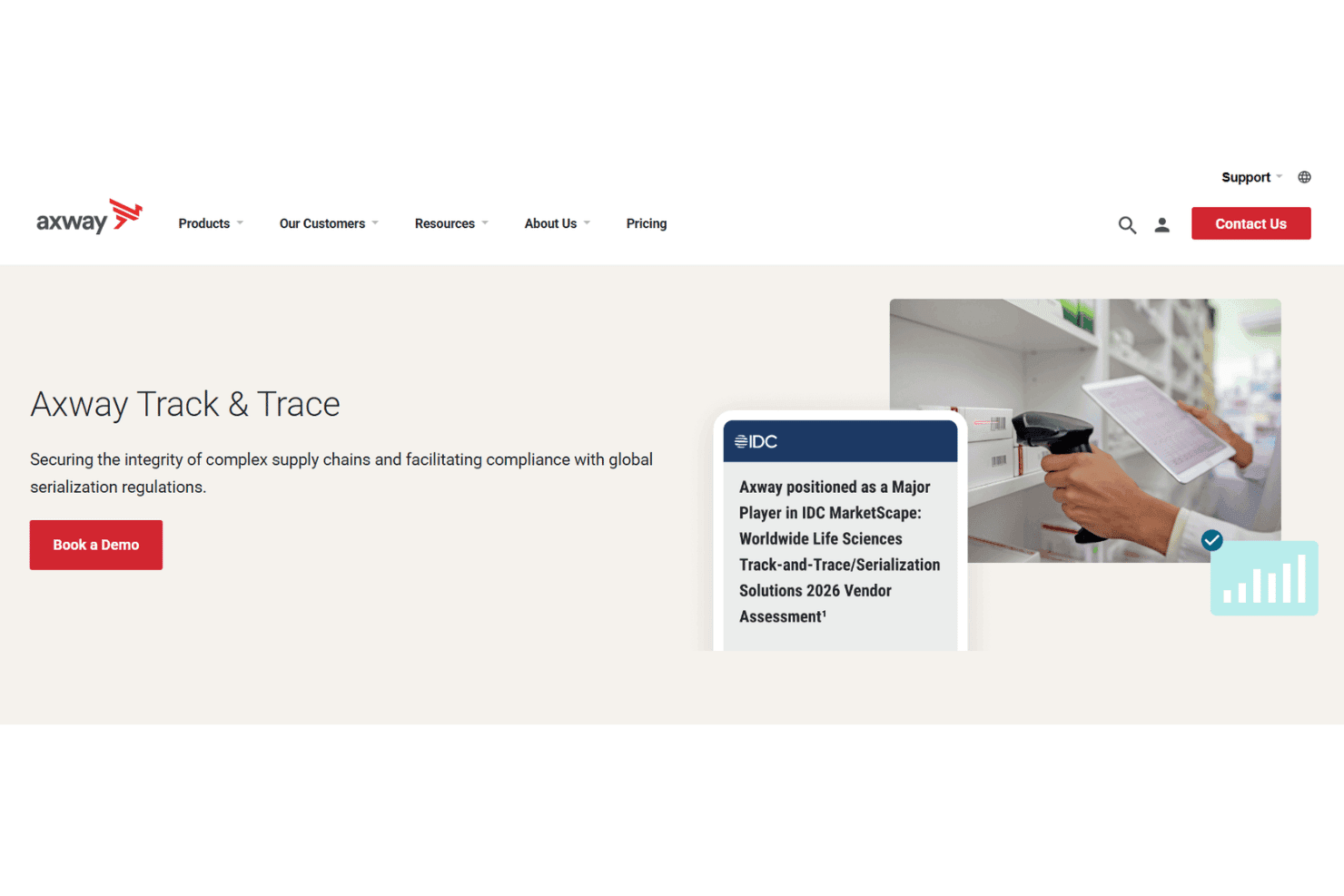
Axway Track & Trace manages DSCSA serialization, verification, and traceability. Axway Track & Trace is a pharmaceutical serialization and traceability platform that manages EPCIS event data, product verification via VRS, and multi-partner supply chain data exchange across DSCSA, EU FMD, and other global serialization regulations.
Who Is Axway Best For?
Axway Track & Trace is a strong fit for large pharmaceutical manufacturers and distributors that need to exchange EPCIS event data with multiple upstream trading partners across complex, multi-tier supply chains.
Why I Picked Axway
Axway earns its spot on my shortlist because of its GS1 EPCglobal-compliant EPCIS event repository, which handles serialized event data exchange across multi-tier pharmaceutical supply chains with multiple upstream trading partners. I like that its native B2B integration layer connects manufacturers, wholesalers, and dispensers without custom middleware. The Verification Router Service (VRS) support adds item-level product status checks in real time, which is exactly what upstream DSCSA compliance requires.
Axway Key Features
- Packaging line and WMS connectivity: Axway connects directly to packaging line systems and warehouse management systems to capture serialization data at the point of production.
- Diversion detection: The platform uses EPCIS event data to flag potential product diversion across the supply chain before items reach dispensers.
- Product recall management: Serialized unit tracking lets you quickly identify and isolate affected product batches across all trading partners during a recall.
- DSCSA event capture status tracking: A dedicated capture status screen logs DSCSA event capture issues and error notifications, making it easier to troubleshoot data quality problems.
Axway Integrations
Axway Track & Trace connects to packaging line systems, warehouse management systems (WMS), and ERP platforms, and supports GS1 EPCglobal-compliant EPCIS event exchange with upstream trading partners via VRS and standards-based query services. Native integrations aren't individually documented by vendor name, but the underlying Axway B2B Integration layer supports multi-protocol EDI and API connectivity, and an API is available for custom integrations.
Pros and Cons
Pros:
- Supports diversion detection across supply chain
- Offers DSCSA capture status tracking interface
- Captures EPCIS event data in real time
Cons:
- Pricing details only available upon request
- No vendor-named native integrations listed
Learn more about Axway: Best for DSCSA pharmaceutical traceability
- Free demo available
- Pricing upon request
Visit WebsiteCustomer Rating:4.2/5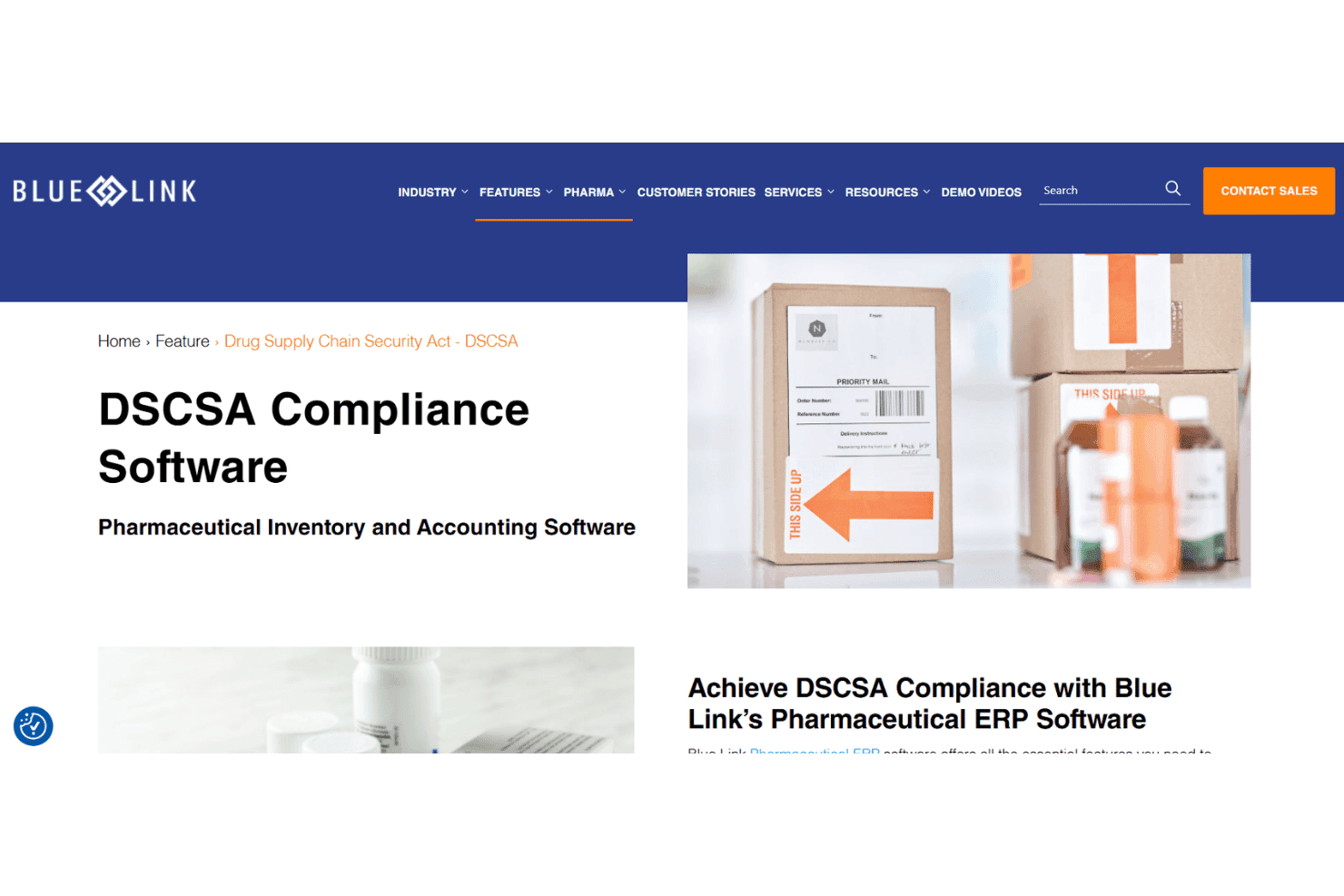
Blue Link ERP supports DSCSA compliance with serialization and lot traceability. Blue Link ERP is an ERP platform built for pharmaceutical distributors that combines inventory management, lot tracking, serialization, and end-to-end supply chain traceability.
Who Is Blue Link ERP Best For?
Blue Link ERP is a strong fit for small to mid-sized pharmaceutical distributors that need end-to-end supply chain traceability built directly into their ERP.
Why I Picked Blue Link ERP
Blue Link ERP earns its spot on my shortlist because it builds DSCSA traceability directly into the ERP rather than bolting it on as an afterthought. I particularly like how lot tracking and serialization work together within a single system, so when a recall hits, you can trace a product's full movement across the supply chain without jumping between platforms. The system's transaction data capture also aligns with DSCSA's interoperability requirements, which matters when you're exchanging verification records with trading partners.
Blue Link ERP Key Features
- Transaction history reporting: Generates detailed transaction history records that document product movement across trading partners to support DSCSA audit requirements.
- Product verification portal: Connects to authorized verification routers to confirm product identifiers against national drug databases.
- Returns and quarantine management: Tracks returned pharmaceutical products and flags items for quarantine until verification and disposition are confirmed.
- Suspect and illegitimate product workflow: Provides a structured process for investigating, documenting, and reporting suspect or illegitimate products as required under DSCSA.
Blue Link ERP Integrations
Blue Link ERP offers native integrations with Gateway Checker and LSPedia for EPCIS file management, plus Shopify, WooCommerce, BigCommerce, Amazon, FedEx, Purolax, Elavon, USA ePay, and DocuWare. It also supports EDI connections through approved translation services and provides a REST API for custom integrations.
Pros and Cons
Pros:
- Structured workflow for suspect products
- Detailed transaction history supports audits
- Built-in DSCSA traceability within ERP
Cons:
- Requires training to use all compliance features
- Best suited for small mid-sized distributors
Learn more about Blue Link ERP: Best for enterprise-grade pharma serialization
- Not available
- Pricing upon request
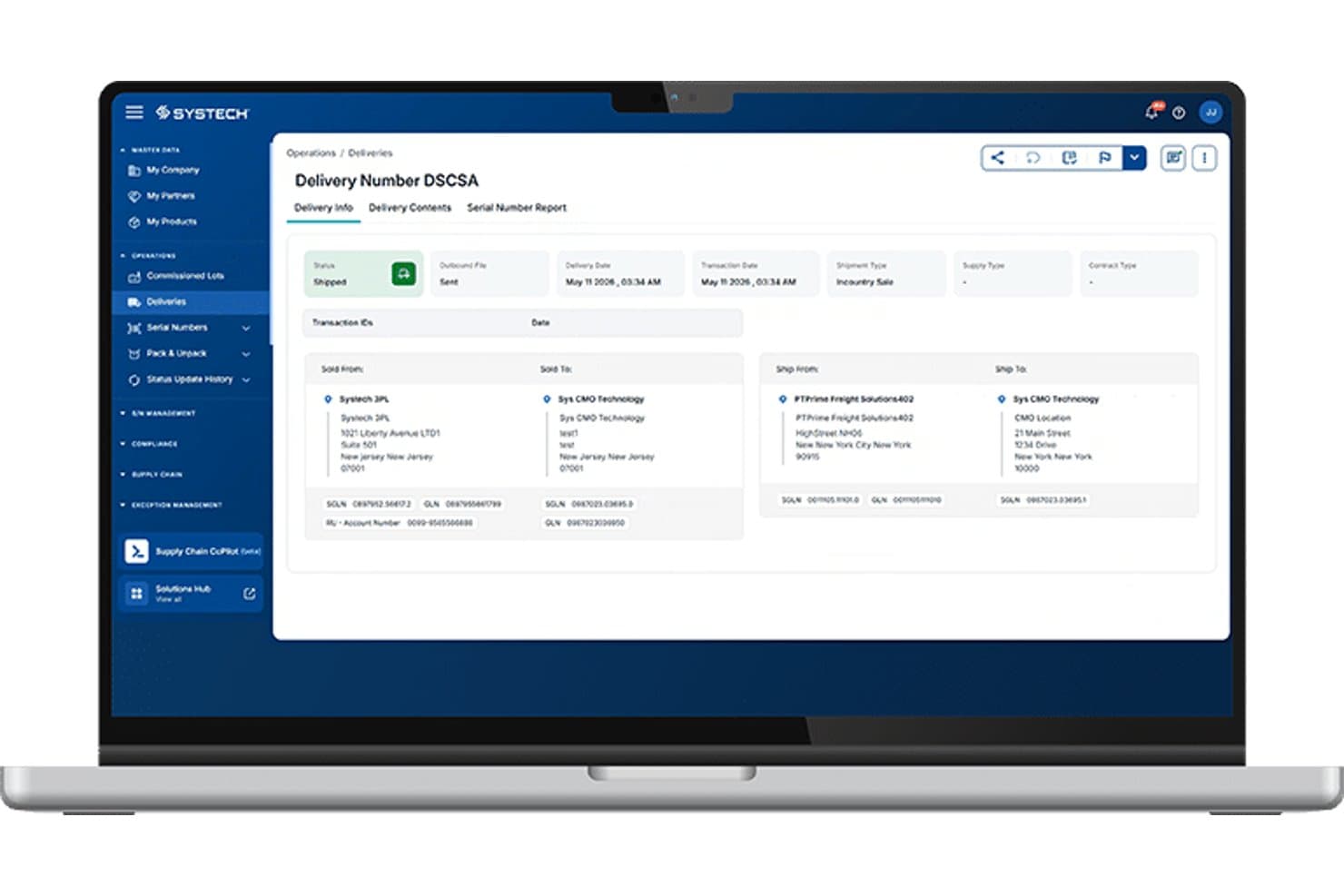
UniTrace tracks DSCSA delivery details, transaction IDs, and shipping info. UniTrace is a cloud-based DSCSA compliance platform from Systech that covers serialization, product tracing, trading partner connectivity, inbound receiving verification, recall management, and suspect product investigation across tiered pharmacy and enterprise configurations.
Who Is UniTrace Best For?
UniTrace is a strong fit for enterprise pharmacy chains and large healthcare organizations that manage serialization and product tracing across multiple distribution tiers.
Why I Picked UniTrace
UniTrace earns its spot on my shortlist because of how far it goes for large pharmacy operations that need more than just inbound verification. The Enterprise tier includes custom pharmacy system integrations and case management workflows, which means your team can investigate suspect products without bouncing between systems. I also like that it includes ATP Credentialing and built-in business intelligence, so compliance reporting and trading partner management sit inside the same platform rather than being patched together from separate tools.
UniTrace Key Features
- EPCIS inbound processing: Captures and processes inbound EPCIS data from suppliers to maintain accurate electronic product tracing records.
- Mobile scan, verify, and track: A mobile application lets pharmacy staff scan, verify, and track products at the point of receipt on the floor.
- Recall management: Tracks and manages product recalls across your inventory so your team can respond quickly with accurate data.
- Store transfer management: Monitors and records product movements between store locations to keep tracing records complete across your network.
UniTrace Integrations
Systech doesn't publicly document a list of native integrations for UniTrace. The platform supports connectivity with Authorized Trading Partners (ATPs) through EPCIS-based data exchange, and the Enterprise tier includes custom pharmacy system integrations built during implementation.
Pros and Cons
Pros:
- Recall and transfer management in one system
- Includes mobile scanning for product verification
- Supports tiered pharmacy and enterprise operations
Cons:
- Custom integrations add complexity to setup
- No public list of native integrations
Learn more about UniTrace: Best for enterprise pharma supply chain traceability
- Free demo available
- Pricing upon request
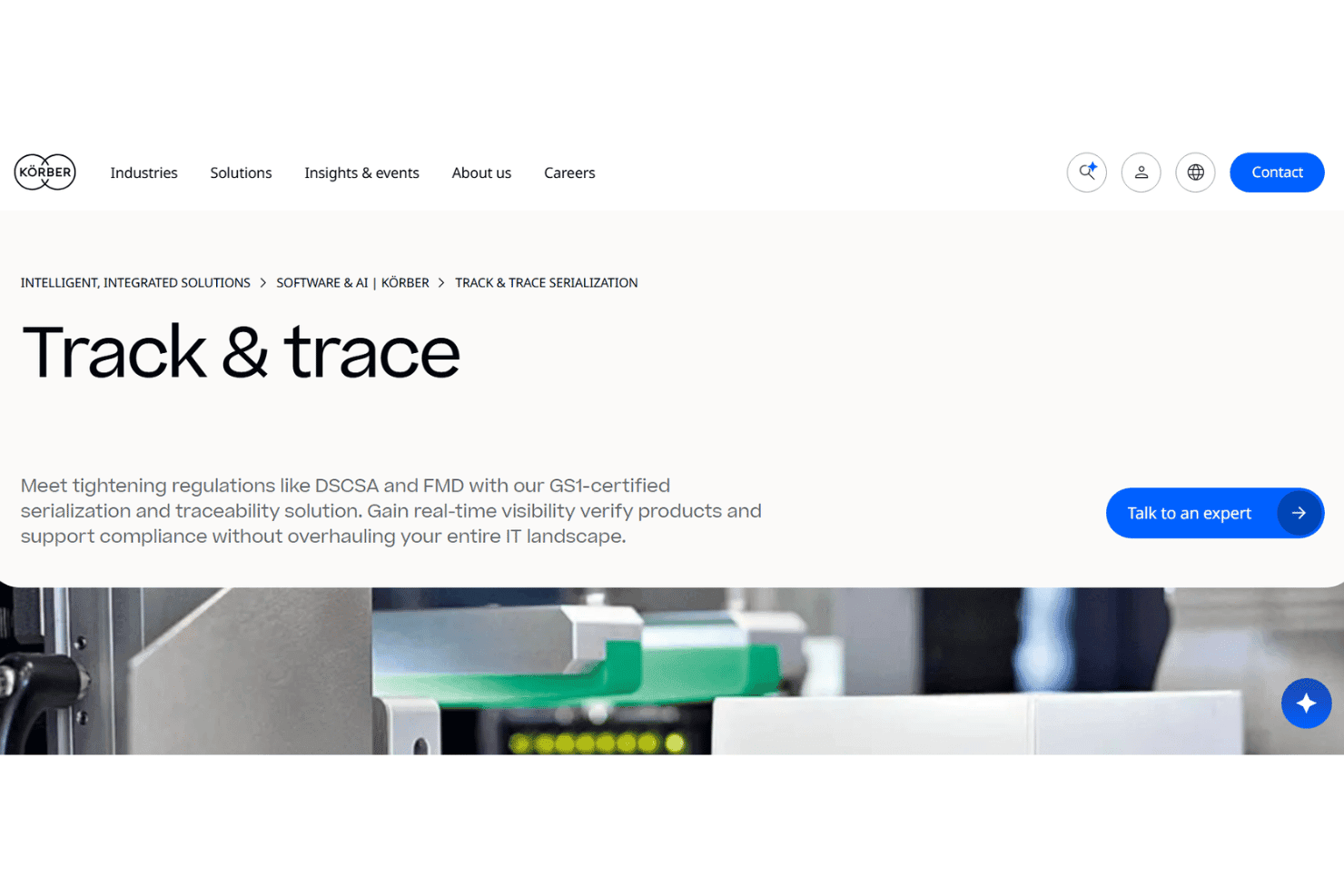
Körber delivers GS1-certified DSCSA serialization and EPCIS-based track-and-trace. Körber's track-and-trace solution is a GS1-certified serialization and traceability platform built for pharmaceutical supply chains, covering DSCSA and FMD compliance through serialization, EPCIS-based partner connectivity, and real-time visibility across manufacturing, warehousing, and distribution.
Who Is Körber Best For?
Körber is a strong fit for large pharmaceutical manufacturers and distributors that need end-to-end serialization and EPCIS-based traceability across complex, multi-site supply chains.
Why I Picked Körber
Körber earns its spot on my shortlist because its enterprise-scale architecture is built specifically for pharmaceutical supply chains that span multiple manufacturing sites, distribution centers, and trading partners. I particularly like STEPLogic Trace, which creates a centralized visibility layer across your entire network and connects directly to global compliance repositories for DSCSA and FMD reporting. PAS-X Track & Trace ties packaging lines, ERP, and compliance systems together at the level 3 platform layer, so serialization data flows from the production line to your partners without gaps.
Körber Key Features
- GS1-certified serialization: STEPLogic Trace carries GS1 certification validated through independent third-party testing via Gateway Checker, confirming standards-based data exchange.
- Automated exception handling: Real-time alerts flag data errors before they cause shipment delays, so your team can resolve issues without manual monitoring.
- No-code workflow configuration: STEPLogic Trace lets you build and adjust serialization workflows without IT involvement or custom coding.
- FDA 21 CFR Part 11 and GAMP 5 validation: The platform runs in a validated environment that meets regulated industry requirements for electronic records and audit trails.
Körber Integrations
Körber's track-and-trace solutions offer native integrations with SAP ATTP, TraceLink, Wipotec, Bausch+Ströbel, COPA-DATA zenon, and eschbach Shiftconnector, and connect to ERP, WMS, and MES systems along with global compliance repositories through EPCIS messaging. The PAS-X MSI Plug & Produce interface and STEPLogic Connector support no-code integration with packaging lines, and configurable APIs are available for custom connections.
Pros and Cons
Pros:
- No-code workflow changes for serialization processes
- Automated data error and exception handling
- Certified for both DSCSA and FMD compliance
Cons:
- Initial setup can require project management
- Best suited for large and complex operations
Learn more about Korber: Best for enterprise pharma network traceability
- Free demo available
- Pricing upon request
TraceLink coordinates DSCSA data exchange, verification, exceptions, and onboarding. TraceLink is a cloud-based DSCSA compliance platform built for pharmaceutical supply chain networks, offering EPCIS-based electronic data exchange, verification request services, exception management, and multi-partner onboarding across manufacturers, wholesale distributors, and dispensers.
Who Is TraceLink Best For?
TraceLink is built for large pharmaceutical manufacturers, wholesale distributors, and dispensers that need to manage DSCSA compliance across complex, multi-partner supply chain networks.
Why I Picked TraceLink
TraceLink earns its spot on my shortlist because of its "Integrate Once, Interoperate with Everyone" network model, which lets a manufacturer or distributor connect a single time and exchange EPCIS-based transaction data with every trading partner on the network. I also like its real-time exception management tools, which let teams flag and resolve DSCSA discrepancies directly with trading partners before a shipment gets held up. For large pharma networks managing thousands of supplier and customer relationships, that single-integration architecture eliminates the point-to-point onboarding burden that makes DSCSA compliance so operationally heavy.
TraceLink Key Features
- Serialized transaction data exchange: TraceLink handles EPCIS-based exchange of Transaction Information (TI) and Transaction Statements (TS) between manufacturers, distributors, and dispensers.
- VRS-compliant verification services: The platform processes verification requests against serialized product data to confirm product authenticity at the pack level.
- Regulatory update deployment: TraceLink's network tenant architecture rolls out DSCSA rule changes to all customers simultaneously, keeping your instance current without manual upgrades.
- Multi-role supply chain support: Separate compliance workflows are configured for manufacturers, wholesale distributors, and retail pharmacies, so each trading partner type meets its specific DSCSA obligations.
TraceLink Integrations
TraceLink offers native integrations with SAP (including SAP ATTP via IDoc formats like DELVRY07 and MATMAS05), Oracle ERP, NetSuite, Microsoft Dynamics Business Central, and Creatio, and supports partner connectivity through EDIFACT, EDI ANSI X12, and EPCIS standards. An XML API is available for custom B2B integrations across manufacturers, CMOs, wholesale distributors, 3PLs, and pharmacies.
Pros and Cons
Pros:
- Automated regulatory update deployment
- Real-time exception management tools included
- Connects entire pharma supply chain network
Cons:
- May require lengthy onboarding process
- Designed primarily for large organizations
Learn more about TraceLink: Best for independent pharmacy DSCSA tracking
- Not available
- Pricing upon request
RedSail connects pharmacies to DSCSA tracking, verification, and serial scanning. RedSail Technologies is a pharmacy software and solutions company that offers DSCSA compliance through vetted partner integrations—LSPedia's Pharmacy Pro and InfiniTrak—giving independent pharmacies access to end-to-end track-and-trace, trading partner verification, automated serial number scanning, and real-time alert monitoring within their existing pharmacy management system.
Who Is RedSail Technologies Best For?
RedSail Technologies is a strong fit for independent pharmacies that need DSCSA compliance built into their existing pharmacy management system rather than a standalone tool.
Why I Picked RedSail Technologies
I picked RedSail Technologies because it meets independent pharmacies exactly where they are, building DSCSA compliance into the pharmacy management systems they already use rather than adding a separate tool. Through its vetted partner integrations with LSPedia's Pharmacy Pro and InfiniTrak, it gives your pharmacy automated serial number scanning and real-time alert monitoring without disrupting existing workflows. Trading partner verification and end-to-end track-and-trace are handled within the same system your staff already knows.
RedSail Technologies Key Features
- Six-year secure data storage: RedSail's DSCSA partner solutions store your transaction data on a cloud-based platform for six years to meet regulatory recordkeeping requirements.
- DSCSA expert guidance: Access dedicated support covering legal updates, technical specifications, standard operating procedure (SOP) development, and compliance reporting.
- Integrated and non-integrated deployment options: Choose a solution that connects directly with your existing RedSail pharmacy management system or runs as a standalone, non-integrated option at a lower monthly cost.
- Free continuing education (CE) credits: Registered pharmacists and pharmacy technicians enrolled through RedSail can access a free CE course on DSCSA compliance at no additional charge.
RedSail Technologies Integrations
RedSail Technologies delivers DSCSA compliance through vetted partner integrations with LSPedia's Pharmacy Pro (OneScan) and InfiniTrak, which connect directly with RedSail pharmacy management systems including BestRx and PioneerRx. Both partner solutions are also available as non-integrated standalone options at a lower monthly cost.
Pros and Cons
Pros:
- Six-year secure cloud data storage
- Automated serial number scanning is included
- Built directly into pharmacy management systems
Cons:
- Initial setup may require guided assistance
- Only supports select pharmacy software platforms
Learn more about RedSail Technologies:
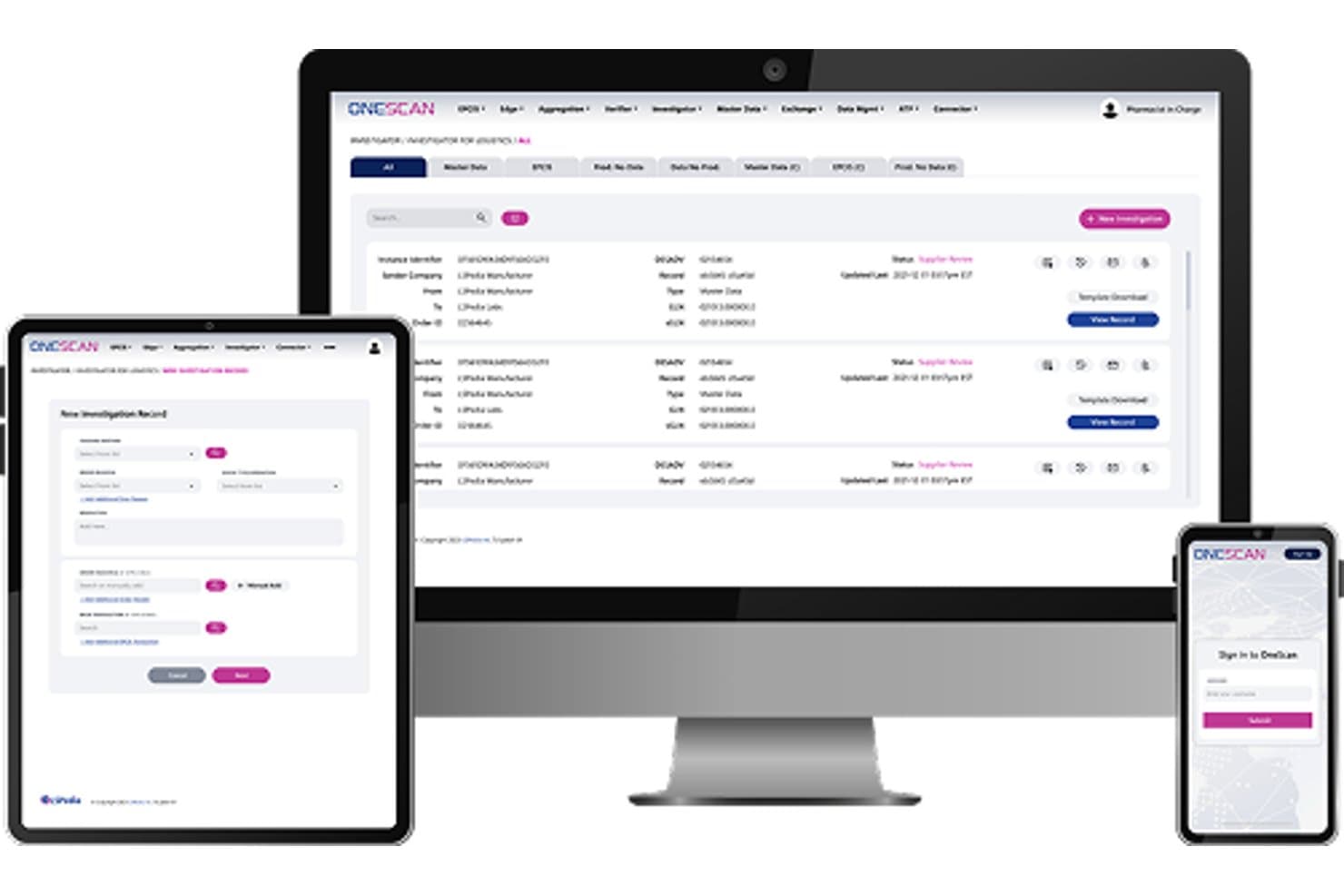
LSPedia centralizes DSCSA investigation tracking across devices. LSPedia is a cloud-based DSCSA compliance platform built around its OneScan suite, which handles serialization, serial number tracking, EPCIS data exchange, and end-to-end supply chain traceability for pharmacies, wholesalers, manufacturers, and 3PLs.
Who Is LSPedia Best For?
LSPedia is a strong fit for pharmacies and pharmacy chains that need DSCSA compliance built around direct integrations with their existing pharmacy management systems.
Why I Picked LSPedia
I picked LSPedia as one of the best because its OneScan Pharmacy Pro is built specifically for dispensers, not adapted from a generic supply chain tool. What I like most is the PMS integration available in the Silver and Gold plans, which pulls EPCIS data directly into your existing pharmacy workflow rather than forcing a parallel system. The built-in Verification Router Service (VRS) lets staff scan products at the point of receipt for instant verification against DSCSA records, and the pre-built SOP templates give pharmacy teams audit-ready documentation without writing anything from scratch.
LSPedia Key Features
- OneScan Investigator: Manages DSCSA exceptions for EPCIS and VRS transactions, giving your team a structured workflow to investigate and resolve product discrepancies.
- Authorized trading partner management: Verifies and authenticates trading partner licenses against DSCSA requirements before transactions are processed.
- FDA Form 3911 autofill: Auto-populates FDA 3911 forms using transaction data already in the system, so your team can submit suspect product reports without manual data entry.
- Recall management alerts: Sends recall notifications scoped only to products physically present at your location, cutting through irrelevant alerts.
LSPedia Integrations
LSPedia offers native pharmacy management system integrations with PioneerRx, BestRx, Liberty Software, and the broader RedSail Technologies platform, plus 150,000+ pre-established AS2 trading partner connections and sFTP support for EPCIS data exchange. It also provides 200+ RESTful Connector APIs for custom integrations with ERP and pharmacy systems.
Pros and Cons
Pros:
- In-system recall notifications for stocked products
- Automated FDA 3911 form autofill
- Built for pharmacy DSCSA workflows
Cons:
- Interface may overwhelm smaller pharmacy teams
- Full feature set requires higher-tier plans
Learn more about LSPedia: Best for enterprise-level ATP and VRS verification
- Not available
- Pricing upon request
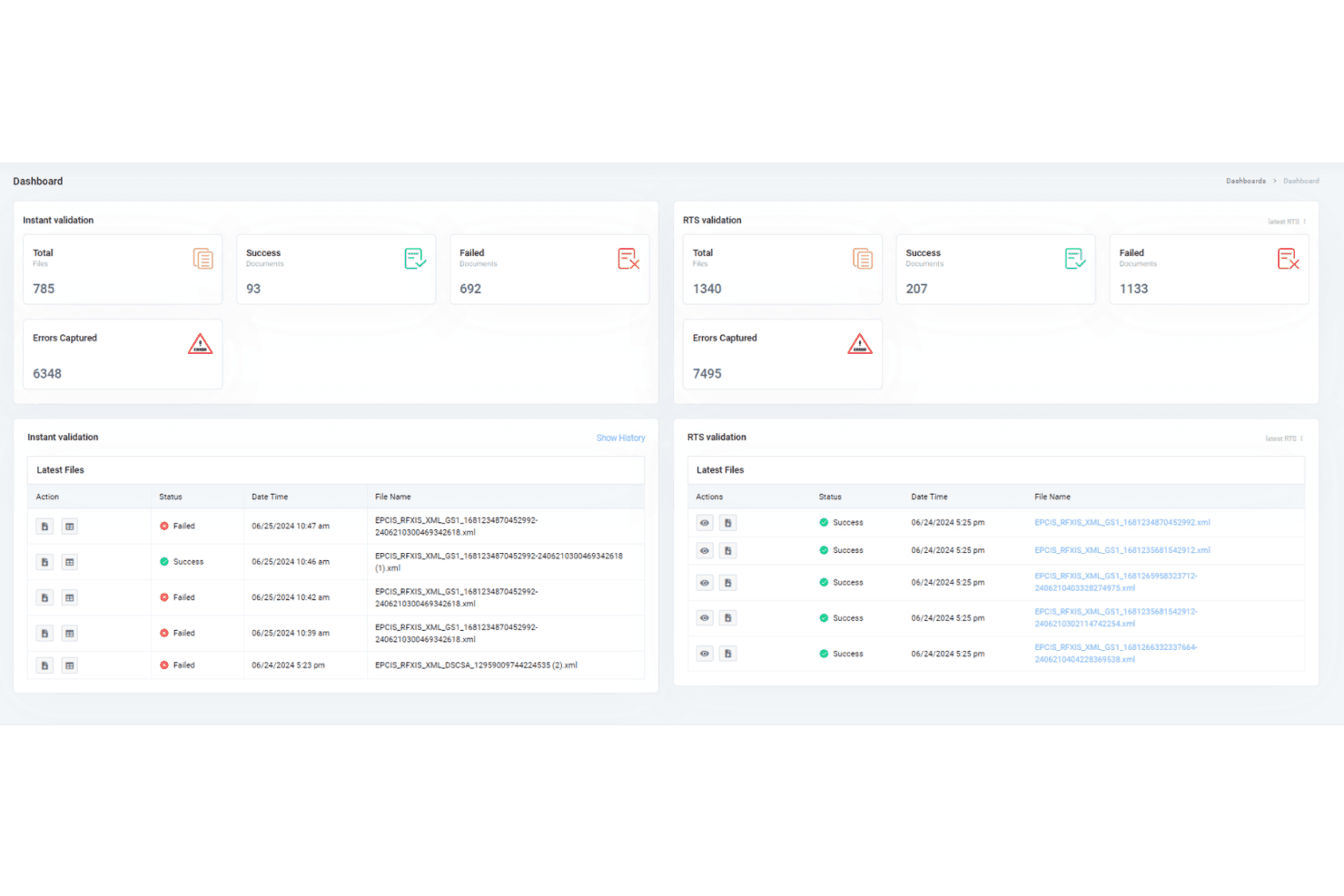
rfxcel tracks file validation and DSCSA errors in real time. rfxcel SNAP is a DSCSA compliance solution for pharmacies that handles T3 data exchange, electronic trading partner connectivity, serialized product verification, and suspect drug investigation workflows.
Who Is rfxcel Best For?
rfxcel SNAP is a strong fit for enterprise pharmacies and large dispensing operations that need a dedicated system for authorized trading partner (ATP) verification and verified returns service (VRS) workflows under DSCSA.
Why I Picked rfxcel
I picked rfxcel SNAP as one of the best because its ATP credentialing verification ties directly into Ledger Domain's digital wallet standard, which is already active across 11,000+ pharmacy sites. SNAP's VRS workflows cover saleable returns verification, and its suspect drug investigation module handles product quarantine and electronic FDA notification in one system. That's the level of end-to-end traceability infrastructure I'd want running at an enterprise dispensing operation.
rfxcel SNAP Key Features
- Six-year T3 data storage: SNAP archives transaction history, transaction information, and transaction statement data in electronic format for a minimum of six years to support audit readiness.
- Trading partner connectivity: SNAP electronically connects your pharmacy to licensed and verified primary wholesalers, secondary wholesalers, and manufacturers for compliant T3 data exchange.
- Outgoing T3 data generation: SNAP generates T3 documentation for outgoing sales and transactions, so your downstream trading partners receive the required traceability records at change of ownership.
- Serialized 2D barcode verification at receipt: SNAP verifies the product identifier encoded in each package's 2D barcode at the point of receiving, confirming serialized data before product enters your inventory.
rfxcel Integrations
rfxcel SNAP connects with the three largest US pharmaceutical wholesalers, including Cardinal Health, McKesson, and AmerisourceBergen, along with hundreds of secondary wholesalers and manufacturers for T3 data exchange, and it integrates with LedgerDomain's XATP digital wallet for authorized trading partner credential verification. An API is available for custom integrations across SAP and non-SAP systems.
Pros and Cons
Pros:
- Electronic FDA notification for suspect drugs
- Handles serialized barcode verification at receipt
- Six-year T3 data storage standard
Cons:
- Onboarding may require extensive workflow adjustments
- Only suited to large enterprise operations
Learn more about rfxcel: Best for pharmacies tracking T3 data long-term
- Not available
- Pricing upon request
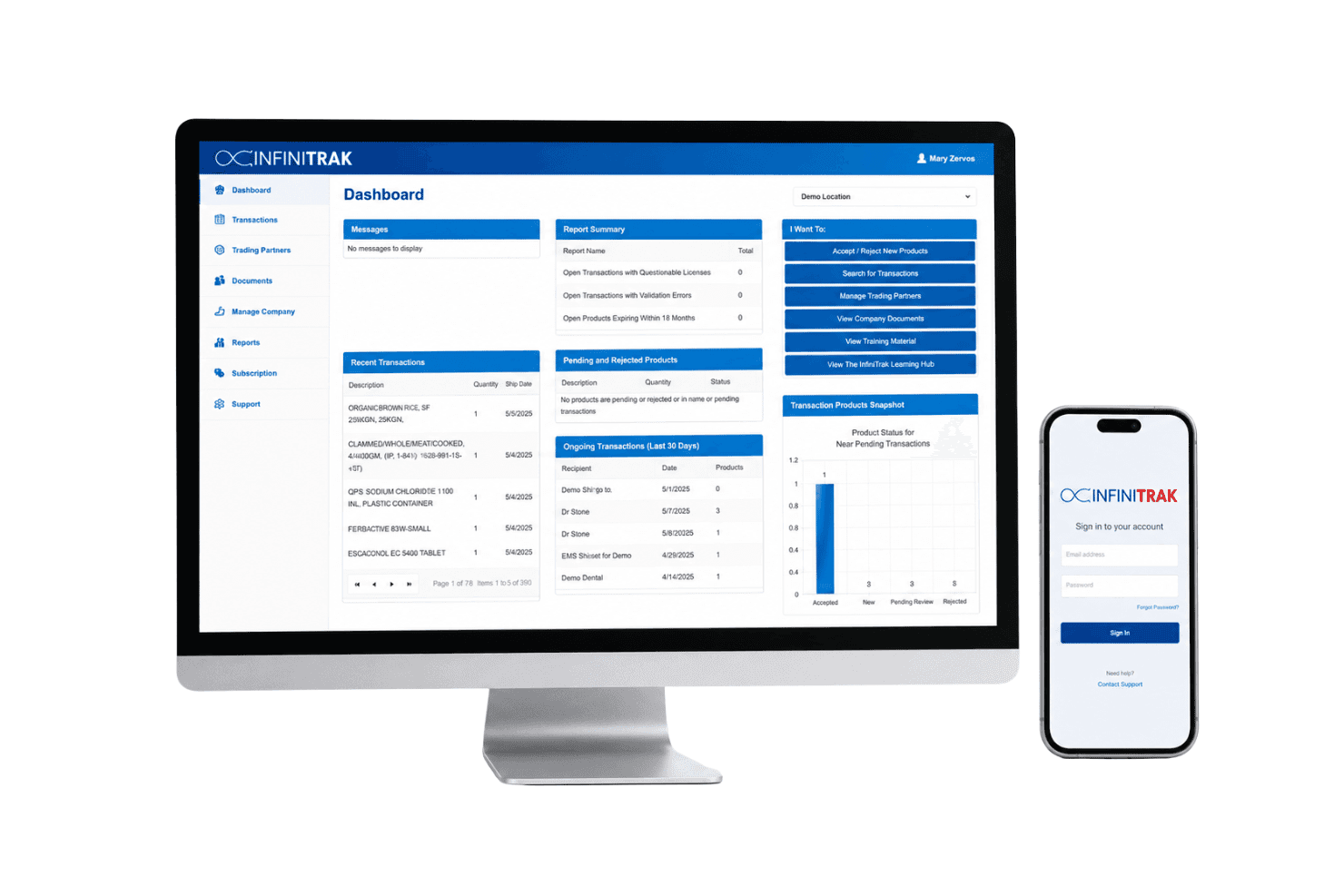
InfiniTrak manages DSCSA tracking, verification, T3 data, and audit records. InfiniTrak is a cloud-based DSCSA compliance platform built for pharmacies, dispensers, and wholesale distributors, covering track-and-trace, product verification, T3 data management, and audit-ready documentation with integrations across 30+ pharmacy management systems.
Who Is InfiniTrak Best For?
InfiniTrak is a strong fit for pharmacies and dispensers that need to store, manage, and retrieve T3 documentation over extended periods to stay audit-ready under DSCSA requirements.
Why I Picked InfiniTrak
InfiniTrak earns its spot on my list because of how well it handles long-term T3 data storage and retrieval for pharmacies that need to stay audit-ready year-round. I like that it centralizes EPCIS transaction data in a secure cloud environment, so your transaction information, transaction history, and transaction statements are organized and accessible when an auditor shows up. Its exception management tools also flag incomplete or missing T3 records before they become compliance gaps.
InfiniTrak Key Features
- VRS product verification: Run verification workflows against product identifiers to confirm authenticity and manage suspect product concerns before they escalate.
- 2D barcode scanning: Scan serialized drug products at intake to capture and record product data without manual entry.
- Trading partner management: Organize trading partner records, verify authorized trading partners, and keep documentation audit-ready in one place.
- Suspect product management: Document the full investigation, quarantine, and resolution process for suspect or illegitimate products within the platform.
InfiniTrak Integrations
InfiniTrak offers native integrations with 30+ pharmacy management systems, including BestRx, PrimeRx, PioneerRx, Liberty Software, McKesson, Speed Script, and partner networks like American Associated Pharmacies, American Pharmacy Cooperative, American Pharmacy Services Corporation, and Northeast Pharmacy Services Corporation. It supports EPCIS-based data exchange for trading partner interoperability, and Zapier and public API availability are not clearly documented.
Pros and Cons
Pros:
- Investigates and documents suspect product events
- Flags missing or incomplete T3 records
- Excels at long-term T3 documentation storage
Cons:
- Zapier and API documentation not clearly listed
- No publicly available trial option
Learn more about InfiniTrak: Best for free trading partner onboarding at scale
- Free demo available
- Pricing upon request
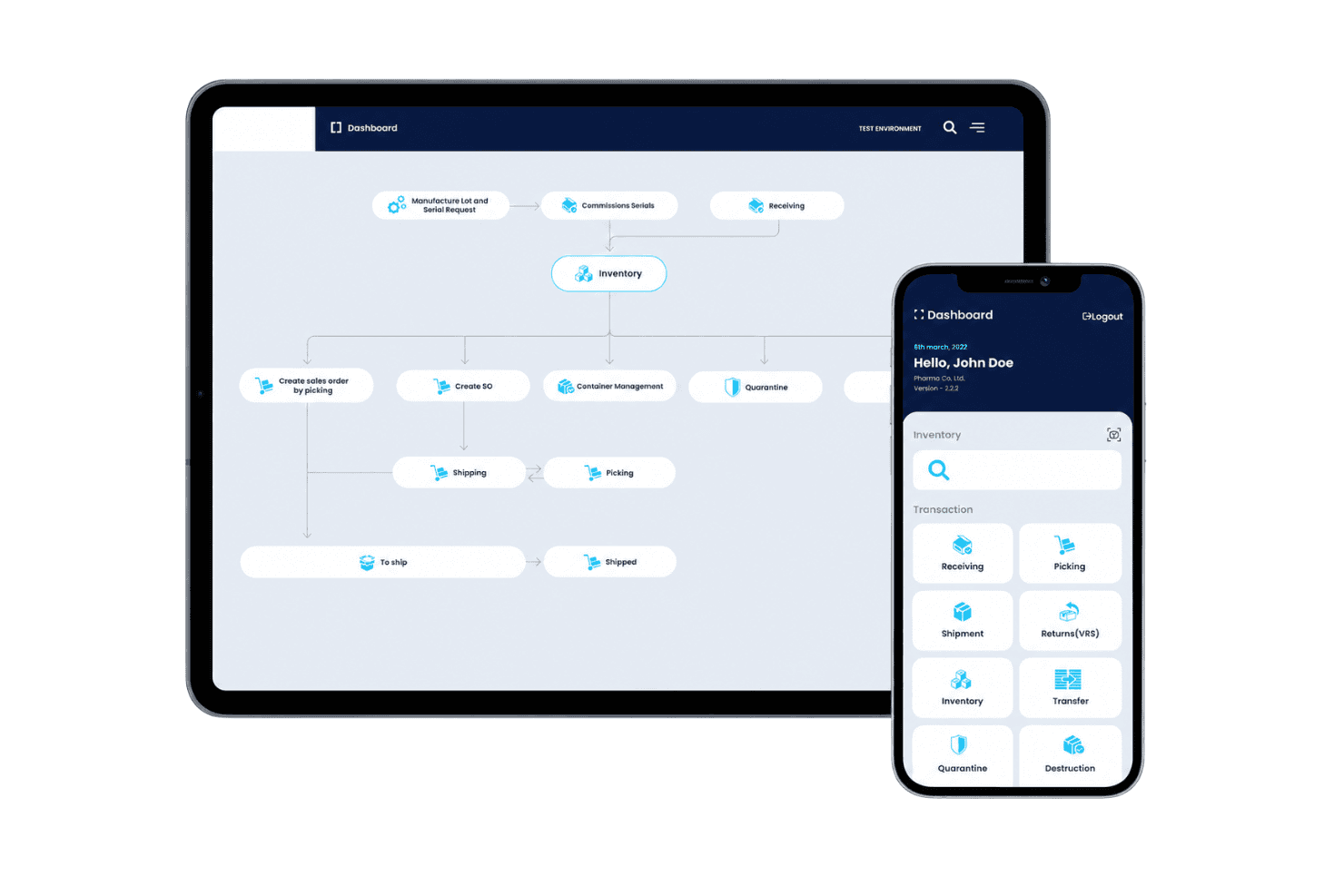
TrackTraceRX supports DSCSA tracking with EPCIS exchange and mobile barcode scans. TrackTraceRX is a DSCSA compliance platform built for pharmaceutical supply chain tracking, offering end-to-end track and trace across manufacturing, distribution, and delivery, with EPCIS data exchange, augmented reality barcode scanning via its RapidRX mobile app, and ERP/WMS integration.
Who Is TrackTraceRX Best For?
TrackTraceRX is a strong fit for pharmaceutical wholesalers, distributors, and pharmacies that need to onboard a large number of trading partners without taking on the cost or coordination burden themselves.
Why I Picked TrackTraceRX
TrackTraceRX is one of my top picks because it's the only DSCSA compliance platform that will personally contact every one of your trading partners and set up data integrations at no cost to you. That's a meaningful differentiator when you're a wholesaler or distributor managing dozens or hundreds of supply chain relationships. It's already connected to over 100,000 trading partner locations, so new users are plugging into an existing network rather than building from scratch. I also like the RapidRX mobile scanner, which uses augmented reality to flag shipment issues in real time directly from a smartphone.
TrackTraceRX Key Features
- VRS and authorized trading partner verification: TrackTraceRX checks trading partner authorization status and supports Verification Router Service (VRS) lookups to confirm product legitimacy at the point of receipt.
- Product recall management: The portal lets you identify specific serialized products or batches involved in a recall and trace where those units were distributed across the supply chain.
- Free FDA audit support: TrackTraceRX includes audit support at no additional cost, giving you access to documentation and compliance records when regulators request them.
- EPCIS exception handling: The platform flags and manages data exceptions during EPCIS transactions so you can resolve interoperability issues before they create compliance gaps.
TrackTraceRX Integrations
TrackTraceRX takes an API-first approach and doesn't publish a list of named native integrations, but it supports connections to major ERP, Warehouse Management System (WMS), and Line Management System (LMS) platforms, including its own erpRX product powered by Odoo. The ERPRX Connector acts as a database endpoint that lets external systems exchange track and trace data with TrackRX and RapidRX, and an API is available for custom integrations.
Pros and Cons
Pros:
- Real-time AR barcode scanning with RapidRX
- Includes free FDA audit support
- Handles trading partner onboarding for you
Cons:
- Pricing details not publicly available
- No published list of native integrations
Learn more about TrackTraceRX:
Other DSCSA Compliance Software
Here are some additional DSCSA compliance software options that didn’t make it onto my shortlist, but are still worth checking out:
- 11ConsortiEXBest for hospital pharmacy DSCSA compliance
- 12DSCSA 360Best for independent pharmacy DSCSA outsourcing
- 13OptelBest for manufacturer-side pharma serialization
- 14Pulse by NABPBest for regulator-backed drug verification
- 15AuthentiTrackBest for manufacturer-grade DSCSA serialization
- 16RxScanBest for multi-site dispenser T3 recordkeeping
- 17mytracekey PHARMABest for manufacturer-side DSCSA serialization
- 18SystechBest for pharma VRS verification at scale
- 19SpherityBest for pharma ATP credentialing and licensing
- 20TrackVisionBest for open-standards DSCSA data exchange
How I Evaluate DSCSA Compliance Software
I split my evaluation into baseline compliance capabilities every tool must cover—T3 recordkeeping, ATP verification, suspect product workflows—and the differentiators that separate vendors when pharmacy staff actually use them day to day.
Core Functionality (Table Stakes For This List)
When I'm selecting tools for my list, I rank each one on a scale from 0 (does not offer the functionality) to 5 (excels in this area) for each core functionality listed below. I then calculate the tool's total score into a percentage, using 55% as a benchmark to help assess its overall fit for the list.
- Product Serialization Verification: I evaluate whether a tool can scan and decode 2D Data Matrix barcodes and validate NDC, serial number, lot, and expiration against VRS lookups in real time.
- T3 Data Management: Each tool needs structured capture and retrieval of TI, TH, and TS records with six-year retention and regulator-ready export options.
- EPCIS Interoperability: I check for bi-directional GS1 EPCIS 1.2+ data exchange, including pre-built connectors and partner onboarding workflows that reduce manual setup.
- Suspect Product Handling: Quarantine workflows, investigation logging, and FDA Form 3911 generation all factor into how I score a tool's ability to manage suspect or illegitimate products.
- ATP Verification: I look for automated license validation against state and federal databases, plus ongoing monitoring with expiration alerts so you aren't caught trading with a lapsed partner.
- Audit Trail and Reporting: Tools should produce on-demand compliance reports and immutable logs you can deliver to FDA or state board inspectors within the required response window.
Once I have a list of tools that meet the criteria, I consider what sets each platform apart.
Differentiating Factors (What Sets Vendors Apart)
Here's how I compare and contrast different vendors:
Standout Features
I look for native pharmacy management system connectors—tools like LSPedia and RedSail Technologies offer pre-built links to systems like PioneerRx and Rx30, which means your dispensing staff skip manual data entry entirely. I also evaluate mobile scanning capabilities, since receiving teams at smaller practices shouldn't need dedicated hardware to verify 2D Data Matrix codes at the dock. Small dispenser exemption tracking matters too; I check whether a platform monitors your staffing thresholds and flags when full DSCSA obligations apply.
Beyond Features
I evaluate how quickly a practice can go live, since most don't have dedicated IT staff. Vendors like LSPedia and RedSail Technologies offer pre-configured trading partner templates that cut onboarding from months to days. Transparent per-location pricing also matters—hidden fees for EPCIS connections or scanner hardware can erode ROI for smaller dispensers. I also check whether the vendor has in-house regulatory advisors who help with FDA Form 3911 filings and evolving exemption timelines.
How to Choose a DSCSA Compliance Software
Choosing DSCSA compliance software for your medical practice comes down to matching your real workflow needs with a platform’s proof of compliance and user-centered features. Here’s how to focus your search:
| If your priority is... | Look for... |
|---|---|
| If your priority is...Quick onboarding and minimal IT involvement | Look for...Pre-built PMS connectors and templated partner onboarding |
| If your priority is...Avoiding compliance gaps during staff turnover | Look for...Automated ATP license monitoring and renewal alerts |
| If your priority is...Reducing admin work for pharmacy staff | Look for...Barcode scanning via app with real-time VRS lookups |
| If your priority is...Long-term audit readiness | Look for...Regulator-ready export and six-year T3 retention |
| If your priority is...Scaling across multiple locations | Look for...Transparent, per-location pricing and cloud-based dashboards |
How to Vet Your Shortlist
- Request a workflow demo: Ask for a live walk-through simulating a T3 data lookup and suspect product investigation.
- Run an onboarding trial: Enroll a new trading partner using templated onboarding, and time the process from start to finish.
- Verify ATP monitoring detail: Request a sample report showing partner license expiration alerts for the past 12 months.
- Ask for a sample 3911 export: Get an FDA Form 3911 output produced by the platform to check formatting and completion.
- Decide on in-house management vs. outsourced compliance: Prioritize direct platform control if your team wants to own processes, or favor fully managed offerings if you prefer to outsource compliance work.
What Is DSCSA Compliance Software?
DSCSA compliance software are digital platforms that help pharmacies and healthcare organizations manage drug traceability, serialization, and partner verification in line with Drug Supply Chain Security Act requirements.
These tools support secure recordkeeping of transaction data, automated license monitoring, and workflows for identifying or reporting suspect products. By centralizing compliance tasks, DSCSA compliance software reduces manual documentation and helps your team respond quickly to regulatory audits or inspection requests.
Features of DSCSA Compliance Software
When selecting DSCSA compliance software, keep an eye out for the following key features:
Product serialization verification: Scan 2D Data Matrix barcodes to verify NDC, serial, lot, and expiration details against VRS in real time.
T3 data management: Capture and retain TI, TH, and TS records for each drug product, keeping them audit-ready for at least six years.
EPCIS interoperability: Exchange GS1 EPCIS 1.2+ serialized data with trading partners using connectors and onboarding workflows.
Suspect product handling: Quarantine and investigate suspicious products while documenting issues and generating FDA Form 3911 reports.
Authorized trading partner (ATP) verification: Monitor trading partner licenses against federal and state databases, with alerts for expirations or lapses.
Audit trail and reporting: Maintain tamper-proof compliance logs and generate regulator-ready reports for state and federal inspections.
Pharmacy management system (PMS) integration: Connect with dispensing and inventory systems to reduce manual entry and keep transaction records synchronized.
Mobile barcode scanning: Scan 2D barcodes on mobile devices or tablets for easier verification and record capture.
Pre-configured partner onboarding: Use templated onboarding workflows to add new trading partners faster and reduce setup delays.
Automated exemption and threshold tracking: Track dispenser exemption thresholds by staff or dispensing volume and flag when expanded DSCSA requirements apply.
Benefits of DSCSA Compliance Software
Implementing DSCSA compliance software provides several benefits for your team and your business. Here are a few you can look forward to:
- Enhanced drug traceability: Track serialized product movement and flag problematic items before they reach patients.
- Automated regulatory recordkeeping: Store and retrieve transaction records (TI, TH, TS) for at least six years with regulator-ready exports, reducing manual documentation and making audits easier.
- Faster onboarding and partner management: Use pre-built connectors and templated workflows to add trading partners quickly, whether you operate a single pharmacy or manage multiple locations.
- Real-time compliance monitoring: Receive alerts for trading partner license expirations or new regulatory updates, helping you avoid compliance lapses without constant manual checks.
- Streamlined suspect product handling: Automate quarantine, investigation, and FDA Form 3911 generation when a suspect or illegitimate product is identified, keeping teams prepared for inspection and reporting.
- Seamless integration with pharmacy systems: Connect directly to your pharmacy management solution to cut out redundant data entry and keep compliance information in sync.
- Mobile-friendly barcode scanning: Verify 2D Data Matrix codes with mobile devices, so you can manage product verification in any location without specialized hardware.
Costs and Pricing of DSCSA Compliance Software
Selecting DSCSA compliance software requires an understanding of the various pricing models and plans available. Costs vary based on features, team size, add-ons, and more. The table below summarizes common plans, their average prices, and typical features included in DSCSA compliance software solutions:
Plan Comparison Table for DSCSA Compliance Software
| Plan Type | Average Price | Common Features |
|---|---|---|
| Plan TypeFree Plan | Average Price$0 | Common FeaturesBasic product compliance tracking, limited T3 data storage, and manual reporting tools. |
| Plan TypePersonal Plan | Average Price$50-$150/month | Common FeaturesBarcode scanning via app, basic ATP license checks, T3 data management, and limited reporting features. |
| Plan TypeBusiness Plan | Average Price$200-$700/month | Common FeaturesEPCIS interoperability, automated suspect product workflows, enhanced compliance reporting, and mobile scanning. |
| Plan TypeEnterprise Plan | Average Price$1,000-$5,000/month | Common FeaturesCustom integrations, unlimited T3 record retention, priority support, and advanced user and location management. |
DSCSA Compliance Software FAQs
Here are some answers to common questions about DSCSA compliance software:
How do DSCSA compliance software solutions handle FDA inspection requests?
Most DSCSA compliance software lets you pull required transaction records and reports on demand for FDA or state board inspections. You’ll find pre-formatted exports for T3 data and tamper-proof audit logs, making it much easier to meet response deadlines without scrambling to compile documentation.
Can DSCSA compliance software integrate with my pharmacy management system?
Yes, many DSCSA compliance tools offer direct integration with popular pharmacy management systems like PioneerRx or Rx30. These integrations cut down on manual entry, syncing your transaction records, barcode scans, and compliance actions automatically within your existing pharmacy workflow.
What’s required to keep my system updated with DSCSA regulatory changes?
Look for vendors with dedicated regulatory advisors or support teams. They should provide regular updates to the software when DSCSA requirements shift, inform you of relevant deadlines, and guide you through new processes—so you aren’t left figuring it out on your own.
How do these platforms manage suspect or illegitimate product detection?
DSCSA compliance software typically includes tools to scan, flag, and quarantine products that trigger suspect criteria. Your team can document investigations, generate and submit FDA Form 3911 reports, and track every action taken until the case is resolved.
Is DSCSA compliance software necessary for small or exempt dispensers?
If you’re a small dispenser or qualify for an exemption, you might not need the full suite of compliance features, but tracking tools still help you prepare for audits. Some platforms monitor exemption thresholds for you and alert you if your status changes.
What’s the role of mobile scanning in DSCSA compliance?
Mobile scanning lets your team use smartphones or tablets to verify barcoded drug products at the point of receipt or dispensing. This reduces the need for expensive scanners and ensures verification steps become part of your standard workflow, not an added task.
How does automated authorized trading partner (ATP) verification work?
Automated ATP checks compare your partner database against state and federal licensing directories. You get alerts when a partner license nears expiration or lapses, so you can avoid compliance gaps without manually checking each trading partner.