

AI revenue cycle management software uses artificial intelligence to automate billing, flag errors, and predict denials before they cost your practice money. If you’re a medical practice owner tired of chasing payments and navigating changing rules, the right tool can take the headaches out of your revenue cycle. In this guide, you’ll find my shortlist of AI-driven solutions that actually work in day-to-day operations—helping your team reduce manual work, minimize lost revenue, and stay focused on patient care. You’ll see what sets each option apart so you can choose the one that truly fits your clinic’s needs.
Why Trust Our Software Recommendations
6,700+
Reviews
20
Industry experts
16+
Evaluation factors
14
Years
Our team has been testing and reviewing software since 2012. As medical practice leaders ourselves, we know how difficult—and important—it is to choose the right software.
For this guide, we evaluated tools using hands-on testing and independent research, scoring tools using our selection criteria.
Our reviews reflect our human editorial judgment, not a sales pitch.
Best AI Revenue Cycle Management Software
This comparison chart summarizes pricing details for my top AI revenue cycle management software selections to help you find the best one for your budget and practice needs.
| Tool | Best For | Trial Info | Price | ||
|---|---|---|---|---|---|
| 1 | Best for specialty-specific AI denial prevention | Free demo available | Pricing upon request | Website | |
| 2 | Best for small practice AI coding and denial prevention | Free demo available | Pricing upon request | Website | |
| 3 | Best for prior auth and coding at scale | Free demo available | From $5,000/month | Website | |
| 4 | Best for agentic AI across the full RCM cycle | Free demo available | Pricing upon request | Website | |
| 5 | Best for payer-level denial prediction at scale | Not available | Pricing upon request | Website | |
| 6 | Best for AI denial appeals across health systems | Free demo available | Pricing upon request | Website | |
| 7 | Best for network-wide AI denial prevention | Free demo available | Pricing upon request | Website | |
| 8 | Best for AI-driven mid-cycle coding and denial cuts | Free demo available | Pricing upon request | Website | |
| 9 | Best for denial prevention across U.S. hospitals | Free demo available | Pricing upon request | Website | |
| 10 | Best for enterprise-level payer denial prevention | Free demo available | Pricing upon request | Website |


AI Revenue Cycle Management Software Reviews
Below are my detailed summaries of the best AI revenue cycle management software that made it onto my shortlist. My reviews offer a detailed look at the features, best use cases, and capabilities of each software to help you find the best one for you.
 Best for specialty-specific AI denial prevention
- Free demo available
- Pricing upon request
Visit WebsiteCustomer Rating:4.4/5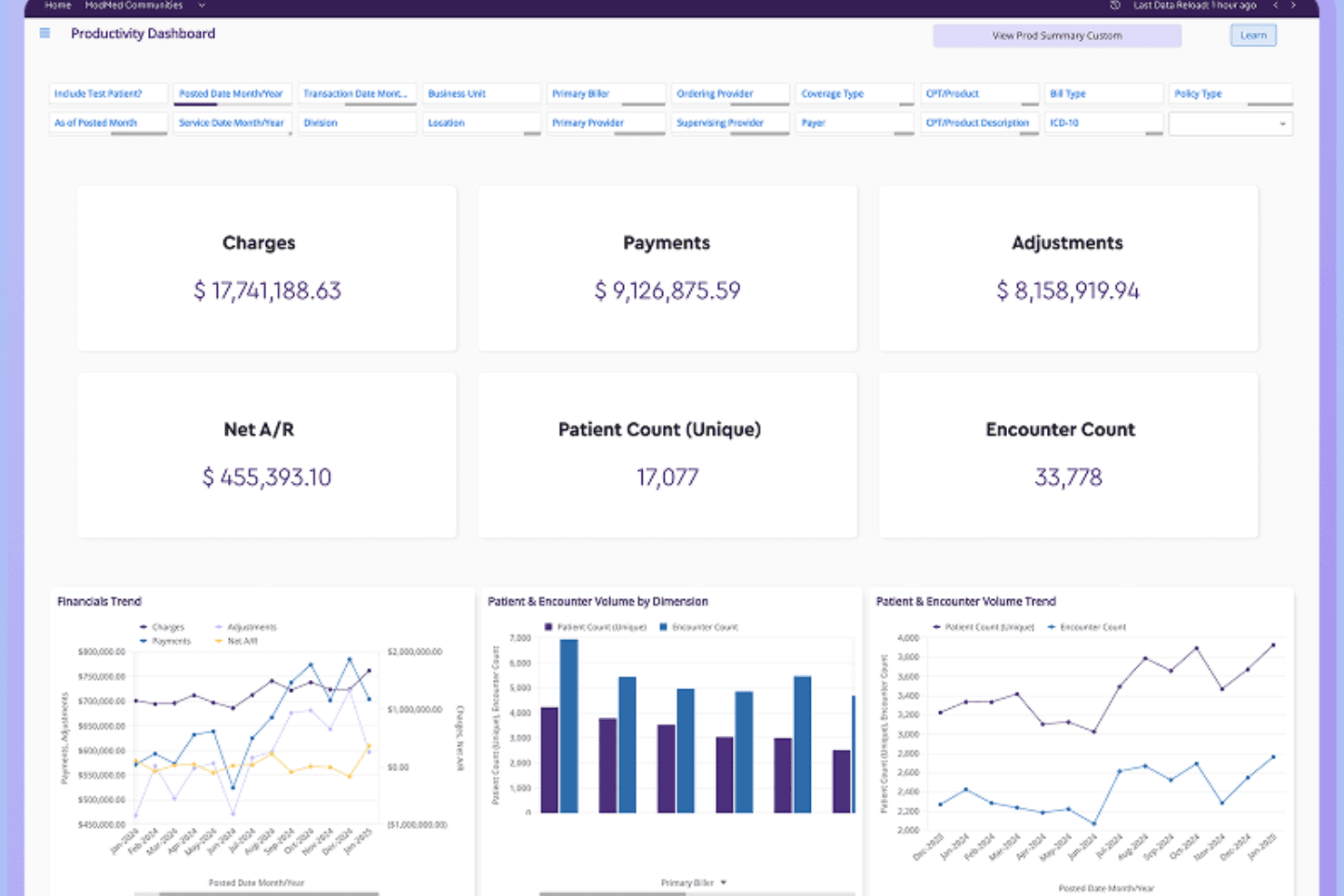
ModMed offers a comprehensive podiatry exam interface with condition-specific treatment plans, findings, and billing tools tailored for foot and ankle care. ModMed is a specialty-focused AI revenue cycle management platform built around an integrated EHR, practice management, and billing system—with AI-powered denial assessment, ambient clinical documentation, and agentic RCM tools purpose-built for 11 medical specialties.
Who Is ModMed Best For?
ModMed is built for specialty medical practices—covering 11 specialties like dermatology, orthopedics, and gastroenterology—that want a single platform connecting EHR, billing, and AI-driven denial management.
Why I Picked ModMed
I picked ModMed as one of the best because no other platform on my shortlist brings the same depth of specialty-specific denial intelligence. Its AI-Powered Denial Assessment flags high-risk claims before submission using a Specialty Intelligence Engine trained on hundreds of millions of claims across 11 specialties, from dermatology to gastroenterology. Paired with ModMed Scribe 2.0, which auto-generates specialty-tuned CPT and ICD-10 coding suggestions from live patient conversations, denial prevention starts at documentation, not just at the clearinghouse.
ModMed Key Features
- ModMed Pay: Integrated payment processing tool that supports AutoPay, Text-to-Pay, eStatements, and online bill pay, with automatic reconciliation posting directly to Practice Management.
- ModMed Analytics: Cloud-based analytics platform with built-in financial dashboards covering A/R aging, payer performance, denial and rejection reporting, and E/M code benchmarking against CMS and specialty peers.
- AI Workflow Manager: A centralized dashboard within the RCM AI Platform that handles claim prioritization, routing, personalized billing queues, and workflow automation with performance tracking.
- Quoting tool: A patient-facing cost estimation feature within Practice Management that generates out-of-pocket estimates before care is delivered.
ModMed Integrations
ModMed offers native integrations between EMA EHR, Practice Management, its built-in clearinghouse, ModMed Pay, Kiosk, APPatient, and Patient Portal. synapSYS connects Enterprise plans with two third-party applications, including labs, registries, or hospitals and health systems.
Pros and Cons
Pros:
- Unified EHR, billing, and payment platform
- Ambient AI scribe for clinical documentation
- Deep specialty-specific AI denial prediction
Cons:
- Limited to 11 supported specialties
- AI RCM platform not fully available yet
Learn more about ModMed: Best for small practice AI coding and denial prevention
- Free demo available
- Pricing upon request
Visit WebsiteCustomer Rating:3.5/5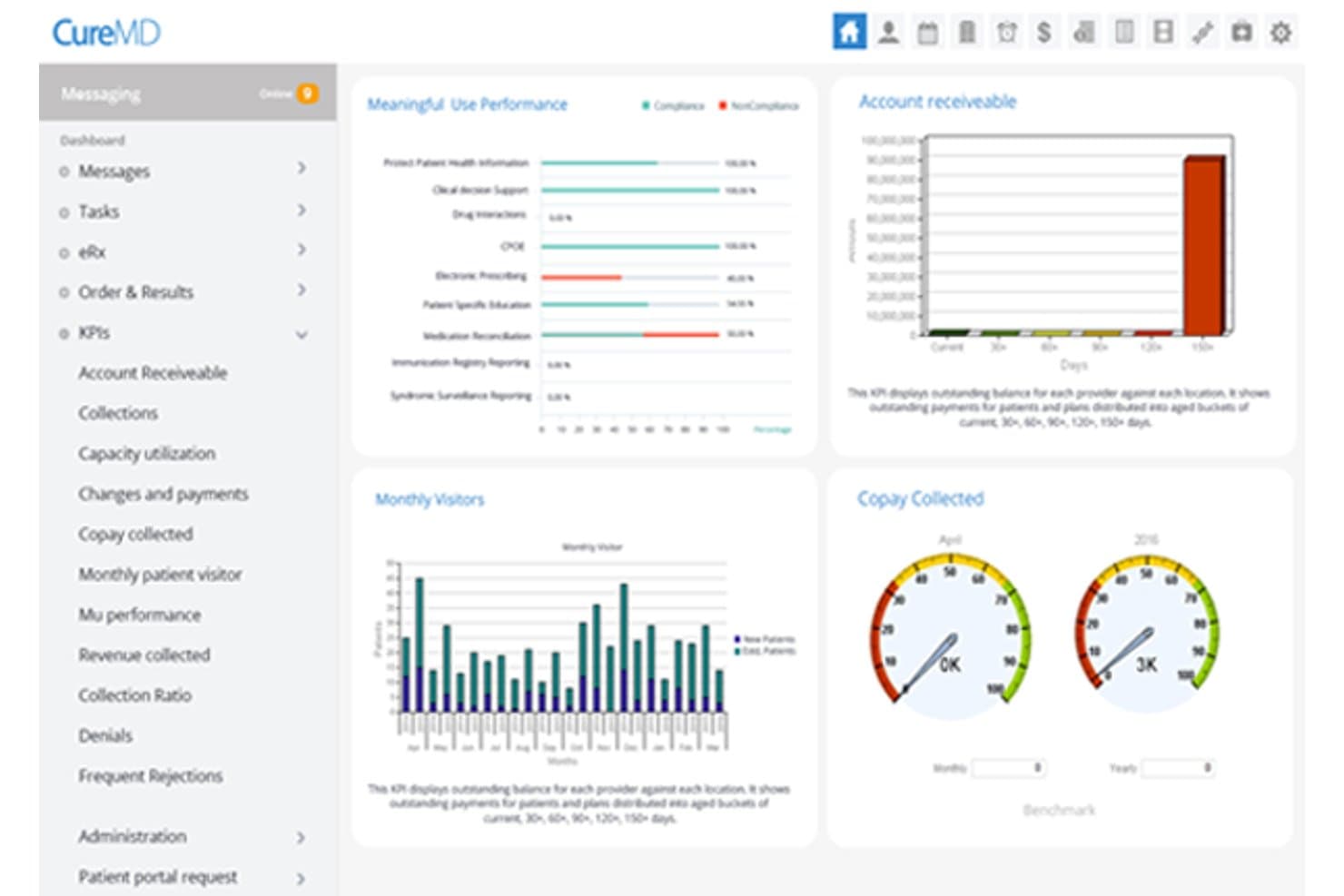
CureMD tracks KPIs like collections, copay, and receivables in one dashboard. CureMD is an AI-driven revenue cycle management platform that combines medical billing, AI coding assistance, denial prediction, claims scrubbing, and practice management into a single unified system built for small-to-midsize practices.
Who Is CureMD Best For?
CureMD is a strong fit for small-to-midsize physician practices that need an all-in-one AI coding and denial management system without managing multiple vendors.
Why I Picked CureMD
I've included CureMD in my top picks because it's one of the few AI RCM platforms built specifically around small practice needs, combining AI coding and denial prevention in a single system. I particularly like its AI Coder module, which delivers real-time ICD-10 and CPT suggestions during documentation, and its AI-Powered Denial Prediction engine, which flags high-risk claims before submission to prevent front-end denials rather than just reacting to them. That combination gives small practices a real shot at CureMD's published 98% first-pass clean claim rate without needing a large billing team.
CureMD Key Features
- AI Medical Scribe: Ambient listening technology that captures patient encounters and auto-generates SOAP notes with ICD-10, CPT, and RxNorm codes in under 15 seconds across 30+ specialties.
- Underpayment recovery: Automatically flags reimbursements that fall below contracted fee schedules and initiates recoupment workflows to recover missed revenue.
- Real-time BI dashboards: Tracks A/R trends, collection rates, claim status, and financial performance with customizable KPI reporting.
- AI credentialing automation: Manages provider enrollment, CAQH maintenance, NPI registration, and payer credentialing with validation against 1,500+ primary-source rules.
CureMD Integrations
CureMD includes a built-in clearinghouse and documented interfaces with LabCorp, Quest Diagnostics, HCA Healthcare, UCSF Medical Center, and SureScripts. It supports HL7, FHIR, HIE, and custom API integrations.
Pros and Cons
Pros:
- Built-in underpayment recovery for missed revenue
- 20,000+ payer rule engine for claims
- AI medical scribe auto-codes encounter notes
Cons:
- No AI-generated appeal letter narratives
- Users report frequent system freezes
Learn more about CureMD:
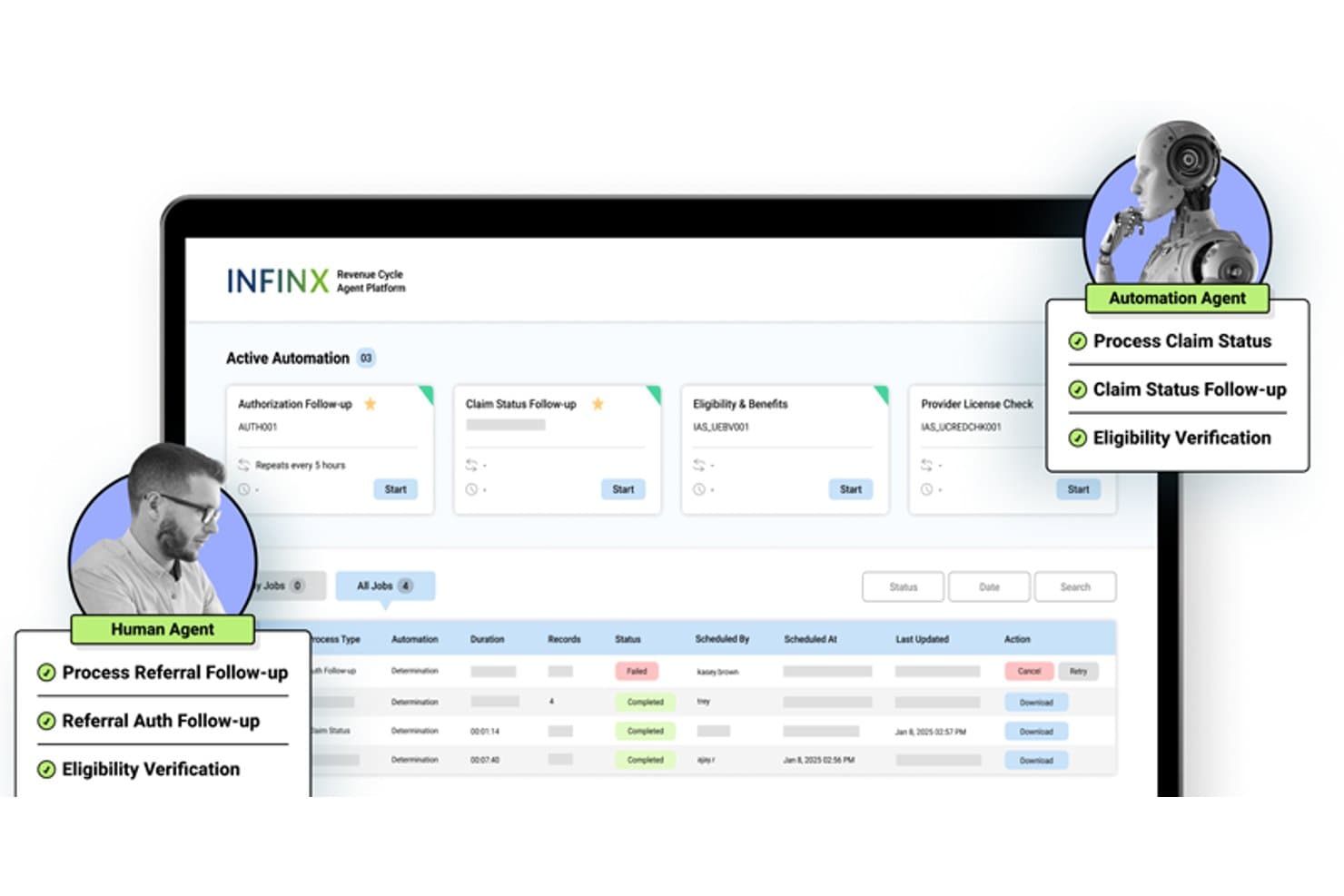
Infinx automates claim status, eligibility, and auth follow-up workflows. Infinx is an AI-powered revenue cycle management platform that combines autonomous prior authorization, AI-driven coding, claims management, and eligibility verification across a hybrid model of AI agents, automation, and human specialists.
Who Is Infinx Best For?
Infinx is a strong fit for mid-to-large health systems and multi-site physician groups that need to manage high volumes of prior authorizations and coding across multiple specialties without adding headcount.
Why I Picked Infinx
I picked Infinx as one of the best because no other platform on my shortlist handles prior authorization and autonomous coding at the volume Infinx does. The Authorization Determination Agent alone processes 10,000+ prior auths daily across 1,400+ payers with a greater than 98% accuracy rate, which is genuinely hard to replicate. Pair that with Maverick AI's autonomous coding engine hitting an 85% direct-to-bill rate, and you've got a platform built for organizations where PA bottlenecks and coding backlogs are daily realities at scale.
Infinx Key Features
- A/R Optimizer work queue prioritization: Uses ML to rank 15,000+ daily claims by recovery probability, routing the highest-value accounts to the right specialists first.
- Revenue Insights dashboards: Real-time, interactive dashboards tracking GCR, A/R aging, denial rate, net collection rate, and cost-to-collect across payers, facilities, and procedures.
- ChargeView charge capture: Scans hospital outpatient bills using 1.6M+ algorithms to flag missing or mischarged services, typically uncovering 12–16% in unbilled charges.
- Multi-model pricing structure: Supports transaction-based, FTE, subscription, managed services, and contingency fee arrangements, letting you mix pricing models across different workstreams.
Infinx Integrations
Infinx integrates with Epic, Cerner, athenahealth, eClinicalWorks, NextGen, Meditech, and Allscripts, plus 2,800+ payer connections. It supports API, HL7, FHIR, X12, RPA, and secure batch/SFTP connectivity for custom workflows.
Pros and Cons
Pros:
- Excels in payer connections and specialty coverage
- Offers multi-agent AI, automation, and human support
- Handles prior authorization and coding at scale
Cons:
- Lacks omnichannel digital payment collection
- No public user reviews for social proof
Learn more about Infinx: Best for agentic AI across the full RCM cycle
- Free demo available
- Pricing upon request
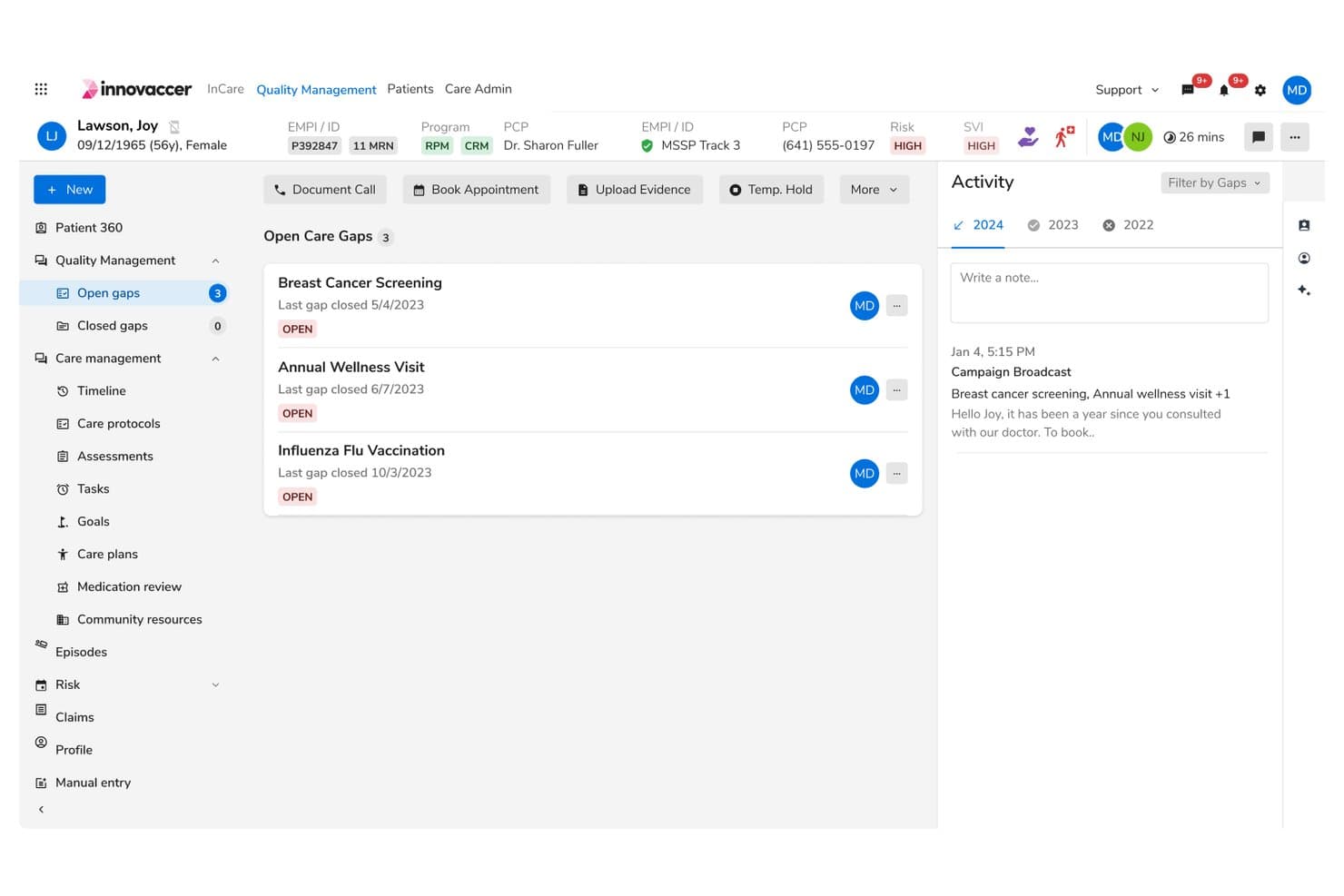
Innovaccer offers a Quality Management module that displays open care gaps, patient risk levels, and activity tracking for streamlined healthcare performance monitoring. Innovaccer Flow is an agentic AI platform for revenue cycle management that covers prior authorization, autonomous medical coding, claims integrity, denials management, and appeals across the full RCM cycle.
Who Is Innovaccer Best For?
Innovaccer Flow is built for enterprise health systems and large multi-specialty groups that need agentic AI across the full RCM cycle, from prior authorization through coding, claims, and appeals.
Why I Picked Innovaccer
Innovaccer earns its spot on my shortlist because no other platform I've seen deploys specialized AI agents across every RCM stage the way Flow does. Flow Auth cuts prior authorization prep from 45 minutes to 3 minutes using payer-specific rule engines, while Flow Capture autonomously codes roughly 80% of encounters across ICD-10, CPT, and DRG without human intervention. The Outcome Intelligence Loop then feeds denial and authorization outcomes back into the models, so the system gets sharper with every claim cycle.
Innovaccer Key Features
- Underpayment detection: Flow Collect automatically identifies payer underpayments and variances, flags recoupments, and initiates recovery actions without manual review.
- Ambient scribing: Flow Capture transcribes patient encounters in real time, producing EHR-ready clinical notes without requiring manual documentation after the visit.
- Pre-visit prep: Surfaces patient history, active conditions, labs, medications, and coding gaps for providers before each encounter begins.
- Generative AI appeals drafting: The Appeals Agent auto-generates payer-specific appeal letters using clinical documentation, care guidelines, and payer deadline tracking.
Innovaccer Integrations
Innovaccer integrates bi-directionally with 80+ EHRs, including Epic, Oracle Cerner, athenahealth, eClinicalWorks, MEDITECH, and NextGen Healthcare. It supports FHIR R4, HL7, USCDI-mapped exchange, APIs, payer portals, and fax submissions.
Pros and Cons
Pros:
- Handles autonomous coding and ambient scribing
- Reduces denial rates and accounts receivable
- Covers full RCM lifecycle with AI agents
Cons:
- Few public user reviews for RCM suite
- Patient payment features not clearly documented
Learn more about Innovaccer: Best for payer-level denial prediction at scale
- Not available
- Pricing upon request
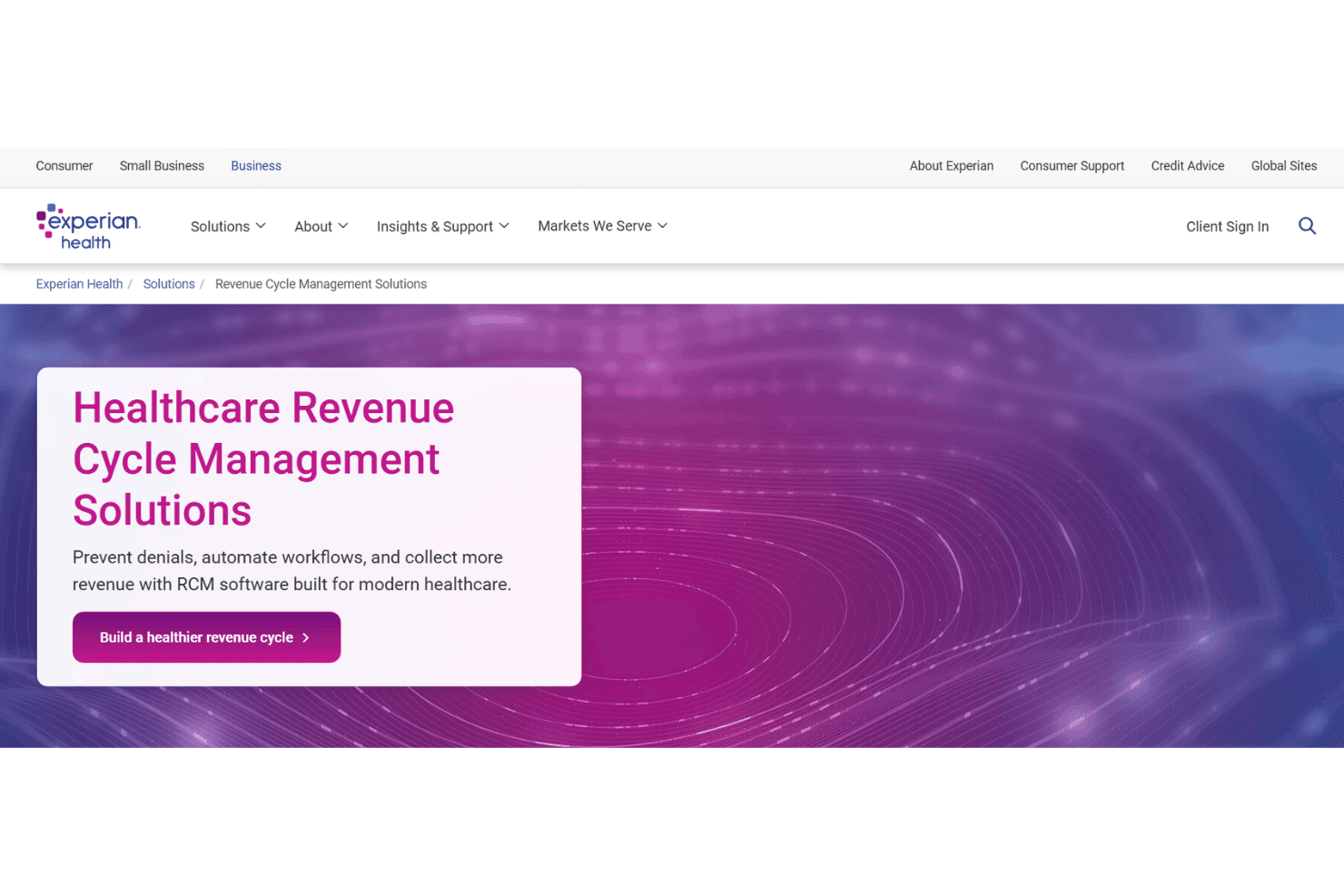
Experian Health edits claims, predicts denials, guides appeals, and tracks payers. Experian Health is an AI revenue cycle management platform built around ClaimSource and AI Advantage, combining claims editing, payer-level denial prediction, prior authorization automation, eligibility verification, and patient financial clearance in one suite.
Who Is Experian Health Best For?
Experian Health is a strong fit for revenue cycle teams at mid-to-large health systems and hospital networks that process high claim volumes and need payer-level denial intelligence built into their workflows.
Why I Picked Experian Health (ClaimSource / AI Advantage)
Experian Health earns its spot on my shortlist because AI Advantage's Predictive Denials module does something most RCM platforms can't: it scores claims against continuously updated payer adjudication patterns before submission, so your team is correcting high-risk claims rather than chasing denials after the fact. Paired with ClaimSource's payer-specific rule library spanning 1,796 payers, that pre-submission intelligence is genuinely hard to replicate at scale. Client outcomes back this up, with organizations like St. Luke's cutting denials by 76% and Blessing Health improving clean claim rates from 63% to 90%.
Experian Health Key Features
- Contract Manager & Analysis: Audits payer contracts by comparing expected versus actual reimbursements, flags underpayments, and surfaces negotiation data to support contract renegotiations.
- Coverage Discovery: Identifies missing or previously unknown patient insurance coverage to reduce write-offs before claims are submitted.
- PaymentSafe: Processes patient payments across IVR, mobile, kiosk, and patient portal channels using point-to-point encryption and PCI DSS Level 1 compliance.
- Power Reporting: Provides built-in dashboards for clean claim rates, denial trends, and cash flow KPIs without requiring a dedicated data analyst to interpret the results.
Experian Health (ClaimSource / AI Advantage) Integrations
Experian Health integrates with Epic, Oracle Health, athenahealth, NextGate, FollowMyHealth, and eCare NEXT. It supports X12 EDI, FHIR, and HL7 connectivity; no public API is documented.
Pros and Cons
Pros:
- Integrated contract management with underpayment detection
- Extensive payer behavioral intelligence and rules
- Unique payer-level denial prediction before submission
Cons:
- Not suited for small or solo practices
- No NLP-powered autonomous coding assistance
Learn more about Experian Health (ClaimSource / AI Advantage): Best for AI denial appeals across health systems
- Free demo available
- Pricing upon request
Visit WebsiteCustomer Rating:4.4/5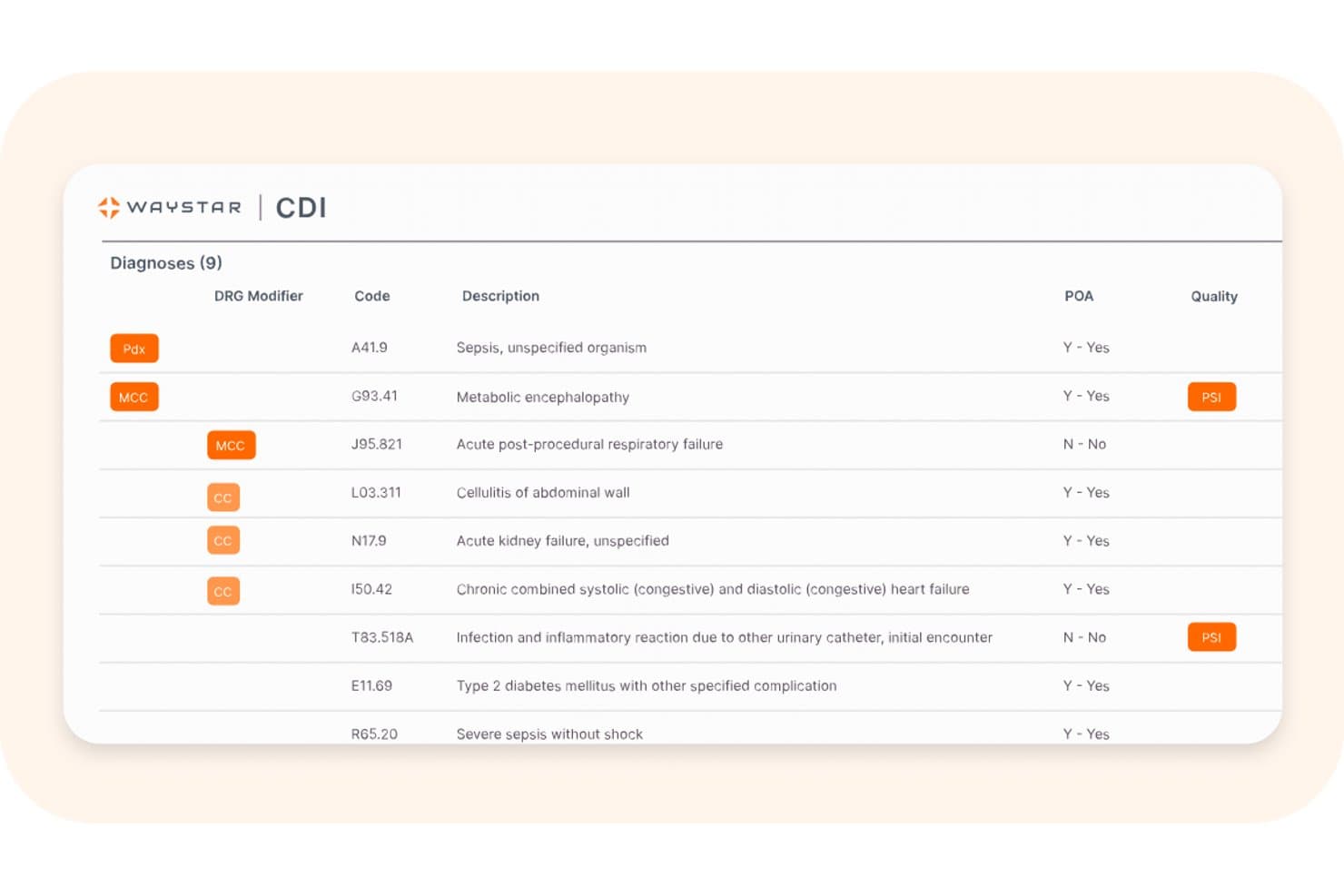
Waystar offers a CDI interface that displays a structured list of 9 diagnoses with DRG modifiers, ICD codes, descriptions, POA status, and quality flags like PSI. Waystar is an AI-powered revenue cycle management platform that covers claims management, prior authorization, denial prevention and appeals, clinical documentation integrity, and patient payment across the full RCM lifecycle.
Who Is Waystar Best For?
Waystar is a strong fit for health systems and large hospital networks that need an end-to-end AI-powered platform to manage denials, prior authorizations, and clinical documentation integrity at scale.
Why I Picked Waystar
Waystar earns its spot on my shortlist because of what AltitudeAI does specifically for denial appeals at scale. I'm particularly impressed by the generative AI appeal drafting, which auto-generates payer-specific appeal letters and packages, cutting creation time by 90% and driving a 40% higher overturn rate. At health systems processing thousands of denials monthly, that kind of throughput isn't achievable manually. The Payer Behavior Intelligence layer also continuously updates denial patterns across 5,000+ payers, so prevention happens before a claim even leaves the queue.
Waystar Key Features
- Auth Accelerate: Automates prior authorization requests end-to-end, including clinical documentation attachments, across 35+ service lines with real-time approval status updates.
- Prebill anomaly detection: AI reviews post-discharge clinical narratives to flag ICD-10 and DRG inaccuracies before a claim is submitted for billing.
- Advanced Propensity to Pay: Predictive scoring stratifies patient accounts by collection risk and expected payment amount without pulling traditional credit bureau data.
- Altitude Assist: A generative AI tool that builds custom claim edits in minutes by drawing on continuously updated rules across 5,000+ payer connections.
Waystar Integrations
Waystar has integrations with 530+ HIS and practice management systems, including Epic, Cerner, athenahealth, eClinicalWorks, NextGen, and Allscripts. It also connects with 5,000+ payers and supports standard X12 EDI transactions.
Pros and Cons
Pros:
- DRG anomaly detection recovers underpaid claims
- Prior authorization automation covers 35 service lines
- Generative AI drafts payer-specific appeal letters
Cons:
- Implementation timelines can be longer than expected
- Full-featured CAC coding tool not included
Learn more about Waystar: Best for network-wide AI denial prevention
- Free demo available
- Pricing upon request
Visit WebsiteCustomer Rating:3.8/5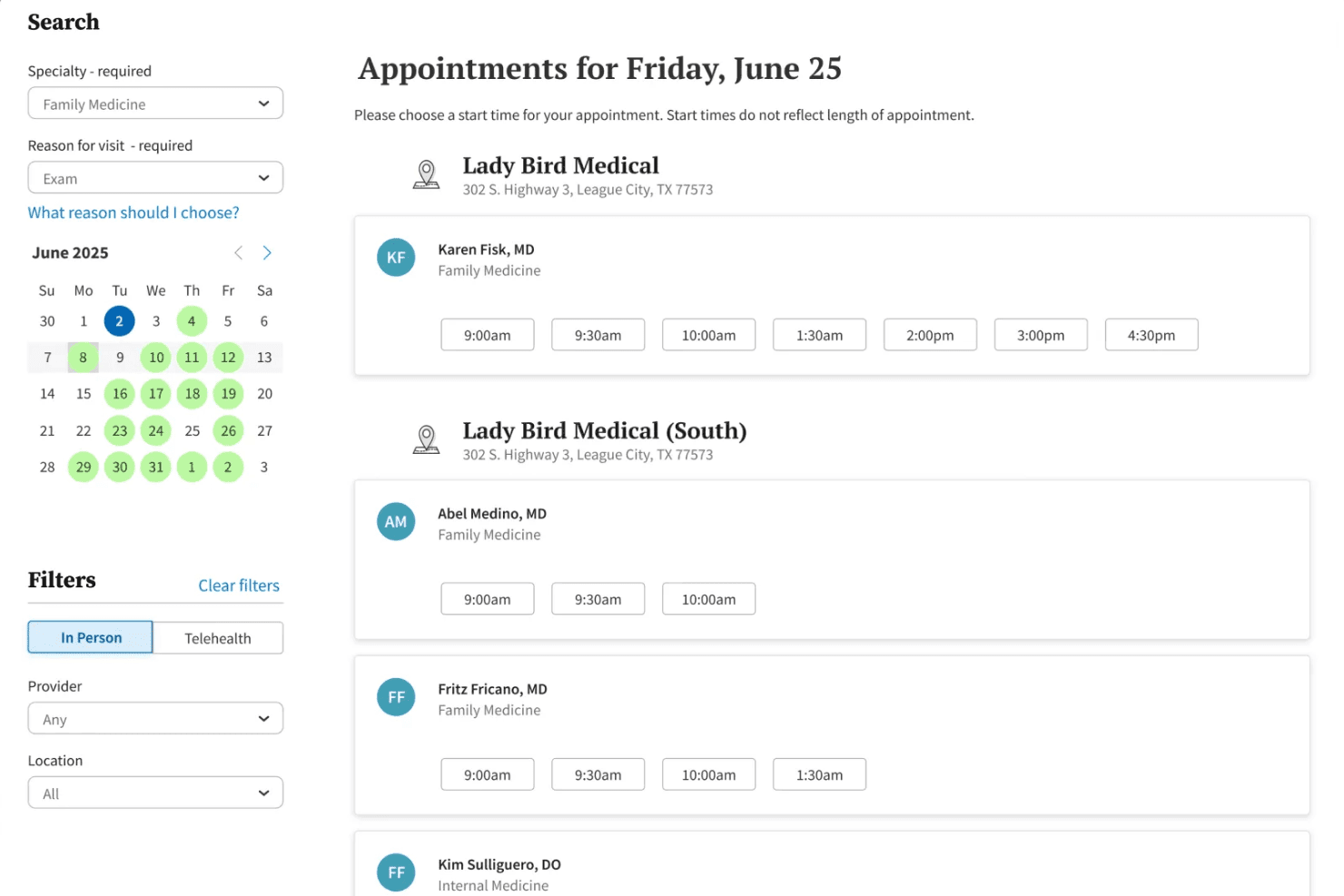
AthenaOne offers appointment scheduling with specialty filters, calendar navigation, provider selection, and available time slots across multiple clinic locations. athenaOne is an AI-native revenue cycle management platform that handles claims scrubbing, denial prediction, prior authorization, coding assistance, and patient payment collection across the full billing lifecycle.
Who Is athenaOne Best For?
athenaOne is a strong fit for independent and ambulatory medical practices that need end-to-end AI-driven revenue cycle management, from claims scrubbing and coding assistance to denial prevention and prior authorization.
Why I Picked athenaOne
I picked athenaOne as one of the best because its denial prevention goes beyond a single practice's claims history, drawing on live payer behavior data from 160,000+ providers across the athenaNet network. That scale means the AI flags denial-prone patterns before submission, not after. I also love the Automated Denial Advice feature, which generates specific, natural-language resolution steps for coding-related denials, cutting the research time billing staff would otherwise spend digging through payer remittance notes.
athenaOne Key Features
- Express Coding: Reviews clinical documentation and generates one-click E&M and CPT code suggestions directly within the billing tab.
- AI Voice Agents: Autonomously conduct prior authorization calls with payers, completing submissions in under an hour without staff involvement.
- Ambient Notes: Records patient visits using generative AI and auto-generates structured SOAP note summaries integrated into patient records.
- Network Insights benchmarking: Compares your practice's RCM performance against similar practices across the 160,000+ provider athenaNet network.
athenaOne Integrations
athenaOne supports RESTful FHIR R4, HL7 v2, and X12 EDI connectivity, plus 380+ APIs for custom integrations. Its Marketplace offers 500+ partner integrations across 50+ categories, including SOAP Health, DeepCura AI Agent, Assort Health, HealthTalk A.I., and Weave.
Pros and Cons
Pros:
- Clean claim rate exceeds most ambulatory platforms
- Automated prior authorization calls reduce staff burden
- AI denial prevention uses payer network insights
Cons:
- Pricing tied to collections increases with revenue
- Partial outsourcing still requires billing staff
Learn more about athenaOne: Best for AI-driven mid-cycle coding and denial cuts
- Free demo available
- Pricing upon request
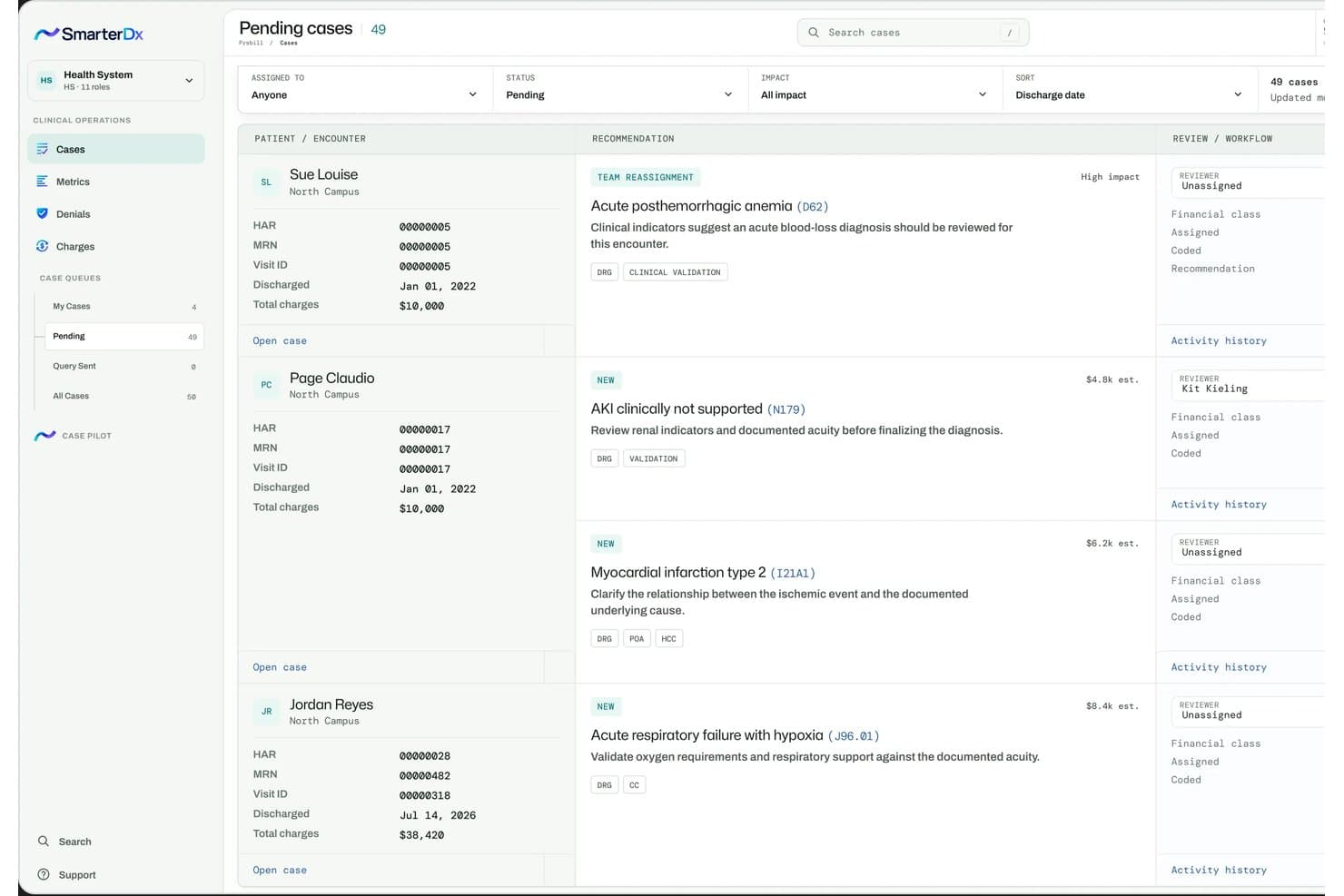
SmarterDx surfaces AI-driven coding recommendations across pending cases. SmarterDx is an AI revenue cycle management platform built around mid-cycle workflows, combining clinical AI-driven coding assistance, autonomous charge capture, documentation integrity, and denial prevention tools into a single system.
Who Is SmarterDx Best For?
SmarterDx is a strong fit for mid-to-large health systems and hospital groups that need AI-driven coding support and denial reduction across mid-cycle revenue operations.
Why I Picked SmarterDx
SmarterDx earns its spot on my shortlist because of how precisely it targets mid-cycle revenue operations, where coding gaps and denials tend to do the most damage. I'm particularly drawn to its Autonomous Coding model, which pairs AI with a human-in-the-loop feedback system to hit 95% coding accuracy across high chart volumes. Its denial prevention analytics go beyond flagging issues, drilling into root causes by payer, coder, and facility so your team can fix the actual problem.
SmarterDx Key Features
- Intelligent Authorization®: A single-source prior authorization tool that automates eligibility verification, ePA submission via EDI 278, and authorization outcome documentation directly back to your EMR.
- Computer-Assisted CDI: Automates concurrent, retrospective, and prospective clinical documentation integrity reviews, replacing manual spreadsheet-based physician query workflows.
- Agentic AI digital workforce: AI agents that apply human-like reasoning to handle complex denial routing, remediation workflows, and multi-step claims tasks across payers.
- Four-tier analytics suite: Layered reporting across descriptive, diagnostic, predictive, and prescriptive analytics, with Power BI and Tableau dashboards for real-time coder productivity and payer performance tracking.
SmarterDx Integrations
SmarterDx has documented integrations with Epic, Cerner, athenahealth, MEDITECH, eClinicalWorks, Allscripts, HARRIS HEALTHCARE, Evident, and 3M APR Grouper. It also supports HL7, EDI 278, ERA/EFT, SFTP, payer APIs, Power BI, and Tableau.
Pros and Cons
Pros:
- Agentic digital workforce handles complex denials
- Four-tier analytics reveal denial root causes
- AI-driven autonomous coding hits 95% accuracy
Cons:
- Platform complexity may challenge smaller practices
- AI patient payment features not fully documented
Learn more about SmarterDx: Best for denial prevention across U.S. hospitals
- Free demo available
- Pricing upon request
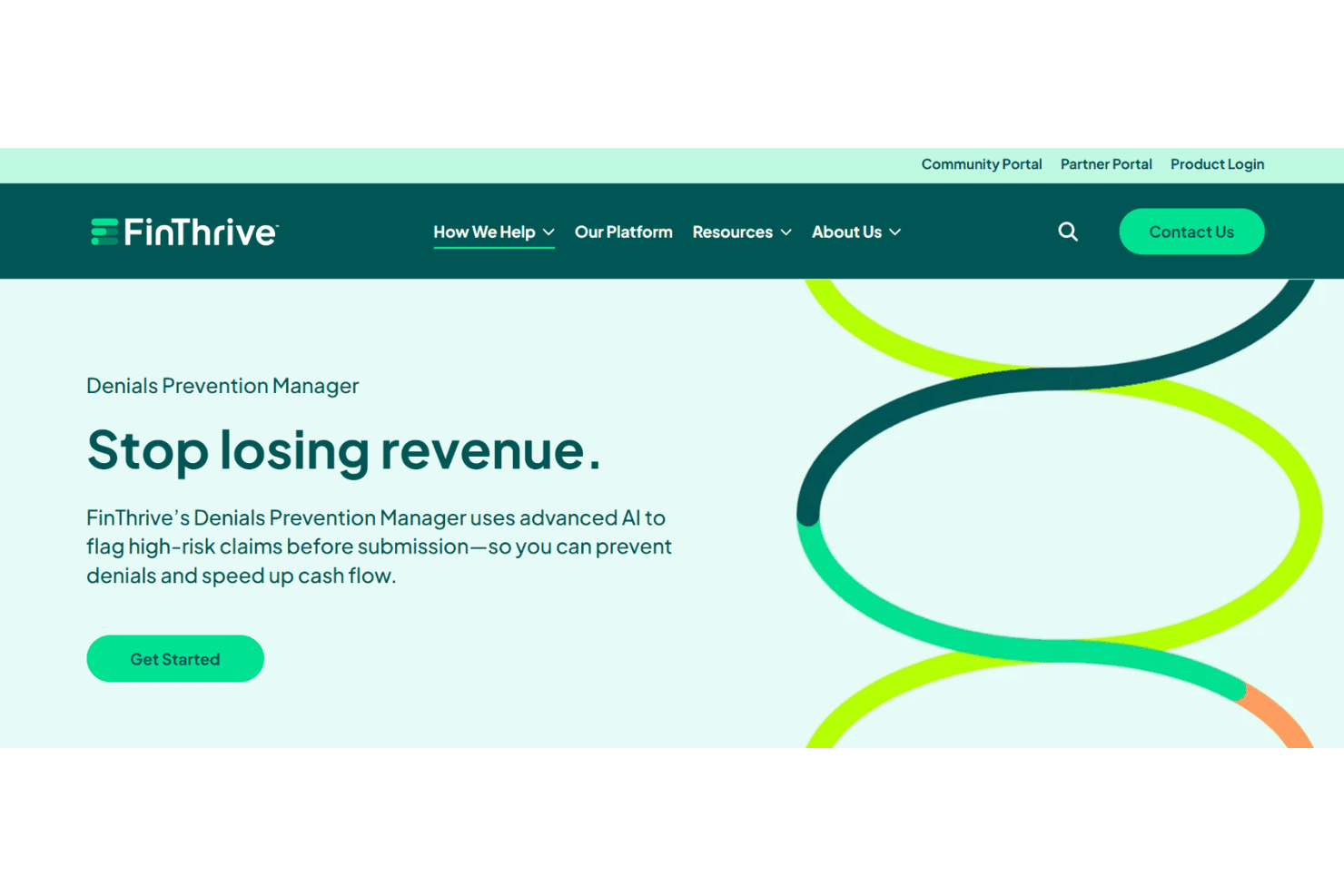
FinThrive predicts denials, tracks outcomes, finds causes, and manages appeals. FinThrive is an AI-driven revenue cycle management platform that covers patient access, claims management, denial prevention, charge integrity, contract management, and RCM analytics under a unified data intelligence architecture called FinThrive Fusion®.
Who Is FinThrive Best For?
FinThrive is built for mid-to-large U.S. hospitals and health systems whose revenue cycle teams need AI-driven denial prevention across the full claims lifecycle.
Why I Picked FinThrive
FinThrive earns its spot on my shortlist because its Denials Prevention Manager applies ML at the claim-line level before submission, trained on billions of real-world adjudication outcomes to flag high-risk claims and recommend corrective actions before they ever reach a payer. I'm particularly impressed by the Intelligent Appeals Agent, which uses generative AI and RPA to auto-draft payer-specific appeal letters and learns continuously from payer outcomes, saving teams an average of 250 staff hours monthly. That kind of pre- and post-submission denial coverage, built on the unified Fusion data architecture, is what makes FinThrive the go-to for U.S. hospital RCM teams laser-focused on denial prevention.
FinThrive Key Features
- Insurance Discover™: Continuously searches for hidden patient insurance coverage across the full patient journey using patented data matching connected to 98% of U.S. covered lives.
- FinThrive Analyze: Surfaces real-time KPI trends, payer performance data, and predictive 30/60/90-day cash forecasting in a single-view dashboard built on the Fusion data lake.
- Authorization Manager: Uses LLMs to interpret payer policy changes in real time and automate prior authorization requests, achieving 99.5% accuracy across 940+ payers.
- RCMTAM benchmarking: A vendor-agnostic benchmarking model developed with HFMA that lets your team assess and prioritize RCM technology investments against 150+ peer organizations.
FinThrive Integrations
FinThrive integrates with MEDITECH Expanse, Epic, Oracle Health (Cerner), and Altera. It also supports HL7, FHIR, and X12 EDI standards, with clearinghouse connectivity to 940+ payers.
Pros and Cons
Pros:
- Agentic AI automates appeals and workflows
- Denials Prevention Manager reduces denials pre-submission
- Industry-leading insurance discovery performance
Cons:
- Vendor financial stability concerns remain high
- No standalone NLP-based coding module
Learn more about FinThrive:

R1 RCM offers a Healthcare Revenue OS platform focused on real-time adjudication, as shown on their homepage hero section. R1 RCM is an AI-powered revenue cycle management platform built around its Phare OS system, which unifies claims management, autonomous coding, prior authorization, denial prevention, and real-time analytics across the full revenue cycle.
Who Is R1 RCM Best For?
R1 RCM is built for large health systems and enterprise-level organizations that need AI-driven revenue cycle management across complex, high-volume payer environments.
Why I Picked R1 RCM
R1 RCM earns its spot on my shortlist because of how seriously it approaches payer denial prevention at the enterprise scale. I'm particularly impressed by Payer Atlas, which monitors 30,000+ payer policy changes and 20,000+ proprietary billing rules in real time to stop denials before a claim ever reaches submission. Phare Flow then handles the back end, autonomously resolving more than 40% of denials and using generative AI to draft appeal letters directly from medical records.
R1 RCM Key Features
- Phare Audit pre-bill scanning: Reviews full EHR records before billing to surface coding and clinical documentation gaps, identifying over $222 in incremental revenue per discharge.
- Phare OS Command Center: A unified real-time dashboard that monitors performance across all revenue cycle workflows, with configurable KPI views for operations leaders.
- DRG validation safety net: Cross-checks inpatient DRG assignments against clinical documentation with 95% coder agreement, flagging underpayments before they're finalized.
- Autonomous prior authorization processing: Manages end-to-end prior auth determination and submission across 1,500+ payer connections, clearing 96% of orders within one day.
R1 RCM Integrations
R1 RCM integrates with Epic, Cerner, major clearinghouses, banks, and 1,500+ payer connections through Payer Atlas. Its Unified Data Exchange supports bidirectional data exchange with major EHR systems.
Pros and Cons
Pros:
- Recognized for underpayment detection and appeals
- Industry-leading AI-powered claims and coding automation
- Excels at payer denial prediction and prevention
Cons:
- No public peer reviews for Phare OS
- Mainly suitable for large enterprise health systems
Learn more about R1 RCM:
Other AI Revenue Cycle Management Software
Here are some additional AI revenue cycle management software options that didn’t make it onto my shortlist, but are still worth checking out:
- 11Honey HealthBest for specialty-specific AI coding and prior auth
- 12Jorie AIBest for denial prevention across 3,500+ payers
- 13DrChronoBest for EHR-embedded coding and claims billing
- 14CareCloudBest for AI-generated appeals in an integrated suite
- 15NextGen HealthcareBest for ambient AI charge capture across specialties
- 16AvailityBest for clearinghouse-scale AI denial prevention
- 17Thoughtful AIBest for agentic back-office RCM automation
- 18RapidClaimsBest for closed-loop denial prevention at scale
How I Evaluate AI Revenue Cycle Management Software
To earn a spot on my list, a tool needs to deliver genuine AI value—think catching a denial before it's submitted, not just flagging it afterward. I split my evaluation into core functionality every tool must cover and the differentiating factors that separate the best from the rest.
Core Functionality (Table Stakes For This List)
When I'm selecting tools for my list, I rank each one on a scale from 0 (does not offer the functionality) to 5 (excels in this area) for each core functionality listed below. I then calculate the tool's total score into a percentage, using 65% as a benchmark to help assess its overall fit for the list.
- AI claims management: I look for AI-driven scrubbing, submission, and status tracking that learns from payer-specific rejection patterns rather than relying on static rule sets.
- Intelligent coding assistance: Each tool's ability to suggest CPT and ICD-10 codes directly from clinical documentation matters here, especially NLP-driven charge capture that adapts to specialty workflows.
- Automated eligibility and prior auth: I evaluate whether the platform can verify coverage and submit prior authorizations across multiple payers without manual follow-up, including automated status checks.
- Denial prediction and prevention: ML models that flag high-risk claims before submission are what I check for, along with root-cause analytics that pinpoint why specific payers reject certain claim types.
- Patient payment and estimation: I consider how accurately the tool generates out-of-pocket estimates and whether it offers digital payment options like payment plans and propensity-to-pay scoring.
- RCM analytics and reporting: Dashboards tracking KPIs like days in A/R, clean claim rate, and net collections need to surface AI-generated insights, not just static charts you have to interpret yourself.
Once I have a list of tools that meet the criteria, I consider what sets each platform apart.
Differentiating Factors (What Sets Vendors Apart)
Here's how I compare and contrast different vendors:
Standout Features
I look for generative AI appeals drafting that auto-generates payer-specific appeal letters and pulls supporting documentation from the EHR—this cuts days off denial turnaround compared to manual letter writing. Underpayment detection matters just as much, since automated contract variance analysis catches shortfalls your team would otherwise miss. I also evaluate specialty-specific coding models, especially for high-complexity areas like cardiology or anesthesia where modifier logic and E/M leveling need to reflect current guidelines.
Beyond Features
I check whether a platform supports HL7, FHIR R4, and X12 EDI transactions with bi-directional EHR connectors—without that, charges and remits end up requiring duplicate entry. Compliance matters just as much: I look for HITRUST CSF certification and No Surprises Act logic built into estimation workflows, not bolted on as an afterthought. I also evaluate how well a tool scales across multi-TIN, multi-location setups so a growing practice can roll up reporting without hitting punitive pricing tiers.
How to Choose AI Revenue Cycle Management Software
Which criteria actually help you navigate the crowded market for AI revenue cycle management tools and pick one that works for your team’s operational realities?
| If your priority is… | Look for… |
| Minimizing denied claims and appeals | Predictive denial analytics with payer-level reporting |
| Reducing staff workload and manual entry | Automated coding, prior auth, and claims submission features |
| Fast payment and reliable reimbursement | Real-time eligibility checks and payment estimation tools |
| Compliance and audit readiness | Integrated compliance workflows and up-to-date certification |
| Scaling as you add new locations or specialties | Multi-location support and specialty-specific coding modules |
How to Vet Your Shortlist
- Run a 5-claim test: Request a sandbox or live demo where you submit five recent denied claims and measure the tool’s denial prediction accuracy.
- Request integration artifacts: Ask for API documentation confirming compatibility with your specific EMR or practice management system.
- Get audit workflow samples: Have the vendor show sample compliance/audit logs and proof of real-time policy updates from the past 12 months.
- Test specialty support: Assign a provider or coder to trial the system with real, specialty-specific codes to verify context-sensitive suggestions.
- Tradeoff: Enterprise-level customization versus prebuilt workflows: Decide if you want deep configuration for large-scale operations or faster deployment with preconfigured templates for small and midsize practices.
What Is AI Revenue Cycle Management Software?
AI revenue cycle management software is a type of healthcare technology that uses artificial intelligence to automate and optimize billing, claims, and payment processes within medical organizations. These tools analyze clinical and financial data, flag coding errors, and predict claim denials before submission. By handling repetitive tasks and surfacing insights, AI revenue cycle management software helps healthcare teams reduce administrative workload and keep payments moving efficiently while supporting compliance and reporting needs.
Features of AI Revenue Cycle Management Software
When selecting AI revenue cycle management software, keep an eye out for the following key features:
- AI claims management: Uses machine learning to scrub, submit, and track claims. Learns from payer-specific rejection patterns rather than just following static rules, helping your team avoid repeat errors and reduce manual intervention.
- Intelligent coding assistance: Applies natural language processing to clinical documentation and suggests CPT and ICD-10 codes. Adapts to your specialty’s workflows and flags missing or mismatched codes to minimize revenue loss.
- Automated eligibility and prior authorization: Verifies patient coverage and initiates prior authorizations across multiple payers without manual follow-up. Monitors authorization status and prompts action only when needed.
- Denial prediction and prevention: Flags high-risk claims before submission using machine learning models trained on payer trends. Surfaces root-cause analytics, so you understand why claims are likely to be denied and can fix issues before they happen.
- Patient payment and estimation: Calculates real-time out-of-pocket estimates based on payer contracts and patient coverage. Offers digital payment options, including online statements, payment plans, and propensity-to-pay scoring to make collections easier.
- RCM analytics and reporting: Provides dashboards that track key performance indicators such as days in accounts receivable and clean claim rate. Includes AI-generated insights that help you spot trends and take actionable steps without spending hours analyzing data.
- Automated appeals generation: Creates draft appeal letters personalized to individual payers and pulls relevant documentation from your EHR. Helps resolve denials faster by reducing the manual workload for appeals.
- Specialty-specific coding models: Supports high-complexity areas by applying AI models tailored to the unique coding rules of specialties like cardiology, anesthesiology, or orthopedics. Ensures modifier logic, E/M leveling, and other specialty codes reflect current guidelines.
- Compliance and audit support: Maintains up-to-date regulatory compliance, including integration of standards like HL7, FHIR, and X12. Logs audit trails and supports requirements for regulations like the No Surprises Act. Makes it easier to demonstrate adherence during external audits.
- Integration with EHR and practice management systems: Uses secure, bi-directional connectors to synchronize data between your revenue cycle tool and your clinical systems, eliminating duplicate entry and keeping records consistent across platforms.
Benefits of AI Revenue Cycle Management Software
Implementing AI revenue cycle management software provides several benefits for your team and your business. Here are a few you can look forward to:
- Lower denial rates: Proactive denial prediction and payer-specific analytics help you address issues before claims are submitted.
- Faster claim and payment cycles: Automated eligibility checks, prior authorization, and digital payment tools move every stage of your revenue cycle along quicker than manual processes.
- Accurate coding and charge capture: AI-driven coding suggestions and specialty-specific models limit errors and adapt to complex workflows across different medical disciplines.
- Reduced manual workload: Automated claims scrubbing, status tracking, and appeals drafting free up staff from repetitive administrative tasks.
- Better compliance and audit readiness: Integrated compliance checks, audit trails, and regulatory updates ensure you meet requirements like the No Surprises Act without extra effort.
- Improved financial visibility: Real-time RCM analytics dashboards surface trends and actionable insights so you can respond quickly to revenue risks.
- Stronger EHR integration: Bi-directional data connections minimize duplicate entry and keep clinical and billing information in sync across your systems.
Costs and Pricing of AI Revenue Cycle Management Software
Selecting AI revenue cycle management software requires an understanding of the various pricing models and plans available. Costs vary based on features, team size, add-ons, and more. The table below summarizes common plans, their average prices, and typical features included in AI revenue cycle management software solutions:
Plan Comparison Table for AI Revenue Cycle Management Software
| Plan Type | Average Price | Common Features |
| Free Plan | $0 | Basic AI claims management, limited reporting tools, and support for a single user. |
| Personal Plan | $50–$150/user/month | AI claims management, intelligent coding assistance, standard analytics, and basic eligibility verification. |
| Business Plan | $200–$600/user/month | Advanced denial prediction, automated appeals generation, patient payment estimation, and multi-user support. |
| Enterprise Plan | $2,000–$10,000+/month | Custom integrations, bi-directional EHR connectivity, specialty-specific coding models, advanced compliance tools, and scalable multi-location support. |
AI Revenue Cycle Management Software FAQs
Here are some answers to common questions about AI revenue cycle management software:
How do I know if AI revenue cycle management software will integrate with my EHR?
You should verify the vendor has bi-directional connectors for your specific EHR or practice management system. Ask for documentation or a demo of the integration process. Most established tools support HL7, FHIR, or X12 standards, but direct testing with your patient and claims data will show whether real-time syncing actually works.
Can AI revenue cycle management software automate prior authorizations?
Yes, many AI revenue cycle management software platforms offer automated prior authorization. They verify eligibility, initiate authorization requests, and track status across major payers. This can save your team from manual follow-up, but actual automation levels vary, so check if the system covers your key payers and workflows.
What steps should I take to evaluate AI denial prediction in these tools?
Start by running a small batch of real, previously denied claims through the software—five is a good baseline. Review which claims the system flags as high-risk and why. Look for payer-specific analytics and root-cause explanations. This shows whether the tool’s machine learning is tuned to your actual claim patterns.
Are small or midsize practices able to afford AI revenue cycle management software?
Yes, most vendors offer plans and pricing that fit smaller teams. Many provide free or low-cost entry plans with the essentials. You can usually scale up to add advanced features, users, or integration support as your practice grows, so you’re not locked into enterprise pricing from day one.
What compliance features should I look for in AI revenue cycle management software?
Look for tools with built-in audit trails, support for standards like HL7 and FHIR, and up-to-date regulatory logic (such as No Surprises Act requirements). Ask about HIPAA, HITRUST CSF, and SOC 2 certifications. You’ll want compliance features that stay current without requiring manual updates or burdensome workarounds.
How can AI revenue cycle management software support specialty practices?
Some platforms have specialty-specific coding models and charge capture, especially for complex fields like cardiology or anesthesia. These help your coding team meet specialty guidelines for things like modifier logic and E/M leveling. Always confirm the tool actually supports your specialty’s unique workflows before committing.
How can AI improve revenue cycle operations for healthcare providers?
AI RCM solutions can help healthcare providers streamline revenue cycle operations by automating repetitive tasks across patient registration, claims processing, and payment follow-up. Robotic process automation can handle routine data entry and status checks, while predictive analytics can identify claims at risk of denial or delayed payment. An AI-driven RCM platform can also help teams monitor revenue capture, revenue integrity, and A/R days, giving staff better visibility into where revenue is being lost and where workflows need attention.