

Et EHR-system for psykiatri er en elektronisk pasientjournalplattform som er utviklet for de unike behovene innen psykiatrisk behandling – og hjelper deg med å dokumentere, administrere og fakturere psykiske helsetjenester på en nøyaktig måte. Hvis du leter etter det beste EHR-systemet for psykiatri, navigerer du sannsynligvis i dokumentasjonskrav, personverntiltak og behovet for fleksibel journalføring og forskrivning.
Denne veiledningen viser hvilke områder dagens beste EHR-systemer for psykiatri dekker, hvilke funksjoner du bør se etter, og de unike styrkene ved hvert alternativ, slik at du kan investere med trygghet og sørge for at både praksisen din og pasientene dine får god støtte.
Why Trust Our Software Recommendations
6,700+
Reviews
20
Industry experts
16+
Evaluation factors
14
Years
Our team has been testing and reviewing software since 2012. As medical practice leaders ourselves, we know how difficult—and important—it is to choose the right software.
For this guide, we evaluated tools using hands-on testing and independent research, scoring tools using our selection criteria.
Our reviews reflect our human editorial judgment, not a sales pitch.
Sammenligningstabell for EHR-systemer for psykiatri
Tabellen nedenfor sammenligner prisdetaljer for mine beste utvalgte EHR-systemer for psykiatri.
| Tool | Best For | Trial Info | Price | ||
|---|---|---|---|---|---|
| 1 | Best for addiction treatment workflows | Free demo available | Pricing upon request | Website | |
| 2 | Best for enterprise behavioral health | Free demo available | Pricing upon request | Website | |
| 3 | Best for addiction treatment programs | Free plan available | Pricing upon request | Website | |
| 4 | Best for independent psychiatry practices | Free demo available | Pricing upon request | Website | |
| 5 | Best for mobile psychiatry charting | Free demo available | Pricing upon request | Website | |
| 6 | Best for solo psychiatry practices | 30-day free trial | From $49/month | Website | |
| 7 | Best for therapy notes and billing | 30-day free trial | From $69/month | Website | |
| 8 | Best for interventional psychiatry | Free demo available | From $249/month | Website | |
| 9 | Best for behavioral health workflows | Free demo available | Pricing upon request | Website | |
| 10 | Best for psychiatry-specific charting | 30-day free trial | From $55/month | Website |


Anmeldelser av de beste EHR-systemene for psykiatri
Nedenfor finner du mine detaljerte sammendrag av de beste EHR-systemene for psykiatri som kom med på kortlisten. Anmeldelsene mine gir en grundig gjennomgang av funksjonene, de beste bruksområdene og prisene for hver plattform, slik at du kan finne det beste alternativet for deg.
 1Best for addiction treatment workflows
Kipu
- Free demo available
- Pricing upon request
Visit WebsiteCustomer Rating:4.7/5
Kipu offers an Executive Dashboard with real-time census, occupancy, admissions, and clinical metrics for psychiatric facility management. Kipu is a behavioral health EHR built for addiction treatment and dual-diagnosis programs, combining clinical documentation, medication management, integrated billing, telehealth, and outcomes tracking in a single platform.
Who Is Kipu Best For?
Kipu is a strong fit for group behavioral health clinics, residential treatment centers, and dual-diagnosis programs that need a facility-scale EHR.
Why I Picked Kipu
I picked Kipu as one of the best because its MAT workflow tools are genuinely built for addiction psychiatry. The medication management module covers Suboxone, Methadone, and Sublocade prescribing with built-in diversion control and patient call-back tracking, which I haven't seen handled this specifically in other EHRs. KIP AI also automatically generates progress notes from session transcriptions, cutting the documentation burden on clinicians running high-volume SUD programs.
Kipu Key Features
- Outcomes library: Includes PHQ-9, GAD-7, BAM, DASS-21, and other standardized screening tools for tracking symptom trends.
- Integrated telehealth: HIPAA-compliant video visits are accessible directly from the patient portal for seamless remote care.
- Automated benefits verification: Instant insurance eligibility checks are built into the admissions and intake workflow.
- Scheduler with waitlist management: Supports staff scheduling, automated reminders, waitlists, and configurable appointment types.
Kipu Integrations
Kipu offers marketplace integrations through the Kipu Consolidated Integrations platform, connecting with tools like Recovery.com, R1 Learning, Huml Health, Further, Braided, and AveaOffice. An API is available for custom integrations.
Pros and Cons
Pros:
- HiTRUST-certified with 42 CFR Part 2 compliance
- KIP AI auto-generates progress notes from sessions
- Built-in MAT workflows for SUD prescribing
Cons:
- Not suited for solo psychiatry practices
- Complex treatment plan tool frustrates clinical users
Learn more about Kipu: Best for enterprise behavioral health
- Free demo available
- Pricing upon request
Visit WebsiteCustomer Rating:4.4/5
Qualifacts CareLogic offers a comprehensive client dashboard displaying patient demographics, diagnosis, treatment plans, payer information, and scheduled appointments for psychiatric care management. Qualifacts CareLogic is an enterprise behavioral health EHR that combines configurable clinical documentation, e-prescribing with EPCS, behavioral health billing, scheduling, telepsychiatry, and outcomes tracking in a single platform.
Who Is Qualifacts CareLogic Best For?
It's a strong fit for multi-location behavioral health agencies and large group psychiatric practices that need configurable workflows and state reporting compliance.
Why I Picked Qualifacts CareLogic
CareLogic earns its spot on my shortlist because it's built for the compliance complexity that large behavioral health organizations face. I particularly like how it handles 42 CFR Part 2 alongside HIPAA, which matters for psychiatric practices treating patients with co-occurring substance use disorders. The configurable documentation system lets clinical teams build MSE templates, treatment plans, and outcome tracking using PHQ-9 and GAD-7 without relying on IT support.
Qualifacts CareLogic Key Features
- Customizable clinical forms: Teams can tailor psychiatric intake, progress, and discharge notes to specific workflows.
- Patient portal with screening tools: Clients complete PHQ-9, GAD-7, and C-SSRS scales before appointments for easy tracking.
- Multi-provider scheduling: Coordinate recurring psychiatric sessions and med-checks for large clinical teams.
- Secure messaging: Providers and clients exchange HIPAA-compliant messages through the online portal.
Qualifacts CareLogic Integrations
Qualifacts CareLogic offers native integrations with DrFirst Rcopia for e-prescribing, OnCall Health for telehealth, and connects to labs, HIEs, and third-party behavioral health solutions. An API is available for custom integrations.
Pros and Cons
Pros:
- Built-in PHQ-9, GAD-7, and C-SSRS tracking
- Configurable MSE and treatment plan templates
- Handles 42 CFR Part 2 SUD compliance
Cons:
- Interface feels dated compared to newer EHRs
- Implementation can take up to 18 months
Learn more about Qualifacts CareLogic: Best for addiction treatment programs
- Free plan available
- Pricing upon request
Visit WebsiteCustomer Rating:4.8/5
Opus EHR offers a home dashboard with patient counts, monthly admissions chart, and a recent documents table showing treatment plans and session notes. Opus EHR is a cloud-based EHR, CRM, and RCM platform built specifically for behavioral health and psychiatry group practices, combining clinical documentation, e-prescribing with EPCS, telehealth, and integrated billing in one system.
Who Is Opus EHR Best For?
Opus EHR is a strong fit for group behavioral health practices and multi-provider treatment facilities running teams of five or more clinicians.
Why I Picked Opus EHR
I picked Opus EHR as one of the best because it's purpose-built for behavioral health from the ground up, not adapted from a general medical EHR. I particularly like the Copilot AI Scribe, which auto-drafts progress notes from both telehealth and in-person sessions without leaving the platform. The built-in EPCS e-prescribing, with drug interaction checking and cross-team medication history, is genuinely useful for psychiatry teams prescribing controlled substances across multiple providers.
Opus EHR Key Features
- Customizable assessment library: Choose from over 100 psychiatric and behavioral health assessment templates to fit various clinical workflows.
- Integrated lab ordering: Order lab tests and receive results directly within patient charts, eliminating the need for separate systems.
- Patient outcomes measurement tool: Track treatment progress and outcomes with built-in standardized scales and analytics.
- Multi-provider scheduling: Manage appointments for large clinical teams, including recurring therapy and med-check visits.
Opus EHR Integrations
Opus EHR offers native integrations with PracticeSuite for billing, Collect Rx for revenue cycle management, and supports lab integration for electronic lab ordering and results. An API is available for custom integrations.
Pros and Cons
Pros:
- Structured 90-day onboarding with dedicated support team
- 100+ customizable clinical assessment templates
- Built specifically for behavioral health, not adapted
Cons:
- Some workflows require multiple steps across screens
- Mobile access is difficult and not fully functional
Learn more about Opus EHR: Best for independent psychiatry practices
- Free demo available
- Pricing upon request
Visit WebsiteCustomer Rating:3.9/5
Tebra offers an integrated e-prescribing workflow that allows providers to send and refill prescriptions with real-time formulary benefits directly from the dashboard. Tebra is an all-in-one EHR platform built exclusively for independent practices, combining psychiatric documentation, integrated EPCS and PDMP e-prescribing, behavioral health billing, telehealth, and patient scheduling in a single system.
Who Is Tebra Best For?
Tebra is a strong fit for solo and small-group psychiatrists or PMHNPs who handle their own billing and want one platform instead of separate EHR, billing, and scheduling tools.
Why I Picked Tebra
Tebra earns its spot on my shortlist because it's purpose-built for independent psychiatry practices, not retrofitted from a general EHR. I particularly like that EPCS and PDMP monitoring are bundled natively into the platform, so prescribing controlled substances doesn't require a separate vendor or a bolt-on workflow. The AI Note Assist also captures MSE and risk assessment details in real time during a session, cutting note-taking time by up to 50% for psychiatrists running back-to-back appointments.
Tebra Key Features
- Integrated telehealth: Built-in HIPAA-compliant video visits let you provide care without switching platforms.
- Customizable mental health templates: Use templates designed for psychiatric intakes, MSEs, and progress notes that fit your workflow.
- Automated patient appointment reminders: Reduce no-shows with text, email, and phone reminders sent directly from the scheduling system.
- Patient portal with digital intake: Patients can complete intake forms and screening tools online before their visit.
Tebra Integrations
Tebra offers native integrations with First Databank, Appriss Health for PDMP checks, and Google Business Profile. An API is available for custom integrations.
Pros and Cons
Pros:
- Telehealth syncs directly to encounter notes
- AI Note Assist reduces documentation time
- EPCS and PDMP bundled natively
Cons:
- ERA support frustrates behavioral health billers
- Note templates are rigid and limited
Learn more about Tebra: Best for mobile psychiatry charting
- Free demo available
- Pricing upon request
Visit WebsiteCustomer Rating:3.9/5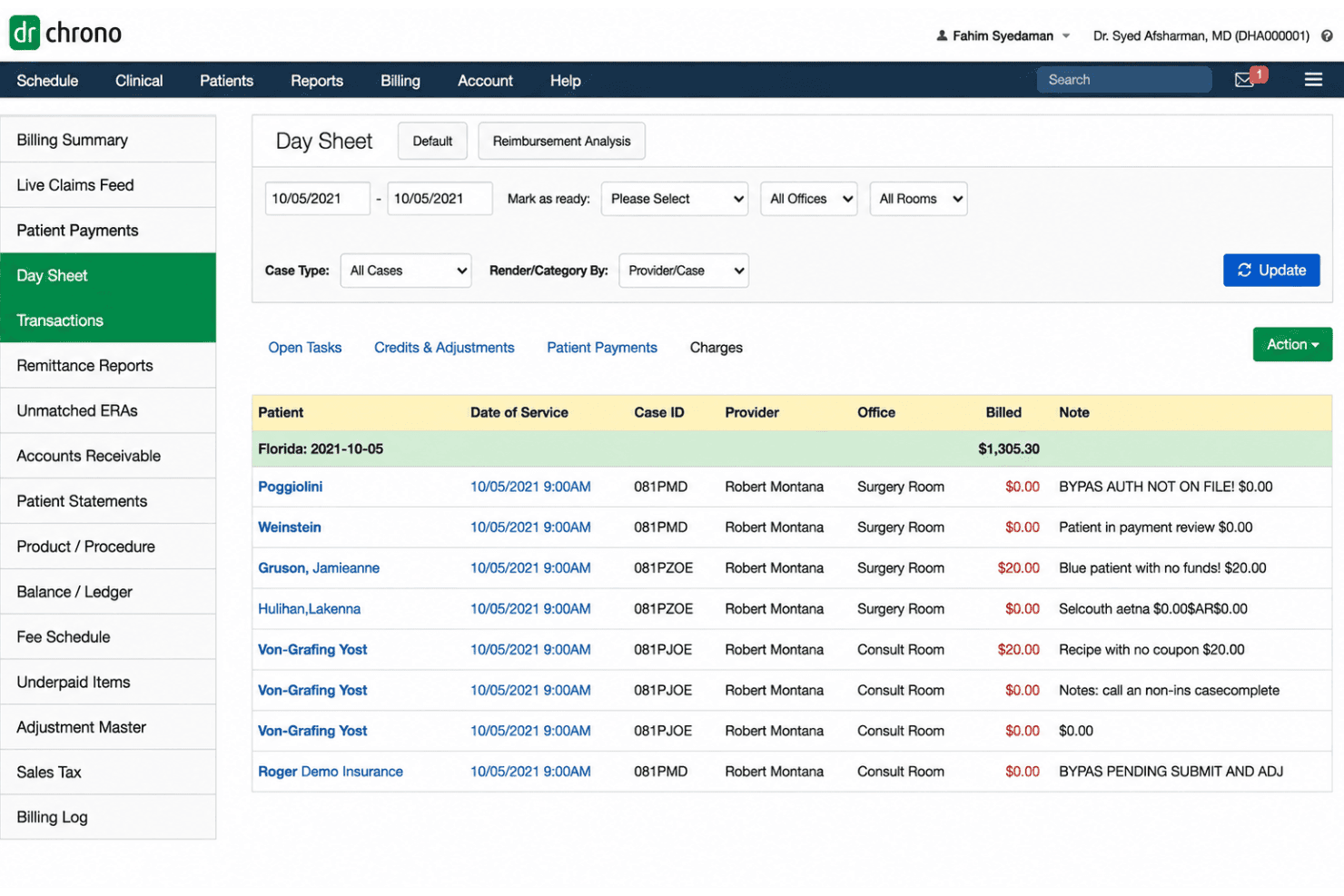
DrChrono processes claims, eligibility, ERA/EOB posting, denials, and billing. DrChrono is a cloud-based EHR built for independent and group practices, combining mobile-first psychiatric charting, EPCS e-prescribing, behavioral health billing, and integrated telepsychiatry in a single platform.
Who Is DrChrono Best For?
DrChrono is a strong fit for solo psychiatrists and small-to-mid-size behavioral health practices that rely heavily on iPad or iPhone-based workflows.
Why I Picked DrChrono
DrChrono earns its spot on my shortlist because no other psychiatry EHR matches its iOS-native charting experience. I can complete a full psychiatric note on an iPad using speech-to-text, pre-programmed macro buttons that drop in entire clinical phrases, and pre-built behavioral health forms including the PHQ-9. I've also found the EPCS functionality genuinely useful, letting me prescribe controlled substances directly from an iPhone without switching devices or systems.
DrChrono Key Features
- Real-time insurance eligibility checks: Instantly verify patient benefits and coverage status before every appointment.
- Integrated telehealth video visits: Schedule and launch secure, HIPAA-compliant video sessions from within the EHR platform.
- Configurable billing profiles: Set up behavioral health-specific billing codes and modifiers that auto-populate claim forms.
- Patient portal with intake forms: Patients can complete psychiatric screening tools, update information, and message securely through a digital portal.
DrChrono Integrations
DrChrono offers native integrations with Quest Diagnostics, LabCorp, and Surescripts, and provides a Healthcare App Directory for selecting additional apps. An API is available for custom integrations.
Pros and Cons
Pros:
- Pre-built behavioral health billing profiles
- Built-in EPCS for controlled substances
- Runs natively on iPhone and iPad
Cons:
- Long-term contracts with limited flexibility
- Slow customer support response times reported
Learn more about DrChrono:

SimplePractice offers an ePrescribe access management modal where admins can add or manage prescribing permissions for individual clinicians. SimplePractice is a cloud-based EHR and practice management platform for mental health and wellness providers that combines clinical documentation, ePrescribing with EPCS, behavioral health billing, integrated telehealth, and a client portal.
Who Is SimplePractice Best For?
Solo psychiatrists and PMHNPs running independent practices who need an all-in-one system with ePrescribing, documentation, and billing in a single platform.
Why I Picked SimplePractice
I picked SimplePractice as one of the best because its ePrescribe add-on handles controlled substance prescriptions natively, including EPCS registration and PDMP integration for tracking high-risk prescribing patterns. I also like the AI Care Aide suite, which puts an AI Note Taker and Session Sidekick directly in the chart for in-session psychiatric notes. Customizable treatment plans and psychiatric intake templates mean I'm not building documentation from scratch for every new patient.
SimplePractice Key Features
- Customizable intake forms: Collect psychiatric intake and demographic information using templates tailored to practice needs.
- Integrated client portal: Clients can access intake forms, appointment details, and secure messages from a central HIPAA-compliant portal.
- Recurring appointment scheduling: Set up and manage ongoing psychiatric or therapy appointments directly within the platform.
- Screening tool library: Access and administer standardized assessments like PHQ-9 and GAD-7 from within client records.
SimplePractice Integrations
SimplePractice offers native integrations with Stripe for payment processing, Wiley Treatment Planners, Experian for identity proofing, and state PDMP systems for controlled substance monitoring. Native integration with personal calendar apps is also supported.
Pros and Cons
Pros:
- PHQ-9 and GAD-7 available within charts
- AI Note Taker assists in-session documentation
- EPCS and PDMP support built in
Cons:
- Less depth than dedicated psychiatry platforms
- Telehealth reliability issues reported by users
Learn more about SimplePractice:

TherapyNotes offers a comprehensive Documents tab displaying organized clinical notes, evaluations, and treatment plans with status tracking for psychiatry patients. TherapyNotes is a behavioral health EHR with psychiatry-specific documentation templates, integrated ePrescribing, behavioral health billing, telehealth, outcome measures, and a patient portal built for mental health practices.
Who Is TherapyNotes Best For?
TherapyNotes is a strong fit for solo psychiatrists and small behavioral health group practices that want a structured, all-in-one system without heavy configuration overhead.
Why I Picked TherapyNotes
I picked TherapyNotes as one of the best because its psychiatry progress notes automatically carry forward medications and pull diagnoses from the most recent note. On the billing side, it handles BH CPT codes, real-time eligibility verification, ERA, and secondary claim submission natively. The TherapyFuel AI suite also generates progress notes directly from session transcripts, with options to customize clinical voice and writing tone within the same interface.
TherapyNotes Key Features
- Outcome measures library: Track symptom changes over time with automated scoring for PHQ-9, GAD-7, and other psychiatric screening tools.
- Patient portal: Give patients secure access to intake forms and allow secure messaging between client and practice.
- Role-based permissions: Configure granular access controls for clinical and non-clinical team members.
- Supervisor co-sign workflow: Allow clinical supervisors to review and sign off on trainee or intern documentation within the platform.
TherapyNotes Integrations
TherapyNotes offers native integrations with Google Calendar and Outlook Calendar, and supports ePrescribing via DrFirst. An API is available for custom integrations.
Pros and Cons
Pros:
- Built-in PHQ-9 and GAD-7 with auto-scoring
- Psychiatry progress notes carry forward medications automatically
- Automated BH billing with ERA and eligibility
Cons:
- Telehealth module lacks group session depth
- Psychiatric note templates aren't user-customizable
Learn more about TherapyNotes: Best for interventional psychiatry
- Free demo available
- From $249/month
Visit WebsiteCustomer Rating:4.6/5
Osmind offers a day-view scheduling interface that displays multiple providers, exam rooms, and color-coded appointment types like Ketamine infusion and Spravato. Osmind is a psychiatry-specific EHR built around interventional treatment workflows, combining psychiatric charting, e-prescribing with EPCS, integrated billing, patient engagement, and measurement-based care tools in one platform.
Who Is Osmind Best For?
Osmind is a strong fit for psychiatry practices offering interventional treatments like TMS, ketamine, or SPRAVATO alongside traditional medication management.
Why I Picked Osmind
I picked Osmind as one of the best because no other psychiatry EHR handles interventional treatment workflows as natively. I use it to manage automated SPRAVATO REMS submissions and pull from ketamine and TMS-specific charting templates built directly into the EHR. On top of that, I like that 30+ validated rating scales can be scheduled automatically to patients, giving me longitudinal outcome data tied directly to the treatment record.
Osmind Key Features
- Customizable psychiatry templates: Create intake, progress, and treatment notes tailored to specific mental health workflows.
- Patient engagement app: Patients can complete intake forms, rating scales, journaling, and secure messaging through a connected mobile app.
- Integrated lab ordering: Order and receive lab results electronically from LabCorp and Quest within the EHR.
- Recurring appointment scheduling: Manage multi-location calendars, enable self-scheduling, and send automated reminders for psychiatric visits.
Osmind Integrations
Osmind offers native integrations with DrFirst/iPrescribe for e-prescribing, LabCorp and Quest for labs, ClaimMD and OfficeAlly for insurance claims, Stripe for payments, Google Calendar, and state PDMPs. An API is available for custom integrations.
Pros and Cons
Pros:
- Integrated telehealth with automatic patient-facing session access
- Native interventional workflows for TMS, ketamine, and SPRAVATO
- Built-in outcome tracking across 30+ validated rating scales
Cons:
- Higher price point makes it less suitable for solo cash-pay practices
- Billing tools feel clunky compared to dedicated RCM platforms
Learn more about Osmind: Best for behavioral health workflows
- Free demo available
- Pricing upon request
Visit WebsiteCustomer Rating:4.1/5
Valant offers structured treatment planning with problems, goals, objectives, and interventions organized in a clear, hierarchical layout within the EHR. Valant is a behavioral health EHR built exclusively for mental health practices, combining psychiatric documentation, ePrescribing with EPCS, measurement-based care, integrated telepsychiatry, and practice management in a single platform.
Who Is Valant Best For?
Valant fits psychiatrists, PMHNPs, and group behavioral health practices that need prescriber-focused workflows, including EPCS and TMS management, across multiple providers or locations.
Why I Picked Valant
Valant earns its spot on my shortlist because it's built from the ground up for behavioral health, not adapted from a primary-care platform. I particularly like the measurement-based care workflow: the PHQ-9 and GAD-7 automatically send to patients before appointments and feed directly into the clinical note. The DrFirst ePrescribing with PDMP lookup sits inside the same workflow, so prescribers aren't toggling between systems during a med-check.
Valant Key Features
- Outcome measures automation: Schedule and automatically deliver standardized rating scales like PHQ-9 and GAD-7 to patients through the portal.
- Group therapy support: Run group therapy sessions with up to 30 participants using integrated telehealth and documentation tools.
- Customizable note templates: Access over 100 configurable templates for psychiatric intakes, MSEs, and therapy progress notes.
- Integrated practice management: Manage scheduling, insurance eligibility, billing, and claims submission from within the same platform.
Valant Integrations
Valant offers native integrations with DrFirst for ePrescribing (including EPCS and PDMP), an integrated clearinghouse for claims submission, and provides an API for custom integrations.
Pros and Cons
Pros:
- Strong fit for multi-provider and TMS-focused practices
- Clinical, billing, and scheduling data unified in one system
- Pre-session outcome measures auto-sent through patient portal
Cons:
- Note templates require significant setup and feel click-heavy
- System outages reported during business hours
Learn more about Valant: 10Best for psychiatry-specific charting
ICANotes
- 30-day free trial
- From $55/month
Visit WebsiteCustomer Rating:4.1/5
ICANotes offers a detailed Review of Systems (ROS) interface that allows providers to document respiratory and other system findings directly within psychiatric progress notes. ICANotes is a cloud-based EHR built exclusively for behavioral health, offering psychiatry-specific documentation templates, EPCS e-prescribing, behavioral health billing, telehealth, and a patient portal.
Who Is ICANotes Best For?
ICANotes is a strong fit for psychiatrists, PMHNPs, and behavioral health practices that need a prescribing-capable EHR built around psychiatric workflows.
Why I Picked ICANotes
ICANotes earns its spot on my shortlist because of its proprietary clinical content engine, which covers over 90 psychiatric and psychosocial concerns using 75,000+ pre-built clinical phrases. I particularly like how it generates full narrative psychiatric evaluations, mental status exams, and progress notes through menu-driven templates. That means a prescriber can complete a detailed medication management note in minutes without free-typing every line.
ICANotes Key Features
- Integrated e-prescribing with EPCS: Enables DEA-certified electronic prescribing for controlled substances, including PDMP checks.
- Behavioral health billing tools: Supports CPT codes for psychiatric services with built-in claim submission and ERA posting.
- HIPAA-compliant patient portal: Lets patients access intake forms, upload documents, complete screening tools, and send secure messages.
- Recurring appointment scheduling: Makes it easy to book therapy and medication management visits on a repeating basis for each client.
ICANotes Integrations
ICANotes offers native integrations with Inovalon, electronic lab systems, e-prescribing networks, clearinghouses, and health information exchanges. An API is available for custom integrations.
Pros and Cons
Pros:
- Scorable psychiatric rating scales auto-populate notes
- Menu-driven charting reduces free-text documentation time
- Pre-built MSE and psychiatric evaluation templates
Cons:
- Limited mobile app functionality for clinicians
- Dated interface compared to newer EHR competitors
Learn more about ICANotes:
Andre EHR-systemer for psykiatri
Her er noen flere alternativer for EHR-systemer for psykiatri som ikke kom med på kortlisten min, men som likevel er verdt å undersøke:
- 11Practice FusionBest for affordable psychiatry EHR
- 12AdvancedMDBest for psychiatry billing automation
- 13CharmHealthBest for flexible psychiatry workflows
- 14BestNotesBest for psychiatry EHR and CRM
- 15NetsmartBest for large behavioral organizations
- 16SunwaveBest for behavioral health management
How I Evaluate Psychiatry EHR
I split my evaluation into baseline requirements—like EPCS support and psychotherapy note separation—and the differentiators that set one platform apart from another.
Core Functionality (Table Stakes For This List)
When I'm selecting tools for my list, I rank each one on a scale from 0 (does not offer the functionality) to 5 (excels in this area) for each core functionality listed below. Then, I calculate the tool's total score into a percentage. Each tool needs to achieve a minimum total score of 65% to be considered for inclusion.
- Psychiatry-Specific Documentation: I check whether each platform offers pre-built templates for psychiatric intakes, mental status exams, and treatment plans rather than generic SOAP notes repurposed for behavioral health.
- E-Prescribing With EPCS: DEA-certified EPCS matters here because psychiatrists prescribe controlled substances regularly. I look for drug interaction checks and PDMP connectivity baked into the prescribing workflow.
- Behavioral Health Billing: I evaluate how each EHR handles codes like 90837 or psychotherapy add-ons, including whether claims scrubbing and ERA posting are built in or require a separate billing tool.
- HIPAA-Compliant Records: Separating psychotherapy notes from the main chart is a key HIPAA requirement. I look for granular access controls and audit logging that make this separation easy to manage.
- Integrated Telepsychiatry: I consider whether video visits are native to the platform or require a third-party add-on, and whether session documentation syncs directly into the encounter note.
- Scheduling and Patient Portal: Recurring appointment support is essential for med-check cadences. I also evaluate whether the portal delivers screening tools like the PHQ-9 or GAD-7 before a visit.
Once I have a list of tools that meet the criteria, I consider what sets each platform apart.
Differentiating Factors (What Sets Vendors Apart)
Here's how I compare and contrast different vendors:
Standout Features
A built-in psychiatric assessment library with scorable scales like the PHQ-9, GAD-7, and C-SSRS saves real time when you need to track symptom trends across visits instead of scoring by hand. I also look at medication management tools—specifically whether a platform offers longitudinal medication history views and side-effect tracking tailored to psychopharmacology. Customizable note templates with smart phrases and macros make a big difference during back-to-back med checks.
Beyond Features
Practice size matters a lot here. A solo psychiatrist doesn't need the same role-based permissions and supervisory workflows that a group practice with residents or LCSWs requires. I also evaluate interoperability—whether a platform connects to labs, pharmacies via Surescripts, and state PDMPs through HL7/FHIR APIs. Pricing transparency is another factor I consider, especially around add-on fees for EPCS or telehealth that can inflate total cost as you scale providers.
Slik velger du EHR-system for psykiatri
Det er lett å gå seg vill i lange funksjonslister og komplekse prismodeller. For å hjelpe deg med å holde fokus mens du arbeider deg gjennom den unike programvarevalgsprosessen din, finner du her en sjekkliste over faktorer du bør ha i tankene:
| Faktor | Hva du bør vurdere |
| Skalerbarhet | Vil verktøyet støtte praksisen din når du får flere klinikere, lokasjoner eller nye spesialområder? |
| Integrasjoner | Kan det kobles til laboratorier, statlige PDMP-er, nettverk for e-resept og verktøy for resultatsporing som du allerede bruker? |
| Tilpasningsmuligheter | Kan inntaksskjemaer, notatmaler og arbeidsflyter enkelt tilpasses arbeidsflytene og dokumentasjonspreferansene dine innen psykiatri? |
| Brukervennlighet | Kan klinikere og ansatte lære systemet raskt uten en omfattende opplæringskurve eller avhengighet av manualer og opplæringsvideoer? |
| Implementering og oppstart | Hvilken støtte og hvilke ressurser tilbyr leverandøren for datamigrering, opplæring og for å gjøre de ansatte fortrolige med systemet? |
| Kostnad | Inkluderer prisen det viktigste, som EPCS, telehelse eller fakturering, eller finnes det skjulte kostnader eller skaleringsgebyrer når virksomheten vokser? |
| Sikkerhetstiltak | Tilbyr plattformen rollebaserte tillatelser, revisjonsspor og HIPAA-/42 CFR-samsvar som standard? |
| Tilgjengelig brukerstøtte | Når du har spørsmål eller problemer, får du rask hjelp på telefon, e-post eller chat, eller må du vente i flere dager? |
Hva er EHR-systemer for psykiatri?
EHR-systemer for psykiatri er en spesialisert type EHR-system for psykisk helse som tilbyr funksjoner for dokumentasjon, forskrivning, fakturering og personvern tilpasset arbeidsflyter innen psykiatri. De hjelper psykiatere og team innen psykisk helse med å administrere legemidler, dokumentere psykoterapinotater, ivareta samsvar med spesifikke regler og levere psykiatriske tjenester på avstand. Disse EHR-programvareplattformene er utviklet for å passe til de daglige kravene ved psykiatrisk vurdering, behandlingsplanlegging og løpende pasientoppfølging.
Funksjoner
Når du velger EHR for psykiatri, bør du se etter følgende viktige funksjoner:
- Malverk spesifikt for psykiatri: Innebygde skjemaer for vurderinger og journalføring av fremgang, utformet for evalueringer, undersøkelser av mental status og terapitimer, tilpasset arbeidsflyter innen psykisk helse.
- E-forskrivning med EPCS: Sikre, DEA-kompatible verktøy for forskrivning av kontrollerte psykiatriske legemidler, inkludert PDMP-kontroller og legemiddelhistorikk.
- Integrert telepsykiatri: HIPAA-kompatible funksjoner for videokonsultasjoner som gjør det mulig for behandlere å møte pasienter eksternt, dokumentere samtaler og støtte oppfølgingen.
- Fakturering innen psykisk helse: Automatisert innsending av krav og støtte for CPT-koder innen psykisk helse, tilleggskoder for psykoterapi og arbeidsflyter for forsikring.
- Separate psykoterapinotater: Verktøy som gjør det mulig for klinikere å lagre psykoterapinotater separat og begrense tilgangen til dem, noe som sikrer samsvar med krav og bedre pasientpersonvern.
- Pasientportal: Sikker nettilgang som lar pasienter bestille timer, fylle ut inntaksskjemaer og sende meldinger til behandlere eller se informasjonsressurser.
- Verktøy for screening og behandlingsresultater: Digital gjennomføring og poengberegning av validerte verktøy som PHQ-9 eller GAD-7, som automatisk fylles inn i journalen og sporer pasientens fremgang over tid.
- Legemiddelhåndtering: Funksjoner for å spore legemidler, gjennomgå legemiddelhistorikk, håndtere varsler om interaksjoner mellom legemidler og overvåke bivirkninger hos psykiatriske pasienter.
- Planlegging av gjentakende avtaler: Støtte for tilbakevendende legemiddelkontroller eller terapitimer, som hjelper praksiser med å håndtere regelmessig oppfølging og redusere antallet pasienter som ikke møter opp.
- Rollebaserte tillatelser: Mulighet til å gi eller begrense tilgangen til pasientjournaler basert på brukerroller for å beskytte sensitiv informasjon om psykisk helse.
Fordeler
Implementering av EHR for psykiatri gir flere fordeler for teamet og virksomheten din. Her er noen av fordelene du kan se frem til:
- Mer effektiv journalføring: Maler og notater spesifikt for psykiatri fremskynder inntak, oppfølging og behandlingsplanlegging, samtidig som de reduserer gjentatt dataregistrering.
- Bedre sikkerhet ved legemiddelbehandling: Integrert e-forskrivning med EPCS og varsler om legemiddelinteraksjoner hjelper deg med å håndtere psykofarmaka trygt og effektivt.
- Bedre faktureringsnøyaktighet: Automatisert koding innen psykisk helse og innsending av krav reduserer feil og fremskynder refusjonen for psykiatriske tjenester.
- Økt pasientpersonvern: Separate psykoterapinotater og detaljerte tilgangskontroller beskytter sensitiv informasjon om psykisk helse i tråd med HIPAA-kravene.
- Enklere koordinering av behandling: Tilgang til portal, meldinger og telepsykiatriverktøy støtter kommunikasjonen med pasienter og gjør det enklere å følge opp resultater og dele relevant informasjon.
- Bedre klinisk innsikt: Automatisert poengberegning av vurderingsskalaer og sporing over tid gjør det mulig å følge endringer i symptomer og respons på behandling over tid.
- Skalerbar drift: Planlegging av gjentakende avtaler, rollebaserte tillatelser og tilpassbare arbeidsflyter hjelper praksisen din med å vokse og tilpasse seg, med mindre administrativ belastning.
Kostnader og priser
Valg av EHR for psykiatri krever en forståelse av de ulike prismodellene og abonnementene som er tilgjengelige. Kostnadene varierer basert på funksjoner, teamstørrelse, tillegg og mer. Tabellen nedenfor oppsummerer vanlige abonnementer, gjennomsnittsprisene deres og typiske funksjoner som er inkludert i EHR-løsninger for psykiatri:
Sammenligningstabell for abonnementer for EHR for psykiatri
| Abonnementstype | Gjennomsnittspris | Vanlige funksjoner |
| Gratisabonnement | $0 | Begrensede journalføringsmaler, grunnleggende timeplanlegging og kundestøtte via e-post. |
| Personlig abonnement | $30-$80/bruker/måned | Vurderingsmaler for psykiatri, e-forskrivning (EPCS kan være utelatt), grunnleggende fakturering, timeplanlegging og begrenset pasientportal. |
| Bedriftsabonnement | $90-$180/bruker/måned | EPCS, integrert telepsykiatri, separate psykoterapinotater, avansert fakturering, rapporter og en portal med full funksjonalitet. |
| Virksomhetsabonnement | $200+/bruker/måned | Tilpassede arbeidsflyter, integrasjoner for større virksomheter, rollebaserte tillatelser, dedikert kundeansvarlig og prioritert kundestøtte. |
Vanlige spørsmål om psykiatriske EHR-systemer
Her er noen svar på vanlige spørsmål om psykiatriske EHR-systemer:
Støtter psykiatriske EHR-plattformer elektronisk forskrivning av kontrollerte stoffer?
Ja, de fleste psykiatriske EHR-plattformer inkluderer EPCS for sikker håndtering av kontrollerte stoffer og psykofarmaka, ofte med integrerte PDMP-kontroller for å ivareta etterlevelse og sikkerhet.
Hvordan bidrar disse systemene til sikkerhet og personvern for journalnotater?
Psykiatriske EHR-løsninger tilbyr muligheter for å holde psykoterapinotater atskilt fra den generelle journalen, ved hjelp av detaljerte tilgangskontroller slik at bare autoriserte brukere kan se svært sensitiv dokumentasjon.
Kan jeg bruke psykiatrisk EHR til telepsykiatriske konsultasjoner?
Ja, mange psykiatriske EHR-systemer tilbyr innebygde, HIPAA-kompatible videoløsninger for telepsykiatri, slik at du kan gjennomføre fjernkonsultasjoner, registrere dokumentasjon direkte i journalen og noen ganger også støtte gruppebesøk.
Finnes det psykiatriske EHR-alternativer som passer for enkeltpraktiserende behandlere?
Ja, du finner lettvektsalternativer utviklet for enkeltstående behandlere, med enkel dokumentasjon, rimelige månedsplaner og minimalt behov for IT-oppsett, samtidig som de støtter elektronisk forskrivning og sikker telepsykiatri.
Hvordan fungerer fakturering i psykiatriske EHR-plattformer?
Disse EHR-systemene støtter vanligvis CPT-koder for psykisk helsevern, automatiserer innsending av krav og tilbyr funksjoner som kontroll av krav, registrering av ERA og oppfølging av forhåndsgodkjenninger, noe som reduserer den administrative arbeidsbelastningen for behandlere.