

Raintree Systems Review: Pros, Cons, Features, and Pricing
Raintree Systems brings EMR and therapy practice management into one platform, from clinical documentation and scheduling to billing, patient engagement, and specialty care workflows.

We review tools independently, and commissions help fund our testing. See our transparency policy, our methodology, or suggest a tool.
Raintree Systems is an EMR system built for therapy and rehabilitation practices, covering physical therapy, occupational therapy, speech-language pathology, and behavioral health. I'd consider it if you're running a multi-location or enterprise-scale therapy organization that needs clinical documentation and revenue cycle management in one platform. Compared to WebPT, for example, Raintree Systems offers more configurable workflows and deeper billing capabilities rather than a solution designed primarily for single-specialty PT clinics.
Raintree Systems Evaluation Summary
4.2/5
- Pricing upon request
- Free demo upon request
Why Trust Our Software Recommendations
6,700+
Reviews
20
Industry experts
16+
Evaluation factors
14
Years
Our team has been testing and reviewing software since 2012. As medical practice leaders ourselves, we know how difficult—and important—it is to choose the right software.
For this guide, we evaluated tools using hands-on testing and independent research, scoring tools using our selection criteria.
Our reviews reflect our human editorial judgment, not a sales pitch.
Raintree Systems Overview
When I compare Raintree Systems to other EMR software, I think its specialty-focused templates, flexible scheduling, and strong billing tools set it apart. The interface feels modern, and support is responsive, but onboarding can take time if your workflows are complex. Pricing is competitive for practices that need customization.
I’d suggest Raintree Systems for therapy, rehab, or multi-specialty clinics that want deep configurability and integrated patient engagement. It is a strong contender in terms of adaptability and specialty support, though smaller practices may find the setup more involved than some alternatives.
Pros
- Responsive customer support with attentive onboarding help.
- Integrated billing and revenue cycle management tools.
- Specialty templates for therapy and rehab practices.
Cons
- Onboarding is time-consuming for complex workflows.
- Limited mobile accessibility for clinicians on the go.
- Interface can feel dated compared to newer EMRs.
Is Raintree Systems Right For Your Needs?
Who Would be a Good Fit for Raintree Systems?
Raintree Systems is a strong choice for organizations that need specialty-focused workflows, integrated billing, and patient engagement tools. Larger practices or those with complex scheduling and documentation needs will appreciate its flexibility and support for custom templates.
It’s best for therapy, rehab, and multi-specialty clinics that want deep configurability and automation.
- Enterprise Health SystemsScalable platform supports multiple locations and high patient volumes.
- Revenue Cycle TeamsBuilt-in billing and claims management streamline revenue operations.
- Behavioral Health ProvidersPatient engagement and telehealth features support behavioral health.
- Multi-Specialty PracticesCustomizable templates fit diverse clinical documentation needs.
- Rehabilitation CentersIntegrated billing and outcome tracking support rehab workflows.
- Physical Therapy ClinicsRaintree Systems offers therapy-specific templates and scheduling tools.
Who Would be a Bad Fit for Raintree Systems?
Raintree Systems may not be the best choice for small practices, solo providers, or organizations that need a lightweight, out-of-the-box EMR. Practices with limited IT resources or simple workflows may find Raintree’s customization and onboarding more than they need.
If you want a modern interface, quick setup, or robust mobile access, you’ll likely find other options more suitable.
- Startups With Limited ITRequires more IT support than most small startups can provide.
- Urgent Care CentersOnboarding and customization are too involved for fast-paced clinics.
- Dental PracticesLacks dental-specific charting and workflow tools.
- Mobile-First TeamsLimited mobile access hinders clinicians who work remotely.
- Small Family ClinicsFeature set is more than most small clinics require.
- Solo PractitionersSetup complexity outweighs benefits for single-provider practices.
How We Test & Score Tools
We’ve spent years building, refining, and improving our software testing and scoring system. The rubric is designed to capture the nuances of software selection and what makes a tool effective, focusing on critical aspects of the decision-making process.
Below, you can see exactly how our testing and scoring works across seven criteria. It allows us to provide an unbiased evaluation of the software based on core functionality, standout features, ease of use, onboarding, customer support, integrations, customer reviews, and value for money.
Core Functionality (25% of final scoring)
The starting point of our evaluation is always the core functionality of the tool. Does it have the basic features and functions that a user would expect to see? Are any of those core features locked to higher-tiered pricing plans? At its core, we expect a tool to stand up against the baseline capabilities of its competitors.
Standout Features (25% of final scoring)
Next, we evaluate uncommon standout features that go above and beyond the core functionality typically found in tools of its kind. A high score reflects specialized or unique features that make the product faster, more efficient, or offer additional value to the user.
We also evaluate how easy it is to integrate with other tools typically found in the tech stack to expand the functionality and utility of the software. Tools offering plentiful native integrations, 3rd party connections, and API access to build custom integrations score best.
Ease of Use (10% of final scoring)
We consider how quick and easy it is to execute the tasks defined in the core functionality using the tool. High scoring software is well designed, intuitive to use, offers mobile apps, provides templates, and makes relatively complex tasks seem simple.
Onboarding (10% of final scoring)
We know how important rapid team adoption is for a new platform, so we evaluate how easy it is to learn and use a tool with minimal training. We evaluate how quickly a team member can get set up and start using the tool with no experience. High scoring solutions indicate little or no support is required.
Customer Support (10% of final scoring)
We review how quick and easy it is to get unstuck and find help by phone, live chat, or knowledge base. Tools and companies that provide real-time support score best, while chatbots score worst.
Customer Reviews (10% of final scoring)
Beyond our own testing and evaluation, we consider the net promoter score from current and past customers. We review their likelihood, given the option, to choose the tool again for the core functionality. A high scoring software reflects a high net promoter score from current or past customers.
Value for Money (10% of final scoring)
Lastly, in consideration of all the other criteria, we review the average price of entry level plans against the core features and consider the value of the other evaluation criteria. Software that delivers more, for less, will score higher.
Core Features
Specialty-Specific Templates
Raintree Systems provides templates tailored for therapy, rehab, and pediatric care. These templates help clinicians document faster and more accurately.
Integrated Billing Management
The platform includes built-in billing and claims tools for end-to-end revenue cycle management. This reduces manual entry and speeds up reimbursement.
Patient Engagement Tools
Features like appointment reminders, patient portals, and telehealth support help practices keep patients involved in their care. These tools improve communication and reduce no-shows.
Customizable Scheduling
Flexible scheduling options let you manage complex provider calendars and recurring appointments. This is especially useful for multi-specialty and high-volume clinics.
Outcome Tracking and Reporting
Raintree Systems offers outcome measurement tools and analytics dashboards. You can track patient progress and generate compliance-ready reports.
Referral and Intake Management
Automated referral tracking and digital intake forms streamline new patient onboarding. This reduces paperwork and helps practices capture accurate information upfront.
Standout Features
Automated Authorization Management
Raintree Systems tracks insurance authorizations and alerts staff when renewals are needed. This helps prevent lapses in coverage and reduces denied claims.
Custom Workflow Automation
You can design automated workflows for tasks like patient follow-up, documentation routing, and compliance checks. This saves staff time and ensures nothing falls through the cracks.
Ease of Use
Raintree Systems offers a modern interface with clear navigation, but some users say the platform feels busy and takes time to master. The customization options are a plus for complex practices, though smaller teams may find the setup overwhelming.
Once configured, daily tasks like scheduling and documentation are straightforward, and the support team is responsive when you need help. Overall, it’s user-friendly for larger clinics but less so for solo or small practices.
Onboarding
Raintree Systems’s onboarding process is thorough but can be lengthy, especially for practices with complex workflows. Users often mention that the implementation team is attentive and provides detailed training, which helps with the transition.
There are plenty of resources, including webinars and documentation, but you’ll need to invest time upfront to get the most out of the system. Larger practices will appreciate the hands-on support, while smaller teams may find the process more involved than expected.
Customer Support
Raintree Systems is known for responsive and knowledgeable customer support, with users often highlighting quick response times and helpful guidance. You can reach support through phone, email, and an online portal, and there’s a strong emphasis on resolving issues efficiently.
The dedicated account managers and proactive follow-up set it apart, especially for practices with ongoing customization needs. Most users feel well-supported, though some mention occasional delays during peak times.
Integrations
Raintree Systems integrates with MedBridge, Physitrack, Physiotec (now Wibbi), Waystar, Availity, Jopari, Kno2, Zocdoc, OccuPro, and Global Payments, among others.
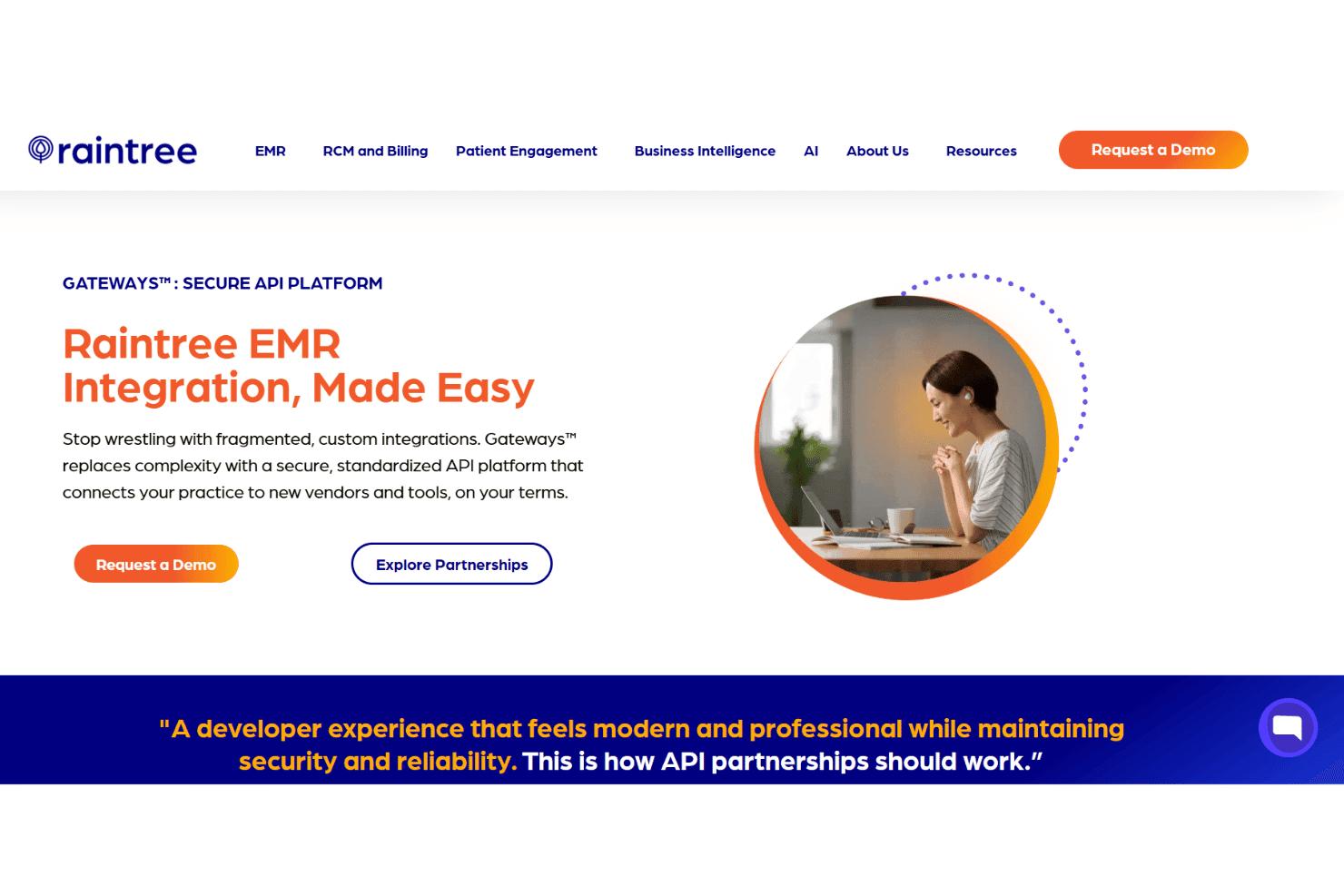
Raintree Systems also offers a secure API platform and supports connections with third-party integration tools.
Value for Money
Raintree Systems uses a custom, quote-based pricing model with costs typically structured per provider per month and depending on factors like practice size, number of users, selected modules (such as EMR, billing, and analytics), and the level of customization or integrations required.
It is generally considered strong for mid-sized to large therapy organizations because it consolidates multiple functions into a single platform, reducing the need for separate tools and improving operational efficiency.
However, the cost and complexity can make it less cost-effective for smaller clinics, particularly those that may not fully utilize its advanced capabilities.
Raintree Systems Specs
- API: Yes
- Appointment Scheduling: Yes
- Athlete Management: No
- Audit Management: No
- Calendar Management: Yes
- Compliance Tracking: Yes
- Customer Management: Yes
- Dashboard: Yes
- Data Export: Yes
- Data Import: Yes
- Data Visualization: Yes
- Electronic Prescribing: No
- External Integrations: Yes
- File Sharing: Yes
- File Transfer: Yes
- Health Management: Yes
- HIPAA Compliance: Yes
- Inventory Tracking: No
- Multi-User: Yes
- Notifications: Yes
- Organization Management: Yes
- Patient Management: Yes
- Project Management: No
- Regulatory Alerts: No
- Risk Assessment: No
- Scheduling: Yes
- Supplier Management: No
Raintree Systems FAQs
Raintree Systems Company Overview & History
Raintree Systems has more than 40 years of experience serving the rehabilitation, physical therapy, and therapy provider industry. The company supports over 8,500 active client locations and processes more than 50 million patient visits annually.
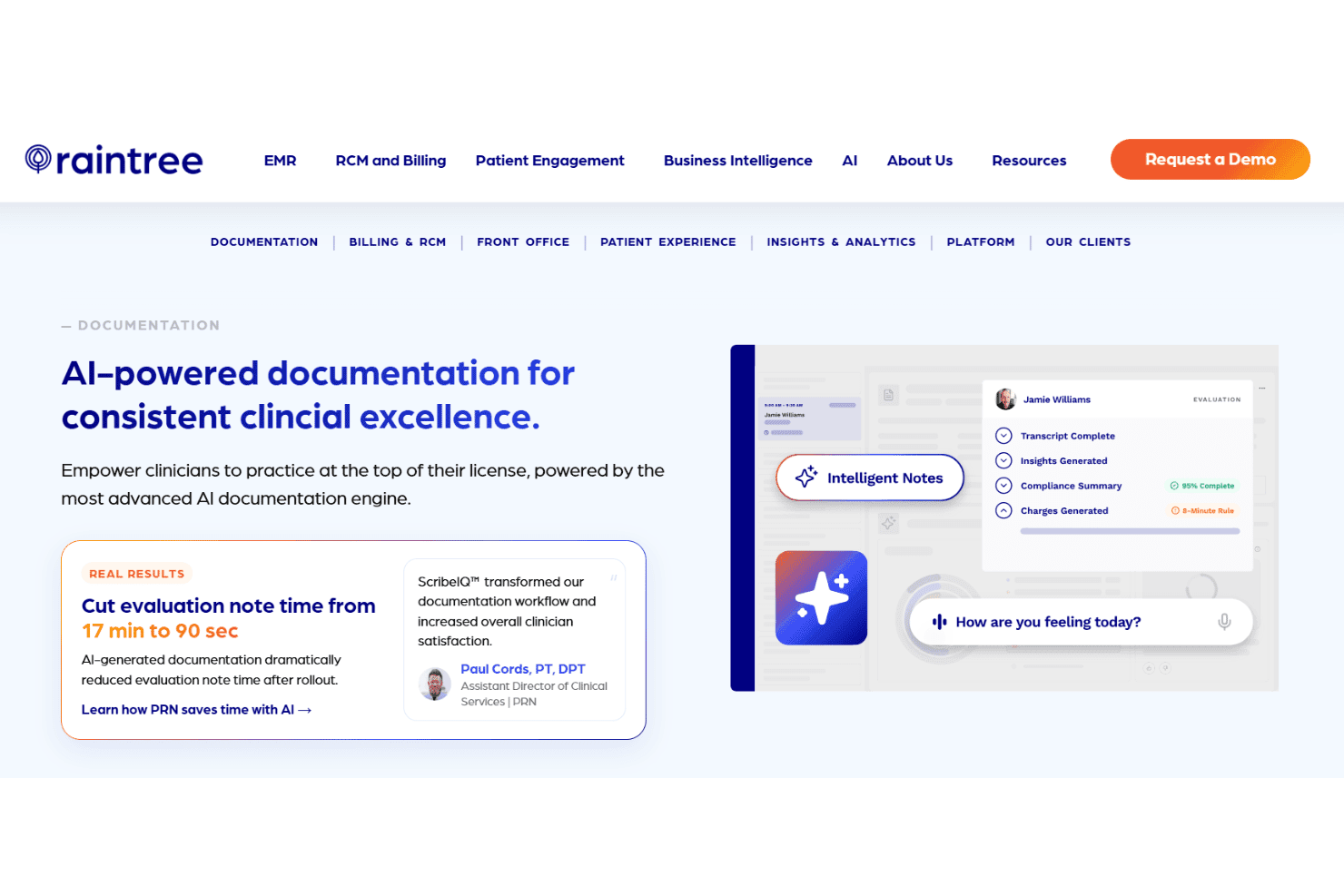
Raintree is recognized for its focus on large therapy organizations and for investing in AI-powered workflow tools and user experience improvements, including its ScribeIQ™ AI documentation solution. Notable clients include Olympic Sports & Spine, Circle of Care, and Easterseals DuPage & Fox Valley.
Raintree Systems Major Milestones
- 1983: Raintree Systems is founded, focusing on software solutions for therapy and rehabilitation practices.
- 2022: Launches ScribeIQ™, an AI-powered clinical documentation assistant integrated into the Raintree EMR platform.
- 2024: Surpasses 8,500 active client locations and supports more than 50 million patient visits annually.
- 2025: Expands investments in AI-driven workflow automation and user experience enhancements for therapy providers.