

Pabau Review: Pros, Cons, Features, and Pricing
Pabau brings clinic management into one platform, from scheduling and billing to patient communication, marketing automation, and day-to-day clinic workflow management.

We review tools independently, and commissions help fund our testing. See our transparency policy, our methodology, or suggest a tool.
Pabau is a clinic management software built for aesthetic clinics, med spas, and similar practices that need to manage appointments, patient records, consent forms, and invoicing in one system. I'd consider it over something like Cliniko if your clinic relies heavily on treatment notes, before/after photo documentation, and client marketing tools—features Pabau handles natively rather than through third-party add-ons.
Pabau Evaluation Summary
4.7/5
- From $65/user/month (billed annually)
- Free demo available
Why Trust Our Software Recommendations
6,700+
Reviews
20
Industry experts
16+
Evaluation factors
14
Years
Our team has been testing and reviewing software since 2012. As medical practice leaders ourselves, we know how difficult—and important—it is to choose the right software.
For this guide, we evaluated tools using hands-on testing and independent research, scoring tools using our selection criteria.
Our reviews reflect our human editorial judgment, not a sales pitch.
Pabau Overview
When judging clinic management software, I think Pabau stands out for its customizable scheduling, strong reporting, and easy patient communications. Its interface is more intuitive than most, and onboarding feels direct. Compared to peers, Pabau’s all-in-one approach and responsive support give it an edge, though integrations and pricing flexibility could be stronger.
I’d suggest it’s best for clinics focused on streamlining admin work who want everything—from digital forms to marketing tools, in a single system.
Pros
- Appointment reminders reduce no-shows for busy clinics.
- Digital consent forms simplify compliance and audits.
- Built-in marketing tools help attract and retain patients.
Cons
- Support wait times can be unpredictable during peak hours.
- Limited options for custom reporting configurations.
- Mobile app lacks key scheduling and chart features.
Is Pabau Right For Your Needs?
Who Would be a Good Fit for Pabau?
Pabau works best for clinics and practices that want one place for patient records, scheduling, charting, and marketing. I think it gives the most value to teams dealing with regular client flow, diverse services, or compliance demands. Whether supporting a single provider or managing multiple practitioners, Pabau’s all-in-one tools keep clinical, administrative, and outreach operations connected.
- Med SpasFrequent, appointment-based services and before/after photo tools align well with Pabau’s visual charting and digital consent workflows.
- Multi-Provider ClinicsCoordination of multiple practitioners, rosters, and clinical histories is simple with Pabau’s user permissions and centralized records.
- Allied Health PracticesPhysios, chiros, and therapists can automate consent, online bookings, and reminders without sacrificing detailed clinical notes.
- Cosmetic Surgery CentersPhoto diaries, consent, and post-treatment recall automate compliance and patient engagement for surgical workflows.
- Business Operations ManagersReporting dashboards, payment integration, and staff management dashboards let managers track KPIs and patient trends in one place.
- Marketing TeamsNative tools for reviews, loyalty programs, and targeted campaigns keep patients engaged and return rates up.
Who Would be a Bad Fit for Pabau?
Pabau isn’t ideal for every healthcare setting, especially if you need specialty features or have requirements outside of the outpatient/private clinic world. Highly specialized, large-budget, or niche organizations may want more advanced customization, deep specialty EMR/EHR features, or broad interoperability. If your workflows live elsewhere or most care is inpatient, you’ll likely find Pabau too limited.
- Large HospitalsPabau doesn’t offer complex inpatient management, bed tracking, or integration with lab and radiology systems typical in hospitals.
- Dental PracticesTooth charting and specialty dental workflows are missing, so dental teams will find essential tools lacking.
- Community Health CentersPublic health reporting, multi-payer billing, and integration with government health systems are outside Pabau’s core focus.
- Labs and Imaging CentersPabau lacks automation, barcode tracking, and PACS or LIS connectivity for diagnostic service workflows.
- Single-Session ProvidersIf your business relies on walk-ins or once-off visits with minimal patient tracking, Pabau’s feature set will feel unnecessary.
- Psychiatric PracticesSpecialized mental health documentation, outcome scoring, and telehealth tools needed for psychiatric clinics are not Pabau’s strength.
How We Test & Score Tools
We’ve spent years building, refining, and improving our software testing and scoring system. The rubric is designed to capture the nuances of software selection and what makes a tool effective, focusing on critical aspects of the decision-making process.
Below, you can see exactly how our testing and scoring works across seven criteria. It allows us to provide an unbiased evaluation of the software based on core functionality, standout features, ease of use, onboarding, customer support, integrations, customer reviews, and value for money.
Core Functionality (25% of final scoring)
The starting point of our evaluation is always the core functionality of the tool. Does it have the basic features and functions that a user would expect to see? Are any of those core features locked to higher-tiered pricing plans? At its core, we expect a tool to stand up against the baseline capabilities of its competitors.
Standout Features (25% of final scoring)
Next, we evaluate uncommon standout features that go above and beyond the core functionality typically found in tools of its kind. A high score reflects specialized or unique features that make the product faster, more efficient, or offer additional value to the user.
We also evaluate how easy it is to integrate with other tools typically found in the tech stack to expand the functionality and utility of the software. Tools offering plentiful native integrations, 3rd party connections, and API access to build custom integrations score best.
Ease of Use (10% of final scoring)
We consider how quick and easy it is to execute the tasks defined in the core functionality using the tool. High scoring software is well designed, intuitive to use, offers mobile apps, provides templates, and makes relatively complex tasks seem simple.
Onboarding (10% of final scoring)
We know how important rapid team adoption is for a new platform, so we evaluate how easy it is to learn and use a tool with minimal training. We evaluate how quickly a team member can get set up and start using the tool with no experience. High scoring solutions indicate little or no support is required.
Customer Support (10% of final scoring)
We review how quick and easy it is to get unstuck and find help by phone, live chat, or knowledge base. Tools and companies that provide real-time support score best, while chatbots score worst.
Customer Reviews (10% of final scoring)
Beyond our own testing and evaluation, we consider the net promoter score from current and past customers. We review their likelihood, given the option, to choose the tool again for the core functionality. A high scoring software reflects a high net promoter score from current or past customers.
Value for Money (10% of final scoring)
Lastly, in consideration of all the other criteria, we review the average price of entry level plans against the core features and consider the value of the other evaluation criteria. Software that delivers more, for less, will score higher.
Core Features
Online Appointment Scheduling
Patients can book, reschedule, or cancel appointments online anytime. This saves front desk time and reduces phone queues.
Automated Reminders and Recalls
Pabau sends SMS or email reminders to help patients remember appointments. This reduces no-shows and keeps schedules predictable.
Digital Consent Forms
Create, send, and securely store digital consent forms for every treatment. Forms are customizable and auto-attach to patient records for audits.
Patient Record Management
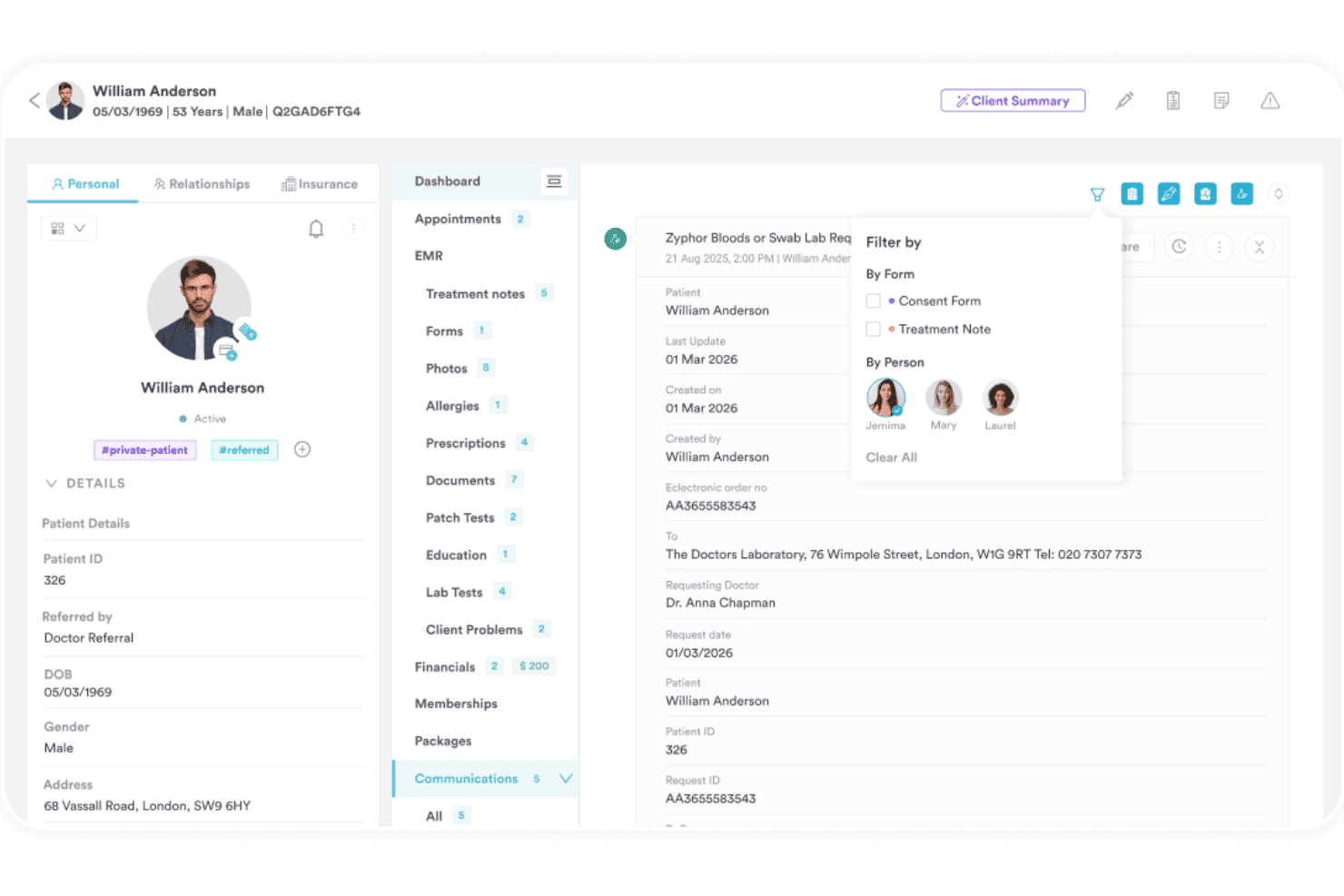
Access detailed, unified electronic patient records from any device. All notes, history, and images are stored in one place for quick review.
Clinical Charting Tools
Drag-and-drop charting and template tools make documentation faster. Clinicians can add diagrams, annotations, and notes with just a few clicks.
Reporting and Analytics Dashboard
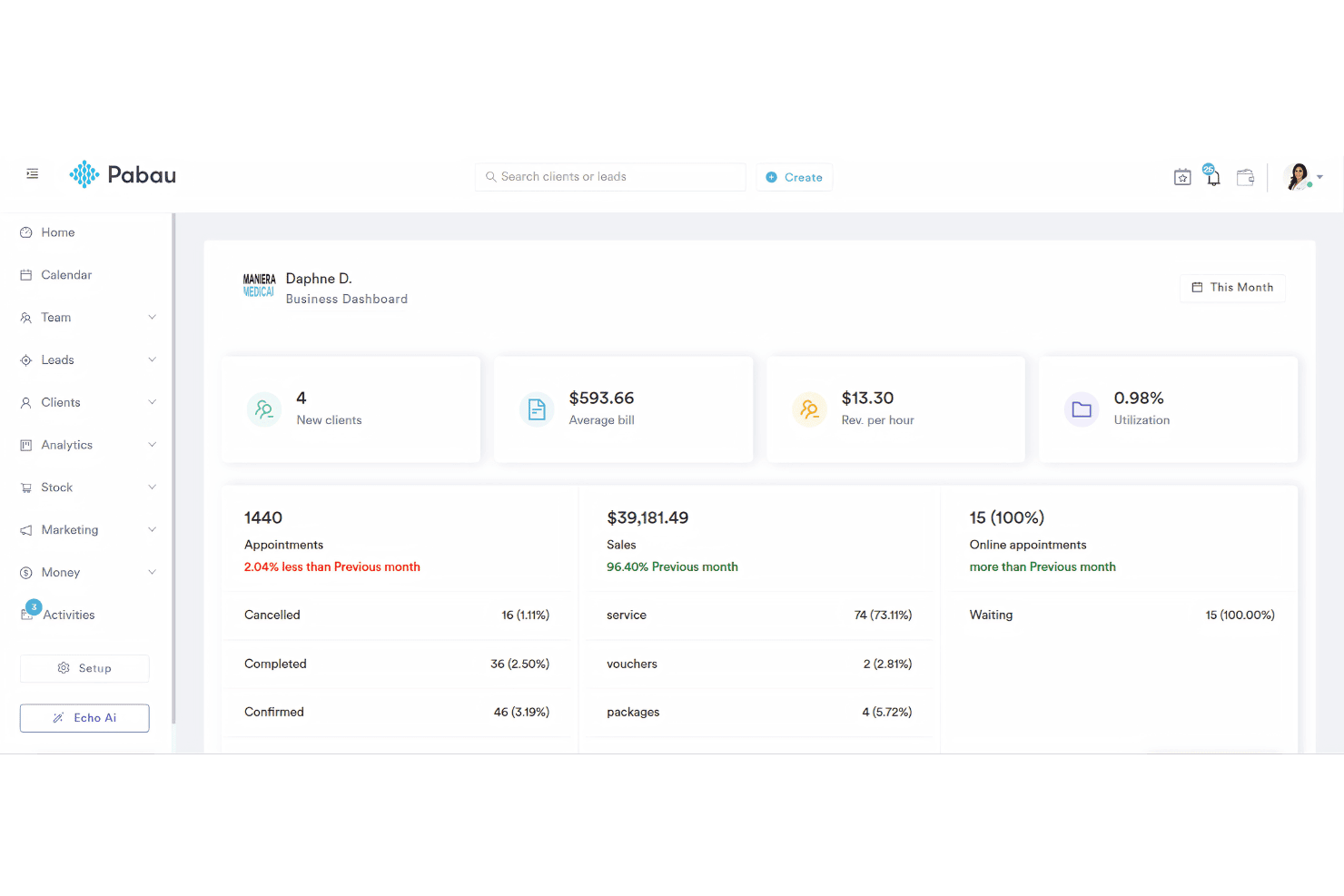
Track revenue, staff performance, and appointment trends in a visual dashboard. Customizable reports help clinics measure what matters most.
Ease of Use
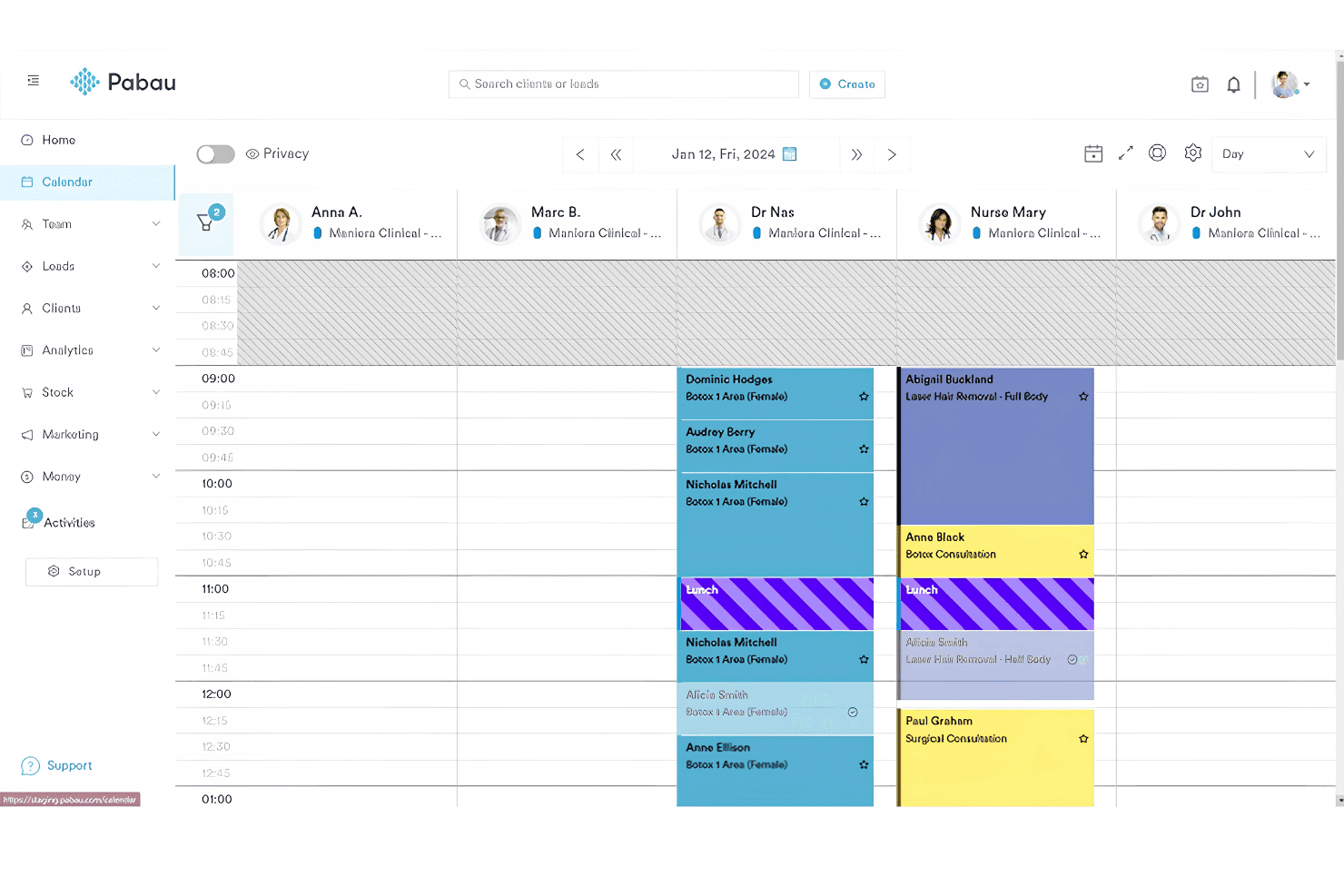
Pabau feels intuitive even for staff new to clinic software, with quick access to core tools from a clean dashboard. Users like the drag-and-drop charting, clear appointment booking workflows, and how patient documents are easy to find.
Some want more in-app guidance, but overall, the navigation and daily workflows require little training.
Integrations
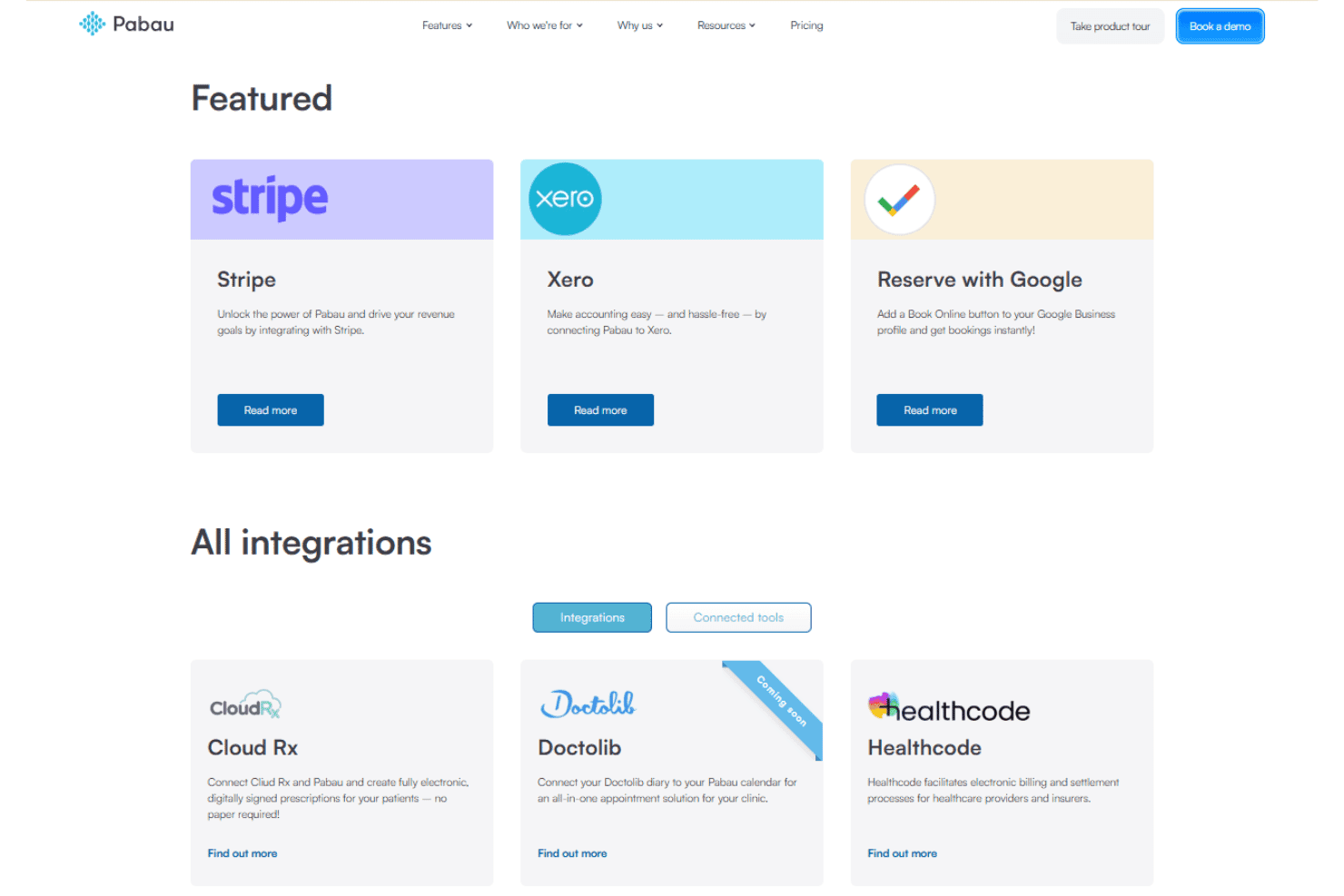
Pabau integrates with Stripe, Xero, Reserve with Google, Cloud Rx, Doctolib, Healthcode, iCal, PatientPerfect, The Doctor’s Lab, and Google Calendar, among others.
Pabau also offers an API and supports connections with select third-party tools.
Pabau Specs
- 2-Factor Authentication: Yes
- API: Yes
- Appointment Scheduling: Yes
- Batch Permissions & Access: Yes
- Billing/Invoicing: Yes
- Budgeting: No
- Customer Management: Yes
- Data Export: Yes
- Data Import: Yes
- Data Visualization: Yes
- Electronic Prescribing: Yes
- Expense Tracking: Yes
- External Integrations: Yes
- File Transfer: Yes
- HIPAA Compliance: Yes
- Multi-User: Yes
- Notifications: Yes
- Patient Management: Yes
- Report & Compliance: Yes
- Self-service Portal: Yes
- Task Scheduling/Tracking: Yes

