

OptiMantra Review: Pros, Cons, Features and Pricing
I see OptiMantra as more than a charting tool: this review weighs its practice-management features, pros, cons, and pricing to help you judge whether it fits your workflow.

We review tools independently, and commissions help fund our testing. See our transparency policy, our methodology, or suggest a tool.
OptiMantra is EMR software and practice-management software for integrative, functional medicine, and multi-modality clinics that need specialty-specific charting and billing. Compared with Jane, I’d choose OptiMantra when your team needs customizable clinical templates, support for IV therapy, and insurance billing in one system.
OptiMantra Evaluation Summary
4.8/5
- From $99/month
- 15-day free trial
Why Trust Our Software Recommendations
6,700+
Reviews
20
Industry experts
16+
Evaluation factors
14
Years
Our team has been testing and reviewing software since 2012. As medical practice leaders ourselves, we know how difficult—and important—it is to choose the right software.
For this guide, we evaluated tools using hands-on testing and independent research, scoring tools using our selection criteria.
Our reviews reflect our human editorial judgment, not a sales pitch.
OptiMantra Overview
OptiMantra is a strong choice for integrative and functional medicine clinics that need specialty-specific charting, IV therapy documentation, and insurance billing. I particularly like its customizable templates for treatment plans, patient assessments, and supplement protocols. However, insurance billing carries additional per-claim fees, and its specialized features may be unnecessary for clinics with simpler workflows. I’d recommend testing its interface, integrations, and onboarding process before committing.
Pros
- Custom SOAP forms and intake workflows suit integrative care.
- Reviewers praise responsive onboarding and support with configuration questions.
- Claims, e-prescribing, telehealth, and patient records share one platform.
Cons
- Reviewers report frozen faxes and documents blocking access to results.
- Follow-up scheduling lacks convenient interval-based calendar options.
- Some reviewers report glitchy forms that misplace fields or punctuation.


How We Test & Score Tools
We’ve spent years building, refining, and improving our software testing and scoring system. The rubric is designed to capture the nuances of software selection and what makes a tool effective, focusing on critical aspects of the decision-making process.
Below, you can see exactly how our testing and scoring works across seven criteria. It allows us to provide an unbiased evaluation of the software based on core functionality, standout features, ease of use, onboarding, customer support, integrations, customer reviews, and value for money.
Core Functionality (25% of final scoring)
The starting point of our evaluation is always the core functionality of the tool. Does it have the basic features and functions that a user would expect to see? Are any of those core features locked to higher-tiered pricing plans? At its core, we expect a tool to stand up against the baseline capabilities of its competitors.
Standout Features (25% of final scoring)
Next, we evaluate uncommon standout features that go above and beyond the core functionality typically found in tools of its kind. A high score reflects specialized or unique features that make the product faster, more efficient, or offer additional value to the user.
We also evaluate how easy it is to integrate with other tools typically found in the tech stack to expand the functionality and utility of the software. Tools offering plentiful native integrations, 3rd party connections, and API access to build custom integrations score best.
Ease of Use (10% of final scoring)
We consider how quick and easy it is to execute the tasks defined in the core functionality using the tool. High scoring software is well designed, intuitive to use, offers mobile apps, provides templates, and makes relatively complex tasks seem simple.
Onboarding (10% of final scoring)
We know how important rapid team adoption is for a new platform, so we evaluate how easy it is to learn and use a tool with minimal training. We evaluate how quickly a team member can get set up and start using the tool with no experience. High scoring solutions indicate little or no support is required.
Customer Support (10% of final scoring)
We review how quick and easy it is to get unstuck and find help by phone, live chat, or knowledge base. Tools and companies that provide real-time support score best, while chatbots score worst.
Customer Reviews (10% of final scoring)
Beyond our own testing and evaluation, we consider the net promoter score from current and past customers. We review their likelihood, given the option, to choose the tool again for the core functionality. A high scoring software reflects a high net promoter score from current or past customers.
Value for Money (10% of final scoring)
Lastly, in consideration of all the other criteria, we review the average price of entry level plans against the core features and consider the value of the other evaluation criteria. Software that delivers more, for less, will score higher.
Core Features
Custom Charting and Intake Forms
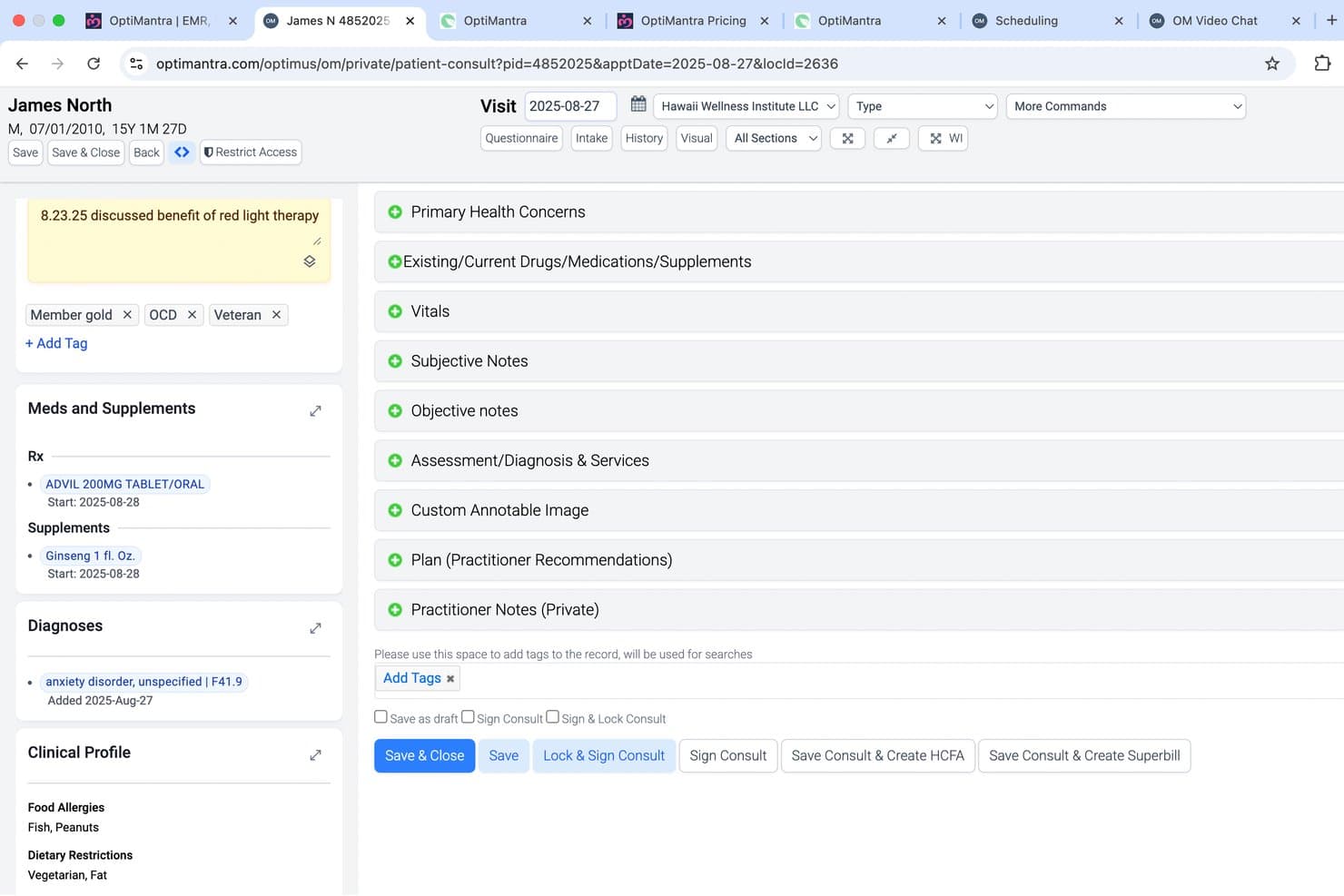
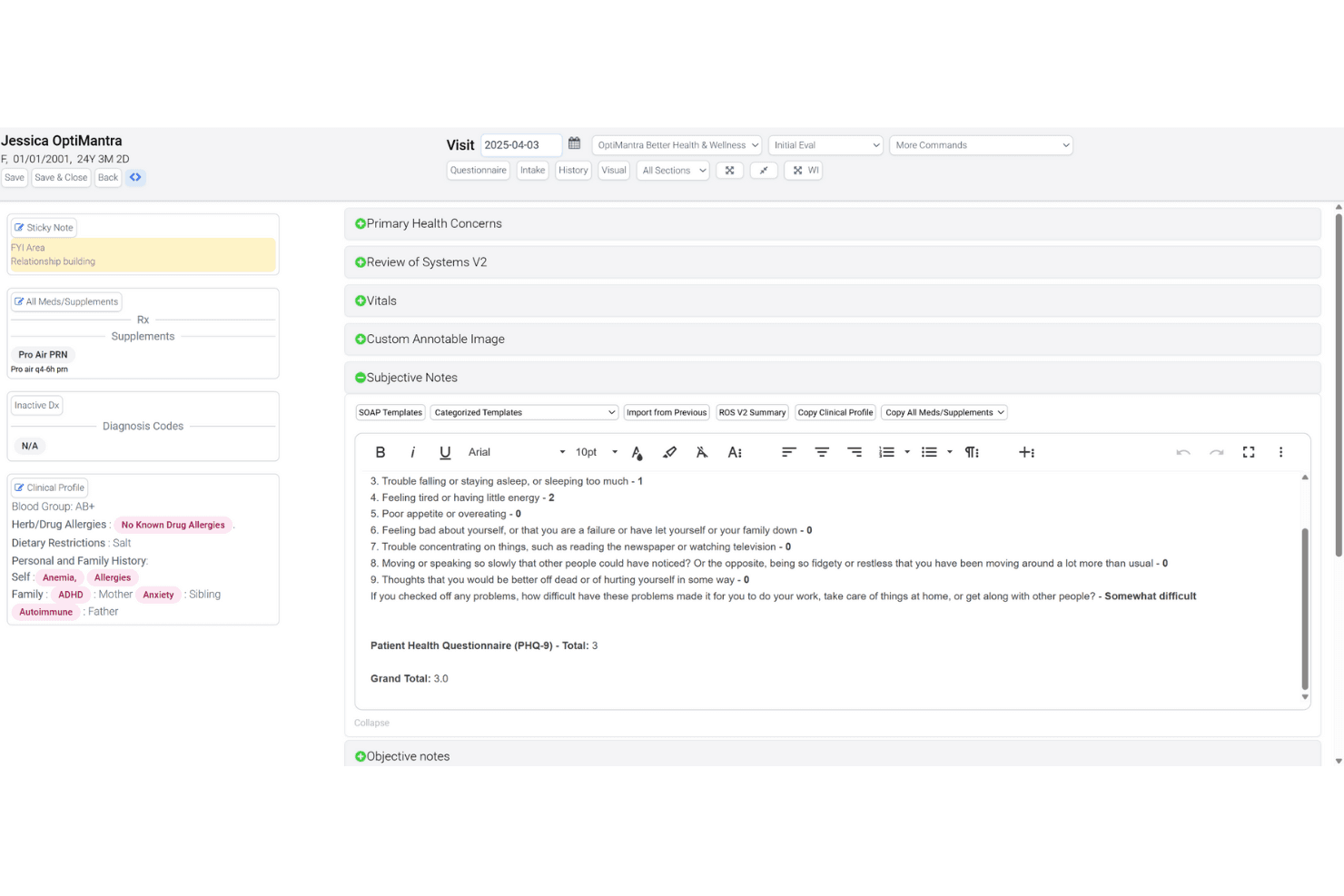
OptiMantra lets you customize SOAP templates, intake forms, and treatment plans, then reuse prior-visit content when creating follow-up charts. This helps your team document different care plans without forcing every specialty into the same note structure.
Appointment Scheduling
Schedule across practitioners, rooms, and locations, with optional online booking and customizable email or text reminders. Patients can book through your website or portal, while your staff can coordinate availability across the clinic.
Superbill
OptiMantra allows clinics to generate superbills with patient details, diagnosis codes, procedure codes, and service charges. Providers can use these documents to give patients the information needed to submit out-of-network insurance reimbursement claims.
E-Prescribing
The e-prescribing feature includes medication history and pharmacy search, with electronic controlled-substance prescribing available. Your clinicians can review medication details and send prescriptions electronically as part of their patient-care workflow.
Telehealth
OptiMantra includes secure video visits, and patients can join through a secure email link without downloading separate software. That gives your team a way to conduct remote appointments within the same system used for records and practice management.
Patient Records
OptiMantra provides centralized patient records where clinicians can access medical histories, clinical notes, diagnoses, treatment plans, and lab results. Providers can review and update patient information, track treatment progress, and maintain clinical documentation within a single system.
Ease of Use
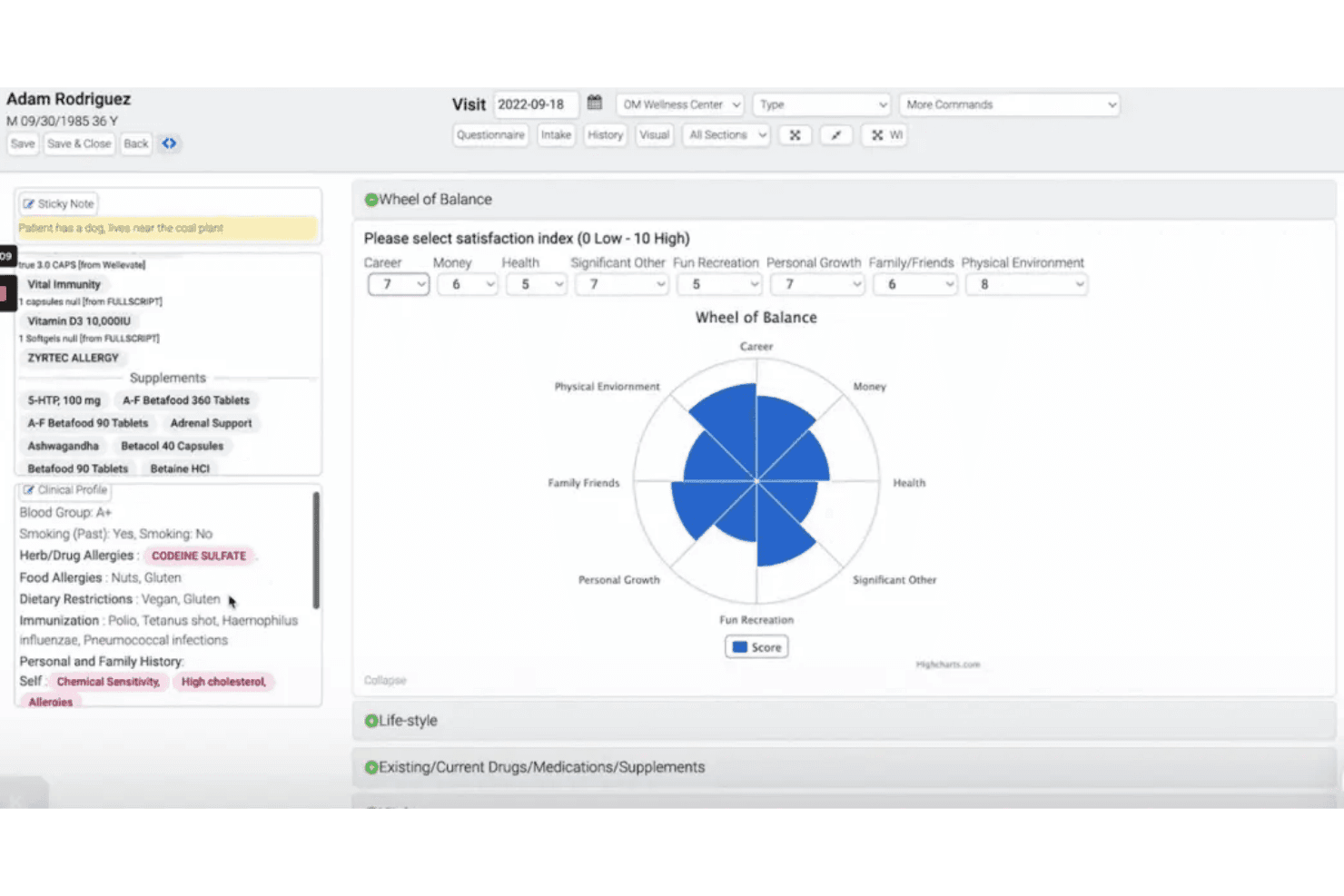
OptiMantra is relatively easy to use, with customizable SOAP notes, intake forms, billing, prescribing, and telehealth in one platform. Users appreciate its responsive onboarding and configuration support, though some report form glitches, fax issues, and scheduling limitations. I’d recommend it for clinics comfortable customizing workflows rather than those seeking a ready-to-use system.
Integrations
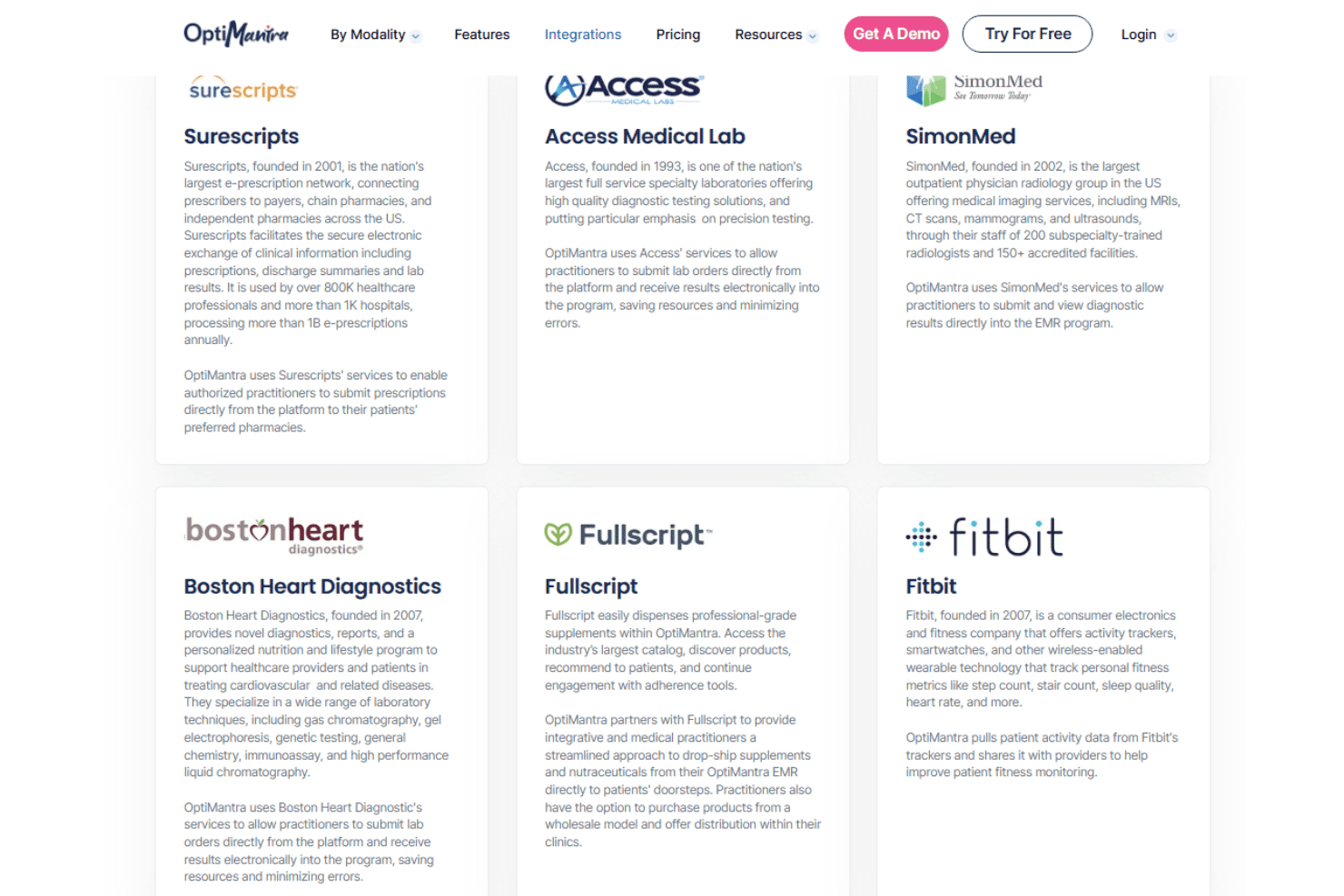
OptiMantra integrates with Surescripts, Labcorp, Quest Diagnostics, Mercy Diagnostics, Rupa Health, Fullscript, DeepCura, Fitbit, Stripe, Fiserv, Authorize.net, Stax, Office Ally, SFax, Google Calendar, HighLevel, Zoho, and SendGrid. It also supports API-based connectivity and CRM-agnostic webhooks for exchanging patient appointment and status data with third-party systems.
OptiMantra Specs
- 2-Factor Authentication: Yes
- API: No
- Appointment Scheduling: Yes
- Approval Workflows: No
- Audit Management: No
- Audit Trail: No
- Batch Permissions & Access: Yes
- Billing/Invoicing: Yes
- Compliance Tracking: No
- Customer Management: Yes
- Data Export: Yes
- Data Import: Yes
- Document Management: No
- Electronic Prescribing: Yes
- External Integrations: Yes
- HIPAA Compliance: Yes
- Incident Management: No
- Multi-User: Yes
- Notifications: Yes
- Patient Management: Yes
- Regulatory Alerts: No
- Report & Compliance: Yes
- Risk Assessment: No
- Self-service Portal: Yes
- Task Scheduling/Tracking: Yes
- Workflow Management: No


