

Vision medical billing software is specialized software that helps eye care practices manage insurance claims, patient billing, and reimbursement for optometry and ophthalmology services. If you’re searching for the right solution, you know that vision billing comes with unique codes, claim rules, and payer requirements that slow down your team if your tools fall short.
This list is built for eye care professionals who need to handle claims faster, reduce denials, and free up more time for patient care. You’ll find patient-focused billing tools built for the real-world pace of modern eye care, so you can compare options and confidently choose the best fit for your practice.
Why Trust Our Software Recommendations
6,700+
Reviews
20
Industry experts
16+
Evaluation factors
14
Years
Our team has been testing and reviewing software since 2012. As medical practice leaders ourselves, we know how difficult—and important—it is to choose the right software.
For this guide, we evaluated tools using hands-on testing and independent research, scoring tools using our selection criteria.
Our reviews reflect our human editorial judgment, not a sales pitch.
Vision Medical Billing Software Comparison Table
This comparison table summarizes pricing details for my top vision medical billing Software selections:
| Tool | Best For | Trial Info | Price | ||
|---|---|---|---|---|---|
| 1 | Best for adaptive ophthalmology charting | Free demo available | Pricing upon request | Website | |
| 2 | Best for specialty eyecare management | Free demo available | Pricing upon request | Website | |
| 3 | Best for eyewear ordering workflows | Free demo available | From $68/month | Website | |
| 4 | Best for optical retail operations | Free demo available | Pricing upon request | Website | |
| 5 | Best for ophthalmology documentation | Free demo available | Pricing upon request | Website | |
| 6 | Best for cloud optometry workflows | Free demo available | From $319/month | Website | |
| 7 | Best for all-in-one eyecare management | Free demo available | Pricing upon request | Website | |
| 8 | Best for integrated optical workflows | Free demo available | From $340/month | Website | |
| 9 | Best for optometry practice management | Free demo available | Pricing upon request | Website | |
| 10 | Best for cloud-based optical management | Free demo available | From $259/month | Website |


Best Vision Medical Billing Software Reviews
Below are my detailed summaries of the best vision medical billing software that made it onto my shortlist. My reviews offer a detailed look at the features, best use cases, and pricing of each software to help you find the best one for you.
 Best for adaptive ophthalmology charting
- Free demo available
- Pricing upon request
Visit WebsiteCustomer Rating:4.4/5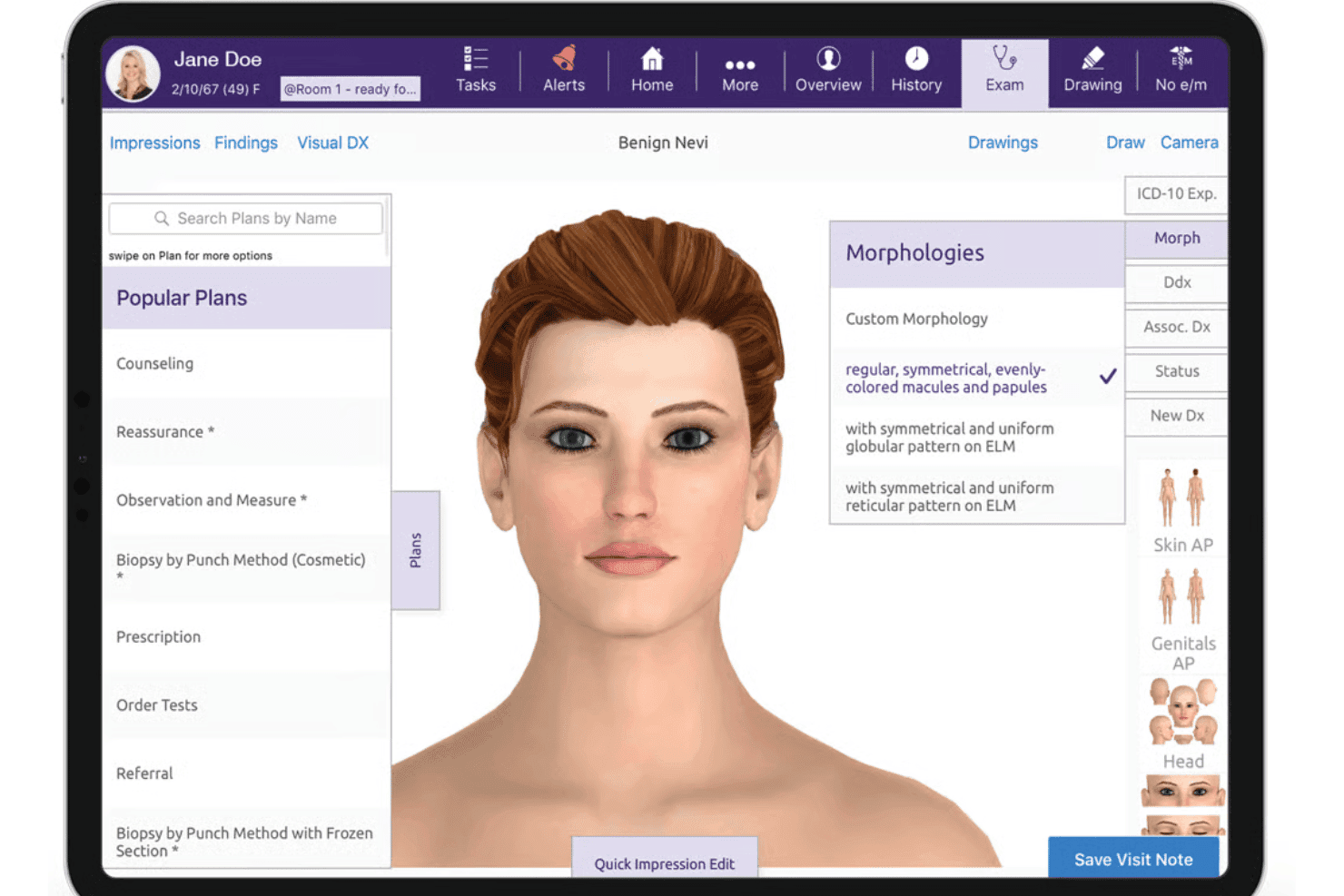
ModMed delivers specialty EHR, AI documentation, e-prescribing, billing, and RCM. ModMed is a specialty-specific EHR and revenue cycle management platform for ophthalmology practices that combines adaptive clinical documentation, ophthalmology-coded claims processing, denial management, and optical POS integrations.
Who Is ModMed Best For?
ModMed is a strong fit for mid-to-large ophthalmology practices and ambulatory surgery centers that need specialty-specific billing built directly into their clinical workflow.
Why I Picked ModMed
I've included ModMed in my top picks because EMA adapts to each physician's charting habits, learning preferred exam notes and auto-suggesting matched ophthalmology CPT codes and ICD-10 modifiers. This directly tightens the link between clinical documentation and billing accuracy. ModMed Scribe 2.0 layers AI on top, trained on real ophthalmology encounter data, so procedure-level codes are pulled from the clinical note rather than entered manually downstream.
ModMed Key Features
- Ophthalmology-specific charge capture: Promptly records and manages surgical, in-office, and diagnostic charges linked to patient exams.
- Integrated optical POS interfaces: Connects with Eyefinity and FlexSys to handle optical dispensary invoicing and payments from within the practice management workflow.
- Automated claims status tracking: Monitors claim progress and alerts staff to denials, rejections, or payer follow-ups using real-time dashboards.
- Medical eligibility verification: Checks patient eligibility and coverage across a network of medical insurance carriers before appointments.
ModMed Integrations
ModMed offers native integrations with Eyefinity, FlexSys, Zeiss Veracity, MDprospects, SamaCare, PX Technology, and Sophrona. Integrations are also available for Klara, Relatient, TouchMD, Artera, Birdeye, Demandforce, Phreesia, and DeepScribe. An API is available for custom integrations.
Pros and Cons
Pros:
- Ophthalmic exam data syncs directly to billing
- Dedicated RCM team for denial management
- Coding engine built for ophthalmology subspecialties
Cons:
- Optical dispensary invoicing requires third-party systems
- Limited vision plan claims billing workflow
Learn more about ModMed: Best for specialty eyecare management
- Free demo available
- Pricing upon request
Visit WebsiteCustomer Rating:4.3/5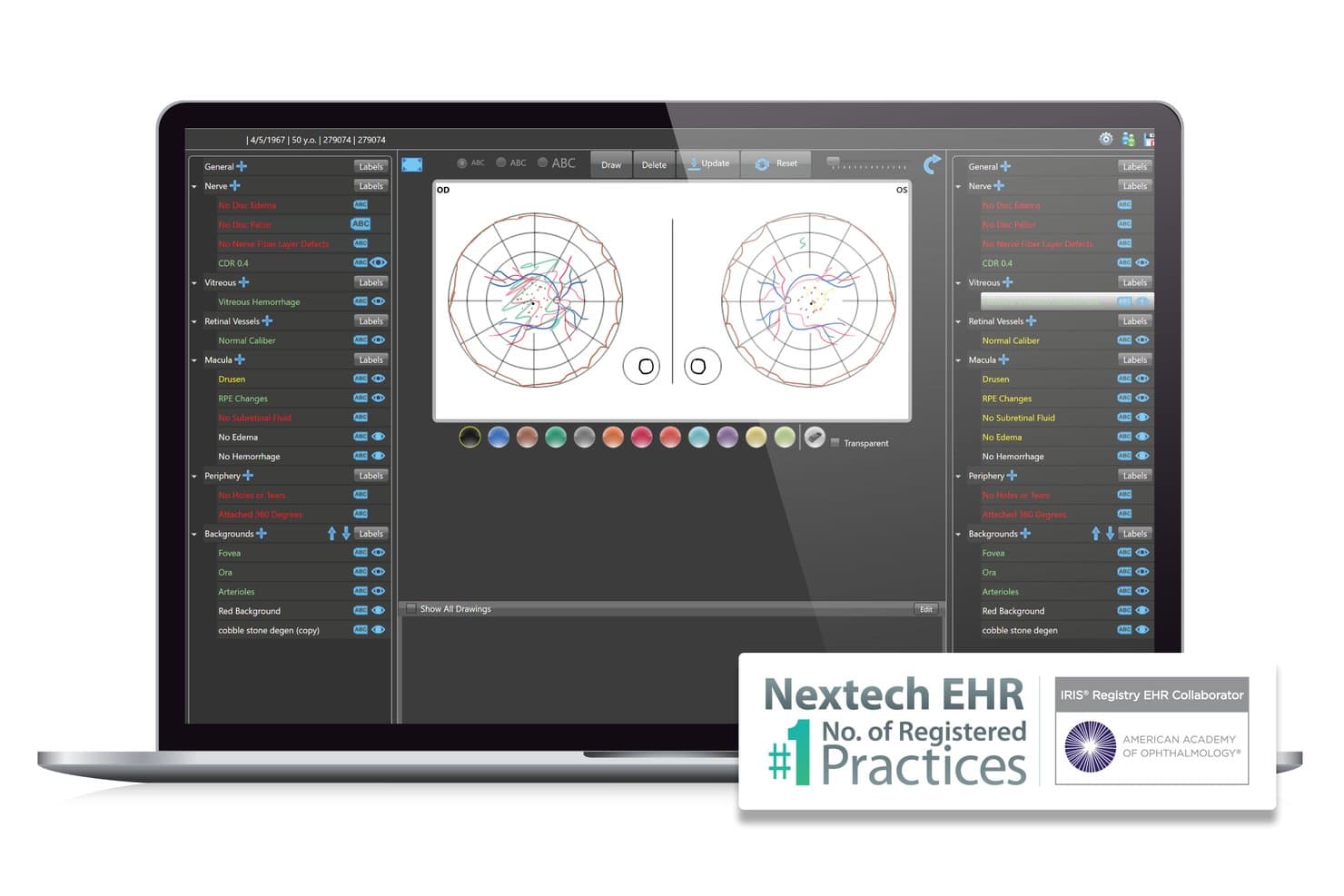
Nextech offers an ophthalmology-focused EHR with retinal drawing tools, structured eye exam documentation, and IRIS Registry integration for vision medical billing. Nextech is a specialty-focused EHR and practice management platform built for ophthalmology and eyecare practices, combining clinical documentation, dual medical and vision claims billing, optical POS, and eligibility verification in one system.
Who Is Nextech Best For?
Nextech is a strong fit for mid-to-large ophthalmology practices that manage both medical and vision insurance billing alongside an in-house optical dispensary.
Why I Picked Nextech
Nextech earns its spot on my shortlist for handling split medical and vision claims in a single native workflow, which I find genuinely rare in this category. I particularly like IntelleChartPRO's glaucoma flowsheet, which pulls longitudinal patient data, images, and visit history onto one screen during charting. The integrated optical POS ties frame and contact lens inventory directly to exam charges, generating a medical claim and retail receipt from a single patient encounter.
Nextech Key Features
- Ophthalmology-specific code library: Includes CPT, HCPCS, and ICD-10 codes pre-loaded for eye care billing and documentation.
- Real-time eligibility verification: Checks both medical and major vision plans for patient coverage and benefits during intake.
- Integrated claims scrubbing: Flags incomplete or inaccurate vision and medical claims using eye care-specific rules before submission.
- Optical inventory integration: Connects frame, lens, and contact lens inventory to patient invoicing and insurance allowances automatically.
Nextech Integrations
Nextech offers 10 native integrations, including Weave, Solutionreach, Demandforce, TouchMD, Harmony, Podium, FlexOptical, MedEvolve, Cubix, and Abyde, and partners with Trizetto clearinghouse for claims processing. An API is available for custom integrations.
Pros and Cons
Pros:
- Ophthalmology-specific coding and templates available
- Native optical POS and inventory integration
- Built-in dual medical and vision billing
Cons:
- Eligibility tied to specific clearinghouse partners
- Not suited for solo or micro practices
Learn more about Nextech: Best for eyewear ordering workflows
- Free demo available
- From $68/month
Visit WebsiteCustomer Rating:3/5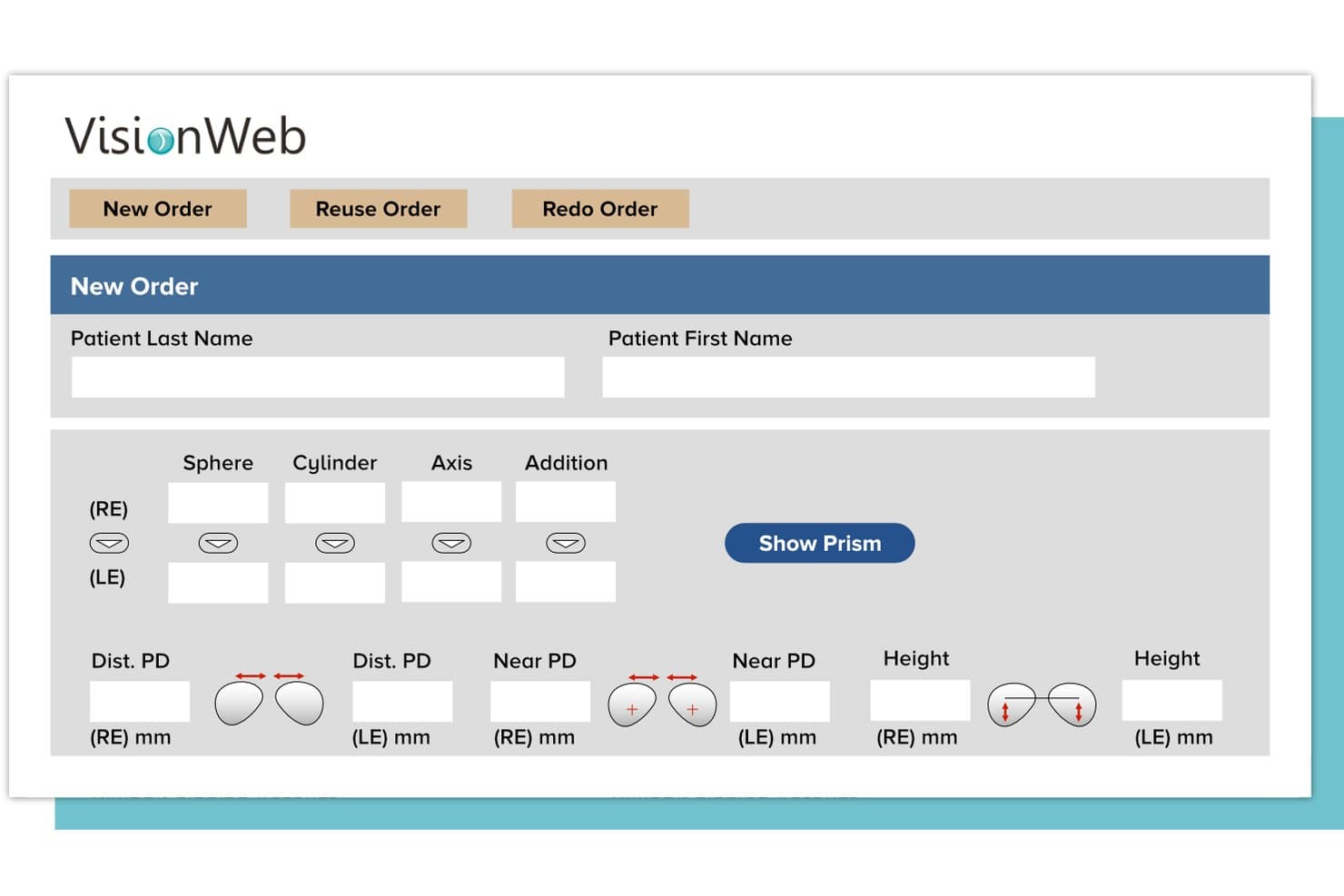
VisionWeb offers a new order entry form with fields for patient name, prescription details (Sphere, Cylinder, Axis, Addition), PD measurements, and height inputs. VisionWeb is a vision-specialized billing clearinghouse that handles electronic claims submission, ERA processing, real-time eligibility verification, and eyewear product ordering across a network of 2,300+ vision and medical payers.
Who Is VisionWeb Best For?
VisionWeb is a strong fit for independent optometry practices and vision clinics that need to manage both optical dispensary orders and insurance claims in one place.
Why I Picked VisionWeb
VisionWeb earns its spot on my shortlist because no other vision billing clearinghouse also operates the industry's largest optical ordering network, connecting practices to 475+ labs and suppliers. I like that staff can place spectacle, contact lens, and frame orders alongside claims filing, rather than toggling between separate platforms. The online ordering workflow consistently returns jobs 1-2 days faster than phone or fax, which means fewer gaps between exam, dispensing, and billing.
VisionWeb Key Features
- Dual payer claims submission: Lets you submit both vision and medical insurance claims through a single electronic clearinghouse workflow.
- Real-time vision plan eligibility: Instantly verifies patient benefits with VSP, EyeMed, and over 2,300 connected payers directly in the system.
- Automated ERA management: Posts 835 electronic remittance files automatically for faster payment reconciliation and reduced manual entry.
- Integrated denial tracking and reporting: Offers reporting tools to monitor denied claims, process appeals, and track key AR metrics for eye care billing.
VisionWeb Integrations
VisionWeb offers native integrations with over 100 optometry and ophthalmology practice management systems, including Eyefinity, RevolutionEHR, Uprise by HELIX, and Crystal PM. An API is available for custom integrations.
Pros and Cons
Pros:
- Automatic dual routing for vision and medical claims
- Real-time eligibility checks for vision and medical
- Largest network of optical labs and suppliers
Cons:
- Eye care code scrubbing not fully user-configurable
- Patient invoicing features require external systems
Learn more about VisionWeb: Best for optical retail operations
- Free demo available
- Pricing upon request
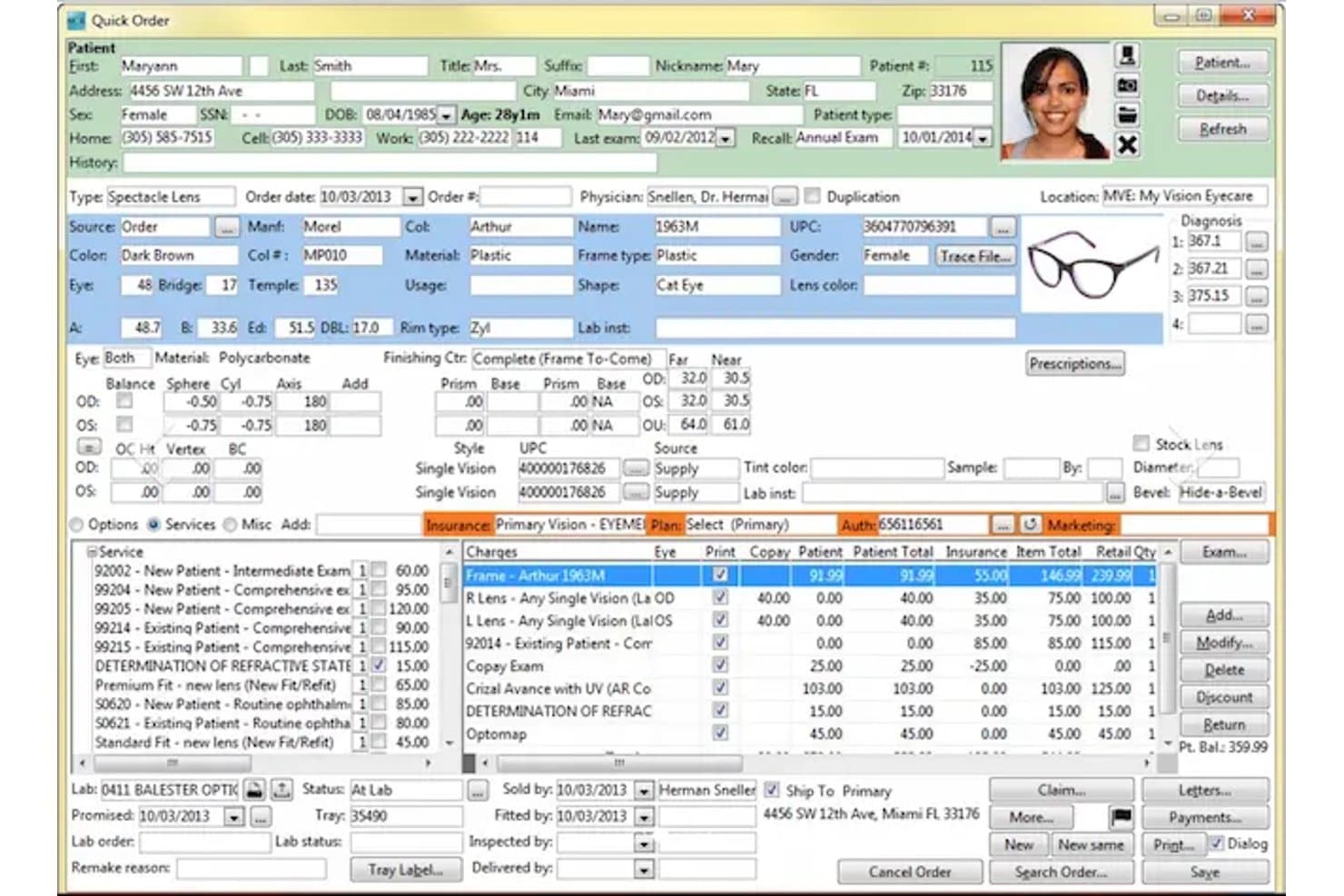
My Vision Express offers a Quick Order screen with detailed patient info, lens specifications, insurance billing, and itemized charges for vision care billing. My Vision Express is an eye care practice management and EHR platform that combines optical retail POS, insurance billing, ICD-10 coding, and dispensary invoicing for optometry and ophthalmology practices.
Who Is My Vision Express Best For?
It's a strong fit for optometry practices with an in-house optical dispensary, especially those managing multiple locations from a single system.
Why I Picked My Vision Express
I picked My Vision Express because no other platform on this list ties optical dispensary billing directly to the exam record the way it does. The Quick Order POS lets staff create an eyewear order, fill a prescription, and post payment on a single screen. That matters when your front desk is managing both a medical claim and a frame sale at the same time. I also rely on the preloaded ophthalmic ICD-10 codes and the industry-first Injury Builder tool to keep claims clean from the start.
My Vision Express Key Features
- Multi-location inventory management: Track, transfer, and reconcile optical inventory across several practice sites from one platform.
- Preloaded CPT and ICD-10 code libraries: Access built-in ophthalmology and optometry codes specific to eye care billing requirements.
- Custom exam and billing templates: Configure templates to match workflow for office visits, exams, and insurance documentation.
- Integrated SSRS reporting: Generate detailed reports spanning billing, exam, and optical retail operations for data-driven oversight.
My Vision Express Integrations
Native integrations are not clearly documented. The platform supports connections with diagnostic equipment and insurance clearinghouse interfaces, and offers an API for custom integrations.
Pros and Cons
Pros:
- Multi-location inventory managed in one platform
- Quick Order POS links exams to orders
- Purpose-built for optometry and optical retail
Cons:
- Named vision plan integrations not clearly documented
- Reporting and analytics are not comprehensive
Learn more about My Vision Express:
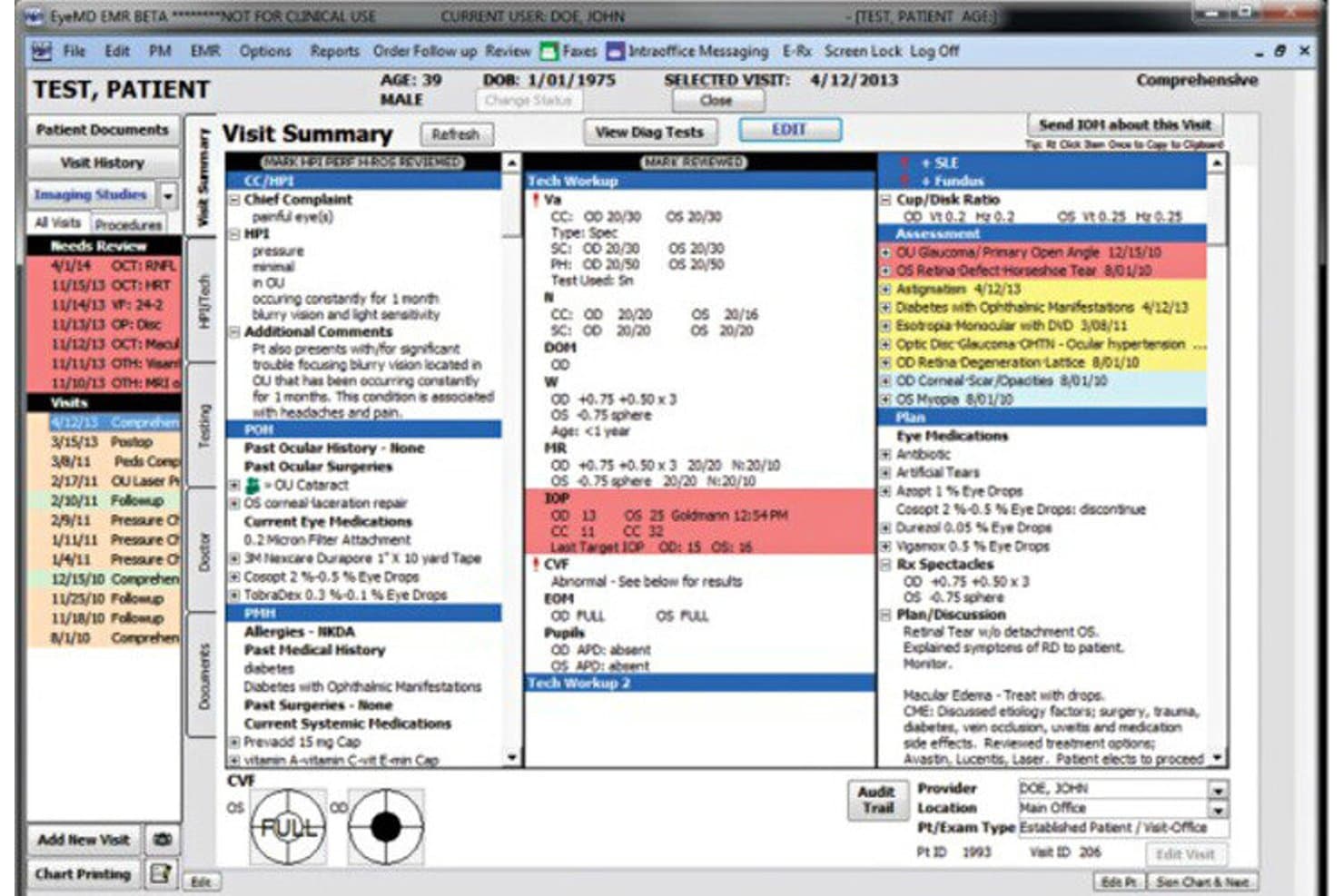
EyeMD EMR dashboard showing ophthalmology visit notes, test results, diagnoses, and treatment plans EyeMD EMR is an ophthalmology-native practice management and medical billing platform that combines an embedded clearinghouse, ophthalmic CPT and modifier coding, claims submission, ERA posting, optical POS integration, and AR management in one specialty-built system.
Who Is EyeMD EMR Best For?
EyeMD EMR is a strong fit for ophthalmology practices that need a billing and documentation system built around eye care workflows rather than adapted from a general-purpose platform.
Why I Picked EyeMD EMR
EyeMD EMR earns its spot on my shortlist because of how tightly its clinical documentation connects to billing. The Fast Plan feature automatically generates treatment plans when specific diagnostic codes are entered, which means billing codes follow directly from documentation without a separate coding step. I also like that the ICD-10 tool auto-associates exam findings with the correct codes, reducing the manual review that typically drives claim delays in ophthalmology practices.
EyeMD EMR Key Features
- Embedded clearinghouse: Tracks claims in real time and supports automated claim follow-up without third-party add-ons.
- Business intelligence dashboard: Centralizes financial analytics and A/R performance metrics for easy monitoring by billing specialists.
- Optical POS integration: Links ophthalmology billing with FlexSys-powered point of sale for dispensing eyewear and accessories.
- Direct scan OCR: Allows staff to scan insurance and ID cards to auto-populate patient records and payer data.
EyeMD EMR Integrations
EyeMD EMR offers over 80 documented practice management integrations, including Athena Health, Allscripts, eClinicalWorks, MedEvolve, Intergy (Greenway), CareCloud, Centricity, Cerner Ideal, Lytec, Medisoft, and MicroMD. Optical POS integration is available with FlexSys.
Pros and Cons
Pros:
- Optical POS integration with eyewear dispensing
- Embedded clearinghouse tracks claims in real time
- Specialty coding automation for ophthalmology billing
Cons:
- Limited optical goods allowance tracking features
- Lacks native VSP and EyeMed eligibility checks
Learn more about EyeMD EMR: Best for cloud optometry workflows
- Free demo available
- From $319/month
Visit WebsiteCustomer Rating:4.5/5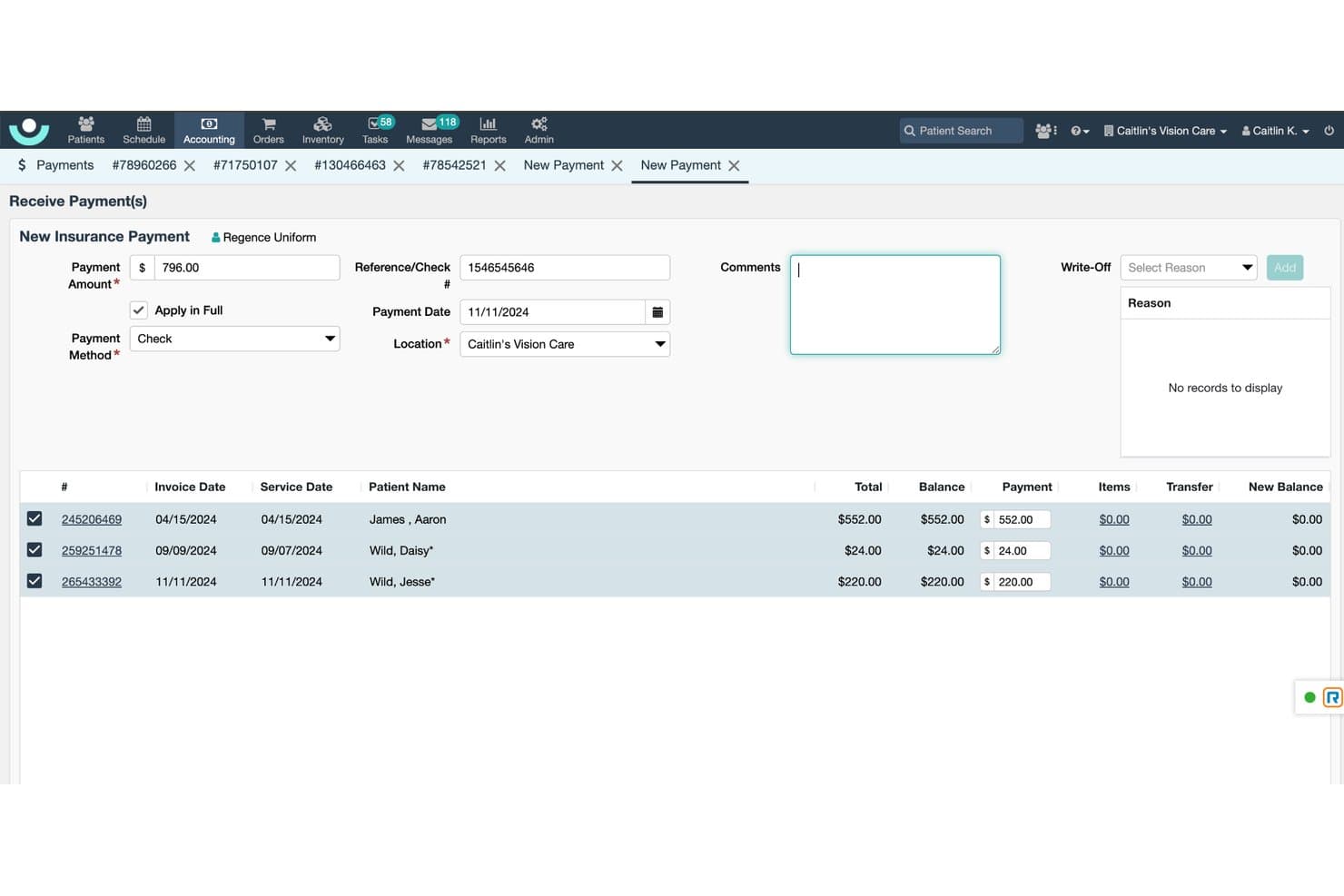
RevolutionEHR offers a detailed insurance payment entry screen allowing billing staff to apply payments across multiple patient invoices with write-off and transfer options. RevolutionEHR is a cloud-based EHR and practice management platform built exclusively for optometry, combining dual vision and medical claims billing, eligibility verification, clearinghouse submission, and optical dispensary invoicing in one system.
Who Is RevolutionEHR Best For?
RevolutionEHR is a strong fit for independent optometry practices and small multi-location eye care clinics managing both vision plan and medical insurance billing.
Why I Picked RevolutionEHR
I've included RevolutionEHR in my top picks because it's the only billing platform I know that's built from the ground up for optometry workflows in the cloud. The built-in RevClear clearinghouse catches claim errors before submission, so VSP and EyeMed claims don't fall through the gaps that plague general-purpose billing tools. I also like that RevBilling lets practices offload coding, ledger reconciliation, and denial follow-up to a dedicated team, all from within the same platform.
RevolutionEHR Key Features
- RevCheck insurance verification: Instantly verifies patient eligibility for both vision and medical payers before the visit.
- Optical dispensary and inventory integration: Links frame, lens, and contact lens sales to claims and invoices with allowance tracking.
- Pre-loaded eye care code libraries: Includes optometry CPT, HCPCS, and ICD-10 codes with specialty modifiers in system templates.
- Automated ERA posting: Enables seamless 835 electronic remittance advice processing within the claims workflow.
RevolutionEHR Integrations
RevolutionEHR offers native integrations with ABB Verify, RevClear (TriZetto), Optos, VisionWeb, FramesData, HOYA, OOGP, 4PatientCare, Solutionreach, Demandforce, and EyeCarePro, and provides an API for custom integrations.
Pros and Cons
Pros:
- Pre-submission claim scrubbing prevents denials
- Built-in eye care specific code libraries
- Dual medical and vision plan billing workflows
Cons:
- Reporting features are less customizable than competitors
- Optical allowance tracking requires duplicate entry
Learn more about RevolutionEHR: Best for all-in-one eyecare management
- Free demo available
- Pricing upon request
Visit WebsiteCustomer Rating:3.9/5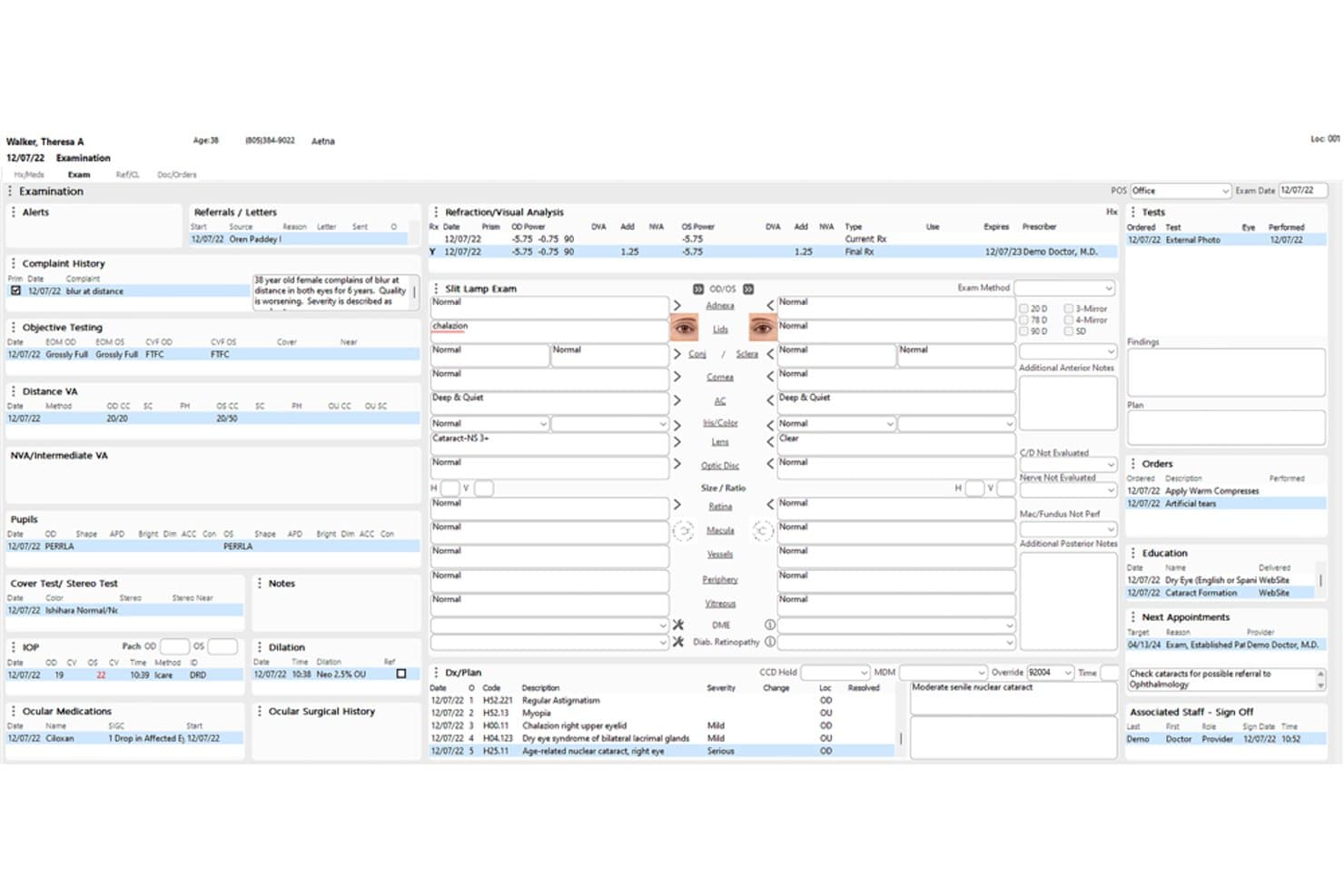
Compulink Advantage (Eyecare Advantage) offers a comprehensive patient examination screen with refraction analysis, slit lamp exam, diagnosis coding, and billing fields in one integrated view. Compulink Advantage is an optometry-focused EHR and practice management platform that integrates dual vision and medical billing, optical POS, claims submission, eligibility verification, and revenue cycle management in a single system.
Who Is Compulink Advantage (Eyecare Advantage) Best For?
It's a strong fit for multi-location optometry and ophthalmology practices that need a single platform to manage clinical, optical, and billing workflows together.
Why I Picked Compulink Advantage (Eyecare Advantage)
I picked Compulink Advantage because no other platform ties the optical dispensary directly to the clinical exam and insurance claim in one motion. The Visual Documentation Engine automatically generates orders and exam documentation from the patient's diagnosis, so billing codes flow from the encounter without manual re-entry. On top of that, AdvantageRCM handles claims scrubbing, denial appeals, and ERA posting, keeping the revenue cycle moving across both vision plan and medical payers.
Compulink Advantage (Eyecare Advantage) Key Features
- Pre-loaded eye care coding libraries: Compulink includes specialty CPT, HCPCS, and ICD-10 code sets specific to optometry and ophthalmology.
- Dual vision and medical claims routing: Automatically directs claims to the appropriate vision plan or medical insurer based on encounter context.
- Real-time eligibility verification: Instantly checks vision and medical plan benefits and eligibility at check-in for all major carriers.
- Optical point-of-sale and inventory integration: Links frame, lens, and contact lens sales directly to patient records and claims in one unified workflow.
Compulink Advantage (Eyecare Advantage) Integrations
Native integrations are available with Waystar, Weave, Phreesia, and MyEyeStore. Compulink supports multiple clearinghouse connections and offers an API for custom integrations.
Pros and Cons
Pros:
- Auto-scrubbing for eye care-specific coding errors
- Integrated optical inventory with claim linkage
- Dual medical and vision billing in one workflow
Cons:
- RCM task tracking may require manual oversight
- Reporting tools can feel overly complex
Learn more about Compulink Advantage (Eyecare Advantage): Best for integrated optical workflows
- Free demo available
- From $340/month
Visit WebsiteCustomer Rating:3.6/5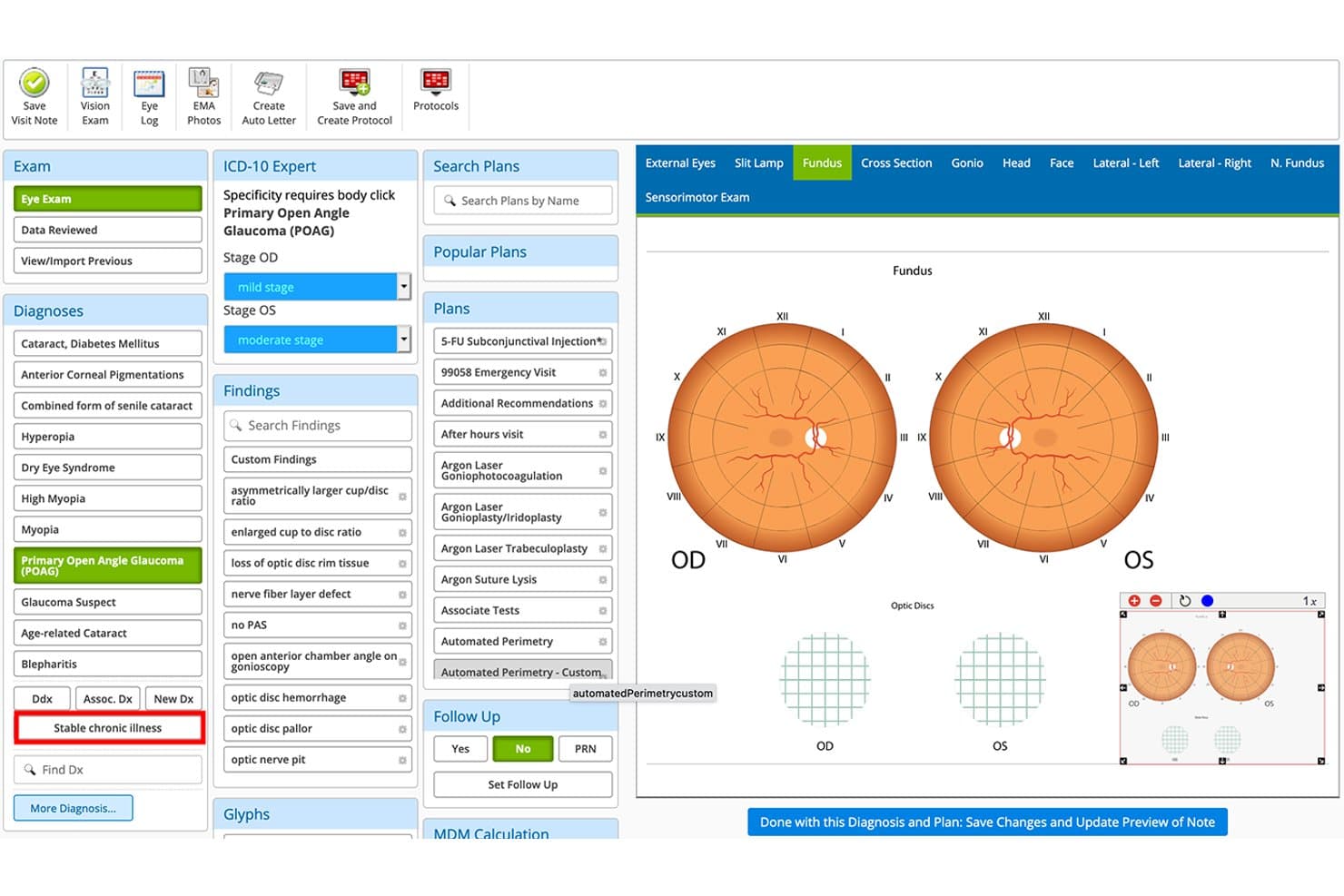
Eyefinity offers a comprehensive diagnosis and treatment planning interface with ICD-10 coding, fundus diagrams, and billing plan selection for glaucoma management. Eyefinity is a cloud-based practice management and billing platform built exclusively for eye care practices, combining VSP-native claim submission, ERA automation, optical dispensary invoicing, and EHR in a single system.
Who Is Eyefinity Best For?
Eyefinity is a strong fit for independent optometry practices that bill heavily through VSP and need optical dispensary and exam billing managed in one platform.
Why I Picked Eyefinity
Eyefinity earns its spot on my shortlist because no other platform connects VSP claims, optical dispensary billing, and exam coding in a single workflow the way Encompass does. I like that the VSP interface handles real-time eligibility, bulk authorizations, and ERA posting without leaving the system. EncompassScribe also suggests CPT codes directly from clinical notes, so billing codes stay accurate from the exam room through to claim submission.
Eyefinity Key Features
- Automated VSP eligibility checks: Instantly confirms patient coverage and authorizations for VSP plans within the workflow.
- Integrated optical inventory management: Tracks frames, lenses, and contacts, syncing inventory with patient orders and insurance allowances.
- HIPAA and SOC 2 Type 2 security: Safeguards protected health information and meets rigorous compliance standards for eye care practices.
- Patient engagement tools: Offers appointment scheduling, two-way texting, and digital forms directly linked to the billing and management system.
Eyefinity Integrations
Eyefinity offers native integrations with VSP Vision Care, TriZetto, NextGen Enterprise EHR/PM, OfficeMate, EyeScape Digital Imaging Systems, Optos, Zeiss FORUM, Worldpay, Optify, Demandforce, and ABB Optical Group. An API is available for custom integrations.
Pros and Cons
Pros:
- CPT and ICD-10 code suggestions from EHR
- Optical inventory synced with billing workflow
- VSP claims and authorizations handled natively
Cons:
- Reporting options are complex and nonintuitive
- Limited native support for EyeMed and Davis
Learn more about Eyefinity: Best for optometry practice management
- Free demo available
- Pricing upon request
Visit WebsiteCustomer Rating:4.1/5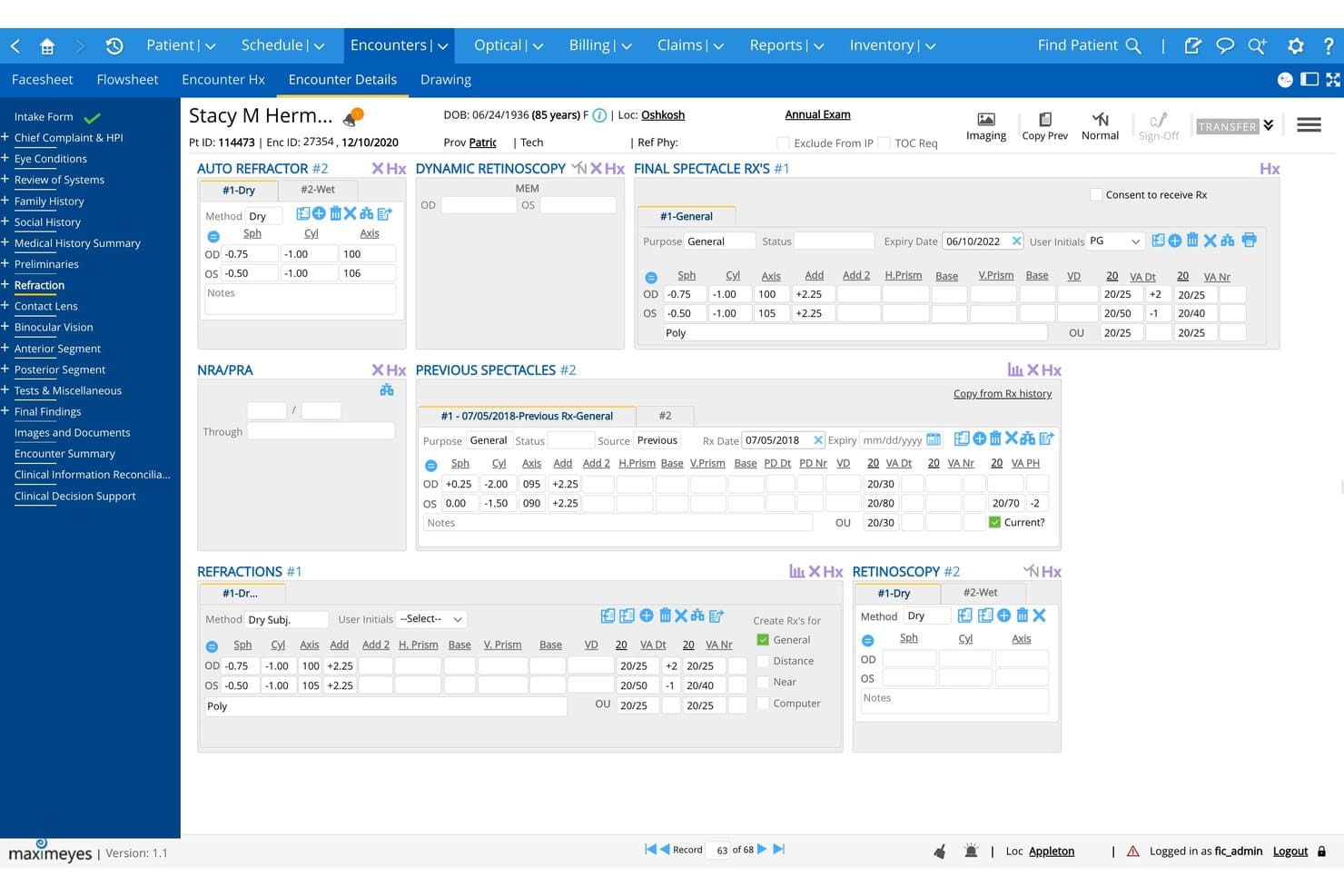
MaximEyes offers a detailed refraction and spectacle prescription management screen within its vision medical billing and EHR platform. MaximEyes is an eye care-specific EHR and practice management platform that combines medical and vision plan billing, optical point-of-sale, eligibility verification, claims submission, and denial management for optometry and ophthalmology practices.
Who Is MaximEyes Best For?
MaximEyes is a strong fit for independent and small-to-mid-size optometry and ophthalmology practices managing both vision plan and medical insurance billing in-house.
Why I Picked MaximEyes
MaximEyes earns its spot on my shortlist because no other platform I've reviewed is built this specifically around optometry billing workflows. I especially like the built-in VSP calculator and the EVAA AI billing assistant, which automates eligibility verification and flags unused vision benefits before they expire. In practice, that means my billing team can confirm coverage before a patient's exam rather than chasing denials after the fact.
MaximEyes Key Features
- Specialty claim scrubbing: Applies ophthalmology and optometry-specific billing rules to claims before submission to prevent denials.
- Optical point-of-sale integration: Connects frame, lens, and contact lens sales directly to patient billing and insurance claims.
- Real-time vision and medical eligibility: Checks eligibility and benefits instantly with both medical and major vision carriers.
- Automated denial worklists: Creates follow-up lists for denied vision or medical claims and tracks accounts receivable aging.
MaximEyes Integrations
MaximEyes offers native integrations with the American Optometric Association MORE Registry, American Academy of Ophthalmology IRIS Registry, and Mango Voice. An API is available for custom integrations.
Pros and Cons
Pros:
- Built-in optical point-of-sale links to billing
- Automated eligibility checks for major vision payers
- Dual medical and vision billing in one workflow
Cons:
- Occasional delays with carrier eligibility responses
- Reporting customization can be limited
Learn more about MaximEyes: Best for cloud-based optical management
- Free demo available
- From $259/month
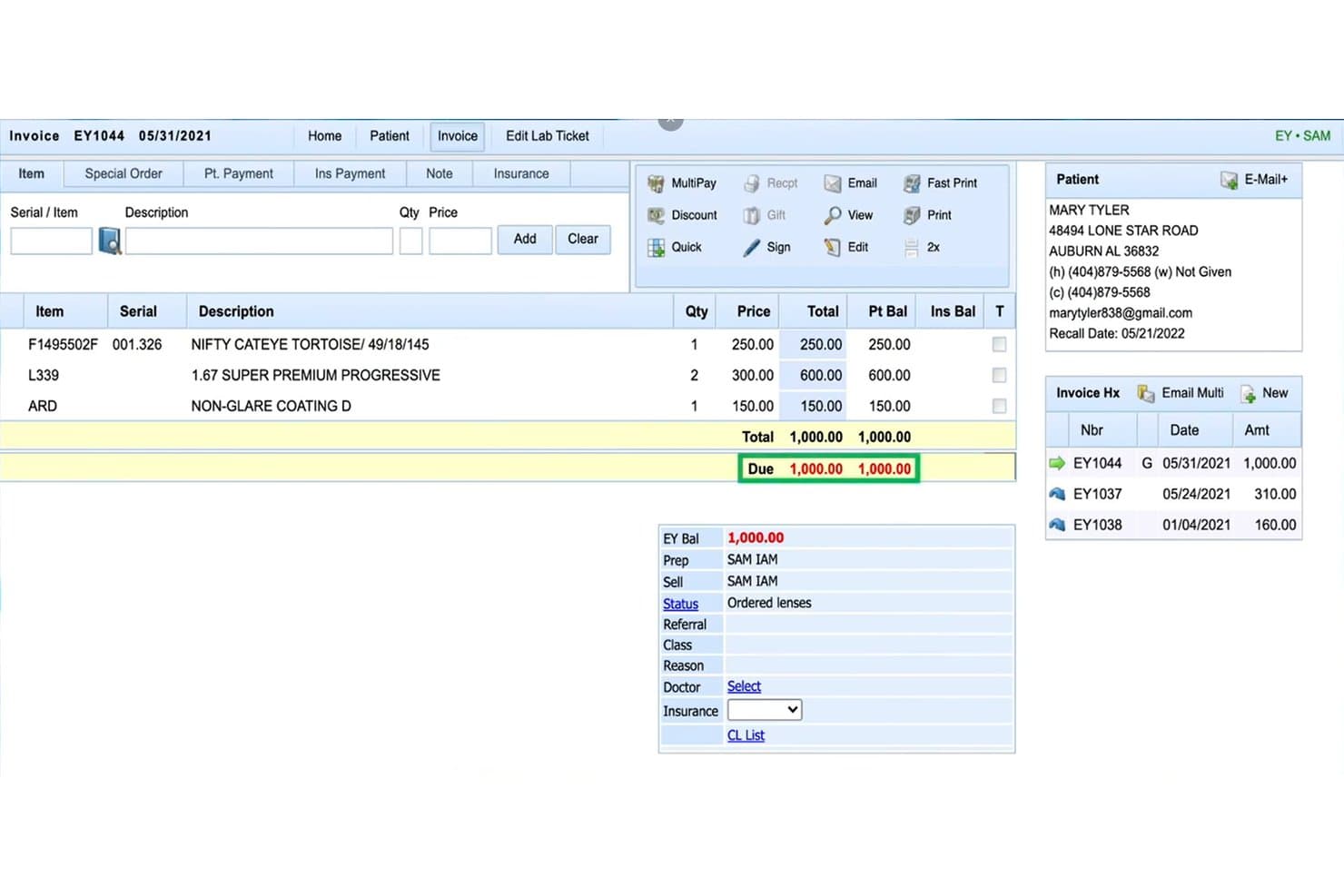
Eye Cloud Pro offers a detailed invoice screen displaying patient billing items, totals, insurance balance, and invoice history for vision care services. Eye Cloud Pro is a cloud-based practice management and billing platform built specifically for optometry, combining EHR, insurance claims processing, optical POS, and inventory management in one system.
Who Is Eye Cloud Pro Best For?
Eye Cloud Pro is a strong fit for independent optometry practices and multi-location optical clinics that need billing, EHR, and optical retail managed in one platform.
Why I Picked Eye Cloud Pro
Eye Cloud Pro earns its spot on my shortlist because its cloud-based architecture means I can pull up a patient's exam record, optical order, and insurance claim status from any device. The optical POS connects directly to patient records and frame inventory, so a dispensary sale and its associated insurance billing move together rather than being entered separately. I also appreciate the automated contact lens ordering through ABB and OOGP, which, paired with VisionWeb lab tracking, keeps the full fulfillment cycle visible in one view.
Eye Cloud Pro Key Features
- CPT monitoring and audit tools: Tracks specialty eye care codes and reviews claims for coding accuracy.
- Integrated clearinghouse connectivity: Submits medical claims electronically and processes ERAs within the platform.
- Revenue and accounts receivable reporting: Provides dashboards and reports for tracking claim statuses and outstanding balances.
- Patient scheduling with eligibility checks: Schedules visits while verifying insurance eligibility in real time.
Eye Cloud Pro Integrations
Eye Cloud Pro offers native integrations with VisionWeb, ABB, OOGP, Surescripts, Ensora Clearinghouse, Optify, Nassau, Apex, and Fullsteam. An API is available for custom integrations.
Pros and Cons
Pros:
- Automated contact lens and lab ordering
- Built-in optical POS and inventory modules
- Cloud-based access for all staff roles
Cons:
- Limited denial management automation
- No native VSP claims integration
Learn more about Eye Cloud Pro:
Other Vision Medical Billing Software
Here are some additional vision medical billing software options that didn’t make it onto my shortlist, but are still worth checking out:
- 11MedflowBest for ophthalmology clinical workflows
- 12iTrustBest for independent optometry practices
- 13AdvancedMDBest for integrated ophthalmology billing
- 14JeloBest for optometry billing workflows
How I Evaluate Vision Medical Billing Software
I split my evaluation into two layers—baseline requirements like dual vision/medical billing and eye care coding support, and the differentiators that set each platform apart.
Core Functionality (Table Stakes For This List)
When I'm selecting tools for my list, I rank each one on a scale from 0 (does not offer the functionality) to 5 (excels in this area) for each core functionality listed below. Then, I calculate the tool's total score into a percentage. Each tool needs to achieve a minimum total score of 65% to be considered for inclusion.
- Dual Vision/Medical Billing: I check whether a platform can process vision plan claims and medical insurance claims in a single workflow, especially for split encounters where a routine exam and a medical diagnosis occur in the same visit.
- Eye Care Coding Support: Pre-loaded ophthalmology and optometry CPT, HCPCS, and ICD-10 codes matter here, along with scrubbing rules that catch common bundling errors before submission.
- Vision Plan Eligibility Verification: I look for real-time eligibility checks against both vision carriers like VSP and EyeMed and medical payers, so front-desk staff can confirm benefits before the patient sits in the exam chair.
- Claims Submission & ERA Processing: Electronic 837 submission paired with automated 835 remittance posting is what I evaluate, since manual ERA posting creates bottlenecks that slow down cash flow.
- Optical & Exam Invoicing: The platform should handle patient billing for dispensary items like frames, lenses, and contacts alongside professional exam charges, with insurance allowance tracking built in.
- Denial Management & AR Reporting: I look for denial worklists and AR aging reports that help billers prioritize follow-ups, especially for common ophthalmic denial patterns like medical necessity edits.
Once I have a list of tools that meet the criteria, I consider what sets each platform apart.
Differentiating Factors (What Sets Vendors Apart)
Here's how I compare and contrast different vendors:
Standout Features
Dual medical/vision plan routing is a big differentiator. The best platforms automatically determine whether a visit bills to a vision plan or a medical payer and split the claim when both apply in a single encounter. I also evaluate how tightly optical dispensary sales connect to claims—when frame and lens purchases flow into patient invoices with allowance tracking, billers avoid duplicate entry. Pre-submission scrubbing tuned to ophthalmic denial patterns like bundling and LCD/NCD edits is another area where I see real variation between vendors.
Beyond Features
Practice type matters—a solo OD office has very different needs than a multi-location ophthalmology group handling cataract and injection billing with J-codes. I evaluate whether a platform scales across those scenarios. EHR integration is just as important; I check whether exam data and superbills flow into claims without manual re-entry from systems like RevolutionEHR or Compulink. Payer connectivity is another factor I consider, particularly direct connections to major vision plans beyond standard medical clearinghouses.
How to Choose Vision Medical Billing Software
It’s easy to get bogged down in long feature lists and complex pricing structures. To help you stay focused as you work through your unique software selection process, here’s a checklist of factors to keep in mind:
| Factor | What to Consider |
| Scalability | Will the software support your growth—from a solo practice to multiple locations or specialties? |
| Integrations | Does it work with your existing EHR, optical POS, clearinghouse, and lab ordering systems? |
| Customizability | Can workflows, codes, and reporting be tailored for your unique payer and procedure mix? |
| Ease of use | Will your team need extensive training, or is the system intuitive enough for new front office staff? |
| Implementation and onboarding | How long will it take to get up and running, and what kind of migration or training support is included? |
| Cost | Are costs predictable with transparent pricing—or could unexpected fees increase your total spend? |
| Security safeguards | Is the system HIPAA compliant and are there controls for sensitive financial and patient data? |
| Support availability | What hours and channels is support available—can your team get help after hours or during busy periods? |
What Are Vision Medical Billing Software?
Vision medical billing software is designed to help eye care practices manage insurance claims, patient billing, and payments for both vision and medical services. These platforms handle dual claims for vision plans and medical payers, automate specialty coding, verify eligibility, and track optical and exam charges, reducing administrative burden for busy clinics.
Features of Vision Medical Billing Software
When selecting vision medical billing software, keep an eye out for the following key features:
- Dual billing workflow: Supports simultaneous claim submission to both vision plans and medical insurance, reducing manual work and billing confusion.
- Specialty coding library: Includes updated ophthalmology and optometry CPT, HCPCS, and ICD-10 codes, helping your team select correct codes for each type of visit or procedure.
- Real-time eligibility checks: Instantly verifies a patient’s coverage and benefits for both vision and medical payers, so surprises are avoided at check-in.
- Claims submission and ERA integration: Automates electronic claim submission (837 files) and electronic remittance posting (835), speeding up the reimbursement process.
- Optical POS and inventory integration: Connects frame, lenses, and contact sales to billing, allowing direct invoicing and tracking of insurance allowances or out-of-pocket payments.
- Denial management tools: Flags, tracks, and organizes denied or underpaid claims, supporting worklists for fast follow-up and appeals.
- Patient balance and invoicing management: Generates clear statements for out-of-pocket costs on exams and optical items, helping collect payments faster and improve communication with patients.
- Reporting and analytics: Provides dashboards and reports for monitoring claim status, accounts receivable, and financial KPIs relevant to eye care practices.
- Appointment and exam linking: Associates charges with specific exam encounters, making sure every service and material gets billed to the right payer.
- Security and compliance controls: Ensures sensitive patient and billing data are protected and meets HIPAA and healthcare industry requirements.
Benefits of Vision Medical Billing Software
Implementing vision medical billing software provides several benefits for your team and your business. Here are a few you can look forward to:
- Faster reimbursement: Automated claim submission to both vision and medical payers helps your practice reduce turnaround time for payments.
- Fewer denials and errors: Real-time eligibility checks, built-in coding libraries, and claim scrubbing features minimize costly mistakes and rejected claims.
- Streamlined dual billing: Support for split encounters and insurance routing makes it easier to manage complex visits where both medical and vision plans are involved.
- Improved patient collections: Clear invoicing and integrated optical POS help staff accurately calculate and collect payments at checkout.
- Enhanced visibility into revenue: Custom reporting and AR dashboards allow office managers to easily monitor financial performance and spot areas for improvement.
- Better compliance and security: HIPAA-compliant workflows and security features protect sensitive patient and payment information.
- Greater staff productivity: Intuitive interfaces and automated workflows help your team focus more on patient care and less on administrative tasks.
Costs and Pricing of Vision Medical Billing Software
Selecting vision medical billing software requires an understanding of the various pricing models and plans available. Costs vary based on features, team size, add-ons, and more. The table below summarizes common plans, their average prices, and typical features included in vision medical billing software solutions:
Plan Comparison Table for Vision Medical Billing Software
| Plan Type | Average Price | Common Features |
| Free Plan | $0 | Basic claim entry, patient invoicing, limited reporting, and manual eligibility checks. |
| Personal Plan | $30-$100/user/month | Dual billing support, built-in eye care codes, real-time eligibility, basic AR tracking, and simple analytics. |
| Business Plan | $200-$400/location/month | Integrated clearinghouse, optical inventory, automated ERAs, denial management, batch eligibility, and better reporting. |
| Enterprise Plan | $500+/location/month | Custom workflows, advanced analytics, premium support, EHR integration, large-scale scalability, and RCM services. |
Vision Medical Billing Software FAQs
Here are some answers to common questions about vision medical billing software:
Can vision medical billing software handle both vision and medical claims?
Yes, most solutions support dual billing workflows, letting you submit claims to vision plans and medical insurance for the same patient visit. This is essential for encounters where a routine eye exam uncovers a medical diagnosis requiring separate claims.
What integrations should I look for with vision medical billing software?
Look for integrations with your EHR, optical POS, clearinghouses, and inventory systems. Connecting these tools means patient data, exam charges, and optical sales flow directly into billing without double entry.
How much training will my staff need to use a new billing system?
Training needs depend on your team and the platform’s usability. Most vendors offer onboarding, workflow guides, and specialty-specific training sessions to help billers and front desk staff get comfortable with new processes.
How does real-time eligibility checking work?
Real-time eligibility features let you instantly verify a patient’s vision and medical insurance, surfacing benefits, copays, and allowances before or during check-in. This reduces denied claims and makes it easier to collect payment upfront.
What kind of reporting is included in vision medical billing software?
These platforms usually provide dashboards and reports for claim status, accounts receivable, revenue metrics, and financial KPIs tailored to eye care practices. Advanced plans may offer custom analytics for business oversight.