

Healthcare reputation management software gives your practice a way to collect, monitor, and act on patient feedback across review sites, surveys, and directory listings.
If you’re looking for the right tool, you’re probably juggling patient trust, compliance requirements, and the reality that a single negative review can drive real business impact.
In this guide, you’ll find options for automating review requests, supporting multi-location practices, handling regulatory demands, and integrating with EHR systems—so you can focus on care, not just your online presence.
Why Trust Our Software Recommendations
6,700+
Reviews
20
Industry experts
16+
Evaluation factors
14
Years
Our team has been testing and reviewing software since 2012. As medical practice leaders ourselves, we know how difficult—and important—it is to choose the right software.
For this guide, we evaluated tools using hands-on testing and independent research, scoring tools using our selection criteria.
Our reviews reflect our human editorial judgment, not a sales pitch.
Healthcare Reputation Management Comparison Table
This comparison table summarizes pricing details for my top healthcare reputation management selections:
| Tool | Best For | Trial Info | Price | ||
|---|---|---|---|---|---|
| 1 | Best for low-cost HIPAA-tier multi-location tracking | Free trial + free demo available | From $63/location/month (billed monthly or annually) | Website | |
| 2 | Best for post-appointment review requests | Free demo available | From $249/month | Website | |
| 3 | Best for EHR-integrated review management | Free demo available | Pricing upon request | Website | |
| 4 | Best for healthcare listings and directories | Free demo available | From $80/location/month | Website | |
| 5 | Best for automated multi-channel review requests | Free demo available | Pricing upon request | Website | |
| 6 | Best for centralized multi-location reviews | Free demo available | Pricing upon request | Website | |
| 7 | Best for patient review automation via text | Free demo available | Pricing upon request | Website | |
| 8 | Best for reviews tied to patient communication | Free demo available | Pricing upon request | Website | |
| 9 | Best for compliant patient feedback workflows | Free demo available | Pricing upon request | Website | |
| 10 | Best for provider-level reputation analytics | Free plan available | From $89/month | Website |


Healthcare Reputation Management Software Reviews
Below are my detailed summaries of the best healthcare reputation management software that made it onto my shortlist. My reviews offer a detailed look at the features, best use cases, and integrations of each platform to help you find the best one for you.
 Best for low-cost HIPAA-tier multi-location tracking
- Free trial + free demo available
- From $63/location/month (billed monthly or annually)
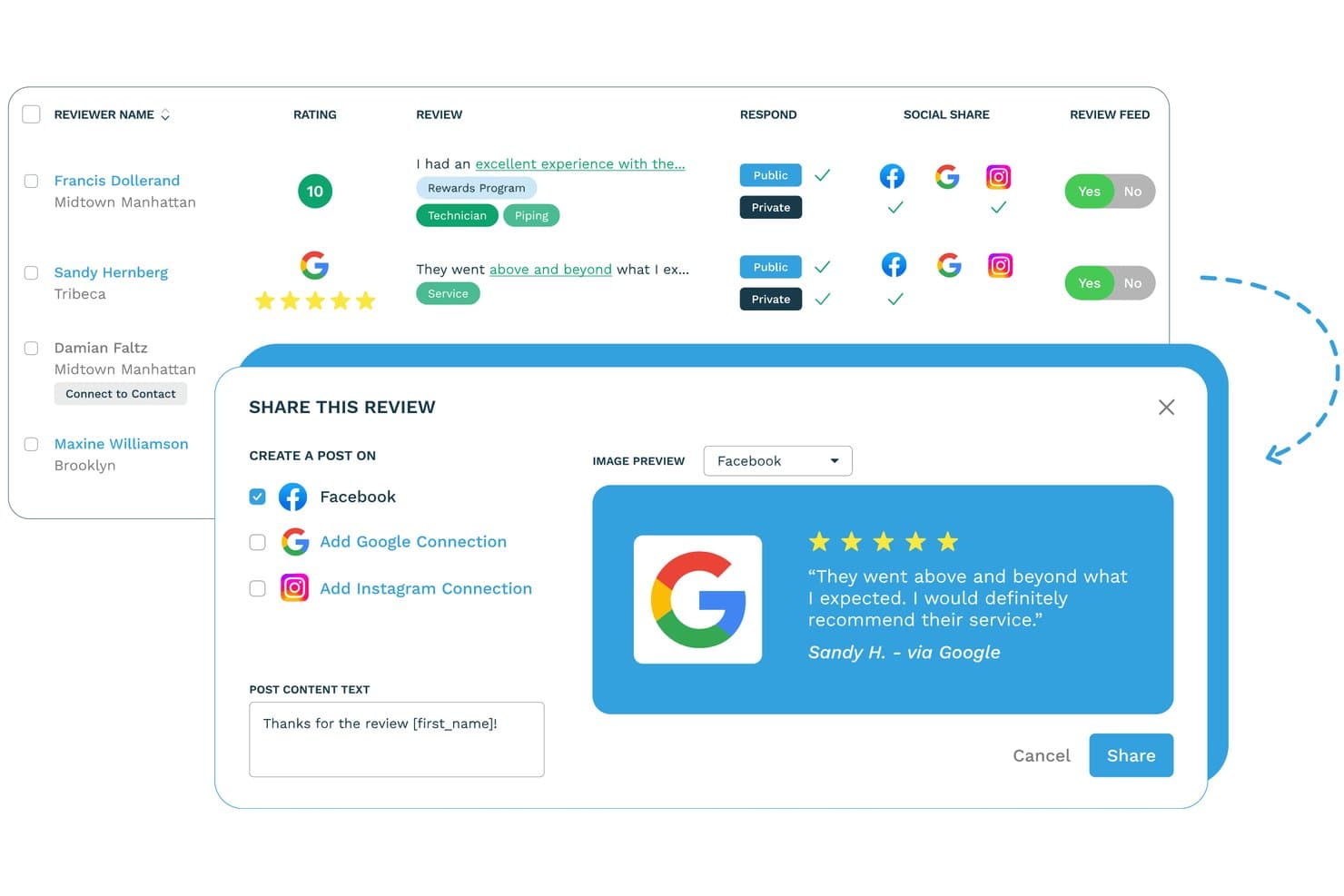
ReputationStacker lets users share patient reviews directly to social media. ReputationStacker is a general-purpose reputation management platform that automates patient review requests, monitors reviews across 100+ sites, and provides AI-driven sentiment analysis and multi-location reporting.
Who Is ReputationStacker Best For?
ReputationStacker is a strong fit for multi-location practice owners who want HIPAA-tier review automation and sentiment tracking without paying enterprise-level prices.
Why I Picked ReputationStacker
I've included ReputationStacker in my top picks because it delivers HIPAA-compliant review automation and multi-location tracking at a price point most healthcare-specific platforms can't touch. The Professional plan includes a BAA and gives each provider or location its own performance dashboard, so a group practice can compare sites side by side without losing individual visibility. I particularly like the AI sentiment analysis, which auto-categorizes patient feedback by themes like staff behavior and service quality across every location at once.
ReputationStacker Key Features
- Smart review funnel: Sends patients a one-question NPS survey after a visit, then routes them to the review sites you've selected based on their response.
- Automated review request reminders: Follows up automatically with patients who haven't responded to an initial review request, without any manual effort on your end.
- AI-drafted review replies: Generates reply suggestions that learn from your past responses, with adjustable tone settings and an option to auto-post or require manual approval.
- Custom user permissions: Lets you control access at the location level so individual providers or staff only see the data relevant to them.
ReputationStacker Integrations
ReputationStacker has direct integrations with Google and Facebook for in-app review replies. It supports custom connections through a REST API and Zapier, but native EHR/PMS integrations are not documented.
Pros and Cons
Pros:
- AI sentiment analysis highlights patient feedback themes
- Provider-level dashboards support multi-location oversight
- HIPAA-tier BAA available for healthcare teams
Cons:
- Review monitoring updates about once daily
- No documented audit logs or SOC 2
Learn more about ReputationStacker: Best for post-appointment review requests
- Free demo available
- From $249/month
Visit WebsiteCustomer Rating:4.8/5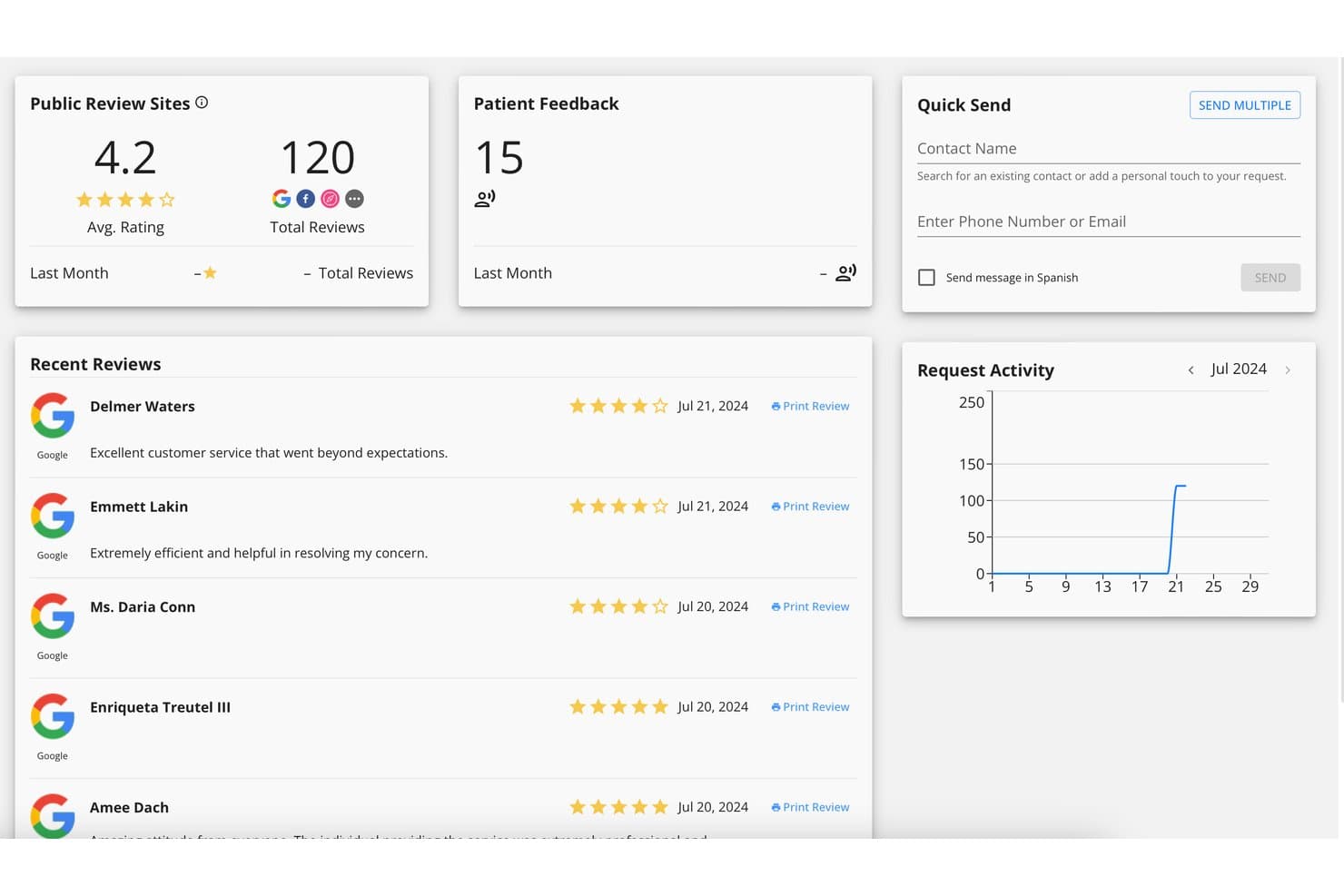
Doctible offers a centralized review management dashboard displaying public ratings, patient feedback, recent Google reviews, request activity charts, and a quick send messaging tool for healthcare providers. Doctible is a healthcare reputation management platform that automates SMS-based review requests, monitors patient reviews across online platforms, and routes negative feedback privately before it reaches public-facing directories.
Who Is Doctible Best For?
Doctible is a strong fit for dental, orthodontic, optometry, and chiropractic practices — from single-location offices to multi-site DSOs and MSOs.
Why I Picked Doctible
I picked Doctible as one of the best because of how it handles the post-appointment review workflow. Once an appointment wraps up, Doctible automatically sends an SMS from the practice's own office phone number to ask about the patient's experience. Patients with positive feedback get routed to Google or Facebook to leave a public review, while those with complaints send feedback directly and privately to the office instead.
Doctible Key Features
- Practice management system integrations: Connects with popular dental, orthodontic, optometry, and chiropractic software to automate feedback workflows.
- HIPAA-compliant patient texting: Allows for secure, two-way messaging with patients from the practice’s main office number.
- Centralized review dashboard: Lets staff monitor total reviews, average ratings, and review trends for all office locations.
- Automated recall and email campaigns: Schedules recall reminders and sends targeted patient communications directly through the platform.
Doctible Integrations
Doctible offers native integrations with practice management systems like Dentrix, Dentrix Enterprise, EagleSoft, Open Dental, Curve Dental, Ortho2, ChiroTouch, Compulink, Dolphin Management, and Practice-Web. An API is available for custom integrations.
Pros and Cons
Pros:
- Deep PMS support for specialty dental practices
- Keeps negative patient feedback off public sites
- Review requests sent from the practice number
Cons:
- Narrower specialty focus limits hospital system use
- Reporting lacks depth for multi-location enterprises
Learn more about Doctible: Best for EHR-integrated review management
- Free demo available
- Pricing upon request
Visit WebsiteCustomer Rating:4.8/5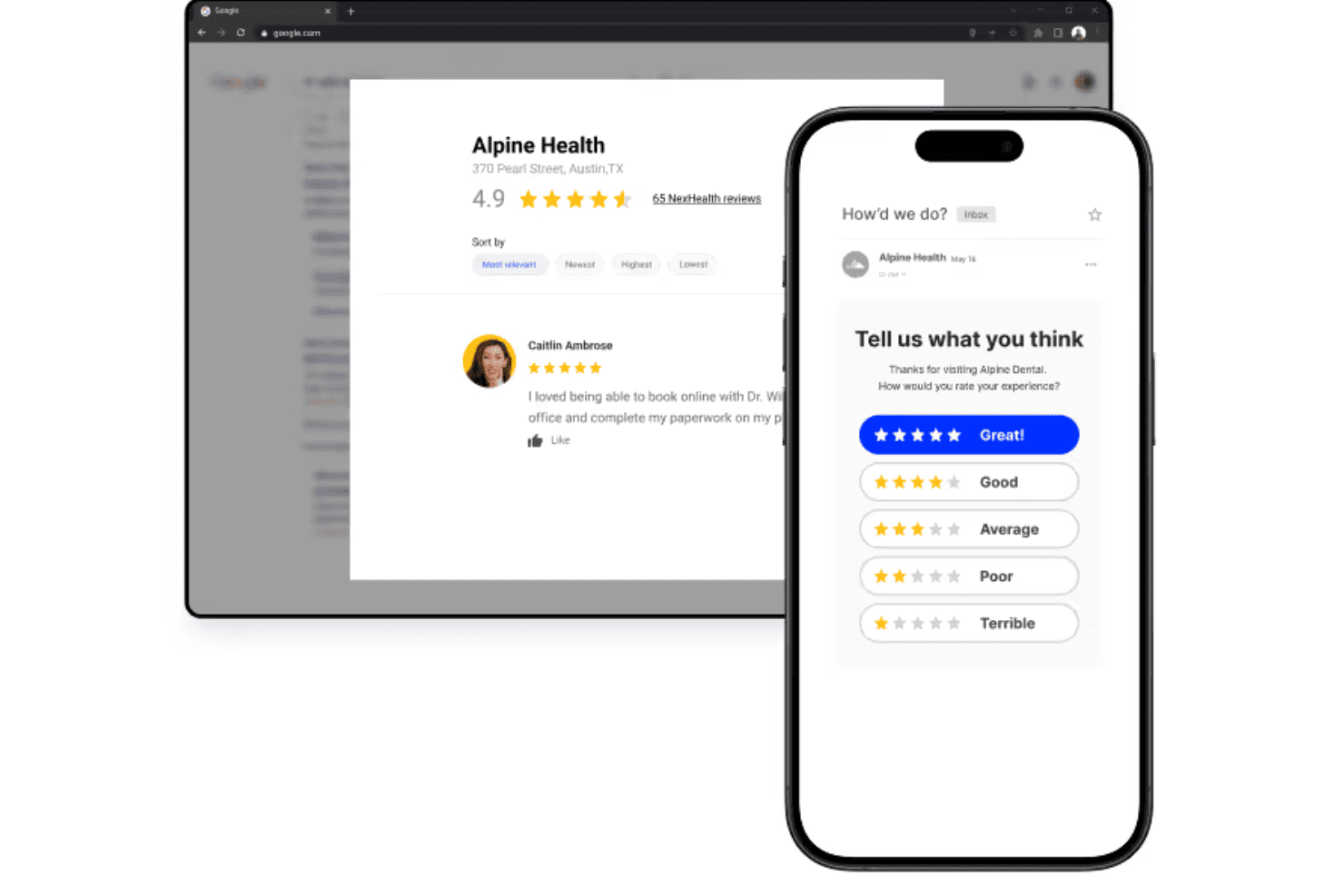
NexHealth automates review requests and routes patient feedback after appointments. NexHealth is a patient experience platform that connects directly to your EHR or practice management system to automate post-visit review requests, route positive feedback to Google, and capture negative responses privately.
Who Is NexHealth Best For?
NexHealth is a strong fit for small to mid-sized dental and medical practices that are already using an EHR or PMS and want to automate patient review generation without adding a separate standalone tool.
Why I Picked NexHealth
I've included NexHealth in my top picks because its review automation runs directly on real-time EHR data, not a manual patient list upload. I like that Appointment Journeys let you trigger review requests by appointment type, so a post-procedure visit gets a different request than a routine checkup. The sentiment-gating is also well-designed: positive reviewers route straight to Google, while anything three stars or below lands in a private dashboard for offline follow-up.
NexHealth Key Features
- EHR synchronizer integration: Syncs appointment and patient data with over 75 major EHR and practice management systems.
- Customizable review templates: Allows you to tailor review request content by appointment type or visit.
- Private feedback dashboard: Collects and stores negative feedback internally for practice review and follow-up.
- Multi-channel review invitations: Delivers review requests to patients via both SMS and email automatically.
NexHealth Integrations
NexHealth offers native integrations with over 75 EHR and practice management systems, including Epic, Dentrix, Eaglesoft, Open Dental, eClinicalWorks, athenahealth, DrChrono, and ModMed. An API is also available for custom integrations.
Pros and Cons
Pros:
- Provider-level review tracking across multiple locations
- Sentiment gating routes negative feedback privately
- EHR-triggered review requests are highly automated
Cons:
- Less suited for large hospital networks
- Reporting dashboards are relatively basic
Learn more about NexHealth: Best for healthcare listings and directories
- Free demo available
- From $80/location/month
Visit WebsiteCustomer Rating:4.6/5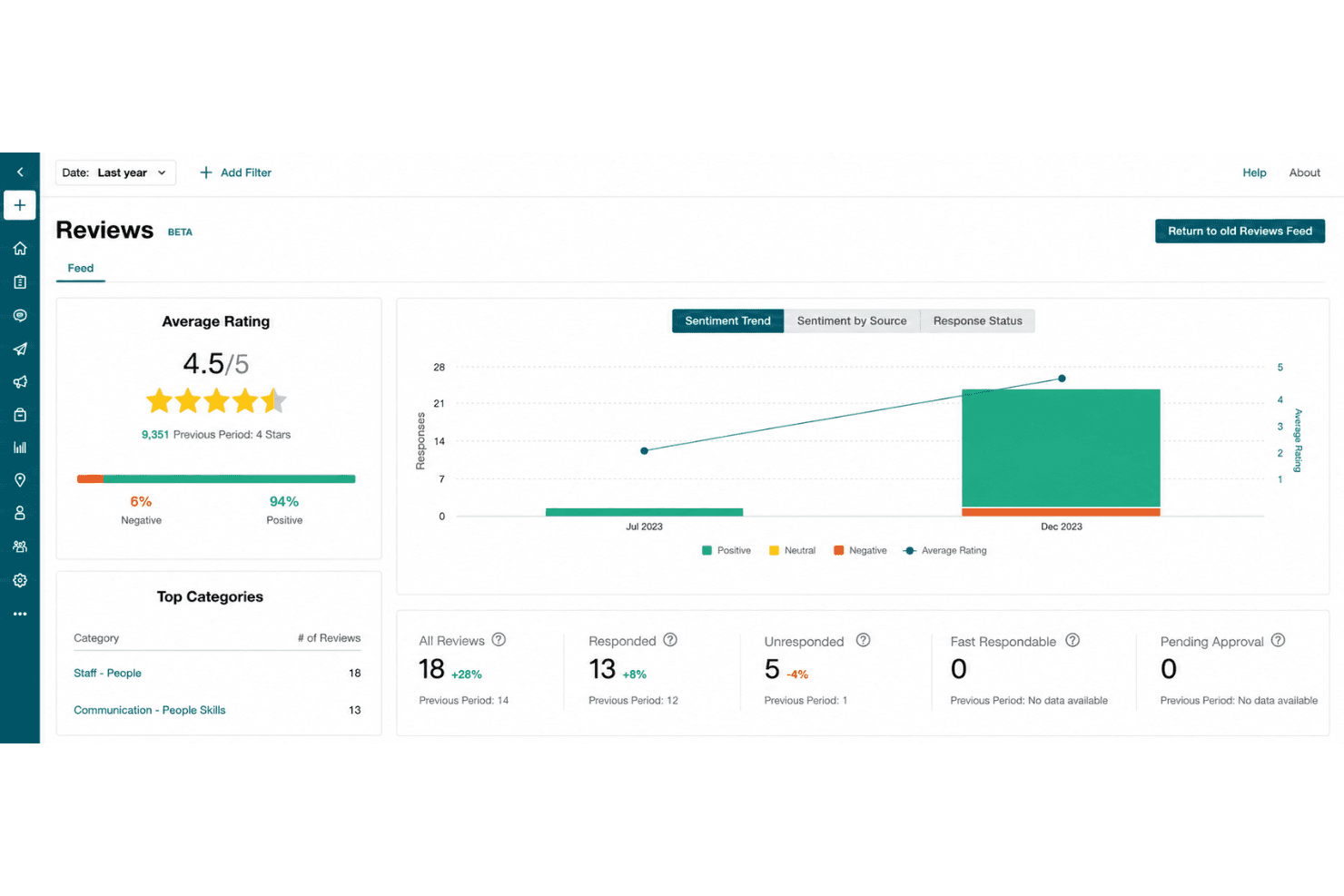
Reputation.com offers a Reviews dashboard with average ratings, sentiment trends, response tracking, and top categories for managing patient feedback. Reputation.com is an AI-native reputation management platform for multi-location healthcare organizations, covering review monitoring, listing management, patient surveys, and provider-level sentiment analysis across 100+ directories.
Who Is Reputation.com Best For?
Reputation.com is a strong fit for enterprise health systems and large multi-location medical groups managing provider reputation across dozens or hundreds of sites.
Why I Picked Reputation.com
I picked Reputation.com as one of the best because of how it handles listings at scale across 100+ healthcare directories. Provider profiles, hours, services, and conditions are all maintained from a single platform, which means a health system with 80 clinic locations isn't manually updating Vitals, Healthgrades, and Google separately. I also like the AI Engine Optimization (AEO) layer, which analyzes how large language models surface provider information and flags structured data gaps.
Reputation.com Key Features
- HIPAA-compliant surveys: Collect patient satisfaction data with workflows that safeguard PHI.
- RepScore sentiment dashboards: Visualize trends in patient sentiment by location, region, or service line.
- Competitive Insights: Benchmark ratings and feedback volume against other providers and health systems.
- AI-powered review response templates: Respond to patient feedback using tailored, AI-suggested replies for various review scenarios.
Reputation.com Integrations
Native integrations are not clearly documented. The tool supports integrations through its API for custom connections.
Pros and Cons
Pros:
- HIPAA-compliant survey and messaging workflows included
- Provider-level reputation scoring with peer benchmarking
- Syndicates listings across 100+ healthcare directories
Cons:
- Customer support response times can lag
- Long onboarding process for enterprise health systems
Learn more about Reputation.com: Best for automated multi-channel review requests
- Free demo available
- Pricing upon request
Visit WebsiteCustomer Rating:4.8/5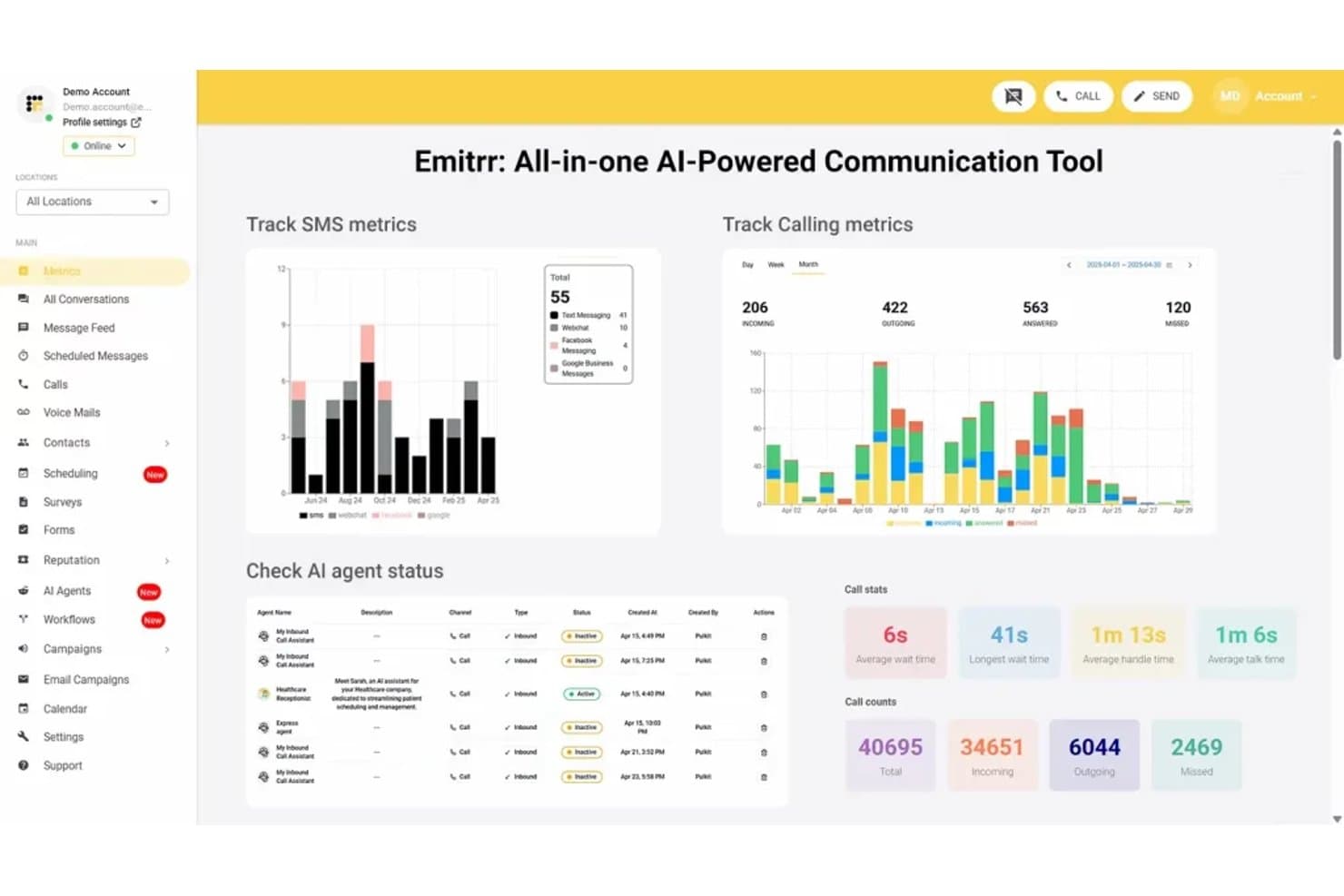
Emitrr offers an all-in-one AI-powered communication dashboard with SMS metrics, call tracking, and AI agent status monitoring for healthcare teams. Emitrr is a HIPAA-compliant patient communication and reputation management platform that automates review requests via SMS and email, monitors reviews across healthcare directories and general platforms, and centralizes review response across multiple locations.
Who Is Emitrr Best For?
Emitrr is a strong fit for small to mid-sized medical, dental, and healthcare practices that need a front-desk-friendly tool for managing patient reviews across multiple locations.
Why I Picked Emitrr
I picked Emitrr as one of the best because its appointment-triggered review requests go out via both SMS and email automatically, requiring no manual follow-up from front desk staff. What I particularly like is the smart redirect feature: if a patient already reviewed your practice on Google, Emitrr routes their next request to Healthgrades or Facebook. The task and ticket system also lets me assign incoming reviews to specific team members, so nothing slips through in a busy practice.
Emitrr Key Features
- Multi-location dashboard: Manage reviews, communications, and analytics for multiple practice locations in one unified interface.
- Healthcare directory monitoring: Track and manage patient reviews from Google, Facebook, Yelp, and Healthgrades within a centralized dashboard.
- HIPAA-compliant messaging: Send and receive patient messages that meet HIPAA security and privacy requirements across all workflows.
- Patient survey automation: Trigger automated patient feedback and satisfaction surveys following appointments or specific care events.
Emitrr Integrations
Emitrr offers native integrations with athenahealth, Dentrix, DrChrono, and eClinicalWorks, and provides an API for custom integrations.
Pros and Cons
Pros:
- Smart review redirect across multiple platforms
- HIPAA-compliant patient messaging built in
- Automated SMS and email review requests
Cons:
- Reporting depth is thin for enterprise practices
- Limited provider-level analytics and benchmarking tools
Learn more about Emitrr: Best for centralized multi-location reviews
- Free demo available
- Pricing upon request
Visit WebsiteCustomer Rating:4.8/5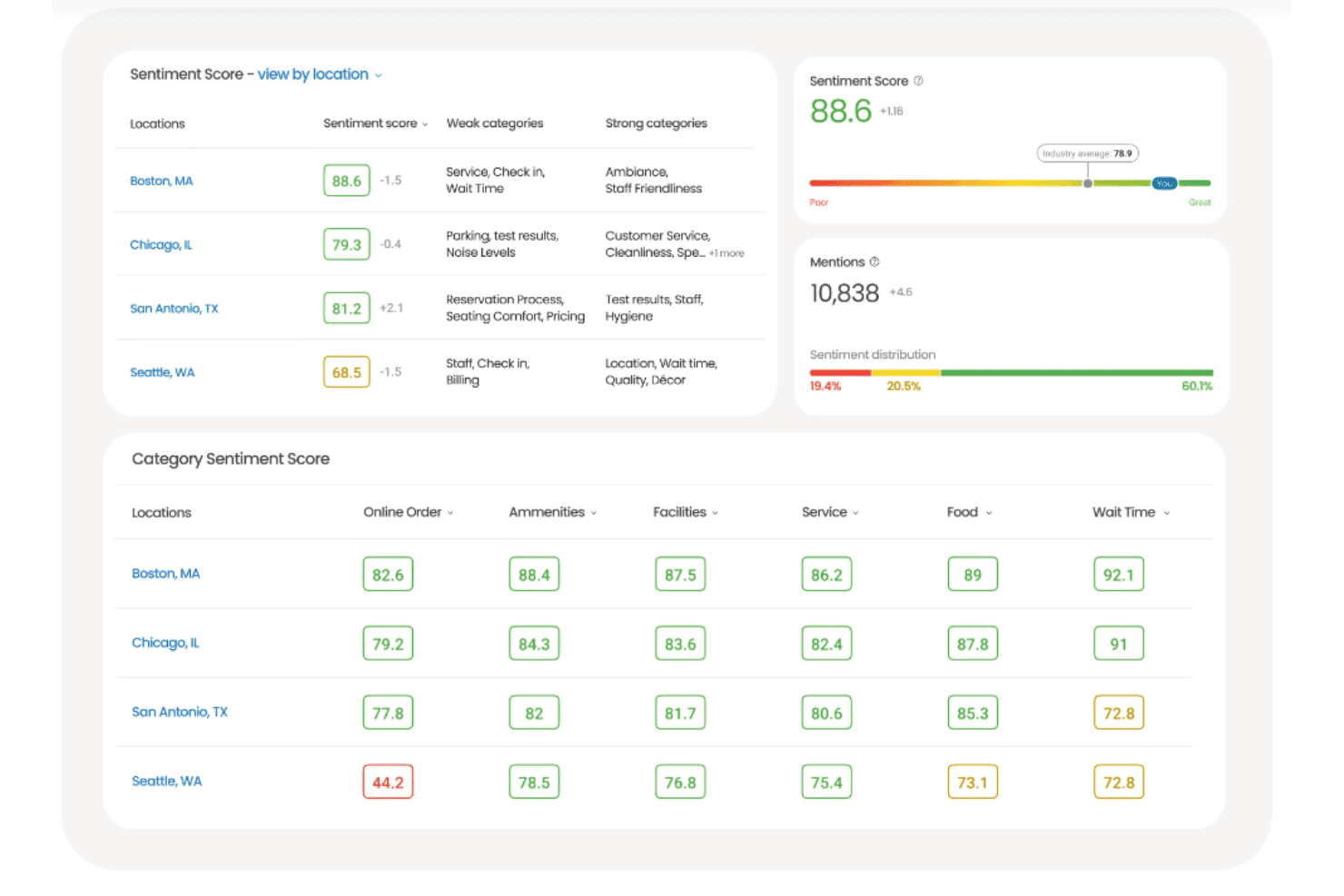
Birdeye monitors reviews, listings, patient feedback, and AI responses across 200+ sites. Birdeye is a healthcare reputation management platform that combines multi-location review monitoring, automated patient review requests, listing management, and AI-driven response tools across 200+ review sites.
Who Is Birdeye Best For?
Birdeye is a strong fit for multi-location healthcare organizations — think hospital networks, DSOs, and large group practices managing reputation across dozens or hundreds of locations.
Why I Picked Birdeye
Birdeye earns its spot on my shortlist because of how it handles review management at scale across dozens or hundreds of locations from a single dashboard. I particularly like the location-specific dashboards that let teams monitor and respond to patient reviews without logging into each location separately. The AI-driven response tools let you auto-respond by star rating or manually approve each reply, keeping brand voice consistent across every practice location.
Birdeye Key Features
- Listings AI: Update and sync practice information across hundreds of general and healthcare-specific directories.
- Surveys AI: Create customizable patient surveys with sentiment and trend analytics powered by AI.
- Competitors AI: Benchmark your organization's reputation and volume of reviews against local and specialty peers.
- Referrals module: Launch automated patient referral campaigns that track which patients send the most referrals.
Birdeye Integrations
Birdeye offers native integrations with athenahealth, Nextech, eClinicalWorks, DrChrono, NextGen, and Allscripts, and provides an open API for custom integrations.
Pros and Cons
Pros:
- Monitors reviews across 200+ healthcare directories
- HIPAA-compliant patient review request workflows included
- Strong provider-level reputation tracking across locations
Cons:
- AI responses require manual tuning initially
- Onboarding can be complex for large systems
Learn more about Birdeye: Best for patient review automation via text
- Free demo available
- Pricing upon request
Visit WebsiteCustomer Rating:4.5/5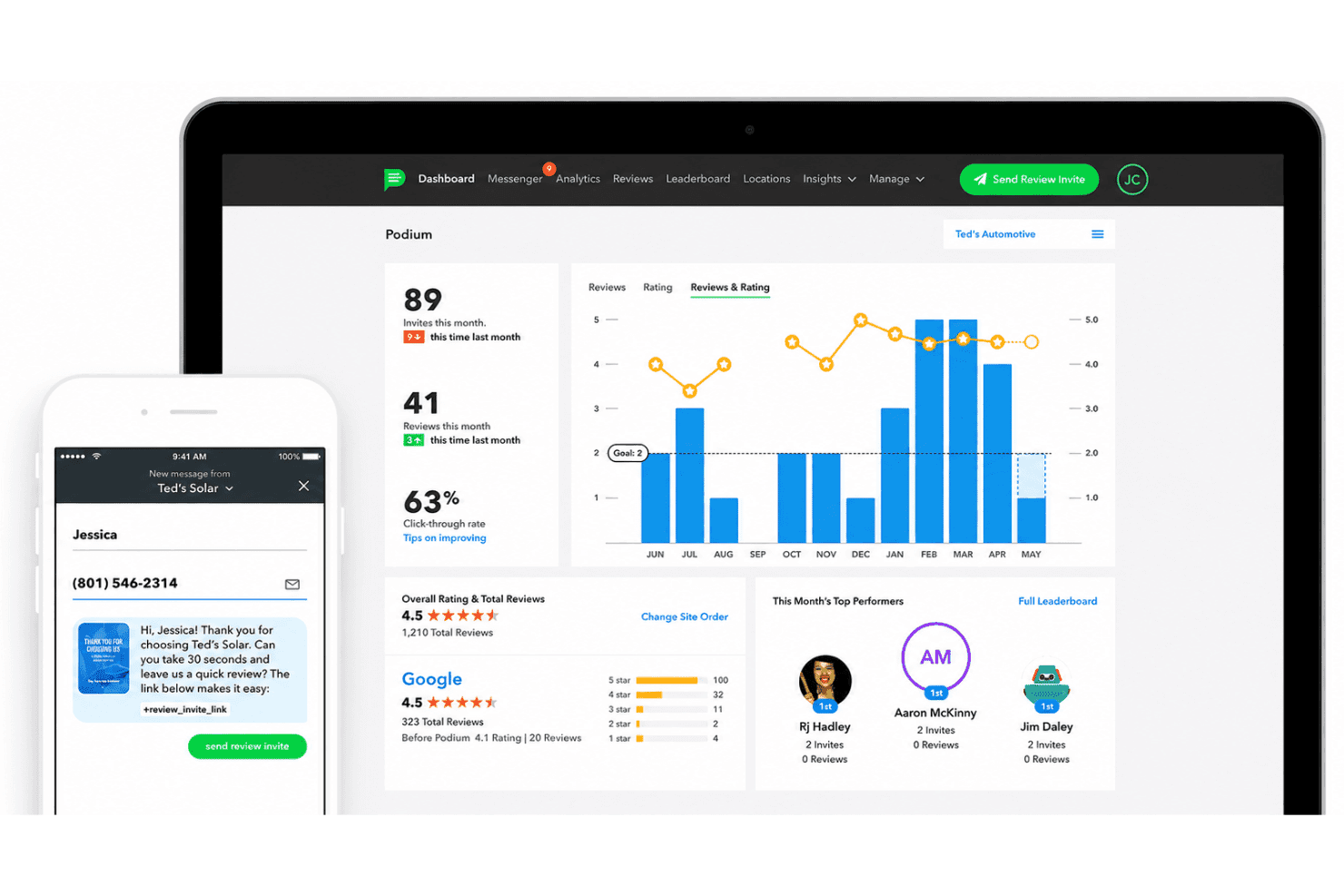
Podium centralizes patient reviews, SMS messaging, and feedback in one shared inbox. Podium is an SMS-first communication and review management platform that lets healthcare practices automate patient review requests, centralize messaging channels, and manage feedback from a single inbox.
Who Is Podium Best For?
Podium is a strong fit for small-to-mid-size dental and medical spa practices that prioritize Google review volume and want to manage patient communication over SMS.
Why I Picked Podium
I picked Podium as one of the best because its SMS-first review collection is the core of what it does, not a bolt-on feature. When a patient completes an appointment in Dentrix or Open Dental, Podium fires an automated text review request without any staff input. The AI Employee feature then drafts responses to incoming reviews directly inside the same unified inbox where all patient texts land.
Podium Key Features
- Unified inbox: View and respond to all patient messages, reviews, calls, and text conversations from a single dashboard.
- HIPAA-compliant messaging: Securely communicate with patients and safeguard PHI with optional BAA in place.
- Connecting with practice management systems: Sync appointment completions from systems like Dentrix and Open Dental to trigger review requests.
- Custom patient surveys: Design and send patient feedback surveys via text for tailored data collection.
Podium Integrations
Podium offers native integrations with Dentrix, Eaglesoft, and Open Dental, and connects with Zapier. An API is available for custom integrations.
Pros and Cons
Pros:
- Combines review management with patient messaging
- AI drafts responses to patient reviews
- Automated SMS review requests after appointments
Cons:
- Provider-level reporting lacks depth
- Limited healthcare-specific directory monitoring
Learn more about Podium: Best for reviews tied to patient communication
- Free demo available
- Pricing upon request
Visit WebsiteCustomer Rating:4.4/5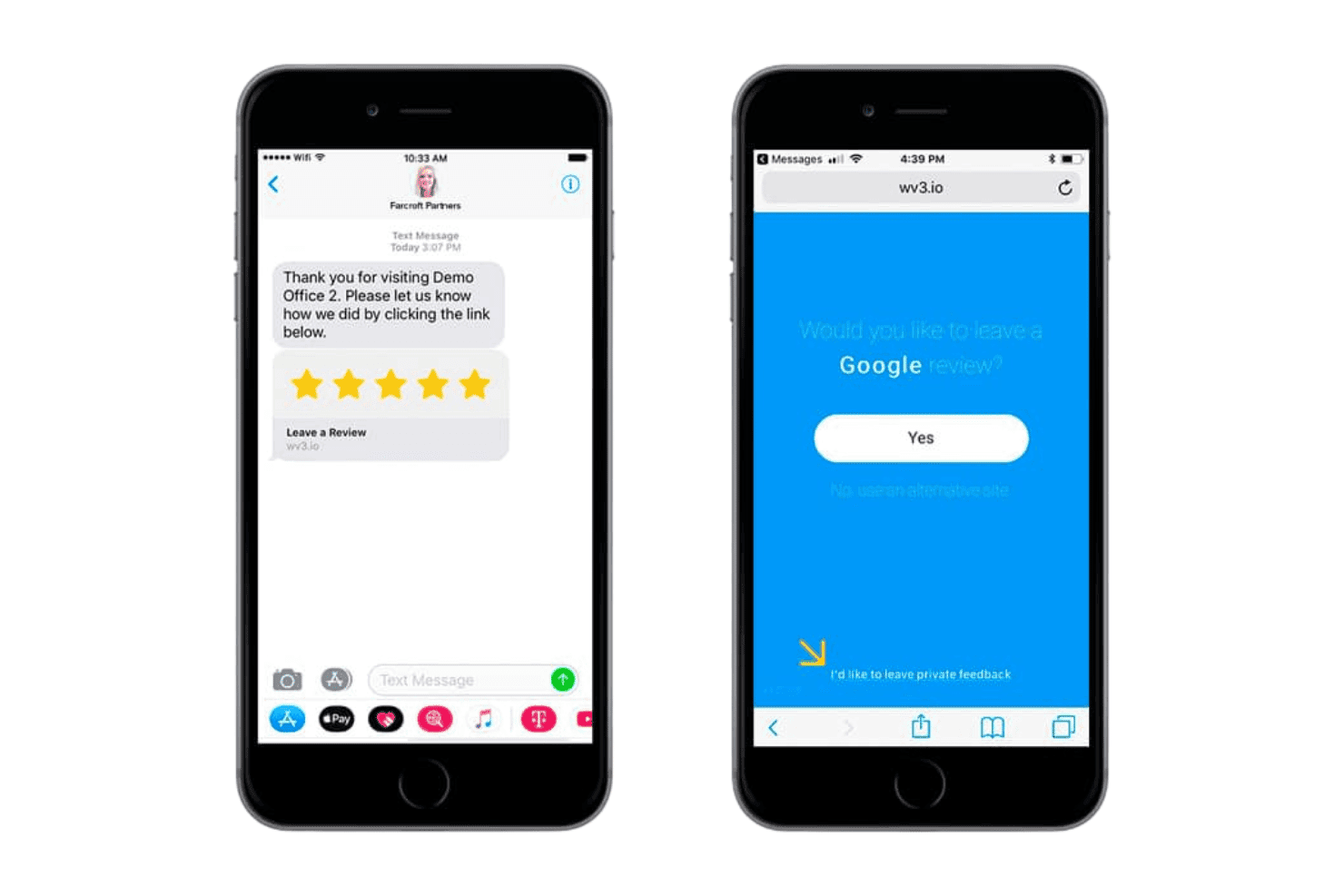
Weave manages reviews, calls, texts, reminders, and patient engagement workflow. Weave is an all-in-one patient communication platform for small and mid-sized healthcare practices that combines review request automation with VoIP calling, two-way texting, appointment reminders, and direct PMS/EHR integration across dental, medical, optometry, and veterinary settings.
Who Is Weave Best For?
Weave is a strong fit for independent and small group practices in dental, optometry, and veterinary care that want review generation built into their daily patient communication workflow.
Why I Picked Weave
Weave earns its spot on my shortlist because of how tightly review requests are woven into the appointment workflow. When a patient checks out, Weave automatically fires an SMS review invite, and I can customize which platforms appear first (Google, then Healthgrades, for example). What I really like is the Private Feedback channel: if a patient is unhappy, they're routed to submit feedback directly to the practice instead of posting publicly, which gives the team a chance to address the issue before it affects the star rating.
Weave Key Features
- HIPAA-compliant two-way texting: Text with patients directly from the platform using secure, compliant channels for appointment and review communications.
- Practice management system integration: Syncs with 20+ PMS and EHR systems to automate review requests and keep patient details current.
- Call Pop patient context: Pops up caller’s full profile, visit history, and family links when patients call the front desk.
- Centralized multi-location communications: Manage messaging, reviews, and analytics for multiple practices or locations from a single dashboard.
Weave Integrations
Weave offers native integrations with over 20 practice management and EHR systems, including Dentrix, Eaglesoft, Open Dental, Curve Dental, Carestream OrthoTrac, tab32, and Athenahealth. An API is available for custom integrations.
Pros and Cons
Pros:
- SMS-based requests see high patient response rates
- Private feedback routing prevents negative public posts
- Review requests fire automatically after patient checkout
Cons:
- Reputation reporting lacks provider-level benchmarking
- Limited healthcare directory monitoring beyond Google
Learn more about Weave: Best for compliant patient feedback workflows
- Free demo available
- Pricing upon request
Visit WebsiteCustomer Rating:4.6/5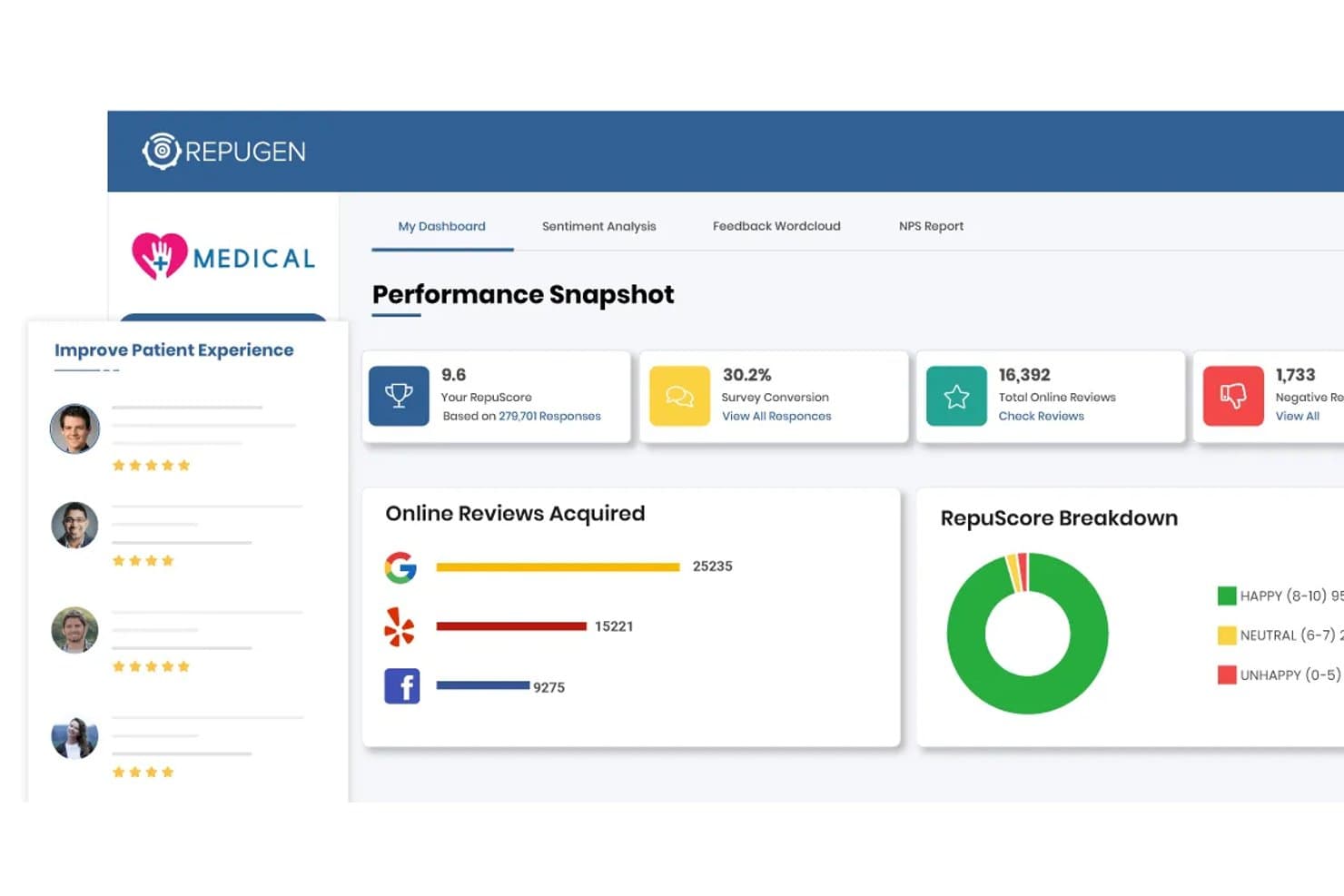
RepuGen offers a healthcare reputation management dashboard displaying RepuScore, survey conversion, online reviews, and patient sentiment breakdown across Google, Yelp, and Facebook. RepuGen is a HIPAA-compliant reputation management platform for healthcare providers, combining automated patient review collection, multi-site monitoring across 45+ directories, AI-powered sentiment analysis, and listing management.
Who Is RepuGen Best For?
RepuGen is a strong fit for multi-location medical practices and urgent care groups that need provider-level reputation tracking across multiple sites and directories.
Why I Picked RepuGen
RepuGen earns its spot on my shortlist because of how seriously it takes compliance inside the patient feedback loop itself. I love that its SMS and email review requests are built around HIPAA-compliant workflows from the start, so there's no retrofitting required. Its service recovery feature intercepts dissatisfied patients before a negative review goes public, and ReplyWize generates AI-drafted responses without exposing protected health information.
RepuGen Key Features
- Multi-site review monitoring: Aggregate and track patient reviews across 45+ healthcare and general platforms in one dashboard.
- Provider-level reputation dashboards: Break down sentiment, ratings, and review counts by individual clinician and location.
- Directory listings management: Sync and update profiles across 60+ healthcare-specific and general online directories.
- AI-powered sentiment and theme analysis: Detect trends and key themes in patient feedback using built-in AI analytics.
RepuGen Integrations
RepuGen offers native integrations with healthcare platforms including AdvancedMD, NextGen, Greenway, Allscripts, ABELDent, and Kalix, and provides an API for custom integrations.
Pros and Cons
Pros:
- Intercepts negative feedback before it goes public
- Provider-level reputation tracking across locations
- HIPAA-compliant patient review request workflows
Cons:
- Analytics depth trails larger enterprise-focused competitors
- Reporting dashboard lacks deeper customization options
Learn more about RepuGen: 10Best for provider-level reputation analytics
rater8
- Free plan available
- From $89/month
Visit WebsiteCustomer Rating:4.9/5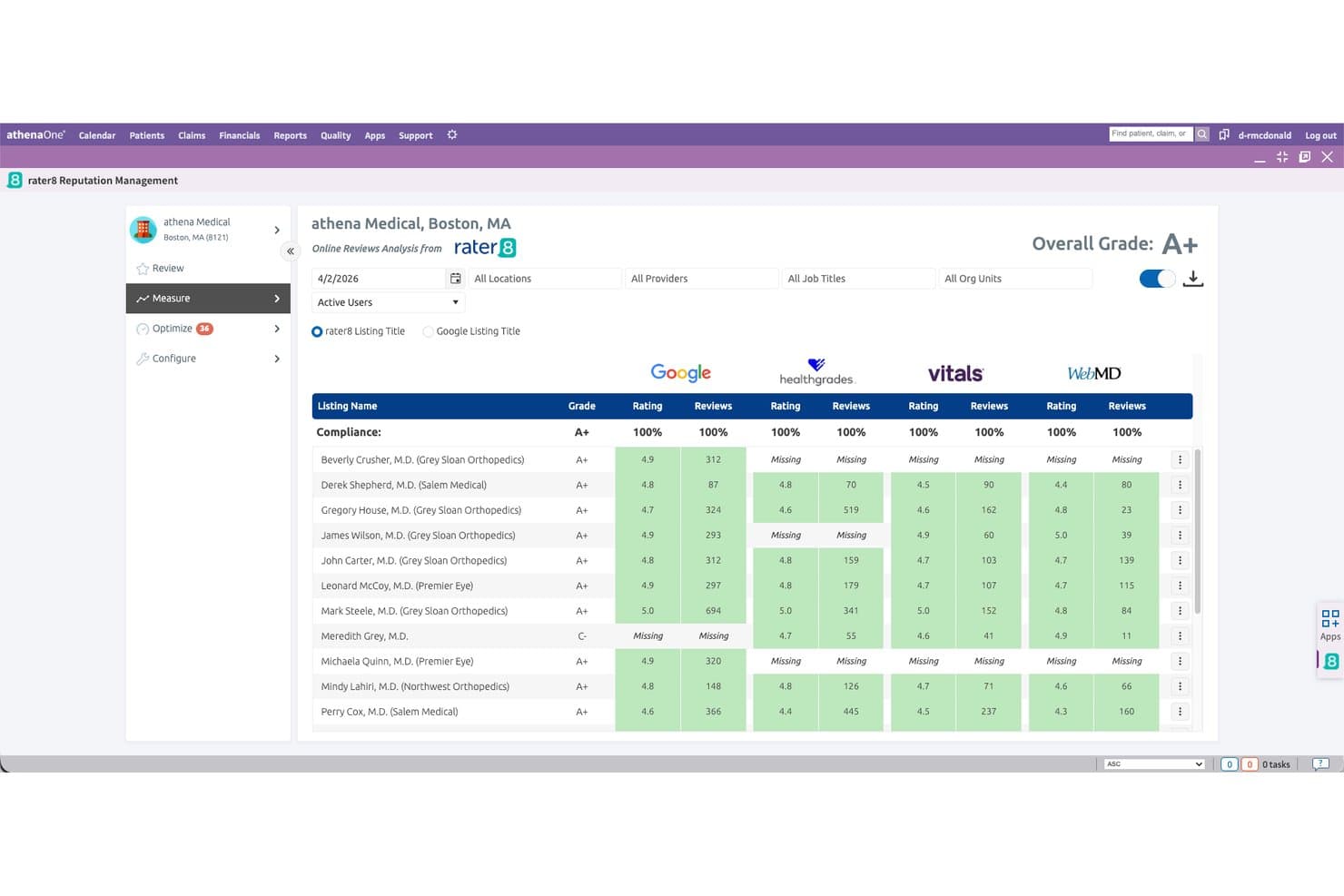
rater8 offers an online reviews scorecard dashboard that displays provider ratings and review counts across Google, Healthgrades, Vitals, and WebMD in one unified view. rater8 is a healthcare-specific reputation management platform that automates patient review generation, monitors ratings across healthcare directories and general platforms, and tracks feedback at the individual provider level.
Who Is rater8 Best For?
rater8 is a strong fit for multi-provider medical practices and health systems that need to track and manage reputation at the individual physician level.
Why I Picked rater8
rater8 earns its spot as one of the best on my shortlist because of how deeply it tracks reputation at the individual physician level. I love that its Reputation Scorecards break performance down by provider, location, and review site, not just practice-wide averages. The benchmarking engine pulls from over 30 million data points, so I can see exactly how each provider stacks up against peers in the same specialty.
rater8 Key Features
- Multi-site review dashboard: View and manage patient feedback from Google, Facebook, Healthgrades, WebMD, and Vitals in one place.
- Automated review invitations: Trigger review requests by integrating with EHR and practice management systems to reach patients after visits.
- Listings management: Keep provider and practice information updated across multiple healthcare directories and platforms.
- AI-powered sentiment analysis: Analyze review content with AI tools to identify trends in patient sentiment and key experience themes.
rater8 Integrations
rater8 offers native integrations with over 100 EHR and practice management systems, including Epic, athenahealth, and NextGen. An API is available for custom integrations.
Pros and Cons
Pros:
- Benchmarks physician ratings against specialty peers
- Deep coverage across healthcare-specific review directories
- Granular provider-level scorecards across locations and specialties
Cons:
- Limited social listening beyond healthcare directories
- Reporting interface can overwhelm smaller single-provider practices
Learn more about rater8:
Other Healthcare Reputation Management Software
Here are some additional healthcare reputation management software options that didn’t make it onto my shortlist, but are still worth checking out:
- 11SolutionReachBest for patient satisfaction insights and surveys
- 12RLDatixBest for enterprise healthcare compliance
- 13SwellBest for AI-powered review responses
- 14TebraBest for solo and small practice online visibility
- 15YextBest for healthcare provider listings management
- 16ChatmeterBest for multi-location brand reputation tracking
- 17Press GaneyBest for patient review analytics and benchmarking
- 18DemandforceBest for automated patient communication tie-in
- 19Doctor.comBest for care network patient acquisition
- 20Kyruus HealthBest for provider search and scheduling
How I Evaluate Healthcare Reputation Management Software
I split my evaluation into two layers: the baseline criteria every tool must meet—HIPAA compliance, EHR integration, and review automation—and the differentiators that set the best apart.
Core Functionality (Table Stakes For This List)
When I'm selecting tools for my list, I rank each one on a scale from 0 (does not offer the functionality) to 5 (excels in this area) for each core functionality listed below. I then calculate the tool's total score into a percentage, using 65% as a benchmark to help assess its overall fit for the list.
- Multi-Site Review Monitoring: I check whether a platform pulls reviews from healthcare directories like Healthgrades, Vitals, and Zocdoc alongside Google and Yelp into one dashboard.
- Automated Review Requests: Post-visit review solicitation via SMS and email should trigger automatically from appointment data, not require manual sends from front desk staff.
- HIPAA-Compliant Workflows: I look for documented BAA availability, secure messaging protocols, and safeguards that prevent PHI from surfacing in public review responses.
- Provider-Level Reputation Tracking: Each clinician's ratings and reviews should be trackable individually, which matters when you're managing a multi-provider group practice.
- PMS/EHR Integration: I evaluate whether the tool connects directly with systems like Epic, athenahealth, or Dentrix to sync patient lists and trigger review requests.
- Review Response & Sentiment Analysis: I look for in-platform response tools across monitored sites and AI-driven sentiment tagging that surfaces themes like wait times or billing.
Once I have a list of tools that meet the criteria, I consider what sets each platform apart.
Differentiating Factors (What Sets Vendors Apart)
Here's how I compare and contrast different vendors:
Standout Features
Provider-level reputation scoring goes beyond basic review tracking. I look for peer benchmarking that lets you compare clinicians within a specialty or across locations to spot coaching opportunities. Sentiment and theme analysis is another key area—the best tools use AI to surface patterns like recurring wait time complaints across hundreds of reviews. I also evaluate healthcare directory syndication, where platforms actively manage your listings on Healthgrades and Vitals rather than just monitoring them.
Beyond Features
HIPAA compliance goes deeper than a checkbox. I look for vendors that offer a signed BAA, SOC 2 Type II certification, and documented PHI handling protocols. EHR and PMS integrations also matter—native connections with platforms like Epic or athenahealth keep patient data synced and review triggers automated without manual imports. Implementation support is worth evaluating too, especially for multi-location practices where onboarding involves mapping provider hierarchies and configuring role-based access for marketing, compliance, and clinical teams.
How to Choose a Healthcare Reputation Management Software
Wondering which reputation management software actually protects your practice’s interests as well as your providers’ reputations? Use these decision points to clarify your needs:
| If your priority is… | Prioritize… |
|---|---|
| If your priority is…HIPAA and PHI compliance | Prioritize…Written BAA, SOC 2 Type II documentation |
| If your priority is…Direct EHR or PMS connections | Prioritize…Vendors with live native integrations |
| If your priority is…Managing reviews for dozens of locations | Prioritize…Hierarchy support for sites/providers |
| If your priority is…Reviewing patient sentiment patterns | Prioritize…AI-driven sentiment and theme analytics |
| If your priority is…Minimizing admin workload | Prioritize…Automated triggers tied to patient visits |
How to Vet Your Shortlist
- Request a signed BAA: Ask the vendor to provide a sample Business Associate Agreement to review PHI safeguards before any demo.
- Demand integration proof: Schedule a walkthrough using your actual EHR or PMS (not screenshots), with at least one test patient sync.
- Run a real review trigger test: Use a demo environment with your own (de-identified) data to see a review request after a mock appointment within 24 hours.
- Ask for multi-location reporting samples: Get sample dashboards that break down results by provider, specialty, and location—no generic reporting decks.
- Balance all-in-one vs. specialty fit: Decide if you need a solution deeply built for healthcare workflows and compliance, or if a more generic platform with healthcare modules is enough for your goals.
What Is Healthcare Reputation Management Software?
Healthcare reputation management software is a specialized platform that helps medical organizations collect, monitor, and manage patient feedback across review sites, surveys, and healthcare directories.
These systems automate review requests, provide HIPAA-compliant communication, and track provider-level reputation for multi-location practices. By centralizing feedback and supporting regulatory requirements, healthcare reputation management software empowers teams to protect and enhance their online standing while maintaining patient trust.
Features of Healthcare Reputation Management Software
When selecting healthcare reputation management software, keep an eye out for the following key features:
- Multi-site review monitoring: Pulls reviews from multiple platforms—like healthcare directories and public sites—into a single dashboard, so you never miss important feedback.
- Automated review requests: Sends patients invitations to leave reviews via SMS or email after appointments, making it easier to maintain a steady flow of new feedback.
- HIPAA-compliant messaging: Protects patient health information during review requests and communications, supporting secure workflows and regulatory standards.
- Provider-level reputation tracking: Breaks down feedback and ratings for each provider or clinician, which is essential for individual coaching and accountability.
- PMS/EHR integration: Syncs with electronic health records or management systems to automate patient data transfer and review request triggers.
- Review response tools: Lets you respond to patient reviews directly from the platform, streamlining communication and ensuring a timely, consistent approach.
- Sentiment analysis and reporting: Surfaces trends in patient comments, helping practices spot issues—like long wait times—that may need immediate attention.
- Directory listing management: Updates and maintains practice and provider profiles across healthcare-specific directories to improve accuracy and online visibility.
Common Healthcare Reputation Management Software AI Features
Beyond the standard healthcare reputation management software features listed above, many of these solutions are incorporating AI with features like:
- AI-powered sentiment analysis: Automatically detects positive, negative, or neutral tones in patient reviews, helping you quickly spot trends and areas needing attention.
- Theme extraction: Identifies recurring topics—such as billing, wait times, or staff friendliness—across large volumes of feedback, so you can prioritize operational improvements.
- Automated response suggestions: Drafts personalized replies to patient reviews using AI, saving time and ensuring responses are consistent and professional.
- Predictive reputation scoring: Uses historical data and review patterns to forecast changes in provider or practice reputation, allowing proactive management.
- Anomaly detection: Flags unusual spikes in negative or positive feedback, alerting you to potential issues or successes that may require immediate action.
Benefits of Healthcare Reputation Management Software
Implementing healthcare reputation management software provides several benefits for your team and your business. Here are a few you can look forward to:
- Centralized feedback management: Aggregate reviews from multiple sites and directories in one dashboard, making it simpler to track and act on patient feedback.
- Enhanced regulatory compliance: Maintain HIPAA standards in every patient communication and reputation workflow with built-in compliance safeguards.
- Improved patient engagement: Automated review requests and secure messaging boost patient participation and show that you value their input.
- Informed decision-making: Provider-level reporting, sentiment analysis, and benchmarking deliver actionable insights to improve provider performance and patient experience.
- Better local search visibility: Directory listing management and timely review responses increase your chances of appearing at the top of local healthcare searches.
- Time and resource savings: Automation—from triggering review requests to drafting responses—reduces manual work for administrative staff.
- Proactive issue resolution: AI pattern recognition and theme analysis help you identify problems, such as recurring complaints, before they escalate.
Costs and Pricing of Healthcare Reputation Management Software
Selecting healthcare reputation management software requires an understanding of the various pricing models and plans available. Costs vary based on features, team size, add-ons, and more. The table below summarizes common plans, their average prices, and typical features included in healthcare reputation management software solutions:
Plan Comparison Table for Healthcare Reputation Management Software
| Plan Type | Average Price | Common Features |
|---|---|---|
| Plan TypeFree Plan | Average Price$0 | Common FeaturesLimited review monitoring, basic reporting, single user access, and no integrations. |
| Plan TypePersonal Plan | Average Price$20–$75/user/month | Common FeaturesMulti-site review monitoring, automated review requests, basic sentiment analysis, and standard support. |
| Plan TypeBusiness Plan | Average Price$100–$350/location/month | Common FeaturesBulk review requests, HIPAA-compliant messaging, directory management, provider-level analytics, and EHR/PMS integration. |
| Plan TypeEnterprise Plan | Average Price$500–$1,500+/month | Common FeaturesAdvanced role-based access, custom onboarding, AI-driven insights, dedicated customer success, and multi-location reporting. |
Healthcare Reputation Management Software FAQs
Here are some answers to common questions about healthcare reputation management software:
Is healthcare reputation management software HIPAA-compliant?
Yes, most specialized healthcare reputation management software is designed to meet HIPAA standards, but you should always request a Business Associate Agreement (BAA) and review the vendor’s compliance documentation before onboarding.
Can these platforms integrate directly with my EHR or practice management system?
Yes, many solutions offer native integrations with major EHR and PMS systems, allowing automated review requests based on completed appointments and improving data accuracy.
How does provider-level reporting work?
Provider-level reporting breaks down reviews, feedback scores, and sentiment data by individual clinician or specialty, making it easier to identify coaching opportunities or celebrate high-performing staff.
What types of healthcare review sites do these tools monitor?
These platforms typically monitor major healthcare directories—like Healthgrades, Vitals, Zocdoc, and WebMD—along with public sites like Google and Yelp, consolidating feedback into a unified dashboard.
How long does it take to implement healthcare reputation management software?
Implementation for multi-location practices usually takes 30–90 days, depending on your number of providers, data migration needs, and integration requirements.