
If you want to stay ahead with trustworthy insights, these healthcare AI newsletters deliver the news, trends, and practical updates you need to navigate emerging challenges and opportunities in clinical, administrative, and tech-driven care.
The 13 Best Healthcare AI Newsletters
Below are my summaries of the best healthcare AI newsletters. My reviews offer a look at each newsletter's audience, frequency, cost, and more.
1. The Medical Practice - Best for frontline practice management insights
- Audience: Medical practice managers and healthcare operations leaders
- Frequency: Weekly
- Cost: Free
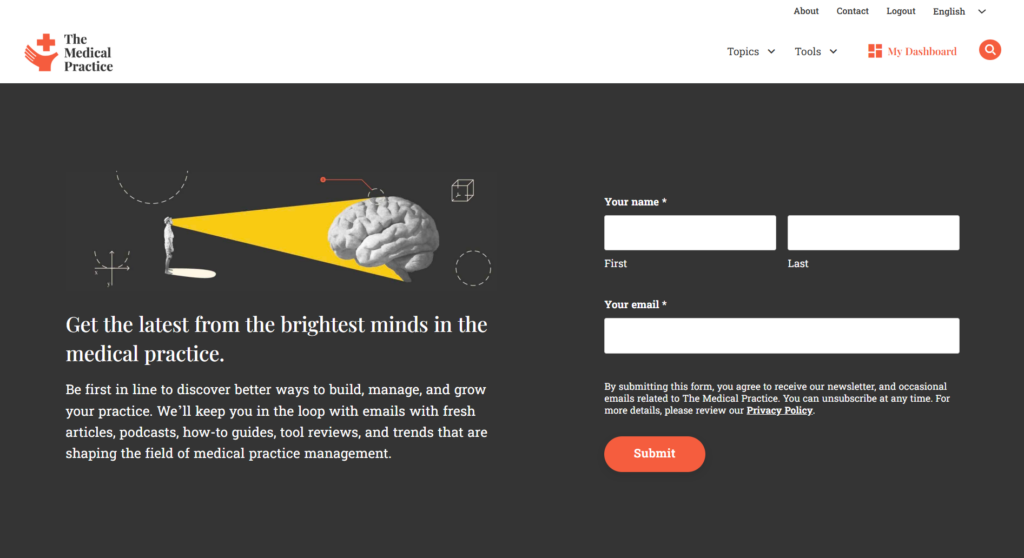
We publish The Medical Practice to give practice managers and healthcare operations leaders a focused weekly briefing on the developments that actually matter to them. Think staffing shifts, reimbursement changes, compliance updates, and AI adoption in healthcare operations—all filtered through the lens of running a medical practice.
Why subscribe? What sets this newsletter apart is what we leave out. We don't cover general healthcare news for its own sake. Every issue zeroes in on how industry changes affect your people, workflows, patients, and finances at the practice level.
If you want to stay ahead of the operational and technological shifts reshaping outpatient care—without sifting through noise that doesn't apply to your role—this one's for you.
2. Health IT Analytics - Best for news on clinical AI applications
- Audience: Health IT professionals and healthcare executives
- Size: 5,000+ members
- Frequency: Every weekday
- Cost: Free
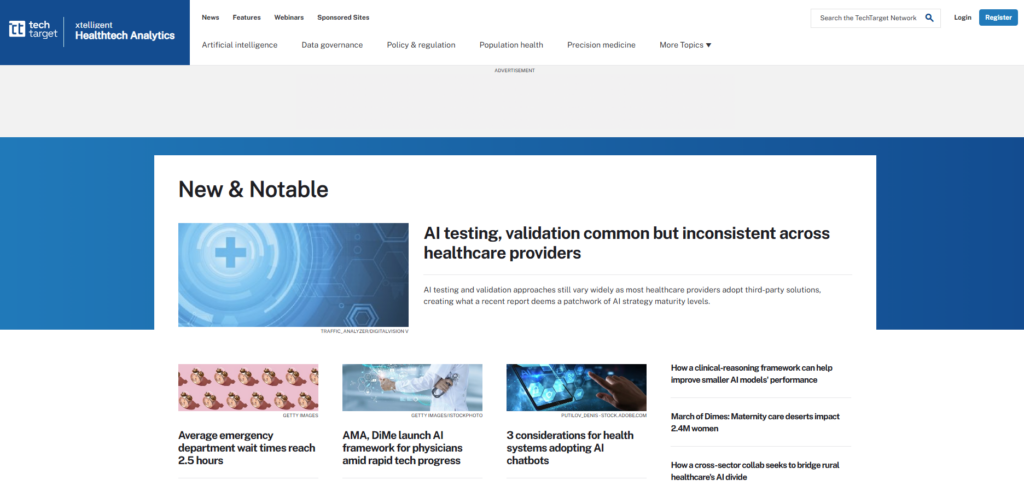
Published by Xtelligent Healthcare Media under Informa TechTarget, HealthITAnalytics is a daily publication covering healthcare data analytics, AI, and machine learning for health IT professionals and clinical leaders. It's one of the most consistently updated sources in the space, with editorial leadership from Kyle Murphy, PhD.
Why subscribe? If you want a steady feed of real-world clinical AI coverage—think AI validation frameworks, governance gaps, and how health systems are actually deploying predictive tools—this is a reliable source to have in your inbox. It goes deeper than general health tech news, with content grounded in how AI intersects with care delivery, population health, and precision medicine.
I'd especially recommend it if you're tracking AI adoption trends across provider organizations and want coverage that reflects what's happening on the ground.
3. Fierce Healthcare - Best for industry AI partnership updates
- Audience: Healthcare executives, payers, and digital health leaders
- Frequency: Weekly
- Cost: Free
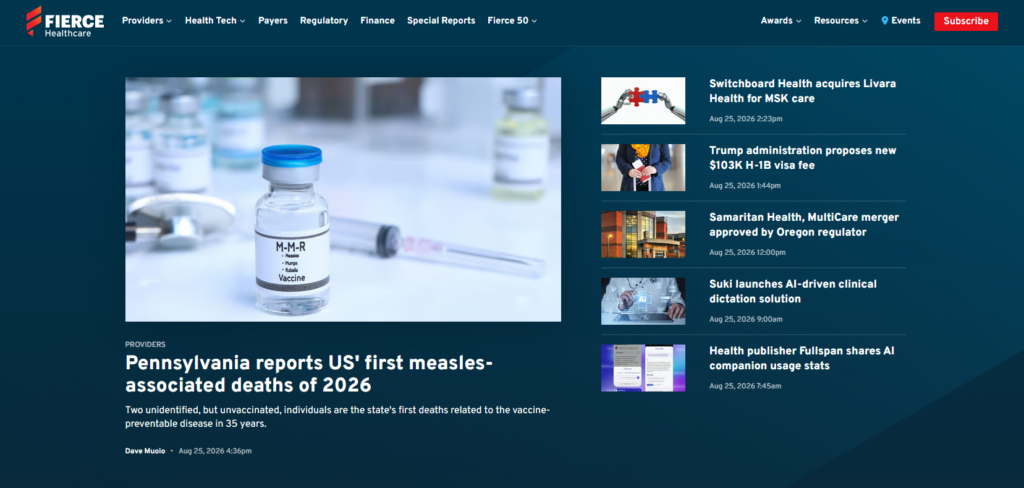
The Fierce Healthcare weekly newsletter covers AI and machine learning developments across the payer, provider, and health tech vendor ecosystem. Journalists like Cailey Gleeson and Anastassia Gliadkovskaya report on where AI is actually being adopted, rejected, or funded across health systems.
Why subscribe? Fierce AI is one of the better sources for tracking the business side of healthcare AI—vendor partnerships, health system deals, payer decisions, and FDA-backed innovation all get consistent coverage. If you're a healthcare executive or digital health leader who needs to stay current on who's partnering with whom and which AI tools are gaining real traction, this newsletter delivers that weekly. I'd especially recommend it if you follow the commercial and organizational dynamics of AI adoption, not just the clinical or technical side.
4. Healthcare IT News - Best for hospital AI and regulatory news
- Audience: Hospital and health system IT and executive leaders
- Size: 85K+ members
- Frequency: Daily or weekly
- Cost: Free
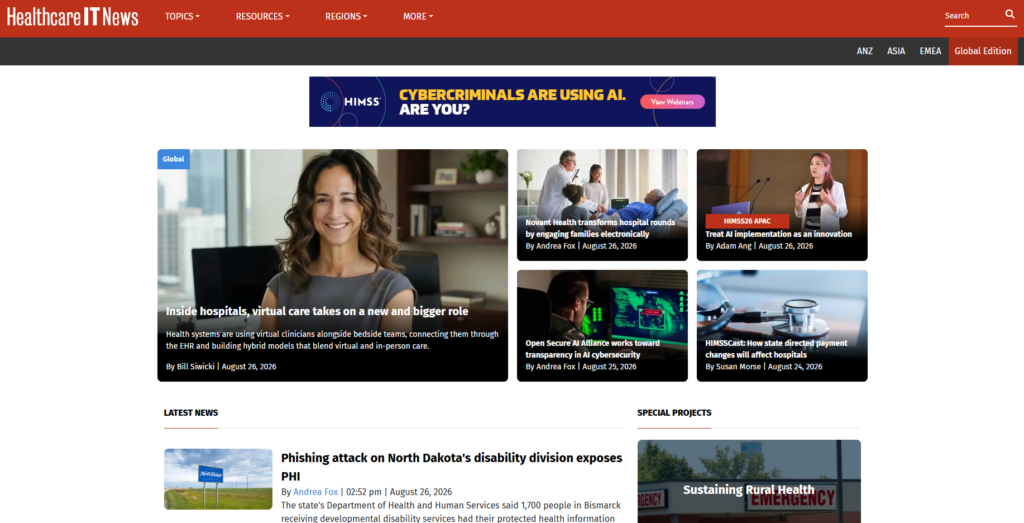
The Healthcare IT News is a HIMSS Media publication covering the full spectrum of health IT—AI, cybersecurity, EHRs, interoperability, telehealth, and policy. It's built for CIOs, CMIOs, and other clinical and IT decision-makers at hospitals and health systems.
Journalists like Bill Siwicki, Andrea Fox, and Mike Miliard regularly report on how real health systems are deploying and governing AI tools.
Why subscribe? Healthcare IT News stands out for its consistent coverage of AI regulatory developments and hospital-level adoption stories. If you want to know how the FDA is approaching generative AI in medical devices or how a specific health system rolled out an AI governance framework, this is where those stories tend to land first.
The daily and weekly Global Edition options also give you flexibility on how closely you want to follow the news cycle. I'd recommend it for any clinical or IT leader who needs to track both the regulatory and operational dimensions of AI in hospital settings.
5. STAT Health Tech - Best for health tech reporting beyond hospital settings
- Audience: Health tech professionals, executives, and clinicians in the US
- Frequency: Twice a week
- Cost: Free
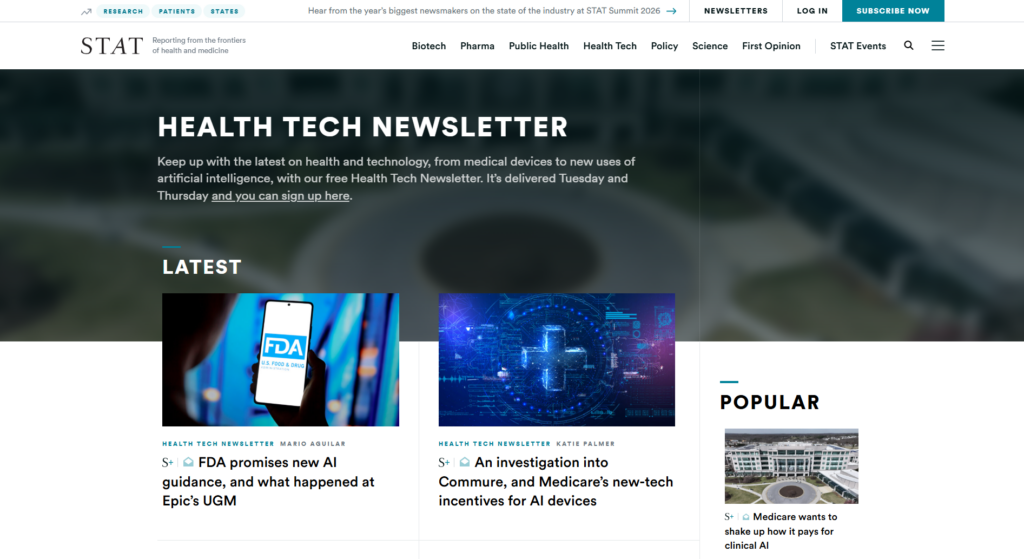
Health Tech is a newsletter from STAT News—a Boston Globe Media publication known for rigorous science and health journalism—covering how technology is reshaping health care and life sciences.
Reporter Mario Aguilar writes it, bringing an investigative lens to health tech company moves, digital health tools, and AI developments across the broader industry.
Why subscribe? Unlike newsletters focused primarily on hospital operations or clinical AI, STAT Health Tech looks at the wider health tech ecosystem—startups, investors, vendors, and policy—which gives you a broader view of where the industry is heading. The reporting goes beyond press releases, so you're getting original, critically examined stories rather than repackaged announcements.
If you work in or alongside the health tech industry and want to track AI from a market and innovation angle, this is a strong complement to more operationally focused newsletters.
6. HIStalk - Best for unfiltered industry insider health IT and AI news
- Audience: Healthcare IT professionals, executives, and experienced industry insiders
- Frequency: Three times per week
- Cost: Free
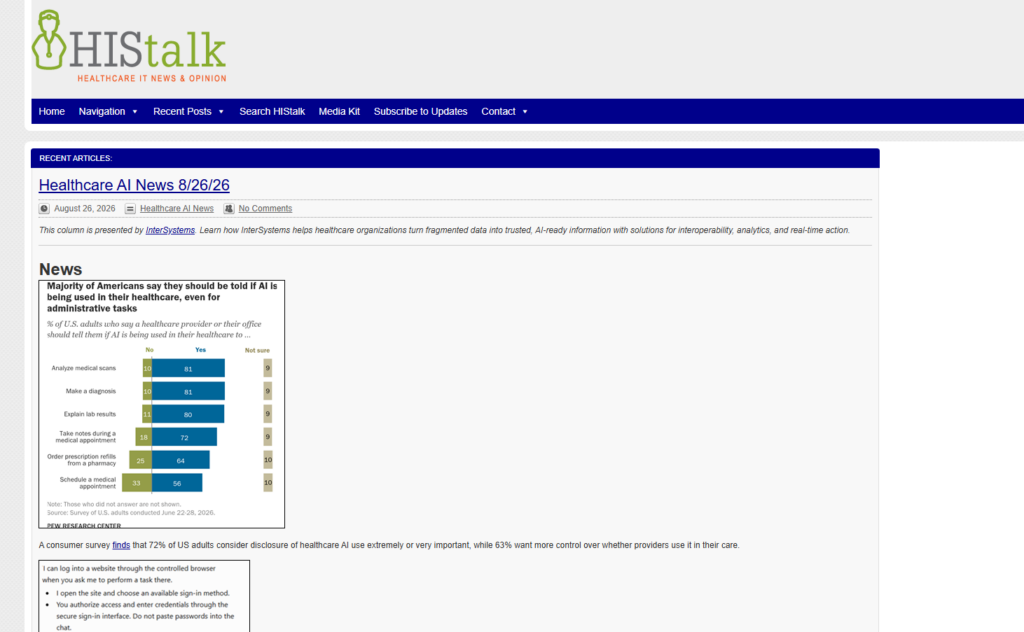
HIStalk is a long-running independent healthcare IT publication written by the pseudonymous "Mr. HIStalk"—a practicing industry veteran—alongside Dr. Jayne, a physician and CMIO who brings a clinical operations lens to the coverage.
It's built for experienced healthcare IT insiders: CIOs, CMIOs, consultants, and vendors who want news, opinion, and industry commentary delivered three times a week for free.
Why subscribe? What sets HIStalk apart is its candor—Mr. HIStalk writes with the kind of unfiltered perspective you'd expect from someone who's actually worked in the industry. Its dedicated Healthcare AI News segment means you're getting AI coverage alongside the vendor moves, M&A activity, and policy shifts that give that AI news real context.
If you want to understand how AI fits into the broader health IT landscape, HIStalk gives you that full picture.
7. Healthcare Dive - Best for key US health IT and AI headlines
- Audience: US healthcare executives, health IT leaders, and consultants
- Frequency: Daily and weekly options
- Cost: Free
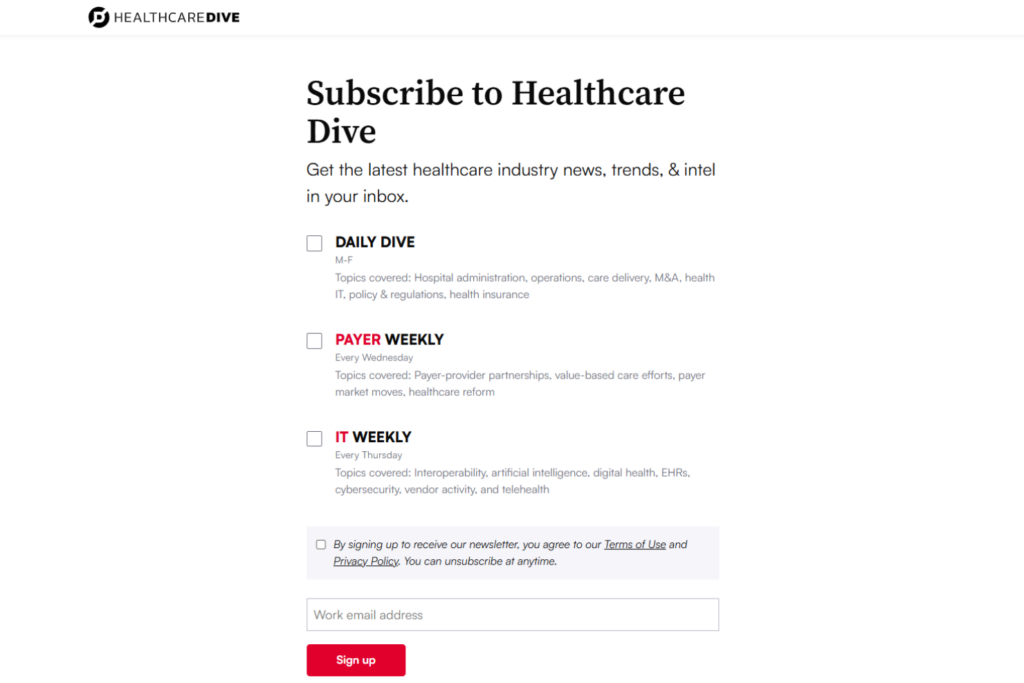
Healthcare Dive is a trade publication covering the US healthcare industry, with a dedicated IT Weekly newsletter that focuses specifically on health IT and AI news every Thursday. It's staffed by a full editorial team of trade journalists and is free to subscribe to.
Why subscribe? The IT Weekly is a practical choice if you want AI and health IT developments framed within the broader industry context—policy shifts, M&A activity, and major vendor moves all show up alongside the AI coverage.
I'd also recommend the Daily Dive if you want a fuller picture of what's happening across the US healthcare sector, Monday through Friday. Together, they give you a reliable, well-sourced pulse on the industry without requiring you to go hunting for news yourself.
8. MobiHealthNews - Best for global digital health and AI news
- Audience: Global digital health and health IT professionals
- Frequency: Daily, Weekly, and Biweekly options available
- Cost: Free
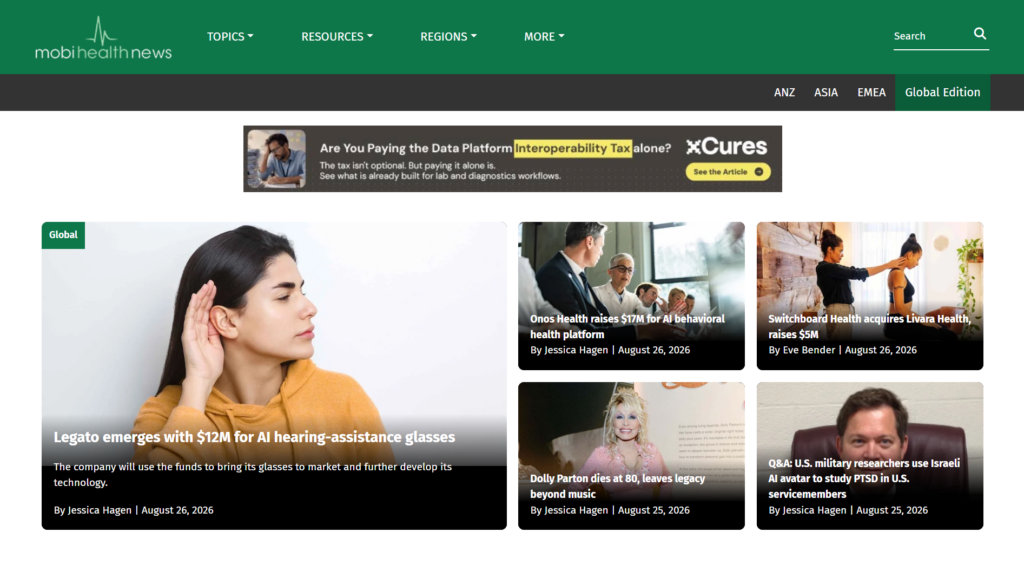
MobiHealthNews is a HIMSS Media publication covering digital health news from a global perspective. It's written by a dedicated editorial team with strong coverage of AI diagnostics, FDA clearances, telehealth, and health tech M&A.
Why subscribe? What I find valuable about MobiHealthNews is its international reach. If you work across regions or want visibility into digital health developments beyond the US, it's one of the few newsletters that consistently covers APAC, EMEA, and global markets alongside domestic news. The AI coverage spans everything from FDA-cleared AI tools to clinical AI deployment stories, so you're getting practical, real-world developments rather than theory.
If you want one newsletter that connects AI news to the broader digital health ecosystem—wearables, remote patient monitoring, cybersecurity, and more—this one covers it all.
9. Rock Weekly - Best for digital health funding and AI startup insights
- Audience: Digital health founders, investors, and enterprise innovation leaders
- Size: 50,000+ members
- Frequency: Weekly
- Cost: Free
Rock Weekly is published by Rock Health, a venture fund and advisory firm that has been tracking digital health funding and innovation since 2010. It's one of the most widely-read free resources for anyone following where money and momentum are moving in digital health.
Why subscribe? What sets Rock Weekly apart is the proprietary data behind it—Rock Health publishes its own longitudinal funding reports, consumer adoption surveys, and market analyses, and subscribers get early access to that research before it's widely published. The AI coverage is grounded in investment and market context, so you'll see topics like AI drug discovery and clinical AI adoption framed through the lens of what's actually getting funded and why.
If you're tracking AI not just as a clinical development but as a market force, this is the newsletter I'd put at the top of your list.
10. AIMed - Best for clinician-led healthcare AI community and events
- Audience: Clinicians, healthcare leaders, data scientists, and healthcare entrepreneurs
- Frequency: Monthly
- Cost: Free
AIMed is a clinician-led AI in medicine community founded by Dr. Anthony Chang, a pediatric cardiologist and Chief Intelligence and Innovation Officer at Children's Hospital of Orange County, with roots going back to 2015. The newsletter keeps you connected to the AIMed ecosystem, which spans 500+ hospitals and health systems and includes a monthly webinar series alongside the flagship annual conference.
Why subscribe? What makes AIMed distinct is its clinician-first perspective—this isn't a tech or investor publication repurposed for healthcare; it's built by and for medical professionals who want AI to be shaped by clinical reality. Subscribing connects you to the AIMed Monthly Webinar Series and early announcements from one of the most respected AI-in-medicine event communities globally.
If you're a clinician or healthcare leader who wants AI insights grounded in actual practice, I think AIMed is worth adding to your inbox.
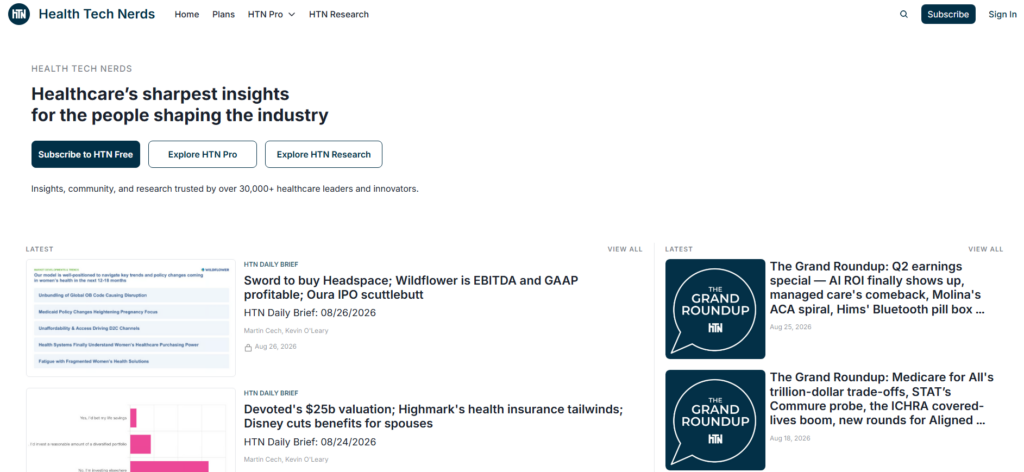
11. Health Tech Nerds - Best for health tech analysis with deep AI coverage
- Audience: Health tech operators, investors, strategy, and corporate development leaders
- Size: 30,000+ members
- Frequency: Weekly
- Cost: Free
The Health Tech Nerds is an independent health tech intelligence community run by Kevin O'Leary and Martin Cech, publishing curated weekly analysis across deals, M&A, funding, and AI developments. The free Weekly Health Tech Reads newsletter distills the most important health tech news into a single weekly digest.
Why subscribe? HTN covers AI in healthcare not as a standalone topic but as part of the broader health tech landscape. You'll see AI developments contextualized alongside funding rounds, policy shifts, and M&A activity in a way that helps you understand what's actually moving the industry.
If you want to go deeper, HTN Pro unlocks a daily briefing for more frequent intelligence. I think it is especially valuable if you're an operator, investor, or strategy leader who needs to track AI alongside the wider commercial and market forces shaping health tech.
More Articles
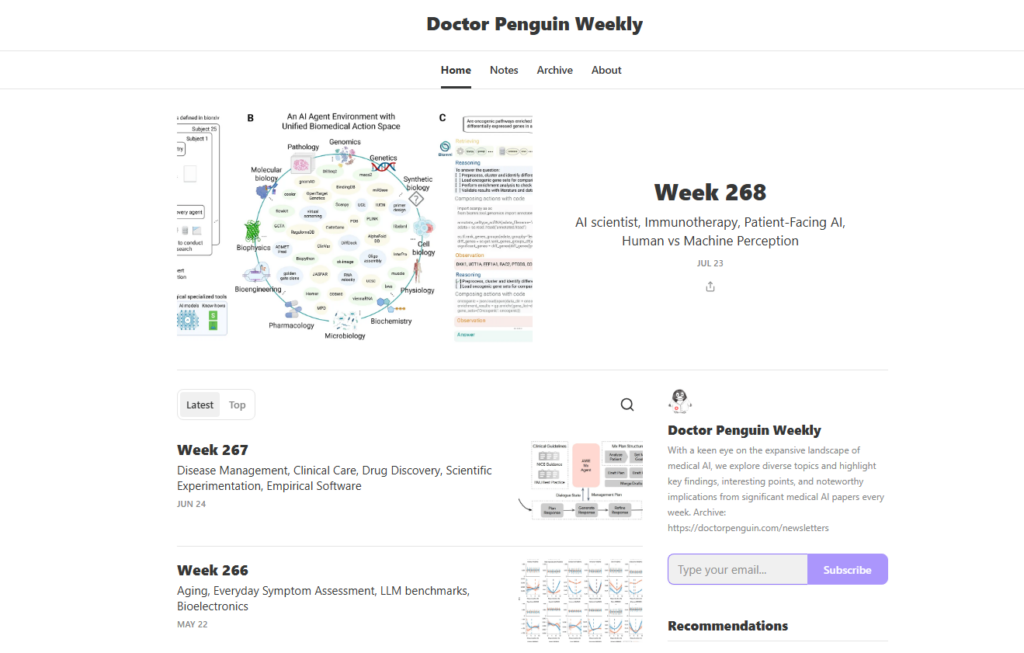
12. Doctor Penguin Weekly - Best for curated academic AI + healthcare research
Audience: Healthcare AI researchers, clinicians, and academic professionals
Size: 8,000+ members
Frequency: Weekly
Cost: Free
Doctor Penguin Weekly is a newsletter run by a Harvard-based team—including medical AI researcher Pranav Rajpurkar and digital medicine thought leader Eric Topol—dedicated to curating and summarizing the latest AI + healthcare research papers. With 186+ editions published, it's one of the more established academic-focused newsletters in this space.
Why subscribe? Most healthcare AI newsletters cover news and industry trends; Doctor Penguin Weekly goes a level deeper by surfacing and contextualizing peer-reviewed research, so you're always aware of what's emerging from the academic frontier. The Harvard and Scripps pedigree of its contributors means the curation is informed by people actively doing and publishing this research.
If you're a clinician or researcher who wants to stay current on the science behind healthcare AI—not just the headlines—this is the newsletter I'd point you to first.
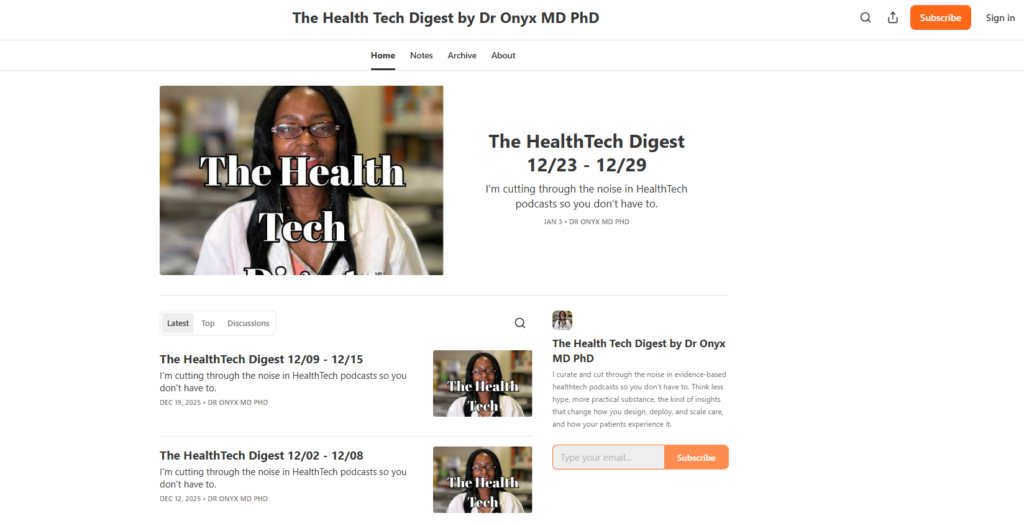
13. The Health Tech Digest - Best for practical takeaways from evidence-based healthtech podcasts
- Audience: Healthtech operators, clinicians, and care-delivery leaders
- Frequency: Weekly
- Cost: Free
The Health Tech Digest is a free weekly newsletter run by Dr. Onyx, MD, PhD, that distills insights from evidence-based healthtech podcasts into practical takeaways for operators and clinicians. It focuses on the real mechanics of designing, deploying, and scaling care—not just what's happening in the industry, but how it works.
Why subscribe? What sets The Health Tech Digest apart is its podcast-first sourcing model. Rather than aggregating news articles, it surfaces and synthesizes insights from expert conversations that most people don't have time to listen to. Topics range from healthcare cost measurement to health system economics, so you're getting substantive, structural analysis of how care delivery actually functions.
I'd recommend it if you want a grounded, evidence-led perspective on health tech that goes beyond product announcements and funding news.
What’s Next?
To stay updated on the latest trends, best practices, and solutions related to your medical practice, subscribe to The Medical Practice newsletter.