

Programvare for styring av inntektssyklusen med kunstig intelligens bruker kunstig intelligens til å automatisere fakturering, flagge feil og forutsi avviste krav før de koster legepraksisen din penger. Hvis du eier en legepraksis og er lei av å følge opp betalinger og holde oversikt over regler i stadig endring, kan det rette verktøyet fjerne mye av bryderiet fra inntektssyklusen. I denne veiledningen finner du min kortliste over KI-drevne løsninger som faktisk fungerer i den daglige driften – og som hjelper teamet ditt med å redusere manuelt arbeid, minimere tapte inntekter og holde fokuset på pasientbehandling. Du får se hva som skiller hvert alternativ fra de andre, slik at du kan velge det som virkelig passer behovene til klinikken din.
Why Trust Our Software Recommendations
6,700+
Reviews
20
Industry experts
16+
Evaluation factors
14
Years
Our team has been testing and reviewing software since 2012. As medical practice leaders ourselves, we know how difficult—and important—it is to choose the right software.
For this guide, we evaluated tools using hands-on testing and independent research, scoring tools using our selection criteria.
Our reviews reflect our human editorial judgment, not a sales pitch.
Sammenligningstabell for programvare for styring av inntektssyklusen med kunstig intelligens
Denne sammenligningstabellen oppsummerer prisopplysningene for mine beste utvalgte programmer for styring av inntektssyklusen med kunstig intelligens:
| Tool | Best For | Trial Info | Price | ||
|---|---|---|---|---|---|
| 1 | Best for specialty-specific AI denial prevention | Free demo available | Pricing upon request | Website | |
| 2 | Best for small practice AI coding and denial prevention | Free demo available | Pricing upon request | Website | |
| 3 | Best for prior auth and coding at scale | Free demo available | From $5,000/month | Website | |
| 4 | Best for agentic AI across the full RCM cycle | Free demo available | Pricing upon request | Website | |
| 5 | Best for payer-level denial prediction at scale | Not available | Pricing upon request | Website | |
| 6 | Best for AI denial appeals across health systems | Free demo available | Pricing upon request | Website | |
| 7 | Best for network-wide AI denial prevention | Free demo available | Pricing upon request | Website | |
| 8 | Best for AI-driven mid-cycle coding and denial cuts | Free demo available | Pricing upon request | Website | |
| 9 | Best for denial prevention across U.S. hospitals | Free demo available | Pricing upon request | Website | |
| 10 | Best for enterprise-level payer denial prevention | Free demo available | Pricing upon request | Website |


Anmeldelser av programvare for styring av inntektssyklusen med kunstig intelligens
\u003cspan style=\u0022font-weight: 400;\u0022\u003eNedenfor finner du mine detaljerte sammendrag av den beste programvaren for styring av inntektssyklusen med kunstig intelligens som kom med på kortlisten. Anmeldelsene mine gir et detaljert innblikk i funksjonene, de beste bruksområdene og mulighetene til hver programvare, slik at du kan finne den som passer best for deg.\u003c/span\u003e
 Best for specialty-specific AI denial prevention
- Free demo available
- Pricing upon request
Visit WebsiteCustomer Rating:4.5/5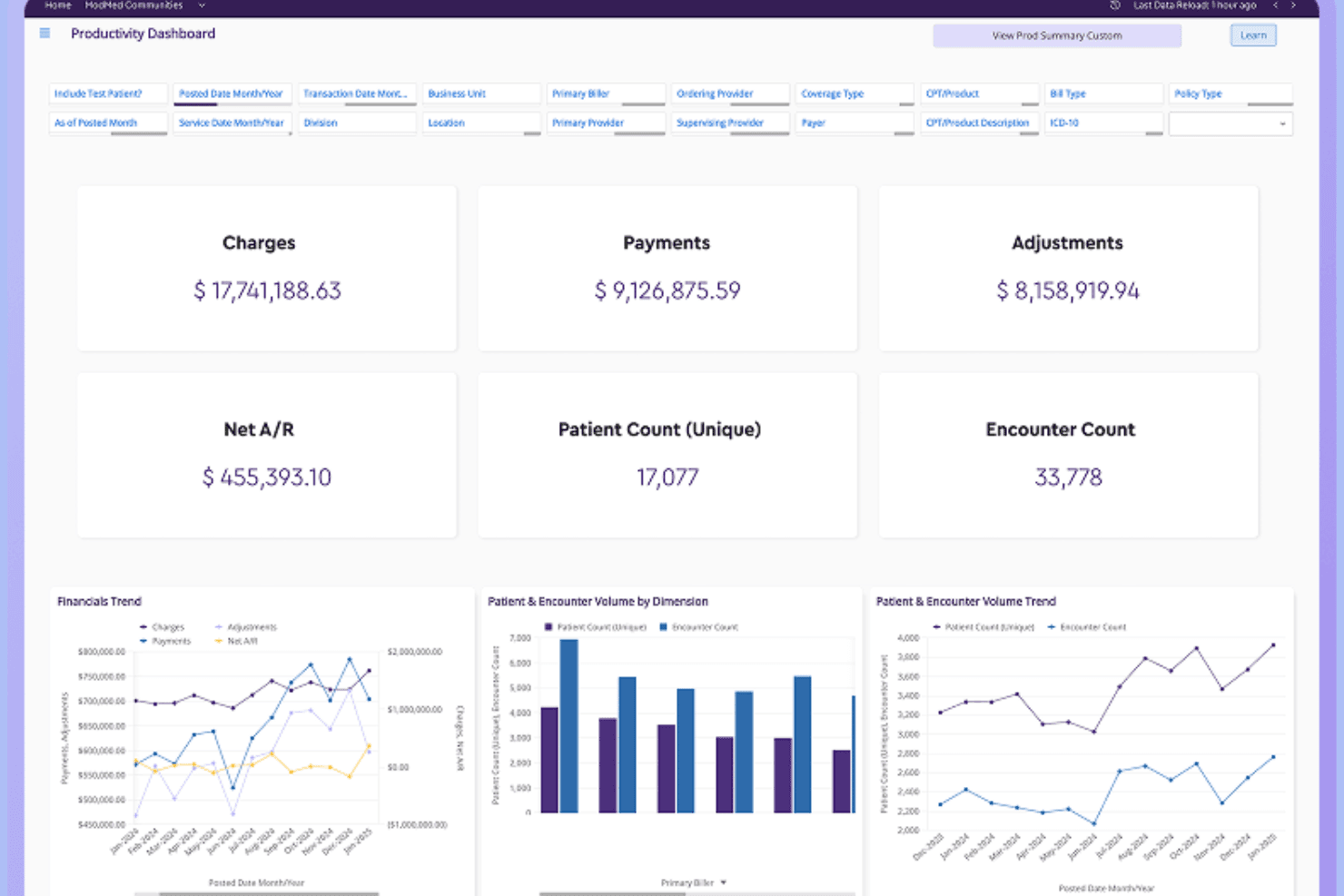
ModMed offers a comprehensive podiatry exam interface with condition-specific treatment plans, findings, and billing tools tailored for foot and ankle care. ModMed is a specialty-focused AI revenue cycle management platform built around an integrated EHR, practice management, and billing system—with AI-powered denial assessment, ambient clinical documentation, and agentic RCM tools purpose-built for 11 medical specialties.
Who Is ModMed Best For?
ModMed is built for specialty medical practices—covering 11 specialties like dermatology, orthopedics, and gastroenterology—that want a single platform connecting EHR, billing, and AI-driven denial management.
Why I Picked ModMed
I picked ModMed as one of the best because no other platform on my shortlist brings the same depth of specialty-specific denial intelligence. Its AI-Powered Denial Assessment flags high-risk claims before submission using a Specialty Intelligence Engine trained on hundreds of millions of claims across 11 specialties, from dermatology to gastroenterology. Paired with ModMed Scribe 2.0, which auto-generates specialty-tuned CPT and ICD-10 coding suggestions from live patient conversations, denial prevention starts at documentation, not just at the clearinghouse.
ModMed Key Features
- ModMed Pay: Integrated payment processing tool that supports AutoPay, Text-to-Pay, eStatements, and online bill pay, with automatic reconciliation posting directly to Practice Management.
- ModMed Analytics: Cloud-based analytics platform with built-in financial dashboards covering A/R aging, payer performance, denial and rejection reporting, and E/M code benchmarking against CMS and specialty peers.
- AI Workflow Manager: A centralized dashboard within the RCM AI Platform that handles claim prioritization, routing, personalized billing queues, and workflow automation with performance tracking.
- Quoting tool: A patient-facing cost estimation feature within Practice Management that generates out-of-pocket estimates before care is delivered.
ModMed Integrations
ModMed offers native integrations between EMA EHR, Practice Management, its built-in clearinghouse, ModMed Pay, Kiosk, APPatient, and Patient Portal. synapSYS connects Enterprise plans with two third-party applications, including labs, registries, or hospitals and health systems.
Pros and Cons
Pros:
- Unified EHR, billing, and payment platform
- Ambient AI scribe for clinical documentation
- Deep specialty-specific AI denial prediction
Cons:
- Limited to 11 supported specialties
- AI RCM platform not fully available yet
Learn more about ModMed: Best for small practice AI coding and denial prevention
- Free demo available
- Pricing upon request
Visit WebsiteCustomer Rating:3.5/5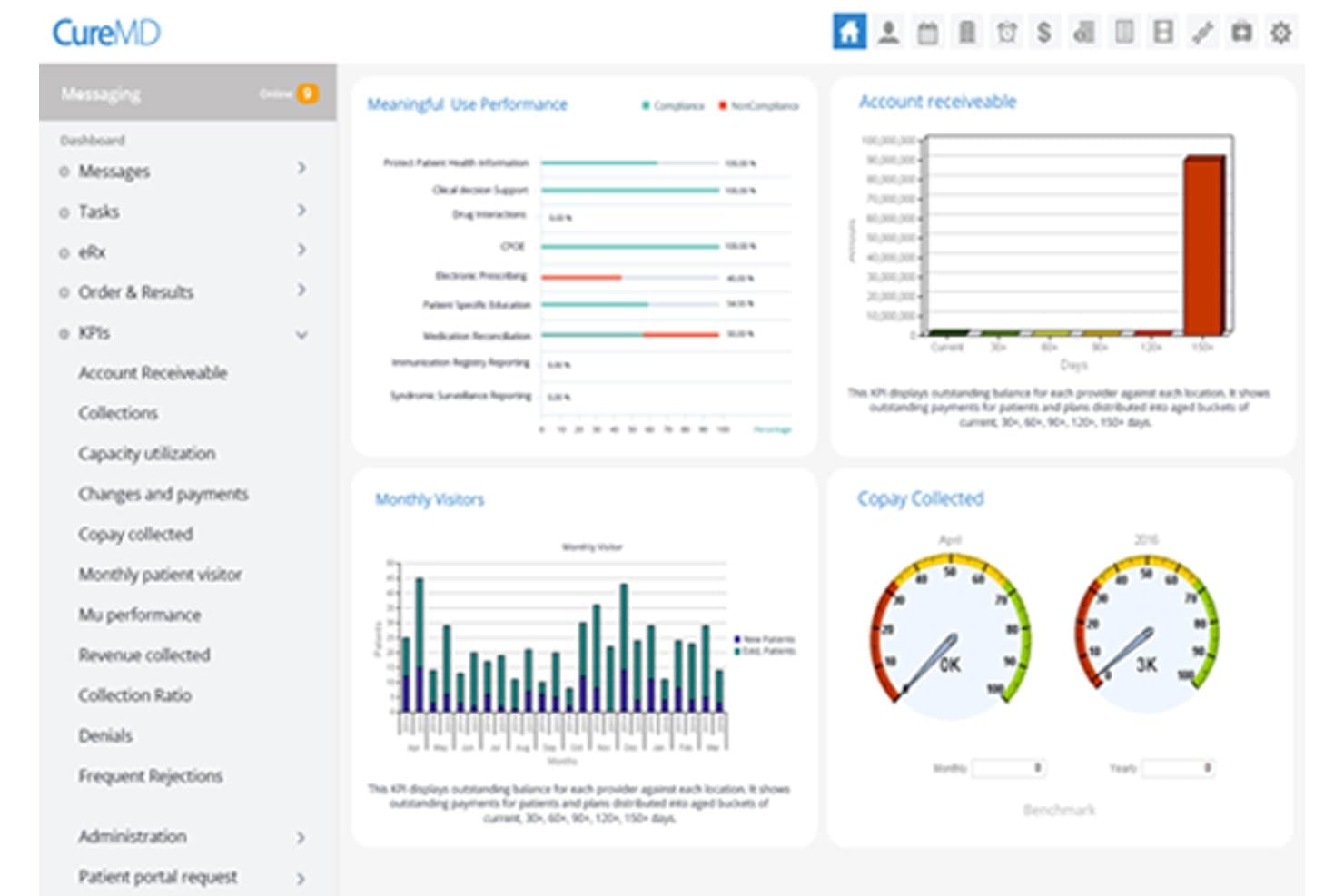
CureMD tracks KPIs like collections, copay, and receivables in one dashboard. CureMD is an AI-driven revenue cycle management platform that combines medical billing, AI coding assistance, denial prediction, claims scrubbing, and practice management into a single unified system built for small-to-midsize practices.
Who Is CureMD Best For?
CureMD is a strong fit for small-to-midsize physician practices that need an all-in-one AI coding and denial management system without managing multiple vendors.
Why I Picked CureMD
I've included CureMD in my top picks because it's one of the few AI RCM platforms built specifically around small practice needs, combining AI coding and denial prevention in a single system. I particularly like its AI Coder module, which delivers real-time ICD-10 and CPT suggestions during documentation, and its AI-Powered Denial Prediction engine, which flags high-risk claims before submission to prevent front-end denials rather than just reacting to them. That combination gives small practices a real shot at CureMD's published 98% first-pass clean claim rate without needing a large billing team.
CureMD Key Features
- AI Medical Scribe: Ambient listening technology that captures patient encounters and auto-generates SOAP notes with ICD-10, CPT, and RxNorm codes in under 15 seconds across 30+ specialties.
- Underpayment recovery: Automatically flags reimbursements that fall below contracted fee schedules and initiates recoupment workflows to recover missed revenue.
- Real-time BI dashboards: Tracks A/R trends, collection rates, claim status, and financial performance with customizable KPI reporting.
- AI credentialing automation: Manages provider enrollment, CAQH maintenance, NPI registration, and payer credentialing with validation against 1,500+ primary-source rules.
CureMD Integrations
CureMD includes a built-in clearinghouse and documented interfaces with LabCorp, Quest Diagnostics, HCA Healthcare, UCSF Medical Center, and SureScripts. It supports HL7, FHIR, HIE, and custom API integrations.
Pros and Cons
Pros:
- Built-in underpayment recovery for missed revenue
- 20,000+ payer rule engine for claims
- AI medical scribe auto-codes encounter notes
Cons:
- No AI-generated appeal letter narratives
- Users report frequent system freezes
Learn more about CureMD:
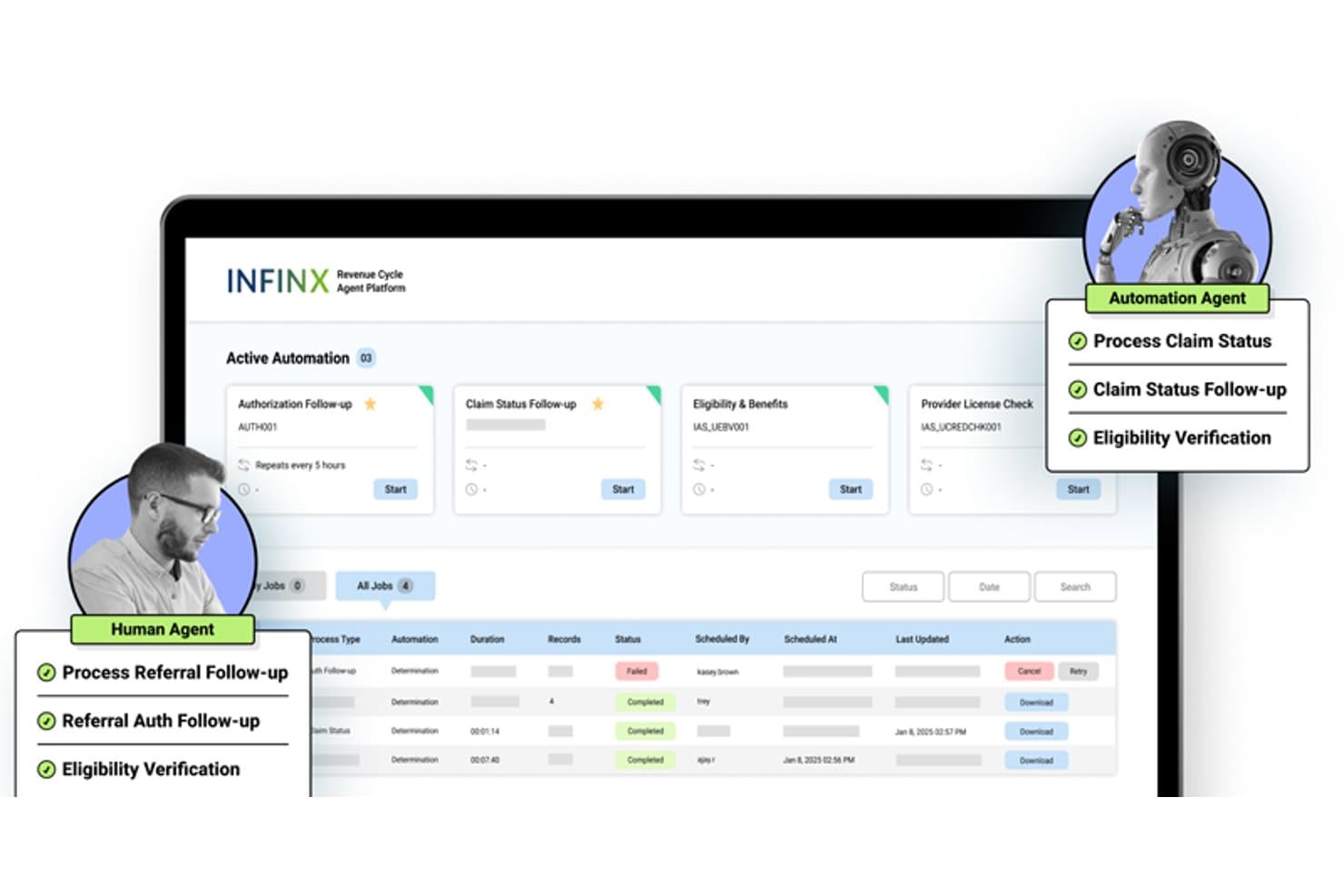
Infinx automates claim status, eligibility, and auth follow-up workflows. Infinx is an AI-powered revenue cycle management platform that combines autonomous prior authorization, AI-driven coding, claims management, and eligibility verification across a hybrid model of AI agents, automation, and human specialists.
Who Is Infinx Best For?
Infinx is a strong fit for mid-to-large health systems and multi-site physician groups that need to manage high volumes of prior authorizations and coding across multiple specialties without adding headcount.
Why I Picked Infinx
I picked Infinx as one of the best because no other platform on my shortlist handles prior authorization and autonomous coding at the volume Infinx does. The Authorization Determination Agent alone processes 10,000+ prior auths daily across 1,400+ payers with a greater than 98% accuracy rate, which is genuinely hard to replicate. Pair that with Maverick AI's autonomous coding engine hitting an 85% direct-to-bill rate, and you've got a platform built for organizations where PA bottlenecks and coding backlogs are daily realities at scale.
Infinx Key Features
- A/R Optimizer work queue prioritization: Uses ML to rank 15,000+ daily claims by recovery probability, routing the highest-value accounts to the right specialists first.
- Revenue Insights dashboards: Real-time, interactive dashboards tracking GCR, A/R aging, denial rate, net collection rate, and cost-to-collect across payers, facilities, and procedures.
- ChargeView charge capture: Scans hospital outpatient bills using 1.6M+ algorithms to flag missing or mischarged services, typically uncovering 12–16% in unbilled charges.
- Multi-model pricing structure: Supports transaction-based, FTE, subscription, managed services, and contingency fee arrangements, letting you mix pricing models across different workstreams.
Infinx Integrations
Infinx integrates with Epic, Cerner, athenahealth, eClinicalWorks, NextGen, Meditech, and Allscripts, plus 2,800+ payer connections. It supports API, HL7, FHIR, X12, RPA, and secure batch/SFTP connectivity for custom workflows.
Pros and Cons
Pros:
- Excels in payer connections and specialty coverage
- Offers multi-agent AI, automation, and human support
- Handles prior authorization and coding at scale
Cons:
- Lacks omnichannel digital payment collection
- No public user reviews for social proof
Learn more about Infinx: Best for agentic AI across the full RCM cycle
- Free demo available
- Pricing upon request
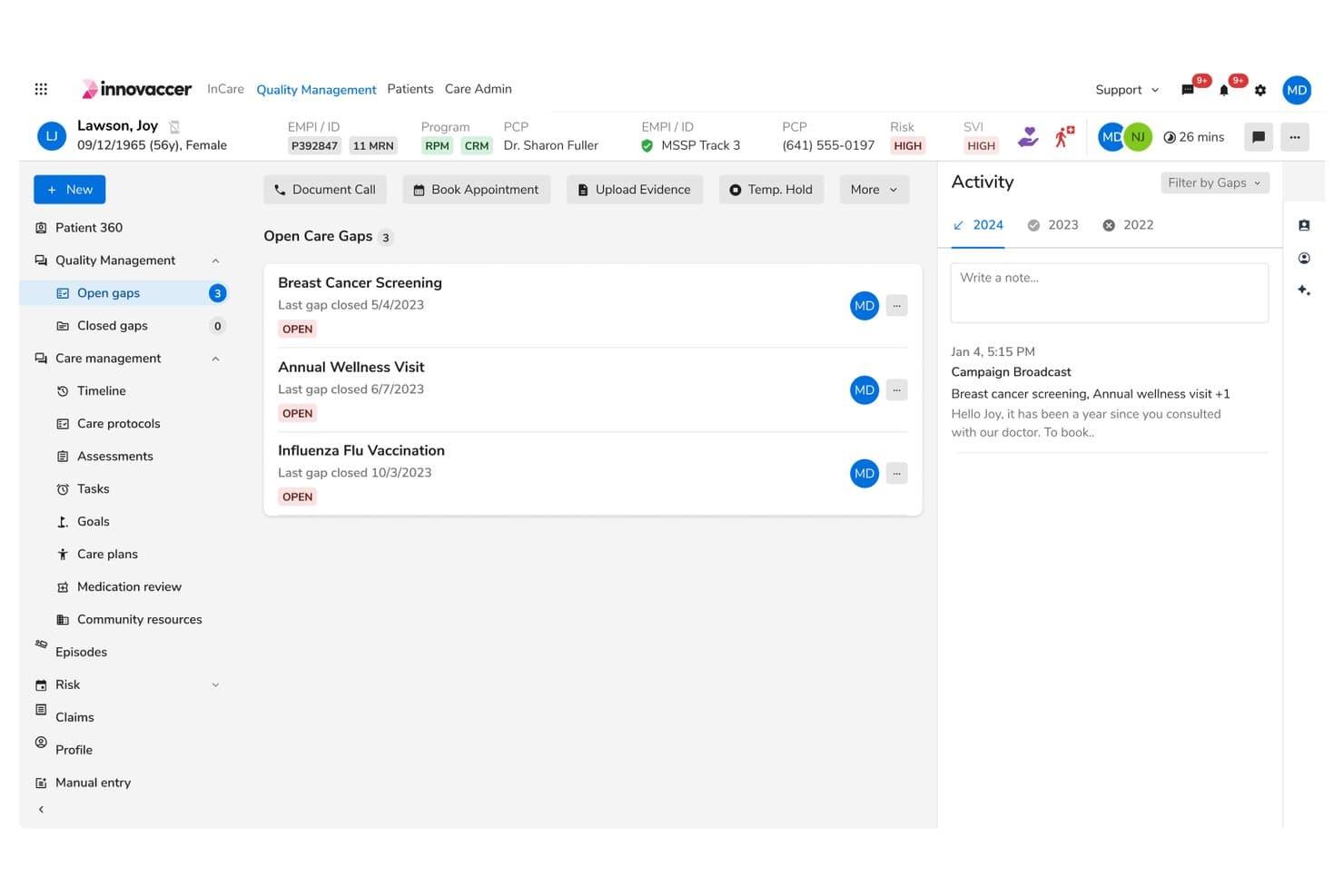
Innovaccer offers a Quality Management module that displays open care gaps, patient risk levels, and activity tracking for streamlined healthcare performance monitoring. Innovaccer Flow is an agentic AI platform for revenue cycle management that covers prior authorization, autonomous medical coding, claims integrity, denials management, and appeals across the full RCM cycle.
Who Is Innovaccer Best For?
Innovaccer Flow is built for enterprise health systems and large multi-specialty groups that need agentic AI across the full RCM cycle, from prior authorization through coding, claims, and appeals.
Why I Picked Innovaccer
Innovaccer earns its spot on my shortlist because no other platform I've seen deploys specialized AI agents across every RCM stage the way Flow does. Flow Auth cuts prior authorization prep from 45 minutes to 3 minutes using payer-specific rule engines, while Flow Capture autonomously codes roughly 80% of encounters across ICD-10, CPT, and DRG without human intervention. The Outcome Intelligence Loop then feeds denial and authorization outcomes back into the models, so the system gets sharper with every claim cycle.
Innovaccer Key Features
- Underpayment detection: Flow Collect automatically identifies payer underpayments and variances, flags recoupments, and initiates recovery actions without manual review.
- Ambient scribing: Flow Capture transcribes patient encounters in real time, producing EHR-ready clinical notes without requiring manual documentation after the visit.
- Pre-visit prep: Surfaces patient history, active conditions, labs, medications, and coding gaps for providers before each encounter begins.
- Generative AI appeals drafting: The Appeals Agent auto-generates payer-specific appeal letters using clinical documentation, care guidelines, and payer deadline tracking.
Innovaccer Integrations
Innovaccer integrates bi-directionally with 80+ EHRs, including Epic, Oracle Cerner, athenahealth, eClinicalWorks, MEDITECH, and NextGen Healthcare. It supports FHIR R4, HL7, USCDI-mapped exchange, APIs, payer portals, and fax submissions.
Pros and Cons
Pros:
- Handles autonomous coding and ambient scribing
- Reduces denial rates and accounts receivable
- Covers full RCM lifecycle with AI agents
Cons:
- Few public user reviews for RCM suite
- Patient payment features not clearly documented
Learn more about Innovaccer: Best for payer-level denial prediction at scale
- Not available
- Pricing upon request
Experian Health edits claims, predicts denials, guides appeals, and tracks payers. Experian Health is an AI revenue cycle management platform built around ClaimSource and AI Advantage, combining claims editing, payer-level denial prediction, prior authorization automation, eligibility verification, and patient financial clearance in one suite.
Who Is Experian Health Best For?
Experian Health is a strong fit for revenue cycle teams at mid-to-large health systems and hospital networks that process high claim volumes and need payer-level denial intelligence built into their workflows.
Why I Picked Experian Health (ClaimSource / AI Advantage)
Experian Health earns its spot on my shortlist because AI Advantage's Predictive Denials module does something most RCM platforms can't: it scores claims against continuously updated payer adjudication patterns before submission, so your team is correcting high-risk claims rather than chasing denials after the fact. Paired with ClaimSource's payer-specific rule library spanning 1,796 payers, that pre-submission intelligence is genuinely hard to replicate at scale. Client outcomes back this up, with organizations like St. Luke's cutting denials by 76% and Blessing Health improving clean claim rates from 63% to 90%.
Experian Health Key Features
- Contract Manager & Analysis: Audits payer contracts by comparing expected versus actual reimbursements, flags underpayments, and surfaces negotiation data to support contract renegotiations.
- Coverage Discovery: Identifies missing or previously unknown patient insurance coverage to reduce write-offs before claims are submitted.
- PaymentSafe: Processes patient payments across IVR, mobile, kiosk, and patient portal channels using point-to-point encryption and PCI DSS Level 1 compliance.
- Power Reporting: Provides built-in dashboards for clean claim rates, denial trends, and cash flow KPIs without requiring a dedicated data analyst to interpret the results.
Experian Health (ClaimSource / AI Advantage) Integrations
Experian Health integrates with Epic, Oracle Health, athenahealth, NextGate, FollowMyHealth, and eCare NEXT. It supports X12 EDI, FHIR, and HL7 connectivity; no public API is documented.
Pros and Cons
Pros:
- Integrated contract management with underpayment detection
- Extensive payer behavioral intelligence and rules
- Unique payer-level denial prediction before submission
Cons:
- Not suited for small or solo practices
- No NLP-powered autonomous coding assistance
Learn more about Experian Health (ClaimSource / AI Advantage): Best for AI denial appeals across health systems
- Free demo available
- Pricing upon request
Visit WebsiteCustomer Rating:4.4/5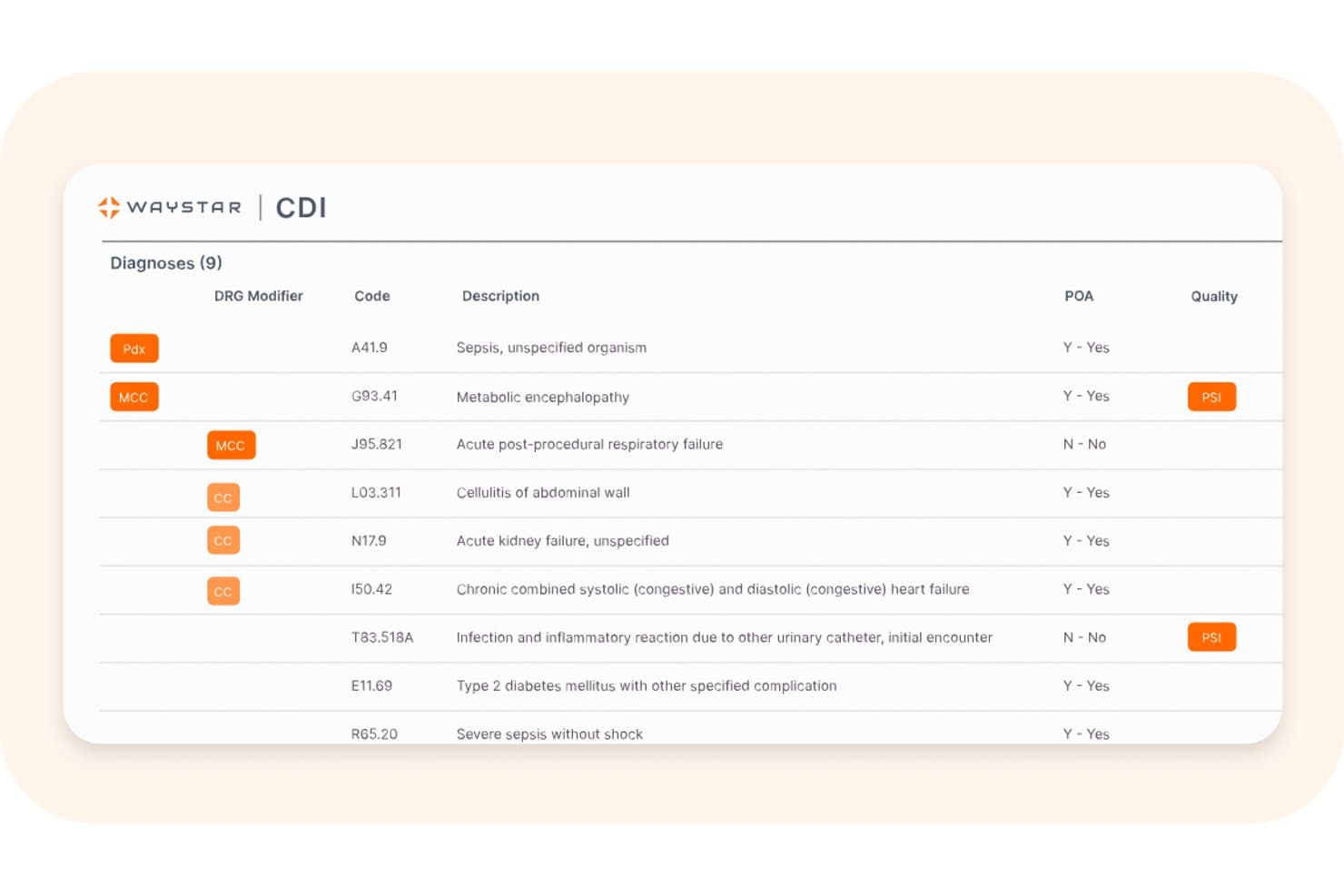
Waystar offers a CDI interface that displays a structured list of 9 diagnoses with DRG modifiers, ICD codes, descriptions, POA status, and quality flags like PSI. Waystar is an AI-powered revenue cycle management platform that covers claims management, prior authorization, denial prevention and appeals, clinical documentation integrity, and patient payment across the full RCM lifecycle.
Who Is Waystar Best For?
Waystar is a strong fit for health systems and large hospital networks that need an end-to-end AI-powered platform to manage denials, prior authorizations, and clinical documentation integrity at scale.
Why I Picked Waystar
Waystar earns its spot on my shortlist because of what AltitudeAI does specifically for denial appeals at scale. I'm particularly impressed by the generative AI appeal drafting, which auto-generates payer-specific appeal letters and packages, cutting creation time by 90% and driving a 40% higher overturn rate. At health systems processing thousands of denials monthly, that kind of throughput isn't achievable manually. The Payer Behavior Intelligence layer also continuously updates denial patterns across 5,000+ payers, so prevention happens before a claim even leaves the queue.
Waystar Key Features
- Auth Accelerate: Automates prior authorization requests end-to-end, including clinical documentation attachments, across 35+ service lines with real-time approval status updates.
- Prebill anomaly detection: AI reviews post-discharge clinical narratives to flag ICD-10 and DRG inaccuracies before a claim is submitted for billing.
- Advanced Propensity to Pay: Predictive scoring stratifies patient accounts by collection risk and expected payment amount without pulling traditional credit bureau data.
- Altitude Assist: A generative AI tool that builds custom claim edits in minutes by drawing on continuously updated rules across 5,000+ payer connections.
Waystar Integrations
Waystar has integrations with 530+ HIS and practice management systems, including Epic, Cerner, athenahealth, eClinicalWorks, NextGen, and Allscripts. It also connects with 5,000+ payers and supports standard X12 EDI transactions.
Pros and Cons
Pros:
- DRG anomaly detection recovers underpaid claims
- Prior authorization automation covers 35 service lines
- Generative AI drafts payer-specific appeal letters
Cons:
- Implementation timelines can be longer than expected
- Full-featured CAC coding tool not included
Learn more about Waystar: Best for network-wide AI denial prevention
- Free demo available
- Pricing upon request
Visit WebsiteCustomer Rating:3.8/5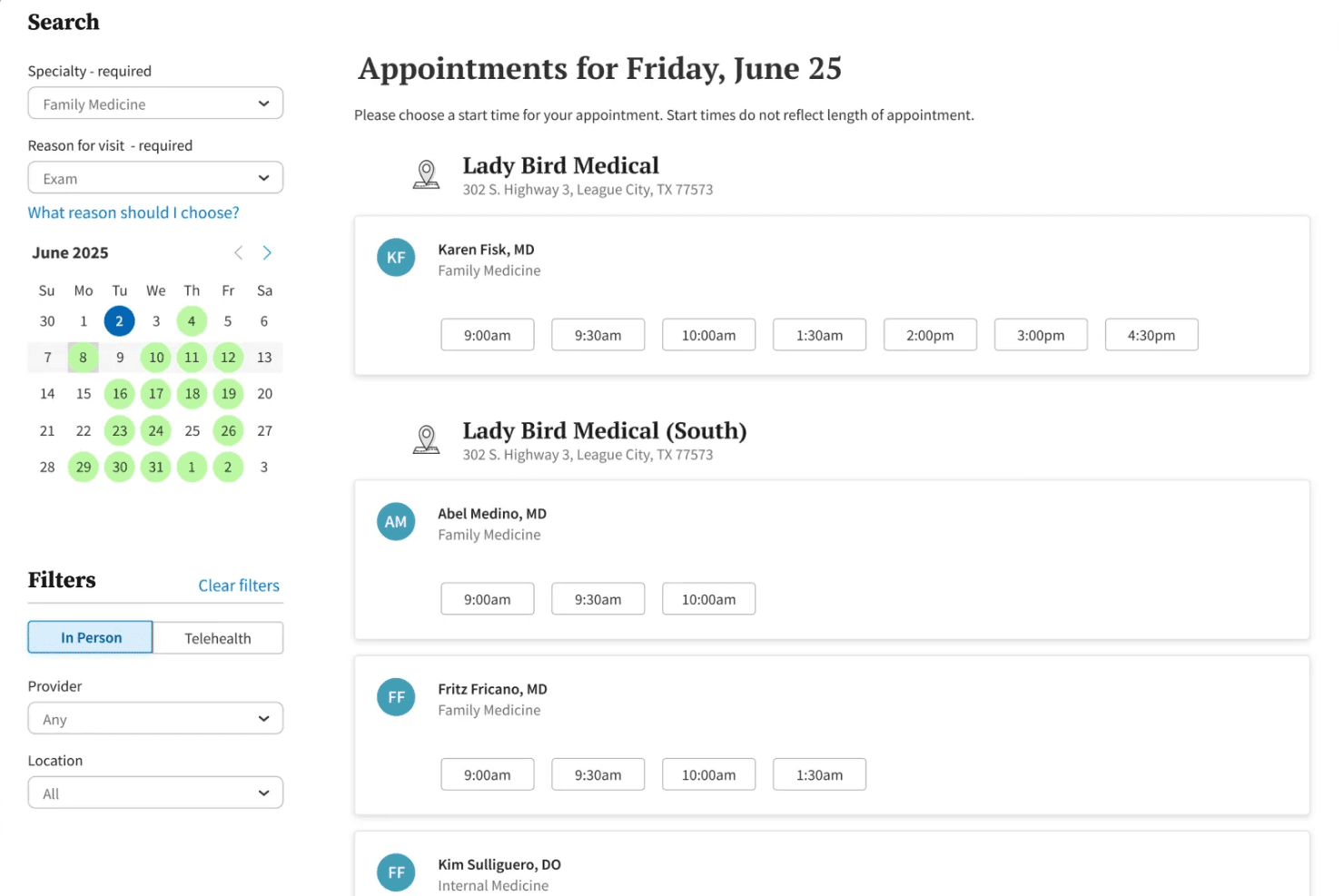
AthenaOne offers appointment scheduling with specialty filters, calendar navigation, provider selection, and available time slots across multiple clinic locations. athenaOne is an AI-native revenue cycle management platform that handles claims scrubbing, denial prediction, prior authorization, coding assistance, and patient payment collection across the full billing lifecycle.
Who Is athenaOne Best For?
athenaOne is a strong fit for independent and ambulatory medical practices that need end-to-end AI-driven revenue cycle management, from claims scrubbing and coding assistance to denial prevention and prior authorization.
Why I Picked athenaOne
I picked athenaOne as one of the best because its denial prevention goes beyond a single practice's claims history, drawing on live payer behavior data from 160,000+ providers across the athenaNet network. That scale means the AI flags denial-prone patterns before submission, not after. I also love the Automated Denial Advice feature, which generates specific, natural-language resolution steps for coding-related denials, cutting the research time billing staff would otherwise spend digging through payer remittance notes.
athenaOne Key Features
- Express Coding: Reviews clinical documentation and generates one-click E&M and CPT code suggestions directly within the billing tab.
- AI Voice Agents: Autonomously conduct prior authorization calls with payers, completing submissions in under an hour without staff involvement.
- Ambient Notes: Records patient visits using generative AI and auto-generates structured SOAP note summaries integrated into patient records.
- Network Insights benchmarking: Compares your practice's RCM performance against similar practices across the 160,000+ provider athenaNet network.
athenaOne Integrations
athenaOne supports RESTful FHIR R4, HL7 v2, and X12 EDI connectivity, plus 380+ APIs for custom integrations. Its Marketplace offers 500+ partner integrations across 50+ categories, including SOAP Health, DeepCura AI Agent, Assort Health, HealthTalk A.I., and Weave.
Pros and Cons
Pros:
- Clean claim rate exceeds most ambulatory platforms
- Automated prior authorization calls reduce staff burden
- AI denial prevention uses payer network insights
Cons:
- Pricing tied to collections increases with revenue
- Partial outsourcing still requires billing staff
Learn more about athenaOne: Best for AI-driven mid-cycle coding and denial cuts
- Free demo available
- Pricing upon request
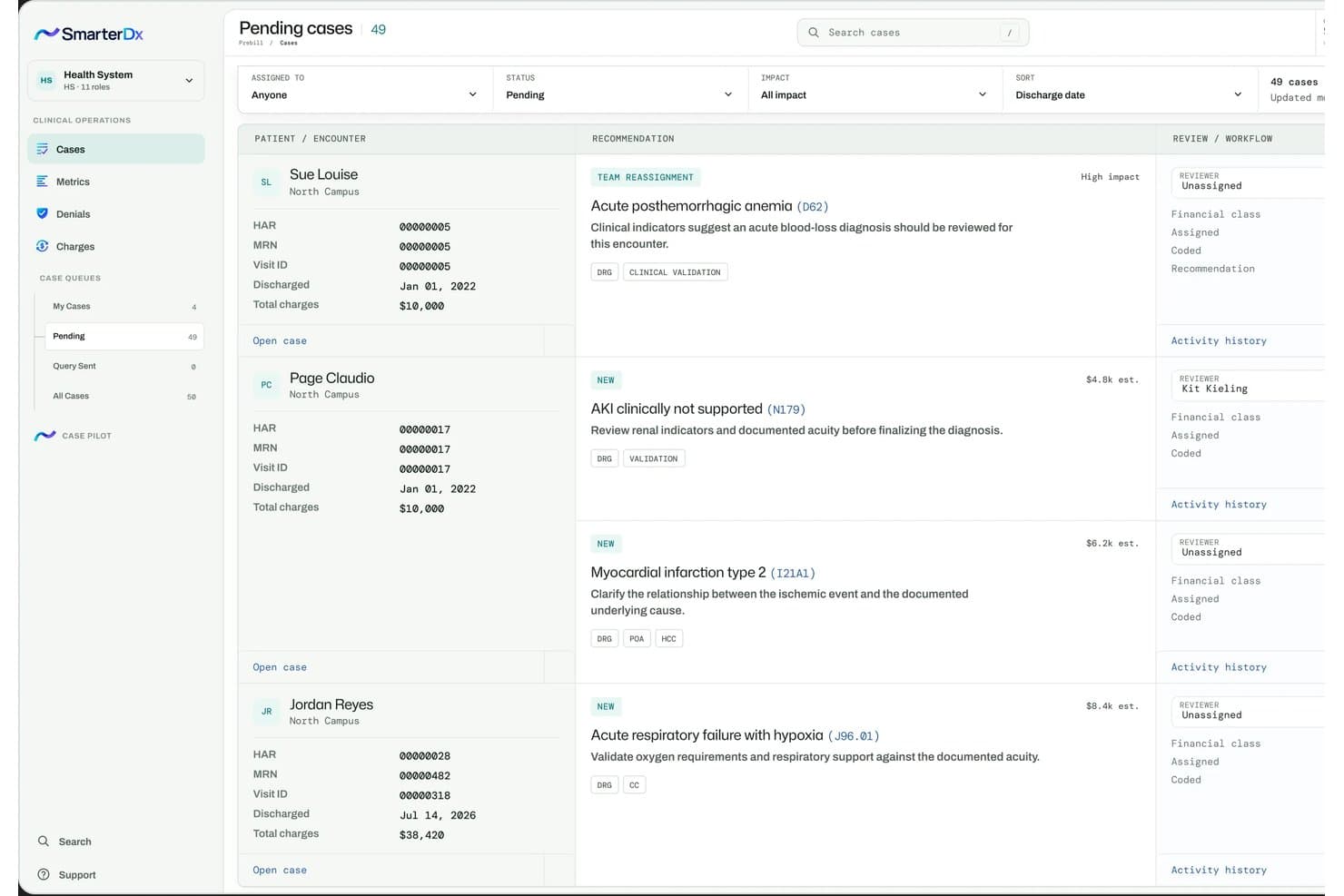
SmarterDx surfaces AI-driven coding recommendations across pending cases. SmarterDx is an AI revenue cycle management platform built around mid-cycle workflows, combining clinical AI-driven coding assistance, autonomous charge capture, documentation integrity, and denial prevention tools into a single system.
Who Is SmarterDx Best For?
SmarterDx is a strong fit for mid-to-large health systems and hospital groups that need AI-driven coding support and denial reduction across mid-cycle revenue operations.
Why I Picked SmarterDx
SmarterDx earns its spot on my shortlist because of how precisely it targets mid-cycle revenue operations, where coding gaps and denials tend to do the most damage. I'm particularly drawn to its Autonomous Coding model, which pairs AI with a human-in-the-loop feedback system to hit 95% coding accuracy across high chart volumes. Its denial prevention analytics go beyond flagging issues, drilling into root causes by payer, coder, and facility so your team can fix the actual problem.
SmarterDx Key Features
- Intelligent Authorization®: A single-source prior authorization tool that automates eligibility verification, ePA submission via EDI 278, and authorization outcome documentation directly back to your EMR.
- Computer-Assisted CDI: Automates concurrent, retrospective, and prospective clinical documentation integrity reviews, replacing manual spreadsheet-based physician query workflows.
- Agentic AI digital workforce: AI agents that apply human-like reasoning to handle complex denial routing, remediation workflows, and multi-step claims tasks across payers.
- Four-tier analytics suite: Layered reporting across descriptive, diagnostic, predictive, and prescriptive analytics, with Power BI and Tableau dashboards for real-time coder productivity and payer performance tracking.
SmarterDx Integrations
SmarterDx has documented integrations with Epic, Cerner, athenahealth, MEDITECH, eClinicalWorks, Allscripts, HARRIS HEALTHCARE, Evident, and 3M APR Grouper. It also supports HL7, EDI 278, ERA/EFT, SFTP, payer APIs, Power BI, and Tableau.
Pros and Cons
Pros:
- Agentic digital workforce handles complex denials
- Four-tier analytics reveal denial root causes
- AI-driven autonomous coding hits 95% accuracy
Cons:
- Platform complexity may challenge smaller practices
- AI patient payment features not fully documented
Learn more about SmarterDx: Best for denial prevention across U.S. hospitals
- Free demo available
- Pricing upon request
FinThrive predicts denials, tracks outcomes, finds causes, and manages appeals. FinThrive is an AI-driven revenue cycle management platform that covers patient access, claims management, denial prevention, charge integrity, contract management, and RCM analytics under a unified data intelligence architecture called FinThrive Fusion®.
Who Is FinThrive Best For?
FinThrive is built for mid-to-large U.S. hospitals and health systems whose revenue cycle teams need AI-driven denial prevention across the full claims lifecycle.
Why I Picked FinThrive
FinThrive earns its spot on my shortlist because its Denials Prevention Manager applies ML at the claim-line level before submission, trained on billions of real-world adjudication outcomes to flag high-risk claims and recommend corrective actions before they ever reach a payer. I'm particularly impressed by the Intelligent Appeals Agent, which uses generative AI and RPA to auto-draft payer-specific appeal letters and learns continuously from payer outcomes, saving teams an average of 250 staff hours monthly. That kind of pre- and post-submission denial coverage, built on the unified Fusion data architecture, is what makes FinThrive the go-to for U.S. hospital RCM teams laser-focused on denial prevention.
FinThrive Key Features
- Insurance Discover™: Continuously searches for hidden patient insurance coverage across the full patient journey using patented data matching connected to 98% of U.S. covered lives.
- FinThrive Analyze: Surfaces real-time KPI trends, payer performance data, and predictive 30/60/90-day cash forecasting in a single-view dashboard built on the Fusion data lake.
- Authorization Manager: Uses LLMs to interpret payer policy changes in real time and automate prior authorization requests, achieving 99.5% accuracy across 940+ payers.
- RCMTAM benchmarking: A vendor-agnostic benchmarking model developed with HFMA that lets your team assess and prioritize RCM technology investments against 150+ peer organizations.
FinThrive Integrations
FinThrive integrates with MEDITECH Expanse, Epic, Oracle Health (Cerner), and Altera. It also supports HL7, FHIR, and X12 EDI standards, with clearinghouse connectivity to 940+ payers.
Pros and Cons
Pros:
- Agentic AI automates appeals and workflows
- Denials Prevention Manager reduces denials pre-submission
- Industry-leading insurance discovery performance
Cons:
- Vendor financial stability concerns remain high
- No standalone NLP-based coding module
Learn more about FinThrive:

R1 RCM offers a Healthcare Revenue OS platform focused on real-time adjudication, as shown on their homepage hero section. R1 RCM is an AI-powered revenue cycle management platform built around its Phare OS system, which unifies claims management, autonomous coding, prior authorization, denial prevention, and real-time analytics across the full revenue cycle.
Who Is R1 RCM Best For?
R1 RCM is built for large health systems and enterprise-level organizations that need AI-driven revenue cycle management across complex, high-volume payer environments.
Why I Picked R1 RCM
R1 RCM earns its spot on my shortlist because of how seriously it approaches payer denial prevention at the enterprise scale. I'm particularly impressed by Payer Atlas, which monitors 30,000+ payer policy changes and 20,000+ proprietary billing rules in real time to stop denials before a claim ever reaches submission. Phare Flow then handles the back end, autonomously resolving more than 40% of denials and using generative AI to draft appeal letters directly from medical records.
R1 RCM Key Features
- Phare Audit pre-bill scanning: Reviews full EHR records before billing to surface coding and clinical documentation gaps, identifying over $222 in incremental revenue per discharge.
- Phare OS Command Center: A unified real-time dashboard that monitors performance across all revenue cycle workflows, with configurable KPI views for operations leaders.
- DRG validation safety net: Cross-checks inpatient DRG assignments against clinical documentation with 95% coder agreement, flagging underpayments before they're finalized.
- Autonomous prior authorization processing: Manages end-to-end prior auth determination and submission across 1,500+ payer connections, clearing 96% of orders within one day.
R1 RCM Integrations
R1 RCM integrates with Epic, Cerner, major clearinghouses, banks, and 1,500+ payer connections through Payer Atlas. Its Unified Data Exchange supports bidirectional data exchange with major EHR systems.
Pros and Cons
Pros:
- Recognized for underpayment detection and appeals
- Industry-leading AI-powered claims and coding automation
- Excels at payer denial prediction and prevention
Cons:
- No public peer reviews for Phare OS
- Mainly suitable for large enterprise health systems
Learn more about R1 RCM:
Annen programvare for styring av inntektssyklusen med kunstig intelligens
\u003cspan style=\u0022font-weight: 400;\u0022\u003eHer er noen flere alternativer for programvare for styring av inntektssyklusen med kunstig intelligens som ikke kom med på kortlisten min, men som likevel er verdt å undersøke:\u003c/span\u003e
- 11Honey HealthBest for specialty-specific AI coding and prior auth
- 12Jorie AIBest for denial prevention across 3,500+ payers
- 13DrChronoBest for EHR-embedded coding and claims billing
- 14CareCloudBest for AI-generated appeals in an integrated suite
- 15NextGen HealthcareBest for ambient AI charge capture across specialties
- 16AvailityBest for clearinghouse-scale AI denial prevention
- 17Thoughtful AIBest for agentic back-office RCM automation
- 18RapidClaimsBest for closed-loop denial prevention at scale
How I Evaluate AI Revenue Cycle Management Software
To earn a spot on my list, a tool needs to deliver genuine AI value—think catching a denial before it's submitted, not just flagging it afterward. I split my evaluation into core functionality every tool must cover and the differentiating factors that separate the best from the rest.
Core Functionality (Table Stakes For This List)
When I'm selecting tools for my list, I rank each one on a scale from 0 (does not offer the functionality) to 5 (excels in this area) for each core functionality listed below. I then calculate the tool's total score into a percentage, using 65% as a benchmark to help assess its overall fit for the list.
- AI claims management: I look for AI-driven scrubbing, submission, and status tracking that learns from payer-specific rejection patterns rather than relying on static rule sets.
- Intelligent coding assistance: Each tool's ability to suggest CPT and ICD-10 codes directly from clinical documentation matters here, especially NLP-driven charge capture that adapts to specialty workflows.
- Automated eligibility and prior auth: I evaluate whether the platform can verify coverage and submit prior authorizations across multiple payers without manual follow-up, including automated status checks.
- Denial prediction and prevention: ML models that flag high-risk claims before submission are what I check for, along with root-cause analytics that pinpoint why specific payers reject certain claim types.
- Patient payment and estimation: I consider how accurately the tool generates out-of-pocket estimates and whether it offers digital payment options like payment plans and propensity-to-pay scoring.
- RCM analytics and reporting: Dashboards tracking KPIs like days in A/R, clean claim rate, and net collections need to surface AI-generated insights, not just static charts you have to interpret yourself.
Once I have a list of tools that meet the criteria, I consider what sets each platform apart.
Differentiating Factors (What Sets Vendors Apart)
Here's how I compare and contrast different vendors:
Standout Features
I look for generative AI appeals drafting that auto-generates payer-specific appeal letters and pulls supporting documentation from the EHR—this cuts days off denial turnaround compared to manual letter writing. Underpayment detection matters just as much, since automated contract variance analysis catches shortfalls your team would otherwise miss. I also evaluate specialty-specific coding models, especially for high-complexity areas like cardiology or anesthesia where modifier logic and E/M leveling need to reflect current guidelines.
Beyond Features
I check whether a platform supports HL7, FHIR R4, and X12 EDI transactions with bi-directional EHR connectors—without that, charges and remits end up requiring duplicate entry. Compliance matters just as much: I look for HITRUST CSF certification and No Surprises Act logic built into estimation workflows, not bolted on as an afterthought. I also evaluate how well a tool scales across multi-TIN, multi-location setups so a growing practice can roll up reporting without hitting punitive pricing tiers.
Slik velger du programvare for styring av inntektssyklusen med kunstig intelligens
Hvilke kriterier hjelper deg faktisk med å navigere i det overfylte markedet for verktøy til styring av inntektssyklusen med kunstig intelligens og velge et som fungerer for teamets praktiske arbeidshverdag?
| Hvis prioriteten din er … | Se etter … |
| Å minimere avviste krav og klager | Prediktiv analyse av avviste krav med rapportering på betaler-nivå |
| Å redusere arbeidsbelastningen og manuell registrering for personalet | Funksjoner for automatisert koding, forhåndsgodkjenning og innsending av krav |
| Rask betaling og pålitelig refusjon | Verktøy for sanntidskontroll av rettigheter og beregning av betaling |
| Samsvar med regelverk og revisjonsberedskap | Integrerte arbeidsflyter for samsvar og oppdatert sertifisering |
| Å skalere når du legger til nye lokasjoner eller spesialområder | Støtte for flere lokasjoner og kodingsmoduler for spesifikke spesialområder |
Slik vurderer du kortlisten din
- Gjennomfør en test med fem krav: Be om en sandkasse eller livedemonstrasjon der du sender inn fem nylig avviste krav og måler verktøyets treffsikkerhet ved forutsigelse av avvisninger.
- Be om integrasjonsdokumentasjon: Be om API-dokumentasjon som bekrefter kompatibilitet med ditt spesifikke EMR- eller praksisadministrasjonssystem.
- Få eksempler på arbeidsflyter for revisjon: Be leverandøren vise eksempler på samsvars- og revisjonslogger samt dokumentasjon på oppdateringer av retningslinjer i sanntid fra de siste 12 månedene.
- Test støtte for spesialområder: La en behandler eller koder prøve systemet med faktiske koder for det aktuelle spesialområdet for å bekrefte kontekstsensitive forslag.
- Avveining: Tilpasning på virksomhetsnivå kontra forhåndsbygde arbeidsflyter: Bestem om du ønsker omfattende konfigurasjonsmuligheter for storskaladrift eller raskere implementering med forhåndskonfigurerte maler for små og mellomstore praksiser.
Hva er programvare for styring av inntektssyklusen med kunstig intelligens?
Programvare for AI-basert inntektssyklusstyring er en type helseteknologi som bruker kunstig intelligens til å automatisere og optimalisere fakturerings-, krav- og betalingsprosesser i medisinske organisasjoner. Disse verktøyene analyserer kliniske og økonomiske data, markerer kodefeil og forutsier avviste krav før innsending. Ved å håndtere repetitive oppgaver og synliggjøre innsikter hjelper programvare for AI-basert inntektssyklusstyring helseteam med å redusere den administrative arbeidsmengden og holde betalingene i gang på en effektiv måte, samtidig som den støtter behovene for etterlevelse og rapportering.
Funksjoner
Her er kjernefunksjonene all god programvare for AI-basert inntektssyklusstyring bør ha:
- AI-basert kravbehandling: Bruker maskinlæring til å kontrollere, sende inn og spore krav. Lærer av avvisningsmønstre hos de enkelte betalerne i stedet for bare å følge statiske regler, noe som hjelper teamet med å unngå gjentatte feil og redusere manuell inngripen.
- Intelligent kodestøtte: Bruker naturlig språkbehandling på klinisk dokumentasjon og foreslår CPT- og ICD-10-koder. Tilpasser seg arbeidsflytene innen fagområdet ditt og markerer manglende eller feilaktige koder for å minimere inntektstap.
- Automatisert kontroll av kvalifikasjon og forhåndsgodkjenning: Verifiserer pasientens dekning og setter i gang forhåndsgodkjenninger hos flere betalere uten manuell oppfølging. Overvåker godkjenningsstatusen og ber bare om handling når det er nødvendig.
- Forutsigelse og forebygging av avvisninger: Marker høyrisikokrav før innsending ved hjelp av maskinlæringsmodeller som er trent på betalertrender. Synliggjør analyser av de underliggende årsakene, slik at du forstår hvorfor krav sannsynligvis blir avvist og kan løse problemene før de oppstår.
- Pasientbetaling og kostnadsestimering: Beregner estimater for pasientens egenbetaling i sanntid basert på betalerkontrakter og pasientens dekning. Tilbyr digitale betalingsalternativer, inkludert nettbaserte kontoutskrifter, betalingsplaner og vurdering av betalingsvillighet for å gjøre innkreving enklere.
- RCM-analyse og rapportering: Tilbyr dashbord som sporer viktige resultatindikatorer, for eksempel antall dager med utestående fordringer og andelen feilfrie krav. Inkluderer AI-generert innsikt som hjelper deg med å oppdage trender og iverksette konkrete tiltak uten å bruke timevis på dataanalyse.
- Automatisert generering av klager: Oppretter utkast til klagebrev som er tilpasset den enkelte betaler, og henter relevant dokumentasjon fra EPJ-systemet ditt. Bidrar til å løse avvisninger raskere ved å redusere den manuelle arbeidsmengden ved klagebehandling.
- Fagområdespesifikke kodemodeller: Støtter områder med høy kompleksitet ved å bruke AI-modeller som er tilpasset de unike kodereglene innen fagområder som kardiologi, anestesiologi og ortopedi. Sikrer at modifikatorlogikk, E/M-nivåinndeling og andre fagområdespesifikke koder gjenspeiler gjeldende retningslinjer.
- Støtte for etterlevelse og revisjon: Opprettholder oppdatert regelverksetterlevelse, inkludert integrasjon av standarder som HL7, FHIR og X12. Logger revisjonsspor og støtter kravene i regelverk som loven om uventede regninger. Gjør det enklere å dokumentere etterlevelse under eksterne revisjoner.
- Integrasjon med EPJ- og praksisstyringssystemer: Bruker sikre, toveis koblinger til å synkronisere data mellom verktøyet for inntektssyklusstyring og de kliniske systemene dine. Dette eliminerer dobbeltregistrering og holder opplysningene konsistente på tvers av plattformene.
Fordeler
Implementering av programvare for AI-basert inntektssyklusstyring gir flere fordeler for teamet og virksomheten din. Her er noen av fordelene du kan se frem til:
- Lavere avvisningsgrad: Proaktiv forutsigelse av avvisninger og betalerspesifikke analyser hjelper deg med å håndtere problemer før kravene sendes inn.
- Raskere krav- og betalingssykluser: Automatiserte kontroller av kvalifikasjon, forhåndsgodkjenning og digitale betalingsverktøy får alle trinn i inntektssyklusen til å gå raskere enn manuelle prosesser.
- Nøyaktig koding og registrering av kostnader: AI-drevne kodeforslag og fagområdespesifikke modeller begrenser feil og tilpasser seg komplekse arbeidsflyter på tvers av ulike medisinske fagområder.
- Redusert manuell arbeidsmengde: Automatisert kontroll av krav, statussporing og utarbeidelse av klageutkast frigjør medarbeidere fra repetitive administrative oppgaver.
- Bedre etterlevelse og revisjonsberedskap: Integrerte etterlevelseskontroller, revisjonsspor og regelverksoppdateringer sikrer at du oppfyller krav som loven om uventede regninger, uten ekstra innsats.
- Bedre økonomisk oversikt: RCM-dashbord for sanntidsanalyse synliggjør trender og handlingsrettet innsikt, slik at du raskt kan reagere på risikoer for inntektene.
- Bedre EPJ-integrasjon: Toveis dataforbindelser minimerer dobbeltregistrering og holder kliniske opplysninger og faktureringsinformasjon synkronisert på tvers av systemene dine.
Kostnader og priser
Ved valg av programvare for AI-basert inntektssyklusstyring er det nødvendig å forstå de ulike prismodellene og abonnementene som er tilgjengelige. Kostnadene varierer basert på funksjoner, teamstørrelse, tillegg og mer. Tabellen nedenfor oppsummerer vanlige abonnementer, gjennomsnittsprisene deres og typiske funksjoner som er inkludert i løsninger for programvare for AI-basert inntektssyklusstyring:
Sammenligningstabell for abonnementer for programvare for AI-basert inntektssyklusstyring
| Plantype | Gjennomsnittlig pris | Vanlige funksjoner |
| Gratisplan | $0 | Grunnleggende AI-basert kravhåndtering, begrensede rapporteringsverktøy og støtte for én enkelt bruker. |
| Personlig plan | $50–$150/bruker/måned | AI-basert kravhåndtering, intelligent kodehjelp, standardanalyse og grunnleggende verifisering av dekning. |
| Bedriftsplan | $200–$600/bruker/måned | Avansert prediksjon av avslag, automatisk generering av klager, estimering av pasientbetalinger og støtte for flere brukere. |
| Storbedriftsplan | $2,000–$10,000+/måned | Tilpassede integrasjoner, toveis EHR-tilkobling, kodemodeller spesifikt for ulike fagområder, avanserte samsvarsverktøy og skalerbar støtte for flere lokasjoner. |
Vanlige spørsmål
Her er noen svar på vanlige spørsmål om AI-programvare for inntektssyklusstyring:
Hvordan vet jeg om AI-programvare for inntektssyklusstyring kan integreres med EPJ-systemet mitt?
Du bør kontrollere at leverandøren har toveisintegrasjoner for det aktuelle EPJ- eller praksisadministrasjonssystemet ditt. Be om dokumentasjon eller en demonstrasjon av integrasjonsprosessen. De fleste etablerte verktøy støtter HL7-, FHIR- eller X12-standarder, men direkte testing med pasient- og kravdataene dine vil vise om synkronisering i sanntid faktisk fungerer.
Kan AI-programvare for inntektssyklusstyring automatisere forhåndsgodkjenninger?
Ja, mange plattformer for AI-programvare for inntektssyklusstyring tilbyr automatiserte forhåndsgodkjenninger. De bekrefter kvalifisering, starter forespørsler om godkjenning og sporer status hos de største betalerne. Dette kan spare teamet ditt for manuell oppfølging, men graden av automatisering varierer, så undersøk om systemet dekker de viktigste betalerne og arbeidsflytene dine.
Hvilke trinn bør jeg ta for å evaluere AI-basert prediksjon av avslag i disse verktøyene?
Begynn med å kjøre et lite utvalg av reelle krav som tidligere har blitt avslått, gjennom programvaren – fem er et godt utgangspunkt. Se gjennom hvilke krav systemet markerer som høyrisiko, og hvorfor. Se etter betalerspesifikk analyse og forklaringer på grunnårsakene. Dette viser om verktøyets maskinlæring er tilpasset de faktiske kravmønstrene dine.
Har små eller mellomstore praksiser råd til AI-programvare for inntektssyklusstyring?
Ja, de fleste leverandører tilbyr abonnementer og priser som passer for mindre team. Mange tilbyr gratis abonnementer eller rimelige startabonnementer med de viktigste funksjonene. Vanligvis kan du oppgradere for å legge til avanserte funksjoner, brukere eller integrasjonsstøtte etter hvert som praksisen vokser, slik at du ikke bindes til bedriftspriser fra første dag.
Hvilke samsvarsfunksjoner bør jeg se etter i AI-programvare for inntektssyklusstyring?
Se etter verktøy med innebygde revisjonsspor, støtte for standarder som HL7 og FHIR og oppdatert regelverkslogikk, for eksempel kravene i No Surprises Act. Spør om sertifiseringer for HIPAA, HITRUST CSF og SOC 2. Du bør ha samsvarsfunksjoner som holdes oppdaterte uten at det kreves manuelle oppdateringer eller tungvinte omveier.
Hvordan kan AI-programvare for inntektssyklusstyring støtte spesialistpraksiser?
Noen plattformer har spesialitetsspesifikke modeller for koding og registrering av utførte tjenester, særlig innen komplekse fagområder som kardiologi eller anestesi. Disse hjelper kodeteamet med å følge retningslinjene for spesialiteten når det gjelder blant annet modifikatorlogikk og E/M-nivåinndeling. Bekreft alltid at verktøyet faktisk støtter spesialitetens unike arbeidsflyter før du bestemmer deg.
Hvordan kan AI forbedre inntektssyklusdriften for helsepersonell?
AI RCM-løsninger kan hjelpe helsepersonell med å effektivisere inntektssyklusdriften ved å automatisere repetitive oppgaver innen pasientregistrering, kravbehandling og oppfølging av betalinger. robotisert prosessautomatisering kan håndtere rutinemessig dataregistrering og statussjekker, mens prediktiv analyse kan identifisere krav med risiko for avslag eller forsinket betaling. En AI-drevet RCM-plattform kan også hjelpe team med å overvåke inntektsregistrering, inntektsintegritet og dager med utestående fordringer, slik at medarbeiderne får bedre oversikt over hvor inntekter går tapt og hvor arbeidsflytene trenger oppmerksomhet.