

Wound care EMR software is a digital platform that lets you assess, document, and manage wound treatment while keeping all records organized and accessible. If you’re evaluating these systems, you’re likely aiming to boost accuracy, speed up workflows, and make informed decisions for every patient. Choosing the right wound care EMR can help your team support continuity of care, reduce errors, and meet compliance requirements while balancing daily clinical pressures. This guide will help you quickly compare top options, key features, and what to expect so you can select the right fit for your practice.
Why Trust Our Software Recommendations
6,700+
Reviews
20
Industry experts
16+
Evaluation factors
14
Years
Our team has been testing and reviewing software since 2012. As medical practice leaders ourselves, we know how difficult—and important—it is to choose the right software.
For this guide, we evaluated tools using hands-on testing and independent research, scoring tools using our selection criteria.
Our reviews reflect our human editorial judgment, not a sales pitch.
Wound Care EMR Software Comparison Table
This comparison table summarizes pricing details for my top wound care EMR software selections:
| Tool | Best For | Trial Info | Price | ||
|---|---|---|---|---|---|
| 1 | Best for wound billing and coding automation | Free demo available, 7-day free trial for the standalone AI scribe | From $249/user/month | Website | |
| 2 | Best for comprehensive wound care EHR | Free demo available | Pricing upon request | Website | |
| 3 | Best for specialized wound care | Free demo available | Pricing upon request | Website | |
| 4 | Best for digital wound assessment | Free demo available | Pricing upon request | Website | |
| 5 | Best for standardized wound care documentation | Not available | Pricing upon request | Website | |
| 6 | Best for physician-designed wound charting | Free demo available | Pricing upon request | Website | |
| 7 | Best for mobile wound care billing automation | Free demo available | From $250/user/month | Website |


Best Wound Care EMR Software Reviews
Below are my detailed summaries of the best wound care EMR software that made it onto my shortlist. My reviews offer a detailed look at the features, best use cases, and integrations of each platform to help you find the best one for you.
 Best for wound billing and coding automation
- Free demo available, 7-day free trial for the standalone AI scribe
- From $249/user/month
Visit WebsiteCustomer Rating:4.4/5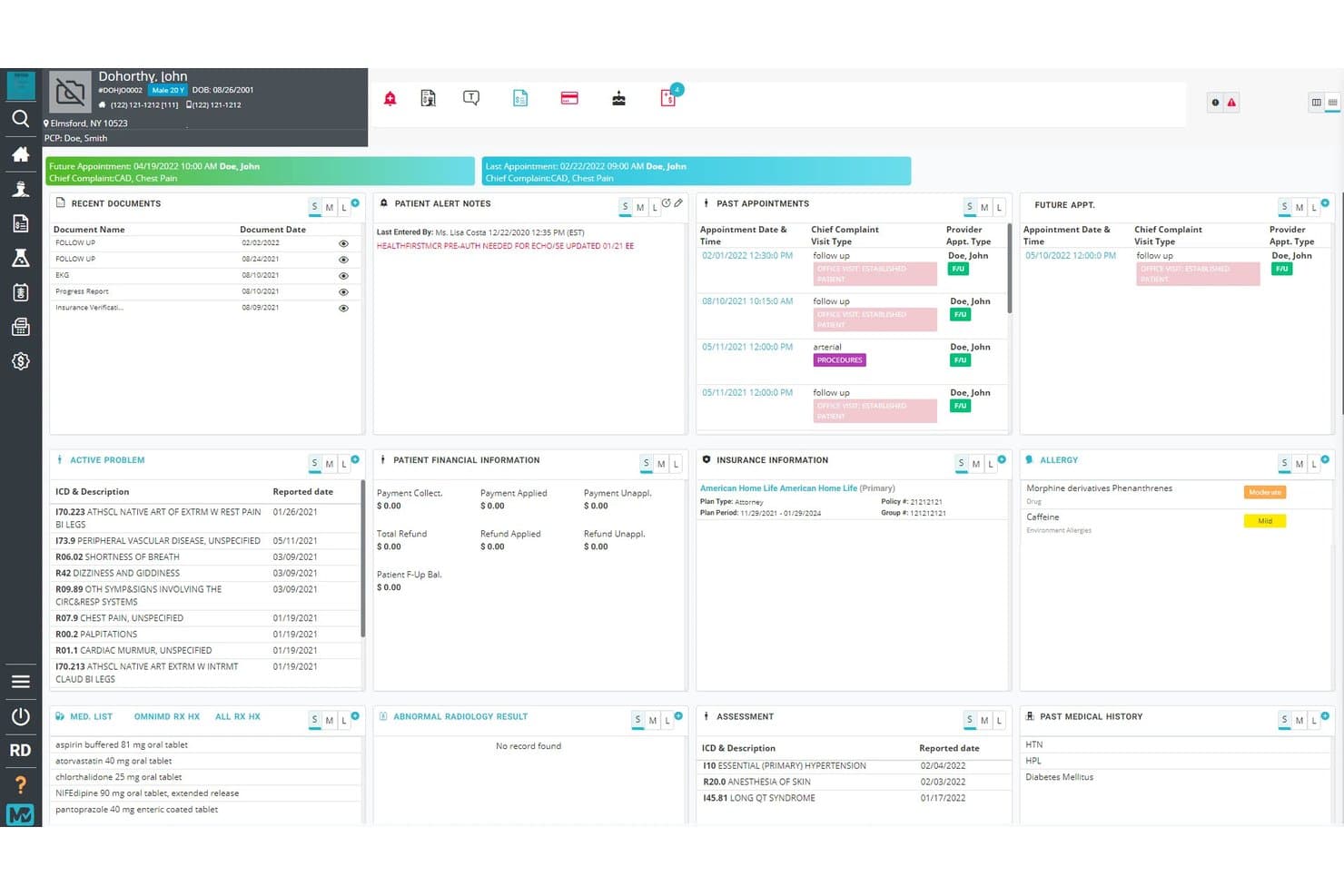
OmniMD centralizes patient health data for streamlined wound care visits. OmniMD is a multi-specialty EHR platform with a dedicated wound care module that covers etiology-specific documentation templates, AI-assisted coding, and billing automation for wound care procedures.
Who Is OmniMD Best For?
OmniMD fits multi-specialty clinics and outpatient wound care practices that want billing and coding automation built into the same system as their clinical documentation.
Why I Picked OmniMD
I picked OmniMD as one of the best because its AI Medical Coder handles the billing complexity that trips up most wound care practices, automatically applying codes like 97597 for debridement and A6xxx HCPCS codes for dressings, while checking modifiers and payer bundling rules before submission. I also like that the AI RCM layer predicts denials based on payer history, so claims get corrected before they're rejected. That coding-to-claims pipeline sits inside the same system as the clinical documentation, meaning a structured wound note feeds directly into a clean claim.
OmniMD Key Features
- Etiology-specific wound templates: Documentation templates tailored by wound type, including diabetic foot ulcers, venous leg ulcers, pressure injuries, burns, and arterial wounds.
- Multi-system wound classification: Supports Wagner, CEAP, NPUAP, Rutherford, and Southampton staging systems, with structured fields for tissue type, exudate, and periwound status.
- AI Medical Scribe for wound visits: Converts spoken assessments into structured chart fields, recognizing wound-specific terminology and prompting for missing post-procedure measurements.
- PUSH Score tracking: Records and plots Pressure Ulcer Scale for Healing scores across visits to visualize healing trends over time.
OmniMD Integrations
OmniMD integrates with LabCorp and Quest, plus regional labs through OmniXchange and HL7. It supports FHIR 4.0.1, SMART-on-FHIR, HL7, and API connections; its standalone AI Medical Scribe connects with Epic, Cerner, athenahealth, eClinicalWorks, and Allscripts.
Pros and Cons
Pros:
- Structured notes support cleaner claim submission
- AI coding checks modifiers and bundling
- Etiology-specific templates support precise staging
Cons:
- No offline bedside wound charting app
- Photo measurement and 3D mapping remain unverified
Learn more about OmniMD: Best for comprehensive wound care EHR
- Free demo available
- Pricing upon request
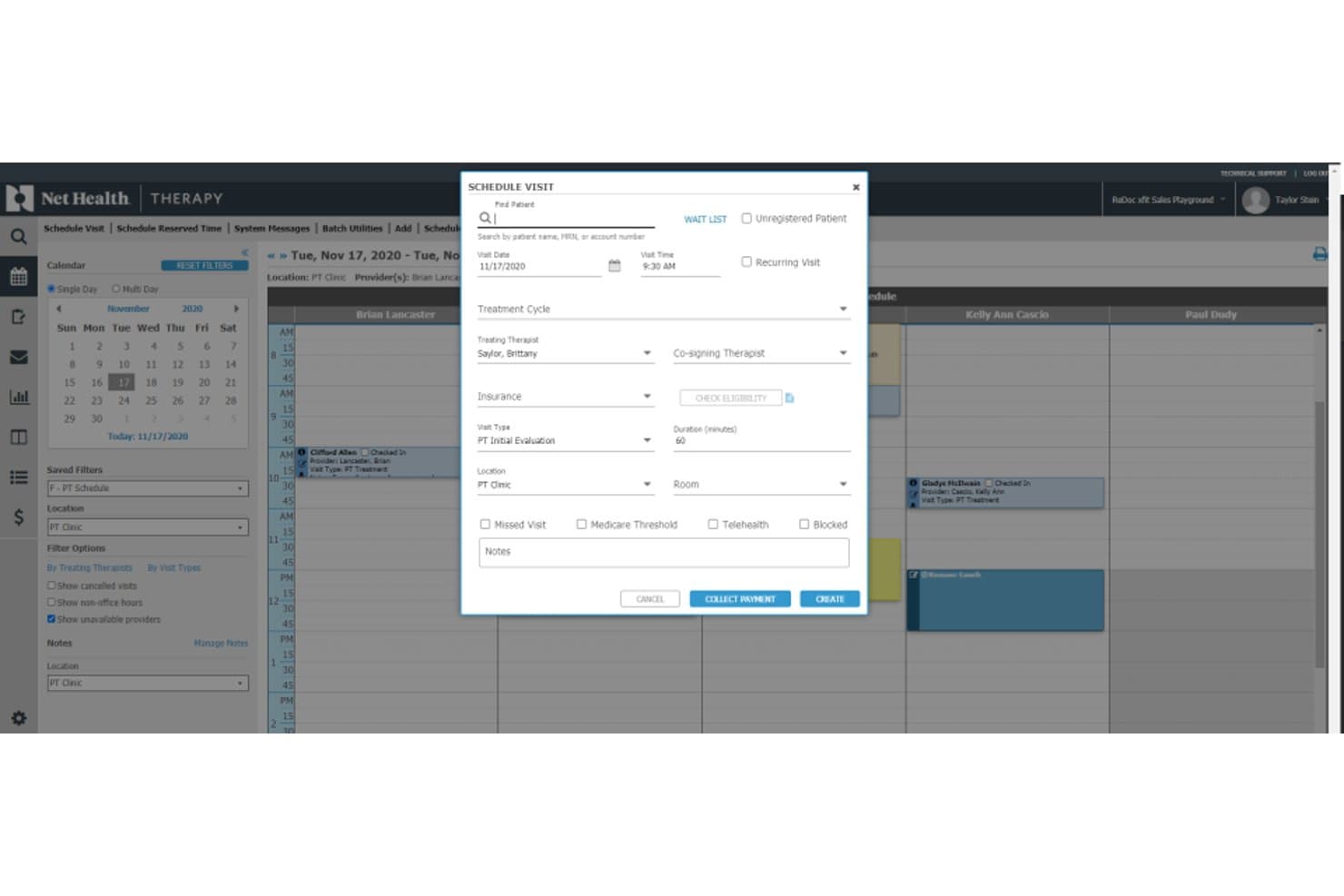
Net Health scheduling dashboard for managing patient visits, providers, insurance, and payments Net Health is a specialty wound care EMR platform that combines structured assessment documentation, AI-powered wound imaging, clinical decision support tools, and automated coding through its WoundExpert EHR and Tissue Analytics products.
Who Is Net Health Best For?
Net Health is a strong fit for wound care specialists and clinicians working across hospital outpatient centers, skilled nursing facilities, and home health settings.
Why I Picked Net Health
Net Health earns its spot as one of the best on my shortlist because it's one of the few wound care EMR platforms built around both clinical documentation and AI-driven imaging in a single system. I particularly like the Tissue Analytics integration, which auto-measures wounds through 3D mobile imaging so I'm not manually inputting dimensions at the bedside. The Wound Healing Velocity Tool and Amputation Risk Tool give me predictive clinical context that most general EHRs simply don't offer.
Net Health Key Features
- Role-based access controls: Assign permissions for clinicians, administrators, and support staff to protect PHI and maintain compliance.
- MatrixCare CSF integration: Sync patient census and real-time resident data for long-term care workflows.
- Population analytics dashboards: Track healing rates, infection trends, and quality benchmarks across patient groups or locations.
- Automated superbill coding: Link wound encounter data directly to CPT codes and prepare billing files within the same workflow.
Net Health Integrations
Net Health offers native integrations with Tissue Analytics and MatrixCare Census Subscriber Feed, supports interoperability with enterprise EHRs like Epic, and provides HL7 and Direct Access for custom integration workflows.
Pros and Cons
Pros:
- Predictive healing analytics and risk tools
- Customizable clinical documentation templates
- AI-powered wound imaging and measurement
Cons:
- Reporting interface sometimes loads slowly
- Workflow setup can require significant onboarding
Learn more about Net Health:
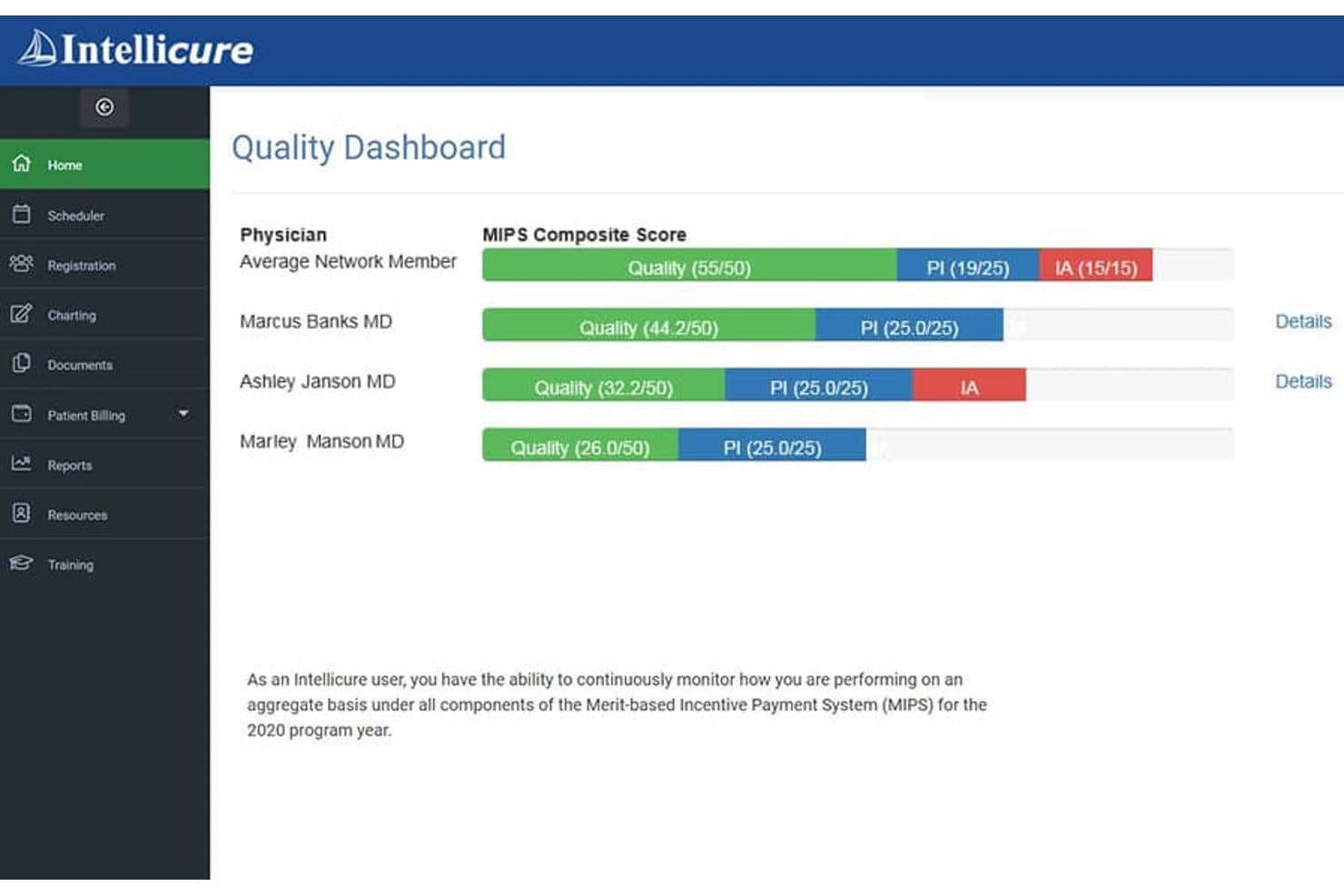
Intellicure quality dashboard showing physician MIPS performance and composite scores Intellicure is a cloud-based EMR built exclusively for wound care and hyperbaric medicine, combining point-of-care charting, AI-assisted coding, mobile wound measurement, and CMS quality reporting in a single platform.
Who Is Intellicure Best For?
Intellicure is a strong fit for hospital outpatient wound centers, mobile wound care practices, and long-term care facilities that need a dedicated wound care EMR.
Why I Picked Intellicure
Intellicure earns its spot as one of the best on my shortlist because no other wound care EMR goes as deep on clinical specificity. I particularly like iMeasure.ai, which detects wound measurements directly from a photo rather than requiring manual entry. The built-in AI also selects wound-specific ICD-10 codes and E/M levels at the point of care, and I've found that level of coding automation, paired with the CTP Audit Defender for skin substitutes, is rarely this tightly integrated in a purpose-built wound care platform.
Intellicure Key Features
- SMART on FHIR EHR integration: Intellicure can launch within major EHRs like Epic and Cerner for direct wound charting in hospital workflows.
- OrderTrak for DME requests: Generate and track durable medical equipment orders directly from the patient chart.
- Quality Suite with CMS-recognized measures: Supports MIPS reporting and benchmarking using US Wound Registry-authored wound care metrics.
- Automated documentation output: Auto-generates therapist notes, nursing notes, lab orders, and home health agency orders from each visit.
Intellicure Integrations
Intellicure offers native integrations with Epic, Oracle Health (Cerner), Meditech, Allscripts, Athena Health, and PointClickCare. MatrixCare integration is coming soon, and an API is available for custom integrations.
Pros and Cons
Pros:
- Embedded clinical decision support for wounds
- Auto-generates wound care quality reports
- AI-driven wound measurement from photos
Cons:
- Limited customization of report output
- Mobile offline charting not fully supported
Learn more about Intellicure:
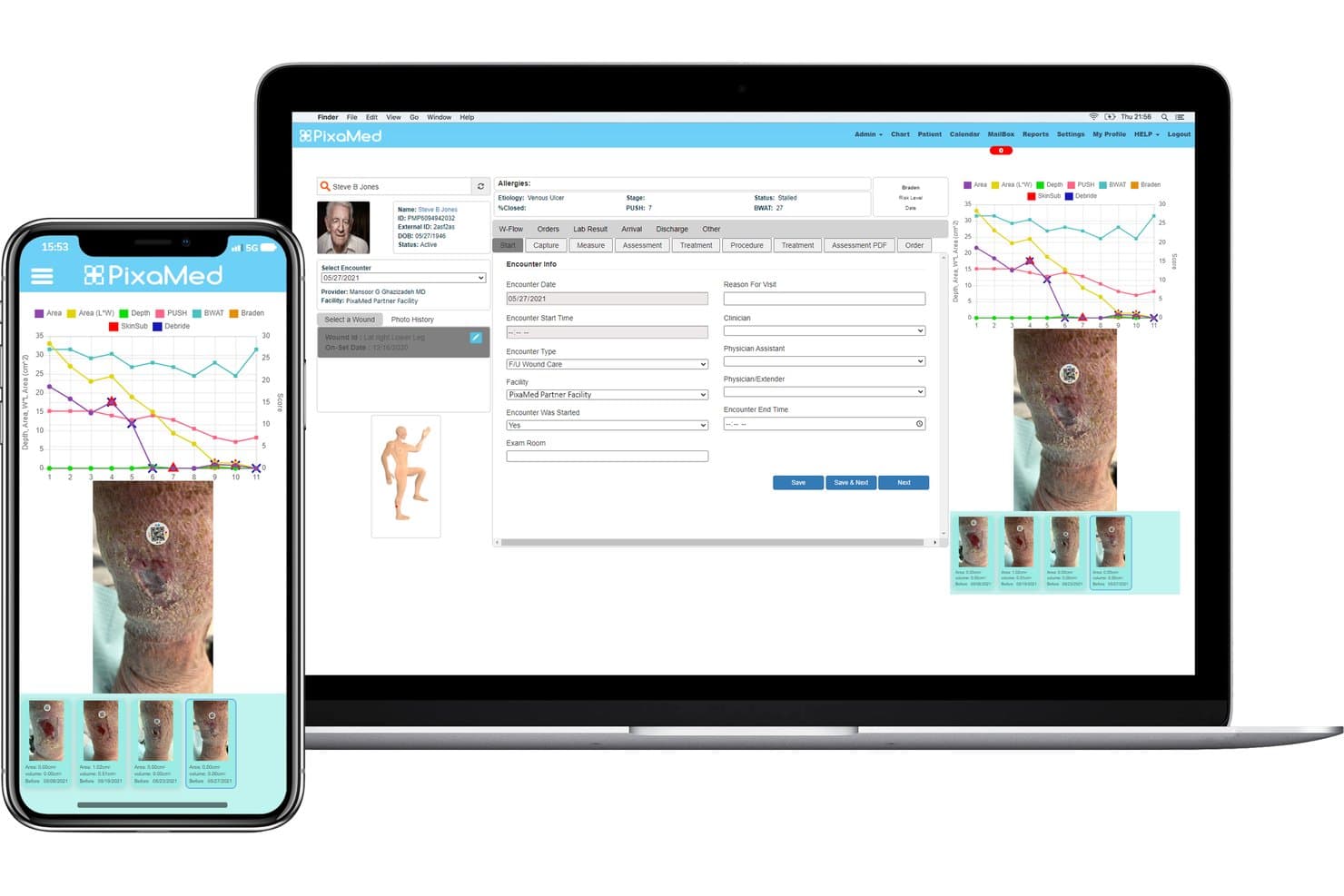
PixaMed offers a dual-device wound care EMR platform with wound photo tracking, measurement charts, and encounter documentation on both mobile and desktop. PixaMed is a specialty wound and burn care EMR platform that combines AI-assisted wound imaging, automatic tissue classification, structured assessment documentation, CPT code generation, and point-of-care mobile access with offline capability.
Who Is PixaMed Best For?
PixaMed is a strong fit for wound care clinicians and clinic administrators who need a specialty-specific EMR rather than a general-purpose system adapted for wound care.
Why I Picked PixaMed
PixaMed earns its spot as one of the best on my shortlist because its digital wound assessment tools go well beyond basic photo capture. I'm particularly impressed by Unwrap Technology, which compensates for body curvature to deliver measurements that are 20–50% more accurate than standard flat-image methods. Pair that with AI-driven tissue classification that automatically quantifies slough and eschar percentages, and I can count on objectively consistent data across every patient visit.
PixaMed Key Features
- Automated CPT coding: Generates wound care CPT codes directly from assessment documentation for billing workflows.
- Practice management module: Handles patient registration, scheduling, and integrated billing within the platform.
- SSO-embedded EHR integration: Can be launched from Epic, athenahealth, and Net Health patient charts for unified workflows.
- Smart Track longitudinal monitoring: Displays wound progress with graphical trend analysis and historical image comparisons.
PixaMed Integrations
PixaMed offers native integrations with Epic, athenahealth, Net Health, Oracle Health Ambulatory Suite, and eClinicalWorks. An API is also available for custom integrations.
Pros and Cons
Pros:
- Embedded specialty-specific templates and staging tools
- Curvature correction for wound imaging accuracy
- AI-powered auto-measurement and tissue classification
Cons:
- Limited predictive analytics for healing trajectory
- CMS and OASIS reporting not explicitly supported
Learn more about PixaMed: Best for standardized wound care documentation
- Not available
- Pricing upon request
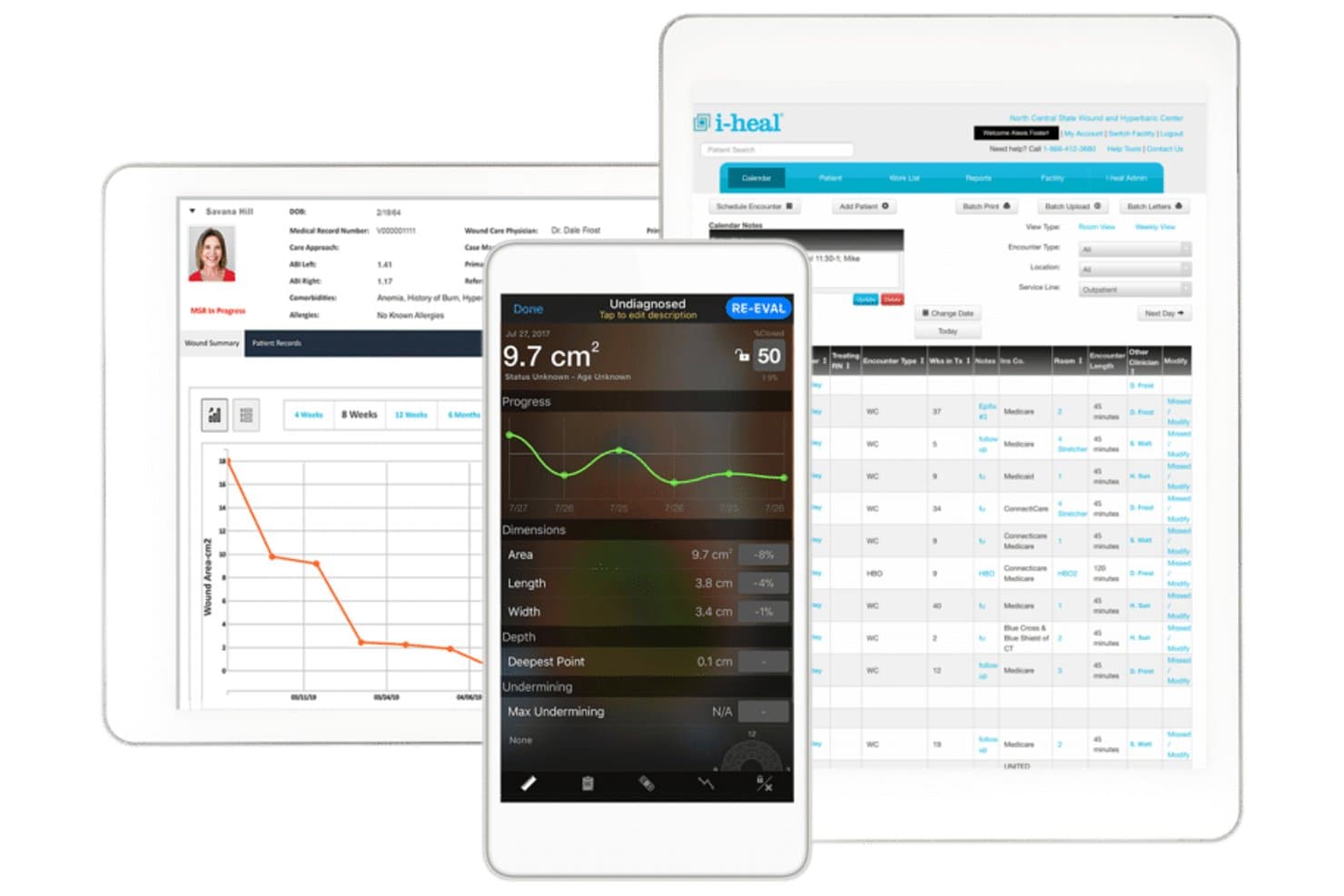
Healogics WoundSuite offers a multi-device wound care EMR platform displaying patient records, wound measurement tracking, and appointment scheduling across tablet, mobile, and desktop interfaces. Healogics WoundSuite is a wound care-specific EMR suite that combines structured clinical documentation through i-heal, workflow coordination tools via Clinical Optimization, and mobile wound imaging with digital measurement through the Photo+ app.
Who Is Healogics WoundSuite Best For?
WoundSuite is a strong fit for outpatient Wound Care Centers® and long-term care facilities that run structured, high-volume wound care programs.
Why I Picked Healogics WoundSuite
I picked WoundSuite as one of the best because i-heal structures documentation around the Healogics Patient Care Process, a six-sigma lean protocol that enforces consistent wound assessment every visit. The Interdisciplinary Care Management Guide and Medical Surveillance Review process build a defined clinical sequence into the workflow, so providers review case status before entering a patient room. I like how this pre-clinic structure removes the guesswork from documentation.
Healogics WoundSuite Key Features
- Mobile wound photo capture: Clinicians use the Photo+ app to capture detailed wound images at the point of care.
- Cloud-based wound measurement: Digital length, width, and area calculations are automatically uploaded to the Healogics Cloud.
- ONC-certified EHR technology: i-heal includes certified APIs for FHIR-based interoperability with other systems.
- Medical Surveillance Review process: Built-in workflows guide clinicians through standardized wound case reviews before each patient visit.
Healogics WoundSuite Integrations
Healogics WoundSuite offers native integrations with PointClickCare and supports FHIR-based interoperability with other EHR systems through ONC-certified APIs. An API is available for custom integrations.
Pros and Cons
Pros:
- Supports regulatory and payer reporting requirements
- Integrates wound photography with EMR charting
- Enforces standardized wound documentation protocols
Cons:
- Lacks public peer-reviewed feedback and ratings
- Mobile app receives infrequent updates
Learn more about Healogics WoundSuite: Best for physician-designed wound charting
- Free demo available
- Pricing upon request
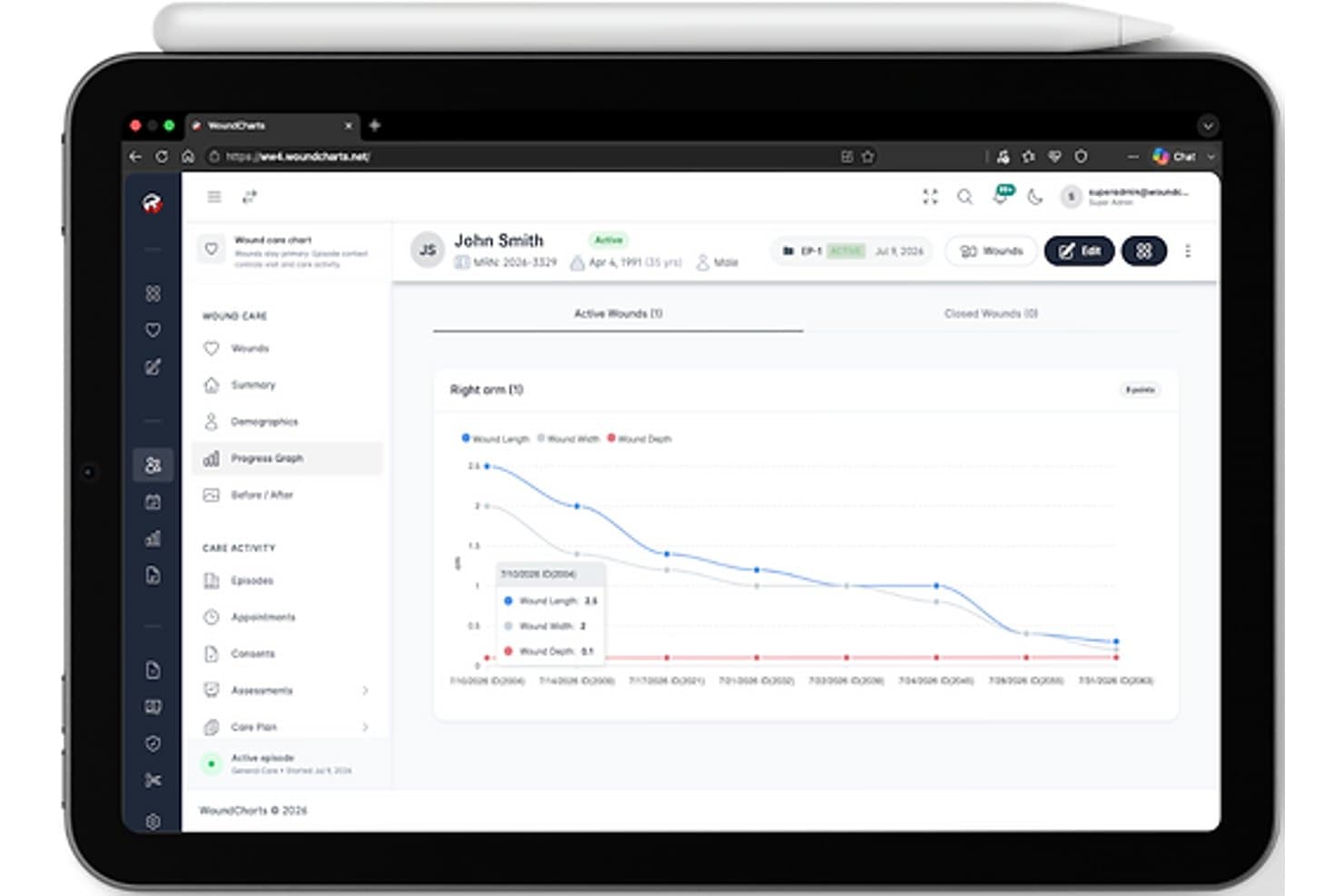
Wound Charts tracks wound dimensions over time with a visual progress graph. Wound Charts is a web-based wound care EMR built by a practicing wound care physician that covers structured wound documentation, calibrated planimetry, photo capture, tissue tracking, healing trend graphs, and ICD-10/CPT coding assistance.
Who Is Wound Charts Best For?
Wound Charts is a strong fit for wound care physicians and nurses who need documentation built around the actual clinical encounter, not a generic EMR adapted for wound care.
Why I Picked Wound Charts
Wound Charts earns its spot on my shortlist because it was built by a practicing wound care physician, not adapted from a general EMR, and that difference shows up directly in the charting workflow. I love how calibrated planimetry, tissue percentage tracking (granulation, slough, eschar, epithelium), and encounter photos all live on a single charting surface, so you can pull up a before-and-after view without hunting across separate modules. The healing trend graphs and automatic milestone predictions make it easy to catch a wound that's stalling before it becomes a bigger clinical problem.
Wound Charts Key Features
- ICD-10/CPT coding assistance: Maps your documented encounter directly to candidate ICD-10 and CPT codes to reduce claim denials.
- Adaptive visit templates: Structured charting templates adjust based on visit type, ensuring consistent documentation across all clinicians.
- Audit trail logging: Every read, write, and export is automatically logged with date, user, and encounter details for compliance purposes.
- Clinical decision support: Guideline-based suggestions surface directly against the live chart to support treatment decisions at the point of care.
Wound Charts Integrations
Wound Charts doesn't have any native integrations. The vendor doesn’t document HL7, FHIR, EHR, clearinghouse, supply system, or custom API connectivity.
Pros and Cons
Pros:
- Manual tissue percentages support serial assessment
- Calibrated planimetry tracks healing trends
- Physician-designed wound encounter workflow
Cons:
- Medication management remains underdeveloped
- Coding stops before claims management
Learn more about Wound Charts: Best for mobile wound care billing automation
- Free demo available
- From $250/user/month
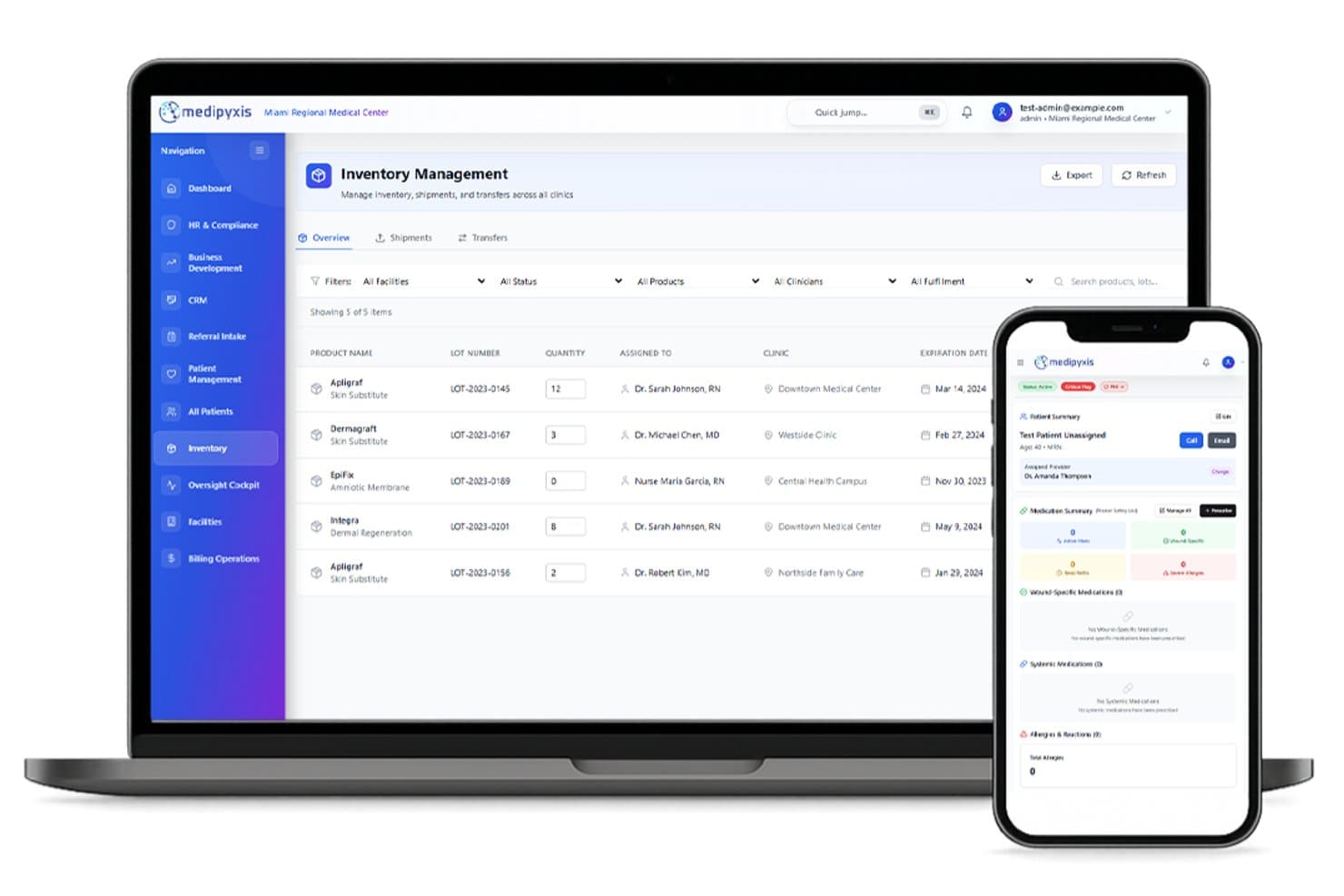
Medipyxis tracks wound care inventory and patient data across clinics. Medipyxis is a mobile wound care EMR built for SNF, assisted living, and home health practices that combines guided visit documentation, wound-specific billing and coding, graft inventory tracking, referral intake, and practice analytics in one platform.
Who Is Medipyxis Best For?
Medipyxis is a strong fit for mobile wound care physicians and practice administrators running multi-clinician operations across SNFs, assisted living, or home health settings.
Why I Picked Medipyxis
I picked Medipyxis as one of the best because its wound-specific billing automation goes deeper than most EMRs I've seen at this scale. Its CPT coding engine uses actual wound area to suggest debridement codes, and its claim scrubber flags issues like deleted skin-substitute C-codes and same-day bundling conflicts before a claim goes out. I also like that ICD-10 codes are mapped directly from wound type and staging, cutting the manual lookup work that slows down billing in mobile SNF practices.
Medipyxis Key Features
- 17-step visit wizard: A guided, etiology-specific workflow that walks clinicians through consent, history, wound assessment, procedures, and provider sign-off in a single structured visit.
- Graft inventory tracking: Lot-level traceability for skin substitutes from shipment to claim, with IVR readiness flags, stock alerts, and a vendor portal for supplier catalog and invoice management.
- Leadership/Oversight Cockpit: A real-time dashboard showing referral conversion rates, denial rates, A/R aging, clinician utilization, and revenue broken down by location.
- ZusHealth/TEFCA integration: Pulls outside medications, allergies, labs, and conditions into the patient record and automatically sends signed visits back to external providers.
Medipyxis Integrations
Medipyxis offers native integrations with ZusHealth/TEFCA, DoseSpot, and Stedi for health-record exchange, e-prescribing, claims, and remittance files. Epic, Cerner, and general HL7 or FHIR integrations aren’t documented.
Pros and Cons
Pros:
- Lot-level graft traceability and tracking
- Detailed etiology-specific assessment workflows
- Area-driven wound procedure code suggestions
Cons:
- Hospital interoperability remains limited
- Manual wound photo measurements limit imaging
Learn more about Medipyxis:
How I Evaluate Wound Care EMR Software
I split my evaluation into three parts, giving the most weight to core functionality: capture measurements, stage wounds, and compare images over time. Next, I look for standout features such as AI tissue classification. Finally, I consider care-setting flexibility, onboarding, support, and pricing value.
Core Functionality (Table Stakes For This List)
When I'm selecting tools for my list, I score each one on a scale from 0 (does not offer the functionality) to 5 (excels in this area) for each core functionality listed below. I then convert the total into a percentage to help assess each tool's overall fit, with extra weight on any functionalities I’ve deemed essential.
- Wound Documentation (Essential): I look for structured fields covering wound size, depth, tissue type, location, etiology, and staging across repeated visits.
- Wound Imaging (Essential): I evaluate photo capture, measurement overlays, and side-by-side comparisons that show healing changes over time.
- Patient Recordkeeping: The chart should connect wound findings with medical history, medications, visit notes, and access for relevant providers.
- Wound Billing And Coding: I check support for wound-related CPT and ICD-10 codes, documentation prompts, and claim-ready coding workflows.
- Treatment Plan Tracking: I assess whether teams can create individualized plans, assign treatments, and track progress across visits and care settings.
- Compliance Reporting: I look for audit-ready reports that capture required assessments, treatment updates, signatures, and payer documentation elements.
Once I have a list of tools that meet the criteria, I consider what sets each platform apart.
Differentiating Factors (What Sets Vendors Apart)
Here's how I compare and contrast different vendors:
Standout Features
AI tissue classification is a big one. I check whether the platform can automatically identify granulation, slough, and necrotic tissue in wound photos, since this reduces the subjectivity that creeps in when multiple clinicians assess the same wound. Predictive healing analytics matter just as much—I look for tools that flag non-healing wounds early based on historical data, giving your team time to adjust treatment before outcomes slip. I also evaluate offline bedside documentation, especially for home health and long-term care teams who can't count on reliable connectivity at every point of care.
Beyond Features
Care-setting flexibility matters most to me. A platform that works in a clinic but drops wound photos during a home visit with spotty Wi-Fi isn't practical for multi-site teams. I also evaluate how each vendor handles patient image privacy, since wound photos are especially sensitive PHI that demand encryption, strict access controls, and clear retention policies. Finally, I check whether onboarding includes wound-specific clinical training—not just software walkthroughs—because staging protocols and measurement standards vary across payer guidelines.
How to Choose Wound Care EMR Software
It’s easy to get bogged down in long feature lists and complex pricing structures. To help you stay focused as you work through your unique software selection process, here’s a checklist of factors to keep in mind:
| Factor | What to Consider |
| Scalability | Will the platform grow with your organization—such as supporting more clinicians, sites, or care settings—without requiring major process overhauls? |
| Integrations | Can you sync data and share workflows with your main EHR, billing systems, or scheduling tools—especially for organizations using Epic or Cerner? |
| Customizability | Does the software allow for template tweaks, workflow changes, or custom fields so you can match your organization’s protocols and reporting needs? |
| Ease of use | Are wound photos, measurements, and documentation easy to complete at the bedside, even for part-time staff or less tech-savvy clinicians? |
| Implementation and onboarding | What level of support does the vendor provide, and how quickly can typical teams expect to get fully trained and productive using the new platform? |
| Cost | Are you factoring in all costs—like implementation, mobile devices, support, or ongoing upgrades—not just baseline subscription fees? |
| Security safeguards | How well does the vendor handle encryption, user permissions, and PHI safeguards in line with HIPAA and HITECH standards? |
| Compliance requirements | Will the platform help you meet CMS, OASIS, or MDS documentation and reporting needs required for your specific wound care setting? |
What Are Wound Care EMR Software?
Wound care EMR software are digital platforms designed to document, track, and manage wound-related assessments, images, and care workflows throughout the healing process. These systems support structured wound documentation, measurement tools, progress trend analysis, point-of-care access, and wound-specific coding to help clinicians deliver consistent, compliant care across multiple settings and teams.
Features of Wound Care EMR Software
When selecting wound care EMR software, keep an eye out for the following key features:
- Wound assessment templates: Structured forms for documenting wound measurements, tissue type, stage, exudate, and other clinical variables during each encounter.
- Photo capture and storage: Securely store and organize wound images at each visit, allowing clinicians to visually track changes and share pictures with the care team.
- Digital measurement tools: Built-in rulers, tracing, and area calculation tools for consistent and accurate wound sizing and depth documentation.
- Healing progress tracking: Timeline or graph views that show healing trends and facilitate quick comparison of wound status across multiple visits.
- Mobile point-of-care access: Full-featured mobile or tablet interfaces so clinicians can document, measure, and photograph wounds at the bedside or in the field.
- Wound-specific coding workflows: Integrated code libraries and suggestions for CPT, ICD-10, and HCPCS, streamlining compliant billing linked directly to documentation.
- Regulatory reporting tools: Automatically generates reports for audits or payer requirements, including CMS, MDS, or OASIS wound-specific quality measures.
- Role-based user permissions: Controls access based on clinician role, protecting sensitive data and maintaining compliance with privacy regulations.
- Interoperability options: Ability to exchange patient data with other EHRs, billing systems, or registries to reduce duplicate data entry and keep records aligned.
Common Wound Care EMR Software AI Features
Beyond the standard wound care EMR software features listed above, many of these solutions are incorporating AI with features like:
- Automated wound measurement: AI analyzes wound images to calculate length, width, area, and depth, reducing manual measurement errors and saving clinicians time.
- Tissue type classification: AI identifies and labels tissue types—such as granulation, slough, or eschar—directly from wound photos, supporting more objective and consistent documentation.
- Healing trajectory prediction: AI models analyze historical wound data to forecast healing rates and flag wounds at risk of delayed closure, helping clinicians prioritize interventions.
- Smart documentation prompts: AI suggests relevant clinical details or missing data fields during charting, improving completeness and accuracy of wound assessments.
- Image quality assessment: AI checks wound photos for clarity, lighting, and focus, prompting clinicians to retake images if needed to ensure reliable documentation.
Benefits of Wound Care EMR Software
Implementing wound care EMR software provides several benefits for your team and your business. Here are a few you can look forward to:
- Improved wound documentation: Structured templates and measurement tools ensure every wound assessment is thorough, consistent, and easy to review.
- Faster clinical decision-making: Progress tracking, imaging, and AI analysis provide clinicians with real-time insights to identify stalled healing or infection risks sooner.
- More efficient workflows: Mobile access and integrated coding help clinicians and billing teams complete documentation and claims at the point of care.
- Enhanced compliance: Built-in regulatory reports and secure audit trails keep your organization aligned with HIPAA and payer requirements.
- Better care coordination: Photo management, trend reporting, and interoperability features support collaborative care across departments or multi-site practices.
- Reduced claim denials: Wound-specific coding and documentation reduce billing errors and help teams meet payer requirements for reimbursement.
- Easier benchmarking: Outcomes dashboards and analytics make it simple to compare healing rates or infection trends against internal or external benchmarks.
Costs and Pricing of Wound Care EMR Software
Selecting wound care EMR software requires an understanding of the various pricing models and plans available. Costs vary based on features, team size, add-ons, and more. The table below summarizes common plans, their average prices, and typical features included in wound care EMR software solutions:
Plan Comparison Table for Wound Care EMR Software
| Plan Type | Average Price | Common Features |
| Free Plan | $0 | Basic wound documentation, limited image storage, and basic reporting. |
| Personal Plan | $30-$75/user/month | Standard assessment templates, digital measurement tools, and basic mobile access. |
| Business Plan | $80-$150/user/month | Advanced photo management, wound-specific coding, custom reports, and interoperability options. |
| Enterprise Plan | $160+/user/month | Integration with EHRs, population analytics dashboards, compliance support, dedicated onboarding, and 24/7 support. |
Wound Care EMR Software FAQs
Here are some answers to common questions about wound care EMR software:
How does wound care EMR software improve accuracy in wound assessments?
Wound care EMR software standardizes documentation using structured templates, digital measurement tools, and photo capture, helping clinicians avoid subjective or inconsistent assessments and making healing progress easier to track.
Can wound care EMR software integrate with our primary EHR system?
Yes, many wound care EMR solutions support integration with major EHRs via HL7, FHIR, or APIs, enabling bi-directional sharing of patient data, wound images, and documentation across platforms.
Is wound care EMR software suitable for home health or mobile clinicians?
Yes, most leading platforms offer mobile apps with offline charting and photo capture, making them practical for home health, hospice, or clinicians working in the field or multiple facilities.
What kind of regulatory compliance features should I expect?
You should expect HIPAA and HITECH compliance, audit logging, encrypted photo storage, role-based access, and built-in workflows for supporting requirements like CMS, OASIS, or MDS wound-specific measures.
How long does it take to implement wound care EMR software?
Implementation timelines vary, but most vendors can get smaller teams up and running in weeks, especially if clinical onboarding and template libraries are provided. Larger organizations or EHR integrations may require extended planning and training.