

Open source medical billing software is billing technology with publicly available code that you can use, customize, and adapt for your healthcare practice. If you’re searching for an alternative to restrictive, expensive billing tools—or want more control over your billing workflows—open source systems put the reins in your hands.
This guide lays out the best open source medical billing software options, helping you spot which ones fit your workflow, your resources, and your patients’ needs. You’ll get a quick rundown of what makes each solution unique so you can make a confident, well-informed choice.
Why Trust Our Software Recommendations
6,700+
Reviews
20
Industry experts
16+
Evaluation factors
14
Years
Our team has been testing and reviewing software since 2012. As medical practice leaders ourselves, we know how difficult—and important—it is to choose the right software.
For this guide, we evaluated tools using hands-on testing and independent research, scoring tools using our selection criteria.
Our reviews reflect our human editorial judgment, not a sales pitch.
Best Open Source Medical Billing Software Summary
This comparison chart summarizes pricing details for my open source medical billing software to help you find the best one for your budget and business needs.
| Tool | Best For | Trial Info | Price | ||
|---|---|---|---|---|---|
| 1 | Best for offline-first billing in remote locations | Free demo available | Pricing upon request | Website | |
| 2 | Best for public health billing in limited settings | Not available | Pricing upon request | Website | |
| 3 | Best for FHIR-based interoperability support | Free plan available | From $349/provider/month | Website | |
| 4 | Best for API-driven custom billing solutions | Free plan available | Pricing upon request | Website | |
| 5 | Best for unified ERP and healthcare billing | Free trial available | Pricing upon request | Website | |
| 6 | Best for integrated EHR and billing workflows | Free demo available | Pricing upon request | Website | |
| 7 | Best for modular clinical and billing extension | Free demo available | Free | Website | |
| 8 | Best for specialty template customization | Not available | Pricing upon request | Website | |
| 9 | Best for multi-facility billing and care | Free demo available | Free | Website | |
| 10 | Best for intuitive physician-friendly interface | Free demo available | Pricing upon request | Website |


Best Open Source Medical Billing Software Reviews
Below are my detailed summaries of the best open source medical billing software that made it onto my shortlist. My reviews offer a detailed look at the features, best use cases, and integrations of each platform to help you find the best one for you.
 Best for offline-first billing in remote locations
- Free demo available
- Pricing upon request
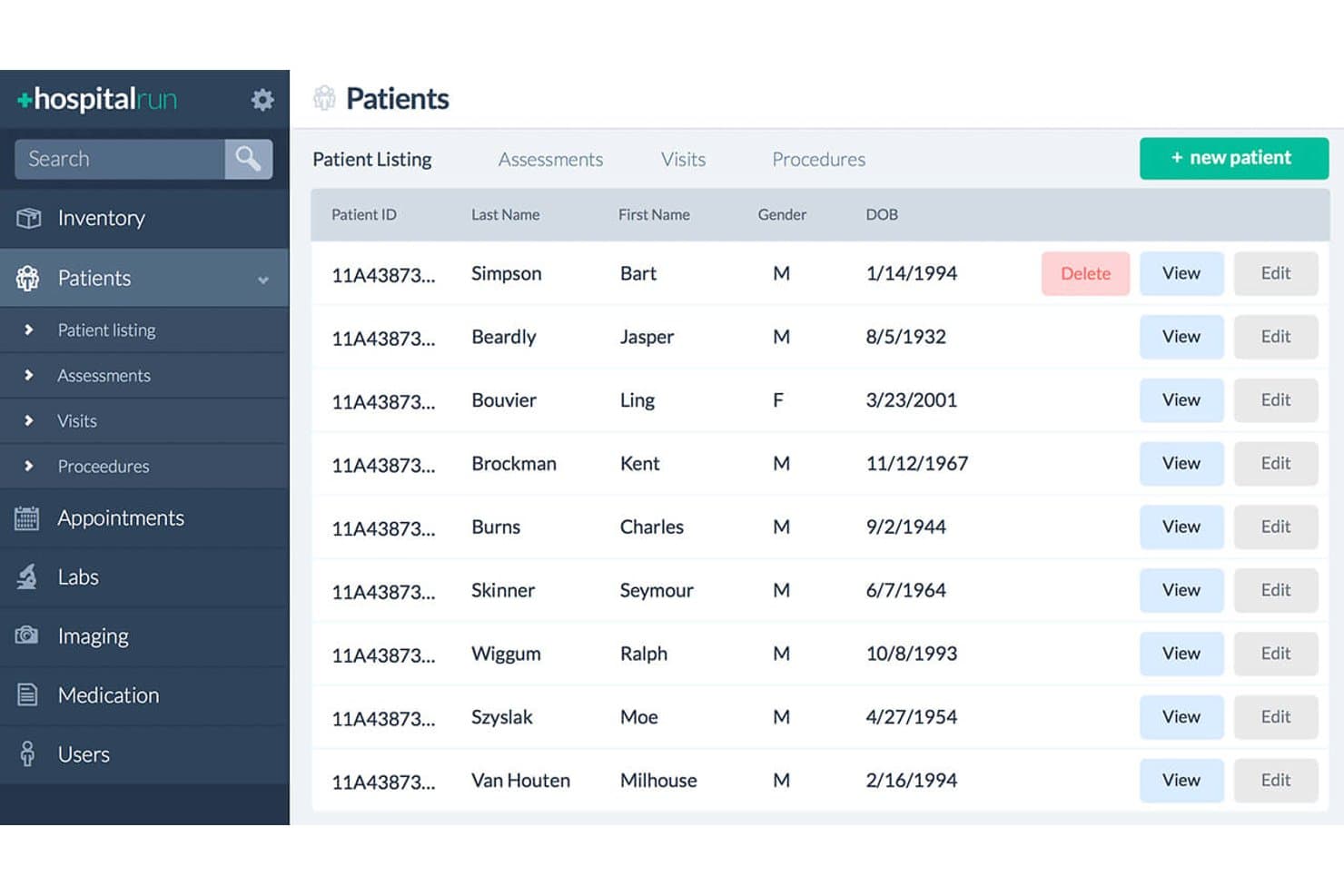
HospitalRun offers a patient listing interface displaying patient IDs, names, gender, date of birth, and action buttons for managing records. HospitalRun is an open-source hospital information system with offline-first billing, invoicing, patient management, and pharmacy modules built for clinics operating in low-connectivity environments.
Who Is Hospital Run Best For?
Health IT developers and NGO-run clinics in low-resource, remote regions who need a self-hosted, offline-capable hospital information system.
Why I Picked Hospital Run
I picked HospitalRun because its PouchDB-to-CouchDB sync architecture lets clinics record patient billing and invoices locally, then sync automatically when a connection becomes available. That offline-first design means a billing desk in a remote facility can keep working through an internet outage without losing any financial records. I also like that it's GPL-licensed and Docker-deployable, giving technical teams full control over the codebase and where patient data lives.
Hospital Run Key Features
- Patient management module: Manage patient records, demographics, and visit histories in a single dashboard.
- Pharmacy inventory tracking: Monitor medication inventory and manage pharmacy dispensing activity within the system.
- Role-based access controls: Assign different permission levels based on user roles for enhanced security in clinical and billing operations.
- Docker deployment package: Deploy the software on various operating systems using a prebuilt Docker image for easier setup.
Hospital Run Integrations
HospitalRun offers a native integration with MedDream for DICOM medical imaging and provides native lab system integration. An API is available for custom integrations.
Pros and Cons
Pros:
- Open-source codebase for customization
- Enables on-premise control over billing data
- Supports offline operation in remote environments
Cons:
- Lacks built-in medical coding libraries
- No insurance claims or eligibility features
Learn more about Hospital Run: Best for public health billing in limited settings
- Not available
- Pricing upon request
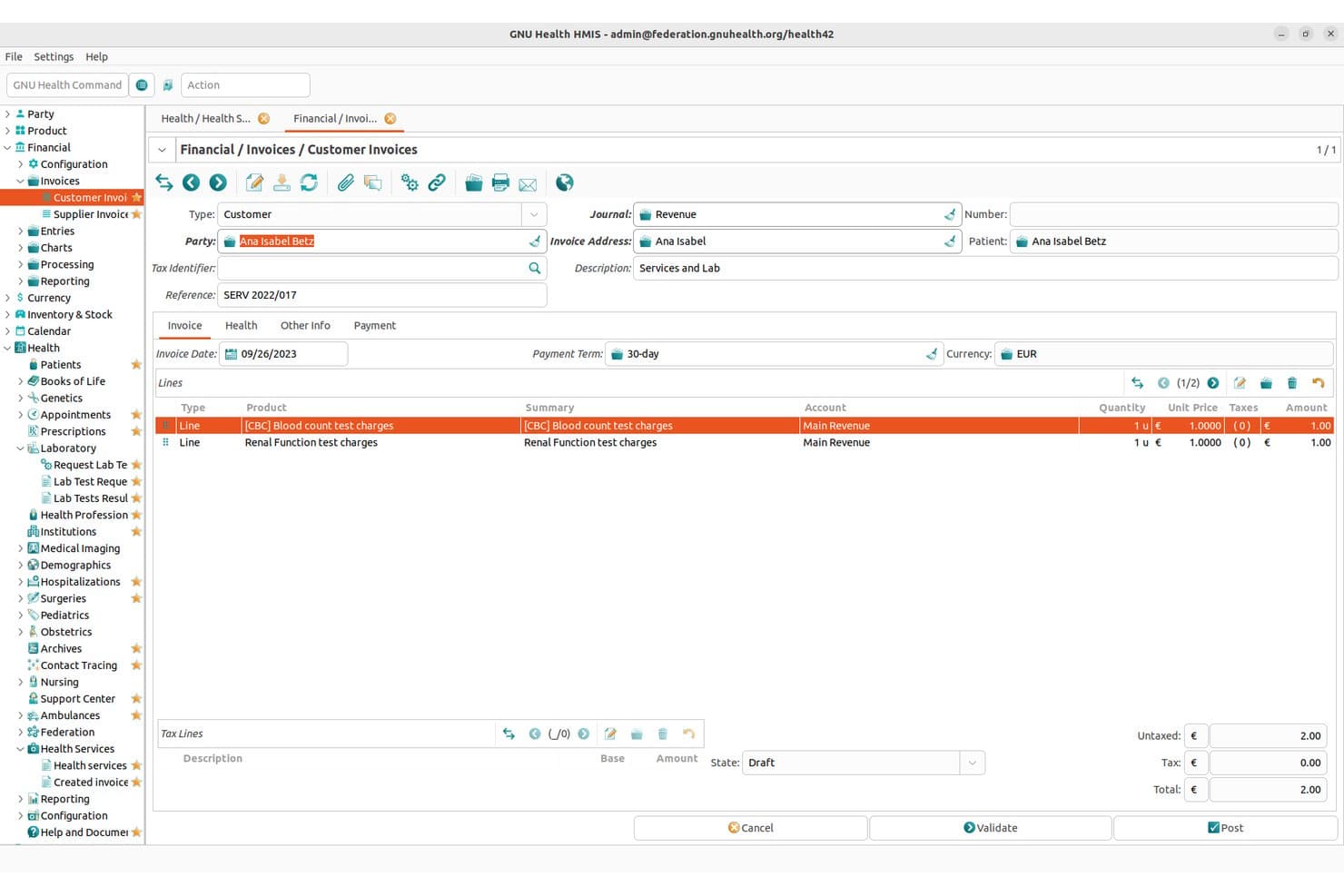
GNU Health offers a detailed customer invoice interface displaying line items, payment terms, currency, and billing totals for medical lab services. GNU Health is a free/libre, GPL-licensed hospital and health information system built on Python and Tryton, covering electronic health records, laboratory management, pharmacy, and health center billing.
Who Is GNU Health Best For?
GNU Health is a strong fit for health IT developers and public sector implementers deploying hospital information systems in resource-limited or international settings.
Why I Picked GNU Health
I've included GNU Health in my top picks because its Services & Billing module links patient encounters and hospitalizations directly to invoices, which is exactly the workflow public health clinics in low-resource settings rely on. I also like that ICD-10 and ICD-10PCS coding are built into the distribution, so care teams can document and bill procedures without bolting on a separate coding tool. The full stack runs on Linux or FreeBSD with PostgreSQL, meaning it's deployable on minimal hardware where commercial SaaS simply isn't an option.
GNU Health Key Features
- Modular hospital management: Configure clinical, administrative, and billing modules based on your implementation needs.
- Built-in ICD-10PCS support: Access standard procedure codes for accurate service documentation and billing.
- Tryton-based accounting: Leverage integrated general ledger and invoicing backed by the Tryton ERP platform.
- Healthcare statistics and analytics: Generate health center statistics and financial analysis reports directly from encounter and billing data.
GNU Health Integrations
GNU Health offers native integrations with HL7 FHIR, DICOM (via Orthanc), CalDAV for appointment management, and Tryton ERP. An API is available for custom integrations.
Pros and Cons
Pros:
- Modular for clinics, hospitals, and laboratories
- Embedded ICD-10 and ICD-10PCS code sets
- Fully open source with public codebase
Cons:
- Lacks automated insurance eligibility verification
- No CMS-1500 or 837 claims support
Learn more about GNU Health: Best for FHIR-based interoperability support
- Free plan available
- From $349/provider/month
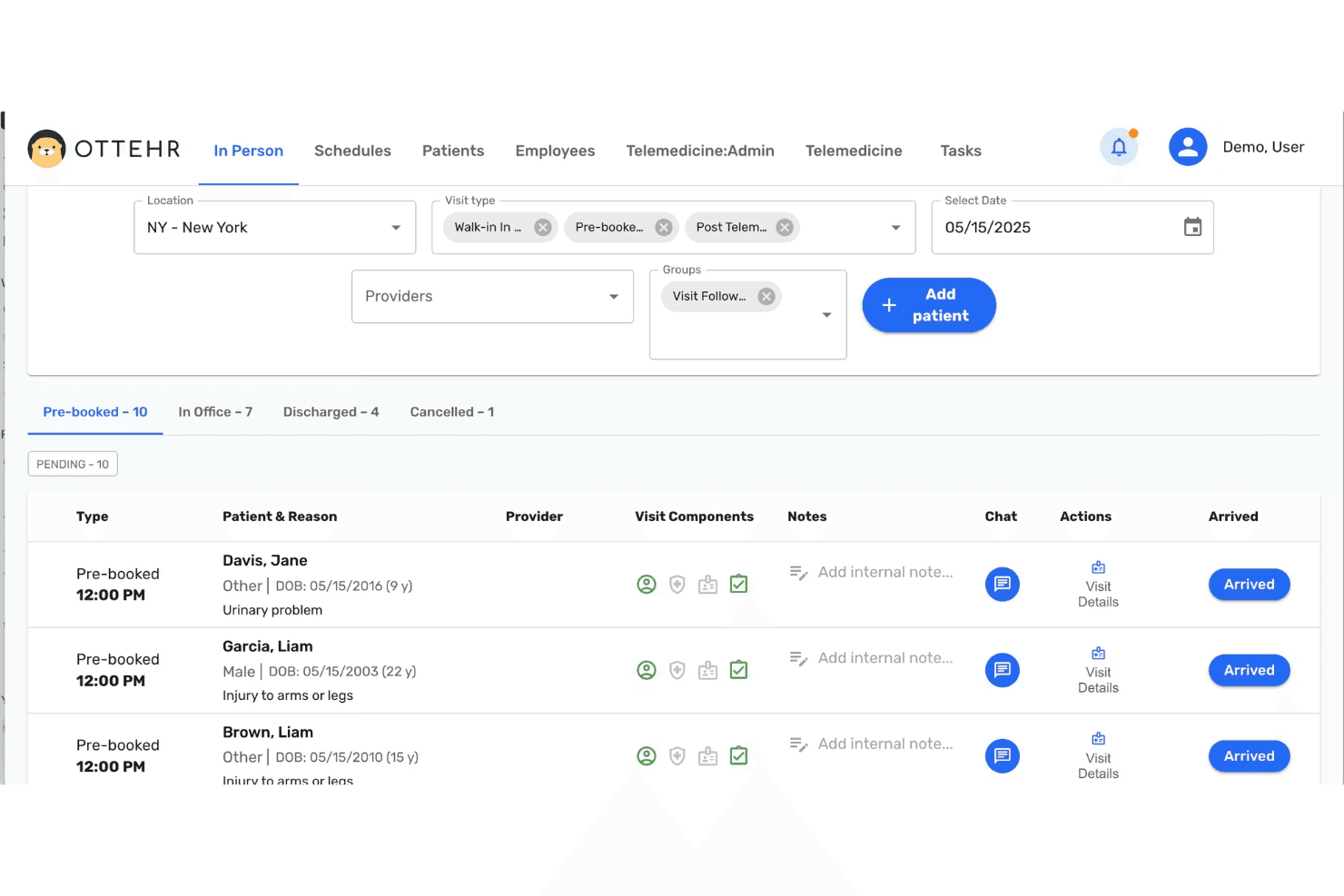
Ottehr delivers FHIR-based EHR, claims, denials, patient billing, and RCM. Ottehr is an open-source, FHIR-native EHR platform with built-in revenue cycle management, claims submission, denial tracking, and patient billing tools designed for urgent care and clinical practices.
Who Is Ottehr Best For?
Ottehr is a strong fit for health IT developers and technically resourced urgent care practices that want a forkable, self-hostable EHR with billing built in.
Why I Picked Ottehr
I picked Ottehr as one of the best because its FHIR R4/R5-native architecture means billing and clinical data share the same structured format across the entire encounter. The same FHIR API that powers the EHR also drives the RCM layer, keeping claims data consistent from documentation through 837P submission. Its built-in HIE and QHIN connectivity means practices exchanging records with outside payers or systems don't need separate middleware to stay interoperable.
Ottehr Key Features
- Patient portal: Lets patients self-register, schedule visits, complete intake forms, and view appointment history online.
- Customizable encounter templates: Enables practices to tailor charting forms and note structures for different specialties or workflows.
- Integrated RCM dashboard: Provides real-time visibility of claims status, denials, receivables, and financial performance within the EHR.
- AI ambient scribe: Converts patient-provider conversations into structured clinical notes in real time during encounters.
Ottehr Integrations
Ottehr offers native integrations with eClinicalWorks EHR, eRx, radiology, in-house and external diagnostic labs, and payment processors. An API is available for custom integrations.
Pros and Cons
Pros:
- Built-in AI coding assistant
- Fully open source with active GitHub repo
- FHIR-native EHR and billing engine
Cons:
- Limited presence on third-party review sites
- Claims and RCM features require paid tier
Learn more about Ottehr: Best for API-driven custom billing solutions
- Free plan available
- Pricing upon request
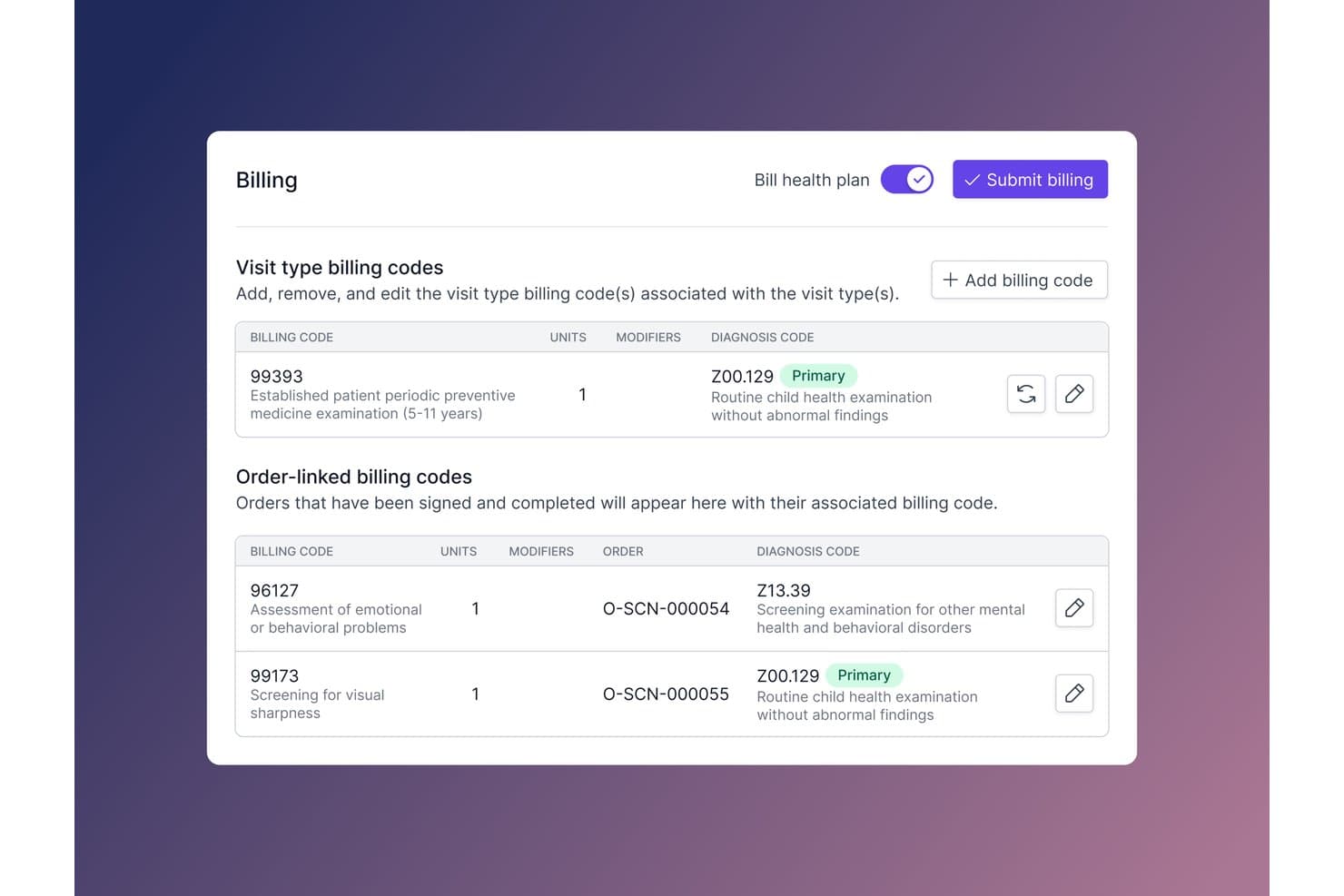
Medplum offers a billing interface with visit type and order-linked billing codes, diagnosis codes, and a one-click submit billing feature. Medplum is an open source, FHIR-native developer platform for building healthcare applications, with built-in support for revenue cycle management, claims tracking, and custom billing workflow automation.
Who Is Medplum Best For?
Medplum is a strong fit for health IT engineering teams at digital health startups and telehealth companies building custom RCM workflows on a FHIR-native foundation.
Why I Picked Medplum
I've included Medplum in my top picks because its Bot framework is the most direct path I've seen to building API-driven billing logic on a FHIR-native backend. Bots execute custom JavaScript whenever a FHIR Claim or ExplanationOfBenefit resource changes, so I can route submissions or push events to a clearinghouse without a separate service layer. The Enterprise Claims Dashboard then surfaces real-time claim status and payor-level tracking in one place.
Medplum Key Features
- FHIR-native data storage: All information is structured according to the FHIR R4 standard for interoperability.
- Open source licensing: Distributed under the Apache 2.0 license with code available for self-hosting and modification.
- Enterprise Master Patient Index (EMPI): Automated patient deduplication to ensure accurate demographics across records.
- Role-based access and audit logs: Fine-grained permissions management and built-in logging for security and compliance.
Medplum Integrations
Medplum offers native integrations with Candid Health, Labcorp, Quest Diagnostics, Health Gorilla, Epic Systems, Okta, Azure SSO, Google SSO, Datadog, Splunk, and Sumo Logic. An API is available for custom integrations.
Pros and Cons
Pros:
- Active open source community and frequent updates
- Bot framework allows custom billing automations
- Full FHIR-native architecture enables interoperability
Cons:
- Billing features require significant developer resources
- No built-in patient statement generation
Learn more about Medplum: Best for unified ERP and healthcare billing
- Free trial available
- Pricing upon request
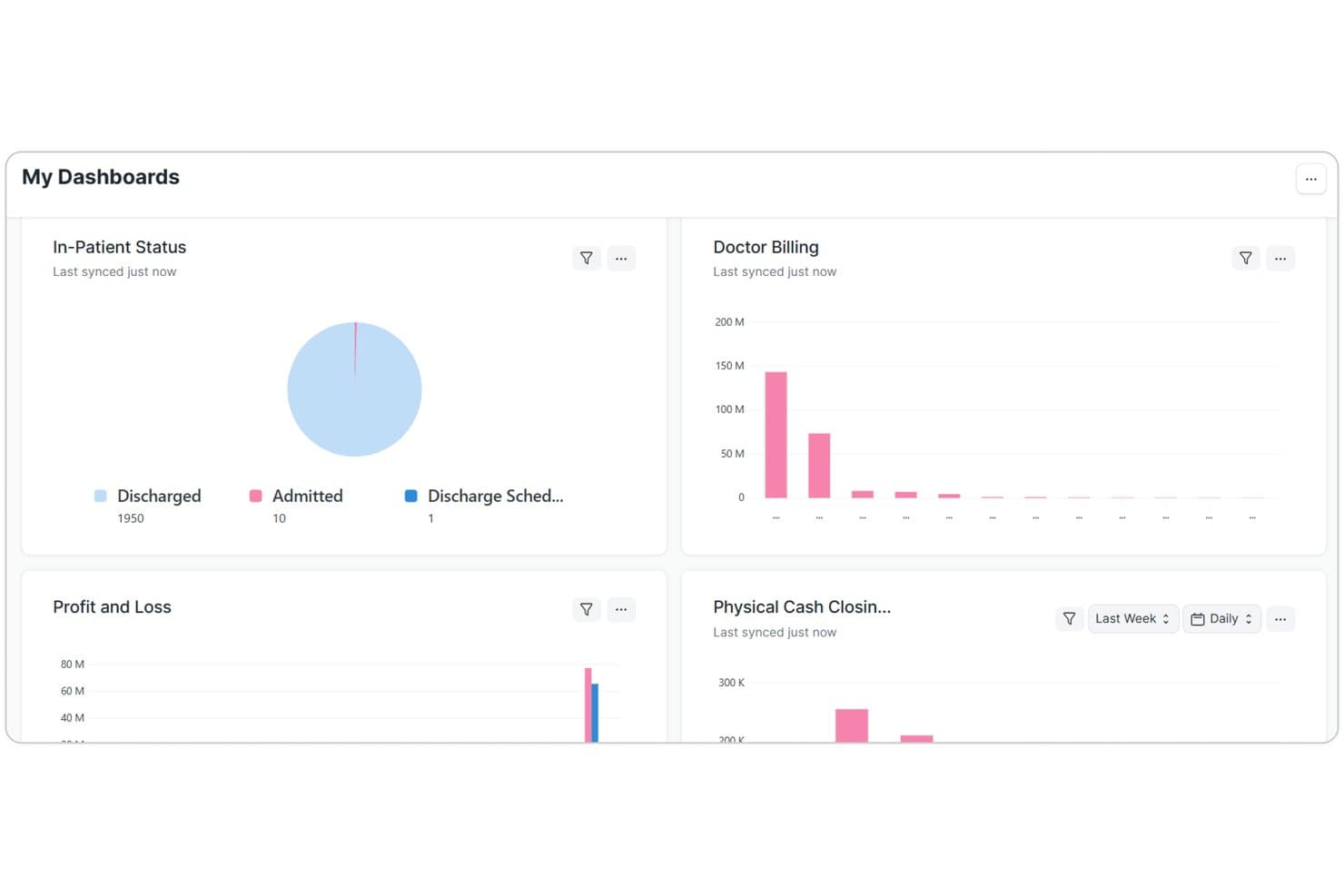
ERPNext Healthcare offers a centralized dashboard displaying in-patient status, doctor billing, profit and loss, and physical cash closing metrics for streamlined medical billing management. ERPNext Healthcare is an open-source ERP platform with a built-in healthcare module that covers patient billing, insurance management, pharmacy, lab operations, and clinical documentation in a single system.
Who Is ERPNext Healthcare Best For?
It's a strong fit for health IT developers and technically capable clinic operators who want to self-host and customize a full ERP stack without licensing costs.
Why I Picked ERPNext Healthcare
ERPNext Healthcare earns its spot on my shortlist because of how tightly billing connects to every clinical operation in the system. I like that when a patient is discharged, invoices auto-generate from lab tests, pharmacy dispensing, room charges, and procedures, without manual entry across separate tools. The insurance and payor configuration lets my team define coverage rules and co-pay calculations inside the same ERP, all within a codebase I can audit and modify freely.
ERPNext Healthcare Key Features
- Centralized patient records: All patient data, clinical notes, and documentation are stored and managed within a unified electronic record.
- Automated pharmacy management: Inventory levels, medication expirations, and dispensing are tracked and managed with barcode support.
- Lab and radiology integration: Orders, sample tracking, and result delivery for lab and imaging services are managed within the same system.
- Customizable insurance setup: Payer details, insurance policies, and coverage rules can be configured and linked to individual patient accounts.
ERPNext Healthcare Integrations
Native integrations are not clearly documented. ERPNext Healthcare provides an API for custom integrations and supports connecting to external systems through configurable webhooks.
Pros and Cons
Pros:
- Unified patient, billing, and clinical records
- Customizable healthcare modules for unique workflows
- Fully open source with public code repository
Cons:
- Lacks built-in insurance eligibility checks
- No native claim forms for US billing
Learn more about ERPNext Healthcare: Best for integrated EHR and billing workflows
- Free demo available
- Pricing upon request
Visit WebsiteCustomer Rating:3.9/5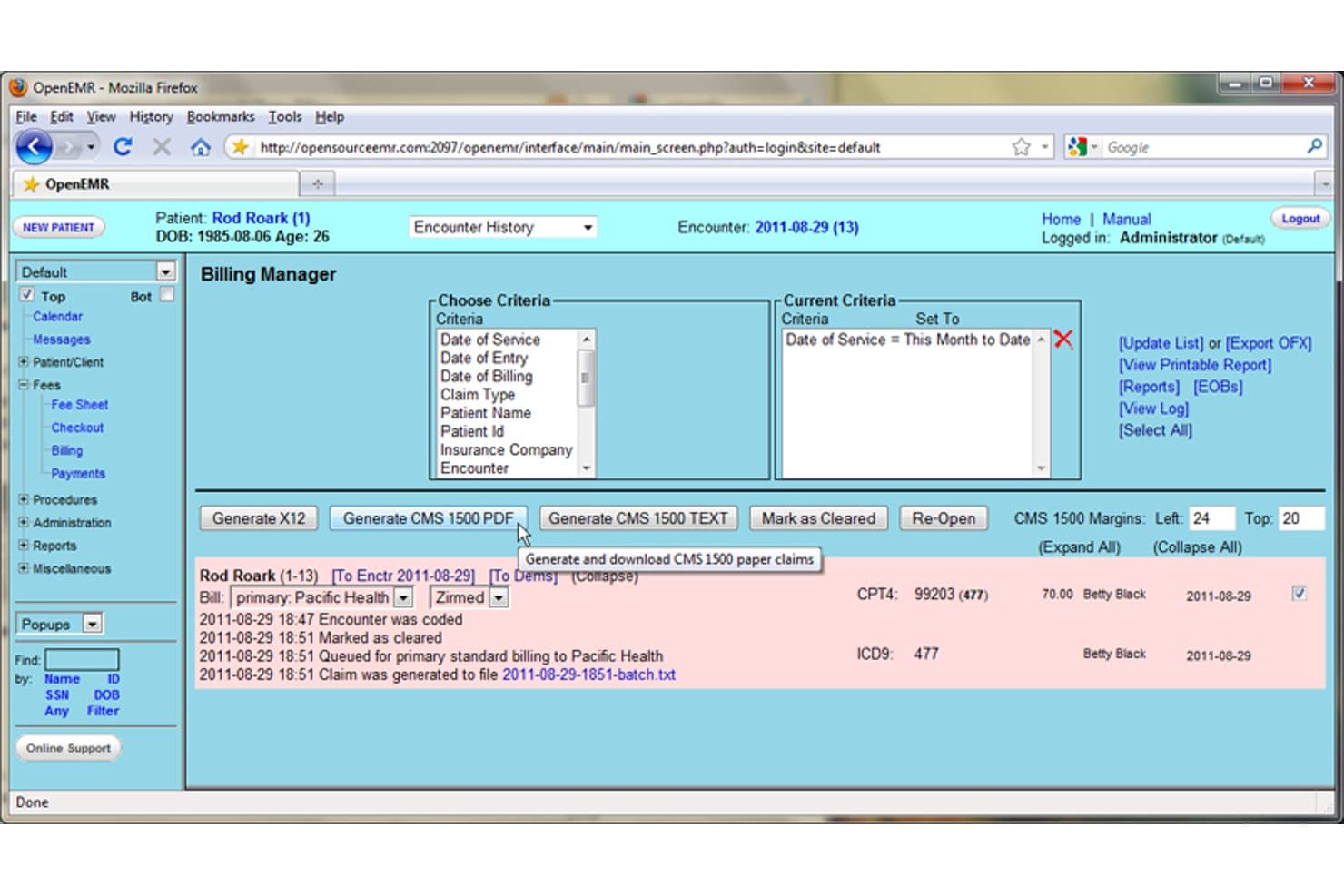
OpenEMR offers a Billing Manager interface with CMS 1500 claim generation, insurance billing status, and date-of-service filtering tools. OpenEMR is an open-source EMR and practice management platform that combines patient scheduling, medical billing, e-prescribing, lab integration, and clinical documentation in a single self-hostable system.
Who Is OpenEMR Best For?
OpenEMR is a strong fit for independent practices and health IT teams that need a self-hosted, fully customizable EHR and billing system without licensing costs.
Why I Picked OpenEMR
OpenEMR earns its spot on my shortlist because the billing module and EHR aren't bolted together as an afterthought—they're built as one system. When I create an encounter note, the CPT and ICD-10 codes feed directly into the claim without manual re-entry. I also like that it transmits 837P claims hourly via connected clearinghouses and handles ERA posting natively, keeping the revenue cycle tied directly to the clinical record.
OpenEMR Key Features
- Open source licensing: Distributed under the GNU GPL, with a public repository for modifying and self-hosting the code.
- Insurance and eligibility management: Supports payer setup, insurance verification, and ERA (835) posting for remittance reconciliation.
- Standard code set support: Includes up-to-date ICD-10, CPT, and HCPCS code sets with modifier support for detailed medical coding.
- Custom reporting tools: Provides financial and productivity reports, plus audit logging and role-based access to support HIPAA compliance.
OpenEMR Integrations
OpenEMR offers native integrations with NewCrop, Weno Exchange, Allscripts, Quest Diagnostics, and LabCorp, and supports clearinghouse connections like ClaimRev for claims submission and eligibility verification. An API is available for custom integrations.
Pros and Cons
Pros:
- Allows unlimited customization for specialty workflows
- Provides full ICD-10 and CPT coding support
- Offers integrated EHR and billing in one system
Cons:
- Denial management tools are basic out of the box
- Patient statement automation is limited
Learn more about OpenEMR: Best for modular clinical and billing extension
- Free demo available
- Free
Visit WebsiteCustomer Rating:4.8/5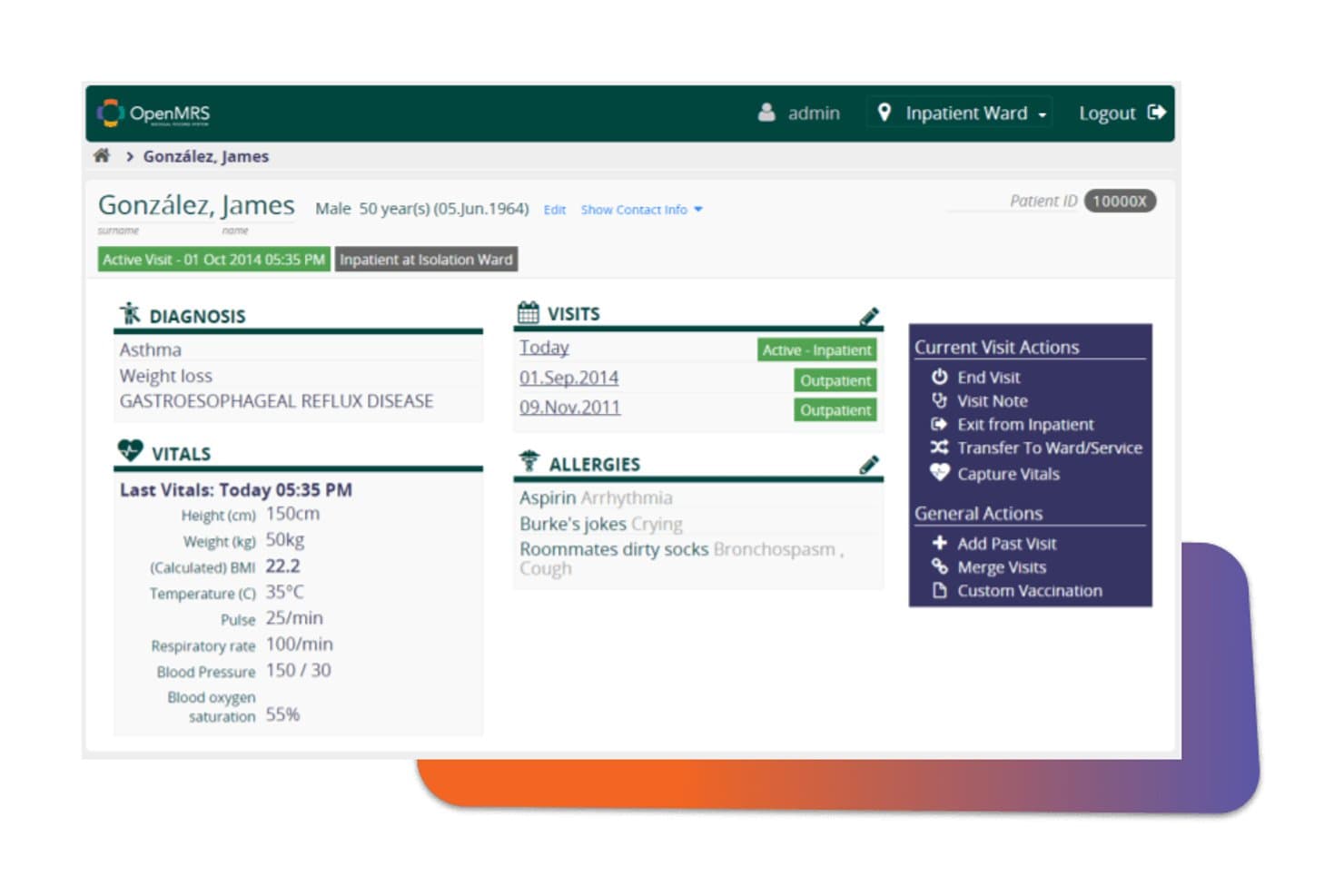
OpenMRS displays a patient dashboard with diagnosis, vitals, visit history, allergies, and clinical action options for inpatient management. OpenMRS is an open-source EMR platform with a modular billing add-on that handles patient bill creation, payment processing, receipt generation, and multi-payment-mode transaction tracking across clinical facilities.
Who Is OpenMRS Best For?
OpenMRS is a strong fit for health IT developers and technical teams building or extending self-hosted clinical systems in resource-constrained or international healthcare settings.
Why I Picked OpenMRS
I picked OpenMRS as one of the best because its billing functionality is a true add-on module, not baked into the core EMR. The Billing Module supports bill creation with multiple line items, multi-payment-mode processing (cash, insurance, mobile money), and configurable Jasper Report receipts. I also like the bill state tracking (draft, posted, adjusted) with full audit trails, which lets technical teams extend financial workflows without touching the clinical core.
OpenMRS Key Features
- Role-based user management: Set granular user access and permissions for data visibility, editing, and billing operations.
- REST and FHIR APIs: Connect billing modules with external EHRs and third-party systems through standards-based APIs.
- Multi-language interface support: Enable billing staff to navigate the system in multiple languages, including right-to-left script compatibility.
- Extensive concept dictionary: Incorporate standard medical coding libraries and custom clinical or billing code sets for flexible data capture.
OpenMRS Integrations
OpenMRS provides native integrations through REST and FHIR APIs for connectivity with EHRs, ERPs like Odoo, DHIS2, and laboratory systems. An API is available for custom integrations.
Pros and Cons
Pros:
- Large global community for support and development
- Modular architecture for adding billing extensions
- Handles multi-currency and multi-payment billing
Cons:
- Insurance eligibility and ERA posting not included
- No CMS-1500 or 837P claims workflow
Learn more about OpenMRS: Best for specialty template customization
- Not available
- Pricing upon request
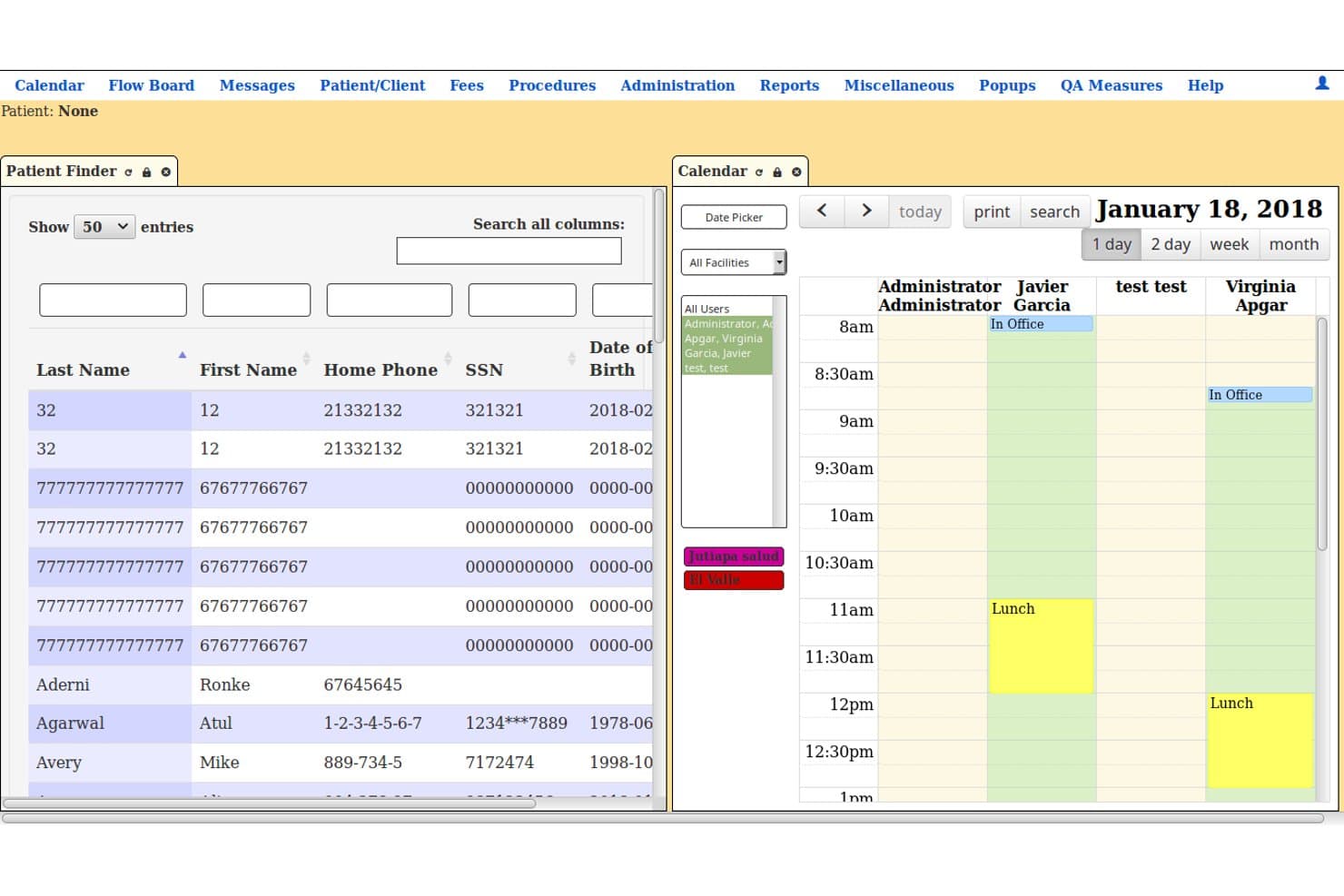
LibreHealth EHR offers a dual-panel interface with a Patient Finder list and a daily calendar view showing provider schedules and appointments. LibreHealth EHR is a free, open-source electronic health record and practice management system that covers clinical documentation, medical billing, scheduling, and medical coding on a modular, self-hostable platform.
Who Is LibreHealth EHR Best For?
Health IT developers and mission-driven clinics that need a fully self-hosted, customizable EHR and billing platform without licensing costs will find it most applicable.
Why I Picked LibreHealth EHR
LibreHealth EHR earns its spot on my shortlist because of how far its modular architecture lets you take specialty-specific customization. I like that the platform's web component system lets developers configure clinical and billing templates tailored to a specific specialty, whether that's behavioral health, orthopedics, or community medicine. The REST API built into the LibreHealth Toolkit makes that level of configuration practical without rewriting the core codebase.
LibreHealth EHR Key Features
- Open source licensing: Code is available under MPL 2.0 and GPL 2+ for full modification and self-hosting.
- Patient billing statements: Generate and print patient statements and track outstanding balances for each account.
- Medical coding libraries: Supports ICD-10, CPT, and HCPCS code libraries within billing workflows.
- Financial reporting tools: Includes basic financial and accounts receivable reports for revenue cycle monitoring.
LibreHealth EHR Integrations
Native integrations are not clearly documented. LibreHealth EHR supports integrations via its REST API and can connect with external labs, pharmacies, billing systems, and other EHRs through standards-based interfaces.
Pros and Cons
Pros:
- Modular design for advanced customization
- Fully open source and self-hostable
- Specialty-specific clinical and billing templates
Cons:
- Security vulnerabilities reported by project maintainers
- No recent updates or active maintenance
Learn more about LibreHealth EHR:
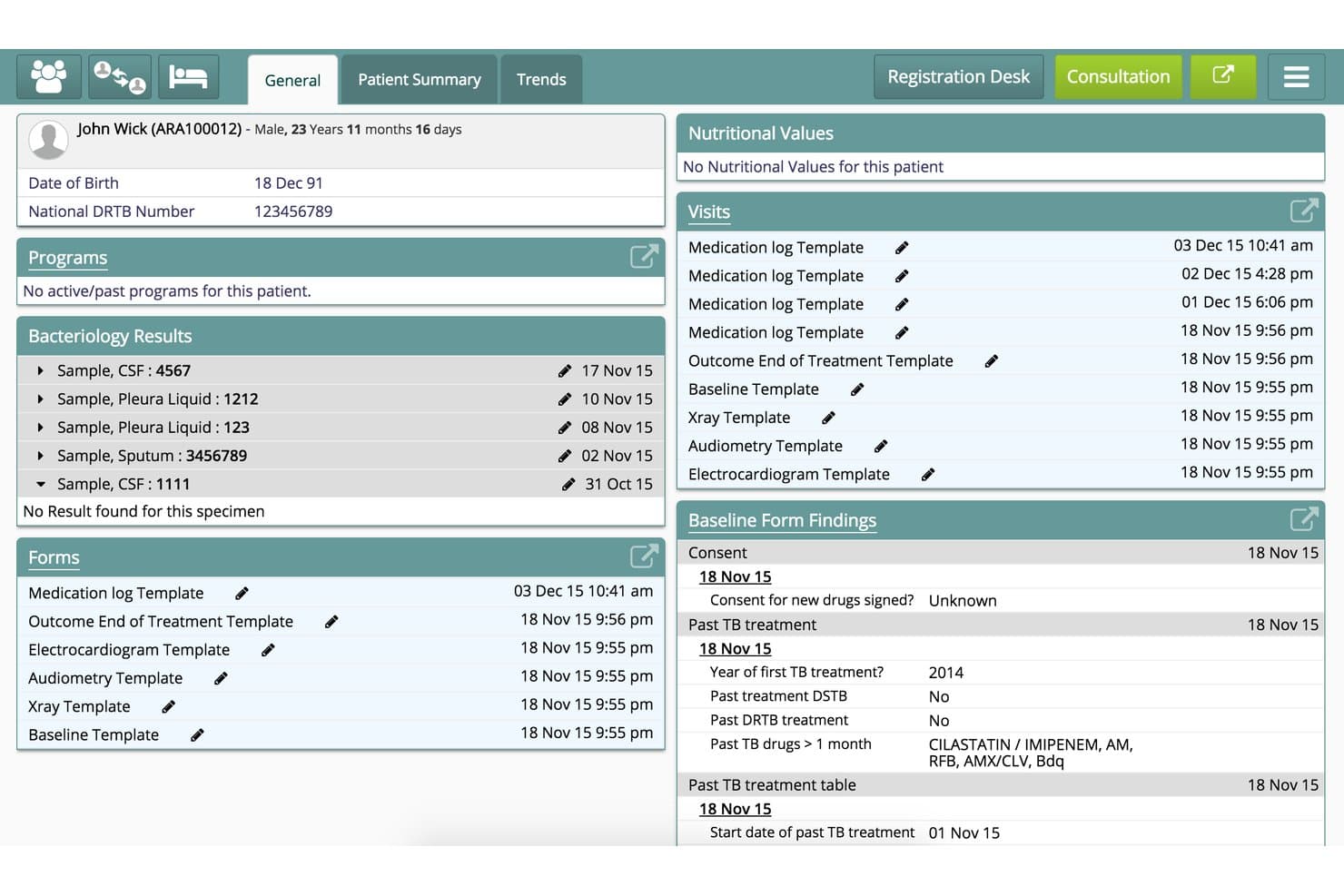
Bahmni offers a comprehensive patient dashboard displaying bacteriology results, visit logs, forms, and baseline clinical findings for medical record management. Bahmni is a free, open-source hospital information system that integrates patient registration, clinical records, inpatient management, laboratory workflows, pharmacy, and Odoo-based billing and accounting into a single platform.
Who Is Bahmni Best For?
Bahmni is a strong fit for health IT teams and developers deploying hospital information systems across NGO, government, or multi-facility clinical environments in low-resource settings.
Why I Picked Bahmni
Bahmni earns its spot as one of the best on my shortlist because its Odoo-based billing connects directly to clinical workflows across multiple facilities. When a drug order is placed in the clinical module, a draft bill generates automatically, keeping billing tied to care delivery at every site. I also like that each facility can maintain its own stock, dispensing records, and financial accounts while sharing a central patient registry.
Bahmni Key Features
- OpenMRS-based clinical data capture: Collects structured clinical data and links it with billing and inventory.
- Odoo-powered billing engine: Tracks charges, taxes, payments, and generates patient invoices using open source accounting tools.
- Multi-module laboratory integration: Supports orders, results, and workflows for lab tests mapped to billing codes.
- Custom reporting with Bahmni Mart: Enables financial, operational, and clinical reporting using prebuilt or user-defined datasets.
Bahmni Integrations
Bahmni offers native integrations with OpenMRS, Odoo, OpenELIS, DCM4CHEE, SNOMED CT through Snowstorm, Metabase, and Keycloak. An API is available for custom integrations.
Pros and Cons
Pros:
- Designed for multi-facility clinical deployments
- SNOMED CT and ICD-10 terminology support
- Modular architecture supports billing, labs, pharmacy
Cons:
- No electronic insurance eligibility verification
- No native CMS-1500 claim generation
Learn more about Bahmni: Best for intuitive physician-friendly interface
- Free demo available
- Pricing upon request
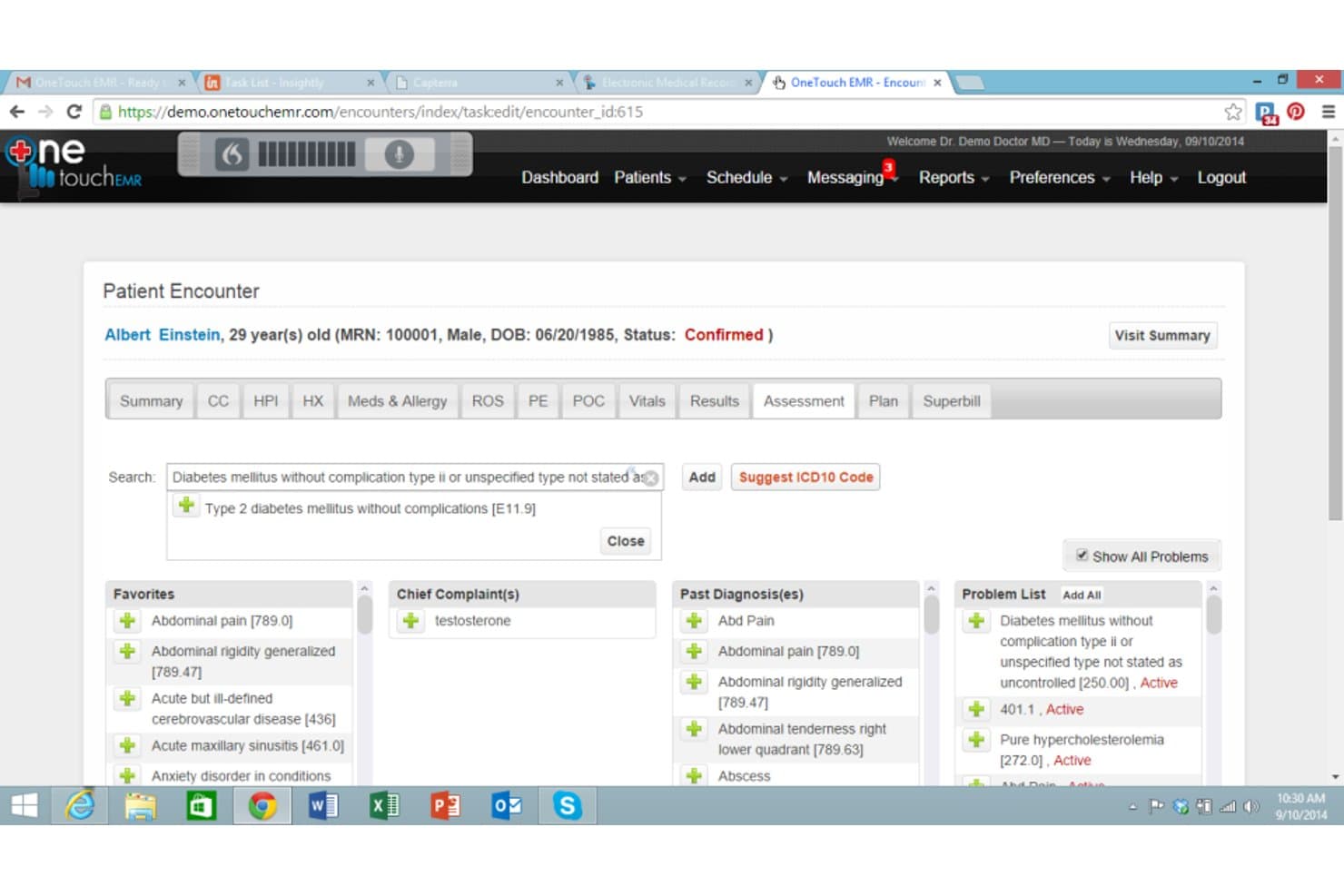
Onetouch EMR offers a patient encounter screen with ICD-10 code search, problem list management, and diagnosis tracking for streamlined medical billing workflows. OneTouch EMR is a physician-designed, cloud-based EMR platform that combines clinical documentation, e-prescribing, practice management, and integrated medical billing with claims submission and eligibility verification.
Who Is Onetouch EMR Best For?
It's a good fit for independent physicians and small-to-mid-size practices that want a single platform covering both clinical documentation and billing.
Why I Picked Onetouch EMR
I picked OneTouch EMR because it's one of the few billing-integrated platforms actually built by a practicing physician, and that origins story is visible in how the clinical interface is structured. Specialty-specific ROS and PE templates come pre-designed, so physicians aren't rebuilding note frameworks from scratch for every encounter type. I also like the AI ambient listening feature, which captures spoken clinical conversations and converts them into structured notes without manual input.
Onetouch EMR Key Features
- Integrated clearinghouse for claims: Submit electronic claims directly to payers with claim scrubbing and real-time status updates.
- ERA auto-posting: Automatically apply 835 electronic remittance information to patient ledgers for easier payment reconciliation.
- Patient payment portal: Let patients access bills and pay balances online using QuickPay and QR codes.
- Insurance eligibility verification: Verify insurance coverage in real time before appointments or claims submission.
Onetouch EMR Integrations
Native integrations include Dragon Medical, Mailchimp, integrated clearinghouses, eFax, and lab systems. An API is available for custom integrations.
Pros and Cons
Pros:
- Claims scrubbing and integrated clearinghouse are included
- Offers customizable specialty clinical templates
- Includes built-in eligibility and ERA auto-posting
Cons:
- Limited interoperability with other open source EHRs
- Closed-source and cannot be self-hosted
Learn more about Onetouch EMR:
Other Open Source Medical Billing Software
Here are some additional open source medical billing software options that didn’t make it onto my shortlist, but are still worth checking out:
- 11NoshBest for self-hosted solo practices
- 12FreeMEDBest for veteran community-driven enhancements
- 13Open DentalBest for dental practice billing features
- 14OSCAR EMRBest for customizable billing templates
- 15OpenClinic GABest for unified inpatient and outpatient billing
- 16SolismedBest for multi-provider billing administration
- 17FreeMedForms EMRBest for connected prescribing and billing
- 18ClearHealthBest for advanced insurance eligibility checks
- 19HOSxPBest for large site network billing support
- 20Fossible HISBest for doctor-led revenue tracking
How I Evaluate Open Source Medical Billing Software
I split my evaluation into two layers: the baseline requirements every tool must meet—like claims submission and ERA posting—and the differentiators that distinguish one platform from another.
Core Functionality (Table Stakes for This List)
When I'm selecting tools for my list, I rank each one on a scale from 0 (does not offer the functionality) to 5 (excels in this area) for each core functionality listed below. Then, I calculate the tool's total score into a percentage. Each tool needs to achieve a minimum total score of 65% to be considered for inclusion.
- Open source licensing: I check that each tool ships under a recognized OSI-approved license like GPL, MIT, or Apache, with source code you can actually fork and self-host.
- Claims management: The platform should handle electronic 837P/837I submission through a clearinghouse, not just generate paper CMS-1500 forms you print and mail.
- Insurance and eligibility: I look for payer setup, 835 ERA posting, and coordination of benefits so your team isn't manually keying in every remittance line item.
- Medical coding support: Built-in ICD-10, CPT, and HCPCS code sets with modifier support matter—tools like OpenEMR and LibreHealth EHR handle this differently.
- Patient billing and statements: Generating patient statements, posting payments, and tracking A/R balances are table stakes for any practice managing its own billing cycle.
- Reporting and compliance: Financial reports like A/R aging and collections summaries should pair with HIPAA-aligned controls such as audit logs and role-based access.
Once I have a list of tools that meet the criteria, I consider what sets each platform apart.
Differentiating Factors (What Sets Vendors Apart)
Here's how I compare and contrast different vendors:
Standout Features
Claim scrubbing engines make a real difference—I look for tools that catch payer-specific edits and CMS rule violations before submission, since even one missed modifier can trigger a denial. ERA auto-posting is another separator; platforms that ingest 835 files and post payments directly to patient ledgers save your team hours of manual reconciliation. I also evaluate denial management workflows, especially dashboards that let billers track rejected claims, assign follow-up tasks, and document appeal steps in one place.
Beyond Features
The license type matters more than people realize—GPL and AGPL carry different implications for how you can modify and redistribute code, which shapes your long-term flexibility. I also evaluate community health by checking GitHub activity, release frequency, and whether a commercial support network exists for practices without in-house developers. HIPAA compliance rounds out my assessment. Self-hosted deployments put the security burden on you, so I look for audit logging, role-based access controls, encryption at rest and in transit, and 2FA support.
How to Choose Open Source Medical Billing Software
It’s easy to get bogged down in long feature lists and complex pricing structures. To help you stay focused as you work through your unique software selection process, here’s a checklist of factors to keep in mind:
| Factor | What to Consider |
|---|---|
| FactorScalability | What to ConsiderWill the solution handle your expected growth, multiple locations, or increased claim volumes? |
| FactorIntegrations | What to ConsiderCan you connect billing with your EHR, clearinghouse, payment gateway, or practice management tools? |
| FactorCustomizability | What to ConsiderAre workflows, code sets, and billing logic customizable to fit your specialty or local needs? |
| FactorEase of use | What to ConsiderIs day-to-day navigation intuitive for your staff with diverse tech backgrounds? |
| FactorImplementation and onboarding | What to ConsiderWhat resources, documentation, or vendor/community support will you need for a smooth rollout? |
| FactorCost | What to ConsiderBeyond free source code, what are the true costs—hosting, IT time, clearinghouse contracts, support services? |
| FactorSecurity safeguards | What to ConsiderCan you confidently manage PHI privacy, user permissions, and HIPAA-related controls in your environment? |
| FactorTechnical setup complexity | What to ConsiderDoes your team have the experience to manage Linux servers, backups, and regular updates, or will you need outside help? |
What Is Open Source Medical Billing Software?
Open source medical billing software is billing technology with source code you can view, modify, and self-host under a permissive license. It supports core functions like claim submission, coding, insurance management, and patient invoicing.
Because it’s open, you get flexibility to customize workflows, integrate with your EHR, and control data security—giving practices direct oversight of costs, compliance, and ongoing software development.
Features of Open Source Medical Billing Software
When selecting open source medical billing software, keep an eye out for the following key features:
- Claims management: Handles electronic and paper claim creation, scrubbing, submission, and tracking so you can manage your entire claims workflow in one system.
- Insurance eligibility verification: Connects with payer databases to check patient coverage and benefits eligibility before submitting claims, reducing denial rates.
- Medical coding support: Provides up-to-date ICD-10, CPT, and HCPCS code sets with modifiers to accurately code encounters and comply with billing regulations.
- ERA/EOB auto-posting: Ingests electronic remittance files (835) to automatically post payments, adjustments, and denials to patient accounts, saving manual effort.
- Patient billing and statements: Generates clear patient statements, supports online and offline payment processing, and tracks outstanding balances for better collections.
- Denial management workflows: Offers tools to track, assign, and resolve denied or rejected claims, helping staff efficiently manage follow-ups and appeals.
- Financial reporting: Produces detailed reports on accounts receivable, collections, payer performance, and key revenue cycle metrics for informed decision-making.
- Role-based access controls: Lets you set permissions by user role to protect sensitive healthcare information and support regulatory compliance.
- Customizable templates and workflows: Enables practices to adjust billing forms, workflows, and templates to match specialty-specific and organizational requirements.
- Integration capabilities: Supports connections with EHR, practice management, and clearinghouse systems through APIs or standard formats, streamlining your billing process.
Benefits of Open Source Medical Billing Software
Implementing open source medical billing software provides several benefits for your team and your business. Here are a few you can look forward to:
- Data control and security: Self-hosting lets you safeguard patient information and maintain compliance with privacy regulations by managing your own PHI.
- Customization flexibility: Adapt workflows, billing rules, and code sets to fit your practice’s specialty and operational preferences.
- Lower total cost of ownership: Avoid vendor lock-in and ongoing subscription fees, budgeting only for hosting, clearinghouse, and support as needed.
- Integration capability: Seamlessly connect your billing system with existing EHR, practice management tools, and clearinghouses.
- Community-driven improvements: Benefit from public forums, shared patches, and collective troubleshooting in active open source user and developer communities.
- Transparency and vendor independence: Review and adjust the source code as needed, ensuring your system evolves with your practice and industry standards.
- Enhanced reporting and tracking: Access robust reporting features for AR, collections, denials, and productivity, supporting data-driven business decisions.
Costs and Pricing of Open Source Medical Billing Software
Selecting open source medical billing software requires an understanding of the various pricing models and plans available. Costs vary based on features, team size, add-ons, and more. The table below summarizes common plans, their average prices, and typical features included in open source medical billing software solutions:
Plan Comparison Table for Open Source Medical Billing Software
| Plan Type | Average Price | Common Features |
|---|---|---|
| Plan TypeFree Plan | Average Price$0 | Common FeaturesAccess to source code, basic claims management, limited user accounts, community support, and basic reporting. |
| Plan TypePersonal Plan | Average Price$10–$50/user/month | Common FeaturesStandard claims workflows, medical coding support, simple insurance management, and email-based help. |
| Plan TypeBusiness Plan | Average Price$50–$150/user/month | Common FeaturesAdvanced billing features, ERA/EOB auto-posting, integration tools, role-based permissions, and priority support. |
| Plan TypeEnterprise Plan | Average Price$150–$400+/user/month | Common FeaturesFull API access, specialty workflow customization, SSO, audit logging, onboarding help, and contracted SLA support. |
Open Source Medical Billing Software FAQs
Here are some answers to common questions about open source medical billing software:
Are open source medical billing tools actually free to use?
Yes, the source code is typically free to download and use, but you may still pay for hosting, support, clearinghouse services, and technical setup.
Can open source medical billing platforms integrate with my EHR?
Yes, many open source billing solutions support integration with EHRs through APIs or standard formats like HL7 or FHIR, but you should always confirm compatibility before making your choice.
How do I ensure HIPAA compliance with open source billing software?
You need to manage your own data security by enabling audit logs, using encryption, limiting user access, and implementing best practices for handling PHI.
What kind of support is available for open source billing systems?
Support often comes from user forums and documentation, but some vendors or consulting groups offer paid support contracts and implementation help.
Is open source billing software suitable for larger or multi-location practices?
Yes, provided you choose a platform that offers multi-user support, customizable workflows, and scalability for larger claim volumes. Always evaluate each tool’s scalability features before committing.