

Non emergency medical transportation billing software helps you manage trip documentation, insurance claims, and payments for NEMT services. If you’re looking to save time on paperwork, reduce claim denials, and get paid faster, using the right billing platform makes a difference. In this guide, you’ll find my top picks for NEMT billing systems that fit a range of team sizes and needs. Compare features, compliance tools, and integrations to choose the solution that keeps your operation running smoothly and supports your goals.
Why Trust Our Software Recommendations
6,700+
Reviews
20
Industry experts
16+
Evaluation factors
14
Years
Our team has been testing and reviewing software since 2012. As medical practice leaders ourselves, we know how difficult—and important—it is to choose the right software.
For this guide, we evaluated tools using hands-on testing and independent research, scoring tools using our selection criteria.
Our reviews reflect our human editorial judgment, not a sales pitch.
Best Non Emergency Medical Transportation Billing Software
This comparison chart outlines pricing for my top non emergency medical transportation billing software picks, helping you find the best option for your budget and practice needs.
| Tool | Best For | Trial Info | Price | ||
|---|---|---|---|---|---|
| 1 | Best for cloud-based NEMT dispatching | Free demo available | From $49.99/month | Website | |
| 2 | Best for integrated transport operations | Free demo available | Pricing upon request | Website | |
| 3 | Best for NEMT scheduling and care coordination | Free demo available | Pricing upon request | Website | |
| 4 | Best for NEMT scheduling and trip management | Free demo available | Pricing upon request | Website | |
| 5 | Best for NEMT billing and revenue tracking | Free demo available | From $778/month | Website | |
| 6 | Best for streamlined NEMT dispatch operations | Free demo available | From $69/vehicle/month | Website | |
| 7 | Best for automated NEMT scheduling and billing | Free demo available | From $50/month | Website | |
| 8 | Best for real-time NEMT routing and dispatch | Free demo available | From $150/month | Website | |
| 9 | Best for NEMT reporting and medicaid billing | 30-day free trial | Pricing upon request | Website | |
| 10 | Best for all-in-one NEMT fleet management | Free demo available | From $60/vehicle/month | Website |


Best Non Emergency Medical Transportation Billing Software Reviews
Below are my detailed summaries of the best non emergency medical transportation billing software that made it onto my shortlist. My reviews offer a detailed look at the features, pricing, and integrations of each platform to help you find the best one for you.
 Best for cloud-based NEMT dispatching
- Free demo available
- From $49.99/month
Visit WebsiteCustomer Rating:4/5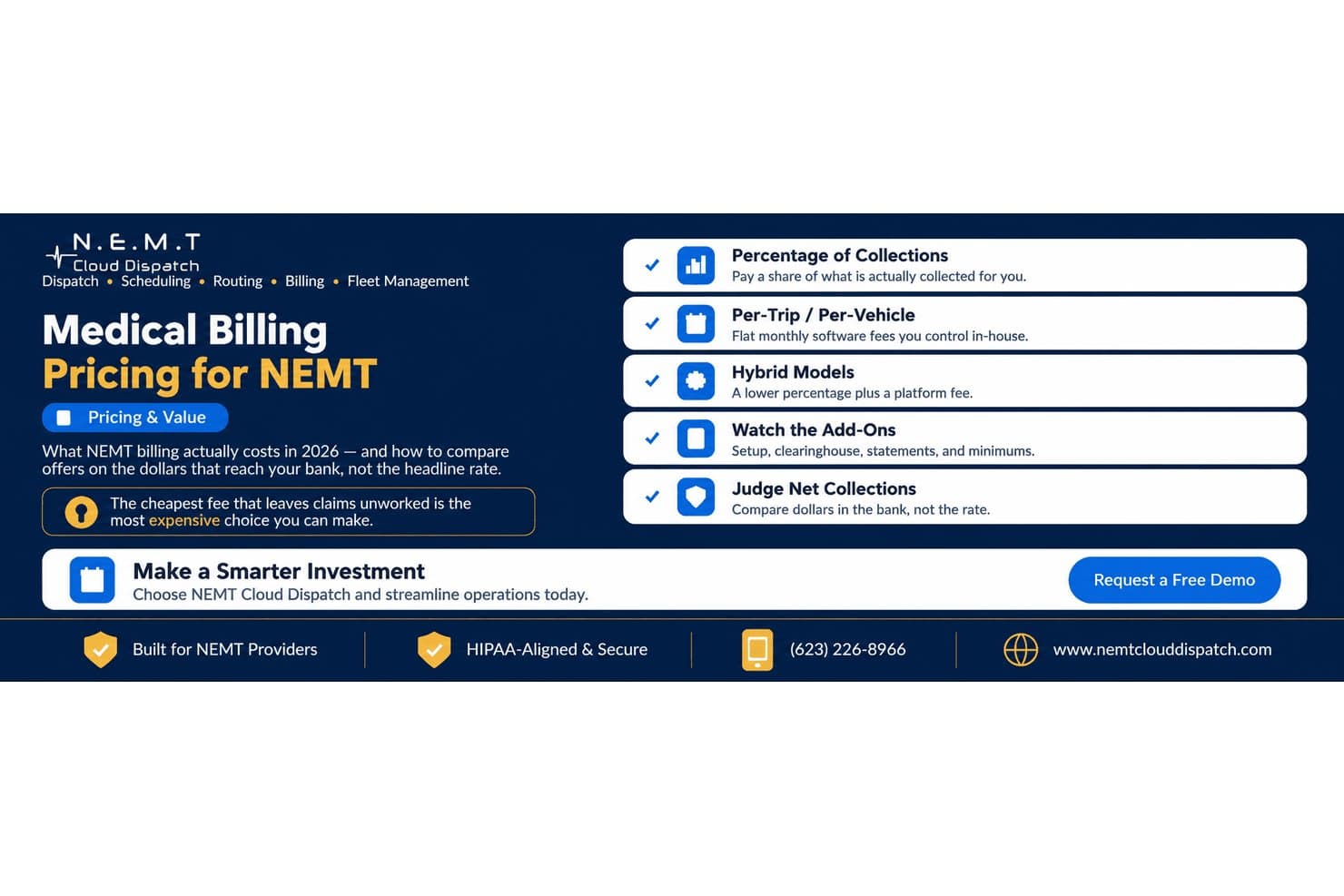
NEMT Cloud Dispatch offers a medical billing pricing breakdown for NEMT providers in 2026, highlighting five pricing models and the importance of judging net collections over headline rates. NEMT Cloud Dispatch is a cloud-based platform that combines trip dispatching, scheduling, EDI 837P claim generation, and direct broker billing integrations for non-emergency medical transportation providers.
Who Is NEMT Cloud Dispatch Best For?
It's a strong fit for small-to-mid-sized NEMT providers—from solo operators to fleets under 50 vehicles—who need billing and dispatch on one platform.
Why I Picked NEMT Cloud Dispatch
I've included NEMT Cloud Dispatch in my top picks because the trip-to-claim architecture eliminates duplicate data entry entirely. Mileage, pickup/drop-off coordinates, and authorization numbers move from the dispatch console directly into the 837P claim. I also like the pre-built broker connectors for Modivcare, MTM, Access2Care, and four other major payers, each formatted to match that broker's specific invoice layout and CSV requirements.
NEMT Cloud Dispatch Key Features
- EDI 837P claim generator: Generates electronic Medicaid and broker claims using NEMT-specific HCPCS codes for each trip.
- Multi-broker integration: Connects natively with Modivcare, MTM, Access2Care, Kaiser, Alivi, HBSS, and VectorCare to sync trip and billing data.
- HIPAA-compliant document storage: Stores signed trip logs, authorizations, and manifests in an encrypted, audit-ready format.
- Billing denial dashboard: Centralizes denied and rejected claims for correction, resubmission, and batch status tracking.
NEMT Cloud Dispatch Integrations
NEMT Cloud Dispatch offers native integrations with Modivcare, MTM, Access2Care, Kaiser Permanente, Alivi, HBSS Connect Corp, and VectorCare for trip and claim data, and connects with QuickBooks, Sage, Stripe, Authorize.net, and PayPal. An API is available for custom integrations.
Pros and Cons
Pros:
- Centralized dashboard for billing denials and appeals
- Supports full Medicaid and broker claim automation
- Trip and billing data move without export
Cons:
- No built-in full-service revenue cycle management
- Modifier automation for claims is limited
Learn more about NEMT Cloud Dispatch: Best for integrated transport operations
- Free demo available
- Pricing upon request
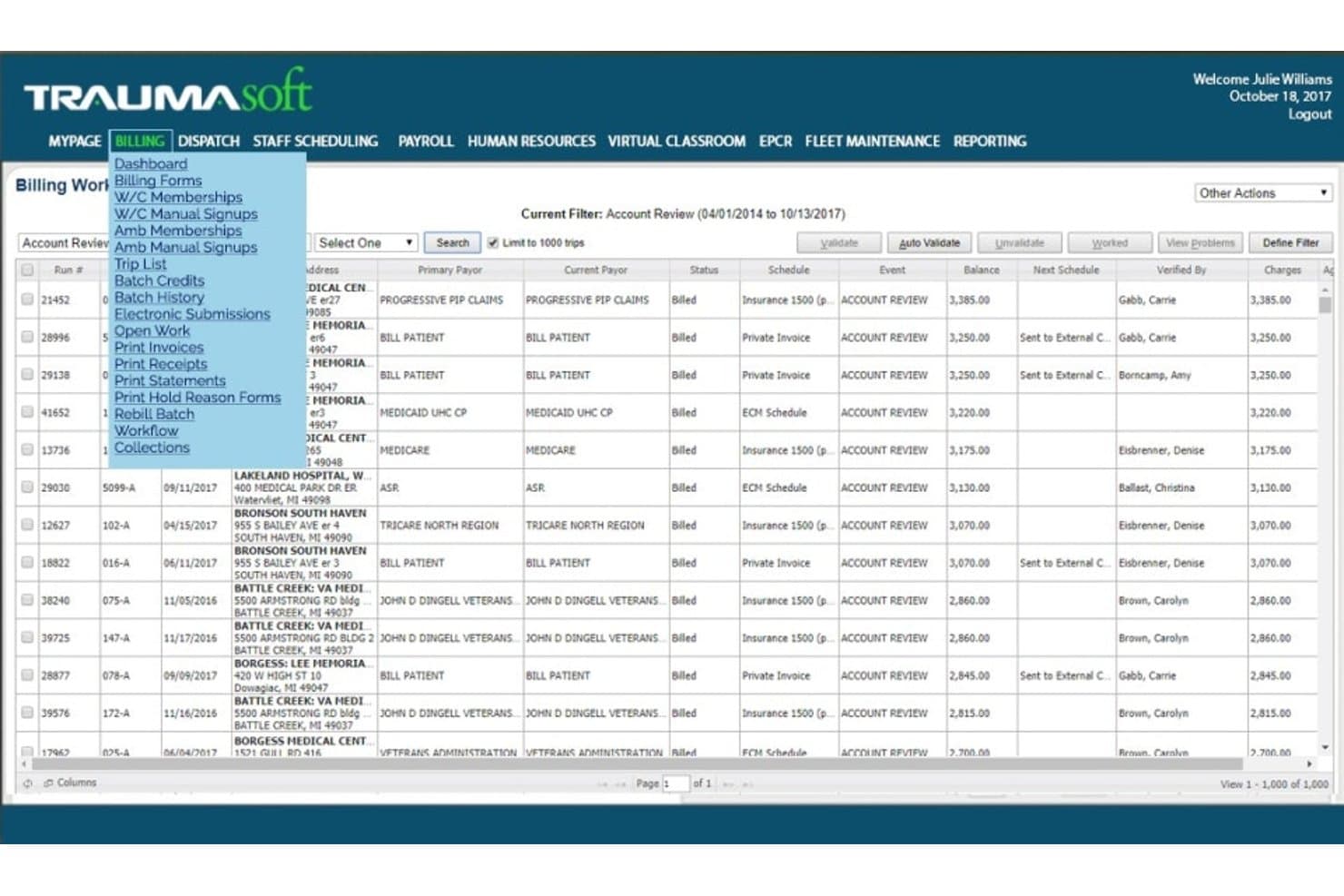
Traumasoft offers a detailed billing account review dashboard displaying trip records, payer information, balances, and billing statuses for medical transportation claims. Traumasoft is an all-in-one EMS and NEMT platform that unifies CAD, dispatch, ePCR, trip management, and billing within a single shared database.
Who Is Traumasoft Best For?
Traumasoft suits NEMT and EMS agencies running mixed-service operations that need dispatch, documentation, and billing managed in one place.
Why I Picked Traumasoft
Traumasoft earns its spot on my shortlist because the trip-to-claim workflow is one of the tightest I've seen in NEMT billing. Every trip logged through the CAD module feeds directly into the billing record, so there's no re-keying mileage, pickup times, or driver data. On top of that, Traumasoft's AI-powered QA/QI layer (Huly) flags documentation gaps before a claim is submitted, which cuts down on denials at the source.
Traumasoft Key Features
- Integrated crew scheduling: Schedule, assign, and manage shifts for drivers and crews in one platform.
- Electronic patient care reporting (ePCR): Capture, store, and review trip and patient care details electronically.
- Bed management dashboard: Track patient movement and bed status in real time for each transport.
- Reporting and analytics tools: Build custom, automated reports pulling data from dispatch, billing, and ePCR modules.
Traumasoft Integrations
Native integrations are not clearly documented. The tool references partner integrations for billing and payroll and offers an API for custom integrations.
Pros and Cons
Pros:
- AI-powered chart validation reduces claim denials
- Unified dispatch, trip, and billing platform
- Trip data flows directly into billing module
Cons:
- Implementation process takes several months
- Broker integrations require extra configuration steps
Learn more about Traumasoft: Best for NEMT scheduling and care coordination
- Free demo available
- Pricing upon request
Visit WebsiteCustomer Rating:4.8/5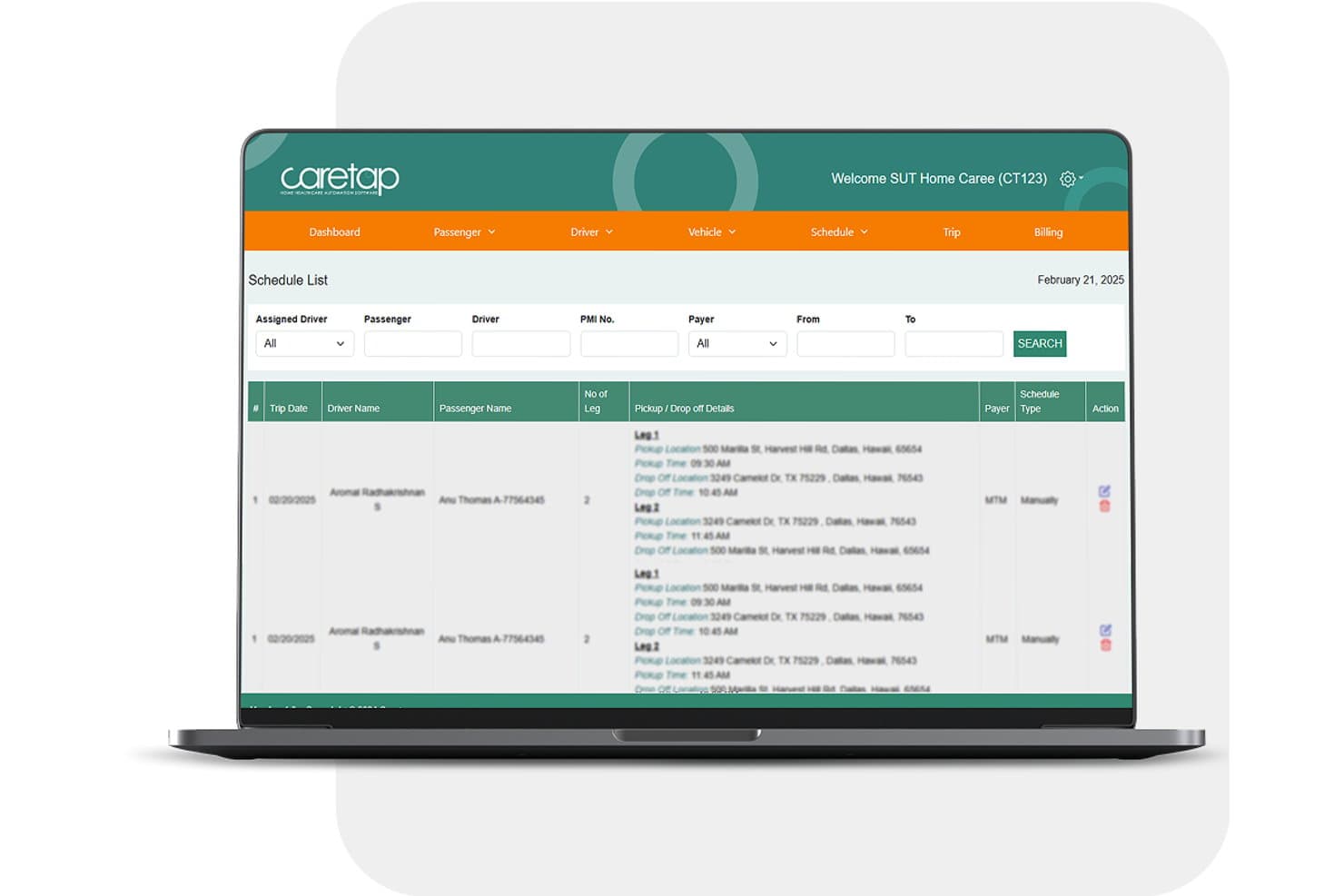
Caretap offers a Schedule List view that displays trip details, driver assignments, passenger names, pickup/drop-off locations, payer type, and schedule type for NEMT billing management. Caretap is a multi-vertical care operations platform with a dedicated NEMT module covering dispatch, trip-to-claim billing automation, EVV, GPS tracking, and HIPAA-compliant documentation.
Who Is Caretap Best For?
Caretap fits smaller-to-mid-size NEMT providers that also run home care or other care service lines and want a single platform to manage them all.
Why I Picked Caretap
Caretap earns its spot on my shortlist because of how tightly its scheduling and billing modules connect. When a driver completes a trip, verified pickup, drop-off, and GPS data automatically converts into a billing record, cutting out manual re-entry. I also like the advance driver assignment and real-time dispatch automation, which lets my team import payer schedules directly and keep trip coordination running in sync with claim generation.
Caretap Key Features
- Waystar clearinghouse integration: Submit and manage EDI claims directly to Medicaid, MCOs, and payers through a built-in clearinghouse connection.
- Driver and vehicle compliance tools: Track license expirations, vehicle maintenance logs, and set renewal reminders for ongoing compliance.
- Electronic signature capture: Collect passenger signatures at drop-off within the mobile app for verifiable proof of service.
- HIPAA-compliant audit trail: Automatically store and log all trip documentation for audit readiness and compliance monitoring.
Caretap Integrations
Caretap offers a native integration with Waystar for clearinghouse claims submission to Medicaid, MCOs, and private insurers. An API is available for custom integrations.
Pros and Cons
Pros:
- Dispatch, compliance, and billing in one platform
- Built-in electronic signature collection for NEMT
- Automated trip-to-claim billing conversion
Cons:
- Multi-step billing workflow can slow processes
- Limited direct broker integrations documented
Learn more about Caretap: Best for NEMT scheduling and trip management
- Free demo available
- Pricing upon request
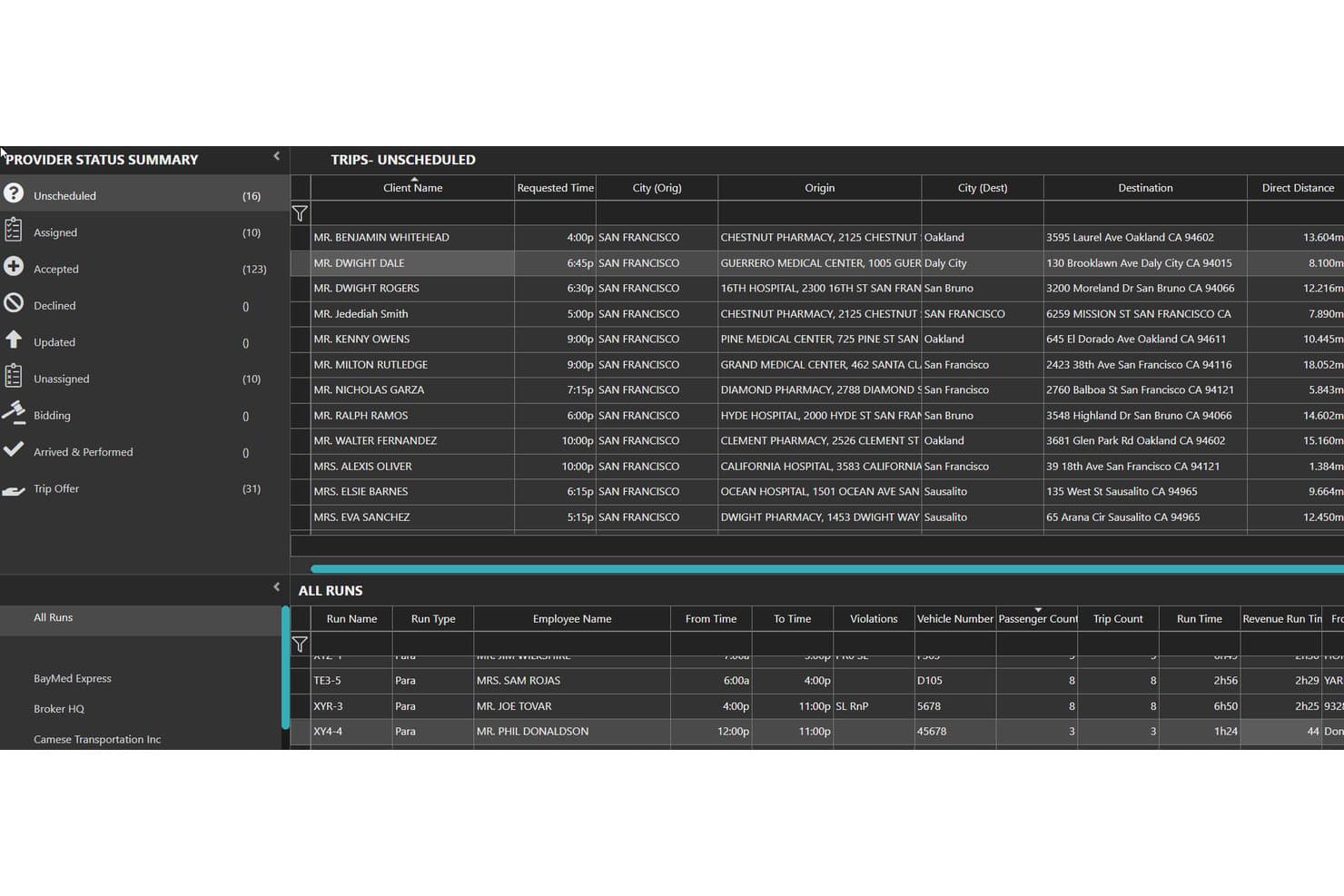
Momentm's NovusMED offers a trip scheduling dashboard displaying unscheduled trips, provider status summaries, and run management for non-emergency medical transportation. Momentm's NovusMED is an enterprise NEMT platform that integrates trip scheduling, dispatch, and billing into a single system, with built-in broker/MCO claims management, credential tracking, and HIPAA-compliant documentation.
Who Is Momentm's NovusMED Best For?
NovusMED is a strong fit for large NEMT fleets, brokers, and managed care organizations managing high trip volumes across multiple payers.
Why I Picked Momentm's NovusMED
I picked NovusMED as one of the best because its scheduling module feeds directly into billing, converting trip records into claims without manual re-entry. I particularly like how it flags rejection causes at the claim level and lets me filter by status (ready-to-bill, pending, submitted, awaiting payment) to manage resubmissions. The pre-built broker connections to ModivCare and MAS mean I'm not manually exporting files between systems.
Momentm’s NovusMED Key Features
- Credential management: Tracks driver and vehicle credentials, licenses, and training statuses with automated alerts for expirations.
- HIPAA-compliant document storage: Stores signed trip logs, prior authorizations, and proof of service securely for audits.
- Customizable reporting dashboard: Provides configurable dashboards for utilization, no-shows, billing status, and trip costs.
- API and broker integrations: Supports open API and direct connections to leading NEMT brokers for automated claim and trip data exchange.
Momentm’s NovusMED Integrations
Momentm's NovusMED offers native integrations with ModivCare, MAS, CTS TripMaster, Ecolane, RouteGenie, IT Curves, Bambi, MediRoutes, FlipCX, Lyft, and Uber. An open API is available for custom integrations.
Pros and Cons
Pros:
- Trip data links directly to billing claims
- HIPAA-compliant document retention with audit trail
- Broker claim submission workflow is automated
Cons:
- Not tailored for small NEMT owner-operators
- Modifier automation not clearly documented
Learn more about Momentm’s NovusMED: Best for NEMT billing and revenue tracking
- Free demo available
- From $778/month
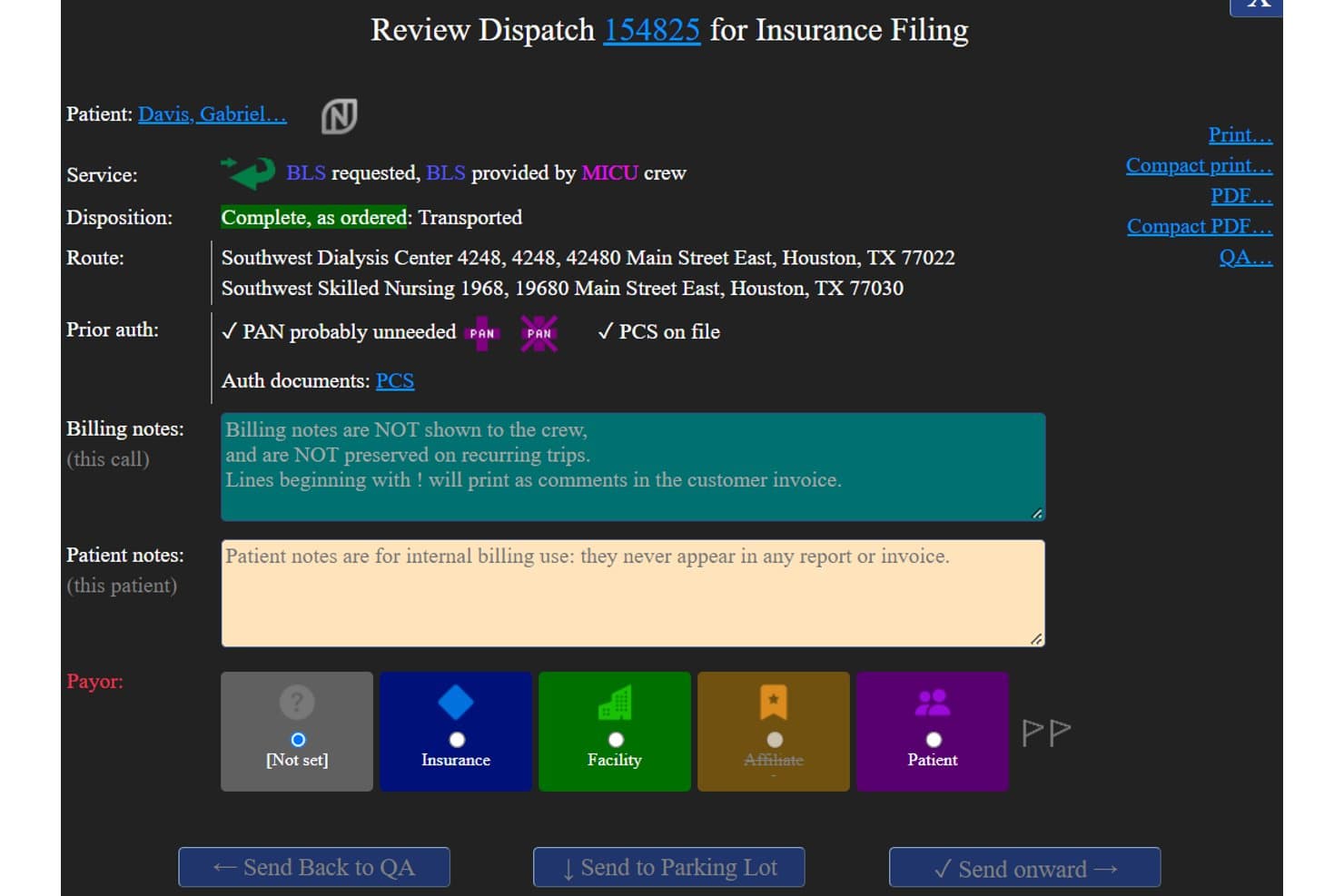
AngelTrack offers a detailed insurance filing review screen that displays patient info, service type, route, prior auth status, payor selection, and billing notes for NEMT dispatches. AngelTrack is a cloud-based NEMT billing platform that connects dispatch, trip documentation, prior authorization tracking, claims filing, and denial management within a single queue-based system.
Who Is AngelTrack Best For?
AngelTrack is a good fit for NEMT agencies and EMS operators that manage billing in-house and need dispatch and claims workflows connected in one platform.
Why I Picked AngelTrack
I've included AngelTrack in my top picks because of how tightly it connects trip data to billing. I like that when a driver completes a run, the pickup time, mileage, and signature automatically pull into the claim with no manual re-entry. The feature I rely on most is the deterministic queue system, which organizes every claim into stages like Prior Authorization, Transmission, and Appeal so my team can see exactly where revenue is getting held up.
AngelTrack Key Features
- Facility self-service portal: Facilities can view invoices and make payments online using Stripe integration.
- Prior authorization alerts: The system flags trips needing updated authorization to avoid denied claims.
- Role-based access control: Assigns permissions to internal staff or third-party billers for secure data handling.
- Permanent audit trails: Maintains a detailed history of changes, signatures, and form attachments for compliance.
AngelTrack Integrations
AngelTrack offers native integrations with Stripe for online payments and clearinghouse platforms for claims transmission. An API is available for connecting external billing services or custom integrations.
Pros and Cons
Pros:
- HIPAA-compliant permanent audit trails
- Queue-based revenue and denial tracking
- Automated dispatch to billing workflow
Cons:
- No built-in driver mobile app
- Limited direct broker portal integrations
Learn more about AngelTrack: Best for streamlined NEMT dispatch operations
- Free demo available
- From $69/vehicle/month
Visit WebsiteCustomer Rating:5/5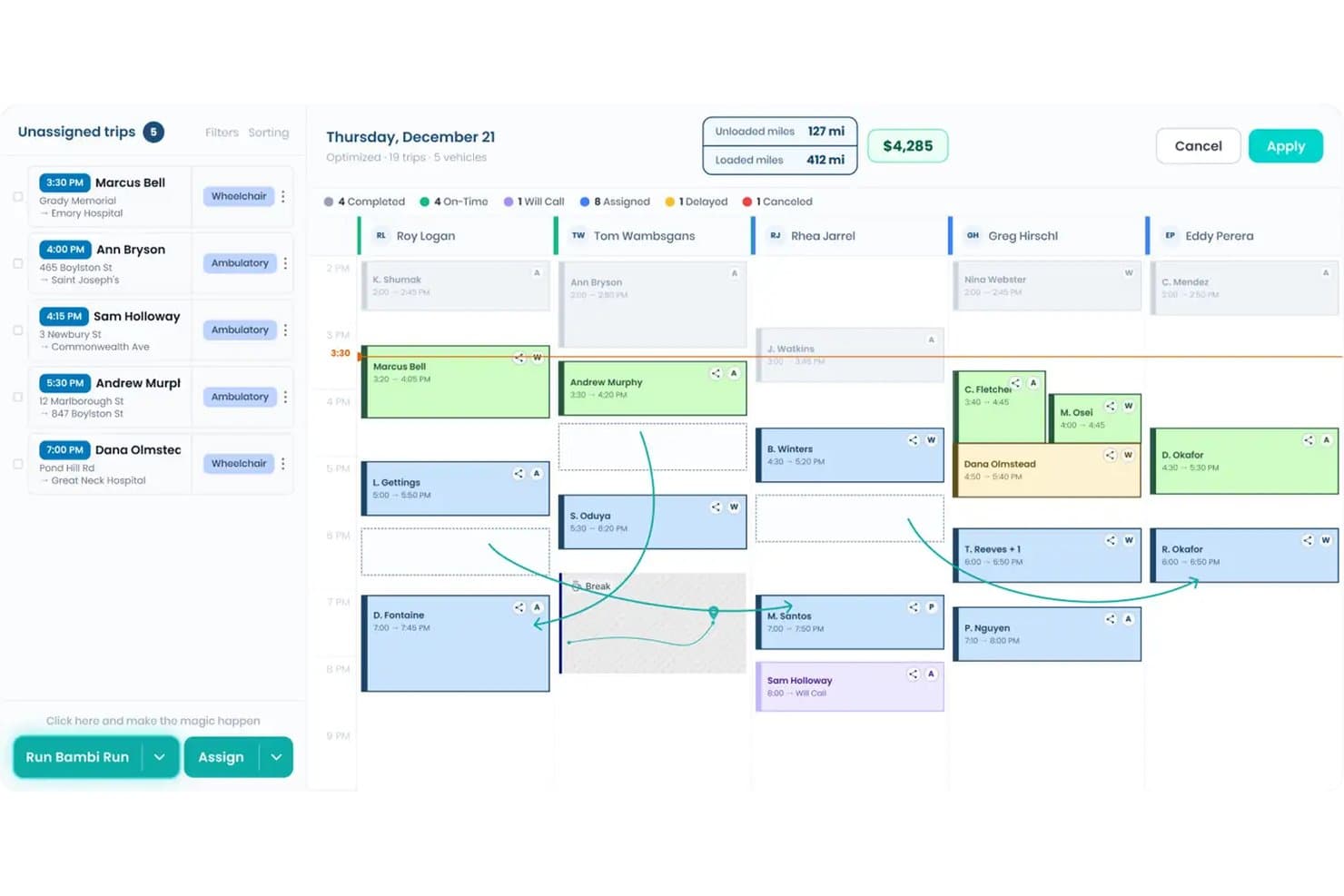
Bambi offers a visual trip scheduling dashboard that displays driver assignments, trip statuses, mileage totals, and unassigned trips for non-emergency medical transportation management. Bambi is an AI-powered NEMT platform that combines dispatch scheduling, real-time fleet tracking, and trip-to-claim billing into a single system built exclusively for non-emergency medical transportation providers.
Who Is Bambi Best For?
Bambi is a strong fit for small to mid-sized NEMT fleet operators who need a single platform to manage dispatch and billing without juggling separate systems.
Why I Picked Bambi
I picked Bambi as one of the best because its dispatch and billing modules share a single data model. When a trip closes, the GPS-stamped verification and e-signature automatically populate the billing record, eliminating manual re-entry between systems. I also like the AI scheduling engine, which auto-assigns drivers and identifies passenger grouping opportunities, keeping trip counts and mileage data accurate before they ever reach a claim.
Bambi Key Features
- Facility trip portal: Hospitals and care centers can request rides directly from an online portal linked to Bambi dispatch.
- Broker integrations: Direct trip imports from major NEMT brokers like MTM and Modivcare with no manual data entry.
- HIPAA-compliant documentation: Role-based access, encrypted PHI storage, and GPS-stamped signature capture are built in.
- Recurring trip scheduling: Set up trip subscriptions for repeat rides like dialysis with automated week-to-week repeats.
Bambi Integrations
Bambi offers native integrations with major NEMT brokers including MTM, Modivcare, and SafeRide, enabling direct trip imports and billing file submission with no manual entry.
Pros and Cons
Pros:
- Built-in GPS and e-signature verification
- Direct broker trip import for dispatching
- Automated trip-to-claim billing flow
Cons:
- No advanced denial analytics or appeals workflow
- Limited clearinghouse and Medicaid portal options
Learn more about Bambi: Best for automated NEMT scheduling and billing
- Free demo available
- From $50/month
Visit WebsiteCustomer Rating:4.9/5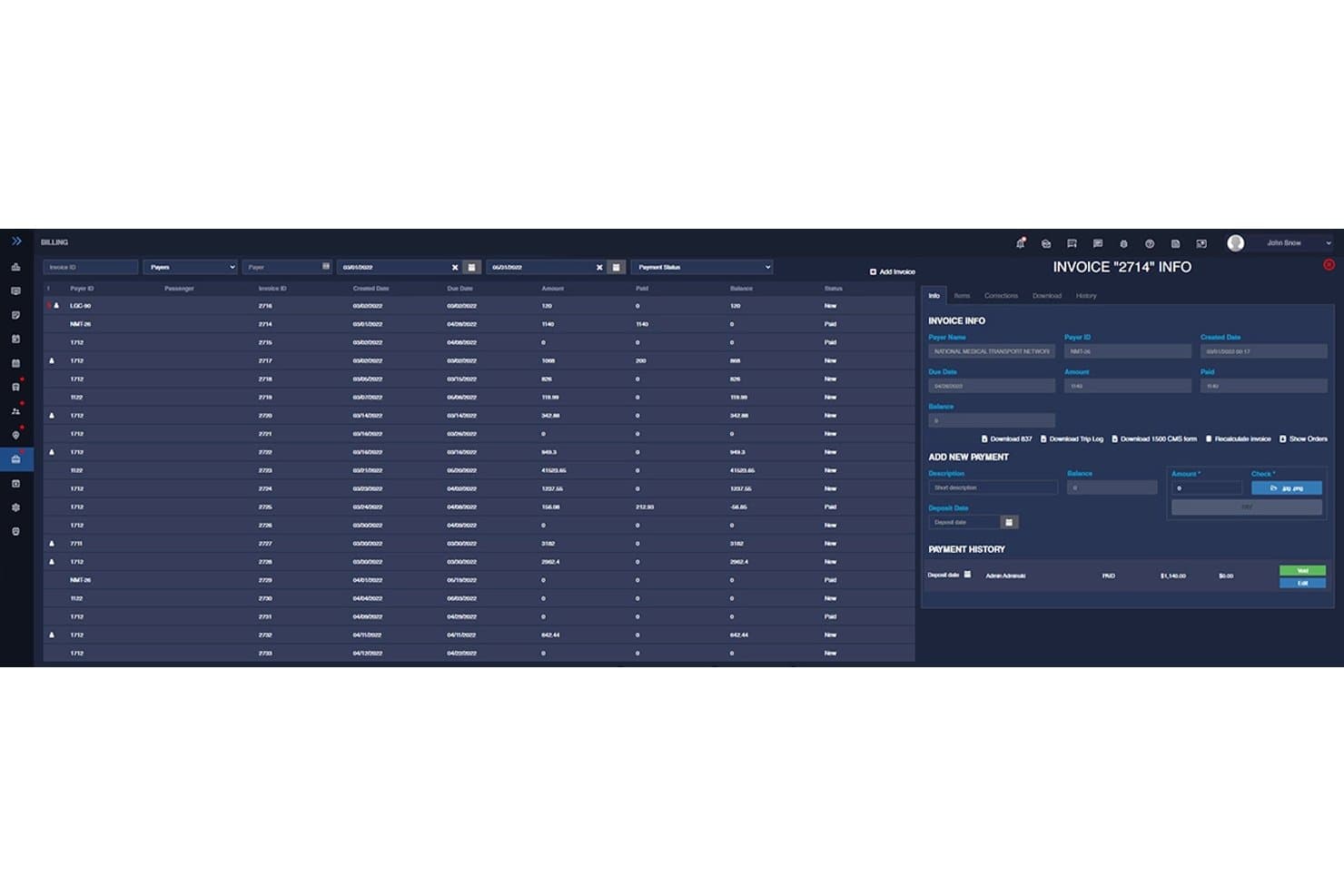
RouteGenie offers a detailed billing interface with invoice management, payment history, and new payment entry for non-emergency medical transportation providers. RouteGenie is an NEMT-specific platform that combines automated scheduling, dispatching, routing, and a dedicated billing module for EDI claim submission, broker billing file generation, and trip-level claim tracking.
Who Is RouteGenie Best For?
RouteGenie is a strong fit for small to mid-sized NEMT operators who manage their own fleet and need scheduling and billing handled within a single platform.
Why I Picked RouteGenie
I picked RouteGenie as one of the best because its BillingGenie module automatically selects the correct medical codes for every trip, cutting out the manual coding step that trips up most NEMT billing teams. I also like the attestation sync, which cross-checks completed trips against payer records before a claim is submitted. That means billing staff aren't chasing down trip confirmations manually before a claim goes out, and broker billing files are generated using templates matched to each individual broker's specifications.
RouteGenie Key Features
- Broker integration library: Connects directly with over 20 leading NEMT brokers for trip import, updates, and billing file exports.
- Automated route optimization: Assigns trips to drivers based on real-time capacity, vehicle type, and geographic proximity.
- HIPAA-compliant documentation storage: Keeps signed trip logs, prior authorizations, and proof of service linked to each claim.
- Denial management dashboard: Tracks, flags, and batches denied claims for corrections and resubmission with payer-specific audit trails.
RouteGenie Integrations
RouteGenie offers native integrations with MTM, Modivcare, Veyo, Verida, Medical Answering Services (MAS), Ride Health, Kaizen Health, Alivi, SafeRide Health, GATRA, and VectorCare. An API is available for custom integrations.
Pros and Cons
Pros:
- Built-in attestation and document capture
- Direct broker claim export functionality
- Automatic HCPCS coding for each trip
Cons:
- Audit reporting could be more granular
- Limited GPS validation for loaded mileage
Learn more about RouteGenie: Best for real-time NEMT routing and dispatch
- Free demo available
- From $150/month
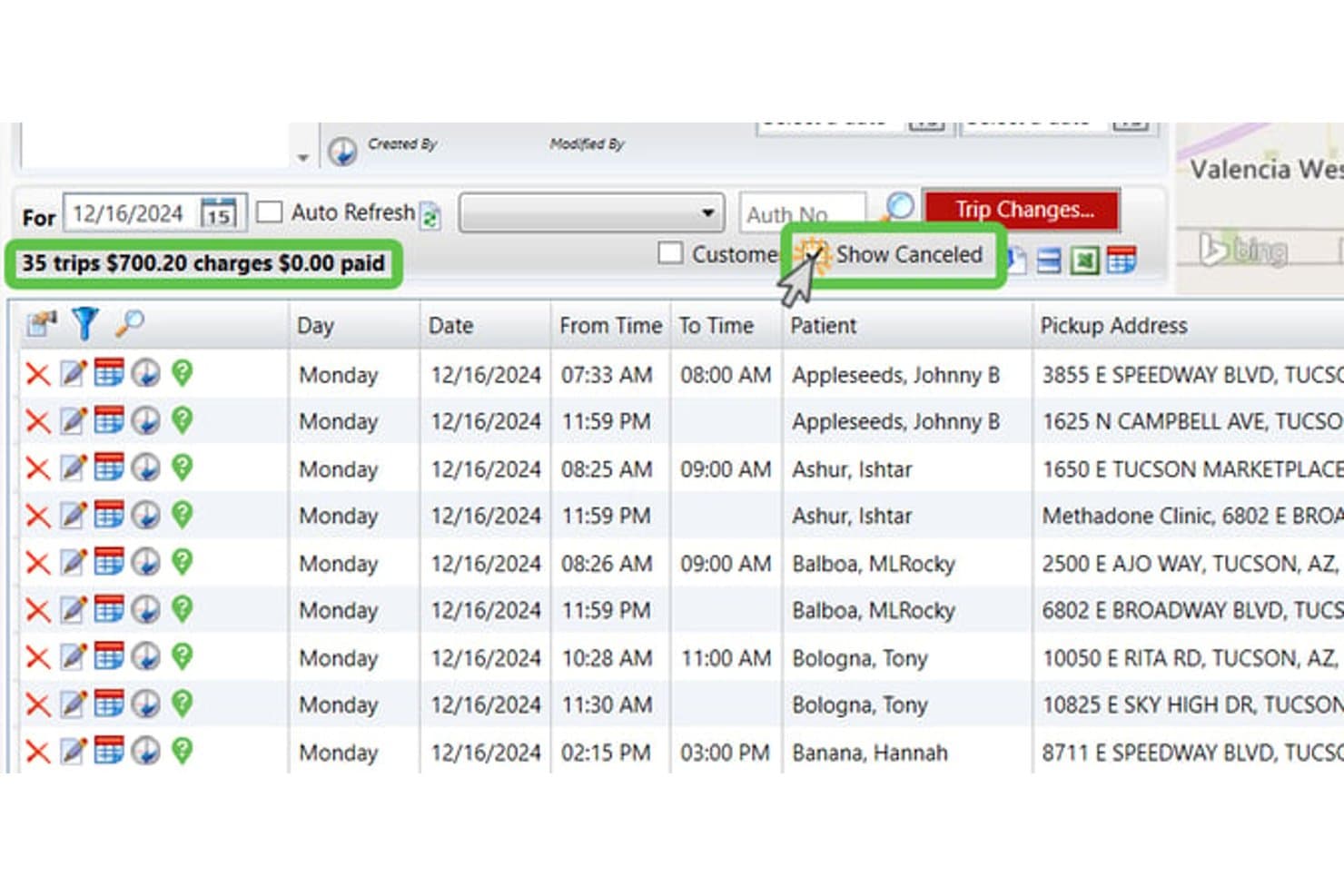
MediRoutes offers a trip scheduling dashboard that displays daily trip charges, patient names, pickup addresses, and time slots for non-emergency medical transportation billing. MediRoutes is a cloud-based NEMT fleet management platform that combines real-time dispatch, broker API integrations, and billing compliance tools including HCPCS mapping, denial management, and multi-payer claim tracking.
Who Is MediRoutes Best For?
MediRoutes is a strong fit for mid-to-large NEMT operators managing multi-broker contracts across multiple states or payers.
Why I Picked MediRoutes
MediRoutes earns its spot on my shortlist because its real-time routing engine ties directly to the billing layer. When dispatch reroutes a trip mid-run, the GPS timestamps and loaded mileage update in the claim record automatically, not through a separate manual step. I also rely on dry run management to document driver-initiated cancellations and no-shows, which builds the audit trail Medicaid reviewers expect without adding administrative work.
MediRoutes Key Features
- Broker EDI integrations: Connects directly with major NEMT brokers like ModivCare and MTM to exchange trip and claim files.
- Mileage and modifier automation: Calculates loaded mileage and applies correct modifiers to claims based on driver and vehicle data.
- Denial management dashboard: Flags rejected claims by reason code, tracks resubmissions, and builds an audit trail.
- Prior authorization tracking: Monitors authorization limits, expiration dates, and remaining eligible trips for each member.
MediRoutes Integrations
MediRoutes offers native integrations with ModivCare, MTM, Provide A Ride, Ride Health, SafeRide, VectorCare, and Verida for real-time trip data exchange and claims processing. An API is available for custom integrations.
Pros and Cons
Pros:
- Denial management dashboard with audit trail
- Strong broker network for automated claims handling
- Real-time sync between dispatch and billing modules
Cons:
- No native direct clearinghouse status tracking
- PCS/CMN document management is limited
Learn more about MediRoutes: Best for NEMT reporting and medicaid billing
- 30-day free trial
- Pricing upon request
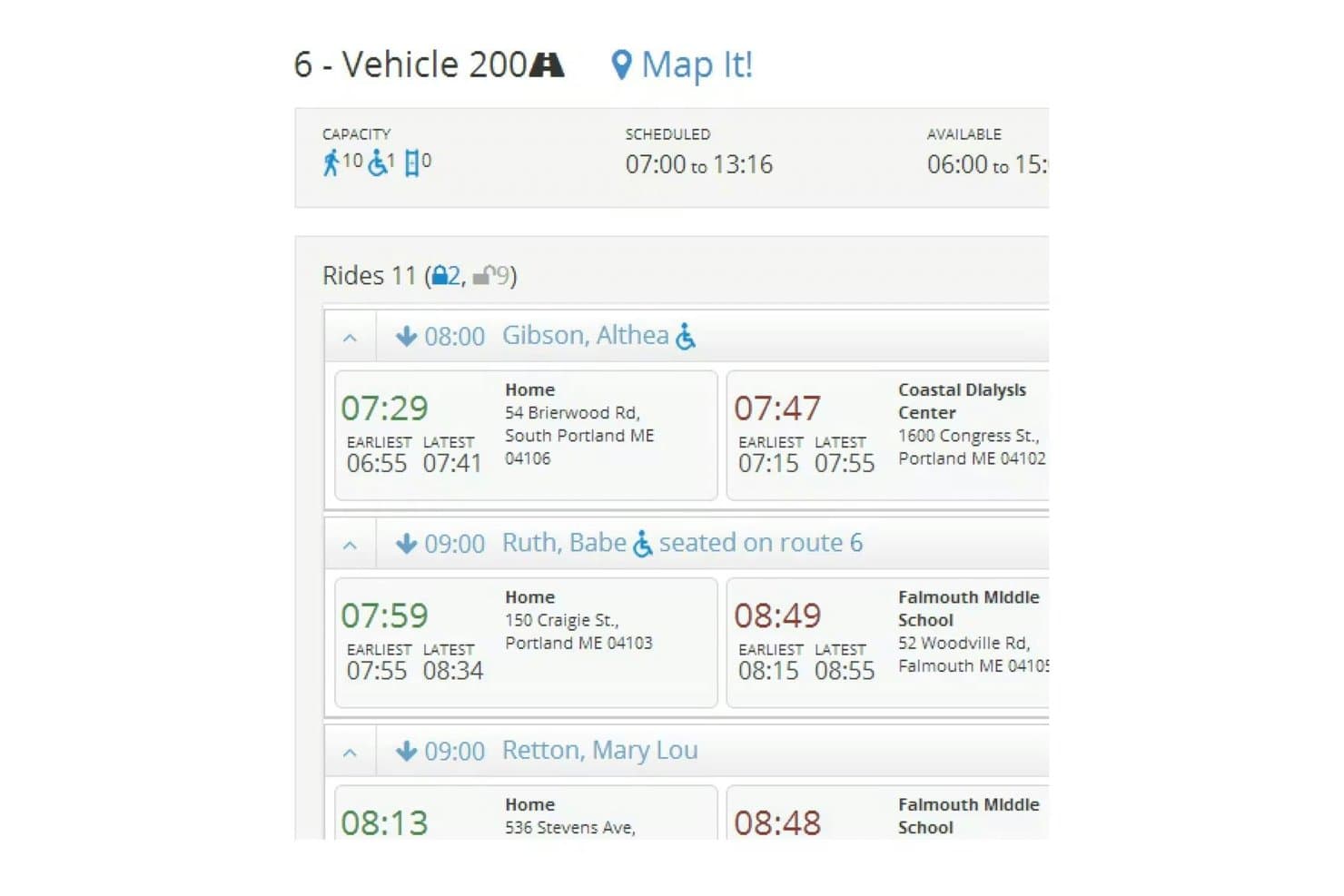
TripMaster offers a detailed ride scheduling view showing passenger pickups, drop-offs, vehicle capacity, and time windows for non-emergency medical and school transportation routes. TripMaster is a cloud-based NEMT and paratransit platform that combines dispatch, automated scheduling, Medicaid billing, broker integrations, and state and federal reporting into a single system built specifically for transportation providers.
Who Is TripMaster Best For?
TripMaster is a strong fit for NEMT and paratransit providers that bill directly to Medicaid and work with multiple trip brokers across demand-response or fixed-route operations.
Why I Picked TripMaster
I picked TripMaster as one of the best because its reporting and Medicaid billing tools are built from the ground up for NEMT compliance. The custom state and federal report builder means my team isn't scrambling when mandatory reporting formats change, since TripMaster's support staff develop those reports at no extra charge. Statewide Medicaid billing pulls directly from completed trip records, cutting out manual re-entry between dispatch and the billing queue entirely.
TripMaster Key Features
- Trip broker integrations: Connects directly with major NEMT brokers like ModivCare, MTM, Access2Care, and Veyo for automated trip import and billing.
- Automated driver manifest creation: Generates detailed manifests for drivers, including passenger info, route details, and required documentation for each shift.
- Custom report builder: Allows users to create and export custom operational, billing, and compliance reports without needing advanced technical skills.
- HIPAA-compliant document storage: Stores electronic trip records, authorizations, and signatures in a secure, audit-ready format.
TripMaster Integrations
TripMaster offers native integrations with ModivCare, MTM, Access2Care, Veyo, Southeastrans, Alivi, and OneCall for trip import and broker billing. An API is available for custom integrations.
Pros and Cons
Pros:
- Automated trip-to-claim data conversion
- Direct Medicaid and broker billing connections
- Custom state and federal report builder
Cons:
- Denial management dashboard lacks real-time updates
- Modifier automation setup requires manual configuration
Learn more about TripMaster: Best for all-in-one NEMT fleet management
- Free demo available
- From $60/vehicle/month
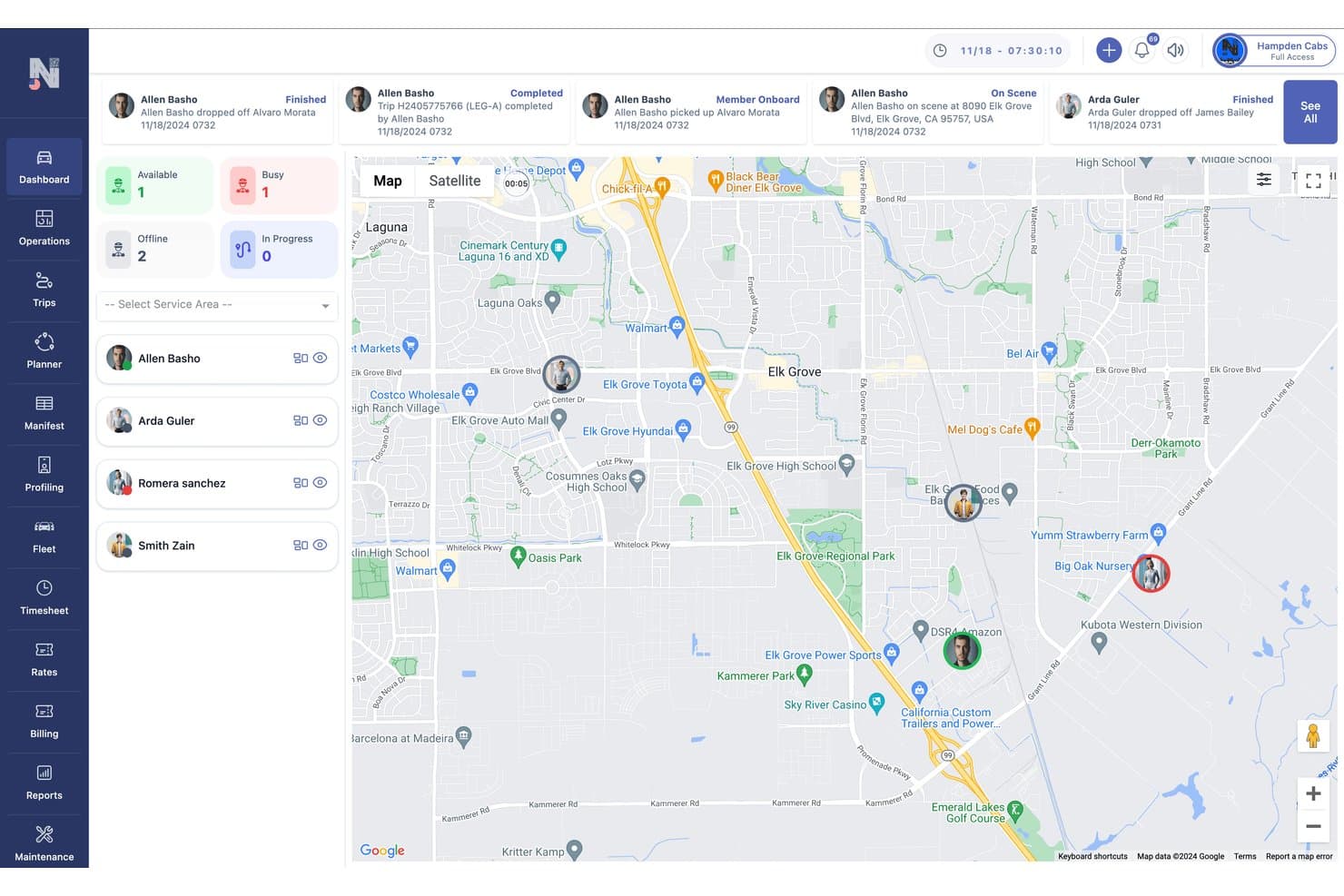
NEMT Platform offers a real-time driver tracking dashboard with trip status updates, driver availability, and a live map view for dispatching non-emergency medical transportation. Tobi is an end-to-end NEMT platform that combines dispatch, scheduling, fleet management, and billing into a single cloud-based system built specifically for non-emergency medical transportation providers.
Who Is NEMT Platform Best For?
Tobi fits small to mid-sized NEMT operators who need dispatch and billing managed in one place rather than across separate systems.
Why I Picked NEMT Platform
Tobi earns its spot on my shortlist because trip data flows directly into billing without any manual re-entry. When a driver completes a run, the pickup, drop-off, and mileage data automatically populates the claim record. I also rely on Tobi's electronic trip attestation feature, which validates claim details before submission and supports real-time status tracking so I can catch and resubmit denied claims without losing visibility into the revenue cycle.
NEMT Platform Key Features
- Autonomous dispatch: Automatically matches drivers to trips based on real-time availability and vehicle capability.
- Multi-fleet management: Provides a single dashboard for managing multiple fleets across different locations, each with custom geofencing.
- White-label booking portal: Lets facilities and partners securely book and track trips through a branded online portal.
- Custom pricing models: Enables creation of configurable pricing structures tied to trip, distance, or service code directly within the system.
NEMT Platform Integrations
Tobi offers native integrations with several leading Medicaid brokers and medical billing providers and provides an open API for custom integrations.
Pros and Cons
Pros:
- Multi-fleet management with custom geofencing tools
- Electronic trip attestation for billing compliance
- Trip data and billing are fully integrated
Cons:
- No direct payer clearinghouse connections
- PHI documentation storage is limited
Learn more about NEMT Platform:
Other Non Emergency Medical Transportation Billing Software
Here are some additional non emergency medical transportation billing software options that didn’t make it onto my shortlist, but are still worth checking out:
- 11RoutingBoxBest for NEMT route optimization
- 12EliteMed FinancialsBest for NEMT billing and financial management
- 13DrDispatchBest for simple transportation dispatching
- 14Ride HealthBest for healthcare transportation coordination
- 15iCabbiBest for scalable fleet dispatch management
- 16DuetBest for coordinated community transportation
How I Evaluate Non Emergency Medical Transportation Billing Software
I split my evaluation into baseline requirements—like EDI 837P claim submission and trip-to-claim automation—and the differentiators that separate a good NEMT billing platform from a great one.
Core Functionality (Table Stakes for This List)
When I'm selecting tools for my list, I rank each one on a scale from 0 (does not offer the functionality) to 5 (excels in this area) for each core functionality listed below. Then, I calculate the tool's total score into a percentage. Each tool needs to achieve a minimum total score of 55% to be considered for inclusion.
- NEMT claim submission: I check whether the platform generates and submits claims using NEMT-specific HCPCS codes (A0100–A0999) to Medicaid, MCOs, and brokers via EDI 837P.
- Trip-to-claim integration: Linking trip records—pickup, drop-off, mileage, wait time, driver—directly to billing entries matters. I look for platforms that eliminate manual re-entry.
- Broker and payer management: I evaluate whether a tool supports major NEMT brokers like MTM, Modivcare, Access2Care, and Verida, plus state Medicaid portal exports or direct connections.
- Mileage and modifier automation: Correct modifiers for ambulatory, wheelchair, and stretcher trips should auto-populate based on trip type. I look for GPS-validated mileage calculations too.
- Claim scrubbing and denials: Pre-submission validation against payer-specific rules is something I look for, along with tools that let you track, correct, and resubmit denied claims in batches.
- HIPAA-compliant documentation: I evaluate how each platform stores signed trip logs, prior authorizations, and proof-of-service forms—and whether records are audit-ready and linked to claims.
Once I have a list of tools that meet the criteria, I consider what sets each platform apart.
Differentiating Factors (What Sets Vendors Apart)
Here's how I compare and contrast different vendors:
Standout Features
Prior authorization tracking is a feature I pay close attention to. Platforms that monitor remaining trips, auth expiration dates, and unit limits help prevent denials before they happen. I also evaluate denial management dashboards—specifically, whether they flag rejections by reason code and support batched corrections with resubmission workflows. Multi-payer claims routing matters too, especially for providers billing Medicaid, MCOs, and brokers from one system based on trip authorization data.
Beyond Features
Broker network coverage is one of the first things I check. If a platform doesn't connect with the brokers you actually work with, you'll end up manually entering claims through broker portals. I also evaluate compliance and audit readiness—specifically whether the vendor offers signed BAAs, encryption, and document retention that holds up during Medicaid audits. Operational scale matters too. A platform built for a 5-vehicle fleet may not handle multi-state operations with mixed ambulatory, wheelchair, and stretcher service lines.
How to Choose Non Emergency Medical Transportation Billing Software
It’s easy to get bogged down in long feature lists and complex pricing structures. To help you stay focused as you work through your unique software selection process, here’s a checklist of factors to keep in mind:
| Factor | What to Consider |
| Scalability | Does the platform support your current fleet size and planned growth—whether you manage 5 or 50+ vehicles? |
| Integrations | Will it connect with your dispatch, broker, and Medicaid systems without forcing double data entry? |
| Customizability | Can workflows, documentation, or billing rules be adapted to your routes, payers, and local compliance? |
| Ease of use | How quickly can dispatchers, billers, and drivers learn the system? Is the workflow intuitive under pressure? |
| Implementation and onboarding | What does setup look like—will you need vendor support or IT resources, and how long will migration take? |
| Cost | Do you understand all fees—per-trip, per-user, or percentage of collections—and are costs predictable as the business scales? |
| Security safeguards | Does the vendor provide HIPAA-compliant practices, encryption, and a signed BAA to protect patient and trip data? |
| Support availability | Who can you contact when a broker or state billing portal changes its requirements, and how responsive is support? |
What Is Non Emergency Medical Transportation Billing Software?
Non emergency medical transportation billing software is a specialized platform that manages trip-level billing, claims, and documentation for NEMT providers. It connects ride and patient data directly to insurance or Medicaid submissions, automates calculations for mileage and wait time, and maintains HIPAA-compliant records. The software helps NEMT companies reduce manual entry, track claim status, and stay compliant with payer rules and audit requirements.
Features of Non Emergency Medical Transportation Billing Software
When selecting non emergency medical transportation billing software, keep an eye out for the following key features:
- Trip-to-claim integration: Links trip data—such as pickup, drop-off, mileage, and wait time—directly to billing records, reducing duplicate data entry.
- NEMT claim generation: Creates claims using HCPCS codes for NEMT trips and submits them via EDI 837P to Medicaid, MCOs, or brokers.
- Mileage and modifier automation: Automatically calculates trip mileage, wait time, and applies correct billing modifiers based on trip details.
- Broker and payer management: Supports exports or direct connections to major NEMT brokers and Medicaid billing portals for multi-payer environments.
- Claim scrubbing and denials: Flags billing errors before submission and provides tools to track, correct, and resubmit denied or rejected claims.
- HIPAA-compliant documentation: Stores signed trip logs, prior authorizations, and required forms in a secure, audit-ready, and compliant format.
- Prior authorization tracking: Monitors authorization units, expiration dates, and remaining trips to prevent billing for unauthorized or expired rides.
- User access controls: Allows administrators to define user roles and permissions to maintain privacy, data integrity, and security for all patient records.
- Reporting and analytics: Offers dashboards and reports for claim status, reimbursements, denials, and operational metrics to guide business decisions.
Benefits of Non Emergency Medical Transportation Billing Software
Implementing non emergency medical transportation billing software provides several benefits for your team and your business. Here are a few you can look forward to:
- Reduced manual entry: Trip-to-claim automation eliminates repetitive data input, freeing staff time for higher-impact tasks.
- Improved claims accuracy: Integrated claim scrubbing and denial management reduce errors, minimizing rejected or denied submissions.
- Faster reimbursements: Automated EDI 837P claim submission and multi-payer routing help accelerate payments from Medicaid, brokers, and MCOs.
- Better compliance: HIPAA-compliant document storage and audit-ready reporting keep your operation prepared for audits or data reviews.
- Transparent trip documentation: Every billed claim links directly to driver signatures, trip logs, and prior authorizations for complete audit trails.
- Streamlined multi-payer workflows: Systems that integrate broker and payer management allow you to handle complex Medicaid, MCO, and private pay scenarios in one place.
- Actionable business insights: Reporting tools and dashboards give you a real-time view of cash flow, denial trends, and key operational metrics.
Costs and Pricing of Non Emergency Medical Transportation Billing Software
Selecting non emergency medical transportation billing software requires an understanding of the various pricing models and plans available. Costs vary based on features, team size, add-ons, and more. The table below summarizes common plans, their average prices, and typical features included in non emergency medical transportation billing software solutions:
Plan Comparison Table for Non Emergency Medical Transportation Billing Software
| Plan Type | Average Price | Common Features |
| Free Plan | $0 | Basic trip-to-claim entry, limited claim submission, and minimal support. |
| Personal Plan | $30–$80/month | Single user access, core claim generation, simple reporting, and standard HIPAA-compliant storage. |
| Business Plan | $100–$400/month | Multi-user support, broker integrations, mileage automation, denial tracking, and enhanced analytics. |
| Enterprise Plan | $500–$2,000+/month | Custom integrations, advanced compliance tools, dedicated onboarding, flexible workflows, and premium support. |
Non Emergency Medical Transportation Billing Software FAQs
Here are some answers to common questions about non emergency medical transportation billing software:
How does NEMT billing software handle multiple payer types?
NEMT billing software often supports routing claims to Medicaid, MCOs, brokers, and private payers from a single platform. This reduces duplicated effort and helps manage claims for providers serving diverse client contracts and funding sources.
Can NEMT billing software help reduce claim denials?
Yes, most solutions include claim scrubbing features and denial management dashboards that flag billing issues before submission and help you track, correct, and resubmit rejected claims efficiently.
Is NEMT billing software secure enough for HIPAA compliance?
Yes, reputable software uses encryption, secure login, audit logs, and signed business associate agreements (BAAs) to help you meet HIPAA requirements for protected health information.
What onboarding and support can I expect from vendors?
Most vendors offer data migration, training, and ongoing customer support, especially during broker or Medicaid rule changes. Some provide full-service billing support for providers without in-house expertise.
Does NEMT billing software integrate with dispatch and driver management tools?
Many platforms integrate directly with dispatch, GPS, and driver apps, linking trip completion data to billing records to eliminate double entry and speed up reimbursement cycles.