

Medical billing software for anesthesia is a digital solution that helps anesthesia providers capture, code, and submit claims specifically for anesthesia services. If you’re searching for the best anesthesia billing platforms, you probably want to reduce denied claims, keep up with fast-changing payer rules, and simplify compliance—all while saving time for your clinical and billing teams. This guide lays out the top options so you can compare features, see how each tool handles anesthesia-specific challenges, and find a solution right for your practice or group.
Why Trust Our Software Recommendations
6,700+
Reviews
20
Industry experts
16+
Evaluation factors
14
Years
Our team has been testing and reviewing software since 2012. As medical practice leaders ourselves, we know how difficult—and important—it is to choose the right software.
For this guide, we evaluated tools using hands-on testing and independent research, scoring tools using our selection criteria.
Our reviews reflect our human editorial judgment, not a sales pitch.
Best Medical Billing Software for Anesthesia
This comparison chart outlines pricing for my top medical billing software for anesthesia picks, helping you find the best option for your budget and practice needs.
| Tool | Best For | Trial Info | Price | ||
|---|---|---|---|---|---|
| 1 | Best for cloud-based anesthesia billing | Free demo available | Pricing upon request | Website | |
| 2 | Best for anesthesia claims management | Not available | From $567/month | Website | |
| 3 | Best for specialty claims processing | Free demo available | From $499.99/month | Website | |
| 4 | Best for anesthesia billing workflows | Free demo available | Pricing upon request | Website | |
| 5 | Best for anesthesia coding automation | Free demo available | Pricing upon request | Website | |
| 6 | Best for anesthesia and ASC billing | Free demo available | Pricing upon request | Website | |
| 7 | Best for anesthesia billing and RCM | Free demo available | Pricing upon request | Website | |
| 8 | Best for anesthesia revenue automation | Free demo available | Pricing upon request | Website | |
| 9 | Best for outsourced anesthesia billing | Free demo available | Pricing upon request | Website | |
| 10 | Best for enterprise anesthesia RCM | Free demo available | Pricing upon request | Website |


Best Medical Billing Software for Anesthesia Reviews
Below are my detailed summaries of the best medical billing software for anesthesia that made it onto my shortlist. My reviews offer a detailed look at the features, best use cases, and integrations of each platform to help you find the best one for you.
 Best for cloud-based anesthesia billing
- Free demo available
- Pricing upon request
Visit WebsiteCustomer Rating:4.1/5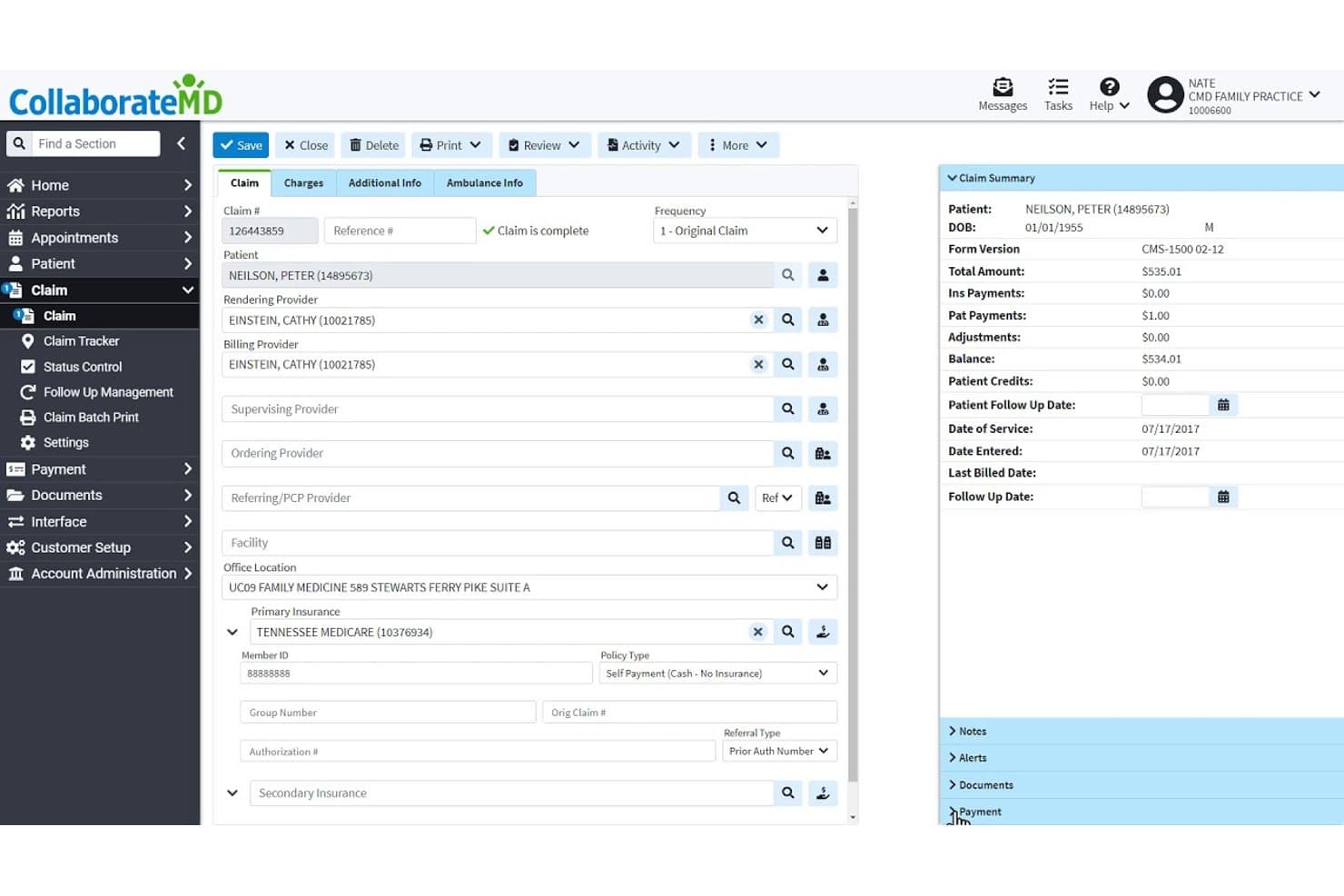
CollaborateMD offers a detailed claim management interface with patient info, provider fields, insurance details, and a claim summary panel showing balances and payments. CollaborateMD is a cloud-based practice management and medical billing platform that handles claim submission, denial management, eligibility verification, and revenue cycle reporting for medical practices.
Who Is CollaborateMD Best For?
It's a good fit for small-to-medium medical practices and independent billing companies that need cloud-based claim submission and revenue cycle management.
Why I Picked CollaborateMD
I've included CollaborateMD in my top picks because its built-in clearinghouse runs Level 2 claim edits, including modifier validation, which matters in anesthesia where QK, AA, and QZ modifiers directly affect reimbursement. I also like that anesthesia templates capture start and end times, supporting time-based billing workflows. The AI-powered claim rejection support translates payer rejection codes into plain-language explanations, which I find useful when tracking down denied anesthesia claims.
CollaborateMD Key Features
- Customizable analytic dashboards: Create and view over 125 report types, including financial and provider productivity reports.
- Digital eligibility verification: Verify patient insurance coverage instantly within the platform before proceeding with claims.
- Integrated lab interfaces: Connect directly with labs like Quest Diagnostics and LabCorp for automated results and charge capture.
- AI-powered universal import: Import and map patient and claims data from any EHR system without manual intervention.
CollaborateMD Integrations
CollaborateMD offers native integrations with Practice Fusion, Nexus Clinical, Alleva, Quest Diagnostics, LabCorp, LabDAQ, MDTech, and MediMobile. An API is available for custom integrations.
Pros and Cons
Pros:
- AI explains payer rejection codes instantly
- Modifier validation supports anesthesia billing workflows
- Achieves 97% clean claim submission rate
Cons:
- No native ASA CROSSWALK code support
- No concurrency or medical direction tracking
Learn more about CollaborateMD:
BrickMed practice management software for billing, scheduling, and healthcare operations BrickMed is an anesthesia-specific practice management and billing platform that handles per-payer unit calculations, concurrency tracking, charge posting, and EHR interfacing for anesthesia groups and billing service bureaus.
Who Is BrickMed Best For?
BrickMed fits small to mid-sized anesthesia groups and billing service bureaus that manage multi-provider, multi-facility billing in-house.
Why I Picked BrickMed
BrickMed earns its spot on my shortlist because of how it handles per-payer unit formula setup. I configure each payer's conversion factors and rounding rules once, and the system applies them automatically at charge posting, with no calculators or cheat sheets involved. I also rely on its built-in concurrency checks, which flag supervision ratio issues before a claim goes out, which is precisely where anesthesia-specific denials tend to originate.
BrickMed Key Features
- Schedula scheduling module: Lets anesthesia groups organize provider shifts and operating room assignments across multiple facilities.
- Multi-practice management: Supports billing and scheduling for multiple providers and practices from a single interface.
- Custom reporting toolkit: Delivers 1,200+ report variants for claims, production, payers, and audit tracking.
- EHR-neutral integration: Interfaces with dozens of EHRs, allowing you to switch clinical systems without disrupting billing.
BrickMed Integrations
BrickMed offers native integrations with dozens of EHR systems through one-way and two-way interfaces, and provides an API for custom integrations.
Pros and Cons
Pros:
- Responsive support team familiar with anesthesia workflows
- Concurrency checks flag supervision issues pre-submission
- Anesthesia-specific per-payer unit formula configuration
Cons:
- Dated interface design compared to newer SaaS competitors
- No dedicated mobile or AIMS charge capture
Learn more about BrickMed:
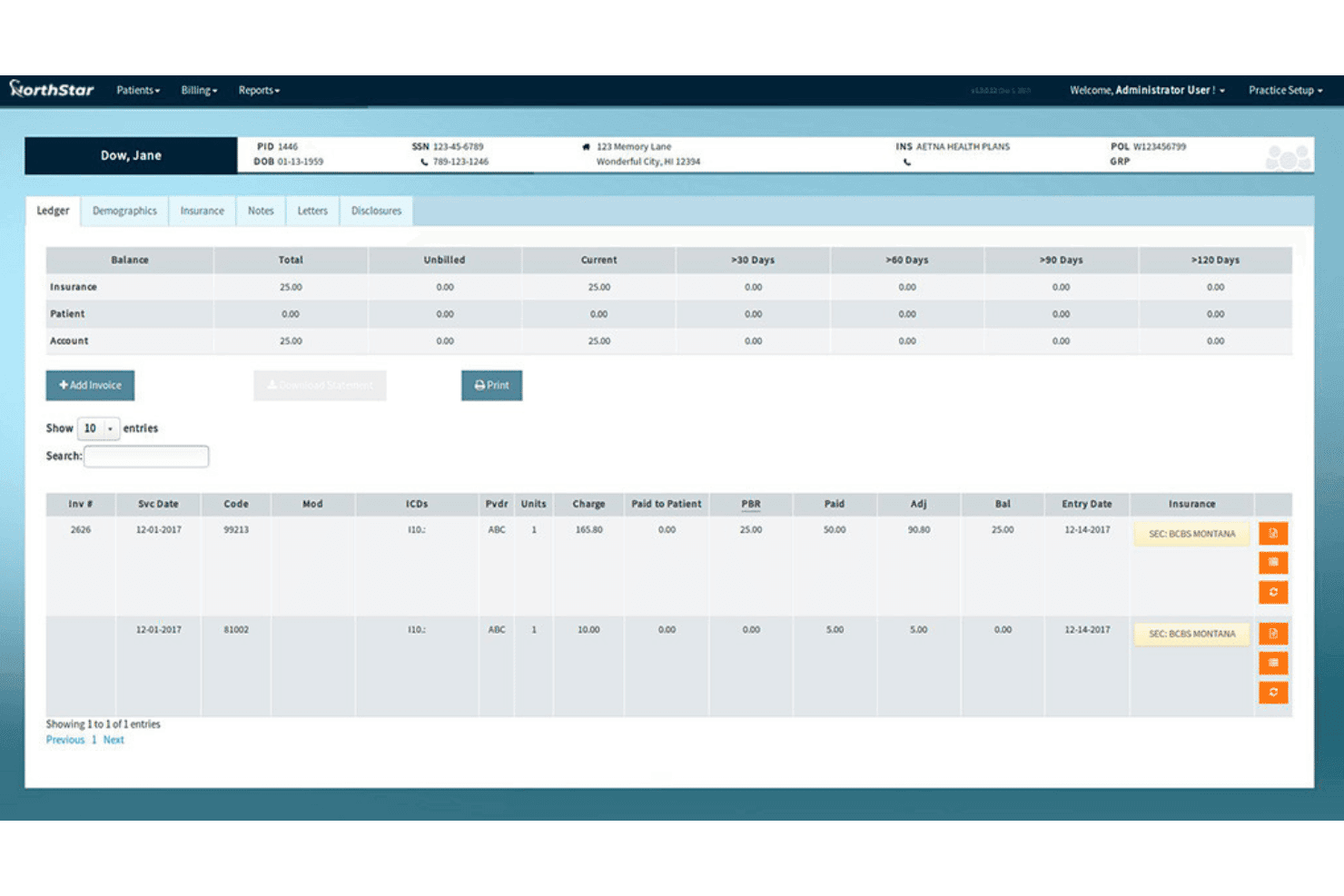
PGM Billing’s patient ledger displays account balances, aging details, insurance information, invoices, charges, payments, and adjustments. PGM Billing is a full-service medical billing and revenue cycle management platform that handles anesthesia-specific coding, claims scrubbing, modifier compliance, time-unit calculations, and denial management across commercial and government payers.
Who Is PGM Billing Best For?
PGM Billing suits anesthesia group practices and multi-specialty physician groups that prefer outsourcing revenue cycle management to a dedicated billing partner.
Why I Picked PGM Billing
I picked PGM Billing as one of the best because its claims scrubbing engine runs thousands of anesthesia-specific checks before submission, including modifier validation for AA, QK, QX, QY, and AD, plus physical status modifiers P1 through P6. I also like how it applies payer-specific reimbursement formulas and concurrency rules automatically, which keeps medical direction compliance intact across complex multi-provider cases.
PGM Billing Key Features
- Customizable dashboard: Track billed charges, collections, denials, and provider productivity using built-in and custom analytics widgets.
- HL7 and CSV integration: Connect with nearly any EMR or LIS to streamline charge entry and automate case capture.
- Batch eligibility verification: Confirm patient insurance eligibility at scale before claims submission for anesthesia cases.
- Multi-location scheduling: Coordinate provider assignments and case scheduling across group practices or facilities.
PGM Billing Integrations
PGM Billing offers native HL7 and CSV integrations with leading electronic medical record systems and laboratory information systems. An API is available for custom integrations.
Pros and Cons
Pros:
- Payer-specific rules engine reduces claim rejections
- Supports 30+ medical specialties beyond anesthesia
- Dedicated anesthesia coders with CANPC credentials
Cons:
- No published mobile charge capture for anesthesia providers
- No self-service software option for in-house billing teams
Learn more about PGM Billing: Best for anesthesia billing workflows
- Free demo available
- Pricing upon request
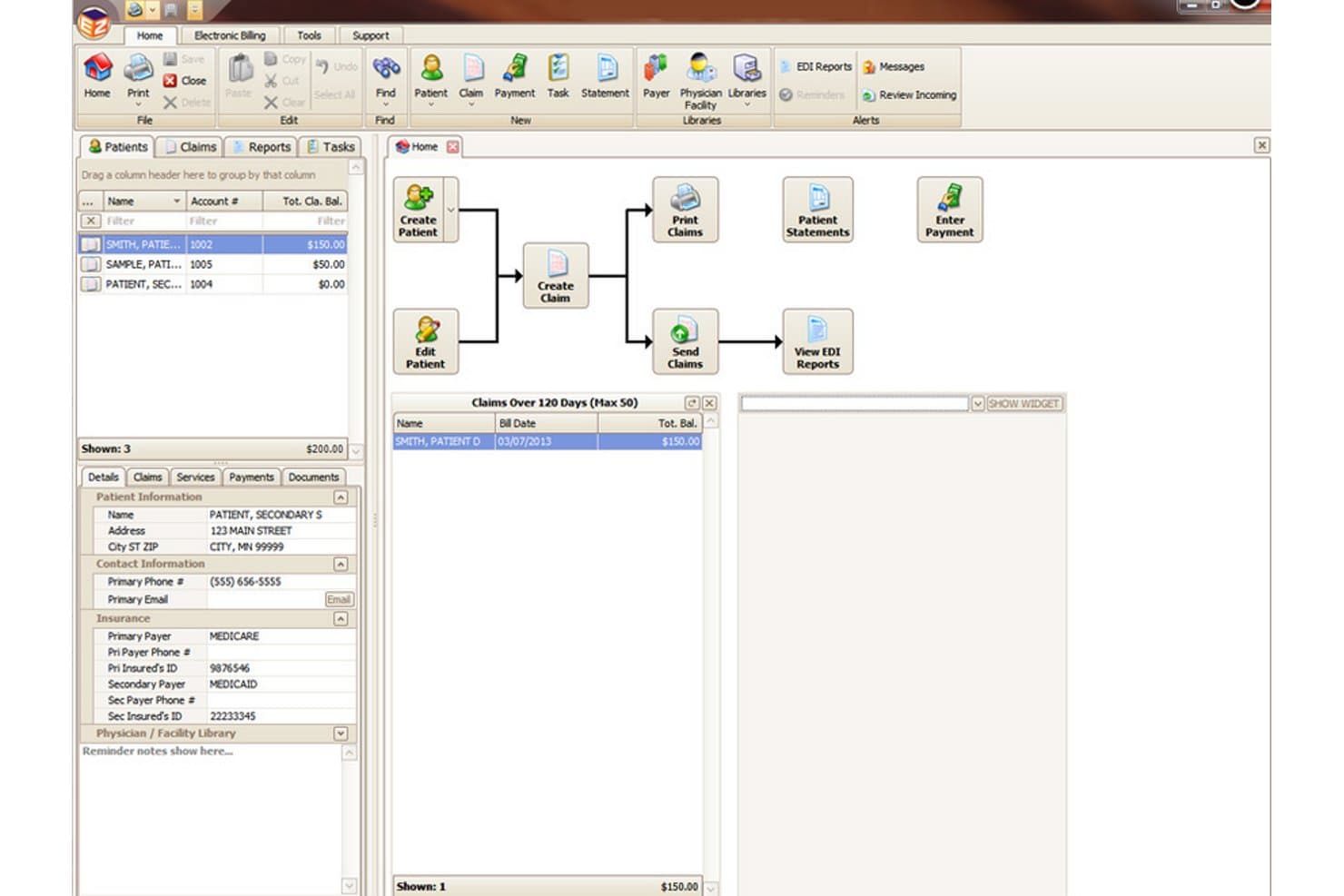
PHIMED Technologies offers a medical billing dashboard with patient management, claim creation workflows, and claims-over-120-days tracking for streamlined billing operations. PHIMED Technologies is an anesthesia-focused revenue cycle management platform with automated time unit calculations, concurrency tracking, medical direction billing, anesthesia-specific claims scrubbing, and denial management.
Who Is PHIMED Technologies Best For?
PHIMED Technologies is a strong fit for mid-to-large anesthesia groups and billing companies managing high-volume, multi-provider claim workflows.
Why I Picked PHIMED Technologies
I picked PHIMED Technologies as one of the best because its concurrency engine evaluates provider overlap across every active case in the system, automatically assigning the correct modifiers based on medical direction ratios rather than flagging issues after the fact. I also like how the platform calculates time units using payer-specific conversion factors, which is exactly where most anesthesia billing errors originate. The 98.5% clean claim rate tells me those two capabilities are working together the way they should.
PHIMED Technologies Key Features
- Integrated OCR data management: Imports and maps scanned charge sheets, case records, and provider documents directly into billing workflows.
- Automated denial management: Flags denied claims and organizes appeal templates for anesthesia-specific denial resolution.
- Payer contract analysis: Detects insurance underpayments by cross-referencing payer contracts and calculated allowed amounts.
- Customizable anesthesia analytics: Builds real-time dashboards for AR days, payer performance, case mix, and denial trends tailored to anesthesia practices.
PHIMED Technologies Integrations
Native integrations are not clearly documented. PHIMED Technologies states it can integrate with EHR and EMR systems and clearinghouses. An API may be available for custom integrations.
Pros and Cons
Pros:
- Unlimited provider handoffs tracked per case
- 98.5% clean claim rate across submitted volume
- Anesthesia-specific concurrency tracking built in
Cons:
- Limited third-party reviews available to verify performance
- No publicly documented mobile charge capture app
Learn more about PHIMED Technologies:
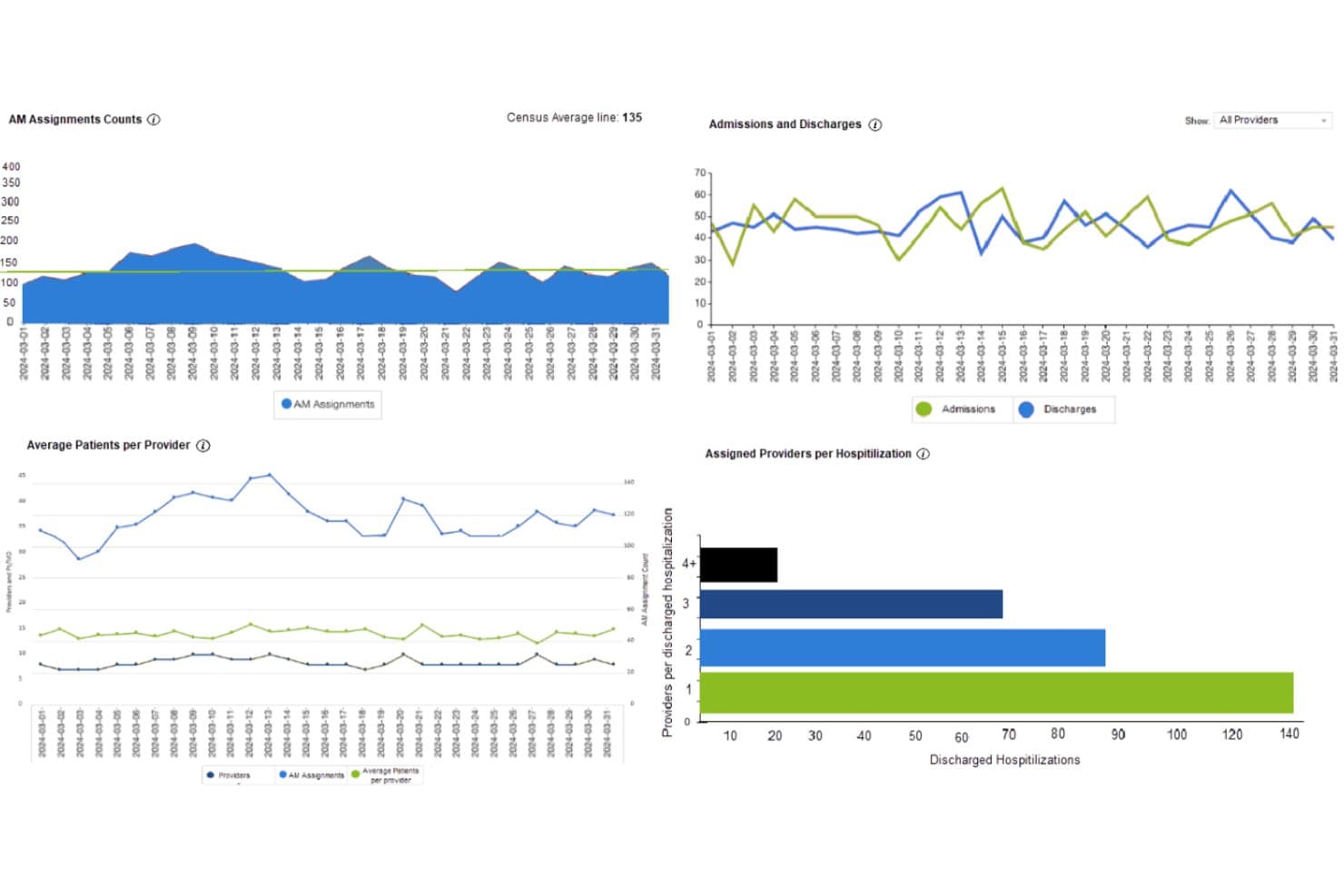
Medaptus dashboard showing assignments, admissions, discharges, and provider workload trends Medaptus is an EHR-integrated charge capture platform built for anesthesia billing, automating time unit calculations, ASA modifier assignment, CPT-ASA code mapping, and CMS concurrency compliance tracking.
Who Is Medaptus Best For?
Medaptus is a strong fit for hospital-based anesthesia groups and health systems that already use a major EHR and need to automate the coding layer of their revenue cycle.
Why I Picked Medaptus
Medaptus earns its spot on my shortlist because of how deeply it automates the coding logic that trips up most anesthesia billing teams. I especially like how it handles CMS concurrency enforcement automatically, applying the correct ASA modifiers based on supervision ratios without any manual lookup. The CPT-ASA code mapping layer is also something I find genuinely useful, as it matches surgical CPT codes to the correct anesthesia codes in real time, replacing a step that's notoriously error-prone when done manually.
Medaptus Key Features
- Mobile charge capture app: Clinicians can enter anesthesia charges and case details using iOS, Android, or tablet devices.
- Exception-based coder workflow: Coders review only flagged encounters that need attention, reducing manual review.
- Embedded EHR integration: Medaptus integrates directly into major EHRs like Cerner and Epic for charge entry within clinical workflow.
- Audit-ready encounter history: Each case entry includes a detailed, timestamped record for compliance reviews and audits.
Medaptus Integrations
Medaptus offers native integrations with Epic, Cerner, Meditech, athenaOne, AMiON, and QGenda for EHR and scheduling connectivity. An API is available for custom integrations.
Pros and Cons
Pros:
- Exception-based workflow flags only problematic encounters
- Deep EHR embed removes duplicate charge entry steps
- Auto-applies ASA modifiers based on live concurrency ratios
Cons:
- Limited standalone use without an existing EHR system
- No native claims submission or clearinghouse functionality
Learn more about Medaptus: Best for anesthesia and ASC billing
- Free demo available
- Pricing upon request
Visit WebsiteCustomer Rating:3.5/5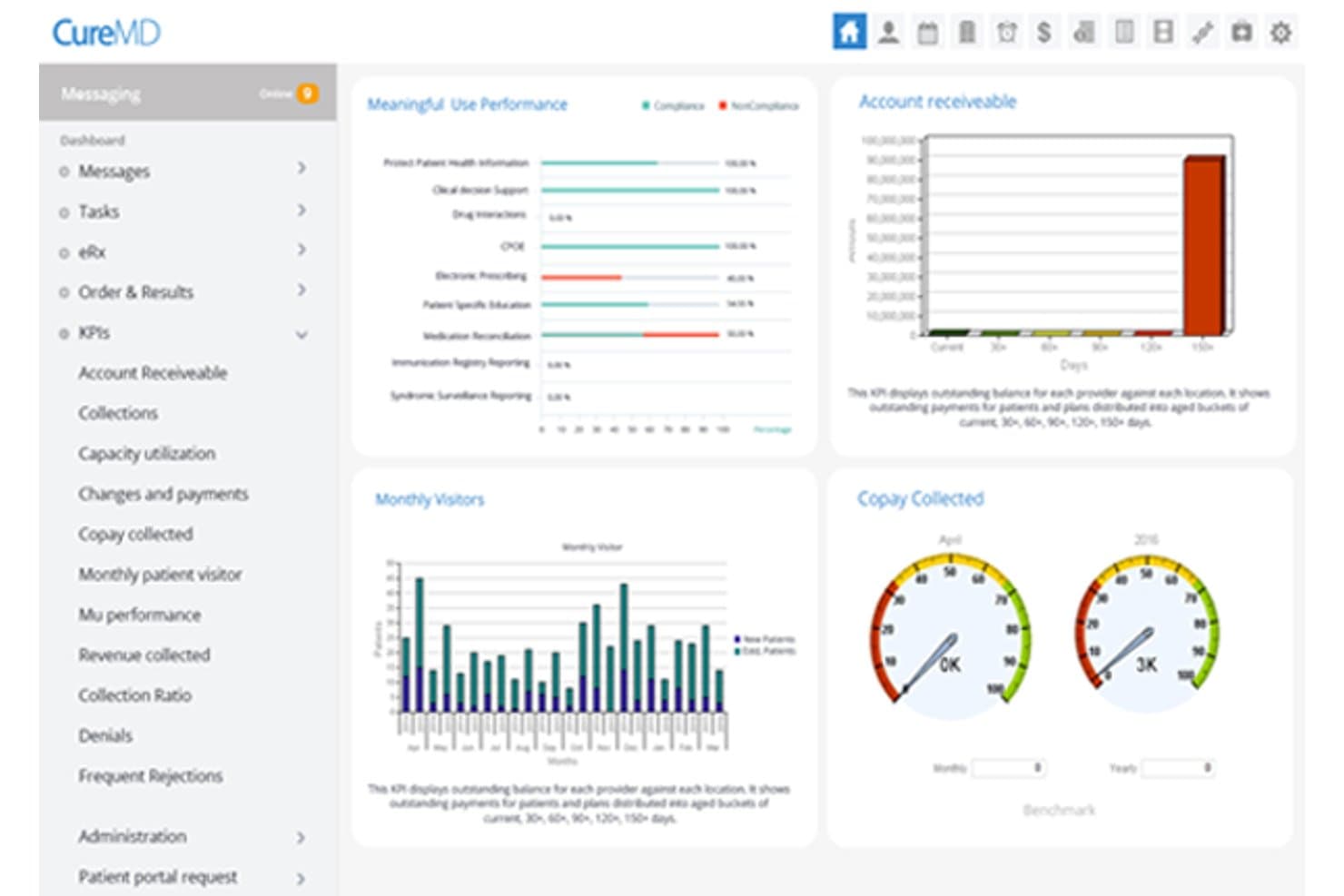
CureMD offers a KPI-driven billing dashboard displaying Meaningful Use Performance, Account Receivables, Monthly Visitors, and Copay Collected metrics for medical practice management. CureMD is a cloud-based EHR and medical billing platform built for surgical specialties, combining ASC-specific clinical templates, AI-assisted claim scrubbing, and end-to-end revenue cycle management services.
Who Is CureMD Best For?
It's a strong fit for ambulatory surgery centers and surgical specialty practices that need a single platform to handle both clinical documentation and billing operations.
Why I Picked CureMD
I picked CureMD as one of the best because its ASC billing module pairs pre-op and post-op clinical templates directly with AI-assisted claim scrubbing, catching coding errors before submission rather than after. I also like that its billing service tier assigns a dedicated account manager to handle denial appeals and A/R follow-up, which reduces the back-and-forth my team would otherwise manage between payers internally.
CureMD Key Features
- Customizable ASC documentation templates: Create and edit digital pre-op, intra-op, and post-op forms for surgery center cases.
- Automated claim scrubbing: Uses AI tools to check and reduce coding errors before claims submission.
- Real-time eligibility verification: Checks patient insurance eligibility instantly prior to procedures.
- Integrated e-prescribing: Connects to a national pharmacy network for electronic medication orders.
CureMD Integrations
CureMD offers native integrations with labs, radiology centers, medical devices, diagnostic equipment, and Health Information Exchanges. An API is available for custom integrations.
Pros and Cons
Pros:
- AI-assisted claim scrubbing before submission
- ASC-specific pre-op and post-op templates
- Supports over 35 medical specialties
Cons:
- Reporting customization requires additional fees
- No dedicated anesthesia time unit calculation
Learn more about CureMD: Best for anesthesia billing and RCM
- Free demo available
- Pricing upon request
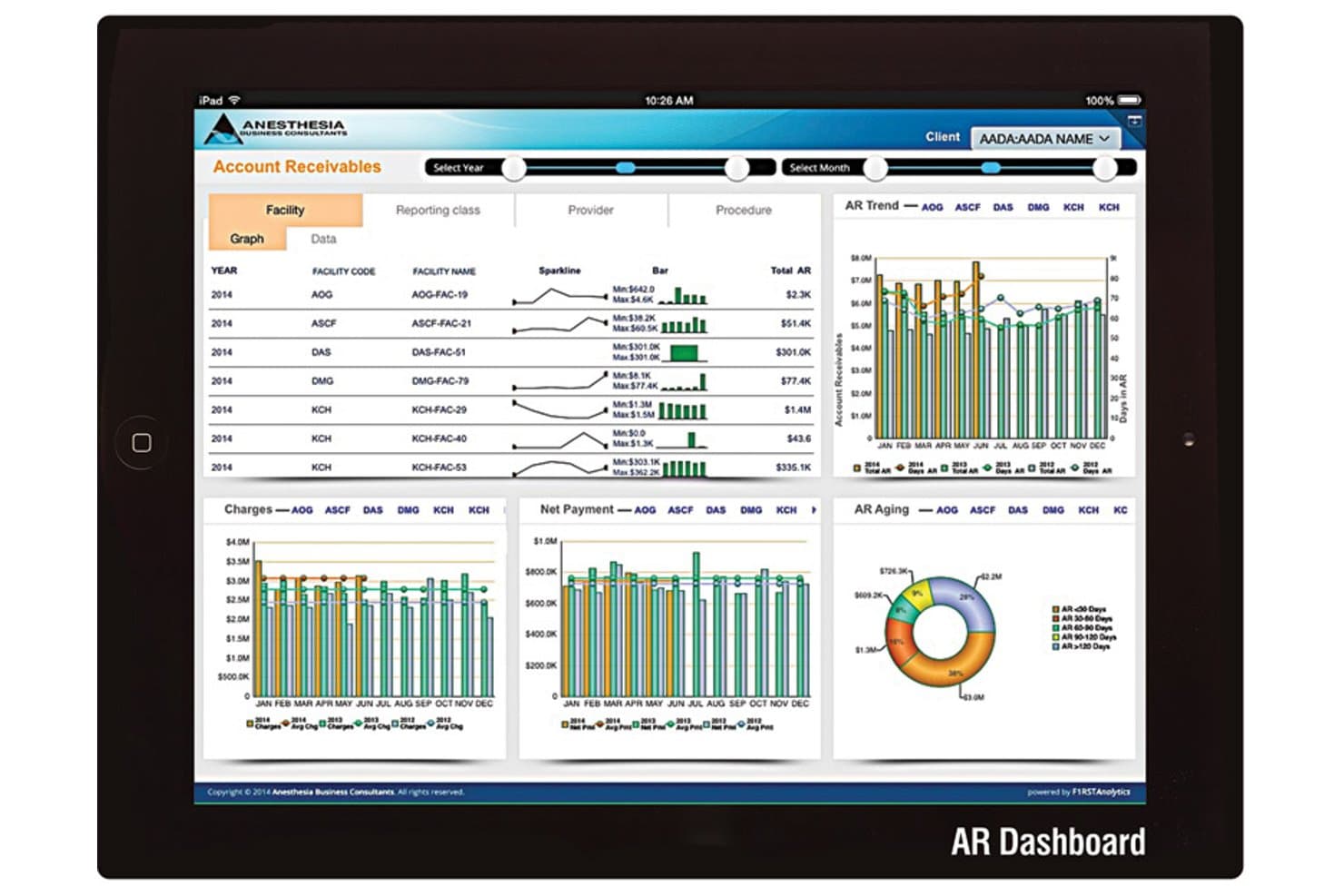
Anesthesia Business Consultants offers an AR Dashboard with account receivables tracking, AR trend charts, charges, net payment graphs, and AR aging breakdowns by facility. Anesthesia Business Consultants is an anesthesia-only billing and RCM platform that handles time-unit calculations, ASA coding, concurrency tracking, claims scrubbing, and payer-specific reimbursement rules for anesthesia practices.
Who Is Anesthesia Business Consultants Best For?
Anesthesia Business Consultants is a strong fit for anesthesia groups and CRNA practices that want to outsource billing to a fully managed, specialty-specific RCM service.
Why I Picked Anesthesia Business Consultants
Anesthesia Business Consultants earns its spot as one of the best on my shortlist because of how it handles concurrency and medical direction billing. The system automatically applies QK, QY, QZ, and AA modifiers based on medical direction ratios, removing a major source of claim denials. I also like the direct Anesthesia Touch AIMS integration, which pulls start/stop times so billing builds from the actual anesthesia record.
Anesthesia Business Consultants Key Features
- Anesthesia Business Consultants portal: Offers secure, web-based access for reviewing patient data, reports, and analytics from any browser.
- Automated remittance processing: Processes electronic remittance advices from most public and commercial payers according to each payer’s specific requirements.
- Patient demographic interfaces: Integrates with hospital and facility systems to pull and verify patient demographic data.
- Analytics dashboards: Provides anesthesia-focused KPI, AR, and facility productivity dashboards for insight into group financial and operational performance.
Anesthesia Business Consultants Integrations
Anesthesia Business Consultants offers native integration with Anesthesia Touch by Plexus Technology Group and can interface with hospital EHR systems for patient demographic and case data. An API is available for custom integrations.
Pros and Cons
Pros:
- Concurrency tracking built into the claims workflow
- Automated modifier assignment for medical direction billing
- Anesthesia-only specialization spanning 40+ years
Cons:
- Limited independent software review presence online
- Not available as standalone self-serve software
Learn more about Anesthesia Business Consultants: Best for anesthesia revenue automation
- Free demo available
- Pricing upon request
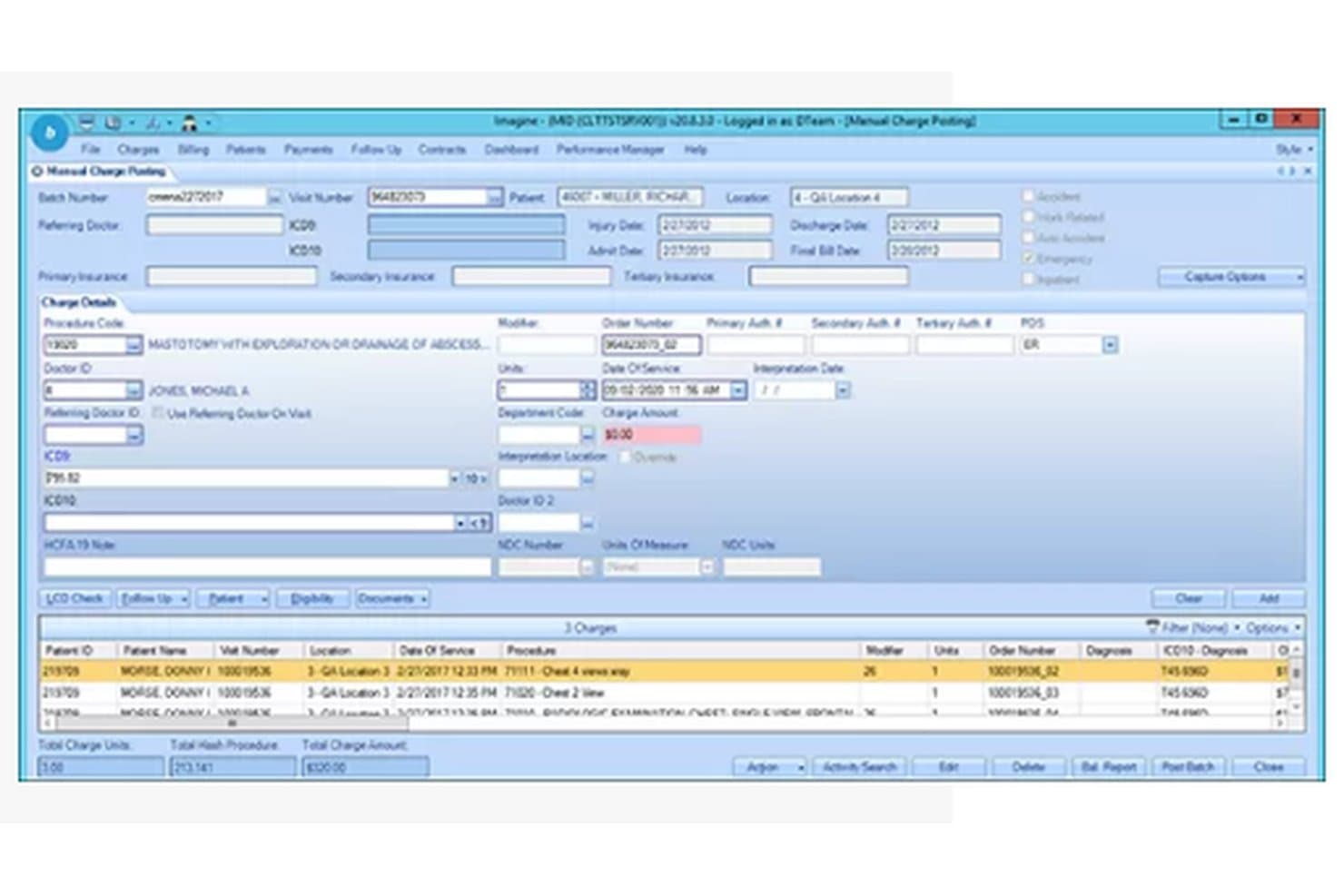
Imagine Software offers a Manual Charge Posting screen with procedure codes, doctor IDs, insurance fields, and a charge details grid for medical billing workflows. ImagineSoftware is an AI-driven medical billing and revenue cycle management platform built for anesthesia practices, handling time-unit calculations, payer-specific modifier rules, medical direction billing, claims scrubbing, and anesthesia-specific analytics.
Who Is Imagine Software Best For?
Imagine Software is a strong fit for high-volume, hospital-based anesthesia groups and billing companies managing complex multi-provider, multi-facility revenue cycles.
Why I Picked Imagine Software
I picked Imagine Software as one of the best because its native handling of medical direction complexity is something I rarely see done well. When one anesthesia case produces two claims at reduced reimbursement, the platform models that automatically rather than leaving it to manual correction. I also like ImagineCo-Pilot's predictive denial engine, which flags payer-specific unit rounding issues before claims go out the door.
Imagine Software Key Features
- Custom anesthesia dashboards: Role-based dashboards provide real-time analytics on provider productivity, payer mix, and anesthesia billing trends.
- Multi-system integrations: Seamlessly connects with EHRs, RIS platforms, and third-party anesthesia data sources for unified charge capture.
- Automated claim edits: Built-in rules engine screens claims for payer-specific anesthesia requirements before submission.
- Patient engagement tools: Allows practices to send estimates, eligibility checks, and payment plans to patients from a branded portal.
Imagine Software Integrations
Imagine Software offers native integrations with electronic health record (EHR) systems and radiology information systems (RIS) platforms, supports connections to clearinghouse and patient statement vendors, and provides an API for custom integrations.
Pros and Cons
Pros:
- Handles 47+ specialties from one platform
- Native MIPS/QCDR reporting via AQI NACOR integration
- Automated medical direction billing for multi-provider cases
Cons:
- Initial setup requires significant technical configuration
- Enterprise pricing puts it out of reach for small practices
Learn more about Imagine Software: Best for outsourced anesthesia billing
- Free demo available
- Pricing upon request
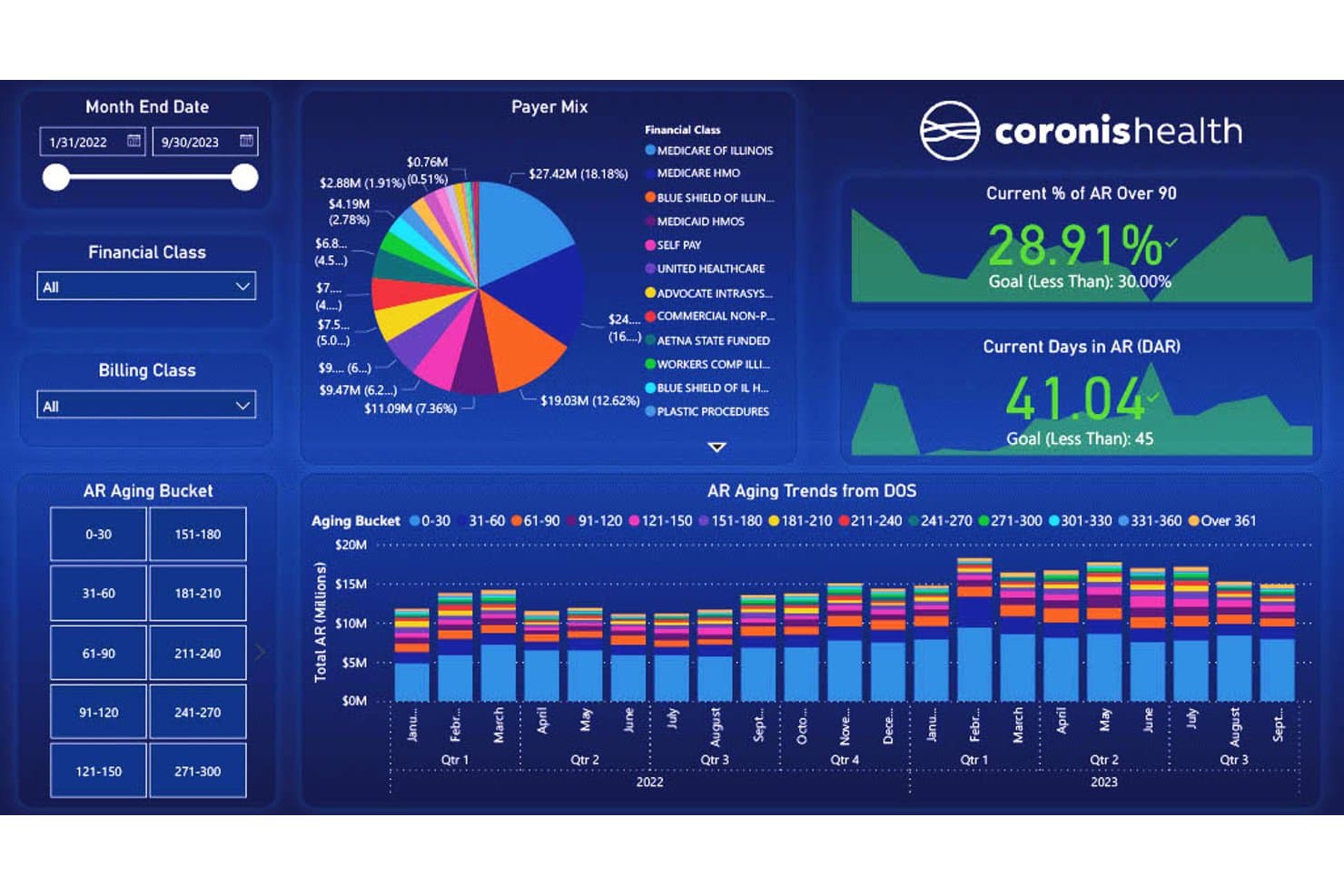
Coronis Health dashboard showing payer mix, A/R aging, and revenue cycle performance. Coronis Health is a fully managed anesthesia RCM service that handles billing, coding, denial management, and charge capture through its proprietary Anesthesia Touch™ AIMS and F1RSTAnesthesia billing platform.
Who Is Coronis Health Best For?
Coronis Health suits hospital-based anesthesia groups, academic departments, and large private practices that want to fully outsource their revenue cycle rather than manage billing in-house.
Why I Picked Coronis Health
I picked Coronis Health as one of the best because it's the rare option that pairs a purpose-built AIMS (Anesthesia Touch™) with a dedicated billing platform (F1RSTAnesthesia) as a single outsourced service. F1RSTAnesthesia automates ASA coding and AR management in real time, while Anesthesia Touch captures physiologic data automatically mid-case. I also like that the service includes a Lost Revenue Assessment upfront, which flags billing gaps before any contract is signed.
Coronis Health Key Features
- Anesthesia-specific claims scrubbing: Custom rules engine checks each claim for anesthesia coding and payer compliance before submission.
- Provider concurrency monitoring: Monitors CRNA and anesthesiologist supervision ratios for TEFRA compliance and accurate modifier assignment.
- Custom anesthesia analytics dashboard: Offers real-time operational and financial reporting by provider, facility, and payer.
- Integration with hospital EHRs and AIMS: Connects to multiple data sources to automate charge capture, case entry, and documentation.
Coronis Health Integrations
Coronis Health’s anesthesia billing platform offers integrations with hospital EHR systems and anesthesia information management systems (AIMS) to support charge capture and case documentation. An API is available for custom integrations.
Pros and Cons
Pros:
- Anesthesia Touch™ captures physiologic data automatically mid-case
- Upfront lost revenue assessment before contract signing
- Dedicated anesthesia coders handle ASA coding in-house
Cons:
- Limited public documentation on concurrency monitoring tools
- No self-service software option for in-house billing
Learn more about Coronis Health: Best for enterprise anesthesia RCM
- Free demo available
- Pricing upon request
Ventra Health offers Anesthesia RCM & Billing Services with AI-enabled solutions, highlighting key stats like 45+ years experience, 18K claims processed, and 98% collection accuracy. Ventra Health is a full-service anesthesia RCM platform that combines AI-powered coding, claims scrubbing, denial management, charge capture, and real-time analytics built specifically for anesthesia groups and hospital-based practices.
Who Is Ventra Health Best For?
Ventra Health is built for large, multi-site anesthesia groups and hospital-based practices that need enterprise-scale RCM infrastructure with specialized anesthesia coding depth.
Why I Picked Ventra Health
Ventra Health earns its spot on my shortlist because no other RCM platform I've evaluated is built exclusively around anesthesia billing at enterprise scale. I'm particularly impressed by the vCision platform's Claim Agent and Coding Agent, which auto-correct coding errors and apply payer-specific time-unit rules before submission. Paired with vSight's daily-updated dashboards tracking denial rates by facility, it handles the full revenue cycle without losing anesthesia specificity.
Ventra Health Key Features
- Payer contract analytics: Review payer performance and reimbursement terms across facilities using customizable dashboards.
- Performance surveillance team: Monitor daily billing and coding trends with support staff who flag anomalies and compliance risks.
- HITRUST r2 certification: Meet advanced data protection standards required for hospital-scale anesthesia billing operations.
- Advisory services for anesthesia: Access support for payer negotiations, MIPS reporting, and specialty-focused revenue strategies.
Ventra Health Integrations
Native integrations are not clearly documented. Ventra Health operates as a full-service RCM partner and proprietary software platform, and custom integrations are supported through its enterprise service delivery model.
Pros and Cons
Pros:
- Dedicated performance surveillance team monitors billing anomalies
- vSight delivers real-time facility-level financial dashboards
- Anesthesia-only RCM with deep coding expertise
Cons:
- No self-serve software option available
- Not suited for small CRNA-only practices
Learn more about Ventra Health:
Other Medical Billing Software for Anesthesia
Here are some additional medical billing software for anesthesia options that didn’t make it onto my shortlist, but are still worth checking out:
- 11Graphium Health AnesthesiaEMRBest for anesthesia charting and billing
- 12CureARBest for anesthesia revenue recovery
- 13Surgical Information Systems (SIS)Best for ASC billing workflows
- 14MedusindBest for outsourced anesthesia RCM
- 15Anesthesia Practice InnovationsBest for anesthesia coding services
How I Evaluate Medical Billing Software for Anesthesia
I split my evaluation into must-have functionality—like ASA crosswalk support and concurrency tracking—and the differentiators that separate good from great.
Core Functionality (Table Stakes for This List)
When I'm selecting tools for my list, I rank each one on a scale from 0 (does not offer the functionality) to 5 (excels in this area) for each core functionality listed below. Then, I calculate the tool's total score into a percentage. Each tool needs to achieve a minimum total score of 55% to be considered for inclusion.
- Anesthesia Time Calculations: I check whether the platform auto-calculates base units, time units, and total billable units from start/stop times using payer-specific conversion factors and rounding rules.
- ASA Codes & Modifiers: Full ASA CROSSWALK support matters here, including physical status modifiers (P1–P6) and provider modifiers like QK, QY, QX, AA, and AD for medical direction scenarios.
- Anesthesia Charge Capture: I look for multiple capture methods—mobile entry, EHR feeds, or AIMS integration—so providers across different facilities can submit case details without manual re-keying.
- Claims Scrubbing & Submission: The scrubber should catch anesthesia-specific errors, like mismatched modifiers or missing time entries, before claims reach the clearinghouse.
- Concurrency & Medical Direction: Tracking CRNA-to-anesthesiologist overlap ratios is essential for TEFRA compliance, so I evaluate how each tool monitors and flags concurrency issues in real time.
- Anesthesia Reporting & Analytics: I look for dashboards that break down units per case, denial reasons by payer, and provider productivity by facility and case type—not just generic billing summaries.
Once I have a list of tools that meet the criteria, I consider what sets each platform apart.
Differentiating Factors (What Sets Vendors Apart)
Here's how I compare and contrast different vendors:
Standout Features
ASA crosswalk automation is a major differentiator. Platforms that auto-map surgical CPT codes to ASA anesthesia codes cut down on manual lookups and coding errors at the point of charge entry. I also evaluate modifier intelligence, where the system suggests physical status and medical direction modifiers based on actual case data rather than requiring manual selection. QCDR/MIPS reporting is another feature I look for, especially native feeds to registries like AQI NACOR that simplify quality reporting for anesthesia groups.
Beyond Features
Service model matters a lot in this space. Some anesthesia groups want software-only access, while others need full-service RCM with dedicated coders who hold CANPC credentials. I also evaluate AIMS compatibility—whether a platform connects to systems like Epic Anesthesia or Plexus TG for automated case capture. Compliance safeguards round out my evaluation, especially built-in audit trails for TEFRA rules and locum tenens billing scenarios that can trip up even experienced billing teams.
How to Choose Medical Billing Software for Anesthesia
It’s easy to get bogged down in long feature lists and complex pricing structures. To help you stay focused as you work through your unique software selection process, here’s a checklist of factors to keep in mind:
| Factor | What to Consider |
| Scalability | Can the software handle your case volume today and as you add providers, facilities, or locations over time? Look for options that support group growth without disruption. |
| Integrations | Does it connect easily with your AIMS, EHR, or clearinghouse systems? Assess each tool’s ability to push and pull data from the tools you already use. |
| Customizability | Can you adapt billing workflows, charge capture forms, and payer rules to match the realities of anesthesia in your organization? Avoid rigid “out of the box” approaches. |
| Ease of use | How long will it take new staff or billing team hires to learn the system? Watch for overly technical interfaces that may frustrate users or slow onboarding. |
| Implementation and onboarding | How much support will you get during setup and data migration, and are training resources included? Consider timeline, cost, and whether you have experienced IT help. |
| Cost | Does the pricing model fit your budget and claim volume? Factor in recurring fees and surprise costs for add-ons, setup, or payer connections. |
| Security safeguards | Is the vendor certified for HIPAA and other data protection standards? Ask about audit trails, user access controls, and how PHI is stored, accessed, or transmitted. |
| Compliance requirements | Will the software support regulatory needs for anesthesia billing, including TEFRA, CMS, or local rules? Ask about audit support and built-in compliance checks. |
What Is Medical Billing Software for Anesthesia?
Medical billing software for anesthesia is a digital platform designed to manage anesthesia-specific charge capture, coding, and claims submission workflows. It automates time unit calculations, applies ASA codes and modifiers, tracks provider concurrency, and ensures compliance with anesthesia payer rules. By addressing the unique complexities of anesthesia billing, these systems help groups and practices efficiently process claims, reduce denials, and maintain regulatory compliance.
Features of Medical Billing Software for Anesthesia
When selecting medical billing software for anesthesia, keep an eye out for the following key features:
- Anesthesia time unit calculation: Automatically tracks start and stop times, applies rounding rules, and converts time into billable units using payer-specific conversion factors.
- ASA crosswalk coding: Maps surgical CPT codes to the appropriate ASA anesthesia codes, minimizing manual lookup errors and ensuring precise claim submissions.
- Modifier management: Applies physical status, medical direction, and qualifying circumstances modifiers based on detailed case data to avoid denied or underpaid claims.
- Concurrency tracking: Monitors how many cases are medically directed by each provider in real time, ensuring compliance with requirements for CRNA and anesthesiologist billing.
- Anesthesia charge capture: Offers tools for digital entry, mobile capture, or EHR integration so providers can submit all required anesthesia record details quickly and accurately.
- Claims scrubbing: Checks anesthesia claims against payer rules, flagging issues like missing times or mismatched codes before submission to minimize rejections.
- Reporting and analytics: Delivers anesthesia-specific dashboards and reports, such as units per case, denial reasons, provider productivity, and payer mix, to support better financial management.
- Integration capabilities: Seamlessly connects with anesthesia information management systems (AIMS), hospital EHRs, and clearinghouses to automate data flows and reduce manual entry.
- Compliance features: Supports regulatory requirements including TEFRA, HIPAA, and local guidelines by providing audit trails and safeguarding protected health information.
- Automated appeals and denial management: Simplifies the process of reworking and resubmitting denied claims, with built-in tracking and workflow tools for anesthesia billing cycles.
Benefits of Medical Billing Software for Anesthesia
Implementing medical billing software for anesthesia provides several benefits for your team and your business. Here are a few you can look forward to:
- Greater billing accuracy: Automated time unit calculations, modifier assignment, and ASA crosswalk coding reduce costly errors and ensure cleaner claim submissions.
- Fewer claim denials: Built-in anesthesia claims scrubbing and compliance checks catch issues early, minimizing rejected or underpaid claims.
- Faster reimbursement cycles: Electronic claim submission, appeals automation, and payer rule validation speed up payment turnaround from all payers.
- Improved compliance: Features like concurrency tracking, TEFRA audit trails, and HIPAA safeguards help your practice stay in line with complex anesthesia regulations.
- Data-driven decision making: Anesthesia-specific dashboards and analytics provide insight into provider productivity, payer mix, and denial reasons for stronger business management.
- Streamlined workflows: Integrated charge capture and system connectivity reduce manual entry, simplifying coordination between clinical and billing staff.
- Scalable operations: Tools designed to support multi-facility or growing anesthesia groups enable your team to increase volume without sacrificing control.
Costs and Pricing of Medical Billing Software for Anesthesia
Selecting medical billing software for anesthesia requires an understanding of the various pricing models and plans available. Costs vary based on features, team size, add-ons, and more. The table below summarizes common plans, their average prices, and typical features included in medical billing software for anesthesia solutions:
Plan Comparison Table for Medical Billing Software for Anesthesia
| Plan Type | Average Price | Common Features |
| Free Plan | $0 | Limited claims entry, basic reporting, and manual charge capture tools. |
| Personal Plan | $30–$75/user/month | Standard claim filing, automated time unit calculation, and ASA code support. |
| Business Plan | $100–$250/user/month | Multi-user access, advanced claims scrubbing, modifier automation, integration options, and basic anesthesia analytics. |
| Enterprise Plan | $300–$500+/user/month | Custom integrations, compliance safeguards, multi-facility management, advanced analytics, and dedicated onboarding support. |
Medical Billing Software for Anesthesia FAQs
Here are some answers to common questions about medical billing software for anesthesia:
How does anesthesia billing software handle provider concurrency?
The software monitors each anesthesiologist’s and CRNA’s case assignments in real time, flagging potential concurrency or supervision violations. This ensures your billing team follows regulations for medical direction, helping prevent denials due to overlap issues.
Can these platforms integrate with hospital EHRs or anesthesia information systems?
Yes, most anesthesia billing platforms offer integrations with EHRs, AIMS, and clearinghouses. This allows for direct data feeds, automated charge capture, and reduces manual entry or double documentation.
What compliance safeguards are included for anesthesia-specific billing?
You should expect built-in checks for TEFRA, HIPAA, and CMS rules, configurable audit trails, access controls, and detailed logging for locum tenens and medical direction scenarios.
Does anesthesia billing software support reporting for MIPS or QCDR requirements?
Yes, leading platforms include native quality reporting options and direct connections to anesthesia-qualified registries, like AQI NACOR, to simplify MIPS participation and track progress on regulatory compliance.
What level of service or support is available with anesthesia billing software?
Vendors offer everything from self-serve software to full-service revenue cycle management with CANPC-certified coders, compliance consulting, and hands-on onboarding. You should review service models and staff availability before choosing.