

Hospice EMR software is specialized electronic medical record technology designed to manage clinical, operational, and compliance needs in hospice care.
If you’re searching for the best hospice EMR software, you’re balancing complex documentation, Medicare requirements, and real-time team communication—all while supporting sensitive patient care. Staying efficient and compliant is key, especially as regulations change and your team adapts.
This guide helps you quickly compare top vendors’ core features and real-world advantages, so you can decide which EMR system fits your hospice organization’s unique workflow and standards.
Why Trust Our Software Recommendations
6,700+
Reviews
20
Industry experts
16+
Evaluation factors
14
Years
Our team has been testing and reviewing software since 2012. As medical practice leaders ourselves, we know how difficult—and important—it is to choose the right software.
For this guide, we evaluated tools using hands-on testing and independent research, scoring tools using our selection criteria.
Our reviews reflect our human editorial judgment, not a sales pitch.
Best Hospice EMR Software Summary
This comparison chart summarizes pricing details for my hospice EMR software to help you find the best one for your budget and business needs.
| Tool | Best For | Trial Info | Price | ||
|---|---|---|---|---|---|
| 1 | Best for instant eligibility and claims processing | Free demo available | Pricing upon request | Website | |
| 2 | Best for bereavement and volunteer tracking | Free demo available | Pricing upon request | Website | |
| 3 | Best for detailed hospice-specific documentation | Free demo available | Pricing upon request | Website | |
| 4 | Best for automatic plan of care updates | Free demo available | Pricing upon request | Website | |
| 5 | Best for integrated referral and intake processes | Free demo available | Pricing upon request | Website | |
| 6 | Best with custom electronic document workflows | Free demo available | Pricing upon request | Website | |
| 7 | Best for advanced Medicare compliance features | Free demo available | Pricing upon request | Website | |
| 8 | Best for multi-location agency coordination | Free demo available | Pricing upon request | Website | |
| 9 | Best for customizable workflow automation | Free demo available | Pricing upon request | Website | |
| 10 | Best for managing interdisciplinary meetings | Free demo available | Pricing upon request | Website |


Best Hospice EMR Software Reviews
Below are my detailed summaries of the best hospice EMR software that made it onto my shortlist. My reviews offer a detailed look at the features, best use cases, and integrations of each software to help you find the best one for you.
 Best for instant eligibility and claims processing
- Free demo available
- Pricing upon request
Visit WebsiteCustomer Rating:4.5/5This rating combines scores from multiple user review sites to reflect overall customer sentiment about the product.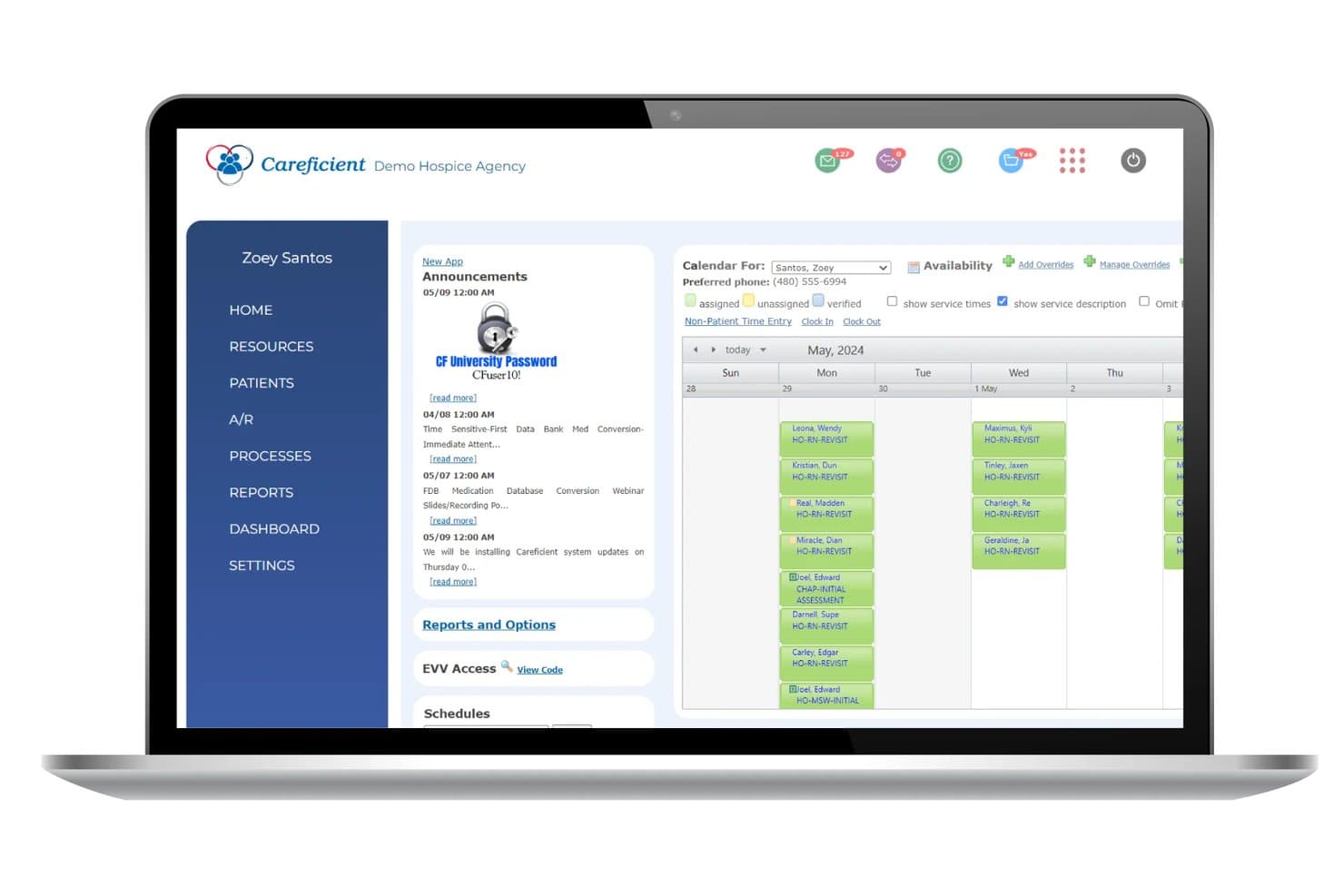
Careficient offers a hospice EMR dashboard with a staff calendar, patient scheduling, announcements, and EVV access for care coordinators. Careficient is a hospice-specific EMR platform that covers clinical documentation, care plan management, CMS compliance reporting, and integrated billing — including eligibility verification, claims submission, and payroll — within a single web-based system.
Who Is Careficient Best For?
Careficient is a strong fit for hospice agencies that need a single platform to handle both clinical documentation and Medicare billing without juggling separate systems.
Why I Picked Careficient
I picked Careficient as one of the best because its CareClaims module handles real-time Medicare eligibility verification and claims submission without ever leaving the EMR. I also like CareDDE, which connects directly to a Medicare fiscal intermediary to automate data transmission and validation report retrieval. In practice, that means my billing team can catch claim errors before submission, cutting down on denials at the source.
Careficient Key Features
- HOPE-centric hospice charting: Includes documentation templates structured for hospice outcomes and patient evaluation compliance.
- Interdisciplinary team management: Automates scheduling and care plan coordination for IDG meetings and team notes.
- CHAP and ACHC certification management: Tracks accreditation requirements and license expirations directly in the EMR.
- Embedded secure messaging: Allows internal communication among staff and care teams within the platform.
Careficient Integrations
Careficient offers native integrations with Bamboo Health, CarePort, CellTrak, Change Healthcare, HHAeXchange, Inovalon, McKesson, Sandata, SHP, Tellus, Waystar, Wolters Kluwer, QuickBooks, AWS, BetterRx, Enclara, FrameworkLTC, OnePoint, Optum, and PDCRx. An API is available for custom integrations.
Pros and Cons
Pros:
- Built-in IDG team scheduling and documentation
- Hospice-specific templates simplify compliance workflows
- Medicare eligibility checks occur in real time
Cons:
- Limited bereavement management compared to competitors
- Lacks a native offline mobile app
Learn more about Careficient: Best for bereavement and volunteer tracking
- Free demo available
- Pricing upon request
Visit WebsiteCustomer Rating:4.1/5This rating combines scores from multiple user review sites to reflect overall customer sentiment about the product.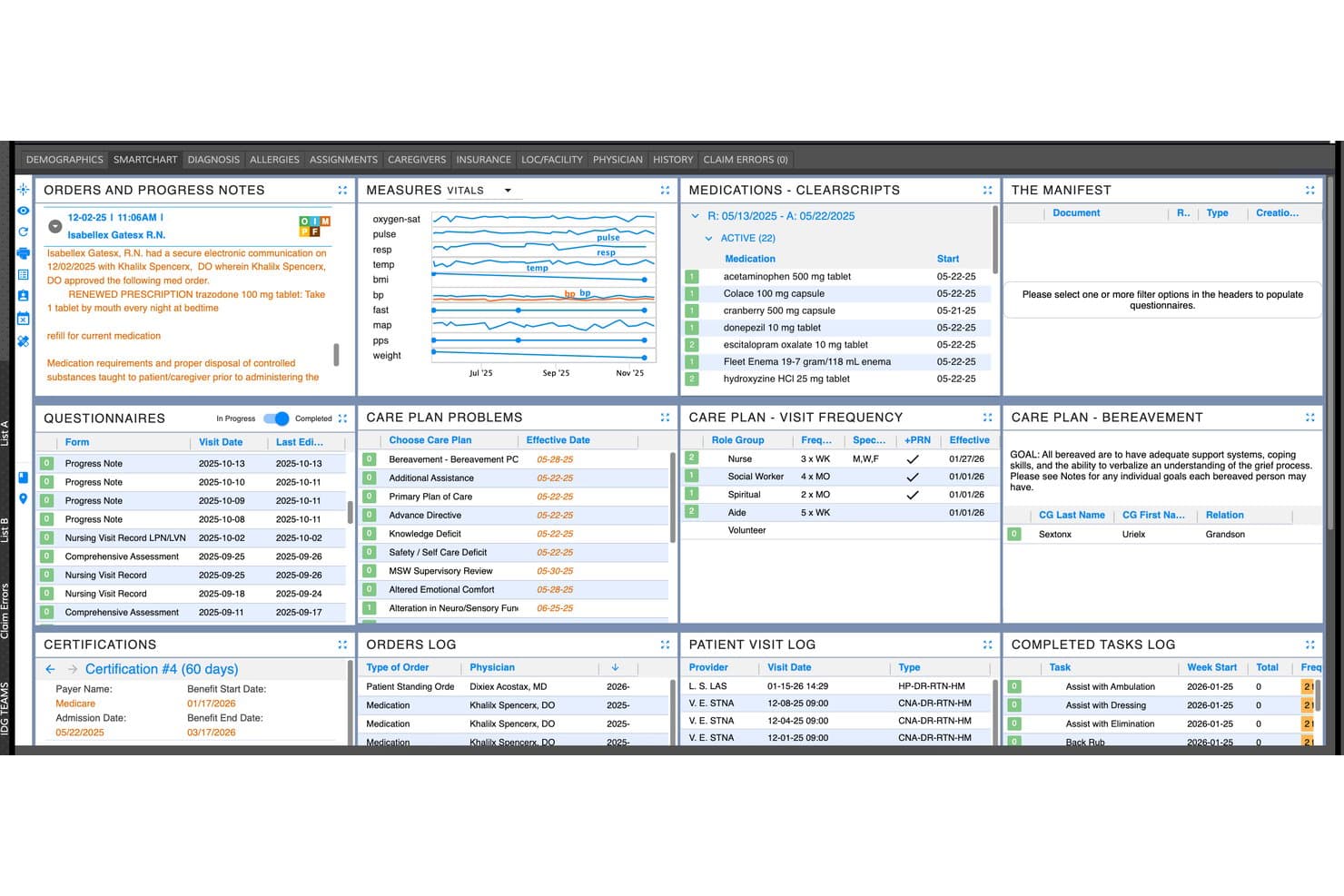
mumms Software offers a comprehensive hospice EMR dashboard featuring orders, medications, care plans, vitals, questionnaires, and patient visit logs in a single view. mumms Software is a hospice-only EMR platform that covers clinical charting, IDG management, hospice billing, bereavement tracking, and volunteer coordination across hospice and palliative care settings.
Who Is mumms Software Best For?
mumms Software is a strong fit for hospice agency administrators and clinical directors who need a dedicated, hospice-only platform rather than a general-purpose EMR adapted for end-of-life care.
Why I Picked mumms Software
I picked mumms Software as one of the best because no other hospice EMR I've seen builds bereavement management this deeply into the clinical workflow. I can configure up to 9 risk levels for caregivers and set automated schedules for letters, visits, and phone calls across a full 13-month follow-up period. The volunteer tracking module logs individual hours, expenses, and productivity, with licensure renewal reminders included alongside staff records.
mumms Software Key Features
- SmartChart clinical documentation: Dynamically surfaces required fields for hospice charting, including symptom management and end-of-life care notes.
- IDG Ultimate workflow: Provides an automated meeting structure, real-time care plan updates, and document generation for hospice interdisciplinary team meetings.
- ClearPay hospice billing: Aligns billing steps with clinical documentation and catches errors before claims submission.
- HOPE compliance support: Integrates HOPE data collection and reporting within the normal clinical workflow to support hospice regulatory requirements.
mumms Software Integrations
mumms Software offers native integrations with Sfax, Google Maps, Microsoft Excel, Acclivity, Wise, Qualis, Procare, and PlayMaker Health. An API is available for custom integrations.
Pros and Cons
Pros:
- Hospice-specific billing reduces Medicare claim denials
- Built-in automation for interdisciplinary meetings
- Industry-leading bereavement workflow and tracking
Cons:
- Limited documentation for advanced reporting features
- No explicit offline charting option
Learn more about mumms Software: Best for detailed hospice-specific documentation
- Free demo available
- Pricing upon request
Visit WebsiteCustomer Rating:4.1/5This rating combines scores from multiple user review sites to reflect overall customer sentiment about the product.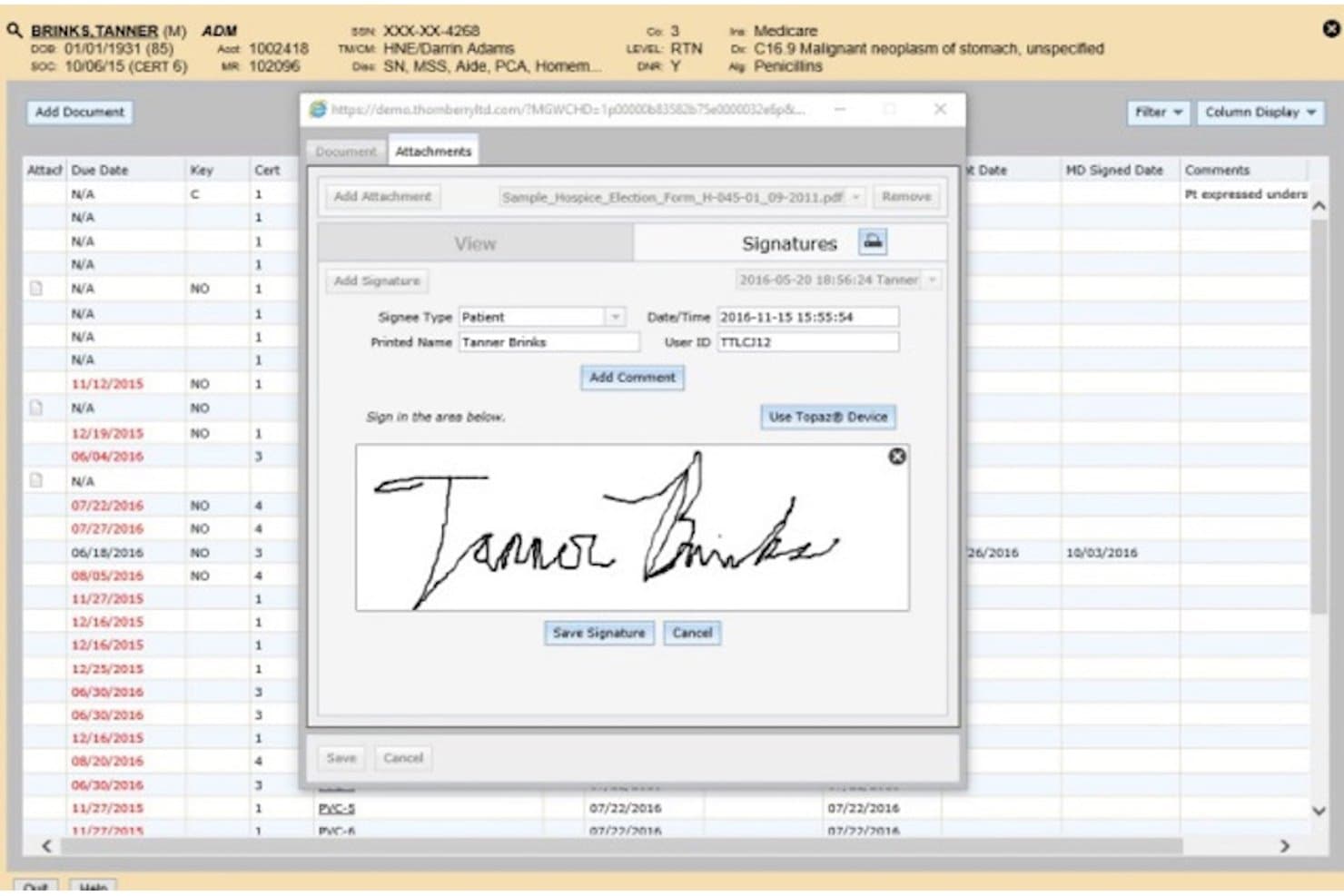
Thornberry NDoc offers a digital signature capture interface within its hospice EMR document management system. Thornberry NDoc is a hospice and home health EMR built for Medicare-certified agencies, covering clinical charting, IDG meeting documentation, HIS compliance, per-diem billing, and care coordination across interdisciplinary teams.
Who Is Thornberry NDoc Best For?
NDoc is a strong fit for Medicare-certified hospice agencies whose clinical and compliance teams need a purpose-built system rather than a general-purpose EMR adapted for hospice use.
Why I Picked Thornberry NDoc
NDoc earns its spot on my shortlist because its hospice-specific charting is built around end-of-life workflows, not retrofitted from a general EMR. I particularly like how the embedded ESAS captures symptom progression visit-by-visit, building a documented decline trajectory that IDT teams can pull directly into recertification discussions. The Pronouncement visit structures the documentation clinicians need at time of death, covering MD notification, medication disposal, and transition to bereavement as a guided, step-by-step workflow.
Thornberry NDoc Key Features
- Automated Medicare per-diem billing: Calculates and generates billing compliant with all four hospice levels of care, including NOE/NOTR submissions.
- Volunteer activity tracking: Monitors hours, assignments, and compliance with Medicare’s 5% volunteer requirement.
- IDT meeting workflow integration: Structures meeting documentation, attendee tracking, and care plan updates for regulatory alignment.
- Embedded clinical screening tools: Includes Karnofsky, PPS, and FAST for standardized patient assessment and ongoing eligibility tracking.
Thornberry NDoc Integrations
Thornberry NDoc offers native integrations with Enclara for hospice pharmacy management and supports interoperability through C-CDA CCD for referrals and information exchange. An API is available for custom integrations.
Pros and Cons
Pros:
- Pronouncement and bereavement workflows included
- Built-in symptom scales for eligibility documentation
- Customizable hospice charting and visit templates
Cons:
- Billing workflows can require manual intervention
- Offline mobile sync can be unreliable
Learn more about Thornberry NDoc: Best for automatic plan of care updates
- Free demo available
- Pricing upon request
Visit WebsiteCustomer Rating:3.8/5This rating combines scores from multiple user review sites to reflect overall customer sentiment about the product.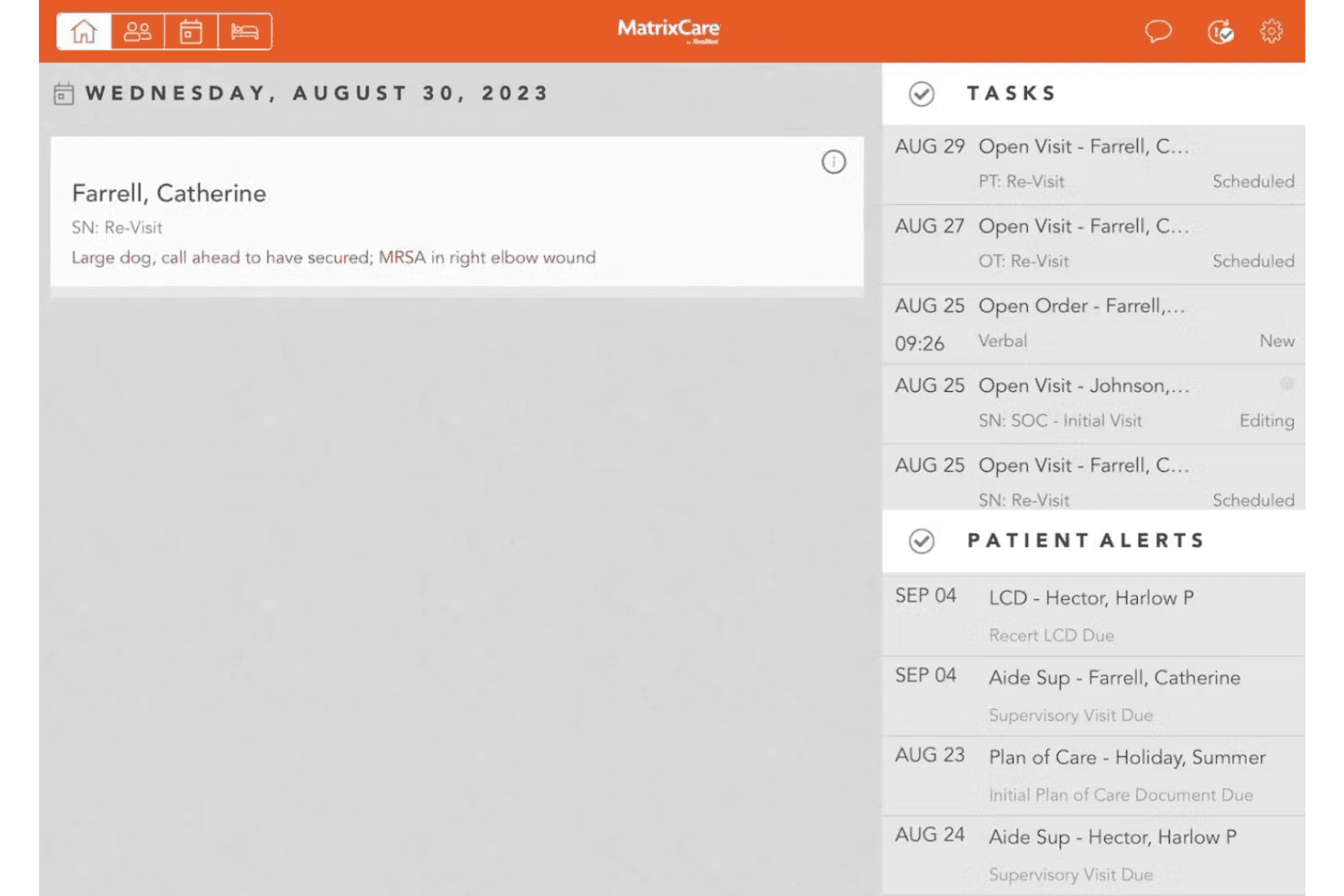
MatrixCare covers charting, care planning, compliance reporting, and billing. MatrixCare Home Health & Hospice is a clinician-designed EHR built for hospice, home health, and palliative care that covers point-of-care charting, IDG care planning, CMS compliance reporting, and hospice-specific billing in one platform.
Who Is MatrixCare Home Health & Hospice Best For?
MatrixCare is a strong fit for hospice agencies that manage multi-discipline care teams and need a single system to handle clinical documentation, IDG workflows, and billing.
Why I Picked MatrixCare Home Health & Hospice
I picked MatrixCare Home Health & Hospice because its automatic plan of care updates genuinely set it apart from other hospice EMRs. When a clinician completes visit documentation in the field, the plan of care updates without requiring manual re-entry from the rest of the team. I also like that IDG workflows are built directly into the same system, so care plan changes are immediately visible across nurses, aides, chaplains, and social workers in real time.
MatrixCare Home Health & Hospice Key Features
- Bereavement management module: Tracks 13-month bereavement care requirements, risk assessments, and family contacts after patient death.
- Medicare eligibility verification: Integrates with CMS systems to instantly confirm patient hospice benefit periods and status.
- Volunteer tracking dashboard: Manages volunteer assignments, service hours, and documentation to meet the CMS 5% requirement.
- Mobile offline charting: Allows clinicians to document visits, capture signatures, and sync records from the field without internet.
MatrixCare Home Health & Hospice Integrations
MatrixCare Home Health & Hospice offers native integrations with CommonWell Health Alliance, Carequality, Epic, Oracle Health, SureScripts, Direct Trust, Brightree HME/DME, Total Triage, Inovalon, and HEALTHCAREfirst. An API is available for custom integrations.
Pros and Cons
Pros:
- Native mobile charting supports offline access
- Full suite of hospice compliance modules included
- Automatic plan of care synchronization after visits
Cons:
- Bereavement module UI feels dated and cluttered
- Mobile app crashes reported by end users
Learn more about MatrixCare Home Health & Hospice: Best for integrated referral and intake processes
- Free demo available
- Pricing upon request
Visit WebsiteCustomer Rating:3.4/5This rating combines scores from multiple user review sites to reflect overall customer sentiment about the product.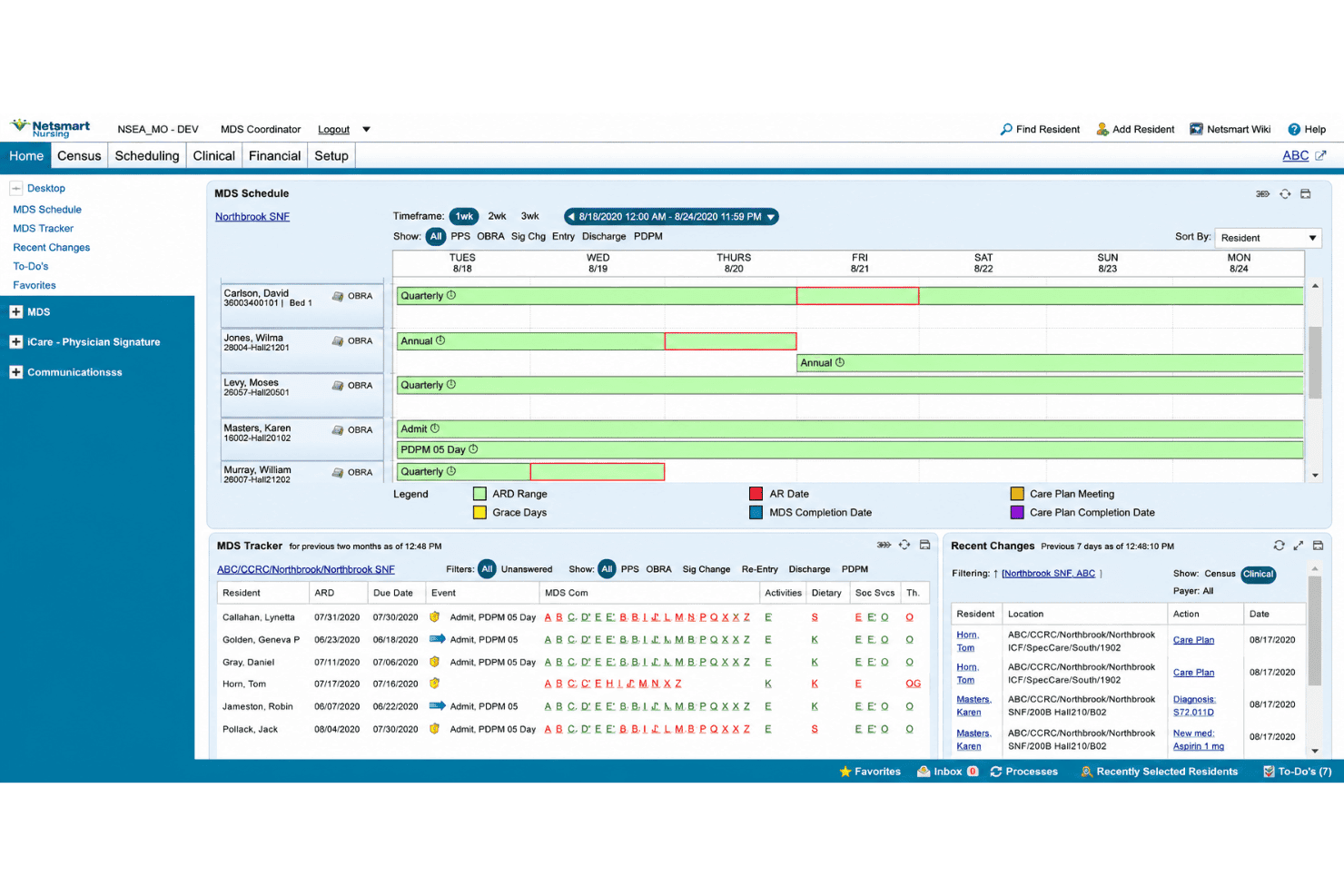
Netsmart myUnity Hospice displays an MDS Schedule and MDS Tracker dashboard with resident scheduling, care plan dates, and recent changes panels. Netsmart myUnity Hospice is a cloud-based hospice EHR that unifies clinical documentation, IDG workflows, CMS compliance tools, billing, and referral management into a single patient record across the care continuum.
Who Is Netsmart myUnity Hospice Best For?
It's a strong fit for hospice agencies that manage care across multiple settings and need a single platform connecting clinical, billing, and compliance teams.
Why I Picked Netsmart myUnity Hospice
I picked Netsmart myUnity Hospice as one of the best because its Referral Manager™ consolidates multiple referral networks into a single platform, reducing referral response times. When a referral comes in, my team can accept it electronically and move directly into intake documentation using the same patient record. The AI-assisted intake tools further reduce manual entry, so admissions move from referral acceptance to care plan creation without the usual bottleneck.
Netsmart myUnity Hospice Key Features
- IDG meeting workflows: Automates interdisciplinary meeting scheduling, agenda preparation, and care plan updates in one place.
- CMS compliance reporting: Supports HIS, HOPE, CAHPS surveys, and CMS condition of participation audit-ready documentation.
- Point-of-care mobile documentation: Clinicians can chart, capture signatures, and update care records from patient homes using mobile devices.
- Bereavement service tracking: Provides dedicated tools to document risk assessments and follow-up contacts for families after a patient’s death.
Netsmart myUnity Hospice Integrations
Netsmart myUnity Hospice offers native integrations with EHRs like Allscripts, Cerner, and Epic, and connects to health information exchanges, referral sources, and local hospitals. An API is available for custom integrations.
Pros and Cons
Pros:
- Offline-capable point-of-care charting for clinicians
- Automates interdisciplinary meeting documentation
- Real-time referral-to-intake tracking with audit history
Cons:
- Occasional system slowdowns during high census
- Reporting customization options are limited
Learn more about Netsmart myUnity Hospice: Best with custom electronic document workflows
- Free demo available
- Pricing upon request
Visit WebsiteCustomer Rating:4.5/5This rating combines scores from multiple user review sites to reflect overall customer sentiment about the product.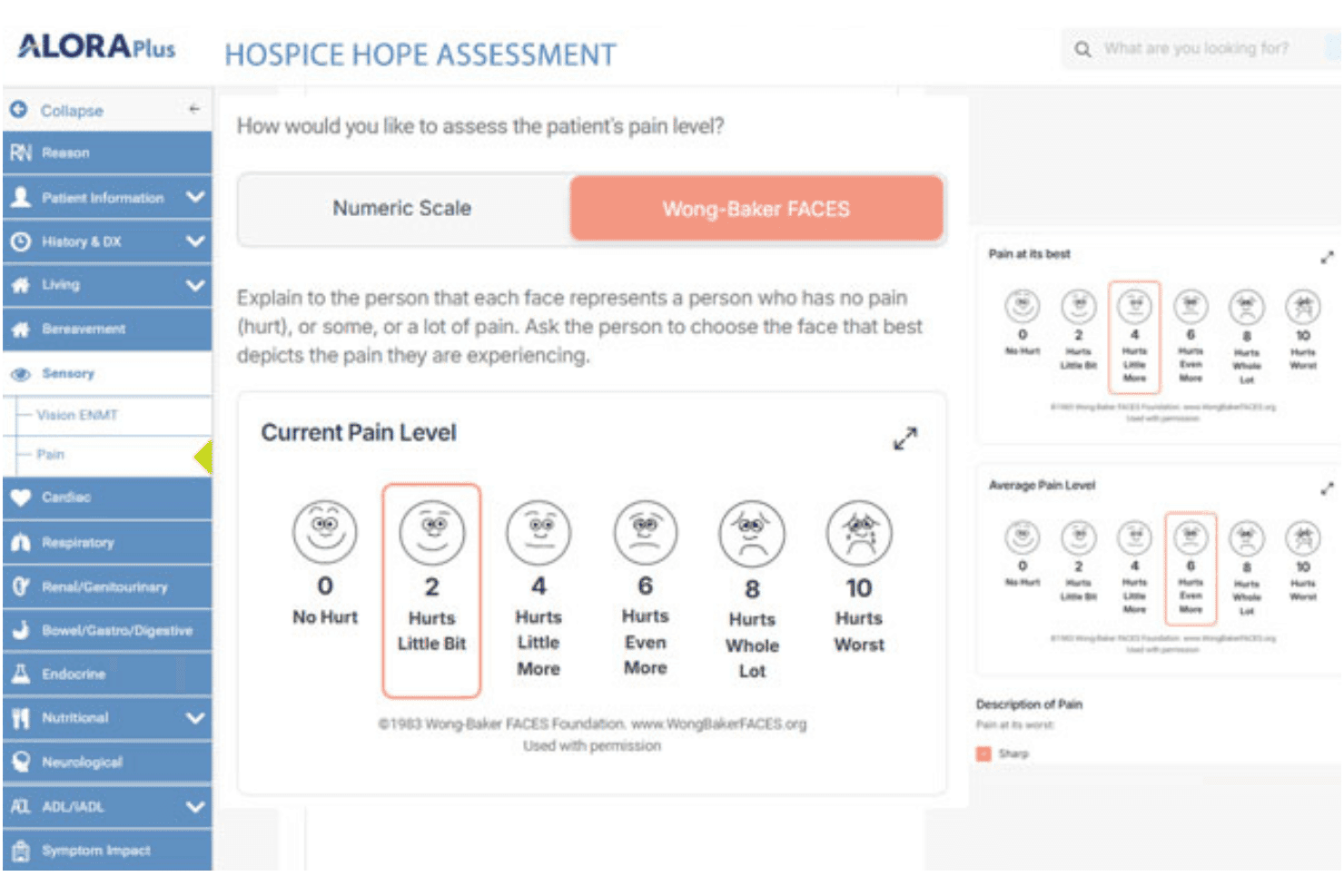
Alora Hospice Software manages charting, IDG meetings, billing, and care plans. Alora Hospice Software is a cloud-based hospice EMR that covers clinical documentation, IDG meeting management, hospice billing, care plan tracking, and compliance tools across nursing, aide, social work, and chaplain disciplines.
Who Is Alora Hospice Software Best For?
It's a strong fit for hospice agencies that manage multiple disciplines or run combined hospice and home health operations under a single platform.
Why I Picked Alora Hospice Software
Alora Hospice Software earns its spot on my shortlist because of how it handles agency-specific documentation. I love that teams can upload proprietary consent forms, election statements, and intake documents directly into the system and route them for electronic signature without leaving the platform. What I find particularly useful is the symptom follow-up workflow, which auto-triggers from the HOPE assessment when pain or dyspnea is flagged, keeping clinicians accountable without manual follow-up.
Alora Hospice Software Key Features
- Local coverage determinations integration: Automatically validates LCDs for terminal diagnosis within the nurse assessment workflow.
- Bereavement plan management: Centralizes bereavement assessments, custom plans, and follow-up tracking for families.
- Medical director portal: Gives hospice physicians a dedicated interface to review and sign orders, CTIs, and care plans remotely.
- Multi-office user management: Supports multiple agency branches or lines of service from a single login, with no additional cost.
Alora Hospice Software Integrations
Alora Hospice Software offers native integrations with clearinghouses for claims submission, SANDATA for EVV transmission, and direct Medicare DDE access. An API is available for custom integrations.
Pros and Cons
Pros:
- Full interdisciplinary care team charting support
- Built-in bereavement plan management and tracking
- Custom electronic signature workflows for agency documents
Cons:
- Volunteer management features are limited
- Mobile offline documentation support unclear
Learn more about Alora Hospice Software: Best for advanced Medicare compliance features
- Free demo available
- Pricing upon request
Visit WebsiteCustomer Rating:3.7/5This rating combines scores from multiple user review sites to reflect overall customer sentiment about the product.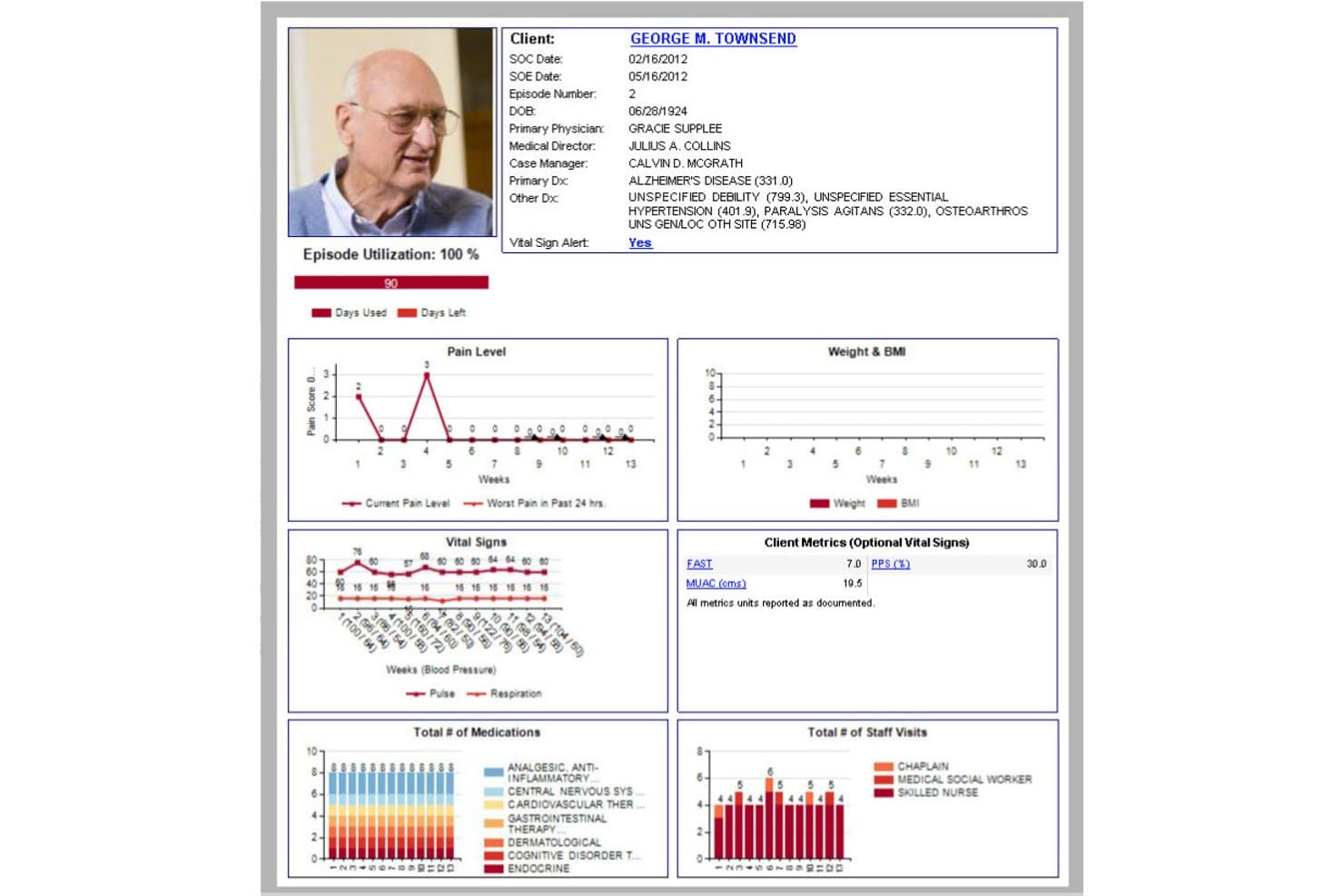
Homecare Homebase (HCHB) offers a comprehensive patient dashboard displaying clinical metrics, vital signs, pain levels, medication tracking, and staff visit history for hospice care management. Homecare Homebase (HCHB) is a cloud-based hospice EMR platform covering clinical documentation, point-of-care mobile charting, Medicare billing, care coordination, and compliance management across hospice and home health agencies.
Who Is Homecare Homebase (HCHB) Best For?
HCHB is a strong fit for mid-to-large hospice agencies that need enterprise-grade compliance, billing, and clinical operations under one platform.
Why I Picked Homecare Homebase (HCHB)
I picked HCHB as one of the best because its compliance infrastructure goes deeper than most hospice EMRs I've evaluated. It actively tracks regulatory changes and surfaces documentation gaps before they become audit risks, with built-in support for HOPE submissions and Medicare Conditions of Participation reporting. I also like that NOE/NOTR submissions are handled directly within the billing workflow, which keeps compliance and revenue cycle work tightly connected rather than managed as separate processes.
Homecare Homebase (HCHB) Key Features
- Dynamic plan of care management: Care teams create, update, and share individualized plans of care with real-time syncing.
- Customizable clinical templates: Provides hospice-specific forms for symptom management, bereavement, and spiritual notes.
- Offline point-of-care charting: Clinicians document visits and assessments on mobile devices even without an internet connection.
- Role-based permissions and audit trails: System tracks user activity and manages access for clinical, administrative, and compliance staff.
Homecare Homebase (HCHB) Integrations
Native integrations are not clearly documented. The tool supports integrations via custom API.
Pros and Cons
Pros:
- Advanced audit trail and reporting features
- Dedicated hospice clinical documentation templates
- Medicare compliance tracking built-in
Cons:
- Limited workflows for non-nursing disciplines
- Lacks mobile charting for iOS
Learn more about Homecare Homebase (HCHB): Best for multi-location agency coordination
- Free demo available
- Pricing upon request
Visit WebsiteCustomer Rating:3.7/5This rating combines scores from multiple user review sites to reflect overall customer sentiment about the product.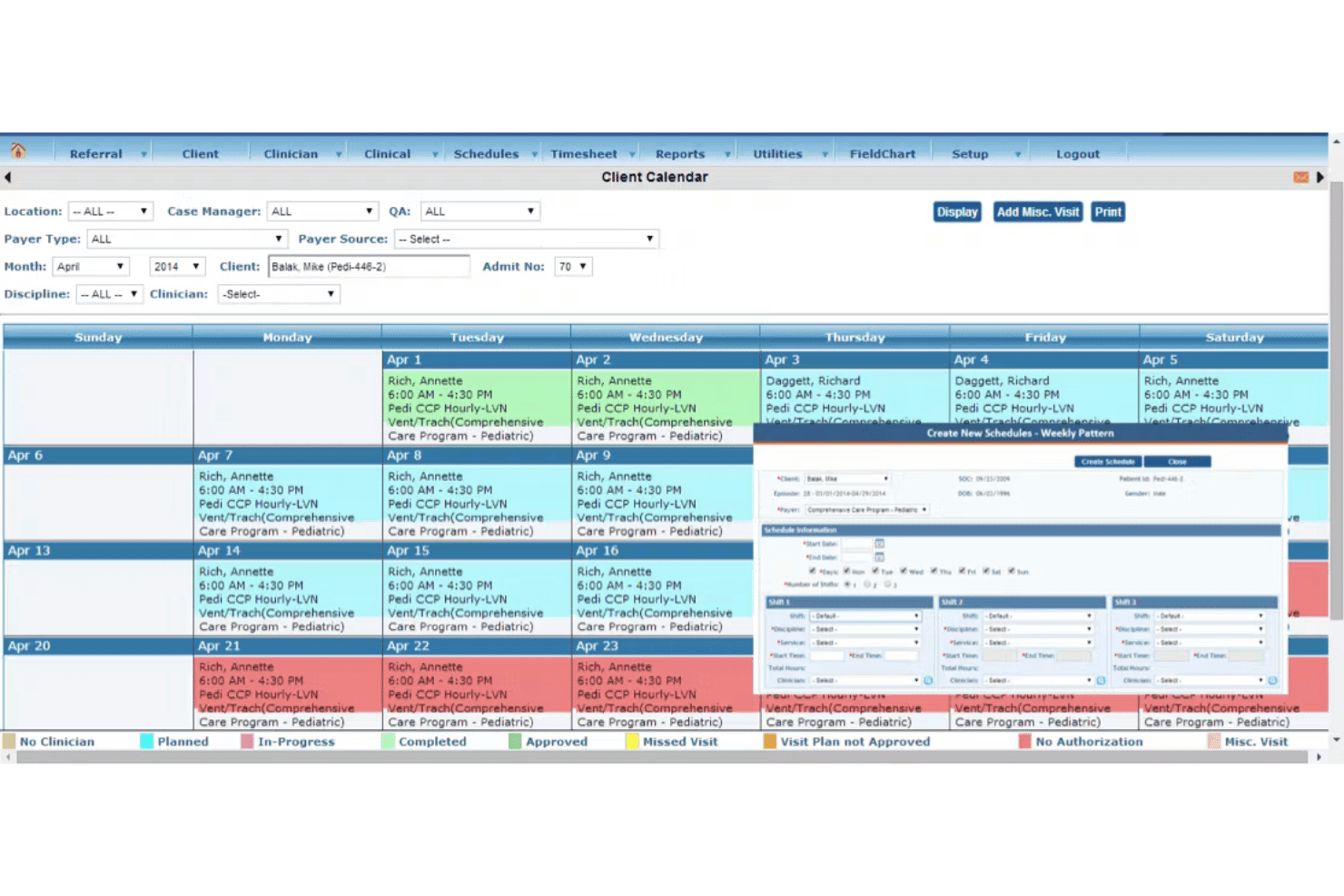
KanTime Hospice handles scheduling, charting, IDT, billing, and offline care. KanTime Hospice is a cloud-based hospice EMR platform covering clinical documentation, IDT management, HIS/HQRP compliance reporting, hospice billing, and offline-capable point-of-care charting for end-of-life care agencies.
Who Is KanTime Hospice Best For?
KanTime Hospice is a strong fit for mid-to-large hospice agencies operating across multiple branches or service lines who need centralized oversight and standardized workflows.
Why I Picked KanTime Hospice
KanTime Hospice earns its spot on my shortlist because of how it handles agency-wide oversight across locations. I like that roll-up reporting across all branches and service lines is built directly into the platform, so administrators aren't manually consolidating data from separate sites. The standardized IDT management workflow also means every location runs IDG meetings consistently, which matters when you're coordinating clinical documentation and care plans across a large, distributed hospice operation.
KanTime Hospice Key Features
- Bereavement management: Track family needs, risk assessments, and required bereavement contacts for regulatory compliance.
- Volunteer management: Log volunteer assignments and hours to support the Medicare 5% volunteer service requirement.
- CMS compliance tools: Manage HIS/HQRP reporting and build audit trails to satisfy hospice Conditions of Participation.
- Mobile offline documentation: Clinicians document patient visits from any location with full offline capability and sync.
KanTime Hospice Integrations
KanTime Hospice offers native integrations with billing clearinghouses like Waystar and Ability, state EVV aggregators such as Sandata and HHAeXchange, MyDirectives for advance care planning, and WorldView for document management.
Pros and Cons
Pros:
- Full-featured mobile offline charting
- Built-in bereavement and volunteer management modules
- Multi-location enterprise oversight and reporting
Cons:
- Care plan updates can require extra data entry
- Implementation and onboarding often require vendor support
Learn more about KanTime Hospice: Best for customizable workflow automation
- Free demo available
- Pricing upon request
Visit WebsiteCustomer Rating:4/5This rating combines scores from multiple user review sites to reflect overall customer sentiment about the product.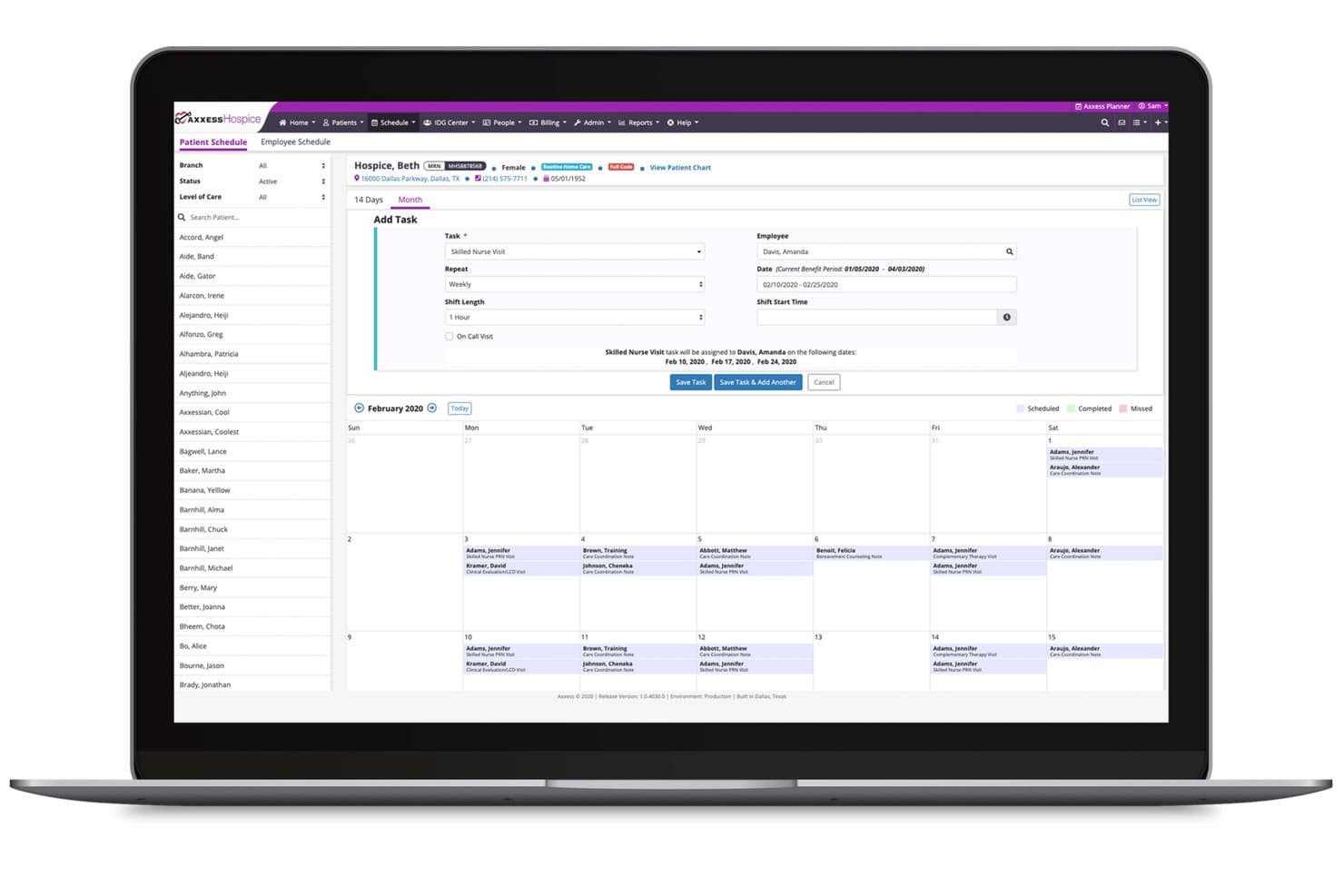
Axxess Hospice offers a patient scheduling interface with an Add Task modal for assigning skilled nurse visits on a monthly calendar view. Axxess Hospice is a cloud-based hospice EMR built specifically for end-of-life care, covering clinical documentation, IDG management, medication management, scheduling, billing, and CMS compliance in one platform.
Who Is Axxess Hospice Best For?
It's a strong fit for hospice agencies whose interdisciplinary teams — nurses, aides, chaplains, social workers, and billing staff — all need to work from a single, connected system.
Why I Picked Axxess Hospice
I picked Axxess Hospice as one of the best because its automation is built around how hospice workflows actually move. When a clinician completes a visit narrative, that information flows automatically into physician orders and the plan of care. The IDG Collaboration Center goes further, auto-generating IDG summaries and syncing them to the care plan. I also like that NOE and NOTR submissions trigger automatically from clinical events rather than requiring a separate administrative step.
Axxess Hospice Key Features
- Bereavement management module: Tracks post-death bereavement assessments, services, and family contacts for compliance.
- Volunteer hours tracking: Manages volunteer assignments, hours, and required documentation for the Medicare 5% requirement.
- Medicare eligibility verification: Connects with CMS/HETS to check hospice eligibility and benefit periods in real time.
- Service intensity add-on (SIA) support: Logs and documents SIA visits during the final days of life for proper billing and compliance.
Axxess Hospice Integrations
Axxess Hospice offers native integrations with pharmacy benefit managers, DME providers, CMS/HETS for Medicare eligibility, and the Kno2 clinical information exchange platform. An API is available for custom integrations.
Pros and Cons
Pros:
- Built-in volunteer and bereavement tracking
- HOPE and CAHPS compliance tools included
- Automated IDG documentation and care plan sync
Cons:
- Reporting customization options are limited
- Mobile app lacks robust offline mode
Learn more about Axxess Hospice: Best for managing interdisciplinary meetings
- Free demo available
- Pricing upon request
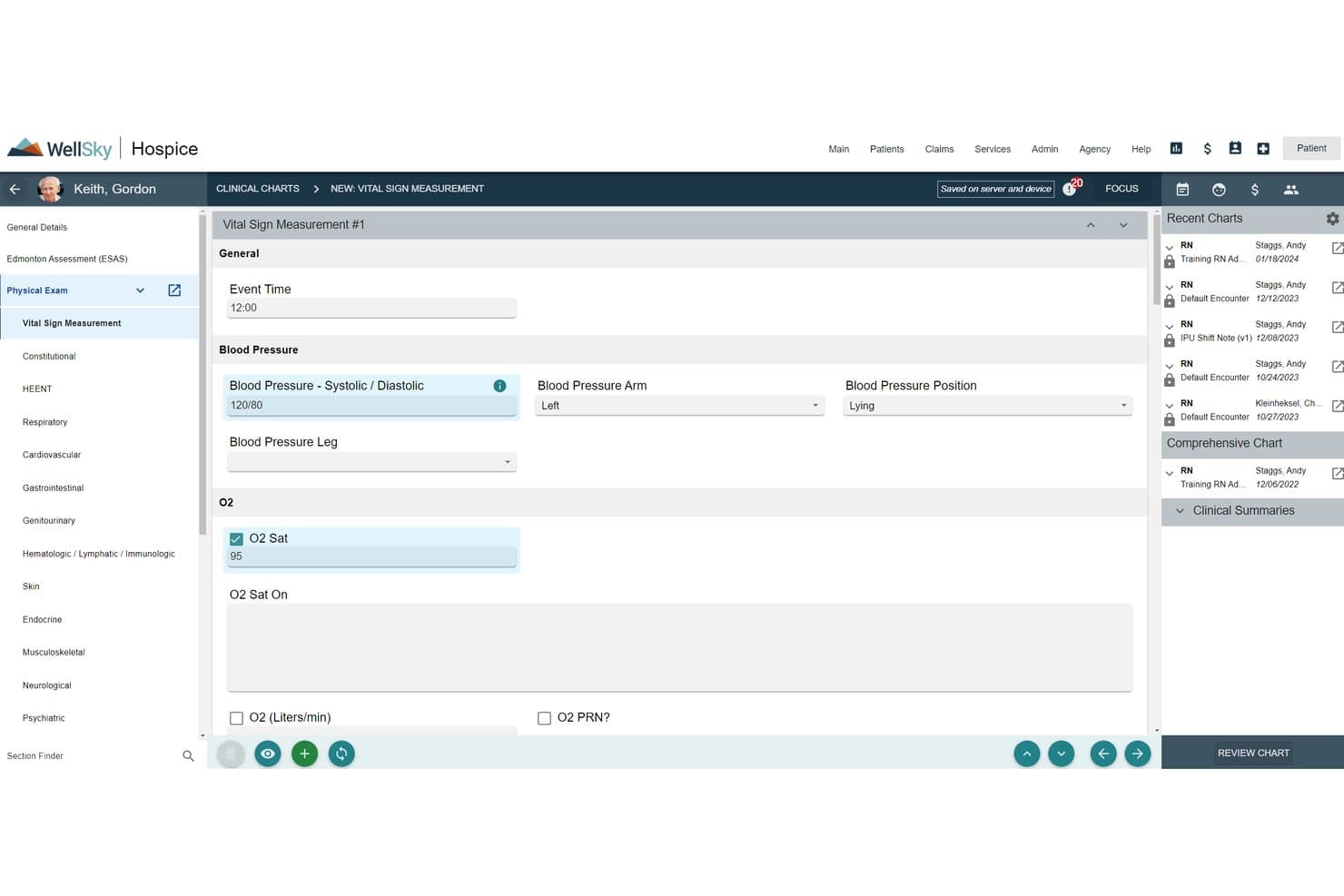
WellSky Hospice & Palliative offers a detailed Vital Sign Measurement form within its clinical charting module, capturing blood pressure, O2 saturation, and positioning data. WellSky Hospice & Palliative is a web-based hospice EMR that covers clinical documentation, IDG/IDT coordination, HOPE-compliant reporting, hospice billing, and point-of-care charting with offline mobile access.
Who Is WellSky Hospice & Palliative Best For?
It's a strong fit for hospice and palliative care agencies that need a single platform to coordinate care across clinical, administrative, and billing teams.
Why I Picked WellSky Hospice & Palliative
WellSky Hospice & Palliative earns its spot on my shortlist because of how well it handles IDG/IDT meeting coordination. I like that my team can view all disciplines on a single unified calendar, so scheduling nurses, chaplains, social workers, and aides around a care plan review doesn't require juggling separate systems. HOPE-compliant documentation and custom SMART goal tracking connect directly to those meetings, keeping care plans current without additional steps after each session.
WellSky Hospice & Palliative Key Features
- Bereavement management module: Track bereavement risk assessments and document services for families over a 13-month period.
- Medicare eligibility verification: Check hospice benefit periods and election status directly with CMS/HETS.
- Volunteer tracking tools: Log volunteer hours and assignments to meet Medicare's 5% benchmark.
- Level of care documentation: Record all four levels of hospice care and manage location-based workflows for home, SNF, ALF, or inpatient units.
WellSky Hospice & Palliative Integrations
Native integrations include Forcura for document management, CMS/HETS for eligibility verification, and WellSky CareInsights analytics. An API is available for custom integrations.
Pros and Cons
Pros:
- Includes robust bereavement management module
- Unified calendar for all IDG disciplines
- HOPE-compliant clinical documentation tools
Cons:
- Offline chart syncing can be unreliable
- Needs manual data re-entry between some workflows
Learn more about WellSky Hospice & Palliative:
Other Hospice EMR Software
Here are some additional hospice EMR software options that didn’t make it onto my shortlist, but are still worth checking out:
- 11FireNoteBest for rapid implementation and onboarding
- 12Hospice Tools EMRBest for offline charting in remote care settings
- 13Trella HealthBest for data-driven hospice market analytics
- 14Curantis SolutionsBest for real-time IDG collaboration features
- 15Suncoast (Complia Health)Best for hospice-specific quality reporting tools
- 16Footprints EMRBest for integrated medication management
- 17HospiceWorksBest for intuitive care planning dashboards
- 18WellSky ConsoloBest for configurable interdisciplinary workflows
- 19ClearView EHRBest for customizable compliance tracking
- 20Hospice EngineBest for streamlined plan of care updates
How I Evaluate Hospice EMR Software
I split my evaluation into baseline requirements—like IDG documentation and CMS compliance tools—and the differentiators that set one hospice EMR apart from the next.
Core Functionality (Table Stakes For This List)
When I'm selecting tools for my list, I rank each one on a scale from 0 (does not offer the functionality) to 5 (excels in this area) for each core functionality listed below. Then, I calculate the tool's total score into a percentage. Each tool needs to achieve a minimum total score of 55% to be considered for inclusion.
- Hospice-specific charting: I check for templates that cover terminal illness certification, symptom management, and bereavement—not just generic clinical notes.
- IDG management: Each tool should support scheduling, attendance tracking, and care plan updates tied directly to interdisciplinary group meetings.
- CMS compliance tools: I look for built-in HIS, HOPE, and CAHPS reporting, plus automated submission workflows that reduce the risk of missed filing deadlines.
- Hospice billing & claims: Per diem billing, NOE/NOTR submissions, and Medicare claims processing should all be built into the billing module from the start.
- Mobile point-of-care access: Field nurses documenting visits in a patient's home need offline charting and e-signature capture that syncs once connectivity returns.
- Plan of care management: I evaluate how each tool handles dynamic POC updates across the full care team, from RNs and aides to chaplains and social workers.
Once I have a list of tools that meet the criteria, I consider what sets each platform apart.
Differentiating Factors (What Sets Vendors Apart)
Here's how I compare and contrast different vendors:
Standout Features
Bereavement management modules make a real difference—I look for tools that track the full 13-month bereavement period, including risk assessments and family outreach logs. Medicare eligibility verification is another separator; real-time CMS/HETS integration helps your billing team confirm benefit periods before submitting claims. I also evaluate volunteer tracking, since meeting the Medicare volunteer hour requirement demands accurate logging of assignments and hours across your program.
Beyond Features
Level of care support matters—I evaluate whether a platform handles documentation and billing across all four hospice levels, including SIA tracking during a patient's final days. Integrations with your hospice tech stack are equally telling; connectivity with pharmacy benefit managers and DME providers keeps medication and equipment workflows inside the EMR. I also consider implementation and training, especially whether a vendor offers role-specific onboarding for clinical and non-clinical staff and data migration from legacy systems.
How to Choose Hospice EMR Software
It’s easy to get bogged down in long feature lists and complex pricing structures. To help you stay focused as you work through your unique software selection process, here’s a checklist of factors to keep in mind:
| Factor | What to Consider |
|---|---|
| FactorScalability | What to ConsiderWill the platform handle census changes and support new sites or teams as your agency grows? Consider future expansion, including new locations or specialties. |
| FactorIntegrations | What to ConsiderDoes the EMR connect with your pharmacy providers, DME vendors, referral sources, and lab systems? Make a list of current integrations you can’t go without. |
| FactorCustomizability | What to ConsiderCan you adapt templates, workflows, and reporting to match your team’s documentation and regulatory requirements? |
| FactorEase of use | What to ConsiderHow quickly can clinicians and staff learn the system? Preview the documentation and scheduling screens to gauge staff training needs and adoption barriers. |
| FactorImplementation and onboarding | What to ConsiderWhat level of migration support and user training does the vendor provide? Ask about dedicated onboarding teams, timelines, and how they handle data import. |
| FactorCost | What to ConsiderAre fees per user, per patient, or per agency? Review how pricing flexes with census, and watch for hidden charges around support, add-ons, or upgrades. |
| FactorSecurity safeguards | What to ConsiderDoes the system cover HIPAA compliance, data encryption, audit logs, and role-based access controls to safeguard sensitive patient information? |
| FactorCompliance requirements | What to ConsiderWill the platform support current and new CMS/Medicare rules? Check for timely updates when regulations or reimbursement guidelines change. |
What Is Hospice EMR Software?
Hospice EMR software is a digital system designed specifically to manage clinical documentation, regulatory compliance, billing, and team coordination for hospice care providers.
These platforms streamline charting, plan of care updates, interdisciplinary group meetings, and reporting workflows to meet hospice-specific needs, including CMS and Medicare requirements.
Features of Hospice EMR Software
When selecting hospice EMR software, keep an eye out for the following key features:
- Hospice-specific charting: Clinical documentation templates address hospice care workflows, including terminal illness certification, pain management, and end-of-life assessments.
- IDG meeting management: Built-in scheduling, attendance tracking, and digital documentation for interdisciplinary group meetings required by hospice regulations.
- Plan of care management: Allows teams to create, share, and update individualized hospice plans, ensuring the care plan evolves with patient needs and team input.
- CMS compliance reporting: Supports mandatory submissions like HIS, HOPE, and CAHPS, helping ensure that agencies meet Medicare and regulatory standards.
- Mobile point-of-care access: Lets clinicians chart notes, capture signatures, and update records from patients’ homes, even when internet connectivity is unreliable.
- Hospice billing and claims: Automates per diem billing, NOE/NOTR processes, and Medicare/Medicaid claims, reducing administrative effort and errors.
- Bereavement services tracking: Documents 13-month bereavement programs, risk assessments, and follow-ups for families, supporting ongoing regulatory compliance.
- Volunteer management: Tracks volunteer hours, assignments, and compliance with Medicare hospice volunteer participation requirements.
- User role customization: Assigns specific permissions and clinical access based on staff roles, helping protect data while streamlining workflow for nurses, aides, and support staff.
Common Hospice EMR Software AI Features
Beyond the standard hospice EMR software features listed above, many of these solutions are incorporating AI with features like:
- Predictive symptom alerts: AI analyzes patient data to flag early signs of pain, agitation, or decline, helping clinicians intervene before symptoms escalate.
- Automated documentation suggestions: AI recommends phrasing and content for clinical notes based on visit details, reducing manual entry and improving consistency.
- Intelligent care plan updates: AI reviews patient progress and suggests care plan adjustments, ensuring interventions stay aligned with changing needs.
- Claims denial risk scoring: AI evaluates billing data to predict which claims are likely to be denied, guiding staff to address issues before submission.
- Natural language processing for compliance: AI scans free-text notes to identify missing regulatory elements, prompting clinicians to complete required documentation.
Benefits of Hospice EMR Software
Implementing hospice EMR software provides several benefits for your team and your business. Here are a few you can look forward to:
- Improved documentation accuracy: Hospice-specific charting templates help clinicians capture critical details for care and compliance in every patient note.
- Simplified compliance management: Built-in CMS reporting and automated regulatory checks reduce the risk of missed deadlines or incomplete data.
- Coordinated interdisciplinary care: Plan of care management and IDG meeting tools keep nurses, aides, chaplains, and social workers aligned on patient needs.
- Faster, more accurate billing: Hospice billing modules automate per diem, NOE/NOTR, and claim submissions, minimizing denials and administrative overhead.
- Real-time point-of-care access: Mobile, offline-capable documentation empowers staff to work efficiently from patient homes, facilities, or inpatient units.
- Streamlined bereavement follow-up: Dedicated bereavement tracking ensures families receive ongoing support after a patient’s death, meeting clinical and Medicare standards.
- Centralized volunteer management: Volunteer tracking modules help agencies meet participation requirements and engage community volunteers with less manual tracking.
Costs and Pricing of Hospice EMR Software
Selecting hospice EMR software requires an understanding of the various pricing models and plans available. Costs vary based on features, team size, add-ons, and more. The table below summarizes common plans, their average prices, and typical features included in hospice EMR software solutions:
Plan Comparison Table for Hospice EMR Software
| Plan Type | Average Price | Common Features |
|---|---|---|
| Plan TypeFree Plan | Average Price$0 | Common FeaturesBasic charting, limited patient records, minimal support, and essential compliance documentation only. |
| Plan TypePersonal Plan | Average Price$50-$150/user/month | Common FeaturesCore charting, mobile access, individual scheduling, some compliance tools, and basic billing capabilities. |
| Plan TypeBusiness Plan | Average Price$200-$400/user/month | Common FeaturesFull patient census, interdisciplinary team tools, advanced billing, CMS reporting, and volunteer management. |
| Plan TypeEnterprise Plan | Average Price$500+/user/month | Common FeaturesAll features, custom integrations, data migration, priority support, role-based permissions, and extended training. |
Hospice EMR Software FAQs
Here are some answers to common questions about hospice EMR software:
How does hospice EMR software help with Medicare compliance?
Hospice EMR software tracks deadlines, automates HIS and HOPE reporting, and ensures documentation meets CMS Conditions of Participation. This makes it easier for your team to stay audit-ready and avoid penalties due to missing or incomplete records.
Can hospice EMR software handle multi-site operations?
Yes, most hospice EMR platforms support multi-site and multi-state agencies. Look for tools that offer cloud-based access, configurable permissions, and unified reporting so teams across locations can work with a single system.
What types of training are included with hospice EMR software?
Training often includes role-based onboarding sessions for nurses, aides, chaplains, and administrators. Many vendors provide ongoing support resources, live webinars, and access to clinical consultants during the setup phase.
Are there integrations with local pharmacies and DME providers?
Yes, many hospice EMR solutions offer integrations with pharmacy benefit managers and DME vendors. These integrations streamline medication ordering, equipment management, and reduce manual paperwork between care settings.
Does hospice EMR software support offline use for field clinicians?
Yes, leading solutions include mobile offline charting, allowing clinicians to enter visit notes and capture signatures in patient homes even if internet access is unreliable. Data then syncs automatically once a connection is restored.