

Billing software for ASCs is specialized technology that manages claims, payments, coding, and financial reporting for ambulatory surgery centers. If you’re looking for tools to reduce billing errors, speed up reimbursements, and handle strict payer requirements, this list is for you.
You face daily pressure to balance patient care with tight financial controls and regulatory demands—getting your billing software right is non-negotiable. Below, you’ll find the leading ASC billing platforms, helping you choose a system that aligns with your workflow, staffing mix, and ever-changing revenue cycle challenges.
Why Trust Our Software Recommendations
6,700+
Reviews
20
Industry experts
16+
Evaluation factors
14
Years
Our team has been testing and reviewing software since 2012. As medical practice leaders ourselves, we know how difficult—and important—it is to choose the right software.
For this guide, we evaluated tools using hands-on testing and independent research, scoring tools using our selection criteria.
Our reviews reflect our human editorial judgment, not a sales pitch.
Comparison Table: Billing Software For ASCs
This comparison table summarizes pricing details for my billing software for ASCs.
| Tool | Best For | Trial Info | Price | ||
|---|---|---|---|---|---|
| 1 | Best for payer payment and denial management | Free demo available | Pricing upon request | Website | |
| 2 | Best for scalable revenue cycle solutions | Free demo available | Pricing upon request | Website | |
| 3 | Best for tracking claims through final payment | Free demo available | Pricing upon request | Website | |
| 4 | Best for automated insurance eligibility checks | Free demo available | Pricing upon request | Website | |
| 5 | Best for cloud-based claims processing | 14-day free trial + free demo available | From $25/month | Website | |
| 6 | Best for optimizing ASC reimbursement workflows | Free demo available | Pricing upon request | Website | |
| 7 | Best for unified clinical and financial oversight | Free demo available | Pricing upon request | Website | |
| 8 | Best for coding automation in surgical centers | Free demo available | Pricing upon request | Website | |
| 9 | Best for customizable documentation options | Free demo available | Pricing upon request | Website | |
| 10 | Best for built-in specialty-specific templates | Free demo available | Pricing upon request | Website |


Best Billing Software for ASCs Reviews
Below are my detailed summaries of the best billing software for ASCs that made it onto my shortlist. My reviews offer a detailed look at the features, best use cases, and integrations of each platform to help you find the best one for you.
 Best for payer payment and denial management
- Free demo available
- Pricing upon request
Visit WebsiteCustomer Rating:4.4/5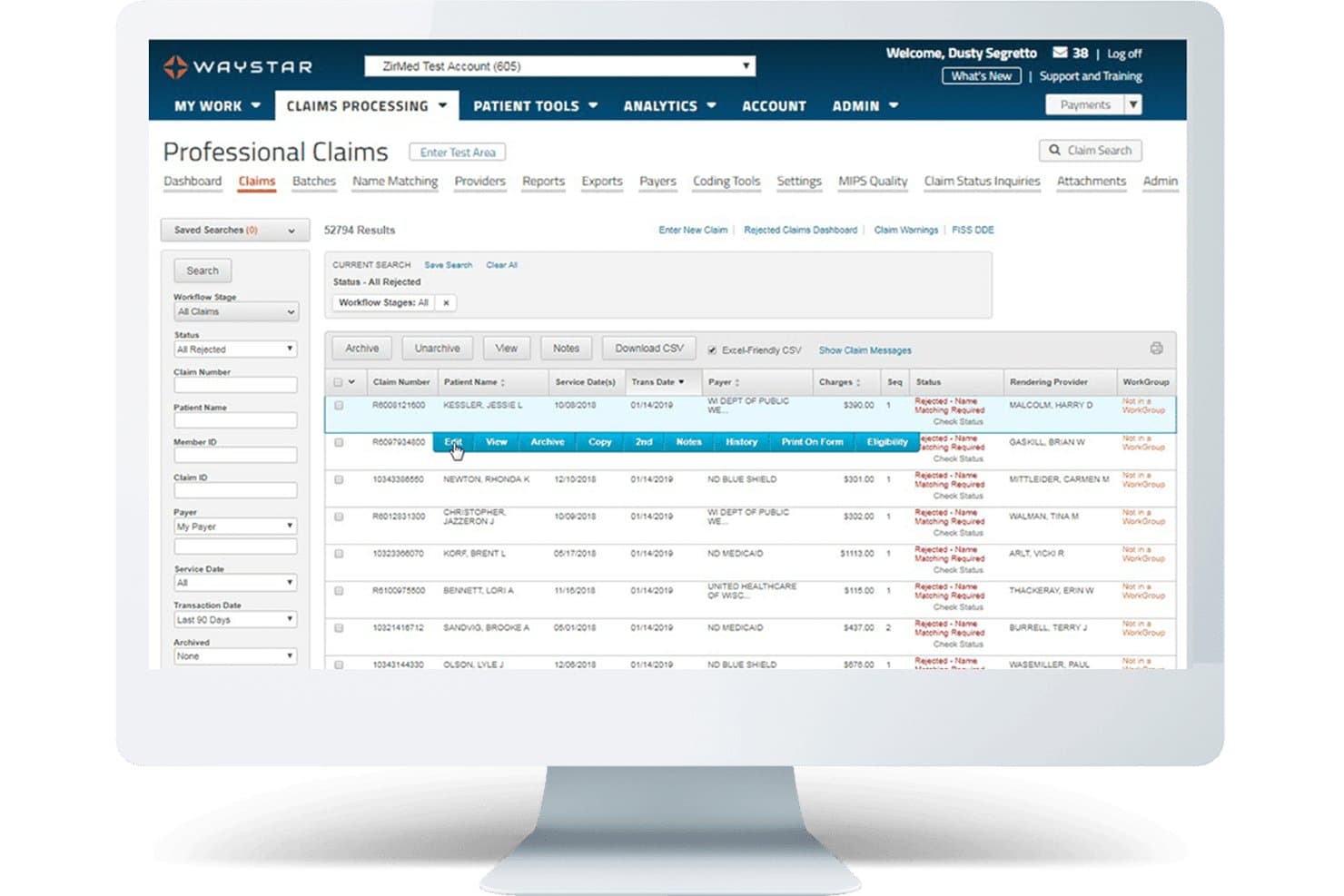
Waystar offers a Professional Claims dashboard that displays rejected claims with filtering, status tracking, and inline action tools for billing management. Waystar is a revenue cycle management platform for ASCs that covers eligibility verification, claim scrubbing and submission, denial and appeals management, remittance processing, and patient payment collection.
Who Is Waystar Best For?
Waystar is a strong fit for mid-to-large ASCs with dedicated revenue cycle teams that handle high claim volumes across multiple payers.
Why I Picked Waystar
I picked Waystar as one of the best because its denial and appeals toolset goes deeper than most ASC billing platforms. I particularly like the appeals wizard, which auto-populates over 1,100 payer-specific templates with remit and provider data. I can also batch up to 100 similar appeals to the same payer at once, which is especially useful when a payer blanket-denies a procedure code across multiple surgical cases.
Waystar Key Features
- Eligibility verification: Checks patient insurance coverage automatically to prevent registration and billing errors.
- Claim scrubbing engine: Applies hundreds of payer-specific edits before claim submission to limit rejections.
- Customizable workflow groups: Lets teams sort and assign billing tasks based on payer, location, or procedure type.
- Analytics and KPI dashboards: Provides real-time revenue cycle reporting and productivity tracking for ASC operations.
Waystar Integrations
Waystar offers native integrations with Practice Pro, Allscripts Practice Management, CGM eMDs, ChiroTouch, ICANotes, AdvancedMD EHR, Cerner Millennium, and eClinicalWorks. An API is available for custom integrations.
Pros and Cons
Pros:
- Real-time eligibility checks across most commercial payers
- ASC billing rules engine supports complex edits
- Denials and appeals tools are industry-leading
Cons:
- Lacks native payer contract modeling module
- No built-in implant or device billing
Learn more about Waystar: Best for scalable revenue cycle solutions
- Free demo available
- Pricing upon request
Visit WebsiteCustomer Rating:3.7/5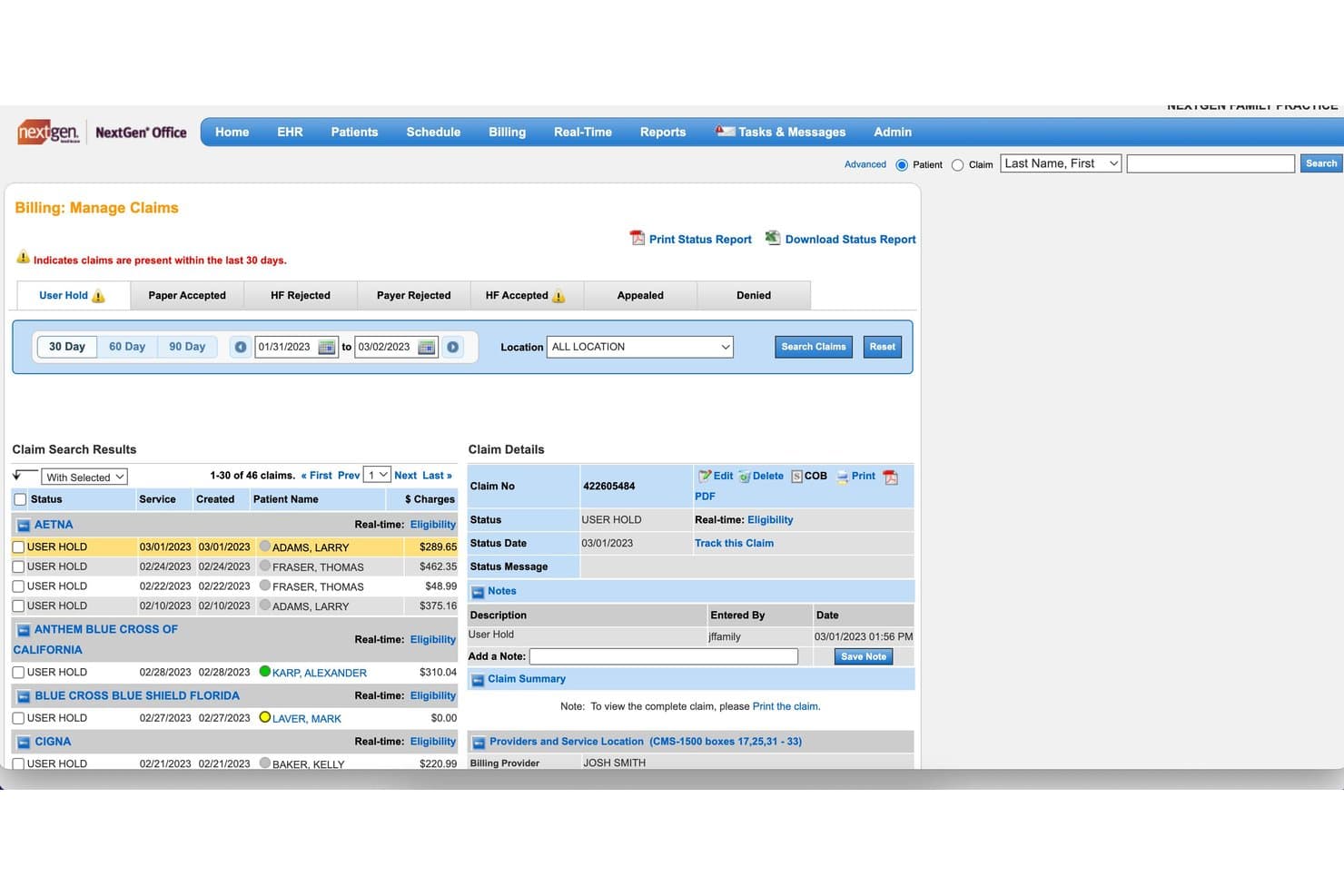
NextGen Healthcare offers a Manage Claims dashboard that allows ASC billing teams to track, filter, and manage claim statuses such as User Hold, HF Rejected, and Payer Rejected across multiple payers. NextGen Healthcare is an ambulatory RCM platform that combines claim scrubbing, multi-format EDI submission, A/R management, denial tracking, and analytics across modular service tiers built for mid-to-enterprise-sized practices and surgery centers.
Who Is NextGen Healthcare Best For?
NextGen Healthcare suits multi-specialty physician groups and hospital-owned ASCs that need a scalable RCM platform across multiple providers and locations.
Why I Picked NextGen Healthcare
I picked NextGen Healthcare as one of the best because its modular RCM service model lets ASC billing teams select only what they need, from claims management to coding services to A/R recovery, without paying for a bundled package they'll never fully use. I also like the analytics layer, where a dedicated RCM subject matter expert reviews your financial data monthly and tracks more than 100 KPIs across payers. The A/R recovery service has delivered 3x to 10x returns for practices, which matters when surgical reimbursement cycles run long.
NextGen Healthcare Key Features
- Multi-format claim submission: Supports 837P, 837I, and 837D EDI formats required for ASC and related specialty billing.
- Centralized credentialing services: Staff complete payer enrollment forms and manage credentialing workflows directly.
- Integrated eligibility verification: Checks patient insurance details before service to reduce eligibility-related denials.
- Customizable financial reporting: Offers KPI dashboards and payer analysis reports suitable for surgery center oversight.
NextGen Healthcare Integrations
NextGen Healthcare offers marketplace integrations with tools like HST Price Transparency, Inbox Health, LinkMD AI, revBot, SamaCare, and Surgimate. It provides an API for custom integrations and uses Waystar as its clearinghouse partner.
Pros and Cons
Pros:
- Modular billing and collections service tiers
- Dedicated monthly reviews with RCM expert
- KPI reporting tailored for multi-site ASCs
Cons:
- Service response time can be inconsistent
- Implant billing lacks ASC-specific logic
Learn more about NextGen Healthcare: Best for tracking claims through final payment
- Free demo available
- Pricing upon request
Visit WebsiteCustomer Rating:3.4/5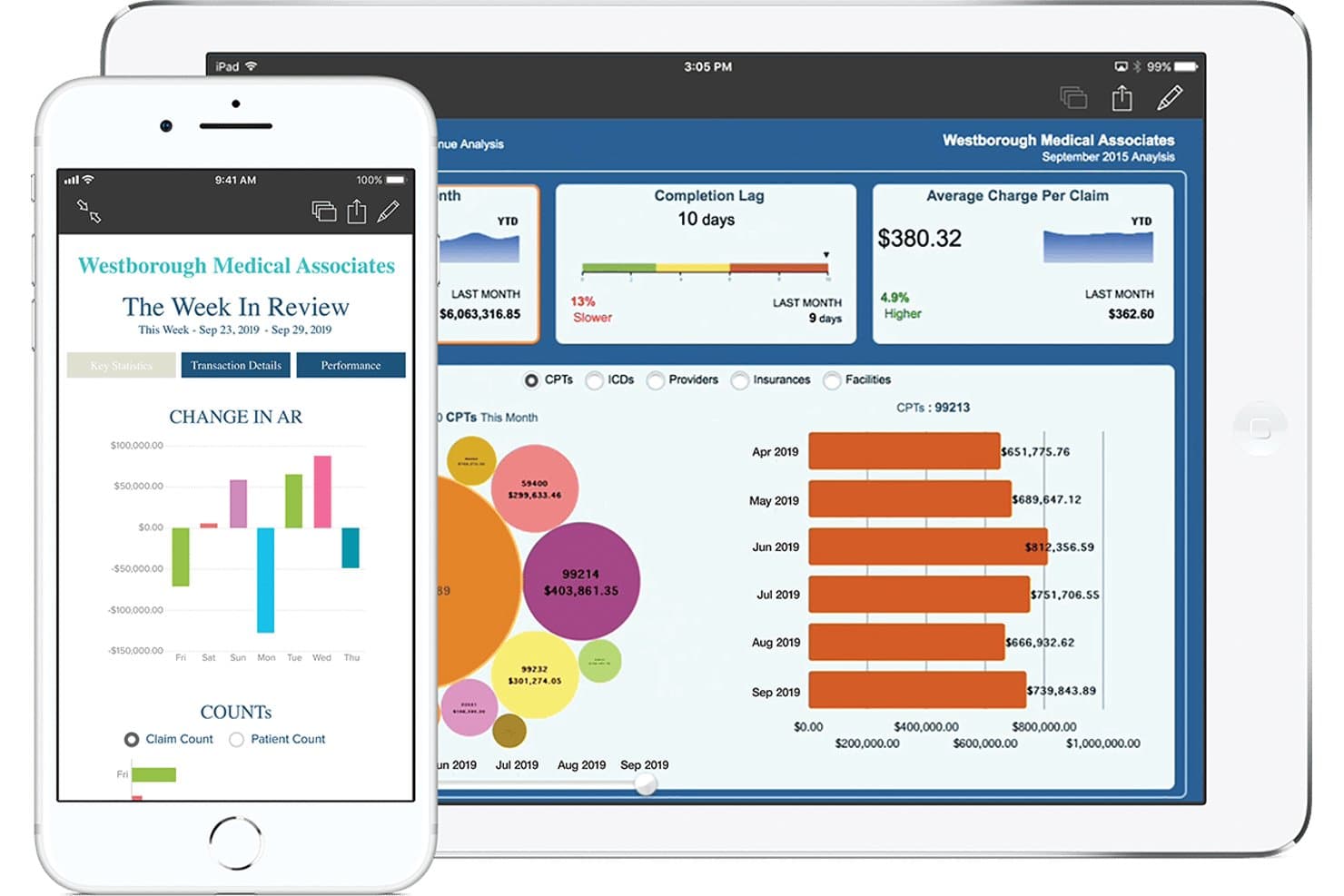
eClinicalWorks offers a revenue cycle management dashboard displaying charge per claim, completion lag, and CPT-level billing analytics across monthly periods on tablet and smartphone. eClinicalWorks is a cloud-based RCM platform that combines AI-driven claim scrubbing, denial management, appeals automation, and A/R tracking for ambulatory surgery centers and multi-specialty practices.
Who Is eClinicalWorks Best For?
It's a strong fit for multi-specialty ASCs and larger practices that need a unified EHR and RCM system with scalable central billing office support.
Why I Picked eClinicalWorks
I picked eClinicalWorks as one of the best because its claim-tracking depth across the full revenue cycle is what sets it apart. The Alerts Dashboard surfaces claims approaching timely filing windows before they become write-offs, and when denials do land, the AI Appeals module generates payer-specific packets in one click. I especially like that the Work Queue Dashboard lets billing teams prioritize and allocate A/R inventory by status, so nothing sits unworked.
eClinicalWorks Key Features
- Integrated inventory management: Track surgical supplies and high-cost implants used in ASC procedures within case documentation.
- Provider analytics dashboard: Visualize productivity, payer mix, and operational metrics with customizable reporting tools.
- EBO view financial reporting: Run detailed financial, compliance, and case costing reports tailored for ASCs.
- Central billing office (CBO) tools: Consolidate billing operations for multiple practice entities with security and single sign-on controls.
eClinicalWorks Integrations
eClinicalWorks offers native integrations with Waystar, Trizetto, Sunoh, healow Genie, PRISMA, and a range of continuous vital sign monitoring devices, with an API available for custom integrations.
Pros and Cons
Pros:
- AI-driven denial defense and appeals packets
- Real-time alerts on pending claims
- Customizable claim edit rules for ASCs
Cons:
- ASC case costing reports are basic
- Implant billing features are limited
Learn more about eClinicalWorks: Best for automated insurance eligibility checks
- Free demo available
- Pricing upon request
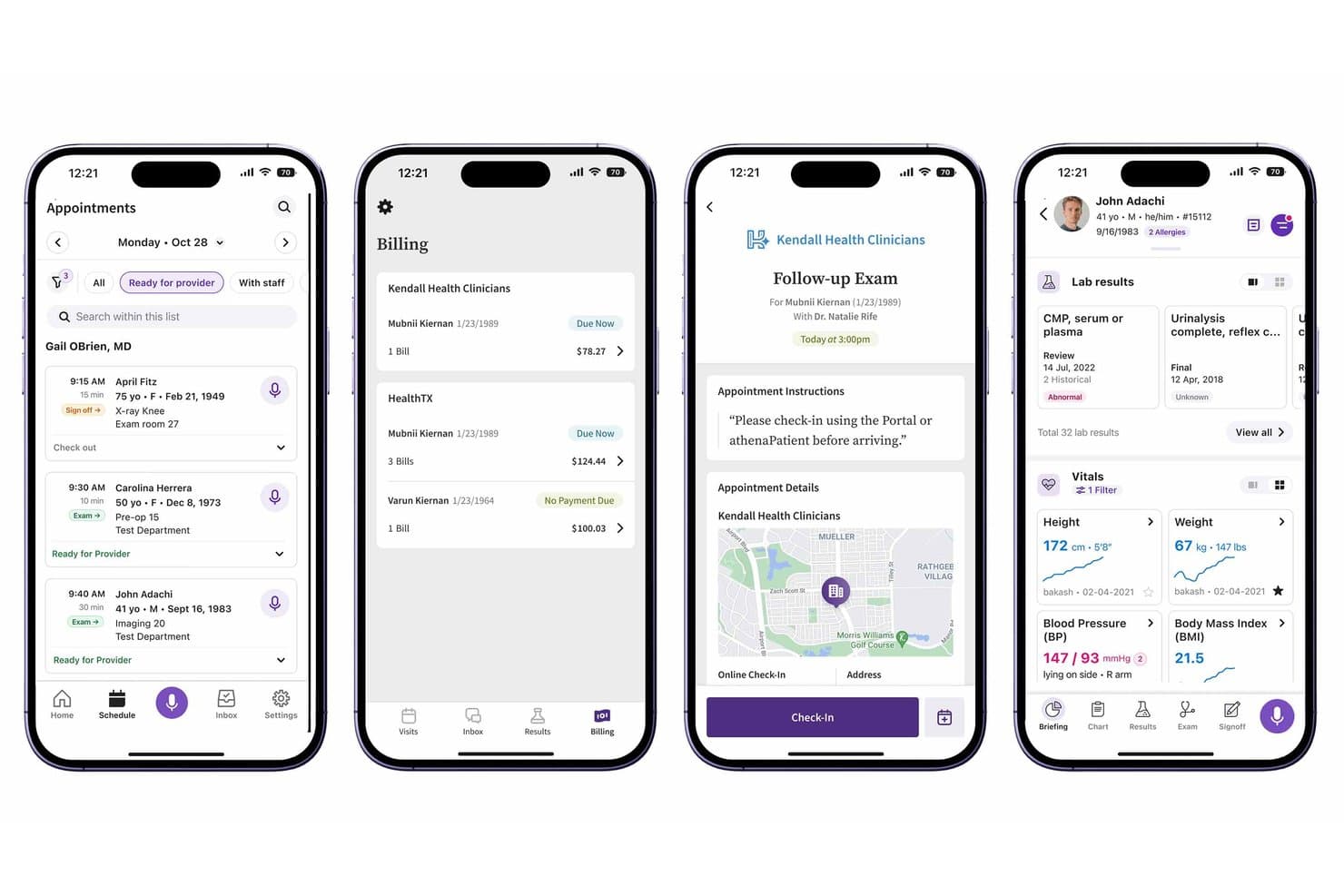
athenahealth (athenaOne) offers a mobile billing interface displaying patient bills with due amounts, payment statuses, and multi-provider billing summaries. athenaOne is a cloud-based RCM and practice management platform that connects clinic and ASC billing workflows, supporting claim submission, denial management, insurance eligibility verification, and financial reporting across ambulatory surgery settings.
Who Is athenahealth (athenaOne) Best For?
It's a strong fit for orthopedic and pain management groups that operate both a clinic and an ASC under one organization.
Why I Picked athenahealth (athenaOne)
I picked athenaOne as one of the best because its Automated Insurance Selection workflow directly reduces insurance-related denials. Claims created using the correct insurance policy through this workflow show a 7.4% reduction in denials compared to other methods. The platform's 160,000+ provider network also continuously refines claim scrubbing rules, keeping first-pass acceptance rates above 95%.
athenahealth (athenaOne) Key Features
- Facility and professional billing workflows: Supports both professional and facility billing in a single platform for integrated ASC management.
- Pre-admission and referral coordination: Enables pre-admission documentation, patient readiness tracking, and referral management for ASC procedures.
- Specialty-specific clinical templates: Offers configurable documentation tailored to orthopedic and pain management operations.
- Marketplace integrations: Connects with over 250 third-party apps for analytics, patient engagement, and additional clinical tools.
athenahealth (athenaOne) Integrations
athenaOne offers over 250 marketplace integrations, including connections with Surescripts, CommonWell, Carequality, and supports FHIR R4 APIs. An API is available for custom integrations.
Pros and Cons
Pros:
- Specialty templates for orthopedic and pain ASCs
- Strong claim scrubbing and denial prevention
- Automated insurance eligibility selection workflow
Cons:
- Lacks ASC-specific payer contract modeling
- Limited implant and supply billing support
Learn more about athenahealth (athenaOne): Best for cloud-based claims processing
- 14-day free trial + free demo available
- From $25/month
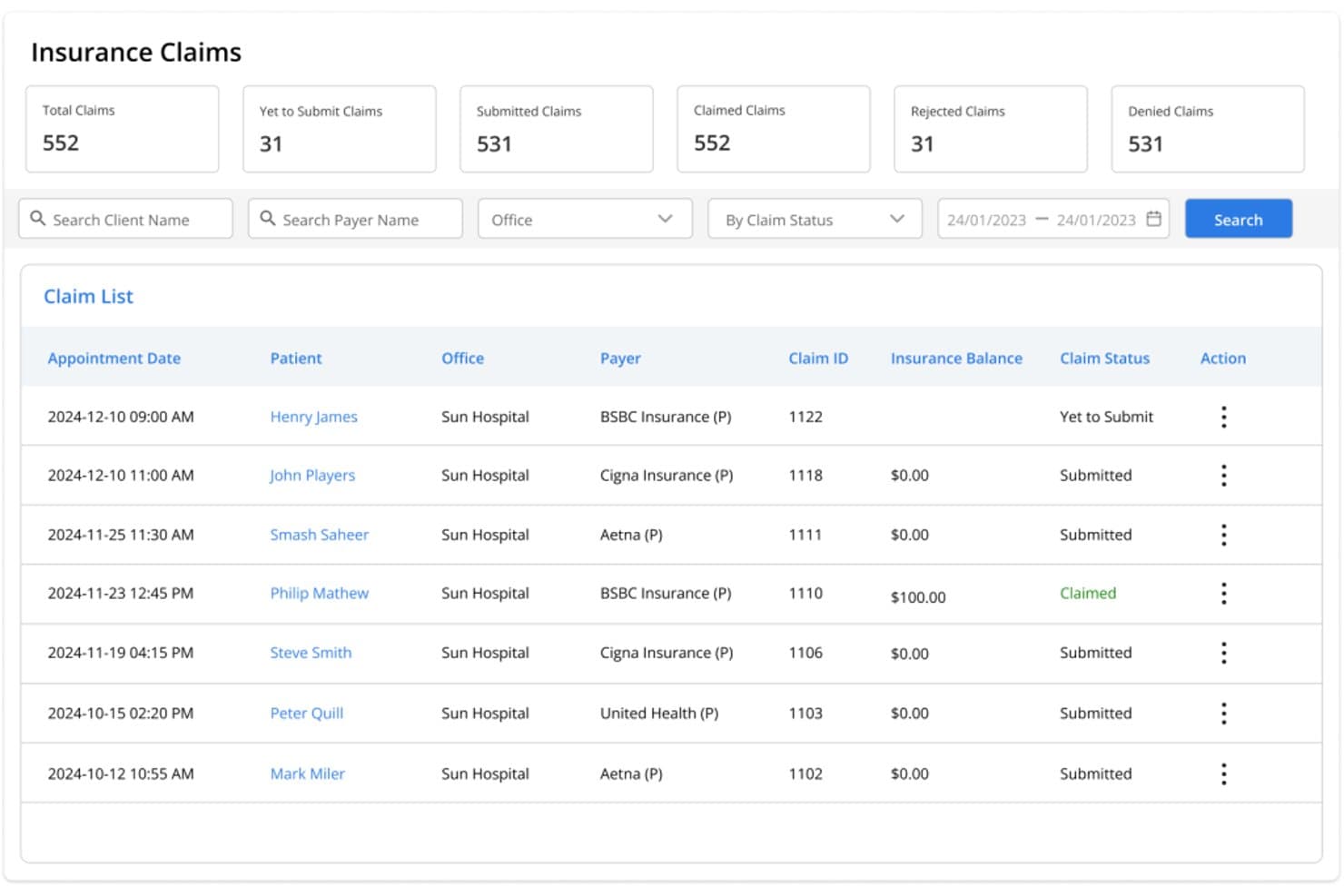
Vozo EHR offers a comprehensive insurance claims management dashboard displaying claim statuses, payer details, and billing summaries for ASC billing workflows. Vozo EHR is a cloud-based EHR and billing platform built for ambulatory surgery centers, combining perioperative documentation, case-based claims processing, and revenue cycle management in a single system.
Who Is Vozo EHR Best For?
Vozo EHR suits small to mid-sized ASCs and outpatient surgical practices looking for an affordable, cloud-based EHR with integrated billing and RCM.
Why I Picked Vozo EHR
Vozo EHR earns its spot on my shortlist because of how it handles cloud-based claims processing end-to-end. I like that it bundles automated claim generation, coding checks, and clearinghouse integration into one workflow, so claims go out clean the first time. The case-based billing structure is particularly well-suited to ASCs, since each case drives its own coding, submission, and collections cycle without manual handoffs between systems.
Vozo EHR Key Features
- OR and case scheduling: Coordinate operating room time, surgical teams, and anesthesia with integrated schedules.
- Perioperative documentation tools: Capture pre-op, intra-op, and post-op notes for each ASC procedure.
- Customizable reporting dashboards: Track financial performance, surgical volume, and workflow trends with adjustable analytics.
- Role-based user permissions: Set access levels for providers, admins, and support staff to protect sensitive data.
Vozo EHR Integrations
Vozo EHR offers native integrations with labs, e-prescribing networks, clearinghouses, and supports HL7 and FHIR standards. An API is available for custom integrations.
Pros and Cons
Pros:
- Supports role-based user management
- Offers dedicated ASC perioperative workflow tools
- Includes built-in clearinghouse for claims
Cons:
- Lacks payer contract management tools
- Does not offer implant billing features
Learn more about Vozo EHR: Best for optimizing ASC reimbursement workflows
- Free demo available
- Pricing upon request
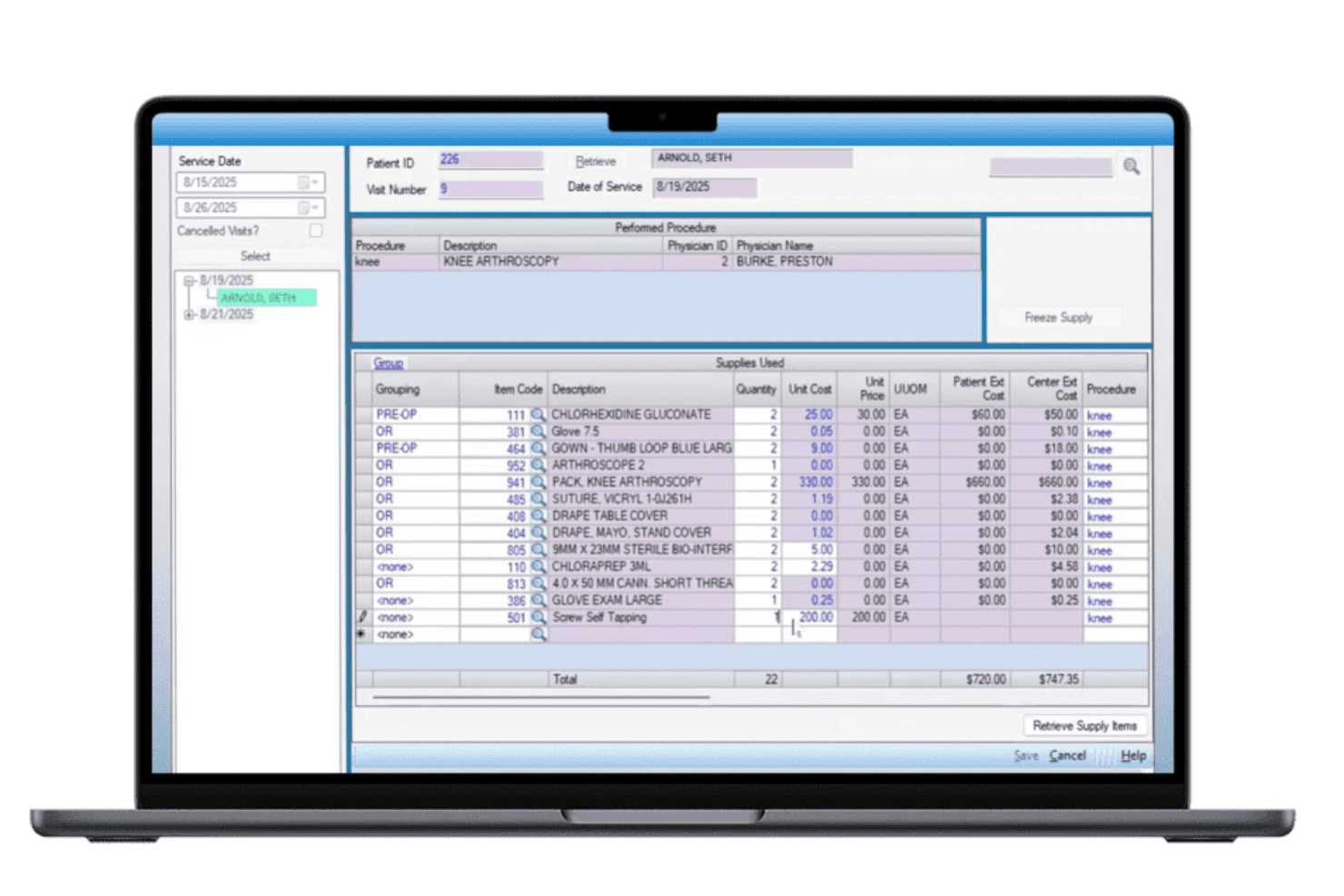
HST Pathways supports ASC claims, RCM, estimates, implant billing and contracts. HST Pathways is an ASC-specific billing and practice management platform that covers claim submission, revenue cycle management, patient estimates, implant and supply billing, and payer contract management.
Who Is HST Pathways Best For?
HST Pathways is a strong fit for ASC billing managers and revenue cycle directors who need a billing platform built specifically around surgery center workflows.
Why I Picked HST Pathways
HST Pathways earns its spot on my shortlist because of how tightly it ties claim submission to ASC-specific reimbursement logic. I particularly like the multi-clearinghouse routing through Waystar, which catches errors before claims reach payers and keeps first-time clean-claim rates high. The Case Profit Estimations module is another feature I find genuinely useful, automatically flagging unprofitable cases before they close so billing managers can course-correct before revenue is lost.
HST Pathways Key Features
- Patient estimates tool: Generates upfront surgical cost estimates that itemize facility, professional, and anesthesia charges for patients.
- Integrated patient engagement: Supports digital pre-assessment and two-way texting with patients about appointments and billing.
- Payer contract auto-calculation: Stores multi-payer contracts and automatically applies reimbursement rates to procedures.
- ASC financial analytics: Delivers real-time access to custom dashboards for case costing, payer mix, and performance benchmarks.
HST Pathways Integrations
HST Pathways offers native integrations with Waystar for claim submission, several clearinghouses for automated insurance verification, and direct bank connections for patient payments. An API is available for custom integrations.
Pros and Cons
Pros:
- Pre-admission patient payments and estimates in platform
- Built-in case profit analytics for ASCs
- Claims scrubbed before submission reduces denials
Cons:
- Report templates require custom configuration
- Limited support for multi-location ASC groups
Learn more about HST Pathways: Best for unified clinical and financial oversight
- Free demo available
- Pricing upon request
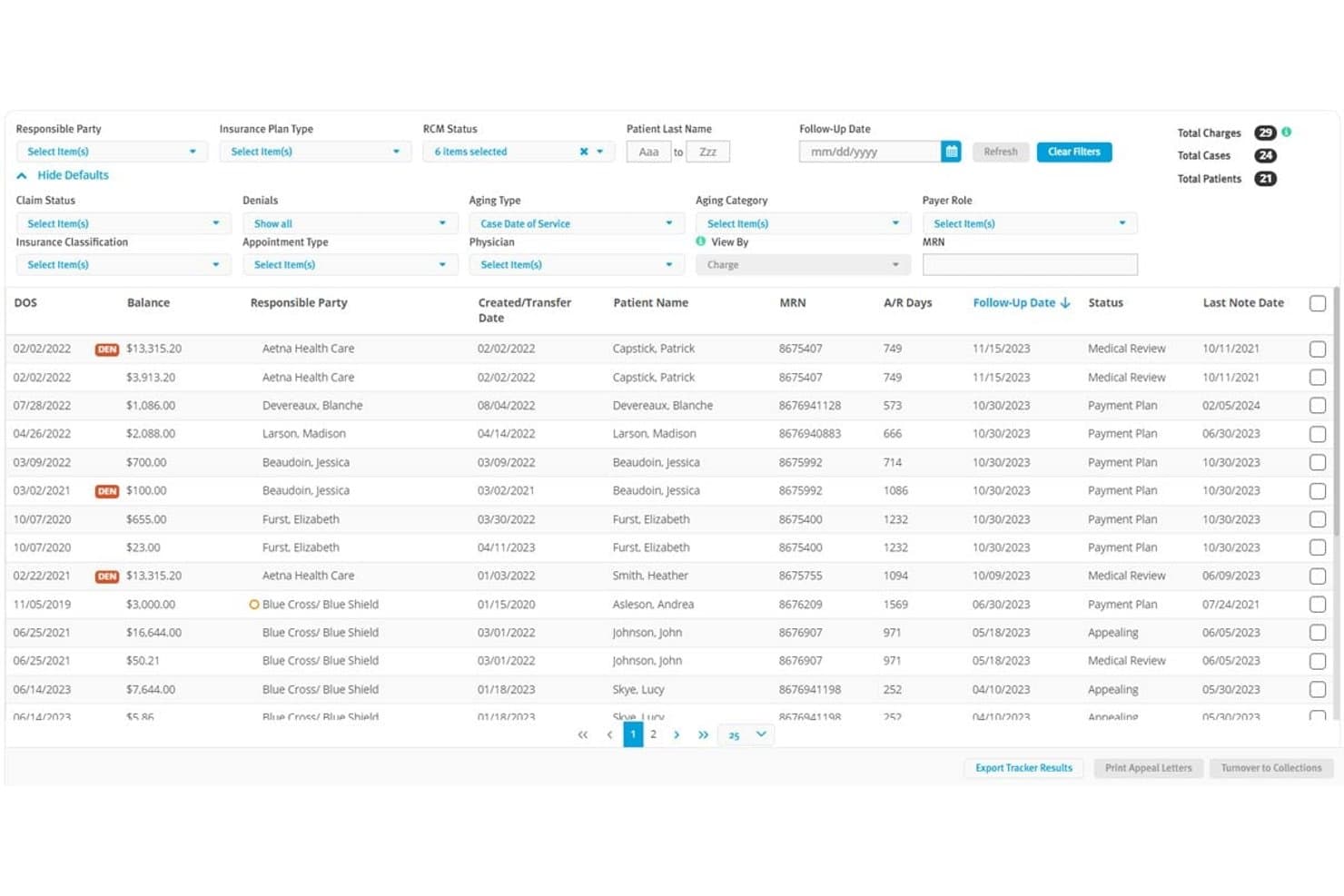
Surgical Information Systems (SIS) offers an RCM Tracker dashboard displaying patient billing cases with filters for responsible party, insurance plan, claim status, aging type, and follow-up dates. SIS Complete is a cloud-based ASC billing and management platform that covers surgical scheduling, clinical documentation, charge entry, claims submission, payer contract management, denial tracking, and financial reporting in a single system.
Who Is Surgical Information Systems (SIS) Best For?
SIS Complete is a strong fit for ASC administrators and revenue cycle directors who need a single platform to manage both clinical operations and billing.
Why I Picked Surgical Information Systems (SIS)
I picked SIS Complete as one of the best because the connection between its clinical documentation and billing modules is genuinely tight. OpNote data from SIS Charts pre-populates charge entry in SIS Office automatically, which means charges move to the clearinghouse within hours of a case closing. I also like that SIS Insights pulls case costing, payer mix, and physician productivity into the same platform, so billing and clinical performance data live in one place.
Surgical Information Systems (SIS) Key Features
- Automated inventory management: Track implants, supplies, and surgical devices at the case level and integrate with ENVI for purchasing.
- Denial and AR tracking tools: Use follow-up worklists and trackers designed specifically for ASC billing cycles and appeals.
- Payer contract storage and management: Store and update multi-payer contracts with built-in fee schedules for expected reimbursement.
- Electronic patient engagement tools: Send appointment reminders, collect pre-op forms, and deliver post-op instructions using secure digital channels.
Surgical Information Systems (SIS) Integrations
SIS Complete offers native integrations with Surescripts, ENVI, Topaz signature devices, and multiple healthcare clearinghouses. An API is available for custom integrations.
Pros and Cons
Pros:
- Robust payer contract management features
- Advanced ASC-specific denial tracking tools
- Unified clinical and billing management platform
Cons:
- Reporting customization options are limited
- Implementation process can be time-consuming
Learn more about Surgical Information Systems (SIS): Best for coding automation in surgical centers
- Free demo available
- Pricing upon request
AdvancedMD ASC combines coding, claims, denials, billing, and financial reports. AdvancedMD ASC is a cloud-based billing and practice management platform built for ambulatory surgical centers, combining ASC-specific coding automation, claim scrubbing, denial management, and financial reporting in a single suite.
Who Is AdvancedMD ASC Best For?
It's a strong fit for independent and small-to-mid-sized ASCs with dedicated billing staff managing high claim volumes across multiple payers.
Why I Picked AdvancedMD ASC
I picked AdvancedMD ASC because its coding automation genuinely stands out for surgical billing. The quick-find CPT and HCPCS code lists, including global billing codes, cut down the time my team spends identifying the right codes for surgical procedures. The Claim Inspector runs 3.5 million edits per claim and includes built-in CMS alerts that flag Medicare claim issues before submission, which is where ASC billing errors tend to be the most costly.
AdvancedMD ASC Key Features
- Denials module: Automatically organizes denied claims into actionable queues for quick follow-up and resolution.
- Integrated payer clearinghouse: Connects to over 1,800 payors for streamlined claim submission and remittance downloads.
- A/R Control Center: Centralizes accounts receivable tracking and work lists within a single dashboard dedicated to ASCs.
- ASC financial and benchmarking reports: Generates recurring, permission-based financial and surgical case reports for administrators and physicians.
AdvancedMD ASC Integrations
AdvancedMD ASC features a native clearinghouse connection supporting over 1,800 payors, and offers an open API for custom integrations with other healthcare platforms and systems.
Pros and Cons
Pros:
- Automated denials workflow tailored to ASCs
- Customizable reporting for administrative and clinical roles
- Advanced claim inspector for surgical coding errors
Cons:
- Lacks ASC contract modeling and underpayment workflows
- No implant or supply pass-through billing
Learn more about AdvancedMD ASC: Best for customizable documentation options
- Free demo available
- Pricing upon request
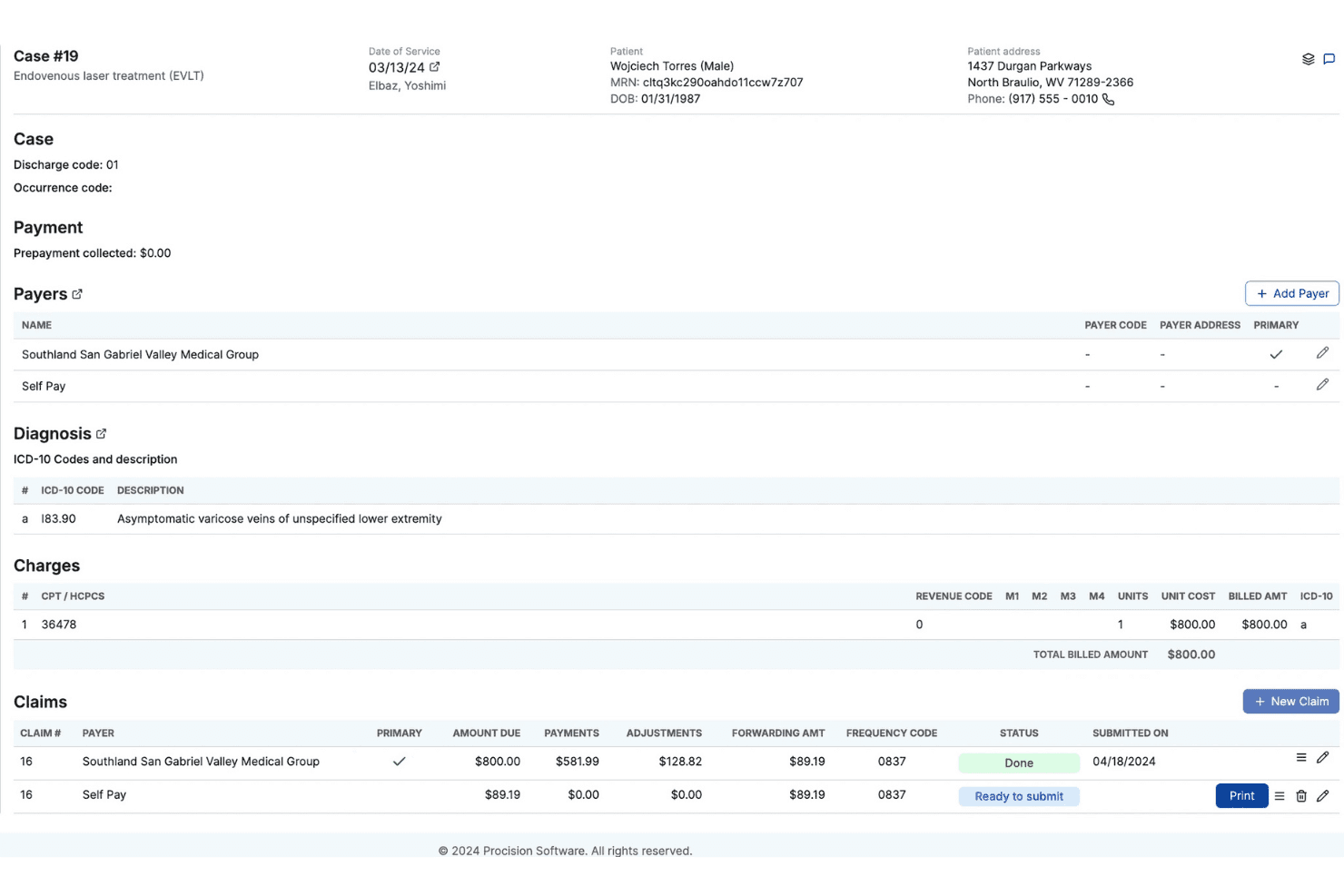
Procision EMR links ASC documentation, RCM, implant billing, and reporting. Procision EMR is an ASC-native platform that combines clinical documentation, revenue cycle management, implant and supply billing, and financial reporting built specifically for ambulatory surgery centers.
Who Is Procision EMR Best For?
Procision EMR is a strong fit for ASC billing managers and administrators who need a single platform covering both clinical documentation and revenue cycle management.
Why I Picked Procision EMR
I've included Procision EMR in my top picks because its customizable chart templates let ASC billing teams document exactly what each surgical case requires. Built-in compliance hard stops flag incomplete charts before they reach claims, reducing denials tied to documentation gaps. The direct data flow between charts and billing means case details move into claim generation without redundant entry.
Procision EMR Key Features
- Automated RCM workflows: Claim submission, tracking, and payments are streamlined within a single platform.
- Integrated materials management: Track and document surgical supplies and implants directly within patient cases.
- ASC financial reporting: Generate detailed reports on case costing, physician productivity, payer mix, and collections.
- Practice portal integration: Coordinate with referring surgeon office EMRs for scheduling, documentation, and billing collaboration.
Procision EMR Integrations
Native integrations include the Practice Portal, which connects with surgeon office EMRs for scheduling and billing collaboration. An API is available for custom integrations. Native integrations with third-party software are not clearly documented.
Pros and Cons
Pros:
- Built-in compliance checks before claims submission
- Automated claim generation from clinical data
- Customizable chart templates for ASC workflows
Cons:
- Lacks published third-party software integrations
- Payer contract management features are limited
Learn more about Procision EMR: Best for built-in specialty-specific templates
- Free demo available
- Pricing upon request
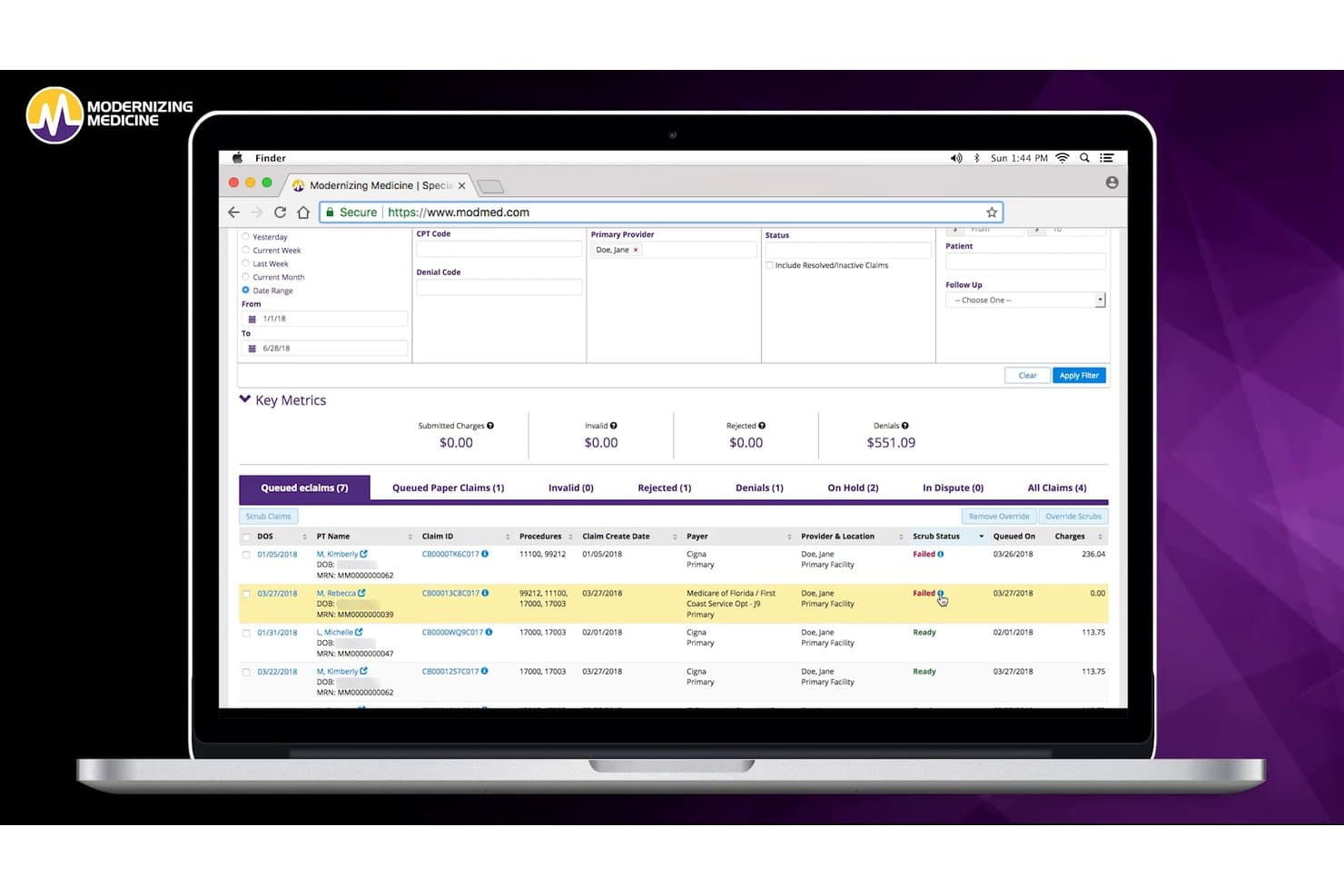
ModMed ASC offers a claims management dashboard displaying queued eclaims, scrub statuses, key billing metrics, and denial tracking for ASC billing workflows. ModMed ASC is a specialty-focused ASC billing and clinical documentation platform that connects procedure coding, facility claim generation, claims scrubbing, and financial reporting within a single system built specifically for ambulatory surgery centers.
Who Is ModMed ASC Best For?
ModMed ASC is a strong fit for gastroenterology and ophthalmology ASCs already running their practice on the ModMed ecosystem.
Why I Picked ModMed ASC
I picked ModMed ASC as one of the best because its built-in specialty-specific templates genuinely set it apart for ASC billing. The GI and ophthalmology surgical narratives auto-populate procedure codes directly from clinical documentation, so billing staff aren't manually reconstructing what happened in the OR. The system also flags high-denial-risk claims before submission, catching coding gaps at the source rather than after a payer rejection.
ModMed ASC Key Features
- Integrated analytics dashboards: Track A/R, procedure volumes, and provider productivity in one real-time reporting hub.
- Automated eligibility checks: Instantly verify insurance eligibility for scheduled ASC procedures within the workflow.
- ASC compliance reporting: Generate Joint Commission, AAAHC, Quad A, CMS, and ACHC accreditation reports directly from the system.
- Multi-role concurrent charting: Enable nurses, anesthesiologists, and surgeons to document simultaneously in the ASC chart.
ModMed ASC Integrations
ModMed ASC offers native integrations with ModMed Practice Management, gGastro EHR, Klara, Relatient, and TouchMD, and supports ModMed Records Exchange for HIE connectivity. An API is available for custom integrations.
Pros and Cons
Pros:
- Automated ASC compliance reporting and dashboards
- Real-time coding suggestions in clinical workflows
- Specialty-specific templates for common ASC procedures
Cons:
- Limited contract modeling for payer reimbursement
- Implant pass-through billing workflows not robust
Learn more about ModMed ASC:
Other Billing Software for ASCs
Here are some additional billing software for ASCs options that didn’t make it onto my shortlist, but are still worth checking out:
- 11Provation ApexBest for evidence-based procedure documentation
- 12Picis Experior SuiteBest for combining clinical and billing data
- 13OmniMDBest for EHR and billing platform integration
- 14CollaborateMDBest for real-time claim tracking
- 15CureMDBest for rapid claims scrubbing technology
- 16CareCloudBest for robust appointment scheduling tools
- 17Greenway HealthBest for compliance-ready documentation features
- 18OASIS by MednetBest for integrated patient payment options
- 19Nextech ASCBest for specialty-specific workflow design
- 20MedicsCloudBest for analytics-driven reimbursement insights
How I Evaluate Billing Software for ASCs
I split my evaluation into core requirements—like ASC-specific claim coding and implant billing—and differentiating factors that separate the best platforms from the rest.
Core Functionality (Table Stakes For This List)
When I'm selecting tools for my list, I rank each one on a scale from 0 (does not offer the functionality) to 5 (excels in this area) for each core functionality listed below. Then, I calculate the tool's total score into a percentage. Each tool needs to achieve a minimum total score of 55% to be considered for inclusion.
- ASC-Specific Claim Coding: I check for support of CPT, HCPCS, ICD-10, ASC payment groupings, and modifiers like -SG or -59 that are common in outpatient surgical billing.
- Implant & Supply Billing: High-cost implant tracking matters. I look for pass-through billing logic, invoice attachment, and cost reconciliation for devices and supplies.
- Claim Scrubbing & Submission: Clean claims start before submission. I evaluate whether the platform offers real-time edits and clearinghouse connectivity for EDI processing.
- Payer Contract Management: Multi-payer contract storage with expected reimbursement calculations helps catch underpayments across commercial and government payers.
- Denials & AR Management: I look for denial tracking with appeals workflows and root-cause analysis so your team can resolve rejections before they age out.
- ASC Financial Reporting: Reports covering case costing, payer mix, and physician productivity give administrators the visibility they need during month-end close.
Once I have a list of tools that meet the criteria, I consider what sets each platform apart.
Differentiating Factors (What Sets Vendors Apart)
Here's how I compare and contrast different vendors:
Standout Features
Multi-payer contract modeling is a big differentiator. I look for tools that flag underpayments by comparing actual reimbursements against contracted rates across commercial and government payers. Real-time eligibility verification also matters—platforms that run automated pre-op insurance checks and estimate patient responsibility during scheduling help prevent surprises on the day of surgery. I also evaluate ASC benchmarking dashboards that compare your center's clean claim rate, days in A/R, and reimbursement per case against industry averages by specialty.
Beyond Features
Specialty and case-mix fit is a key factor I evaluate. An orthopedic ASC with high-cost implants has very different billing needs than a GI center running high-volume endoscopies. Integration with the ASC tech stack also matters—I check for clearinghouse connectivity and bi-directional data exchange with ASC-focused EHRs and anesthesia billing systems. Compliance is another area I consider, including HIPAA-compliant hosting, audit trail documentation, and adherence to CMS ASC payment system rules.
How to Choose Billing Software for ASCs
It’s easy to get bogged down in long feature lists and complex pricing structures. To help you stay focused as you work through your unique software selection process, here’s a checklist of factors to keep in mind:
| Factor | What to Consider |
|---|---|
| FactorScalability | What to ConsiderWill the software handle increased case volume, new specialties, or additional facilities as your ASC grows? Assess for practical limits and upgrade paths. |
| FactorIntegrations | What to ConsiderCan the system reliably exchange data with your EHR, anesthesia billing, and clearinghouse partners? Check for direct, bi-directional interfaces with your existing tech stack. |
| FactorCustomizability | What to ConsiderAre workflows, forms, and reporting fields adaptable to your site’s processes, specialties, and payers? Avoid tools that force rigid templates or billing logic. |
| FactorEase of use | What to ConsiderWould frontline billing and clinical staff pick it up quickly? Ask for demos and see how long common tasks actually take. Consider intuitive navigation and workload impact. |
| FactorImplementation and onboarding | What to ConsiderDoes the vendor offer ASC-specific training, data migration services, and payer setup support? Understand available resources and timelines for full go-live. |
| FactorCost | What to ConsiderHow are licensing, support, and transaction fees structured? Look for tiered pricing, volume discounts, and hidden charges that could affect your total cost of ownership. |
| FactorSecurity safeguards | What to ConsiderDoes the vendor support HIPAA-compliant hosting, granular access controls, and regular audits? Ensure safeguards match not only legal but also organizational standards. |
| FactorSupport availability | What to ConsiderWhat are support hours and escalation paths? Make sure live help is available during your busiest times—especially around claims deadlines and month-end close. |
What Is Billing Software for ASCs?
Billing software for ASCs is specialized technology designed to manage claims, payments, coding, and reimbursement for ambulatory surgery centers. It helps teams handle ASC-specific requirements for implant tracking, multi-payer contracts, claim scrubbing, and compliance reporting—addressing unique workflows that are very different from general medical billing systems.
Features of Billing Software for ASCs
When selecting billing software for ASCs, keep an eye out for the following key features:
- ASC-specific claim coding: Supports CPT, HCPCS, ICD-10, payment groupings, and ASC modifiers to ensure accurate, compliant billing for outpatient surgical cases.
- Implant and supply billing: Tracks and bills high-cost implants, devices, and supplies separately, with invoice attachment for pass-through reimbursement.
- Claim scrubbing and EDI submission: Scrubs claims for errors and submits them electronically to clearinghouses, reducing denials and expediting payment.
- Multi-payer contract management: Stores multiple payer contracts, calculates expected reimbursement, and flags underpayments for better financial oversight.
- Denials and AR management: Tracks claim denials, automates appeals, and helps manage accounts receivable follow-up throughout the billing cycle.
- ASC financial reporting: Generates reporting on case costing, physician productivity, payer mix, and reimbursement performance specific to surgery centers.
- Integration with ASC systems: Connects seamlessly with EHRs, anesthesia billing, inventory, and clearinghouse partners to keep data synchronized.
- Security and compliance tools: Includes HIPAA-compliant hosting, audit trails, and access controls to meet healthcare security standards and regulatory requirements.
- Customizable workflows: Lets you adapt billing, claims, and reporting workflows to align with your surgery center’s procedures and specialty mix.
- Real-time eligibility verification: Automates insurance verification, captures prior authorizations pre-op, and estimates patient responsibility before the date of surgery.
Benefits of Billing Software for ASCs
Implementing billing software for ASCs provides several benefits for your team and your business. Here are a few you can look forward to:
- Reduced claim denials: Automated claim scrubbing and payer rule checks help catch errors before submission, leading to more approvals and faster payment.
- Accurate implant billing: Line-item tracking and invoice attachments ensure high-cost implants and supplies are billed and reimbursed correctly.
- Improved contract oversight: Multi-payer contract management tools make it easier to detect underpayments and confirm proper reimbursement for each procedure.
- Streamlined AR and denial management: Automated AR follow-up and denial tracking free up staff time and help prevent delayed revenue.
- Better compliance and audit readiness: Built-in HIPAA safeguards, audit trails, and regulatory reporting features support compliance with healthcare standards.
- Actionable financial insights: ASC-specific financial reports and benchmarking dashboards highlight trends, case costs, and payer mix for better business decisions.
- Enhanced patient experience: Real-time eligibility checks and clear responsibility estimates reduce billing surprises and help patients understand their coverage.
Costs and Pricing of Billing Software for ASCs
Selecting billing software for ASCs requires an understanding of the various pricing models and plans available. Costs vary based on features, team size, add-ons, and more. The table below summarizes common plans, their average prices, and typical features included in billing software for ASCs solutions:
Plan Comparison Table for Billing Software for ASCs
| Plan Type | Average Price | Common Features |
|---|---|---|
| Plan TypeFree Plan | Average Price$0 | Common FeaturesBasic claim entry, limited reporting, manual submission tools, and basic user support. |
| Plan TypePersonal Plan | Average Price$100-$300/month | Common FeaturesStandard coding support, basic claim scrubbing, multi-payer submission, and standard financial reports. |
| Plan TypeBusiness Plan | Average Price$500-$1,200/month | Common FeaturesAdvanced contract management, automated appeals, ASC-specific reporting, supply billing, and clearinghouse integration. |
| Plan TypeEnterprise Plan | Average Price$1,500-$3,000+/month | Common FeaturesCustom integrations, configurable workflows, dedicated onboarding, enhanced compliance features, and priority support. |
Billing Software for ASCs FAQs
Here are some answers to common questions about billing software for ASCs:
What makes billing software for ASCs different from general medical billing systems?
Billing software for ASCs addresses unique coding rules, implant billing, and contract management needs specific to ambulatory surgery centers that general medical billing systems typically don’t handle well.
Can ASC billing software integrate with our EHR and inventory systems?
Yes, most ASC billing platforms offer bi-directional integration with popular ASC-focused EHRs and inventory tools, helping you synchronize scheduling, documentation, and billing information.
How does ASC billing software help manage high-cost implants and supplies?
These systems track implants and supplies as line items and support attaching invoices, allowing you to bill payers for reimbursable costs and reconcile charges efficiently.
What should we know about compliance and security when evaluating ASC billing platforms?
Look for HIPAA-compliant hosting, audit trails, and configurable user access controls. These safeguard patient data and support your center during audits or payer reviews.
How quickly can we expect to implement new ASC billing software?
Implementation timelines vary but can range from a few weeks to several months. Factors include data migration complexity, training needs, and the level of support the vendor provides.