

Software-ul EMR pentru gastroenterologie este un tip de sistem de dosare medicale electronice conceput pentru a răspunde nevoilor clinice, administrative și de facturare ale furnizorilor de servicii medicale gastrointestinale. Dacă sunteți în căutarea celui mai bun software EMR pentru gastroenterologie, aveți nevoie de instrumente concepute pentru fluxurile de lucru din endoscopie, documentarea procedurilor de specialitate și respectarea cerințelor unice de raportare. Cu programări strânse, gestionarea complexă a cazurilor și presiunea constantă de a îmbunătăți rezultatele, echipa dumneavoastră nu își poate permite o tehnologie care vă încetinește sau adaugă obstacole. Acest ghid reunește opțiunile software potrivite pentru cabinetele de gastroenterologie, astfel încât să petreceți mai puțin timp cu cercetarea și mai mult timp concentrându-vă asupra îngrijirii pacienților, eficienței și dezvoltării cabinetului.
Why Trust Our Software Recommendations
6,700+
Reviews
20
Industry experts
16+
Evaluation factors
14
Years
Our team has been testing and reviewing software since 2012. As medical practice leaders ourselves, we know how difficult—and important—it is to choose the right software.
For this guide, we evaluated tools using hands-on testing and independent research, scoring tools using our selection criteria.
Our reviews reflect our human editorial judgment, not a sales pitch.
Cel mai bun software EMR pentru gastroenterologie
Score legend (out of 5)
- Excellent4.5–5
- Good4–4.4
- Average3–3.9
- Below average2–2.9
- Poor1–1.9
Sorted by: Default
| Tool | Starting Price | Website | |||||||
|---|---|---|---|---|---|---|---|---|---|
Best for its robust mobile support | 4.3 out of 5 | 5 | 4 | 4 | 4 | 4 | 5 | Pricing upon request Free demo available | Website |
Best for comprehensive workflow management | 3.7 out of 5 | 3 | 4 | 3 | 4 | 4 | 4 | Pricing upon request Free demo available | Website |
Best for large-scale health systems | 3.8 out of 5 | 4 | 3 | 3 | 5 | 4 | 4 | Pricing upon request Not available | Website |
Best for its data analytics capabilities | 3.3 out of 5 | 3 | 3 | 3 | 4 | 4 | 3 | $499/user/month Free demo available | Website |
Best for GI billing and surveillance automation | 3.5 out of 5 | 2 | 4 | 4 | 4 | 4 | 3 | $229/user/month Free demo available | Website |
Best for multi-specialty practices | 3.5 out of 5 | 3 | 4 | 2 | 4 | 4 | 4 | Pricing upon request Free demo available | Website |
Best for AI-driven endoscopy documentation | 3.3 out of 5 | 4 | 2 | 3 | 4 | 3 | 4 | Pricing upon request Free demo available | Website |
Best for AI-aided endoscopy procedure notes | 3.3 out of 5 | 5 | 3 | 4 | 2 | 2 | 4 | Pricing upon request Free demo available | Website |
Best for GI coding and pathology-linked recalls | 3.8 out of 5 | 4 | 4 | 4 | 4 | 3 | 4 | $200/prescriber/month Free demo available | Website |
Best for flexible and scalable solutions | 3.3 out of 5 | 2 | 3 | 3 | 4 | 4 | 4 | Pricing upon request Free demo available | Website |


Recenzii ale celor mai bune programe EMR pentru gastroenterologie
 Best for its robust mobile support
- Free demo available
- Pricing upon request
Visit WebsiteCustomer Rating:4.5/5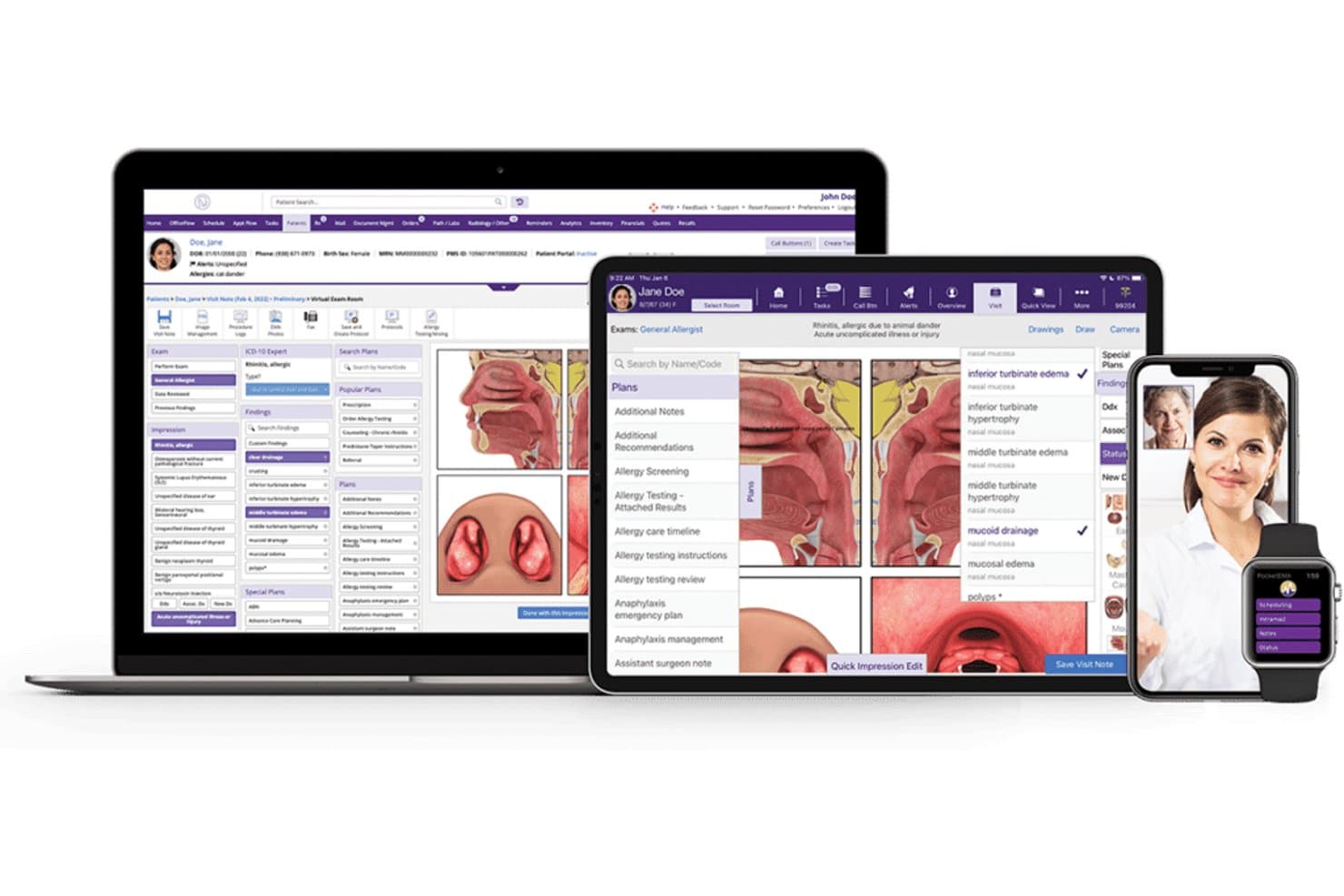
Here's the EMR software interface of ModMed in desktop and mobile view. ModMed, also known as Modernizing Medicine, is an integrated healthcare platform that combines specialty-specific EHR, practice management, telehealth, patient engagement, and mobile tools.
Who Is ModMed Best For?
ModMed works well for specialty medical practices that need mobile access to clinical and administrative workflows from smartphones and tablets.
Why I Picked ModMed
I picked ModMed because its mobile capabilities help providers access patient information, review schedules, document encounters, and manage clinical tasks while away from a desktop computer. Its specialty-focused workflows also connect mobile charting with practice management, telehealth, and patient engagement tools. This makes ModMed a strong option for practices that want an integrated healthcare platform with reliable mobile functionality.
ModMed Key Features
- Mobile EHR access: Review patient charts, document visits, manage schedules, and complete clinical tasks from supported mobile devices.
- Specialty-specific workflows: Use templates and clinical tools designed around the needs of different medical specialties.
- Practice management: Manage appointment scheduling, billing, patient information, and administrative tasks from one platform.
- Integrated telehealth: Conduct virtual visits while keeping documentation and patient information connected to the EHR.
ModMed Integrations
ModMed connects its EHR with practice management, telehealth, revenue cycle management, analytics, and patient engagement tools. It also supports connections with laboratories, pharmacies, clearinghouses, and other healthcare services to streamline clinical and administrative data exchange.
Pros and Cons
Pros:
- Intuitive and user-friendly interface
- Integrates with a variety of medical tools and services
- Excellent mobile support for on-the-go access
Cons:
- Limited customization options
- Higher pricing tier compared to some competitors
Learn more about ModMed: Best for comprehensive workflow management
- Free demo available
- Pricing upon request
Visit WebsiteCustomer Rating:4.3/5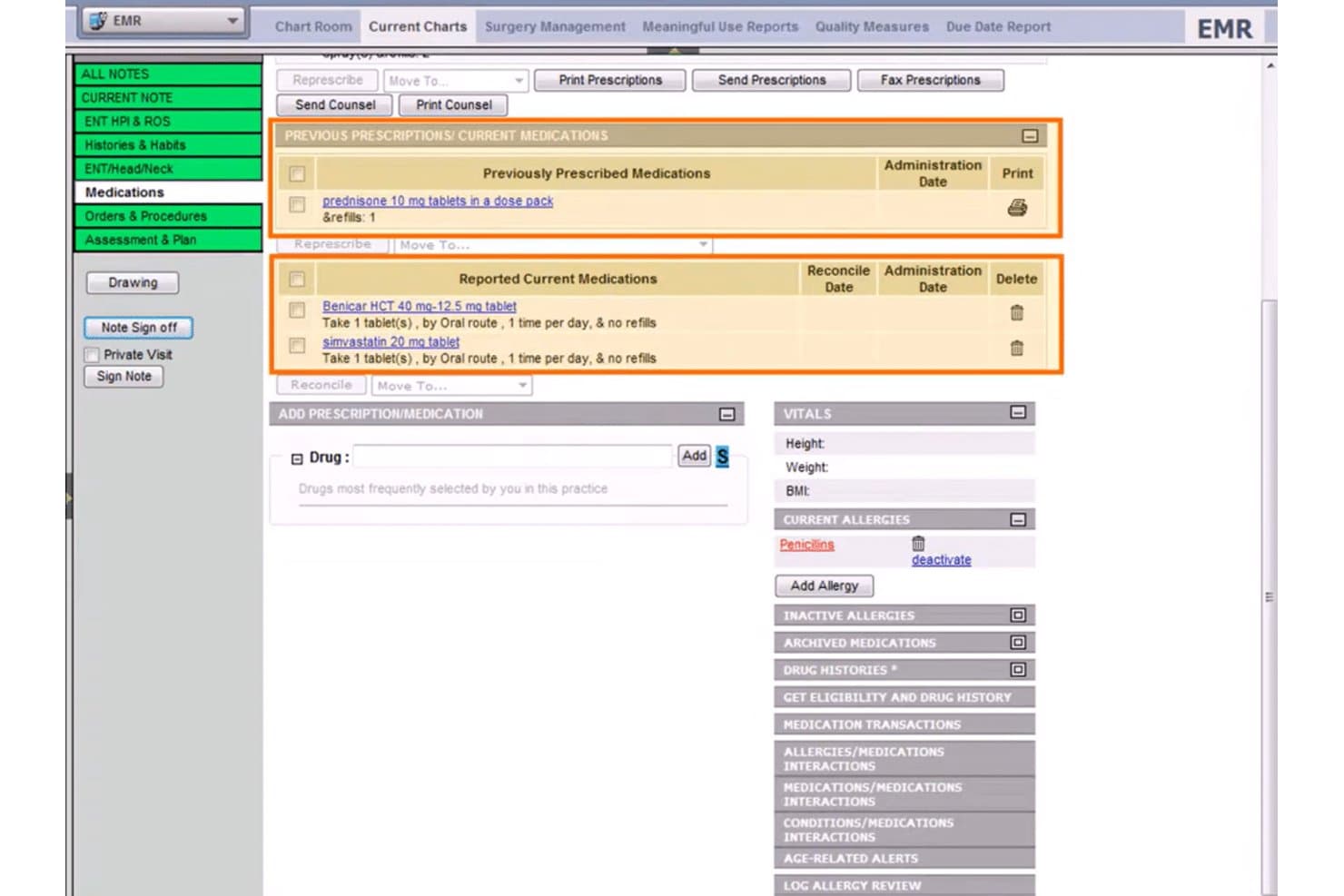
Welcome to the patient medications tab inside WRS Health. WRS Health is a cloud-based gastroenterology EMR and practice management platform that combines GI-specific clinical documentation, procedure reporting, scheduling, and integrated billing.
Who Is WRS Health Best For?
WRS Health fits GI practices that want clinical documentation, scheduling, and billing managed within a single platform—from solo physicians to multi-location groups.
Why I Picked WRS Health
WRS Health earns its spot on my shortlist because it ties clinical documentation, scheduling, and billing into one connected workflow built specifically for GI. I like how the GI superbill auto-populates charges as procedures are charted, which cuts the lag between documentation and claim submission. The built-in procedure queue walks teams through colonoscopy and endoscopy from pre-op to post-op, with consent forms and global-period tracking handled along the way.
WRS Health Key Features
- AI scribe: Captures GI patient histories—including abdominal pain, GERD, and colonoscopy follow-ups—and pre-fills templates automatically.
- MIPS quality reporting: Tracks GI-specific measures like colorectal cancer screening, IBD monitoring, and hepatitis C management for compliance reporting.
- Digital consent management: Stores e-signed consent forms for colonoscopy, endoscopy, and liver biopsy directly in the patient chart.
- Online patient intake forms: GI-specific questionnaires—including colonoscopy pre-screening and IBS/IBD symptom trackers—flow directly into the patient record.
WRS Health Integrations
WRS Health supports integrations with Surescripts, Medicity, OptumInsight, EMR Direct phiMail, and MDToolBox, plus two-way lab interfaces. It also offers FHIR and EDI connectivity for custom data exchange.
Pros and Cons
Pros:
- Inbound fax routing reduces result-handling work
- Prebuilt GI templates shorten procedure charting
- GI procedure queues connect notes to charges
Cons:
- Patient registration can create duplicate accounts
- ASC and anesthesia workflows remain undocumented
Learn more about WRS Health: 3Best for large-scale health systems
Epic
- Not available
- Pricing upon request
Visit WebsiteCustomer Rating:3.9/5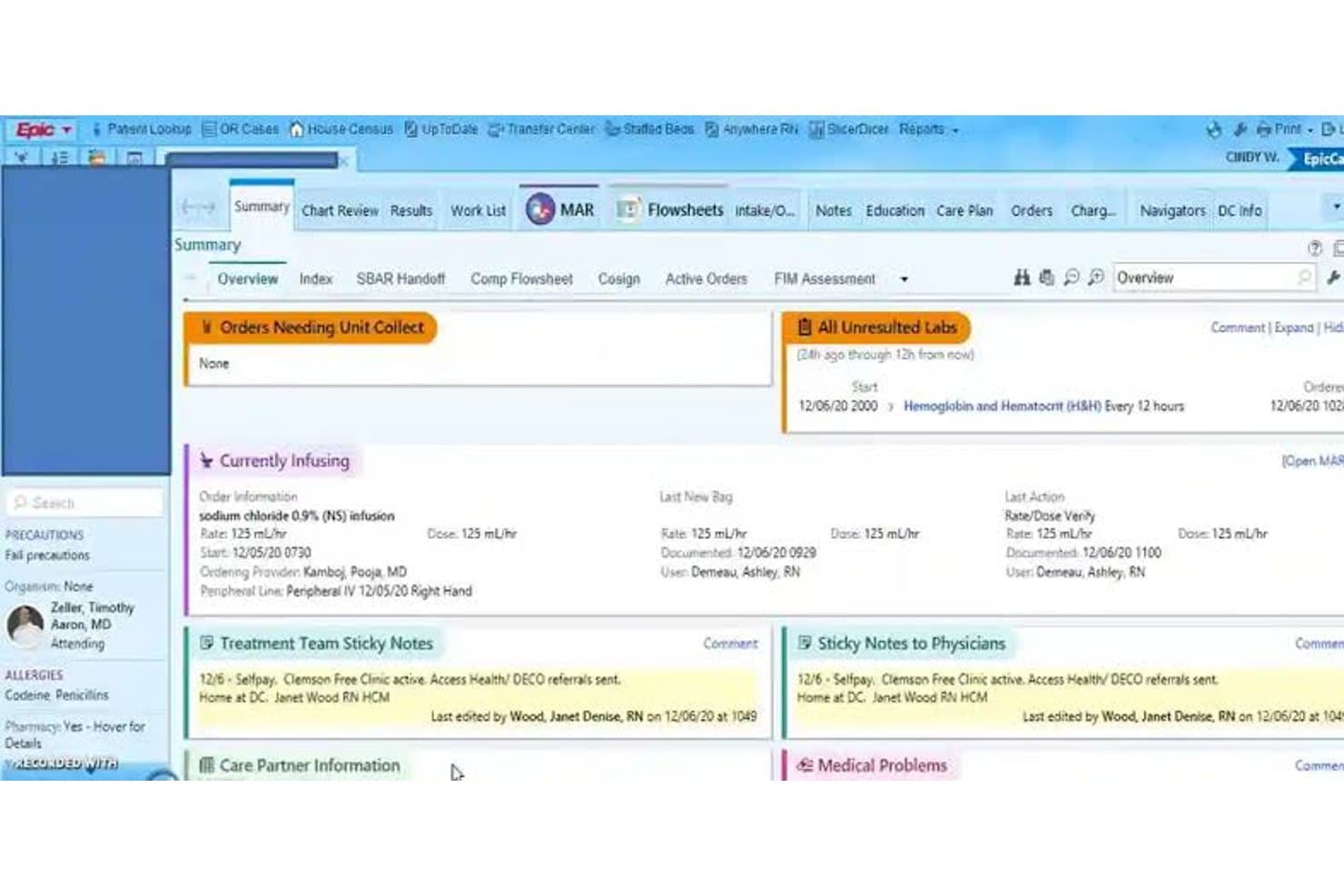
Epic patient care summary dashboard Epic is a comprehensive healthcare software platform that combines electronic health records, patient engagement, telehealth, revenue cycle tools, and enterprise-wide clinical workflows.
Who Is Epic Best For?
Epic works well for large hospitals, academic medical centers, and multi-site health systems that need a scalable platform for managing complex clinical, operational, and patient care workflows.
Why I Picked Epic
I picked Epic because it is built to support large, highly complex healthcare organizations. Its broad feature set connects clinical documentation, scheduling, billing, patient communication, analytics, and care coordination across departments and facilities. Epic’s scalability and interoperability also make it a strong option for health systems that need a unified platform capable of supporting extensive provider networks and large patient populations.
Epic Key Features
- Enterprise EHR: Manage clinical documentation, orders, medications, patient histories, and care plans across multiple departments.
- Patient engagement: Give patients access to appointments, test results, messages, bills, and telehealth services through digital tools.
- Practice and revenue cycle management: Support scheduling, claims, billing, payments, and administrative workflows across the organization.
- Telehealth capabilities: Enable virtual visits and remote care while keeping documentation connected to the patient record.
Epic Integrations
Epic supports interoperability with laboratories, pharmacies, imaging systems, health information exchanges, medical devices, and third-party healthcare applications. Its integration tools help large health systems exchange clinical and administrative data across internal departments and external care networks.
Pros and Cons
Pros:
- Strong interoperability and integrations
- Extensive suite of features
- Highly scalable for large health systems
Cons:
- Implementing the system across a large organization may be challenging
- Pricing and contract terms can be complex due to customization
Learn more about Epic: Best for its data analytics capabilities
- Free demo available
- From $499/user/month
Visit WebsiteCustomer Rating:3.4/5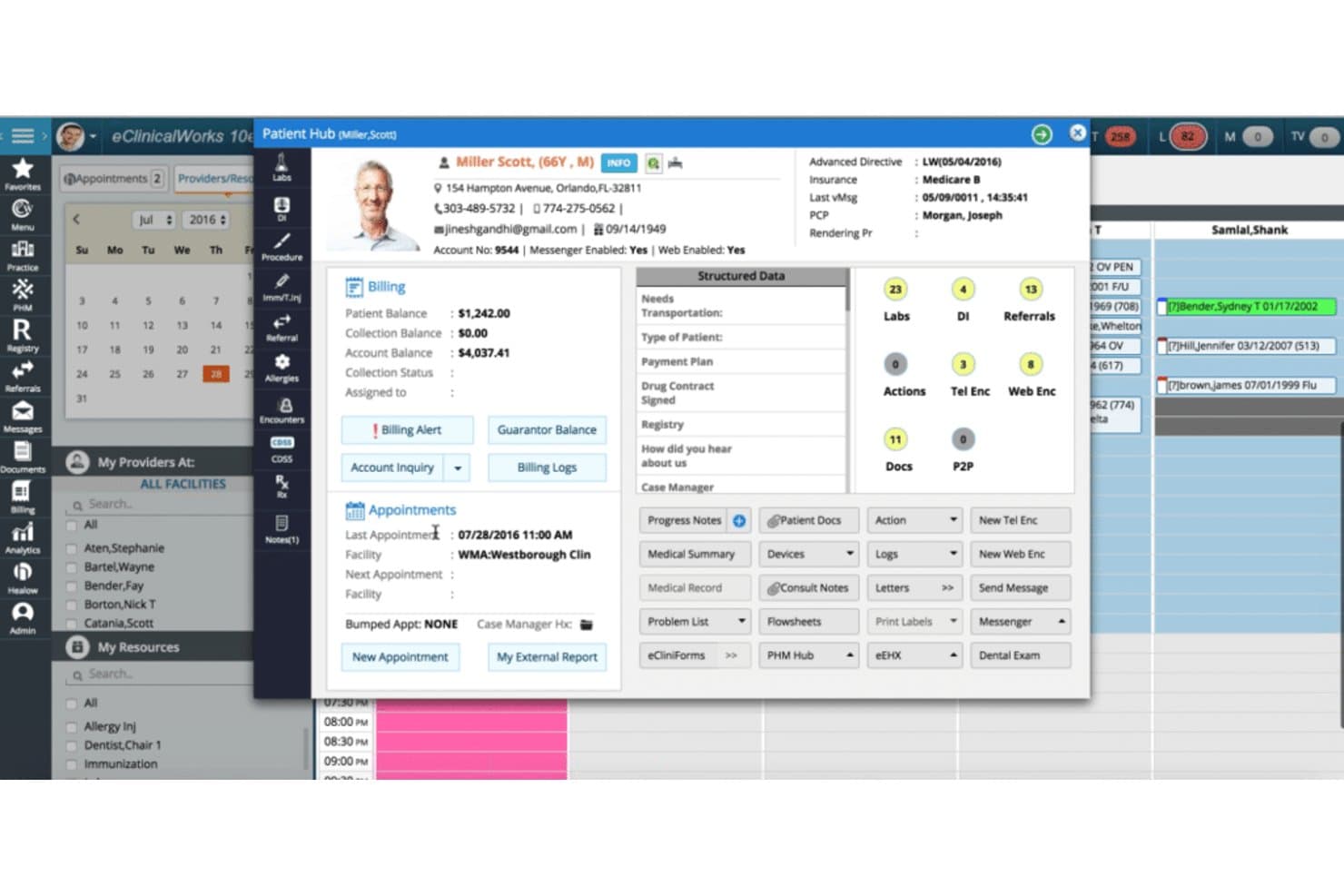
The patient hub of eClinicalWorks provides all the information necessary to provide excellent patient care. eClinicalWorks is a healthcare IT platform that combines electronic health records, practice management, medical billing, patient engagement, and data analytics tools.
Who Is eClinicalWorks Best For?
eClinicalWorks works well for healthcare organizations that want to use clinical, operational, and financial data to improve practice performance and patient care.
Why I Picked eClinicalWorks
I picked eClinicalWorks because its analytics capabilities help practices monitor performance across clinical and administrative workflows. Healthcare organizations can use dashboards and reporting tools to evaluate patient outcomes, identify operational bottlenecks, track revenue cycle performance, and support more informed decisions. Its combination of analytics, interoperability, EHR, and billing tools makes it a strong option for practices that want a data-driven healthcare platform.
eClinicalWorks Key Features
- Data analytics dashboards: Monitor clinical, financial, and operational performance through centralized reports and visual dashboards.
- Electronic health records: Manage patient histories, clinical documentation, orders, prescriptions, and care plans.
- Practice management: Handle scheduling, billing, claims, patient registration, and other administrative processes.
- Interoperability tools: Exchange patient information with connected healthcare organizations and external systems.
eClinicalWorks Integrations
eClinicalWorks supports connections with laboratories, pharmacies, billing systems, imaging services, clearinghouses, and other healthcare IT platforms. These integrations help practices exchange clinical and financial data while maintaining more complete patient records.
Pros and Cons
Pros:
- Comprehensive suite of healthcare IT tools
- Strong interoperability with other systems
- Advanced data analytics capabilities
Cons:
- Some users report that customer service can be improved
- Steep learning curve for new users
Learn more about eClinicalWorks: Best for GI billing and surveillance automation
- Free demo available
- From $229/user/month
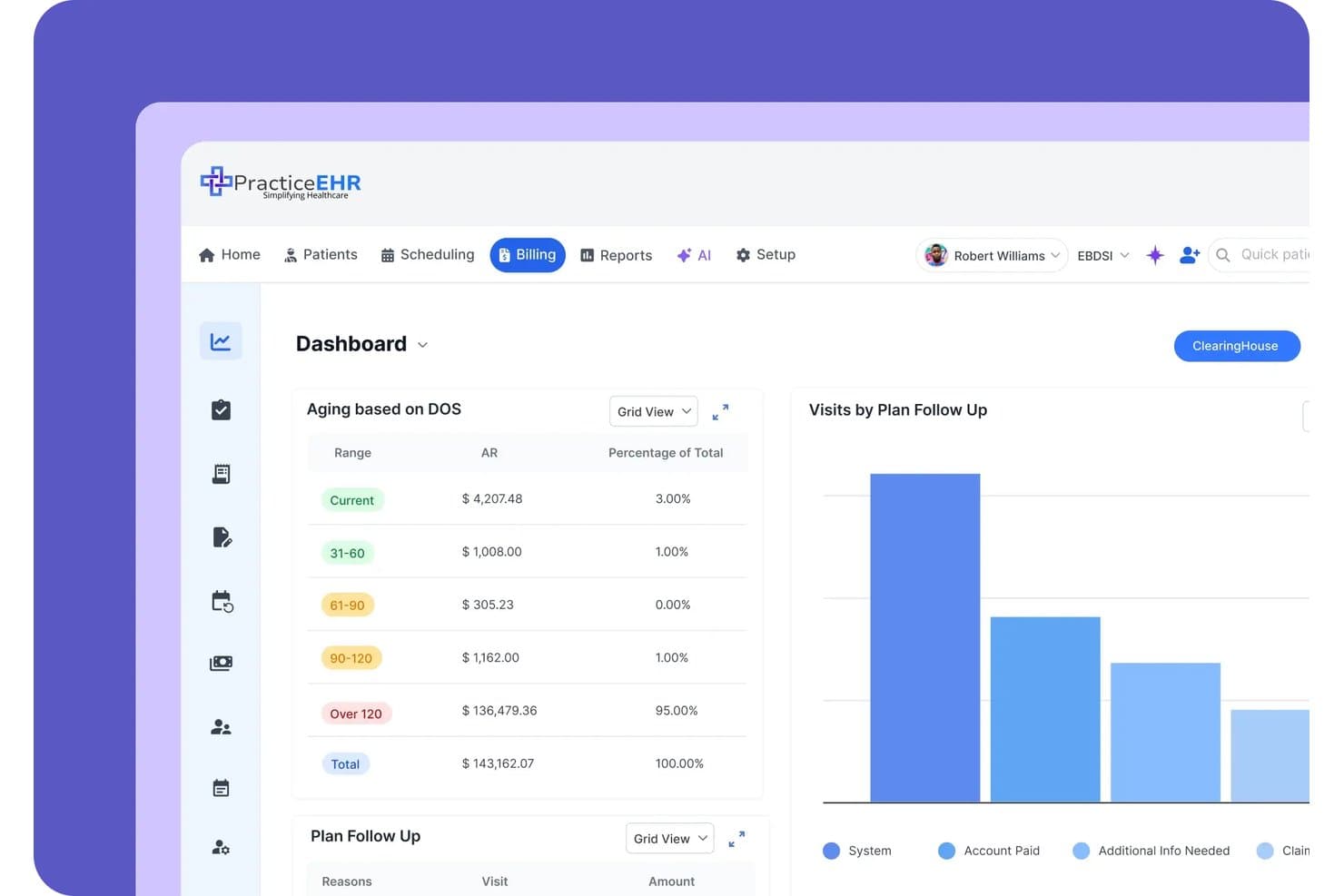
Practice EHR tracks aging AR and plan follow-up data on one billing dashboard. Practice EHR is a cloud-based EHR, practice management, and revenue cycle management platform built for independent practices, with GI-specific workflows spanning clinical documentation, pathology-linked surveillance recalls, ASC billing, and AI-assisted coding and claim editing.
Who Is Practice EHR Best For?
Practice EHR fits independent GI practices that want billing automation and surveillance recall workflows without managing separate RCM or PM systems.
Why I Picked Practice EHR
Practice EHR earns its spot on my shortlist because its billing automation is genuinely built around GI workflows, not retrofitted from a generic template. I like that the AI Claim Editor checks claims line by line and flags denial risk before submission, which matters when you're billing complex ASC cases with both facility and professional components. Pathology results link directly to scope cases and automatically trigger 3-, 5-, or 10-year surveillance recalls, cutting the manual follow-up work that bogs down independent GI practices.
Practice EHR Key Features
- AI Scribe: Transcribes patient visits in 20+ languages and auto-drafts SOAP notes with suggested ICD/CPT codes for provider review.
- GIQuIC registry reporting: Automatically submits quality data, including adenoma detection rate, to the GI quality registry for MIPS compliance.
- Biologic prior authorization tracking: Monitors prior auth status and visit limits for IBD biologics like Humira, Stelara, and Entyvio.
- AI no-show prediction: Scores each appointment for cancellation risk so your front desk can prioritize outreach before a scope slot goes to waste.
Practice EHR Integrations
Practice EHR integrates with LabCorp, Quest, Kno2, Carequality, TEFCA, Surescripts, and unnamed endoscopy report writers. It offers a FHIR R4 API for custom integrations and supports HL7 connections with imaging centers.
Pros and Cons
Pros:
- AI claim editing flags denial risks
- Supports dual ASC and professional billing
- Automates pathology-driven surveillance recalls
Cons:
- Template setup requires detailed staff input
- Structured procedure documentation remains underdeveloped
Learn more about Practice EHR: Best for multi-specialty practices
- Free demo available
- Pricing upon request
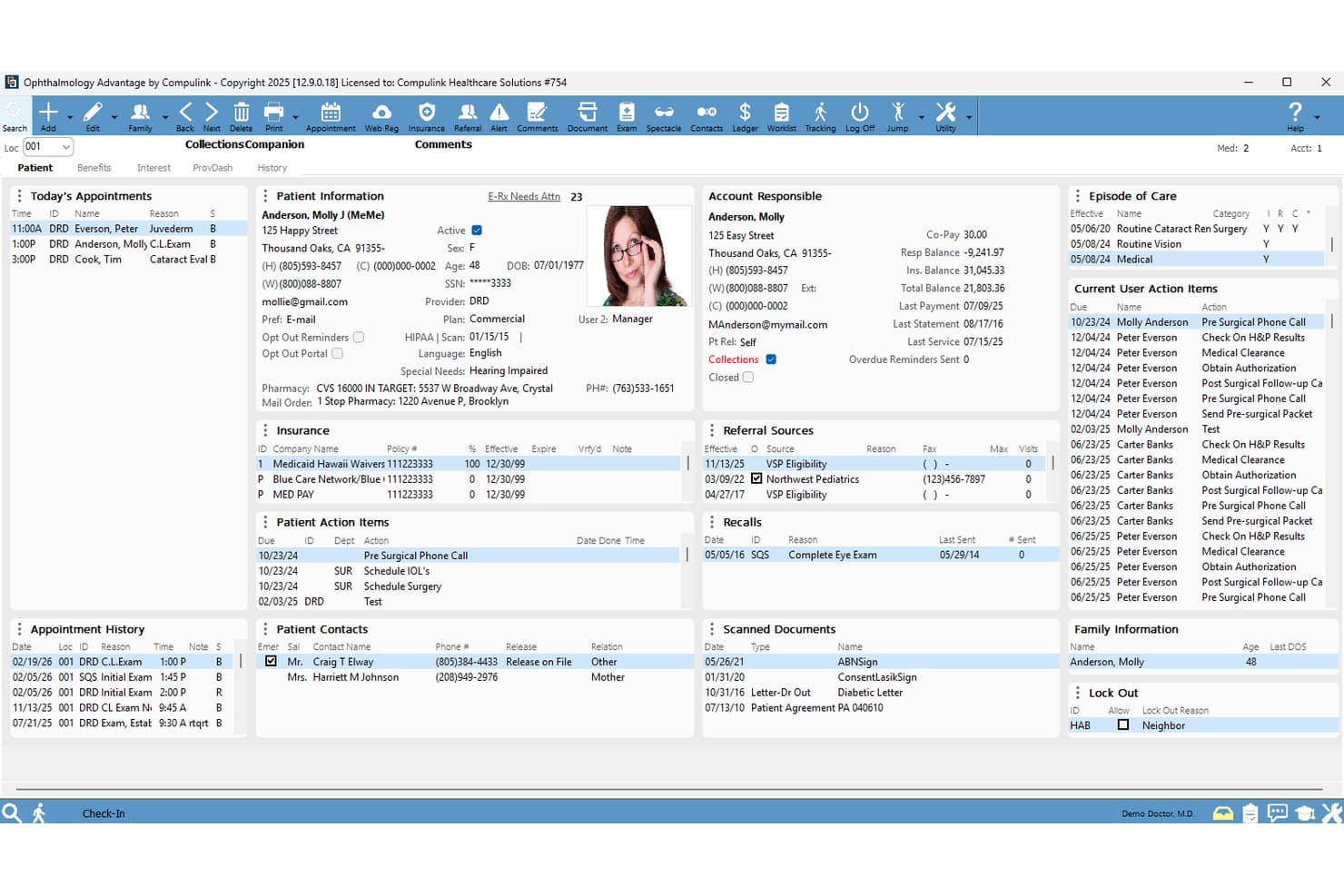
Here's a screenshot of the patient portal inside Compulink Healthcare Solutions. Patient records such as diagnosis and medical history is securely stored here to provide not just gastroenterology care solutions. Compulink Healthcare Solutions is a specialty-focused EMR platform that combines GI-specific clinical documentation, procedure reporting, scheduling, and integrated revenue cycle management tools in a single database.
Who Is Compulink Healthcare Solutions Best For?
Compulink is a strong fit for GI practices that also run an ambulatory surgery center and need one system to manage clinic scheduling, procedure documentation, and billing across both settings.
Why I Picked Compulink Healthcare Solutions
I picked Compulink Healthcare Solutions because it's one of the few GI EMR platforms that genuinely handles both a clinic and an ambulatory surgery center from a single database. I especially like how its combined clinic/ASC scheduling coordinates procedure rooms, anesthesia availability, and recovery capacity in one view, so nothing falls through the cracks on a busy scope day. The Standard of Care Engine also flags undercoding tied directly to documented findings, which I find valuable for GI practices where CPT and modifier selection can make or break reimbursement.
Compulink Healthcare Solutions Key Features
- AI ambient scribe: Quantum AI listens to patient visits and maps documentation into 350+ discrete EHR fields across 18 languages in real time.
- Standard of Care Engine: Flags undercoding and unbilled services by linking care rules to appointment reasons and documented findings before and after the visit.
- AdvantageRCM outsourced billing: An optional service pairing your practice with a dedicated US-based billing manager who handles denials, appeals, and on-demand reporting.
- ONC-certified MIPS/MACRA reporting: Built-in GI-specific quality measure tracking covers ADR, colorectal cancer screening follow-up, and ASC reporting workflows.
Compulink Healthcare Solutions Integrations
Documented integrations include Surescripts for e-prescribing and Quantum AI for ambient scribing. Compulink also offers a FHIR API using US Core 6.1.0 and clearinghouse connectivity for billing workflows.
Pros and Cons
Pros:
- Finding-linked coding and charge capture
- Customizable single-screen charting layouts
- Combined clinic and ASC scheduling
Cons:
- Updates can disrupt scheduler workflows
- GI-specific user feedback remains scarce
Learn more about Compulink Healthcare Solutions: Best for AI-driven endoscopy documentation
- Free demo available
- Pricing upon request
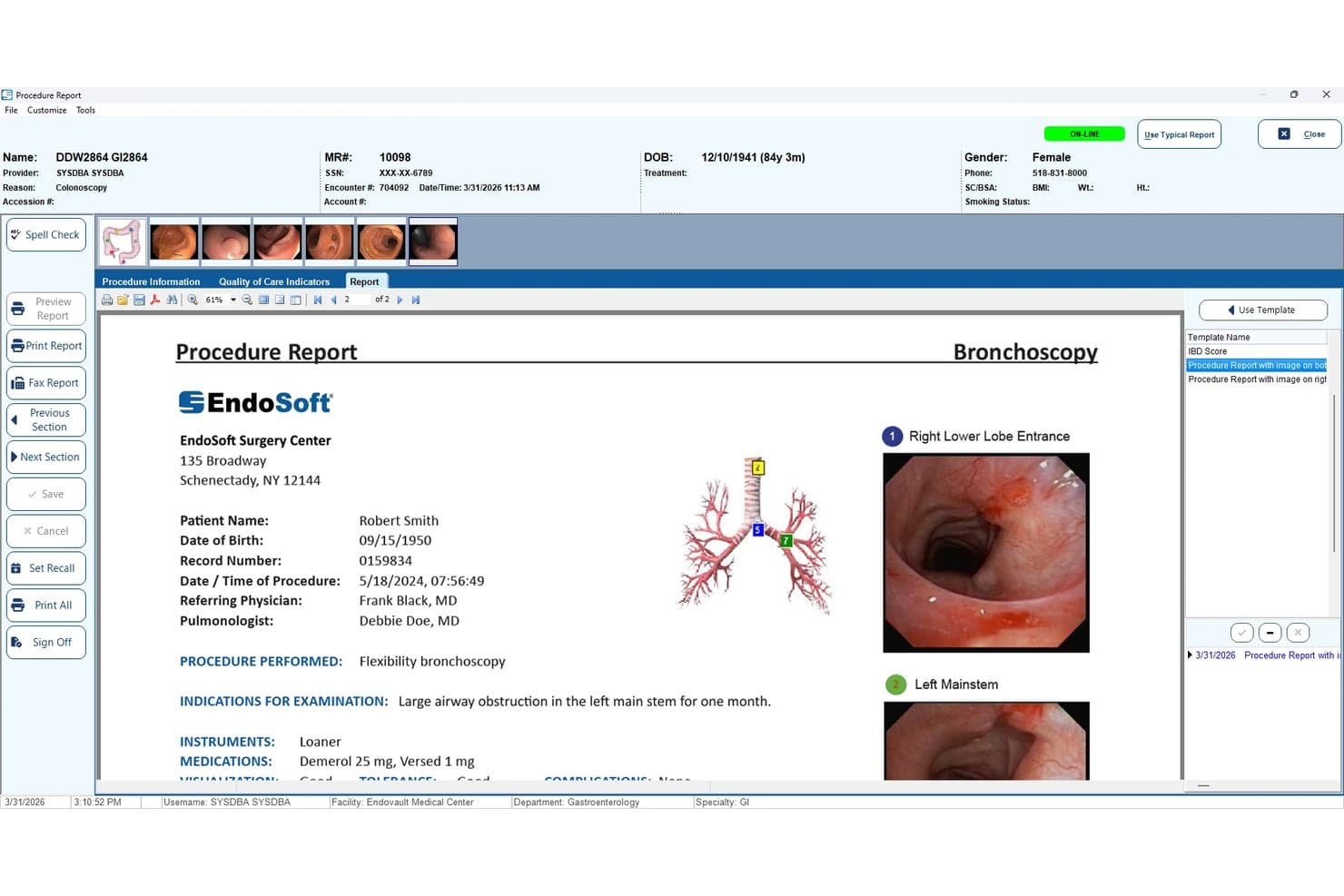
EndoSoft generates bronchoscopy procedure reports with embedded images. EndoVault® by EndoSoft is a GI-native EHR that combines AI-assisted voice documentation, structured endoscopy procedure reporting, image and video capture, and quality registry reporting for gastroenterology practices and ASCs.
Who Is EndoSoft Best For?
EndoSoft suits GI physicians and practice administrators in endoscopy-focused practices or ASCs who need AI-assisted procedure documentation and quality registry reporting built into their EHR.
Why I Picked EndoSoft
I've included EndoSoft in my top picks because its Argus AI voice documentation is genuinely built for the endoscopy suite, not bolted on as an afterthought. During a colonoscopy, Argus NLP captures what the physician says and sorts it directly into the right report fields, auto-filling quality metrics like ADR, withdrawal time, and bowel prep scores without manual entry. I also like that specimen jar labels print in real time via voice command, cutting a step that typically slows post-procedure charting.
EndoSoft Key Features
- GIQuIC-certified quality registry reporting: Automatically extracts procedure data for GIQuIC, MIPS/MACRA, and CDC submissions without manual data entry.
- Multi-source HD image and video capture: Records up to four simultaneous video sources during complex procedures, with built-in PACS and a DICOM viewer for image management.
- HL7 pathology interface with automated ADR calculation: Pulls pathology results directly into EndoVault and calculates adenoma detection rates and sessile serrated adenoma rates automatically.
- Legacy system data migration: Moves patient records, images, reports, quality metrics, and billing data from EndoWorks, EndoPRO, and Endobase with no data loss.
EndoSoft Integrations
EndoSoft integrates with Epic, Oracle Cerner, VA CPRS, and VistA, plus Olympus, Pentax, and Fuji scopes. It supports HL7, FHIR, DICOM, IHE, and an API for custom connections.
Pros and Cons
Pros:
- Scope-neutral imaging links directly to reports
- Automated quality metrics support GI reporting
- AI voice capture structures procedure reports
Cons:
- Users report errors and outdated interfaces
- Setup can challenge smaller organizations
Learn more about EndoSoft: Best for AI-aided endoscopy procedure notes
- Free demo available
- Pricing upon request
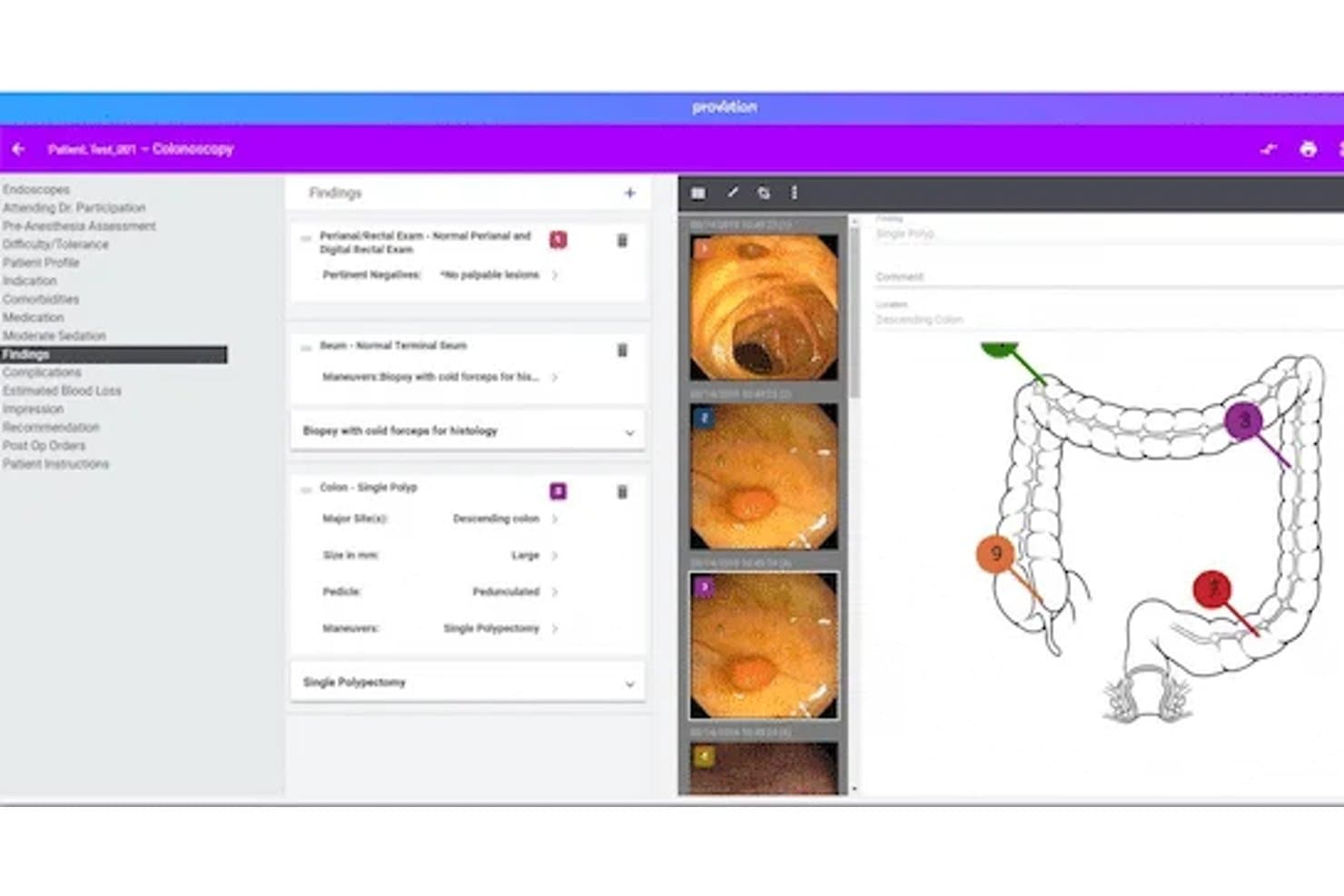
Provation Apex streamlines colonoscopy documentation with findings and imaging. Provation Apex is a cloud-based GI procedure documentation and endoscopy reporting platform that covers physician notes, nursing charting, anesthesia records, pathology integration, and patient tracking across the full procedural episode—from pre-op to post-op.
Who Is Provation Apex Best For?
Provation Apex is a strong fit for GI-focused hospitals and ambulatory surgery centers that need deep, procedure-level documentation but already have a separate EHR handling outpatient records and scheduling.
Why I Picked Provation Apex
I picked Provation Apex as one of the best because its AI voice documentation tool, Mira, turns spoken commentary during a colonoscopy or upper GI endoscopy into a structured procedure note in real time—no dictation cleanup required afterward. It also generates CPT and ICD-10 codes automatically from the note selections, covering 150+ CPT/HCPCS codes tied to the procedure. What seals it for me is the native scope-to-note image capture, which pulls images directly from the endoscope into the report without a manual import step.
Provation Apex Key Features
- GIQuIC quality registry submission: Structured procedure data feeds directly into GIQuIC for benchmarking and quality reporting, available in Standard and Premium packages.
- Electronic specimen collection and label printing: Specimen data is logged digitally during the procedure and auto-populates into the physician's note.
- Real-time patient tracking board: An electronic board replaces paper and whiteboards, showing live patient and room status across the care team.
- Pathology lab interface: Results from approved partner labs like LabCorp and Quest Diagnostics automatically populate into procedure notes through a built-in interface.
Provation Apex Integrations
Provation Apex integrates with Epic, Oracle Health/Cerner, MEDITECH, LabCorp, Quest Diagnostics, Sonic Healthcare USA, and other approved pathology labs. Its Secure Communication Connector supports HL7, pathology PDFs, vitals, and DICOM data.
Pros and Cons
Pros:
- GI templates cover advanced procedures and pediatrics
- Native scope image capture supports procedure reporting
- AI converts endoscopy speech into structured notes
Cons:
- Reported support availability varies by user experience
- No longitudinal outpatient record or native scheduling
Learn more about Provation Apex: Best for GI coding and pathology-linked recalls
- Free demo available
- From $200/prescriber/month
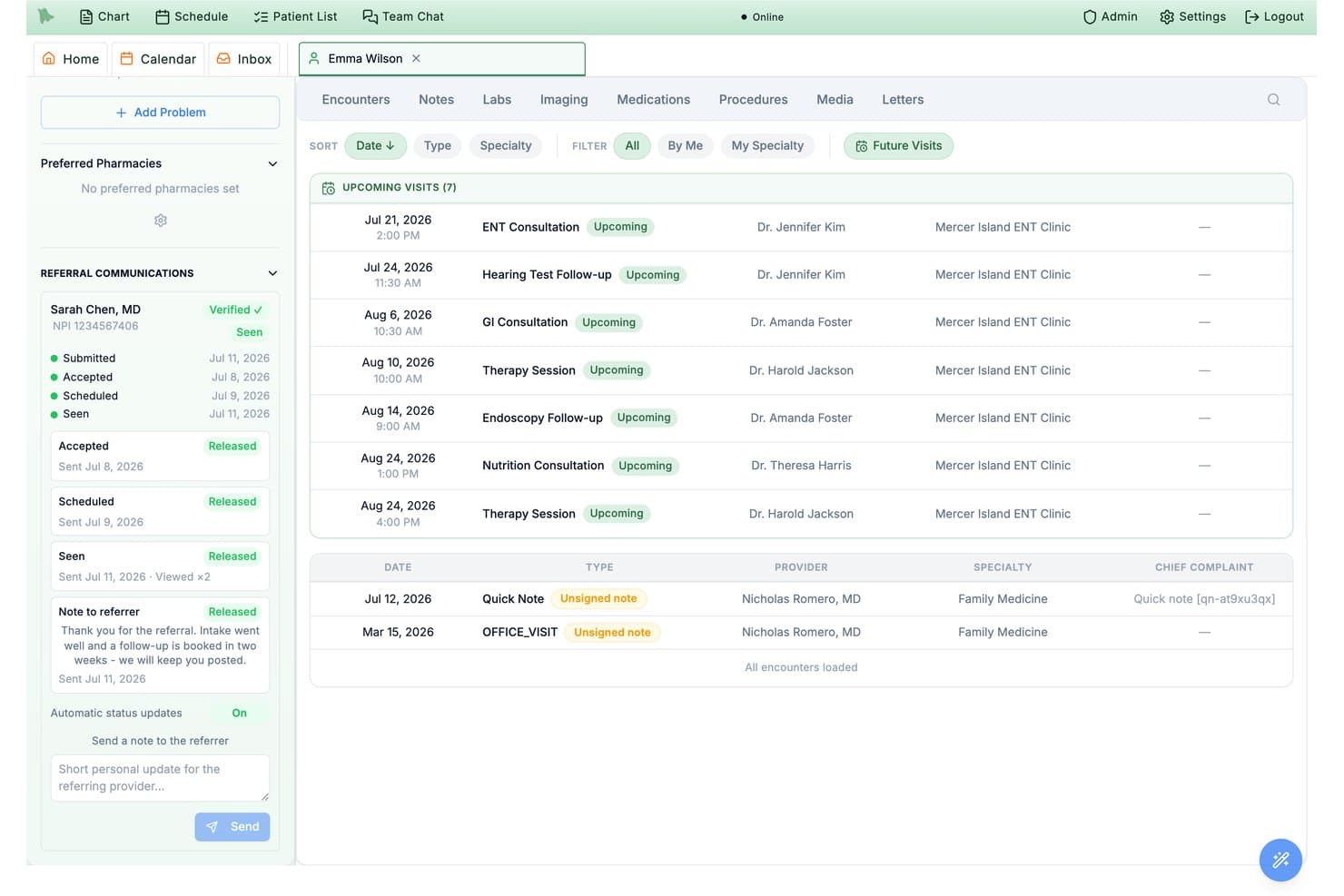
Hero EMR tracks referral communication status and upcoming specialist visits. Hero EMR is a gastroenterology-focused EMR platform that combines GI-specific clinical documentation, structured endoscopy reporting, pathology-linked surveillance recalls, and specialty coding support.
Who Is Hero EMR Best For?
Hero EMR is a strong fit for independent GI practices where billing staff need accurate coding support and clinicians want pathology-linked surveillance built directly into their workflow.
Why I Picked Hero EMR
I've included Hero EMR in my top picks because its GI coding logic goes deeper than most platforms I've seen. Smart Coding Intelligence automatically switches a screening colonoscopy to a therapeutic code when the procedure converts, then applies the correct PT or 33 modifier without manual lookup. I also like that pathology results are matched directly to colonoscopy findings, with surveillance intervals calculated under US Multi-Society Task Force guidelines and recall alerts pushed practice-wide.
Hero EMR Key Features
- AI scribe with disease scoring: Drafts structured GI office visit notes and automatically calculates disease activity scores like Mayo and Harvey-Bradshaw for IBD and hepatology follow-ups.
- Live quality dashboard: Tracks ADR, serrated lesion detection rate, withdrawal time, and prep adequacy against GIQuIC registry benchmarks and ASGE-ACG targets.
- GI dotphrases: Typed shortcuts like
.colonoscopy,.ibdscoremayo, and.liverpanelinsert structured templates and calculators directly into the note editor. - Specimen jar tracking: Assigns each polyp to a specimen jar and tracks it from the procedure through to the matched pathology report.
Hero EMR Integrations
Hero EMR documents integrations with Quest, Epic FHIR, Rayus, Surescripts, Zoom, Office Ally, Availity, Stedi, Optum, and UHC.
Pros and Cons
Pros:
- Structured reports capture polyp-level details
- Pathology findings trigger surveillance recalls
- GI coding handles screening-to-therapeutic conversion
Cons:
- Scope capture and ASC billing undocumented
- GI capabilities lack independent user validation
Learn more about Hero EMR: 10Best for flexible and scalable solutions
NextGEN
- Free demo available
- Pricing upon request
Visit WebsiteCustomer Rating:5/5
The main page of NextGen gives easy access to important links, as well as profile information and the latest news. NextGen is a comprehensive healthcare technology platform that offers solutions including electronic health records (EHR), practice management, and telehealth services. Its flexibility and scalability make it an ideal option for growing practices that need a system that can evolve with their changing needs.
Why I Picked NextGen: I chose NextGen for its exceptional adaptability and scalability. In a field where change is the only constant, having a flexible tool that scales with the growth of your practice is essential. NextGen distinguishes itself with its capacity to adapt to various sizes and types of medical practices, making it the best option for practices seeking a flexible and scalable solution.
Standout features & integrations:
Among the many features of NextGen, its robust EHR, comprehensive practice management, and flexible telehealth services stand out. The platform integrates well with many other medical systems and tools, simplifying workflows and improving patient care.
Pros and Cons
Pros:
- Good integration with other systems and tools
- Comprehensive feature set, including EHR, practice management, and telehealth
- Highly flexible and scalable, adjusting to the size of the practice
Cons:
- User interface could be more intuitive
- Initial setup can be complex
- Some users report a steep learning curve
Learn more about NextGEN:
How I Evaluate Gastroenterology EMR Software
I split my evaluation into three parts, with the most weight on core functionality: documenting GI visits, capturing endoscopy findings, and linking results to patient records. Next, I look for distinctions such as pathology result matching. Finally, I consider support beyond features, including GI-specific migration, endoscopy staff training, and clear pricing.
Core Functionality (Table Stakes For This List)
When I'm selecting tools for my list, I score each one on a scale from 0 (does not offer the functionality) to 5 (excels in this area) for each core functionality listed below. I then convert the total into a percentage to help assess each tool's overall fit, with extra weight on any functionalities I’ve deemed essential.
- GI Documentation (Essential): I look for structured GI templates that capture symptoms, history, and visit-specific details without forcing routine consults into generic notes.
- Endoscopy Reporting (Essential): For colonoscopy and other procedures, I assess structured findings, image links, and outcome documentation tied to the patient record.
- Patient Records: I check whether clinicians can review longitudinal charts with history, medications, allergies, and records from prior visits.
- GI Coding and Billing: I assess whether GI procedure and diagnosis coding workflows support claim preparation and give staff ways to review codes before submission.
- Lab and Pathology: I consider how results are received, matched to the right patient and procedure, and surfaced for follow-up after biopsy.
- Scheduling and Coordination: I look for appointment and procedure calendars connected to patient charts and follow-up workflows across clinical and administrative teams.
Once I have a list of tools that meet the criteria, I consider what sets each platform apart.
Differentiating Factors (What Sets Vendors Apart)
Here's how I compare and contrast different vendors:
Standout Features
Pathology result matching is a big one. I check whether biopsy specimens auto-link back to the originating procedure note so clinicians aren't manually chasing results across systems. Scope integration also matters—I look for direct image capture from endoscopy towers into the report, which saves documentation time and keeps visual findings tied to the patient record. I also evaluate ASC billing workflows, since GI groups running separate procedure sites need clean separation of professional and facility fees.
Beyond Features
I check whether a vendor can handle data migration from legacy GI-specific systems—not just generic EMRs—since losing structured procedure history during a switch is a real risk. Referral connectivity matters too: I look for automated routing of procedure reports and pathology results back to referring providers, especially for post-colonoscopy coordination with primary care or oncology teams. I also evaluate total cost transparency, particularly whether endoscopy reporting or ASC billing modules carry separate fees that aren't obvious in base pricing.
Cum să alegeți un program EMR pentru gastroenterologie
Este ușor să te pierzi în liste lungi de funcționalități și structuri complexe de prețuri. Pentru a te ajuta să rămâi concentrat în timp ce parcurgi procesul unic de selecție a software-ului, iată o listă de verificare cu factorii de care trebuie să ții cont:
| Factor | Ce trebuie luat în considerare |
| Scalabilitate | Va susține acest EMR cabinetul dumneavoastră dacă adăugați medici sau locații noi ori extindeți volumul procedurilor de endoscopie? |
| Integrări | Se conectează EMR-ul fără probleme la sistemele de laborator, serviciile de imagistică, portalurile pentru pacienți, raportarea anesteziei și soluțiile de facturare pe care le utilizați deja? |
| Posibilități de personalizare | Se pot adapta șabloanele, fluxurile de lucru și rapoartele la documentația și procedurile preferate de specialitatea dumneavoastră? |
| Ușurință în utilizare | Cât de repede poate învăța personalul nou să utilizeze sistemul și va reduce sau va crește volumul zilnic de sarcini administrative? |
| Implementare și integrare inițială | Ce resurse, instruire și asistență oferă furnizorul pentru a vă ajuta echipa să înceapă să lucreze în cel mai scurt timp posibil? |
| Cost | Sunt costurile prezentate clar? Asigurați-vă că luați în calcul taxele recurente, actualizările și tarifele pentru asistență, utilizatori sau module suplimentare. |
| Măsuri de securitate | Îndeplinește instrumentul standardele naționale de securitate din domeniul sănătății, criptează datele pacienților și permite configurarea permisiunilor la nivel de utilizator? |
| Disponibilitatea asistenței | Este disponibilă asistență în timp real, specializată în gastroenterologie, atunci când aveți nevoie, inclusiv în afara programului sau în zilele de sărbătoare? Este asistența inclusă în acordul dumneavoastră de servicii? |
Ce este software-ul EMR pentru gastroenterologie?
Software-ul EMR pentru gastroenterologie constă în sisteme de evidență electronică a dosarelor medicale concepute special pentru nevoile clinice, administrative și de facturare ale furnizorilor de servicii de îngrijire gastrointestinală. Aceste platforme eficientizează documentarea procedurilor endoscopice, susțin fluxurile de lucru specifice specialității și ajută cabinetele să îndeplinească cerințele de reglementare și raportare specifice medicinei gastroenterologice.
Funcționalitățile software-ului EMR pentru gastroenterologie
Atunci când selectați software-ul EMR pentru gastroenterologie, urmăriți următoarele funcționalități esențiale:
- Șabloane specifice gastroenterologiei: Șabloanele de notițe predefinite și personalizabile, concepute pentru colonoscopii, endoscopii și consultații gastrointestinale frecvente, eficientizează completarea fișelor și reduc timpul necesar documentării.
- Generarea rapoartelor de endoscopie: Instrumentele de raportare structurată înregistrează constatările, recomandările și imaginile din timpul procedurilor, asigurând consecvența și acuratețea dosarelor, în conformitate cu cerințele de reglementare.
- Prescriere electronică integrată: Trimiteți în siguranță rețete electronice, inclusiv pentru substanțe controlate, direct din dosarul pacientului către farmacii, reducând erorile și eficientizând fluxurile de lucru.
- Asistență pentru codificarea procedurilor: Codificarea automatizată sugerează codurile CPT și ICD corespunzătoare pe baza notei clinice, reducând numărul cererilor respinse și susținând rambursarea corectă.
- Programarea și gestionarea resurselor: Instrumentele de programare coordonează disponibilitatea furnizorilor, alocarea sălii de endoscopie și instrucțiunile de pregătire, minimizând erorile de programare și timpii de așteptare ai pacienților.
- Portal pentru pacienți: Pacienții pot accesa rezultatele testelor, instrucțiunile pentru proceduri, formularele și mesajele securizate, rămânând informați și implicați pe tot parcursul îngrijirii.
- Integrarea analizelor de laborator și a imagisticii: Primiți și analizați rezultatele de laborator și rapoartele de imagistică în cadrul EMR, permițând luarea mai rapidă a deciziilor și o mai bună coordonare a îngrijirii.
- Instrumente de raportare a calității: Monitorizarea integrată pentru MIPS și alte programe de reglementare ajută cabinetele să colecteze datele necesare și să simplifice raportarea conformității.
- Fluxuri de lucru personalizabile: Adaptați documentarea, traseele de prescriere și comunicarea cu pacienții pentru a reflecta preferințele cabinetului sau pentru a răspunde nevoilor diferitelor subspecialități.
Funcționalități AI frecvente ale software-ului EMR pentru gastroenterologie
Pe lângă funcționalitățile standard ale software-ului EMR pentru gastroenterologie prezentate mai sus, multe dintre aceste soluții integrează inteligența artificială prin funcționalități precum:
- Analiză predictivă a riscului de îmbolnăvire: Inteligența artificială analizează istoricul pacienților și rezultatele testelor pentru a-i identifica pe cei cu risc mai mare de afecțiuni gastrointestinale, susținând intervenția timpurie și planurile de îngrijire personalizate.
- Documentare clinică automatizată: Inteligența artificială ascultă conversațiile dintre furnizor și pacient sau analizează notele de procedură, apoi generează rezumate clinice structurate pentru a reduce timpul de completare manuală a fișelor.
- Sugestii inteligente pentru codificare: Inteligența artificială analizează documentația și recomandă cele mai exacte coduri CPT și ICD, contribuind la reducerea respingerilor cererilor și la îmbunătățirea acurateței facturării.
- Analiza imaginilor pentru endoscopie: Inteligența artificială ajută la identificarea polipilor, leziunilor sau anomaliilor din imaginile endoscopice, sprijinind furnizorii în stabilirea unor diagnostice mai rapide și mai exacte.
- Căutare în limbaj natural: Inteligența artificială le permite furnizorilor să caute în dosarele pacienților folosind întrebări formulate conversațional, afișând rapid informațiile clinice relevante fără filtre complexe.
- Recomandări pentru optimizarea fluxurilor de lucru: Inteligența artificială analizează tiparele de lucru ale cabinetului și sugerează ajustări pentru îmbunătățirea eficienței, cum ar fi optimizarea programărilor sau a mementourilor pentru consultațiile ulterioare.
Beneficiile software-ului EMR pentru gastroenterologie
Implementarea software-ului EMR pentru gastroenterologie oferă mai multe beneficii pentru echipa și activitatea dumneavoastră. Iată câteva dintre avantajele de care vă puteți bucura:
- Documentație simplificată: Șabloanele specifice specialității și rezumatele clinice automatizate fac documentarea mai rapidă și mai consecventă pentru cazurile de rutină și cele complexe.
- Raportare precisă a procedurilor: Documentația structurată pentru endoscopie și integrările imaginilor susțin înregistrări complete și conforme și simplifică raportarea calității.
- Reducerea erorilor de facturare: Instrumentele integrate de codificare și sugestiile inteligente pentru cereri contribuie la asigurarea unei rambursări corecte și la reducerea numărului de cereri respinse.
- Implicarea mai bună a pacienților: Portalurile pentru pacienți și mesageria securizată le oferă pacienților acces mai ușor la rezultate, instrucțiuni și monitorizare ulterioară.
- Coordonarea îmbunătățită a îngrijirii: Integrările cu laboratoarele, serviciile de imagistică și sistemele de trimitere permit partajarea mai rapidă a informațiilor între furnizori și echipe.
- Asistență pentru conformitatea cu reglementările: Monitorizarea integrată a conformității și stocarea securizată a datelor ajută la îndeplinirea cerințelor privind confidențialitatea și raportarea specifice cabinetelor de gastroenterologie.
- Fluxuri de lucru scalabile: Programarea personalizabilă, gestionarea resurselor și opțiunile pentru mai multe locații se adaptează pe măsură ce cabinetul dumneavoastră se dezvoltă sau evoluează.
Costurile și prețurile software-ului EMR pentru gastroenterologie
Selectarea unui software EMR pentru gastroenterologie necesită înțelegerea diferitelor modele și planuri de preț disponibile. Costurile variază în funcție de caracteristici, dimensiunea echipei, modulele suplimentare și alți factori. Tabelul de mai jos rezumă planurile comune, prețurile medii ale acestora și caracteristicile incluse de obicei în soluțiile software EMR pentru gastroenterologie:
Tabel comparativ al planurilor pentru software-ul EMR de gastroenterologie
| Tipul planului | Preț mediu | Caracteristici comune |
| Plan gratuit | $0 | Documentare limitată, programare de bază și asistență pentru cabinete mici. |
| Plan personal | $50-$150/utilizator/lună | Șabloane specifice specialității, rapoarte de endoscopie, prescriere electronică și acces de bază la portalul pentru pacienți. |
| Plan pentru companii | $200-$400/utilizator/lună | Integrări avansate, module de facturare, raportarea calității și fluxuri de lucru personalizabile. |
| Plan pentru întreprinderi | $500+/utilizator/lună | Gestionarea mai multor locații, configurare inițială personalizată, migrare robustă a datelor, asistență prioritară și manager de cont dedicat. |
Întrebări frecvente despre software-ul EMR pentru gastroenterologie
Iată câteva răspunsuri la întrebările frecvente despre software-ul EMR pentru gastroenterologie:
Cât timp este necesar pentru implementarea software-ului EMR pentru gastroenterologie?
Implementarea poate dura de la câteva săptămâni la câteva luni, în funcție de dimensiunea cabinetului dumneavoastră, de necesitățile de migrare a datelor și de disponibilitatea asistenței din partea furnizorului și a instruirii personalizate.
Se poate integra software-ul EMR pentru gastroenterologie cu echipamentele de endoscopie și sistemele de laborator existente?
Da, majoritatea platformelor oferă integrare cu dispozitivele de captură a imaginilor endoscopice, sistemele informatice de laborator și rețelele spitalicești, pentru a simplifica fluxurile de lucru și a centraliza informațiile despre pacienți.
Ce ar trebui să urmăresc în ceea ce privește asistența pentru configurarea inițială și instruirea personalului?
Căutați un furnizor care oferă configurare inițială structurată, instruire specifică pentru gastroenterologie și asistență disponibilă prompt, pentru a vă ajuta echipa să se adapteze rapid și să evite întreruperile activităților clinice.
Este disponibil accesul de la distanță cu software-ul EMR pentru gastroenterologie?
Da, multe sisteme EMR sunt bazate pe cloud și oferă acces securizat de la distanță, permițând furnizorilor să consulte dosarele și să gestioneze îngrijirea din mai multe locații sau de la birourile de acasă.
Cum ajută aceste sisteme la raportarea calității și la conformitate?
Software-ul EMR pentru gastroenterologie include adesea instrumente automatizate pentru raportarea conformității cu reglementările, monitorizarea conformității și indicatorii de performanță, pentru a vă menține aliniați la cerințele naționale și la cerințele finanțatorilor.