

Programvare for medisinsk fakturering innen synshelse er spesialisert programvare som hjelper øyehelsepraksiser med å håndtere forsikringskrav, pasientfakturering og refusjon for optometri- og oftalmologitjenester. Hvis du leter etter den rette løsningen, vet du at fakturering innen synshelse innebærer unike koder, kravregler og betalerkrav som forsinker teamet ditt hvis verktøyene dine ikke strekker til.
Denne listen er laget for fagpersoner innen øyehelse som trenger å behandle krav raskere, redusere avvisninger og frigjøre mer tid til pasientbehandling. Her finner du pasientfokuserte faktureringsverktøy som er utviklet for det høye tempoet i moderne øyehelse, slik at du kan sammenligne alternativer og trygt velge det som passer best for praksisen din.
Why Trust Our Software Recommendations
6,700+
Reviews
20
Industry experts
16+
Evaluation factors
14
Years
Our team has been testing and reviewing software since 2012. As medical practice leaders ourselves, we know how difficult—and important—it is to choose the right software.
For this guide, we evaluated tools using hands-on testing and independent research, scoring tools using our selection criteria.
Our reviews reflect our human editorial judgment, not a sales pitch.
Sammenligningstabell for programvare for medisinsk fakturering innen synshelse
Denne sammenligningstabellen oppsummerer prisdetaljene for mine beste utvalgte programmer for medisinsk fakturering innen synshelse:
| Tool | Best For | Trial Info | Price | ||
|---|---|---|---|---|---|
| 1 | Best for adaptive ophthalmology charting | Free demo available | Pricing upon request | Website | |
| 2 | Best for specialty eyecare management | Free demo available | Pricing upon request | Website | |
| 3 | Best for eyewear ordering workflows | Free demo available | From $68/month | Website | |
| 4 | Best for optical retail operations | Free demo available | Pricing upon request | Website | |
| 5 | Best for ophthalmology documentation | Free demo available | Pricing upon request | Website | |
| 6 | Best for cloud optometry workflows | Free demo available | From $319/month | Website | |
| 7 | Best for all-in-one eyecare management | Free demo available | Pricing upon request | Website | |
| 8 | Best for integrated optical workflows | Free demo available | From $340/month | Website | |
| 9 | Best for optometry practice management | Free demo available | Pricing upon request | Website | |
| 10 | Best for cloud-based optical management | Free demo available | From $259/month | Website |


Anmeldelser av den beste programvaren for medisinsk fakturering innen synshelse
\u003cspan style=\u0022font-weight: 400;\u0022\u003eNedenfor finner du mine detaljerte sammendrag av den beste programvaren for medisinsk fakturering innen synshelse som kom med på kortlisten min. Anmeldelsene mine gir et detaljert innblikk i funksjonene, de beste bruksområdene og prisene for hvert program, slik at du kan finne det beste alternativet for deg.\u003c/span\u003e
 Best for adaptive ophthalmology charting
- Free demo available
- Pricing upon request
Visit WebsiteCustomer Rating:4.5/5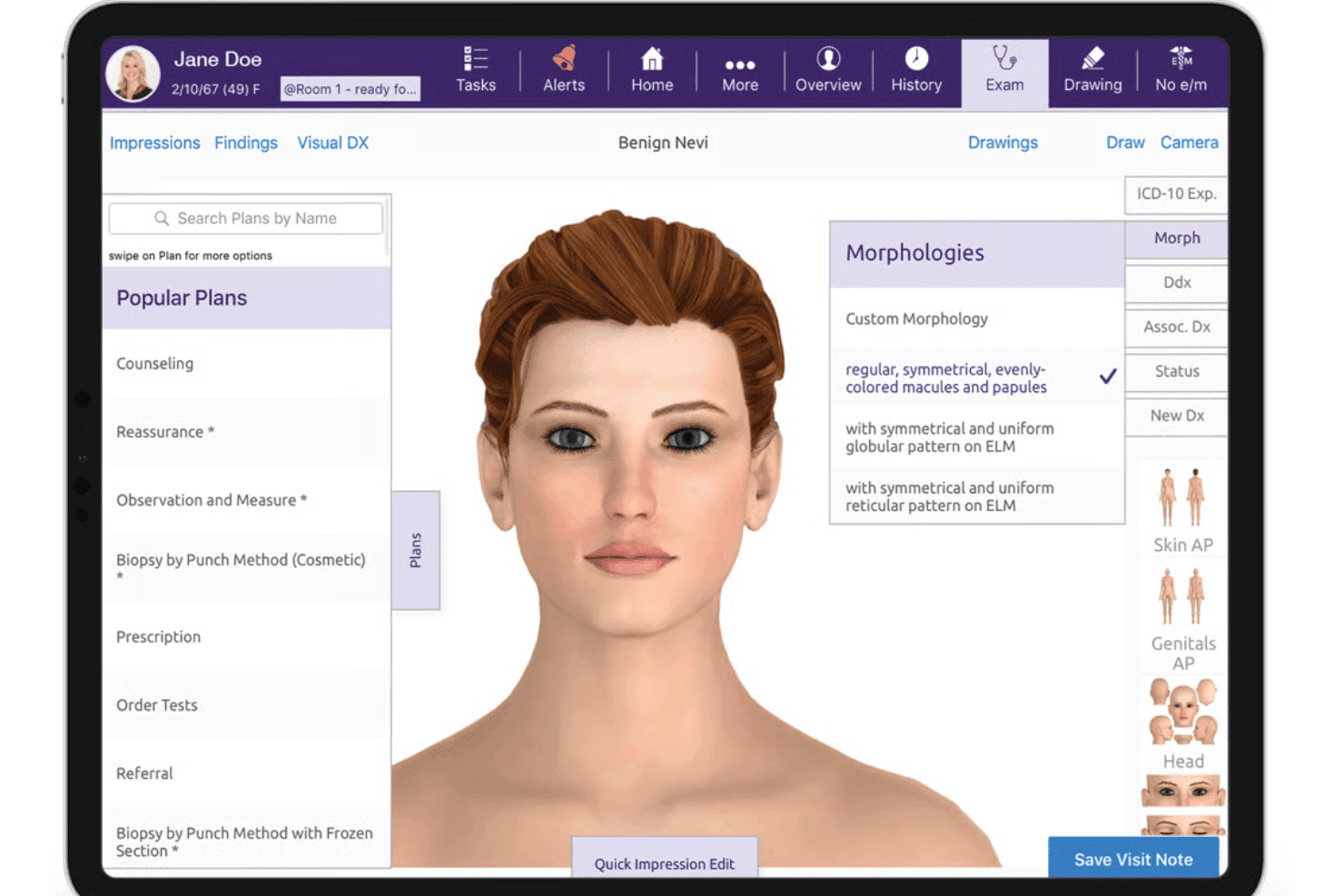
ModMed delivers specialty EHR, AI documentation, e-prescribing, billing, and RCM. ModMed is a specialty-specific EHR and revenue cycle management platform for ophthalmology practices that combines adaptive clinical documentation, ophthalmology-coded claims processing, denial management, and optical POS integrations.
Who Is ModMed Best For?
ModMed is a strong fit for mid-to-large ophthalmology practices and ambulatory surgery centers that need specialty-specific billing built directly into their clinical workflow.
Why I Picked ModMed
I've included ModMed in my top picks because EMA adapts to each physician's charting habits, learning preferred exam notes and auto-suggesting matched ophthalmology CPT codes and ICD-10 modifiers. This directly tightens the link between clinical documentation and billing accuracy. ModMed Scribe 2.0 layers AI on top, trained on real ophthalmology encounter data, so procedure-level codes are pulled from the clinical note rather than entered manually downstream.
ModMed Key Features
- Ophthalmology-specific charge capture: Promptly records and manages surgical, in-office, and diagnostic charges linked to patient exams.
- Integrated optical POS interfaces: Connects with Eyefinity and FlexSys to handle optical dispensary invoicing and payments from within the practice management workflow.
- Automated claims status tracking: Monitors claim progress and alerts staff to denials, rejections, or payer follow-ups using real-time dashboards.
- Medical eligibility verification: Checks patient eligibility and coverage across a network of medical insurance carriers before appointments.
ModMed Integrations
ModMed offers native integrations with Eyefinity, FlexSys, Zeiss Veracity, MDprospects, SamaCare, PX Technology, and Sophrona. Integrations are also available for Klara, Relatient, TouchMD, Artera, Birdeye, Demandforce, Phreesia, and DeepScribe. An API is available for custom integrations.
Pros and Cons
Pros:
- Ophthalmic exam data syncs directly to billing
- Dedicated RCM team for denial management
- Coding engine built for ophthalmology subspecialties
Cons:
- Optical dispensary invoicing requires third-party systems
- Limited vision plan claims billing workflow
Learn more about ModMed: Best for specialty eyecare management
- Free demo available
- Pricing upon request
Visit WebsiteCustomer Rating:4.3/5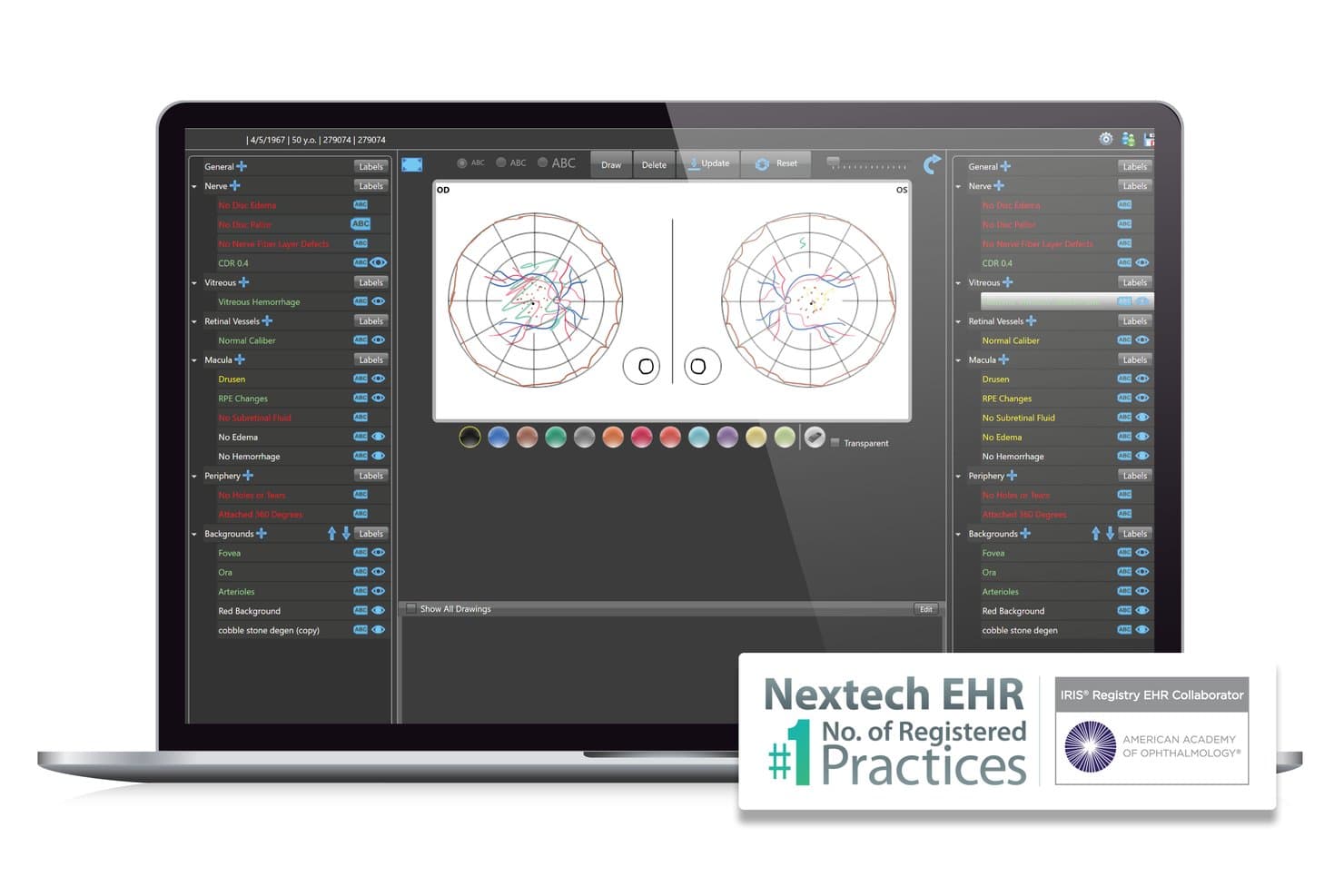
Nextech offers an ophthalmology-focused EHR with retinal drawing tools, structured eye exam documentation, and IRIS Registry integration for vision medical billing. Nextech is a specialty-focused EHR and practice management platform built for ophthalmology and eyecare practices, combining clinical documentation, dual medical and vision claims billing, optical POS, and eligibility verification in one system.
Who Is Nextech Best For?
Nextech is a strong fit for mid-to-large ophthalmology practices that manage both medical and vision insurance billing alongside an in-house optical dispensary.
Why I Picked Nextech
Nextech earns its spot on my shortlist for handling split medical and vision claims in a single native workflow, which I find genuinely rare in this category. I particularly like IntelleChartPRO's glaucoma flowsheet, which pulls longitudinal patient data, images, and visit history onto one screen during charting. The integrated optical POS ties frame and contact lens inventory directly to exam charges, generating a medical claim and retail receipt from a single patient encounter.
Nextech Key Features
- Ophthalmology-specific code library: Includes CPT, HCPCS, and ICD-10 codes pre-loaded for eye care billing and documentation.
- Real-time eligibility verification: Checks both medical and major vision plans for patient coverage and benefits during intake.
- Integrated claims scrubbing: Flags incomplete or inaccurate vision and medical claims using eye care-specific rules before submission.
- Optical inventory integration: Connects frame, lens, and contact lens inventory to patient invoicing and insurance allowances automatically.
Nextech Integrations
Nextech offers 10 native integrations, including Weave, Solutionreach, Demandforce, TouchMD, Harmony, Podium, FlexOptical, MedEvolve, Cubix, and Abyde, and partners with Trizetto clearinghouse for claims processing. An API is available for custom integrations.
Pros and Cons
Pros:
- Ophthalmology-specific coding and templates available
- Native optical POS and inventory integration
- Built-in dual medical and vision billing
Cons:
- Eligibility tied to specific clearinghouse partners
- Not suited for solo or micro practices
Learn more about Nextech: Best for eyewear ordering workflows
- Free demo available
- From $68/month
Visit WebsiteCustomer Rating:3/5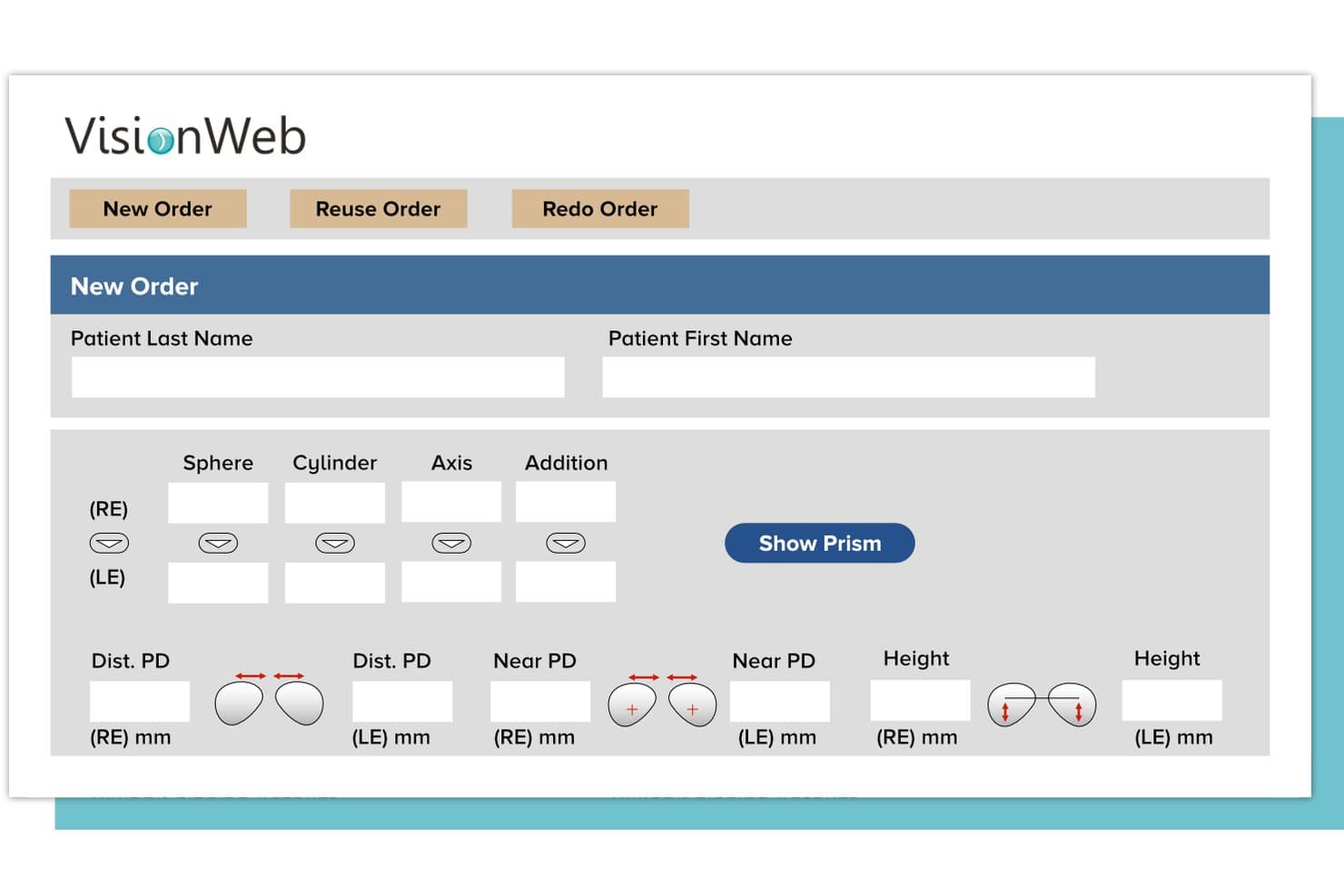
VisionWeb offers a new order entry form with fields for patient name, prescription details (Sphere, Cylinder, Axis, Addition), PD measurements, and height inputs. VisionWeb is a vision-specialized billing clearinghouse that handles electronic claims submission, ERA processing, real-time eligibility verification, and eyewear product ordering across a network of 2,300+ vision and medical payers.
Who Is VisionWeb Best For?
VisionWeb is a strong fit for independent optometry practices and vision clinics that need to manage both optical dispensary orders and insurance claims in one place.
Why I Picked VisionWeb
VisionWeb earns its spot on my shortlist because no other vision billing clearinghouse also operates the industry's largest optical ordering network, connecting practices to 475+ labs and suppliers. I like that staff can place spectacle, contact lens, and frame orders alongside claims filing, rather than toggling between separate platforms. The online ordering workflow consistently returns jobs 1-2 days faster than phone or fax, which means fewer gaps between exam, dispensing, and billing.
VisionWeb Key Features
- Dual payer claims submission: Lets you submit both vision and medical insurance claims through a single electronic clearinghouse workflow.
- Real-time vision plan eligibility: Instantly verifies patient benefits with VSP, EyeMed, and over 2,300 connected payers directly in the system.
- Automated ERA management: Posts 835 electronic remittance files automatically for faster payment reconciliation and reduced manual entry.
- Integrated denial tracking and reporting: Offers reporting tools to monitor denied claims, process appeals, and track key AR metrics for eye care billing.
VisionWeb Integrations
VisionWeb offers native integrations with over 100 optometry and ophthalmology practice management systems, including Eyefinity, RevolutionEHR, Uprise by HELIX, and Crystal PM. An API is available for custom integrations.
Pros and Cons
Pros:
- Automatic dual routing for vision and medical claims
- Real-time eligibility checks for vision and medical
- Largest network of optical labs and suppliers
Cons:
- Eye care code scrubbing not fully user-configurable
- Patient invoicing features require external systems
Learn more about VisionWeb: Best for optical retail operations
- Free demo available
- Pricing upon request
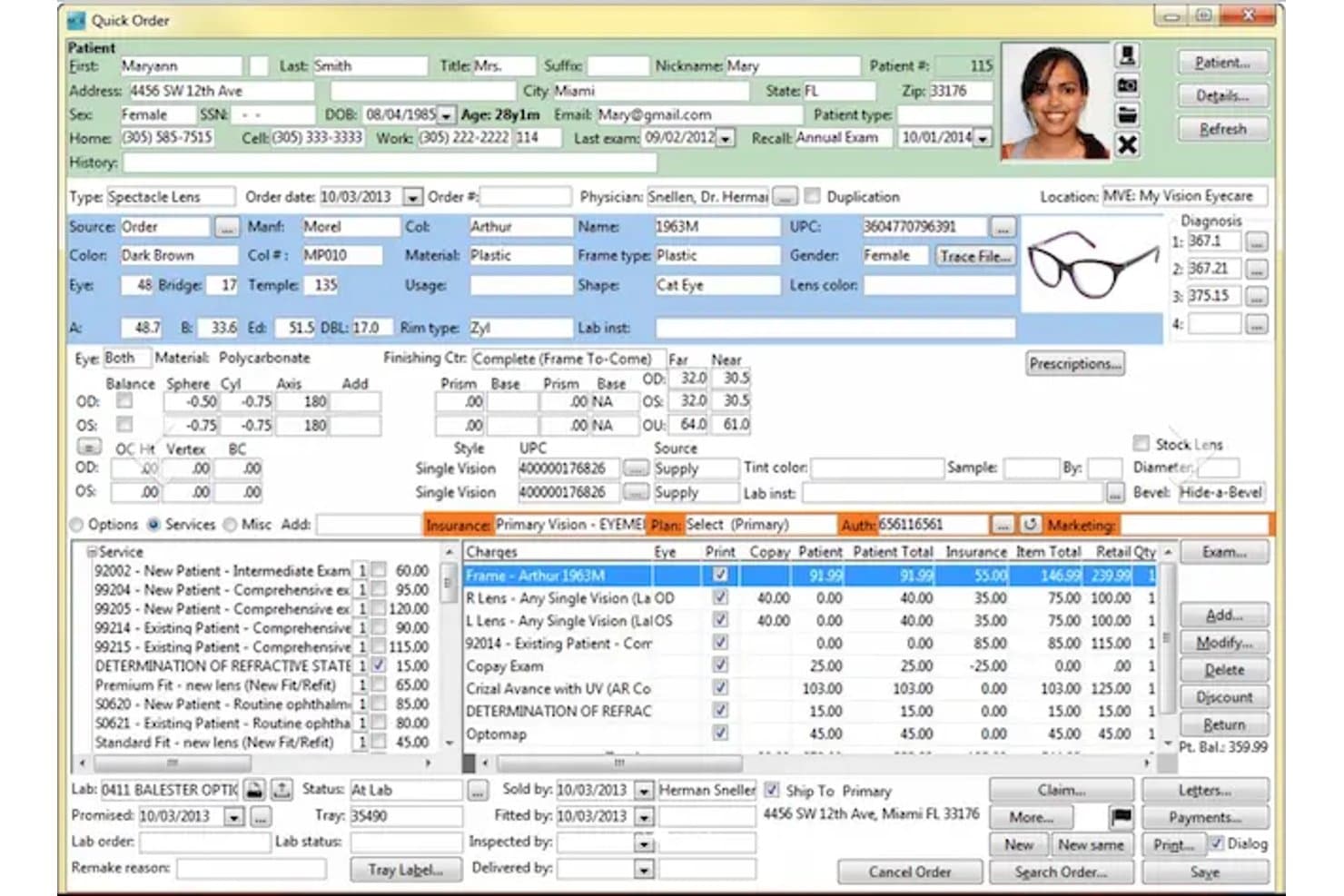
My Vision Express offers a Quick Order screen with detailed patient info, lens specifications, insurance billing, and itemized charges for vision care billing. My Vision Express is an eye care practice management and EHR platform that combines optical retail POS, insurance billing, ICD-10 coding, and dispensary invoicing for optometry and ophthalmology practices.
Who Is My Vision Express Best For?
It's a strong fit for optometry practices with an in-house optical dispensary, especially those managing multiple locations from a single system.
Why I Picked My Vision Express
I picked My Vision Express because no other platform on this list ties optical dispensary billing directly to the exam record the way it does. The Quick Order POS lets staff create an eyewear order, fill a prescription, and post payment on a single screen. That matters when your front desk is managing both a medical claim and a frame sale at the same time. I also rely on the preloaded ophthalmic ICD-10 codes and the industry-first Injury Builder tool to keep claims clean from the start.
My Vision Express Key Features
- Multi-location inventory management: Track, transfer, and reconcile optical inventory across several practice sites from one platform.
- Preloaded CPT and ICD-10 code libraries: Access built-in ophthalmology and optometry codes specific to eye care billing requirements.
- Custom exam and billing templates: Configure templates to match workflow for office visits, exams, and insurance documentation.
- Integrated SSRS reporting: Generate detailed reports spanning billing, exam, and optical retail operations for data-driven oversight.
My Vision Express Integrations
Native integrations are not clearly documented. The platform supports connections with diagnostic equipment and insurance clearinghouse interfaces, and offers an API for custom integrations.
Pros and Cons
Pros:
- Multi-location inventory managed in one platform
- Quick Order POS links exams to orders
- Purpose-built for optometry and optical retail
Cons:
- Named vision plan integrations not clearly documented
- Reporting and analytics are not comprehensive
Learn more about My Vision Express:
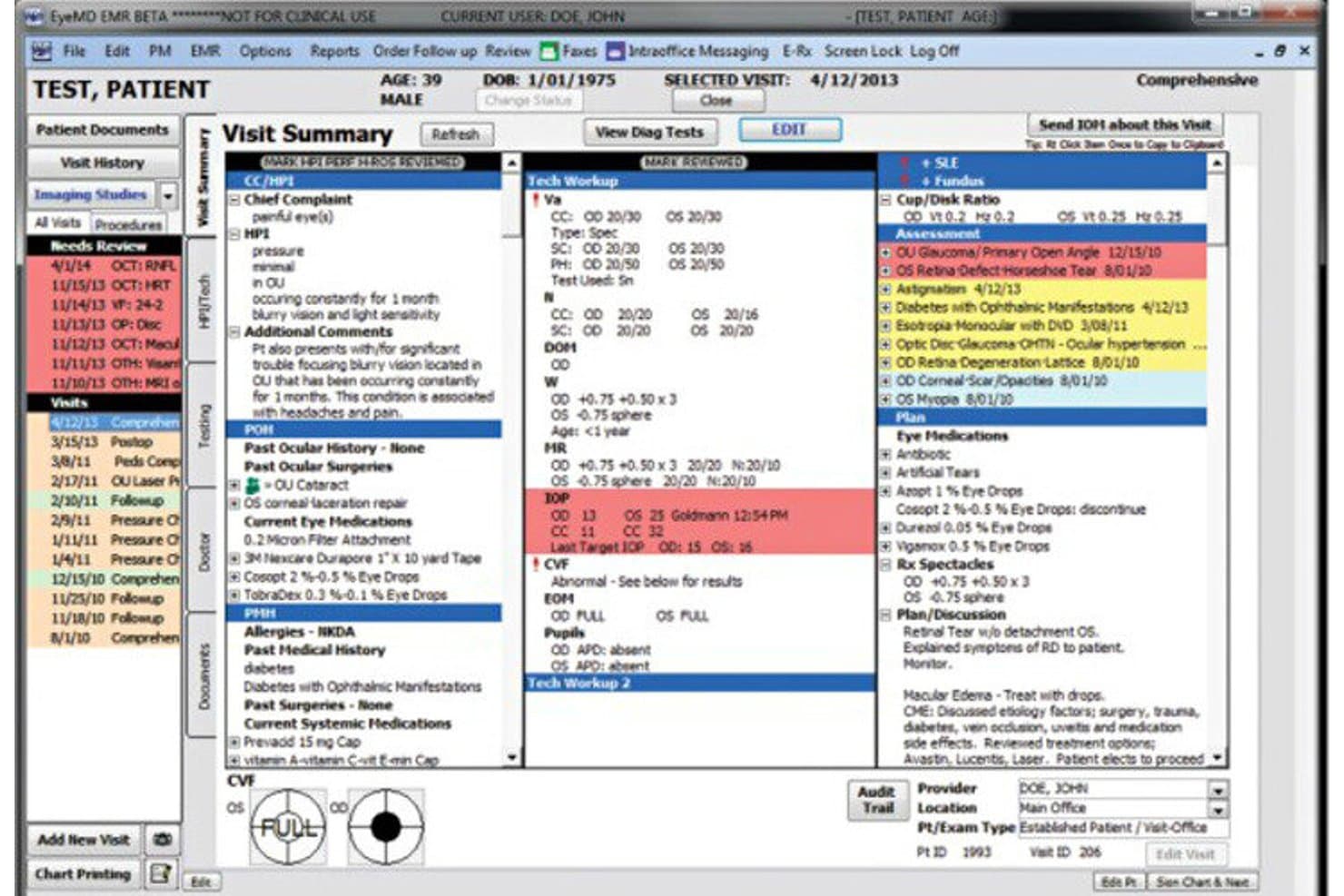
EyeMD EMR dashboard showing ophthalmology visit notes, test results, diagnoses, and treatment plans EyeMD EMR is an ophthalmology-native practice management and medical billing platform that combines an embedded clearinghouse, ophthalmic CPT and modifier coding, claims submission, ERA posting, optical POS integration, and AR management in one specialty-built system.
Who Is EyeMD EMR Best For?
EyeMD EMR is a strong fit for ophthalmology practices that need a billing and documentation system built around eye care workflows rather than adapted from a general-purpose platform.
Why I Picked EyeMD EMR
EyeMD EMR earns its spot on my shortlist because of how tightly its clinical documentation connects to billing. The Fast Plan feature automatically generates treatment plans when specific diagnostic codes are entered, which means billing codes follow directly from documentation without a separate coding step. I also like that the ICD-10 tool auto-associates exam findings with the correct codes, reducing the manual review that typically drives claim delays in ophthalmology practices.
EyeMD EMR Key Features
- Embedded clearinghouse: Tracks claims in real time and supports automated claim follow-up without third-party add-ons.
- Business intelligence dashboard: Centralizes financial analytics and A/R performance metrics for easy monitoring by billing specialists.
- Optical POS integration: Links ophthalmology billing with FlexSys-powered point of sale for dispensing eyewear and accessories.
- Direct scan OCR: Allows staff to scan insurance and ID cards to auto-populate patient records and payer data.
EyeMD EMR Integrations
EyeMD EMR offers over 80 documented practice management integrations, including Athena Health, Allscripts, eClinicalWorks, MedEvolve, Intergy (Greenway), CareCloud, Centricity, Cerner Ideal, Lytec, Medisoft, and MicroMD. Optical POS integration is available with FlexSys.
Pros and Cons
Pros:
- Optical POS integration with eyewear dispensing
- Embedded clearinghouse tracks claims in real time
- Specialty coding automation for ophthalmology billing
Cons:
- Limited optical goods allowance tracking features
- Lacks native VSP and EyeMed eligibility checks
Learn more about EyeMD EMR: Best for cloud optometry workflows
- Free demo available
- From $319/month
Visit WebsiteCustomer Rating:4.5/5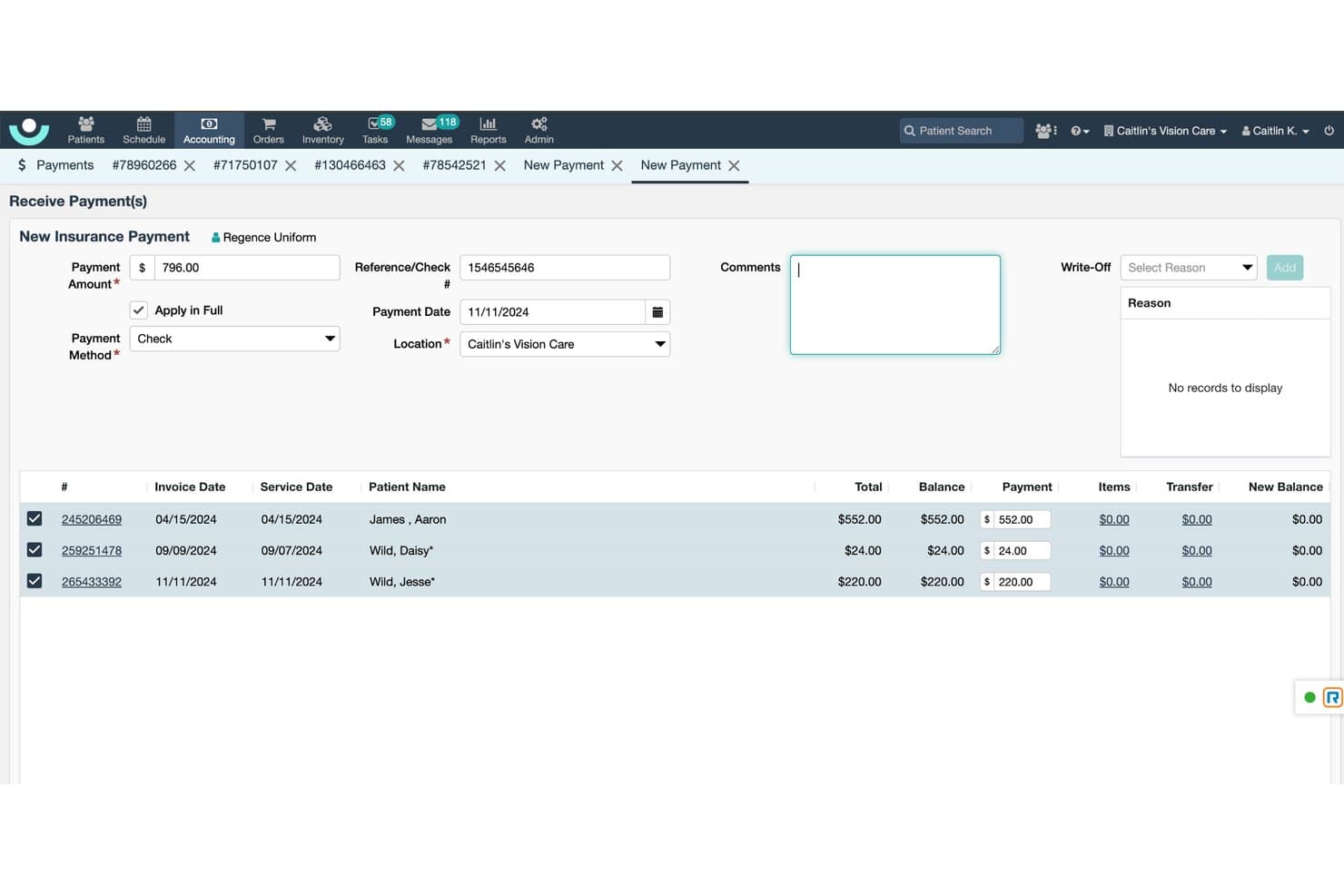
RevolutionEHR offers a detailed insurance payment entry screen allowing billing staff to apply payments across multiple patient invoices with write-off and transfer options. RevolutionEHR is a cloud-based EHR and practice management platform built exclusively for optometry, combining dual vision and medical claims billing, eligibility verification, clearinghouse submission, and optical dispensary invoicing in one system.
Who Is RevolutionEHR Best For?
RevolutionEHR is a strong fit for independent optometry practices and small multi-location eye care clinics managing both vision plan and medical insurance billing.
Why I Picked RevolutionEHR
I've included RevolutionEHR in my top picks because it's the only billing platform I know that's built from the ground up for optometry workflows in the cloud. The built-in RevClear clearinghouse catches claim errors before submission, so VSP and EyeMed claims don't fall through the gaps that plague general-purpose billing tools. I also like that RevBilling lets practices offload coding, ledger reconciliation, and denial follow-up to a dedicated team, all from within the same platform.
RevolutionEHR Key Features
- RevCheck insurance verification: Instantly verifies patient eligibility for both vision and medical payers before the visit.
- Optical dispensary and inventory integration: Links frame, lens, and contact lens sales to claims and invoices with allowance tracking.
- Pre-loaded eye care code libraries: Includes optometry CPT, HCPCS, and ICD-10 codes with specialty modifiers in system templates.
- Automated ERA posting: Enables seamless 835 electronic remittance advice processing within the claims workflow.
RevolutionEHR Integrations
RevolutionEHR offers native integrations with ABB Verify, RevClear (TriZetto), Optos, VisionWeb, FramesData, HOYA, OOGP, 4PatientCare, Solutionreach, Demandforce, and EyeCarePro, and provides an API for custom integrations.
Pros and Cons
Pros:
- Pre-submission claim scrubbing prevents denials
- Built-in eye care specific code libraries
- Dual medical and vision plan billing workflows
Cons:
- Reporting features are less customizable than competitors
- Optical allowance tracking requires duplicate entry
Learn more about RevolutionEHR: Best for all-in-one eyecare management
- Free demo available
- Pricing upon request
Visit WebsiteCustomer Rating:3.9/5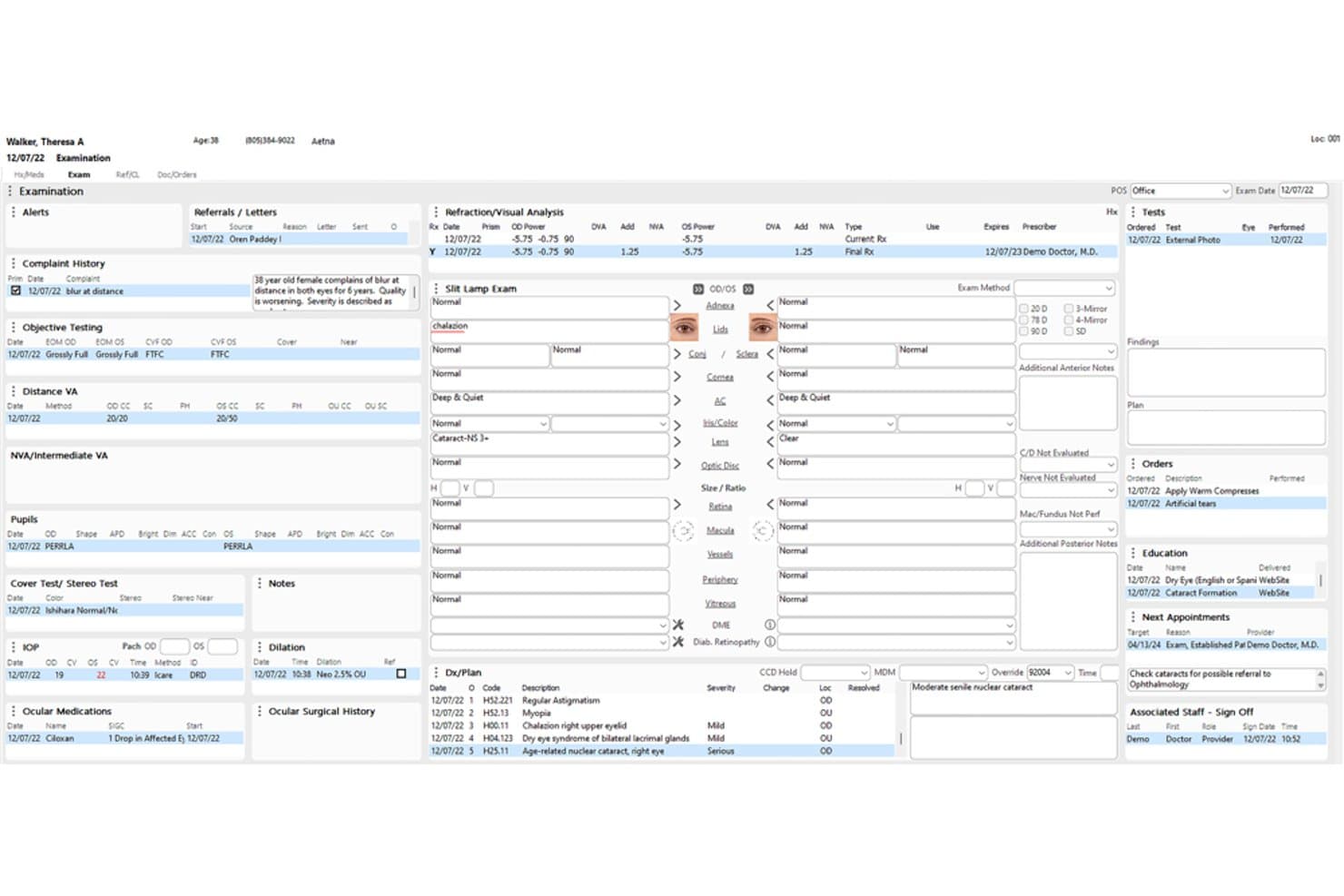
Compulink Advantage (Eyecare Advantage) offers a comprehensive patient examination screen with refraction analysis, slit lamp exam, diagnosis coding, and billing fields in one integrated view. Compulink Advantage is an optometry-focused EHR and practice management platform that integrates dual vision and medical billing, optical POS, claims submission, eligibility verification, and revenue cycle management in a single system.
Who Is Compulink Advantage (Eyecare Advantage) Best For?
It's a strong fit for multi-location optometry and ophthalmology practices that need a single platform to manage clinical, optical, and billing workflows together.
Why I Picked Compulink Advantage (Eyecare Advantage)
I picked Compulink Advantage because no other platform ties the optical dispensary directly to the clinical exam and insurance claim in one motion. The Visual Documentation Engine automatically generates orders and exam documentation from the patient's diagnosis, so billing codes flow from the encounter without manual re-entry. On top of that, AdvantageRCM handles claims scrubbing, denial appeals, and ERA posting, keeping the revenue cycle moving across both vision plan and medical payers.
Compulink Advantage (Eyecare Advantage) Key Features
- Pre-loaded eye care coding libraries: Compulink includes specialty CPT, HCPCS, and ICD-10 code sets specific to optometry and ophthalmology.
- Dual vision and medical claims routing: Automatically directs claims to the appropriate vision plan or medical insurer based on encounter context.
- Real-time eligibility verification: Instantly checks vision and medical plan benefits and eligibility at check-in for all major carriers.
- Optical point-of-sale and inventory integration: Links frame, lens, and contact lens sales directly to patient records and claims in one unified workflow.
Compulink Advantage (Eyecare Advantage) Integrations
Native integrations are available with Waystar, Weave, Phreesia, and MyEyeStore. Compulink supports multiple clearinghouse connections and offers an API for custom integrations.
Pros and Cons
Pros:
- Auto-scrubbing for eye care-specific coding errors
- Integrated optical inventory with claim linkage
- Dual medical and vision billing in one workflow
Cons:
- RCM task tracking may require manual oversight
- Reporting tools can feel overly complex
Learn more about Compulink Advantage (Eyecare Advantage): Best for integrated optical workflows
- Free demo available
- From $340/month
Visit WebsiteCustomer Rating:3.6/5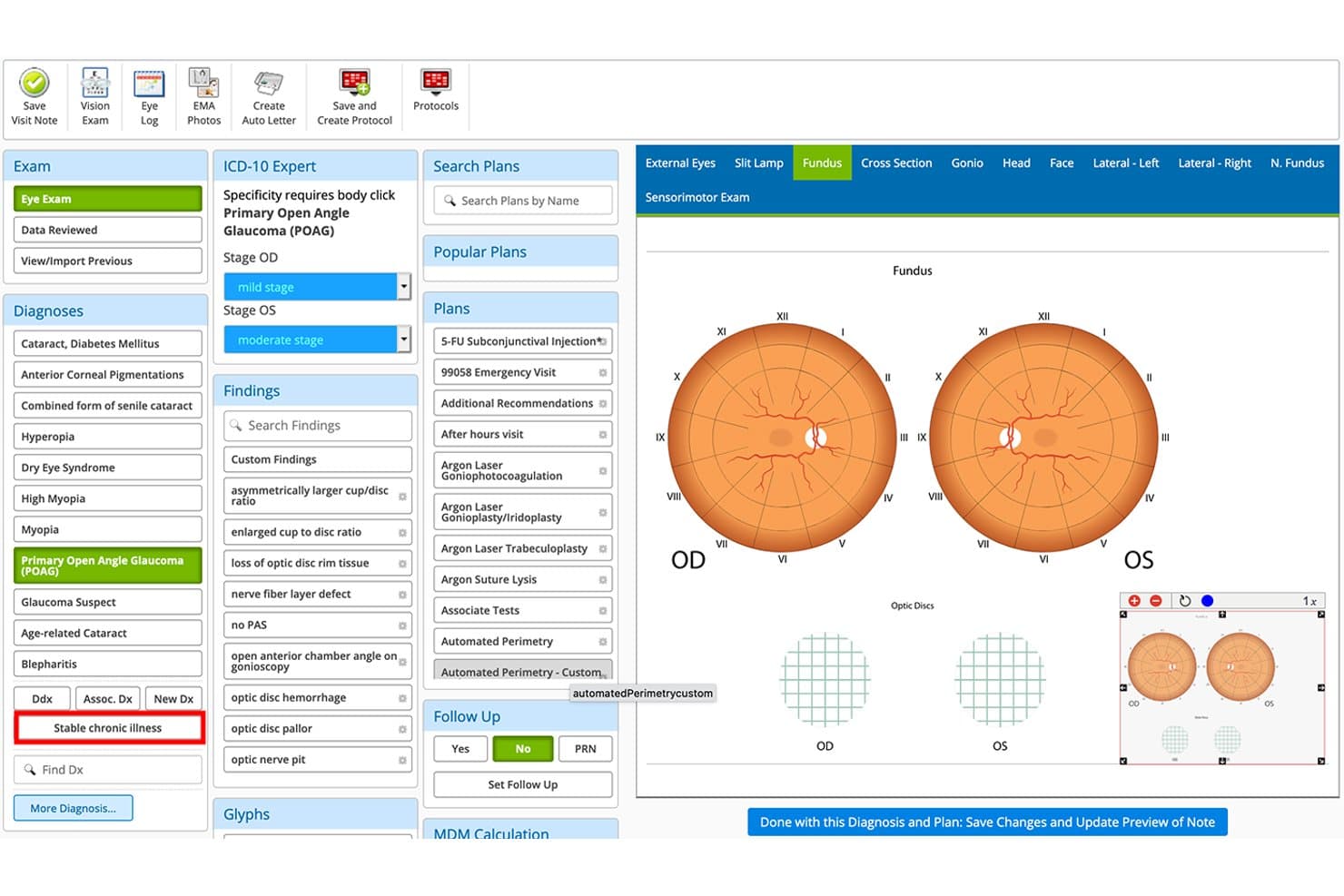
Eyefinity offers a comprehensive diagnosis and treatment planning interface with ICD-10 coding, fundus diagrams, and billing plan selection for glaucoma management. Eyefinity is a cloud-based practice management and billing platform built exclusively for eye care practices, combining VSP-native claim submission, ERA automation, optical dispensary invoicing, and EHR in a single system.
Who Is Eyefinity Best For?
Eyefinity is a strong fit for independent optometry practices that bill heavily through VSP and need optical dispensary and exam billing managed in one platform.
Why I Picked Eyefinity
Eyefinity earns its spot on my shortlist because no other platform connects VSP claims, optical dispensary billing, and exam coding in a single workflow the way Encompass does. I like that the VSP interface handles real-time eligibility, bulk authorizations, and ERA posting without leaving the system. EncompassScribe also suggests CPT codes directly from clinical notes, so billing codes stay accurate from the exam room through to claim submission.
Eyefinity Key Features
- Automated VSP eligibility checks: Instantly confirms patient coverage and authorizations for VSP plans within the workflow.
- Integrated optical inventory management: Tracks frames, lenses, and contacts, syncing inventory with patient orders and insurance allowances.
- HIPAA and SOC 2 Type 2 security: Safeguards protected health information and meets rigorous compliance standards for eye care practices.
- Patient engagement tools: Offers appointment scheduling, two-way texting, and digital forms directly linked to the billing and management system.
Eyefinity Integrations
Eyefinity offers native integrations with VSP Vision Care, TriZetto, NextGen Enterprise EHR/PM, OfficeMate, EyeScape Digital Imaging Systems, Optos, Zeiss FORUM, Worldpay, Optify, Demandforce, and ABB Optical Group. An API is available for custom integrations.
Pros and Cons
Pros:
- CPT and ICD-10 code suggestions from EHR
- Optical inventory synced with billing workflow
- VSP claims and authorizations handled natively
Cons:
- Reporting options are complex and nonintuitive
- Limited native support for EyeMed and Davis
Learn more about Eyefinity: Best for optometry practice management
- Free demo available
- Pricing upon request
Visit WebsiteCustomer Rating:4.1/5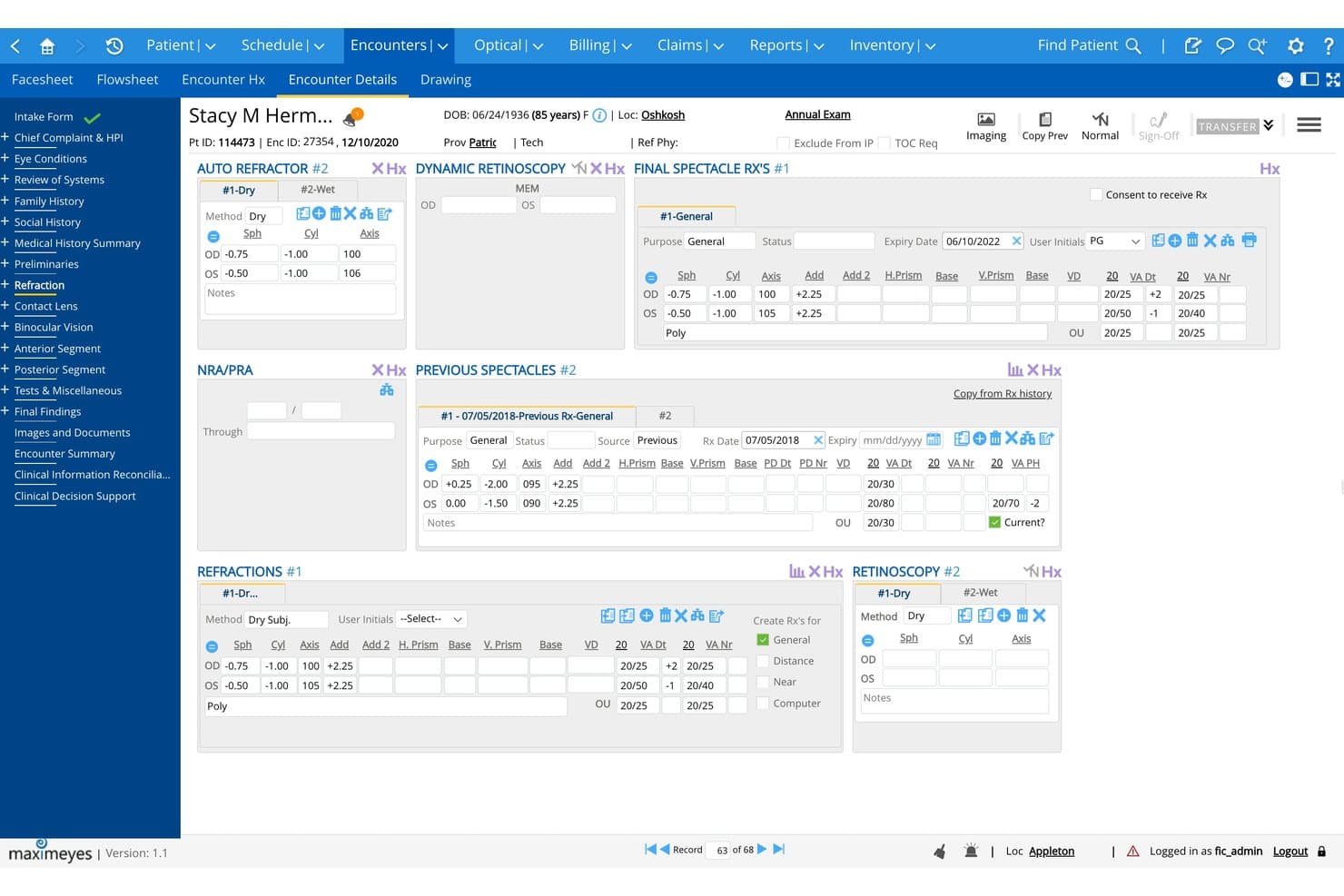
MaximEyes offers a detailed refraction and spectacle prescription management screen within its vision medical billing and EHR platform. MaximEyes is an eye care-specific EHR and practice management platform that combines medical and vision plan billing, optical point-of-sale, eligibility verification, claims submission, and denial management for optometry and ophthalmology practices.
Who Is MaximEyes Best For?
MaximEyes is a strong fit for independent and small-to-mid-size optometry and ophthalmology practices managing both vision plan and medical insurance billing in-house.
Why I Picked MaximEyes
MaximEyes earns its spot on my shortlist because no other platform I've reviewed is built this specifically around optometry billing workflows. I especially like the built-in VSP calculator and the EVAA AI billing assistant, which automates eligibility verification and flags unused vision benefits before they expire. In practice, that means my billing team can confirm coverage before a patient's exam rather than chasing denials after the fact.
MaximEyes Key Features
- Specialty claim scrubbing: Applies ophthalmology and optometry-specific billing rules to claims before submission to prevent denials.
- Optical point-of-sale integration: Connects frame, lens, and contact lens sales directly to patient billing and insurance claims.
- Real-time vision and medical eligibility: Checks eligibility and benefits instantly with both medical and major vision carriers.
- Automated denial worklists: Creates follow-up lists for denied vision or medical claims and tracks accounts receivable aging.
MaximEyes Integrations
MaximEyes offers native integrations with the American Optometric Association MORE Registry, American Academy of Ophthalmology IRIS Registry, and Mango Voice. An API is available for custom integrations.
Pros and Cons
Pros:
- Built-in optical point-of-sale links to billing
- Automated eligibility checks for major vision payers
- Dual medical and vision billing in one workflow
Cons:
- Occasional delays with carrier eligibility responses
- Reporting customization can be limited
Learn more about MaximEyes: Best for cloud-based optical management
- Free demo available
- From $259/month
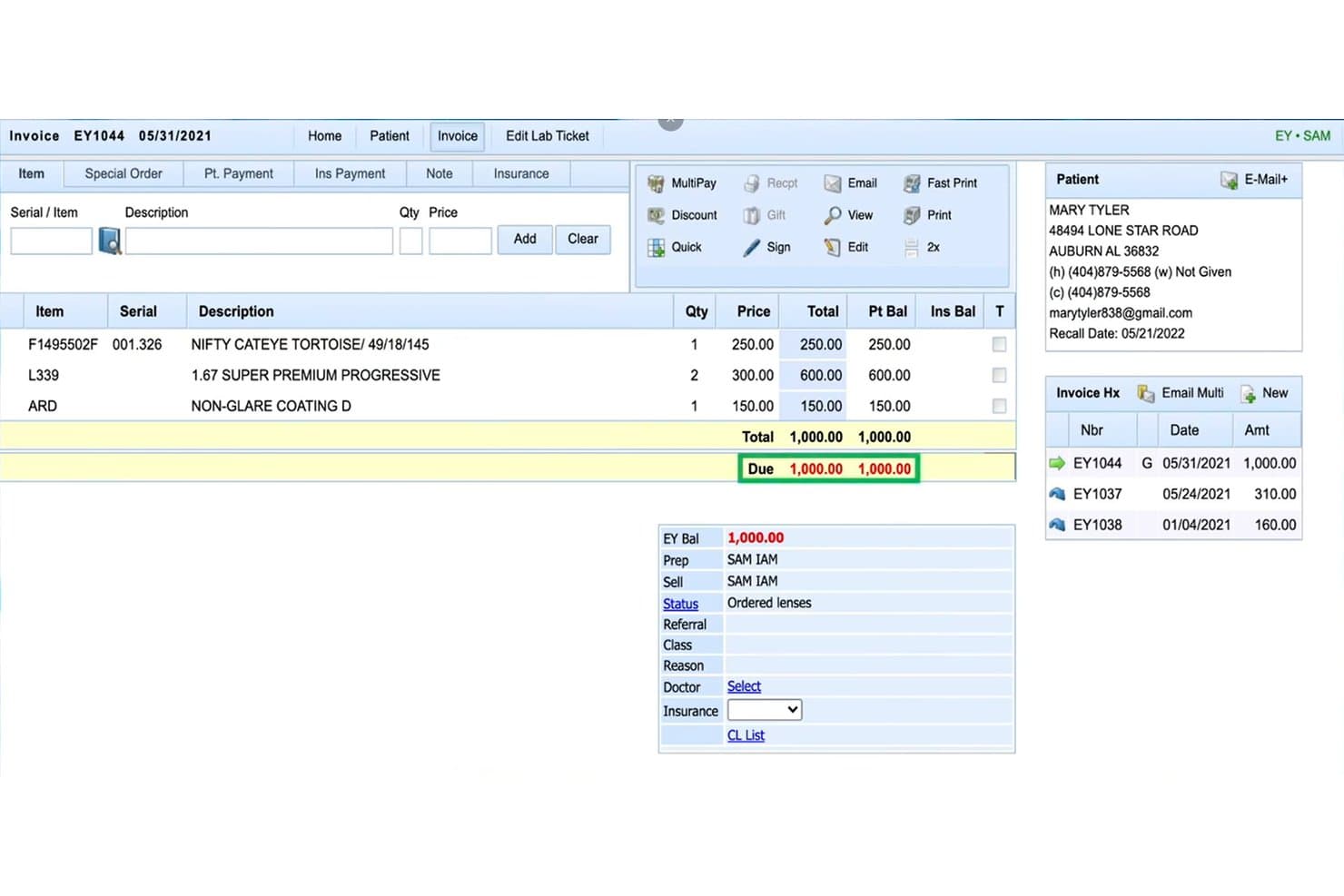
Eye Cloud Pro offers a detailed invoice screen displaying patient billing items, totals, insurance balance, and invoice history for vision care services. Eye Cloud Pro is a cloud-based practice management and billing platform built specifically for optometry, combining EHR, insurance claims processing, optical POS, and inventory management in one system.
Who Is Eye Cloud Pro Best For?
Eye Cloud Pro is a strong fit for independent optometry practices and multi-location optical clinics that need billing, EHR, and optical retail managed in one platform.
Why I Picked Eye Cloud Pro
Eye Cloud Pro earns its spot on my shortlist because its cloud-based architecture means I can pull up a patient's exam record, optical order, and insurance claim status from any device. The optical POS connects directly to patient records and frame inventory, so a dispensary sale and its associated insurance billing move together rather than being entered separately. I also appreciate the automated contact lens ordering through ABB and OOGP, which, paired with VisionWeb lab tracking, keeps the full fulfillment cycle visible in one view.
Eye Cloud Pro Key Features
- CPT monitoring and audit tools: Tracks specialty eye care codes and reviews claims for coding accuracy.
- Integrated clearinghouse connectivity: Submits medical claims electronically and processes ERAs within the platform.
- Revenue and accounts receivable reporting: Provides dashboards and reports for tracking claim statuses and outstanding balances.
- Patient scheduling with eligibility checks: Schedules visits while verifying insurance eligibility in real time.
Eye Cloud Pro Integrations
Eye Cloud Pro offers native integrations with VisionWeb, ABB, OOGP, Surescripts, Ensora Clearinghouse, Optify, Nassau, Apex, and Fullsteam. An API is available for custom integrations.
Pros and Cons
Pros:
- Automated contact lens and lab ordering
- Built-in optical POS and inventory modules
- Cloud-based access for all staff roles
Cons:
- Limited denial management automation
- No native VSP claims integration
Learn more about Eye Cloud Pro:
Annen programvare for medisinsk fakturering innen synshelse
\u003cspan style=\u0022font-weight: 400;\u0022\u003eHer er noen flere alternativer for programvare for medisinsk fakturering innen synshelse som ikke kom med på kortlisten min, men som fortsatt er verdt å undersøke:\u003c/span\u003e
- 11MedflowBest for ophthalmology clinical workflows
- 12iTrustBest for independent optometry practices
- 13AdvancedMDBest for integrated ophthalmology billing
- 14JeloBest for optometry billing workflows
How I Evaluate Vision Medical Billing Software
I split my evaluation into two layers—baseline requirements like dual vision/medical billing and eye care coding support, and the differentiators that set each platform apart.
Core Functionality (Table Stakes For This List)
When I'm selecting tools for my list, I rank each one on a scale from 0 (does not offer the functionality) to 5 (excels in this area) for each core functionality listed below. Then, I calculate the tool's total score into a percentage. Each tool needs to achieve a minimum total score of 65% to be considered for inclusion.
- Dual Vision/Medical Billing: I check whether a platform can process vision plan claims and medical insurance claims in a single workflow, especially for split encounters where a routine exam and a medical diagnosis occur in the same visit.
- Eye Care Coding Support: Pre-loaded ophthalmology and optometry CPT, HCPCS, and ICD-10 codes matter here, along with scrubbing rules that catch common bundling errors before submission.
- Vision Plan Eligibility Verification: I look for real-time eligibility checks against both vision carriers like VSP and EyeMed and medical payers, so front-desk staff can confirm benefits before the patient sits in the exam chair.
- Claims Submission & ERA Processing: Electronic 837 submission paired with automated 835 remittance posting is what I evaluate, since manual ERA posting creates bottlenecks that slow down cash flow.
- Optical & Exam Invoicing: The platform should handle patient billing for dispensary items like frames, lenses, and contacts alongside professional exam charges, with insurance allowance tracking built in.
- Denial Management & AR Reporting: I look for denial worklists and AR aging reports that help billers prioritize follow-ups, especially for common ophthalmic denial patterns like medical necessity edits.
Once I have a list of tools that meet the criteria, I consider what sets each platform apart.
Differentiating Factors (What Sets Vendors Apart)
Here's how I compare and contrast different vendors:
Standout Features
Dual medical/vision plan routing is a big differentiator. The best platforms automatically determine whether a visit bills to a vision plan or a medical payer and split the claim when both apply in a single encounter. I also evaluate how tightly optical dispensary sales connect to claims—when frame and lens purchases flow into patient invoices with allowance tracking, billers avoid duplicate entry. Pre-submission scrubbing tuned to ophthalmic denial patterns like bundling and LCD/NCD edits is another area where I see real variation between vendors.
Beyond Features
Practice type matters—a solo OD office has very different needs than a multi-location ophthalmology group handling cataract and injection billing with J-codes. I evaluate whether a platform scales across those scenarios. EHR integration is just as important; I check whether exam data and superbills flow into claims without manual re-entry from systems like RevolutionEHR or Compulink. Payer connectivity is another factor I consider, particularly direct connections to major vision plans beyond standard medical clearinghouses.
Slik velger du programvare for medisinsk fakturering innen synshelse
Det er lett å gå seg vill i lange funksjonslister og komplekse prismodeller. For å hjelpe deg med å holde fokus mens du går gjennom den unike prosessen med å velge programvare, får du her en sjekkliste over faktorer du bør ha i bakhodet:
| Faktor | Hva bør du vurdere? |
| Skalerbarhet | Vil programvaren støtte veksten din – fra en solopraksis til flere lokasjoner eller spesialområder? |
| Integrasjoner | Fungerer den med ditt eksisterende EHR-system, optiske POS-system, oppgjørssentral og systemer for laboratoriebestillinger? |
| Tilpasningsmuligheter | Kan arbeidsflyter, koder og rapportering tilpasses din unike kombinasjon av betalere og prosedyrer? |
| Brukervennlighet | Vil teamet ditt trenge omfattende opplæring, eller er systemet intuitivt nok for nyansatte i resepsjonen? |
| Implementering og oppstart | Hvor lang tid tar det å komme i gang, og hva slags støtte til migrering eller opplæring er inkludert? |
| Kostnad | Er kostnadene forutsigbare med transparente priser, eller kan uventede gebyrer øke de totale utgiftene? |
| Sikkerhetstiltak | Er systemet i samsvar med HIPAA, og finnes det kontroller for sensitive økonomi- og pasientdata? |
| Tilgjengelig kundestøtte | Hvilke åpningstider og kanaler er kundestøtten tilgjengelig gjennom – kan teamet ditt få hjelp utenom åpningstid eller i travle perioder? |
Hva er programvare for medisinsk fakturering innen synshelse?
Programvare for medisinsk fakturering innen synshelse er utviklet for å hjelpe øyehelsepraksiser med å håndtere forsikringskrav, pasientfakturering og betalinger for både syns- og medisinske tjenester. Disse plattformene håndterer doble krav til synsplaner og medisinske betalere, automatiserer spesialiserte koder, bekrefter berettigelse og sporer kostnader for optiske tjenester og undersøkelser, noe som reduserer den administrative belastningen for travle klinikker.
Funksjoner i programvare for medisinsk fakturering innen synshelse
Ved valg av programvare for medisinsk fakturering innen synshelse bør du se etter følgende viktige funksjoner:
- Dobbel faktureringsarbeidsflyt: Støtter samtidig innsending av krav til både synsplaner og medisinsk forsikring, noe som reduserer manuelt arbeid og forvirring rundt faktureringen.
- Spesialisert kodebibliotek: Inneholder oppdaterte CPT-, HCPCS- og ICD-10-koder for oftalmologi og optometri, slik at teamet kan velge riktige koder for hver type konsultasjon eller prosedyre.
- Sanntidskontroll av dekning: Bekrefter umiddelbart pasientens dekning og ytelser hos både syns- og medisinske betalere, slik at overraskelser unngås ved innsjekking.
- Innsending av krav og ERA-integrasjon: Automatiserer elektronisk innsending av krav (837-filer) og elektronisk bokføring av betalingsbekreftelser (835), noe som fremskynder refusjonsprosessen.
- Integrasjon med optisk POS og lager: Kobler salg av innfatninger, linser og kontaktlinser til faktureringen, slik at direkte fakturering og sporing av forsikringsbeløp eller egenbetaling blir mulig.
- Verktøy for avslagshåndtering: Merker, sporer og organiserer avviste eller underbetalte krav, og støtter arbeidslister for rask oppfølging og klagebehandling.
- Håndtering av pasientsaldo og fakturering: Genererer tydelige kontoutskrifter for egenbetaling ved undersøkelser og optiske produkter, noe som bidrar til raskere innbetalinger og bedre kommunikasjon med pasientene.
- Rapportering og analyse: Tilbyr oversikter og rapporter for overvåking av kravstatus, utestående fordringer og økonomiske nøkkeltall som er relevante for synshelsepraksiser.
- Kobling mellom avtaler og undersøkelser: Knytter kostnader til bestemte undersøkelsesbesøk og sørger for at hver tjeneste og hvert materiale faktureres til riktig betaler.
- Sikkerhets- og samsvarskontroller: Sørger for at sensitive pasient- og faktureringsdata er beskyttet, og oppfyller kravene i HIPAA og helsesektoren.
Fordeler med programvare for medisinsk fakturering innen synshelse
Implementering av programvare for medisinsk fakturering innen synshelse gir flere fordeler for teamet og virksomheten din. Her er noen av fordelene du kan se frem til:
- Raskere refusjon: Automatisert innsending av krav til både syns- og medisinske betalere hjelper praksisen med å redusere behandlingstiden for betalinger.
- Færre avslag og feil: Sanntidskontroller av dekning, innebygde kodebiblioteker og funksjoner for kvalitetssikring av krav reduserer kostbare feil og avviste krav.
- Effektivisert dobbel fakturering: Støtte for delte konsultasjoner og dirigering til riktig forsikring gjør det enklere å håndtere komplekse besøk der både medisinske planer og synsplaner er involvert.
- Bedre innkreving fra pasienter: Tydelig fakturering og integrert optisk POS hjelper personalet med å beregne og innkreve betalinger nøyaktig ved utsjekking.
- Bedre oversikt over inntektene: Tilpasset rapportering og oversikter over utestående fordringer gjør det enkelt for kontorledere å følge med på den økonomiske utviklingen og finne forbedringsområder.
- Bedre samsvar og sikkerhet: HIPAA-kompatible arbeidsflyter og sikkerhetsfunksjoner beskytter sensitive pasient- og betalingsopplysninger.
- Høyere produktivitet blant ansatte: Intuitive grensesnitt og automatiserte arbeidsflyter hjelper teamet med å fokusere mer på pasientbehandling og mindre på administrative oppgaver.
Kostnader og priser for programvare for medisinsk fakturering innen synshelse
Ved valg av programvare for medisinsk fakturering innen synshelse er det nødvendig å forstå de ulike prismodellene og abonnementene som er tilgjengelige. Kostnadene varierer ut fra funksjoner, teamstørrelse, tillegg og mer. Tabellen nedenfor oppsummerer vanlige abonnementer, gjennomsnittsprisene deres og typiske funksjoner som er inkludert i programvareløsninger for medisinsk fakturering innen synshelse:
Sammenligningstabell for abonnementer på programvare for medisinsk fakturering innen synshelse
| Abonnementstype | Gjennomsnittspris | Vanlige funksjoner |
| Gratisabonnement | $0 | Grunnleggende registrering av krav, pasientfakturering, begrenset rapportering og manuelle kontroller av dekning. |
| Personlig abonnement | $30-$100/bruker/måned | Støtte for dobbel fakturering, innebygde koder for synshelse, sanntidskontroll av dekning, grunnleggende sporing av utestående fordringer og enkel analyse. |
| Bedriftsabonnement | $200-$400/lokasjon/måned | Integrert oppgjørssentral, optisk lager, automatiserte ERA-er, avslagshåndtering, gruppevis kontroll av dekning og bedre rapportering. |
| Virksomhetsabonnement | $500+/lokasjon/måned | Tilpassede arbeidsflyter, avansert analyse, førsteklasses brukerstøtte, EHR-integrasjon, skalerbarhet i stor skala og RCM-tjenester. |
Vanlige spørsmål om faktureringsprogramvare for syns- og medisinske tjenester
Her er noen svar på vanlige spørsmål om faktureringsprogramvare for syns- og medisinske tjenester:
Kan faktureringsprogramvare for syns- og medisinske tjenester håndtere både syns- og medisinske krav?
Ja, de fleste løsninger støtter arbeidsflyter for dobbel fakturering, slik at du kan sende krav til synsforsikringer og helseforsikringer for samme pasientbesøk. Dette er avgjørende ved konsultasjoner der en rutinemessig synsundersøkelse avdekker en medisinsk diagnose som krever separate krav.
Hvilke integrasjoner bør jeg se etter i faktureringsprogramvare for syns- og medisinske tjenester?
Se etter integrasjoner med EHR, optiske kassasystemer, oppgjørssentraler og lagerstyringssystemer. Når disse verktøyene kobles sammen, overføres pasientdata, undersøkelsesbelastninger og optikksalg direkte til faktureringen uten dobbeltregistrering.
Hvor mye opplæring trenger de ansatte for å bruke et nytt faktureringssystem?
Opplæringsbehovet avhenger av teamet og hvor brukervennlig plattformen er. De fleste leverandører tilbyr innføring, veiledninger for arbeidsflyter og opplæringsøkter tilpasset fagområdet, slik at fakturamedarbeidere og resepsjonspersonell blir fortrolige med de nye prosessene.
Hvordan fungerer kontroll av forsikringsberettigelse i sanntid?
Funksjoner for kontroll av forsikringsberettigelse i sanntid lar deg umiddelbart bekrefte pasientens syns- og helseforsikring og se dekning, egenandeler og tilskuddsgrenser før eller under innsjekking. Dette reduserer avviste krav og gjør det enklere å kreve inn betaling på forhånd.
Hva slags rapportering er inkludert i faktureringsprogramvare for syns- og medisinske tjenester?
Disse plattformene tilbyr vanligvis instrumentbord og rapporter for kravstatus, utestående fordringer, inntektsmålinger og finansielle nøkkeltall tilpasset synshelsepraksiser. Avanserte abonnementer kan tilby tilpassede analyser for virksomhetsstyring.