
EMR-programvare for sårbehandling er en digital plattform som lar deg vurdere, dokumentere og administrere sårbehandling, samtidig som alle journaler holdes organiserte og tilgjengelige. Hvis du vurderer disse systemene, ønsker du sannsynligvis å øke nøyaktigheten, effektivisere arbeidsflyten og ta informerte beslutninger for hver pasient. Ved å velge riktig EMR for sårbehandling kan teamet ditt sikre kontinuitet i behandlingen, redusere feil og oppfylle krav til samsvar, samtidig som dere håndterer det daglige kliniske presset. Denne veiledningen hjelper deg med raskt å sammenligne de beste alternativene, viktige funksjoner og hva du kan forvente, slik at du kan velge løsningen som passer best for praksisen din.
Why Trust Our Software Recommendations
6,700+
Reviews
20
Industry experts
16+
Evaluation factors
14
Years
Our team has been testing and reviewing software since 2012. As medical practice leaders ourselves, we know how difficult—and important—it is to choose the right software.
For this guide, we evaluated tools using hands-on testing and independent research, scoring tools using our selection criteria.
Our reviews reflect our human editorial judgment, not a sales pitch.
Sammenligningstabell for EMR-programvare for sårbehandling
Denne sammenligningstabellen oppsummerer prisdetaljene for mine utvalgte EMR-programvarer for sårbehandling:
| Tool | Best For | Trial Info | Price | ||
|---|---|---|---|---|---|
| 1 | Best for wound billing and coding automation | Free demo available, 7-day free trial for the standalone AI scribe | From $249/user/month | Website | |
| 2 | Best for comprehensive wound care EHR | Free demo available | Pricing upon request | Website | |
| 3 | Best for specialized wound care | Free demo available | Pricing upon request | Website | |
| 4 | Best for digital wound assessment | Free demo available | Pricing upon request | Website | |
| 5 | Best for standardized wound care documentation | Not available | Pricing upon request | Website | |
| 6 | Best for physician-designed wound charting | Free demo available | Pricing upon request | Website | |
| 7 | Best for mobile wound care billing automation | Free demo available | From $250/user/month | Website |


Anmeldelser av den beste EMR-programvaren for sårbehandling
Nedenfor finner du mine detaljerte oppsummeringer av den beste EMR-programvaren for sårbehandling som kom med på kortlisten min. Anmeldelsene mine gir en detaljert gjennomgang av funksjonene, de beste bruksområdene og integrasjonene til hver plattform, slik at du kan finne den som passer best for deg.
 Best for wound billing and coding automation
- Free demo available, 7-day free trial for the standalone AI scribe
- From $249/user/month
Visit WebsiteCustomer Rating:4.4/5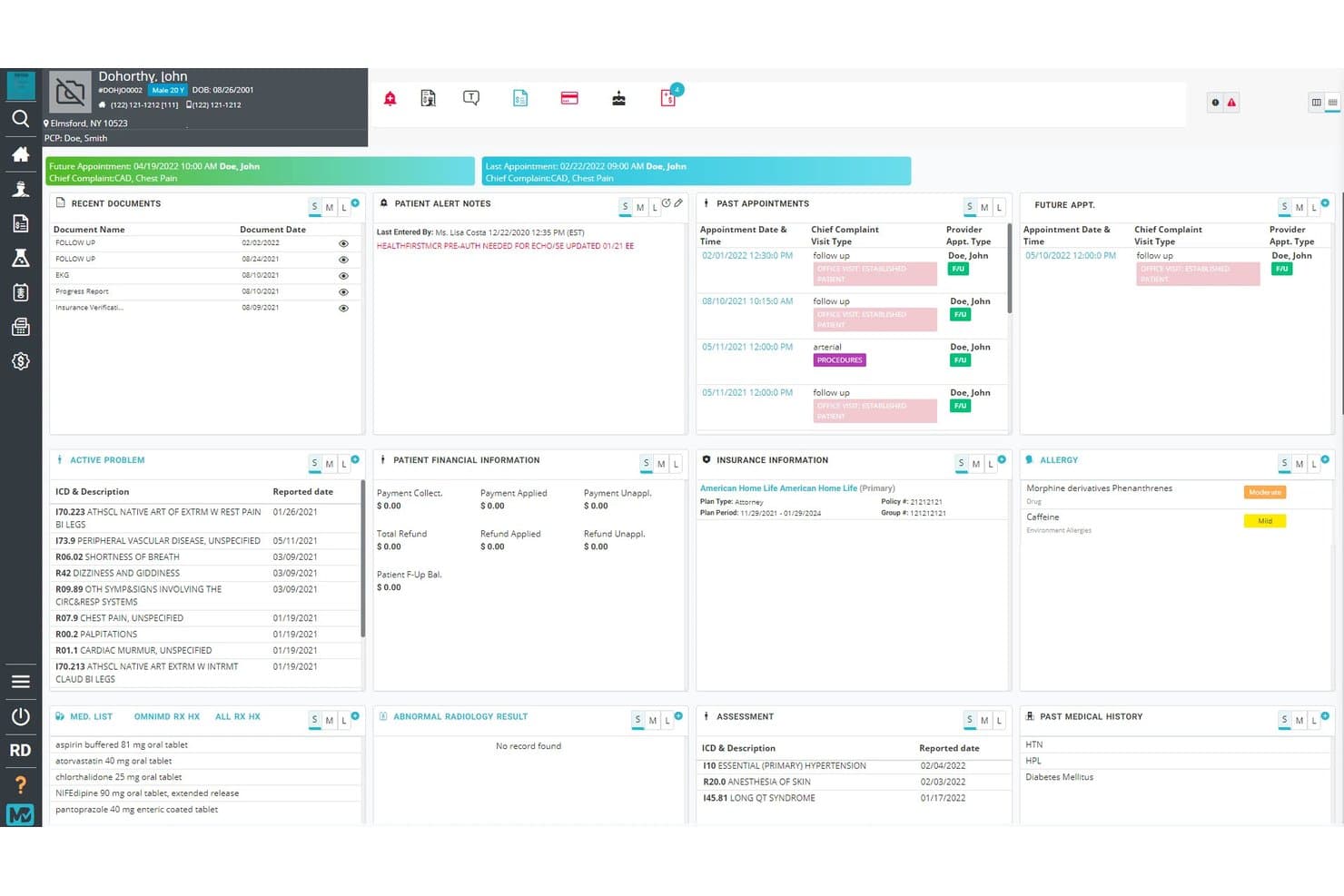
OmniMD centralizes patient health data for streamlined wound care visits. OmniMD is a multi-specialty EHR platform with a dedicated wound care module that covers etiology-specific documentation templates, AI-assisted coding, and billing automation for wound care procedures.
Who Is OmniMD Best For?
OmniMD fits multi-specialty clinics and outpatient wound care practices that want billing and coding automation built into the same system as their clinical documentation.
Why I Picked OmniMD
I picked OmniMD as one of the best because its AI Medical Coder handles the billing complexity that trips up most wound care practices, automatically applying codes like 97597 for debridement and A6xxx HCPCS codes for dressings, while checking modifiers and payer bundling rules before submission. I also like that the AI RCM layer predicts denials based on payer history, so claims get corrected before they're rejected. That coding-to-claims pipeline sits inside the same system as the clinical documentation, meaning a structured wound note feeds directly into a clean claim.
OmniMD Key Features
- Etiology-specific wound templates: Documentation templates tailored by wound type, including diabetic foot ulcers, venous leg ulcers, pressure injuries, burns, and arterial wounds.
- Multi-system wound classification: Supports Wagner, CEAP, NPUAP, Rutherford, and Southampton staging systems, with structured fields for tissue type, exudate, and periwound status.
- AI Medical Scribe for wound visits: Converts spoken assessments into structured chart fields, recognizing wound-specific terminology and prompting for missing post-procedure measurements.
- PUSH Score tracking: Records and plots Pressure Ulcer Scale for Healing scores across visits to visualize healing trends over time.
OmniMD Integrations
OmniMD integrates with LabCorp and Quest, plus regional labs through OmniXchange and HL7. It supports FHIR 4.0.1, SMART-on-FHIR, HL7, and API connections; its standalone AI Medical Scribe connects with Epic, Cerner, athenahealth, eClinicalWorks, and Allscripts.
Pros and Cons
Pros:
- Structured notes support cleaner claim submission
- AI coding checks modifiers and bundling
- Etiology-specific templates support precise staging
Cons:
- No offline bedside wound charting app
- Photo measurement and 3D mapping remain unverified
Learn more about OmniMD: Best for comprehensive wound care EHR
- Free demo available
- Pricing upon request
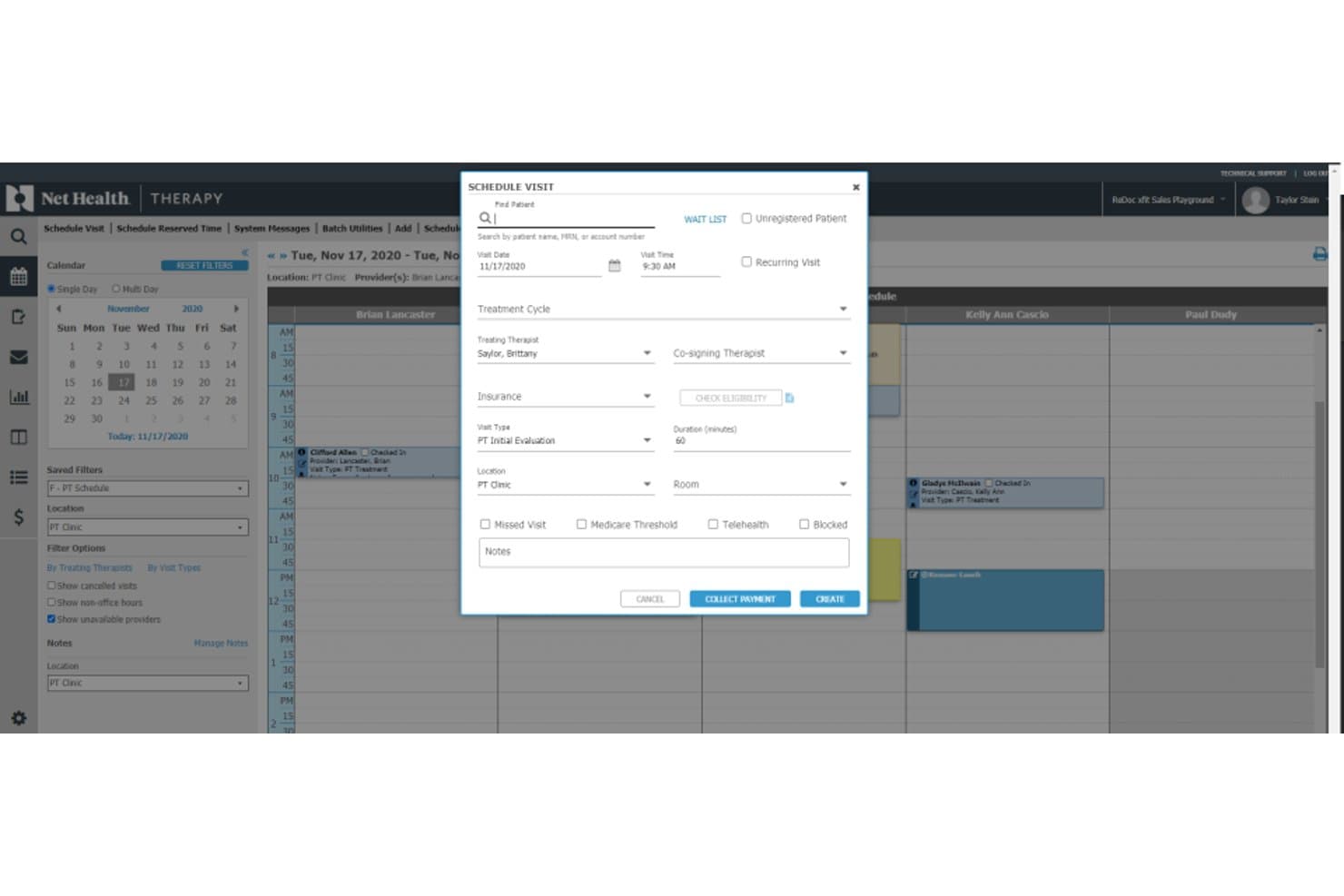
Net Health scheduling dashboard for managing patient visits, providers, insurance, and payments Net Health is a specialty wound care EMR platform that combines structured assessment documentation, AI-powered wound imaging, clinical decision support tools, and automated coding through its WoundExpert EHR and Tissue Analytics products.
Who Is Net Health Best For?
Net Health is a strong fit for wound care specialists and clinicians working across hospital outpatient centers, skilled nursing facilities, and home health settings.
Why I Picked Net Health
Net Health earns its spot as one of the best on my shortlist because it's one of the few wound care EMR platforms built around both clinical documentation and AI-driven imaging in a single system. I particularly like the Tissue Analytics integration, which auto-measures wounds through 3D mobile imaging so I'm not manually inputting dimensions at the bedside. The Wound Healing Velocity Tool and Amputation Risk Tool give me predictive clinical context that most general EHRs simply don't offer.
Net Health Key Features
- Role-based access controls: Assign permissions for clinicians, administrators, and support staff to protect PHI and maintain compliance.
- MatrixCare CSF integration: Sync patient census and real-time resident data for long-term care workflows.
- Population analytics dashboards: Track healing rates, infection trends, and quality benchmarks across patient groups or locations.
- Automated superbill coding: Link wound encounter data directly to CPT codes and prepare billing files within the same workflow.
Net Health Integrations
Net Health offers native integrations with Tissue Analytics and MatrixCare Census Subscriber Feed, supports interoperability with enterprise EHRs like Epic, and provides HL7 and Direct Access for custom integration workflows.
Pros and Cons
Pros:
- Predictive healing analytics and risk tools
- Customizable clinical documentation templates
- AI-powered wound imaging and measurement
Cons:
- Reporting interface sometimes loads slowly
- Workflow setup can require significant onboarding
Learn more about Net Health:
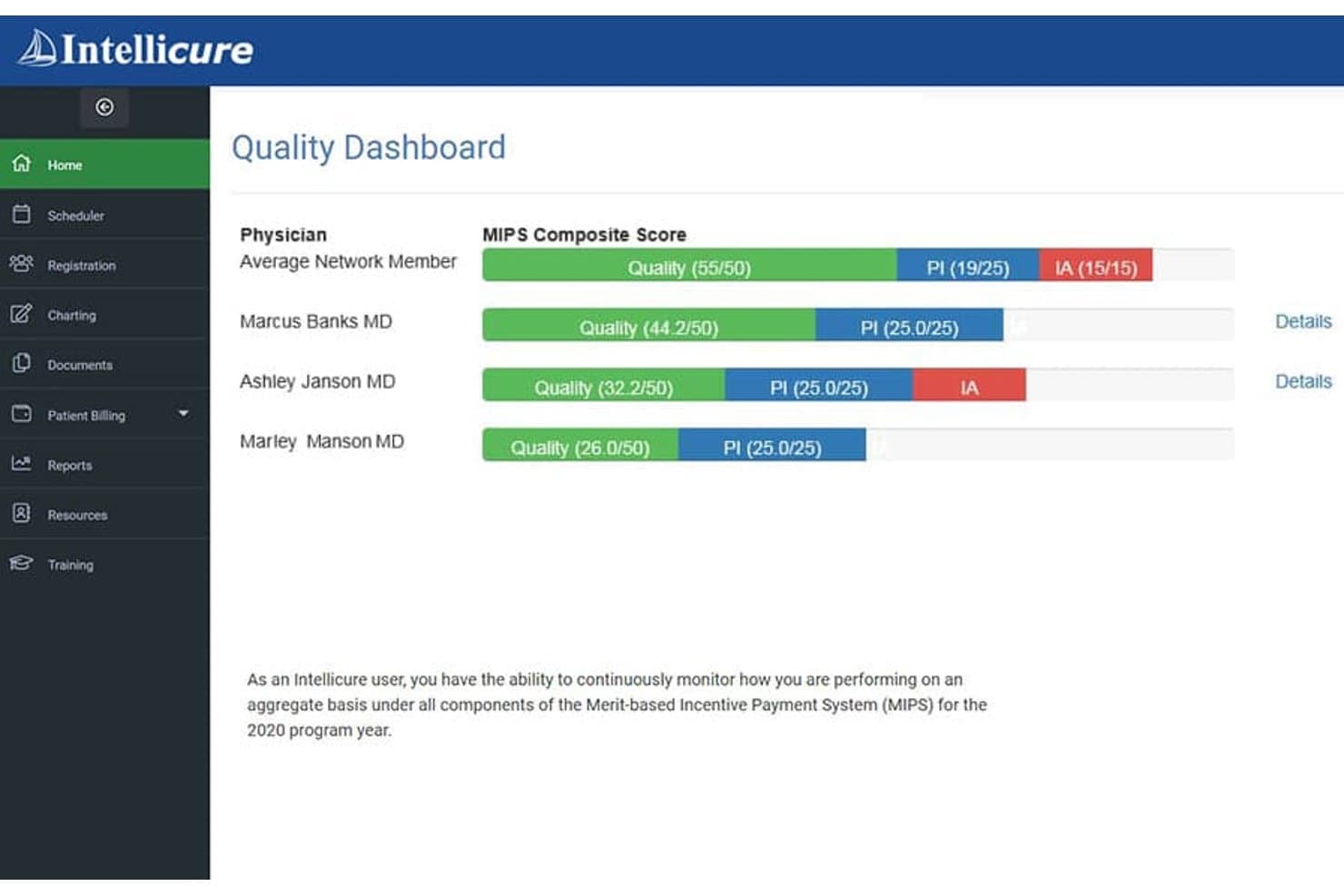
Intellicure quality dashboard showing physician MIPS performance and composite scores Intellicure is a cloud-based EMR built exclusively for wound care and hyperbaric medicine, combining point-of-care charting, AI-assisted coding, mobile wound measurement, and CMS quality reporting in a single platform.
Who Is Intellicure Best For?
Intellicure is a strong fit for hospital outpatient wound centers, mobile wound care practices, and long-term care facilities that need a dedicated wound care EMR.
Why I Picked Intellicure
Intellicure earns its spot as one of the best on my shortlist because no other wound care EMR goes as deep on clinical specificity. I particularly like iMeasure.ai, which detects wound measurements directly from a photo rather than requiring manual entry. The built-in AI also selects wound-specific ICD-10 codes and E/M levels at the point of care, and I've found that level of coding automation, paired with the CTP Audit Defender for skin substitutes, is rarely this tightly integrated in a purpose-built wound care platform.
Intellicure Key Features
- SMART on FHIR EHR integration: Intellicure can launch within major EHRs like Epic and Cerner for direct wound charting in hospital workflows.
- OrderTrak for DME requests: Generate and track durable medical equipment orders directly from the patient chart.
- Quality Suite with CMS-recognized measures: Supports MIPS reporting and benchmarking using US Wound Registry-authored wound care metrics.
- Automated documentation output: Auto-generates therapist notes, nursing notes, lab orders, and home health agency orders from each visit.
Intellicure Integrations
Intellicure offers native integrations with Epic, Oracle Health (Cerner), Meditech, Allscripts, Athena Health, and PointClickCare. MatrixCare integration is coming soon, and an API is available for custom integrations.
Pros and Cons
Pros:
- Embedded clinical decision support for wounds
- Auto-generates wound care quality reports
- AI-driven wound measurement from photos
Cons:
- Limited customization of report output
- Mobile offline charting not fully supported
Learn more about Intellicure:
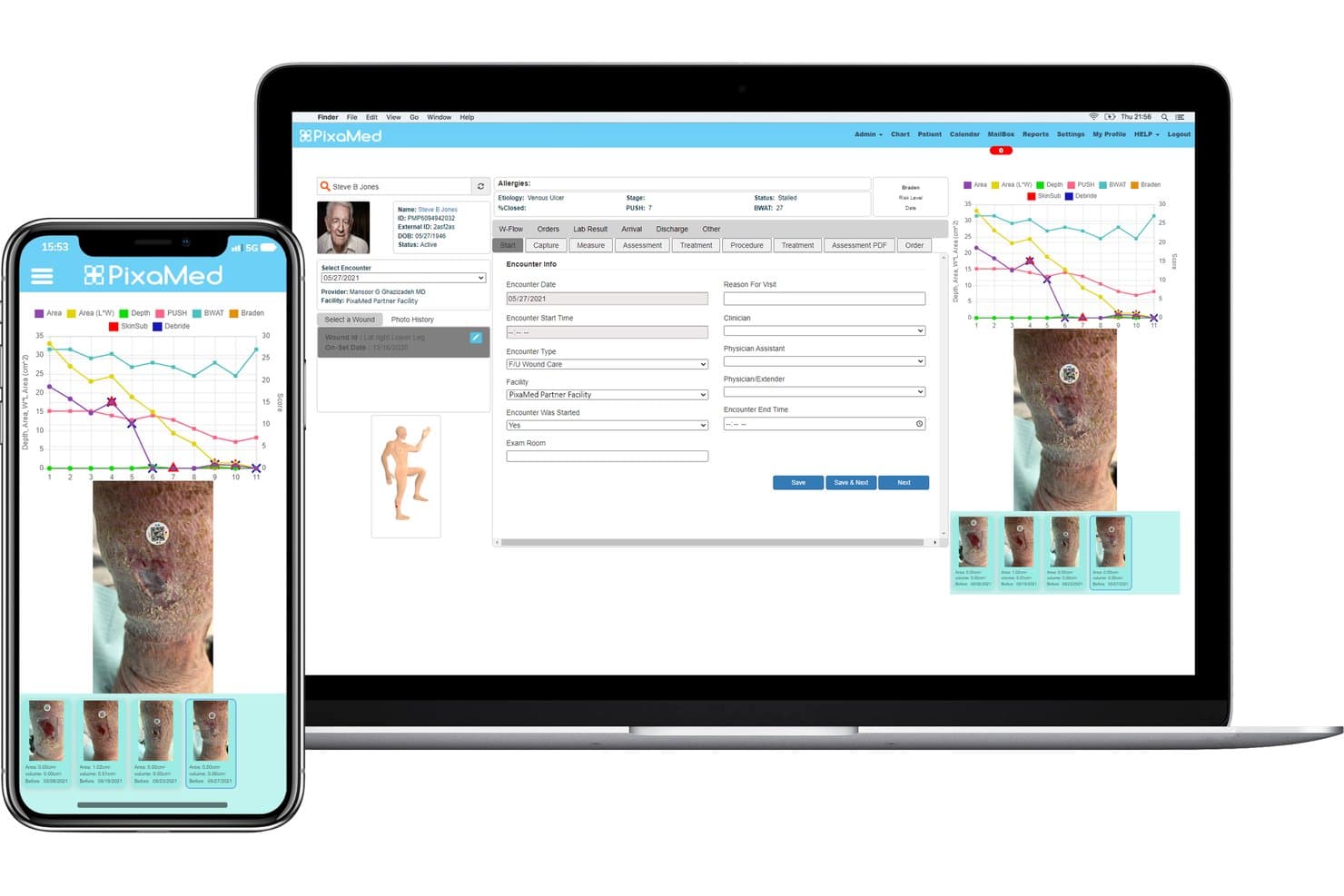
PixaMed offers a dual-device wound care EMR platform with wound photo tracking, measurement charts, and encounter documentation on both mobile and desktop. PixaMed is a specialty wound and burn care EMR platform that combines AI-assisted wound imaging, automatic tissue classification, structured assessment documentation, CPT code generation, and point-of-care mobile access with offline capability.
Who Is PixaMed Best For?
PixaMed is a strong fit for wound care clinicians and clinic administrators who need a specialty-specific EMR rather than a general-purpose system adapted for wound care.
Why I Picked PixaMed
PixaMed earns its spot as one of the best on my shortlist because its digital wound assessment tools go well beyond basic photo capture. I'm particularly impressed by Unwrap Technology, which compensates for body curvature to deliver measurements that are 20–50% more accurate than standard flat-image methods. Pair that with AI-driven tissue classification that automatically quantifies slough and eschar percentages, and I can count on objectively consistent data across every patient visit.
PixaMed Key Features
- Automated CPT coding: Generates wound care CPT codes directly from assessment documentation for billing workflows.
- Practice management module: Handles patient registration, scheduling, and integrated billing within the platform.
- SSO-embedded EHR integration: Can be launched from Epic, athenahealth, and Net Health patient charts for unified workflows.
- Smart Track longitudinal monitoring: Displays wound progress with graphical trend analysis and historical image comparisons.
PixaMed Integrations
PixaMed offers native integrations with Epic, athenahealth, Net Health, Oracle Health Ambulatory Suite, and eClinicalWorks. An API is also available for custom integrations.
Pros and Cons
Pros:
- Embedded specialty-specific templates and staging tools
- Curvature correction for wound imaging accuracy
- AI-powered auto-measurement and tissue classification
Cons:
- Limited predictive analytics for healing trajectory
- CMS and OASIS reporting not explicitly supported
Learn more about PixaMed: Best for standardized wound care documentation
- Not available
- Pricing upon request
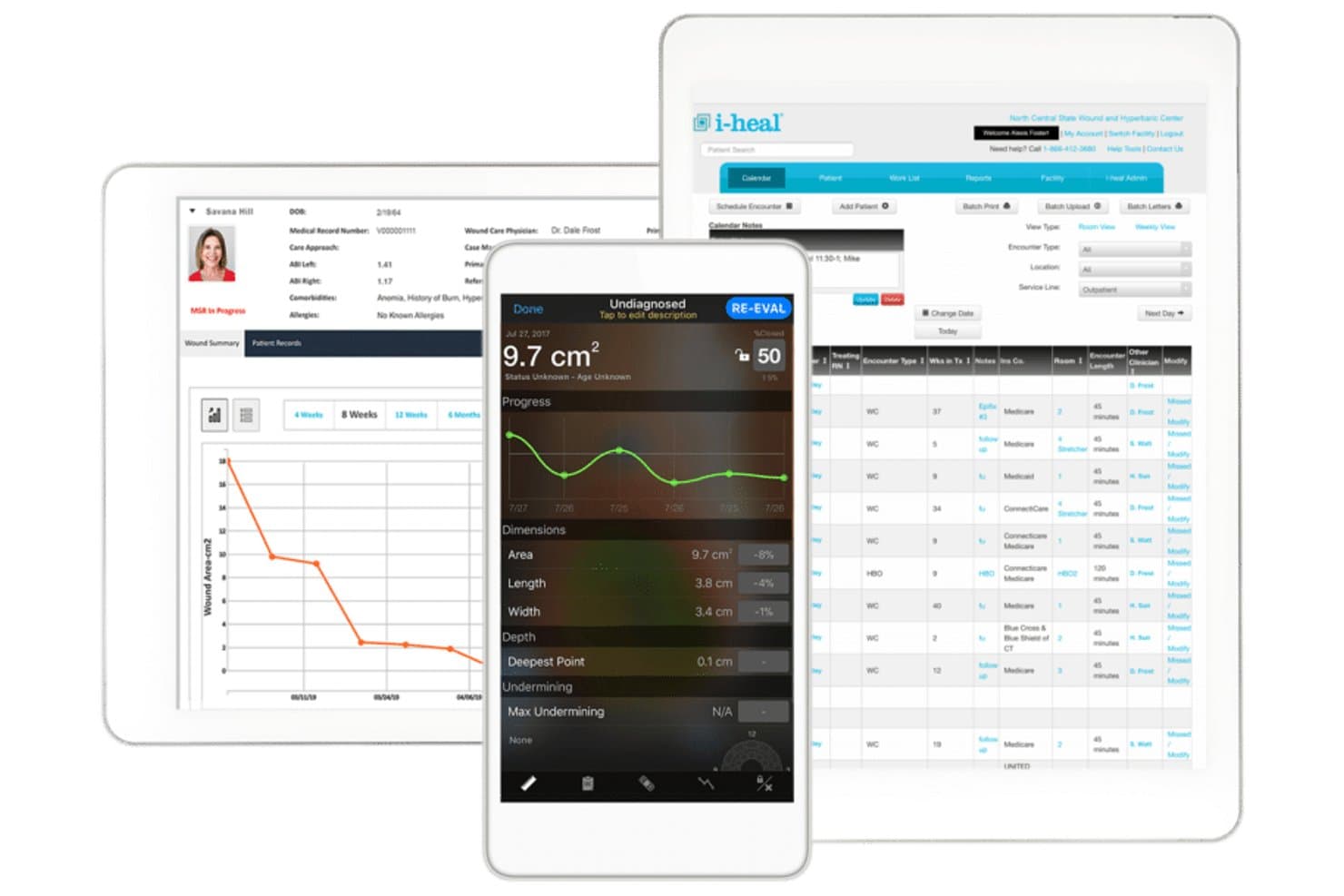
Healogics WoundSuite offers a multi-device wound care EMR platform displaying patient records, wound measurement tracking, and appointment scheduling across tablet, mobile, and desktop interfaces. Healogics WoundSuite is a wound care-specific EMR suite that combines structured clinical documentation through i-heal, workflow coordination tools via Clinical Optimization, and mobile wound imaging with digital measurement through the Photo+ app.
Who Is Healogics WoundSuite Best For?
WoundSuite is a strong fit for outpatient Wound Care Centers® and long-term care facilities that run structured, high-volume wound care programs.
Why I Picked Healogics WoundSuite
I picked WoundSuite as one of the best because i-heal structures documentation around the Healogics Patient Care Process, a six-sigma lean protocol that enforces consistent wound assessment every visit. The Interdisciplinary Care Management Guide and Medical Surveillance Review process build a defined clinical sequence into the workflow, so providers review case status before entering a patient room. I like how this pre-clinic structure removes the guesswork from documentation.
Healogics WoundSuite Key Features
- Mobile wound photo capture: Clinicians use the Photo+ app to capture detailed wound images at the point of care.
- Cloud-based wound measurement: Digital length, width, and area calculations are automatically uploaded to the Healogics Cloud.
- ONC-certified EHR technology: i-heal includes certified APIs for FHIR-based interoperability with other systems.
- Medical Surveillance Review process: Built-in workflows guide clinicians through standardized wound case reviews before each patient visit.
Healogics WoundSuite Integrations
Healogics WoundSuite offers native integrations with PointClickCare and supports FHIR-based interoperability with other EHR systems through ONC-certified APIs. An API is available for custom integrations.
Pros and Cons
Pros:
- Supports regulatory and payer reporting requirements
- Integrates wound photography with EMR charting
- Enforces standardized wound documentation protocols
Cons:
- Lacks public peer-reviewed feedback and ratings
- Mobile app receives infrequent updates
Learn more about Healogics WoundSuite: Best for physician-designed wound charting
- Free demo available
- Pricing upon request
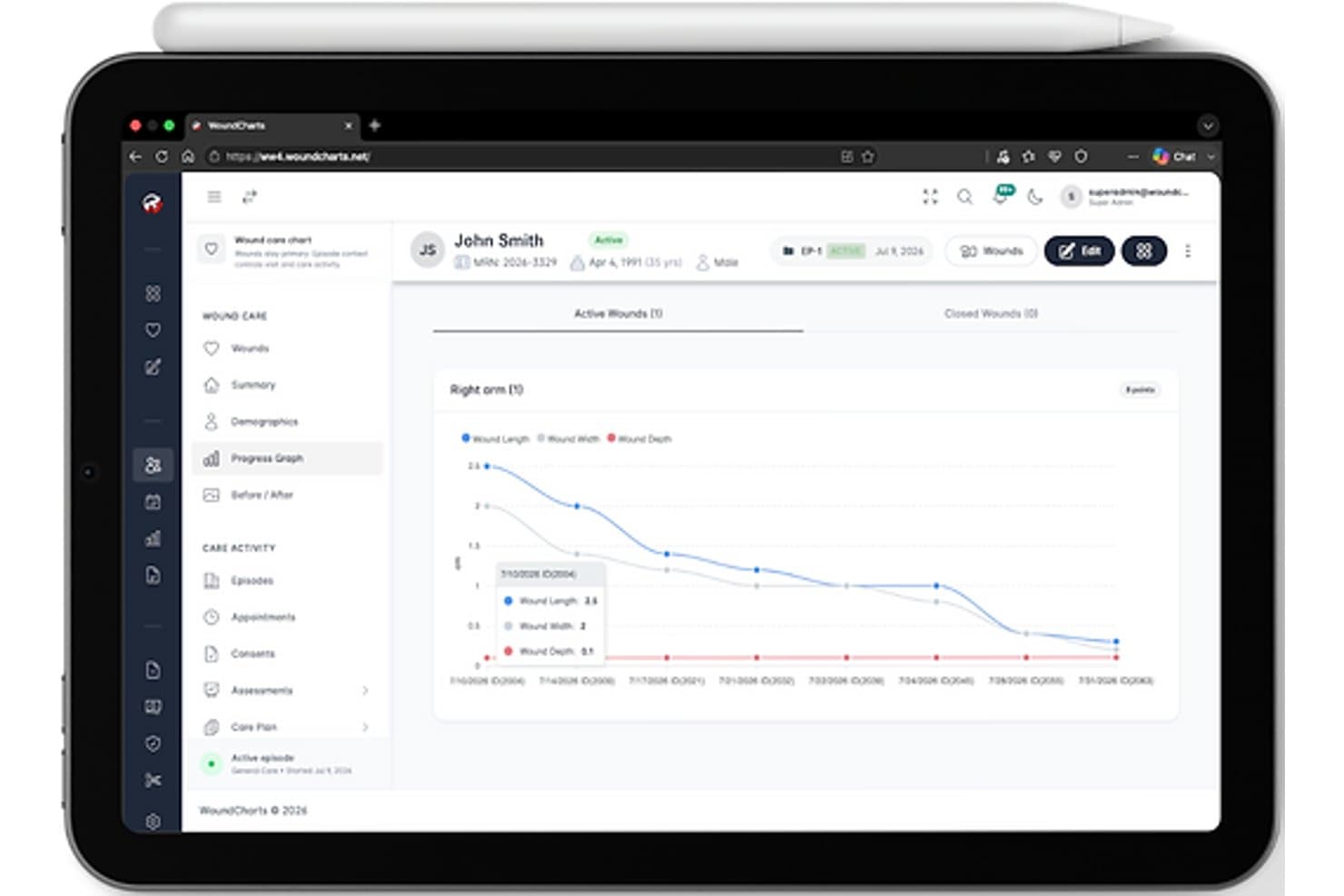
Wound Charts tracks wound dimensions over time with a visual progress graph. Wound Charts is a web-based wound care EMR built by a practicing wound care physician that covers structured wound documentation, calibrated planimetry, photo capture, tissue tracking, healing trend graphs, and ICD-10/CPT coding assistance.
Who Is Wound Charts Best For?
Wound Charts is a strong fit for wound care physicians and nurses who need documentation built around the actual clinical encounter, not a generic EMR adapted for wound care.
Why I Picked Wound Charts
Wound Charts earns its spot on my shortlist because it was built by a practicing wound care physician, not adapted from a general EMR, and that difference shows up directly in the charting workflow. I love how calibrated planimetry, tissue percentage tracking (granulation, slough, eschar, epithelium), and encounter photos all live on a single charting surface, so you can pull up a before-and-after view without hunting across separate modules. The healing trend graphs and automatic milestone predictions make it easy to catch a wound that's stalling before it becomes a bigger clinical problem.
Wound Charts Key Features
- ICD-10/CPT coding assistance: Maps your documented encounter directly to candidate ICD-10 and CPT codes to reduce claim denials.
- Adaptive visit templates: Structured charting templates adjust based on visit type, ensuring consistent documentation across all clinicians.
- Audit trail logging: Every read, write, and export is automatically logged with date, user, and encounter details for compliance purposes.
- Clinical decision support: Guideline-based suggestions surface directly against the live chart to support treatment decisions at the point of care.
Wound Charts Integrations
Wound Charts doesn't have any native integrations. The vendor doesn’t document HL7, FHIR, EHR, clearinghouse, supply system, or custom API connectivity.
Pros and Cons
Pros:
- Manual tissue percentages support serial assessment
- Calibrated planimetry tracks healing trends
- Physician-designed wound encounter workflow
Cons:
- Medication management remains underdeveloped
- Coding stops before claims management
Learn more about Wound Charts: Best for mobile wound care billing automation
- Free demo available
- From $250/user/month
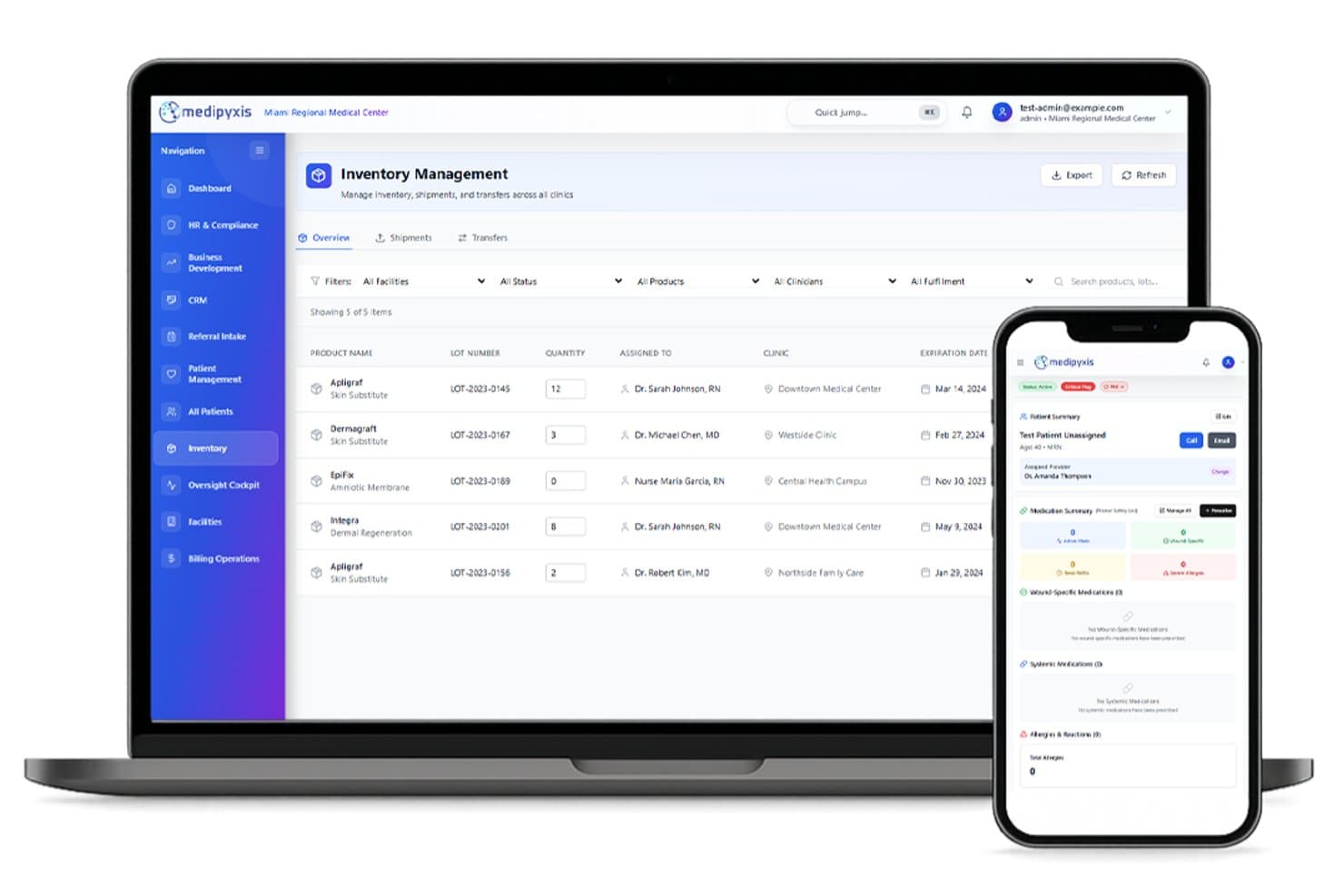
Medipyxis tracks wound care inventory and patient data across clinics. Medipyxis is a mobile wound care EMR built for SNF, assisted living, and home health practices that combines guided visit documentation, wound-specific billing and coding, graft inventory tracking, referral intake, and practice analytics in one platform.
Who Is Medipyxis Best For?
Medipyxis is a strong fit for mobile wound care physicians and practice administrators running multi-clinician operations across SNFs, assisted living, or home health settings.
Why I Picked Medipyxis
I picked Medipyxis as one of the best because its wound-specific billing automation goes deeper than most EMRs I've seen at this scale. Its CPT coding engine uses actual wound area to suggest debridement codes, and its claim scrubber flags issues like deleted skin-substitute C-codes and same-day bundling conflicts before a claim goes out. I also like that ICD-10 codes are mapped directly from wound type and staging, cutting the manual lookup work that slows down billing in mobile SNF practices.
Medipyxis Key Features
- 17-step visit wizard: A guided, etiology-specific workflow that walks clinicians through consent, history, wound assessment, procedures, and provider sign-off in a single structured visit.
- Graft inventory tracking: Lot-level traceability for skin substitutes from shipment to claim, with IVR readiness flags, stock alerts, and a vendor portal for supplier catalog and invoice management.
- Leadership/Oversight Cockpit: A real-time dashboard showing referral conversion rates, denial rates, A/R aging, clinician utilization, and revenue broken down by location.
- ZusHealth/TEFCA integration: Pulls outside medications, allergies, labs, and conditions into the patient record and automatically sends signed visits back to external providers.
Medipyxis Integrations
Medipyxis offers native integrations with ZusHealth/TEFCA, DoseSpot, and Stedi for health-record exchange, e-prescribing, claims, and remittance files. Epic, Cerner, and general HL7 or FHIR integrations aren’t documented.
Pros and Cons
Pros:
- Lot-level graft traceability and tracking
- Detailed etiology-specific assessment workflows
- Area-driven wound procedure code suggestions
Cons:
- Hospital interoperability remains limited
- Manual wound photo measurements limit imaging
Learn more about Medipyxis:
How I Evaluate Wound Care EMR Software
I split my evaluation into three parts, giving the most weight to core functionality: capture measurements, stage wounds, and compare images over time. Next, I look for standout features such as AI tissue classification. Finally, I consider care-setting flexibility, onboarding, support, and pricing value.
Core Functionality (Table Stakes For This List)
When I'm selecting tools for my list, I score each one on a scale from 0 (does not offer the functionality) to 5 (excels in this area) for each core functionality listed below. I then convert the total into a percentage to help assess each tool's overall fit, with extra weight on any functionalities I’ve deemed essential.
- Wound Documentation (Essential): I look for structured fields covering wound size, depth, tissue type, location, etiology, and staging across repeated visits.
- Wound Imaging (Essential): I evaluate photo capture, measurement overlays, and side-by-side comparisons that show healing changes over time.
- Patient Recordkeeping: The chart should connect wound findings with medical history, medications, visit notes, and access for relevant providers.
- Wound Billing And Coding: I check support for wound-related CPT and ICD-10 codes, documentation prompts, and claim-ready coding workflows.
- Treatment Plan Tracking: I assess whether teams can create individualized plans, assign treatments, and track progress across visits and care settings.
- Compliance Reporting: I look for audit-ready reports that capture required assessments, treatment updates, signatures, and payer documentation elements.
Once I have a list of tools that meet the criteria, I consider what sets each platform apart.
Differentiating Factors (What Sets Vendors Apart)
Here's how I compare and contrast different vendors:
Standout Features
AI tissue classification is a big one. I check whether the platform can automatically identify granulation, slough, and necrotic tissue in wound photos, since this reduces the subjectivity that creeps in when multiple clinicians assess the same wound. Predictive healing analytics matter just as much—I look for tools that flag non-healing wounds early based on historical data, giving your team time to adjust treatment before outcomes slip. I also evaluate offline bedside documentation, especially for home health and long-term care teams who can't count on reliable connectivity at every point of care.
Beyond Features
Care-setting flexibility matters most to me. A platform that works in a clinic but drops wound photos during a home visit with spotty Wi-Fi isn't practical for multi-site teams. I also evaluate how each vendor handles patient image privacy, since wound photos are especially sensitive PHI that demand encryption, strict access controls, and clear retention policies. Finally, I check whether onboarding includes wound-specific clinical training—not just software walkthroughs—because staging protocols and measurement standards vary across payer guidelines.
Slik velger du EMR-programvare for sårbehandling
Det er lett å gå seg vill i lange funksjonslister og komplekse prismodeller. For å holde fokus mens du arbeider deg gjennom den unike prosessen med å velge programvare, kan du bruke denne sjekklisten over faktorer du bør ha i bakhodet:
| Faktor | Hva bør du vurdere? |
| Skalerbarhet | Vil plattformen vokse med organisasjonen din – for eksempel ved å støtte flere klinikere, lokasjoner eller behandlingsmiljøer – uten at det kreves omfattende endringer i prosessene? |
| Integrasjoner | Kan du synkronisere data og dele arbeidsflyter med det viktigste elektroniske pasientjournalsystemet, faktureringssystemene eller planleggingsverktøyene dine – spesielt for organisasjoner som bruker Epic eller Cerner? |
| Tilpasningsmuligheter | Gir programvaren mulighet til å justere maler og arbeidsflyter eller legge til egendefinerte felt, slik at du kan tilpasse den til organisasjonens protokoller og rapporteringsbehov? |
| Brukervennlighet | Er det enkelt å ta sårbilder, registrere målinger og dokumentere ved pasientens seng, også for deltidsansatte eller klinikere som er mindre teknologivante? |
| Implementering og innføring | Hvilket nivå av støtte tilbyr leverandøren, og hvor raskt kan vanlige team forvente å bli fullt opplært og produktive med den nye plattformen? |
| Kostnad | Tar du med alle kostnader i beregningen – som implementering, mobile enheter, brukerstøtte eller løpende oppgraderinger – og ikke bare de grunnleggende abonnementsavgiftene? |
| Sikkerhetstiltak | Hvor godt håndterer leverandøren kryptering, brukertillatelser og beskyttelse av PHI i tråd med HIPAA- og HITECH-standardene? |
| Etterlevelseskrav | Vil plattformen hjelpe deg med å oppfylle CMS-, OASIS- eller MDS-krav til dokumentasjon og rapportering som gjelder for ditt spesifikke sårbehandlingsmiljø? |
Hva er EMR-programvare for sårbehandling?
EMR-programvare for sårbehandling er digitale plattformer som er utviklet for å dokumentere, følge opp og administrere sårrelaterte vurderinger, bilder og behandlingsarbeidsflyter gjennom hele helingsprosessen. Disse systemene støtter strukturert sårobservasjon, måleverktøy, analyse av utvikling over tid, tilgang ved behandlingsstedet og sårspesifikk koding, slik at klinikere kan levere ensartet behandling i samsvar med krav på tvers av ulike miljøer og team.
Funksjoner i EMR-programvare for sårbehandling
Se etter følgende viktige funksjoner når du velger EMR-programvare for sårbehandling:
- Maler for sårvurdering: Strukturerte skjemaer for dokumentasjon av sårmål, vevstype, stadium, eksudat og andre kliniske variabler ved hvert møte.
- Fotografering og lagring: Lagre og organiser sårbilder på en sikker måte ved hvert besøk, slik at klinikere kan følge endringer visuelt og dele bilder med behandlingsteamet.
- Digitale måleverktøy: Innebygde linjaler, sporingsverktøy og verktøy for arealberegning gir konsekvent og nøyaktig dokumentasjon av sårets størrelse og dybde.
- Oppfølging av tilhelingsforløp: Tidslinje- eller grafvisninger som viser tilhelingstrender og gjør det enkelt å sammenligne sårstatus på tvers av flere besøk.
- Mobil tilgang ved behandlingsstedet: Fullverdige mobil- eller nettbrettgrensesnitt, slik at klinikere kan dokumentere, måle og fotografere sår ved pasientsengen eller ute i feltet.
- Sårspesifikke kodingsarbeidsflyter: Integrerte kodebiblioteker og forslag for CPT, ICD-10 og HCPCS effektiviserer samsvarende fakturering som er direkte knyttet til dokumentasjonen.
- Verktøy for myndighetsrapportering: Genererer automatisk rapporter for revisjoner eller krav fra betalere, inkludert CMS-, MDS- eller OASIS-kvalitetsmål som gjelder sår.
- Brukertillatelser basert på roller: Styrer tilgangen basert på klinikerens rolle, beskytter sensitive data og opprettholder samsvar med personvernforskrifter.
- Muligheter for interoperabilitet: Mulighet til å utveksle pasientdata med andre EHR-systemer, faktureringssystemer eller registre for å redusere dobbeltregistrering og holde journalene samordnet.
Vanlige AI-funksjoner i EMR-programvare for sårbehandling
I tillegg til standardfunksjonene i EMR-programvare for sårbehandling som er nevnt ovenfor, tar mange av disse løsningene i bruk AI med funksjoner som:
- Automatisk sårmåling: AI analyserer sårbilder for å beregne lengde, bredde, areal og dybde, noe som reduserer manuelle målefeil og sparer klinikere for tid.
- Klassifisering av vevstype: AI identifiserer og merker vevstyper – for eksempel granulasjonsvev, fibrinbelegg eller nekrotisk vev – direkte fra sårbilder, noe som støtter mer objektiv og konsekvent dokumentasjon.
- Prediksjon av tilhelingsforløp: AI-modeller analyserer historiske sårdata for å forutsi tilhelingshastighet og flagge sår med risiko for forsinket lukking, slik at klinikere kan prioritere tiltak.
- Smarte dokumentasjonspåminnelser: AI foreslår relevante kliniske detaljer eller manglende datafelter under journalføringen, noe som forbedrer fullstendigheten og nøyaktigheten i sårvurderingene.
- Vurdering av bildekvalitet: AI kontrollerer sårbilder for klarhet, belysning og fokus, og ber klinikere ta nye bilder ved behov for å sikre pålitelig dokumentasjon.
Fordeler med EMR-programvare for sårbehandling
Implementering av EMR-programvare for sårbehandling gir flere fordeler for teamet og virksomheten din. Her er noen av fordelene du kan se frem til:
- Forbedret sårdokumentasjon: Strukturerte maler og måleverktøy sikrer at hver sårvurdering er grundig, konsekvent og enkel å gjennomgå.
- Raskere kliniske beslutninger: Oppfølging av fremgang, bildediagnostikk og AI-analyse gir klinikere innsikt i sanntid, slik at de tidligere kan identifisere manglende tilheling eller infeksjonsrisiko.
- Mer effektive arbeidsflyter: Mobil tilgang og integrert koding hjelper klinikere og faktureringsteam med å fullføre dokumentasjon og krav ved behandlingsstedet.
- Bedre samsvar: Innebygde myndighetsrapporter og sikre revisjonsspor holder organisasjonen i samsvar med HIPAA og krav fra betalere.
- Bedre koordinering av behandlingen: Funksjoner for bildehåndtering, trendrapportering og interoperabilitet støtter samarbeidende behandling på tvers av avdelinger eller praksiser med flere lokasjoner.
- Færre avviste krav: Sårspesifikk koding og dokumentasjon reduserer faktureringsfeil og hjelper teamene med å oppfylle betalernes krav for refusjon.
- Enklere referansemåling: Resultatdashbord og analyseverktøy gjør det enkelt å sammenligne tilhelingsrater eller infeksjonstrender med interne eller eksterne referanseverdier.
Kostnader og priser for EMR-programvare for sårbehandling
Valg av EMR-programvare for sårbehandling krever en forståelse av de ulike prismodellene og planene som er tilgjengelige. Kostnadene varierer basert på funksjoner, teamstørrelse, tillegg og mer. Tabellen nedenfor oppsummerer vanlige planer, gjennomsnittsprisene deres og typiske funksjoner som er inkludert i EMR-programvareløsninger for sårbehandling:
Sammenligningstabell for planer for EMR-programvare for sårbehandling
| Plantype | Gjennomsnittspris | Vanlige funksjoner |
| Gratisabonnement | $0 | Grunnleggende dokumentasjon av sår, begrenset bildelagring og grunnleggende rapportering. |
| Personlig abonnement | $30-$75 per bruker/måned | Standardiserte vurderingsmaler, digitale måleverktøy og grunnleggende mobiltilgang. |
| Bedriftsabonnement | $80-$150 per bruker/måned | Avansert bildehåndtering, sårspesifikk koding, egendefinerte rapporter og alternativer for interoperabilitet. |
| Virksomhetsabonnement | $160+ per bruker/måned | Integrasjon med EHR-systemer, dashbord for befolkningsanalyse, støtte for etterlevelse, dedikert oppstart og støtte døgnet rundt. |
Vanlige spørsmål om EMR-programvare for sårbehandling
\u003cspan style=\u0022font-weight: 400\u0022\u003eHer er noen svar på vanlige spørsmål om EMR-programvare for sårbehandling:\u003c/span\u003e
Hvordan forbedrer EMR-programvare for sårbehandling nøyaktigheten i sårvurderinger?
\u003cspan style=\u0022font-weight: 400\u0022\u003eEMR-programvare for sårbehandling standardiserer dokumentasjonen ved hjelp av strukturerte maler, digitale måleverktøy og fotografering. Dette hjelper klinikere med å unngå subjektive eller inkonsekvente vurderinger og gjør det enklere å følge med på tilhelingsprosessen.\u003c/span\u003e
Kan EMR-programvare for sårbehandling integreres med vårt primære EHR-system?
\u003cspan style=\u0022font-weight: 400\u0022\u003eJa, mange EMR-løsninger for sårbehandling støtter integrasjon med ledende EHR-systemer via HL7, FHIR eller API-er. Dette muliggjør toveis deling av pasientdata, sårbilder og dokumentasjon på tvers av plattformene.\u003c/span\u003e
Er EMR-programvare for sårbehandling egnet for hjemmesykepleie eller mobile klinikere?
\u003cspan style=\u0022font-weight: 400\u0022\u003eJa, de fleste ledende plattformene tilbyr mobilapper med journalføring og fotografering uten nettilkobling. Dette gjør dem praktiske for hjemmesykepleie, hospice eller klinikere som arbeider ute i feltet eller ved flere institusjoner.\u003c/span\u003e
Hvilke funksjoner for etterlevelse av regelverk bør jeg forvente?
\u003cspan style=\u0022font-weight: 400\u0022\u003eDu bør forvente etterlevelse av HIPAA og HITECH, revisjonslogging, kryptert bildelagring, rollebasert tilgang og innebygde arbeidsflyter som støtter krav som CMS-, OASIS- eller MDS-spesifikke sårmål.\u003c/span\u003e
Hvor lang tid tar det å implementere EMR-programvare for sårbehandling?
\u003cspan style=\u0022font-weight: 400\u0022\u003eTidsrammen for implementeringen varierer, men de fleste leverandører kan få mindre team i gang i løpet av noen uker, særlig når klinisk opplæring og malbiblioteker tilbys. Større organisasjoner eller EHR-integrasjoner kan kreve mer omfattende planlegging og opplæring.\u003c/span\u003e