

EPJ-programvare for hospice er spesialisert teknologi for elektroniske pasientjournaler, utviklet for å håndtere kliniske, operative og lovpålagte behov innen hospiceomsorg.
Hvis du leter etter den beste EPJ-programvaren for hospice, må du balansere kompleks dokumentasjon, Medicare-krav og sanntidskommunikasjon i teamet – samtidig som du gir støtte til sårbar pasientbehandling. Det er viktig å arbeide effektivt og overholde kravene, særlig når regelverket endres og teamet ditt tilpasser seg.
Denne veiledningen hjelper deg med å sammenligne de viktigste funksjonene og de praktiske fordelene hos ledende leverandører, slik at du kan avgjøre hvilket EPJ-system som passer til hospiceorganisasjonens unike arbeidsflyt og standarder.
Why Trust Our Software Recommendations
6,700+
Reviews
20
Industry experts
16+
Evaluation factors
14
Years
Our team has been testing and reviewing software since 2012. As medical practice leaders ourselves, we know how difficult—and important—it is to choose the right software.
For this guide, we evaluated tools using hands-on testing and independent research, scoring tools using our selection criteria.
Our reviews reflect our human editorial judgment, not a sales pitch.
Sammenligningstabell for EPJ-programvare for hospice
Tabellen nedenfor sammenligner prisopplysninger for mine beste utvalgte EPJ-programvarer for hospice.
| Tool | Best For | Trial Info | Price | ||
|---|---|---|---|---|---|
| 1 | Best with custom electronic document workflows | Free demo available | Pricing upon request | Website | |
| 2 | Best for bereavement and volunteer tracking | Free demo available | Pricing upon request | Website | |
| 3 | Best for detailed hospice-specific documentation | Free demo available | Pricing upon request | Website | |
| 4 | Best for integrated referral and intake processes | Free demo available | Pricing upon request | Website | |
| 5 | Best for real-time IDG collaboration features | Free demo available | Pricing upon request | Website | |
| 6 | Best for customizable workflow automation | Free demo available | Pricing upon request | Website | |
| 7 | Best for integrated medication management | Not available | Pricing upon request | Website | |
| 8 | Best for managing interdisciplinary meetings | Free demo available | Pricing upon request | Website | |
| 9 | Best for offline charting in remote care settings | 14-day free trial + free demo available | From $85/user/month | Website | |
| 10 | Best for streamlined plan of care updates | Free demo available | From $250/month | Website |


Anmeldelser av den beste EPJ-programvaren for hospice
Nedenfor finner du mine detaljerte sammendrag av den beste EPJ-programvaren for hospice som kom med på kortlisten. Anmeldelsene mine gir en detaljert gjennomgang av funksjonene, de beste bruksområdene og integrasjonene for hver programvare, slik at du kan finne den som passer best for deg.
 Best with custom electronic document workflows
- Free demo available
- Pricing upon request
Visit WebsiteCustomer Rating:4.5/5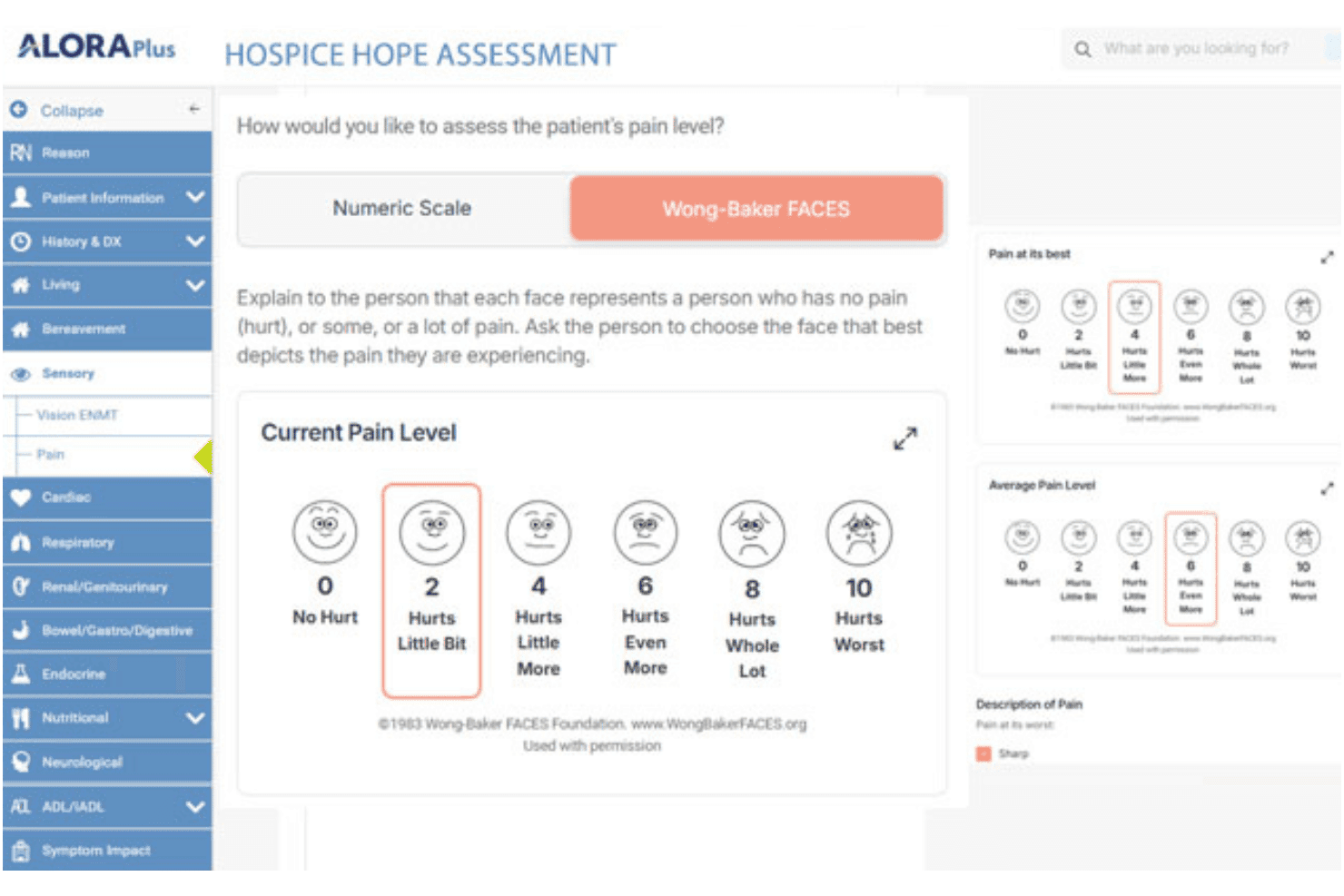
Alora Hospice Software manages charting, IDG meetings, billing, and care plans. Alora Hospice Software is a cloud-based hospice EMR that covers clinical documentation, IDG meeting management, hospice billing, care plan tracking, and compliance tools across nursing, aide, social work, and chaplain disciplines.
Who Is Alora Hospice Software Best For?
It's a strong fit for hospice agencies that manage multiple disciplines or run combined hospice and home health operations under a single platform.
Why I Picked Alora Hospice Software
Alora Hospice Software earns its spot on my shortlist because of how it handles agency-specific documentation. I love that teams can upload proprietary consent forms, election statements, and intake documents directly into the system and route them for electronic signature without leaving the platform. What I find particularly useful is the symptom follow-up workflow, which auto-triggers from the HOPE assessment when pain or dyspnea is flagged, keeping clinicians accountable without manual follow-up.
Alora Hospice Software Key Features
- Local coverage determinations integration: Automatically validates LCDs for terminal diagnosis within the nurse assessment workflow.
- Bereavement plan management: Centralizes bereavement assessments, custom plans, and follow-up tracking for families.
- Medical director portal: Gives hospice physicians a dedicated interface to review and sign orders, CTIs, and care plans remotely.
- Multi-office user management: Supports multiple agency branches or lines of service from a single login, with no additional cost.
Alora Hospice Software Integrations
Alora Hospice Software offers native integrations with clearinghouses for claims submission, SANDATA for EVV transmission, and direct Medicare DDE access. An API is available for custom integrations.
Pros and Cons
Pros:
- Full interdisciplinary care team charting support
- Built-in bereavement plan management and tracking
- Custom electronic signature workflows for agency documents
Cons:
- Volunteer management features are limited
- Mobile offline documentation support unclear
Learn more about Alora Hospice Software: Best for bereavement and volunteer tracking
- Free demo available
- Pricing upon request
Visit WebsiteCustomer Rating:4.1/5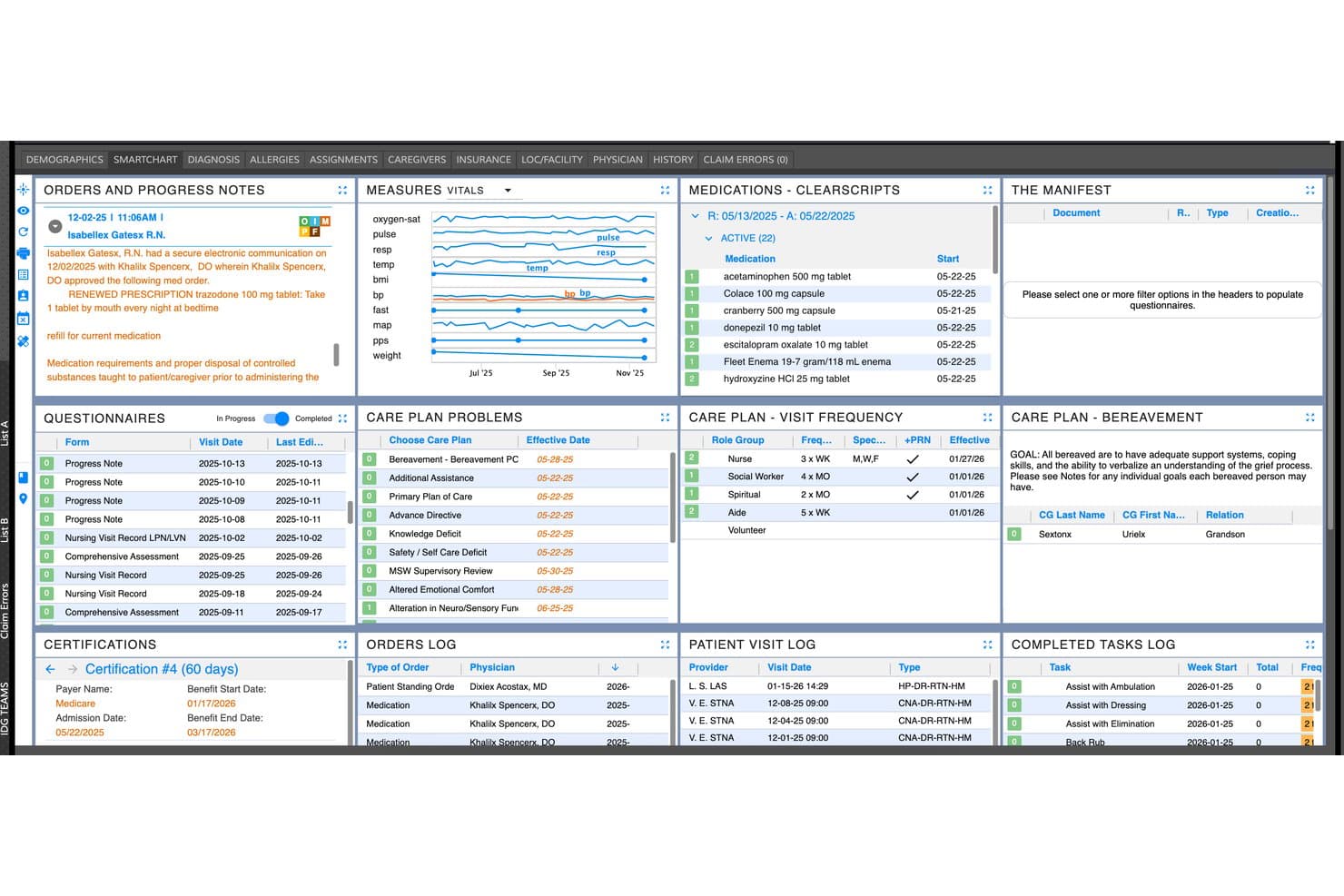
mumms Software offers a comprehensive hospice EMR dashboard featuring orders, medications, care plans, vitals, questionnaires, and patient visit logs in a single view. mumms Software is a hospice-only EMR platform that covers clinical charting, IDG management, hospice billing, bereavement tracking, and volunteer coordination across hospice and palliative care settings.
Who Is mumms Software Best For?
mumms Software is a strong fit for hospice agency administrators and clinical directors who need a dedicated, hospice-only platform rather than a general-purpose EMR adapted for end-of-life care.
Why I Picked mumms Software
I picked mumms Software as one of the best because no other hospice EMR I've seen builds bereavement management this deeply into the clinical workflow. I can configure up to 9 risk levels for caregivers and set automated schedules for letters, visits, and phone calls across a full 13-month follow-up period. The volunteer tracking module logs individual hours, expenses, and productivity, with licensure renewal reminders included alongside staff records.
mumms Software Key Features
- SmartChart clinical documentation: Dynamically surfaces required fields for hospice charting, including symptom management and end-of-life care notes.
- IDG Ultimate workflow: Provides an automated meeting structure, real-time care plan updates, and document generation for hospice interdisciplinary team meetings.
- ClearPay hospice billing: Aligns billing steps with clinical documentation and catches errors before claims submission.
- HOPE compliance support: Integrates HOPE data collection and reporting within the normal clinical workflow to support hospice regulatory requirements.
mumms Software Integrations
mumms Software offers native integrations with Sfax, Google Maps, Microsoft Excel, Acclivity, Wise, Qualis, Procare, and PlayMaker Health. An API is available for custom integrations.
Pros and Cons
Pros:
- Hospice-specific billing reduces Medicare claim denials
- Built-in automation for interdisciplinary meetings
- Industry-leading bereavement workflow and tracking
Cons:
- Limited documentation for advanced reporting features
- No explicit offline charting option
Learn more about mumms Software: Best for detailed hospice-specific documentation
- Free demo available
- Pricing upon request
Visit WebsiteCustomer Rating:4.1/5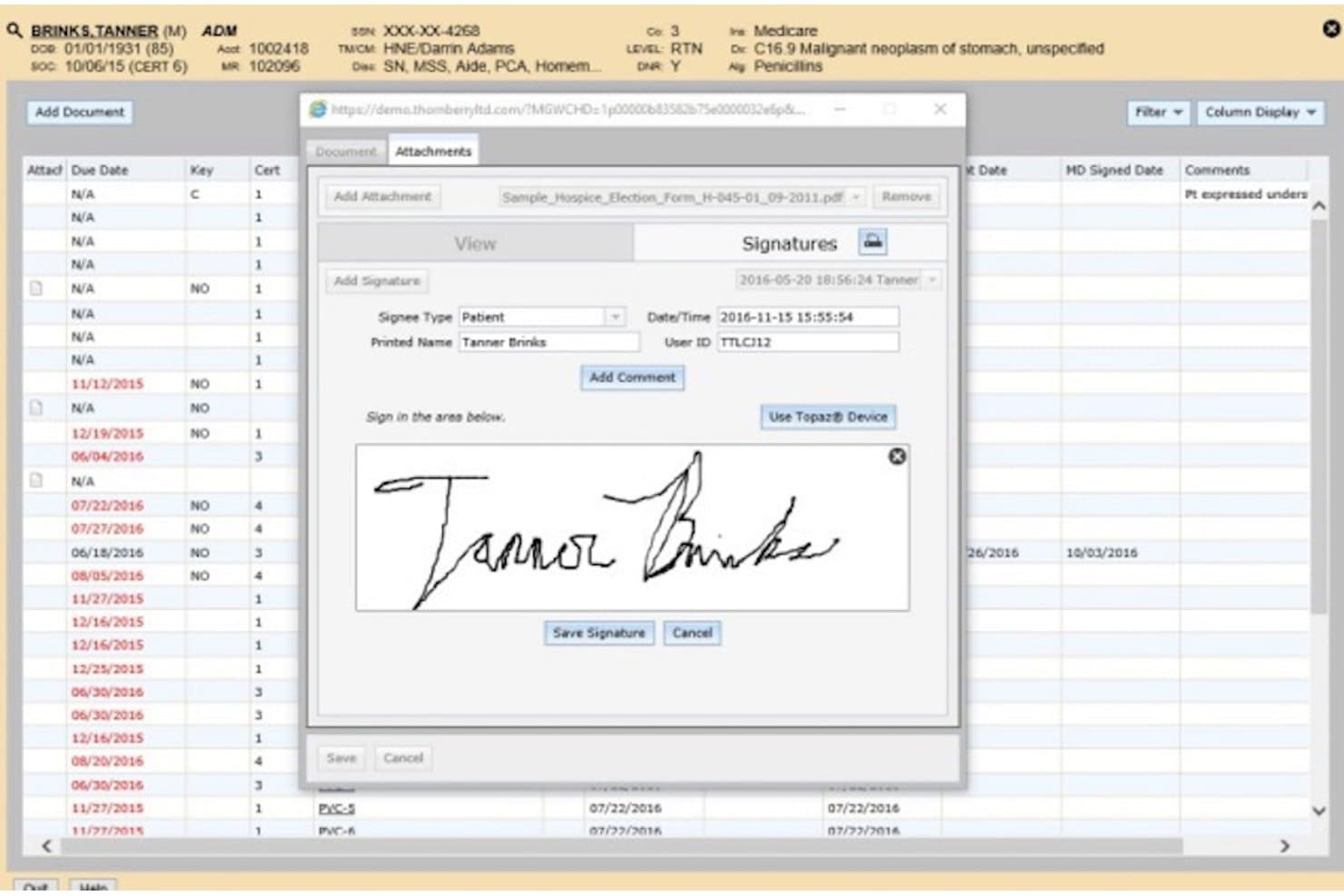
Thornberry NDoc offers a digital signature capture interface within its hospice EMR document management system. Thornberry NDoc is a hospice and home health EMR built for Medicare-certified agencies, covering clinical charting, IDG meeting documentation, HIS compliance, per-diem billing, and care coordination across interdisciplinary teams.
Who Is Thornberry NDoc Best For?
NDoc is a strong fit for Medicare-certified hospice agencies whose clinical and compliance teams need a purpose-built system rather than a general-purpose EMR adapted for hospice use.
Why I Picked Thornberry NDoc
NDoc earns its spot on my shortlist because its hospice-specific charting is built around end-of-life workflows, not retrofitted from a general EMR. I particularly like how the embedded ESAS captures symptom progression visit-by-visit, building a documented decline trajectory that IDT teams can pull directly into recertification discussions. The Pronouncement visit structures the documentation clinicians need at time of death, covering MD notification, medication disposal, and transition to bereavement as a guided, step-by-step workflow.
Thornberry NDoc Key Features
- Automated Medicare per-diem billing: Calculates and generates billing compliant with all four hospice levels of care, including NOE/NOTR submissions.
- Volunteer activity tracking: Monitors hours, assignments, and compliance with Medicare’s 5% volunteer requirement.
- IDT meeting workflow integration: Structures meeting documentation, attendee tracking, and care plan updates for regulatory alignment.
- Embedded clinical screening tools: Includes Karnofsky, PPS, and FAST for standardized patient assessment and ongoing eligibility tracking.
Thornberry NDoc Integrations
Thornberry NDoc offers native integrations with Enclara for hospice pharmacy management and supports interoperability through C-CDA CCD for referrals and information exchange. An API is available for custom integrations.
Pros and Cons
Pros:
- Pronouncement and bereavement workflows included
- Built-in symptom scales for eligibility documentation
- Customizable hospice charting and visit templates
Cons:
- Billing workflows can require manual intervention
- Offline mobile sync can be unreliable
Learn more about Thornberry NDoc: Best for integrated referral and intake processes
- Free demo available
- Pricing upon request
Visit WebsiteCustomer Rating:3.4/5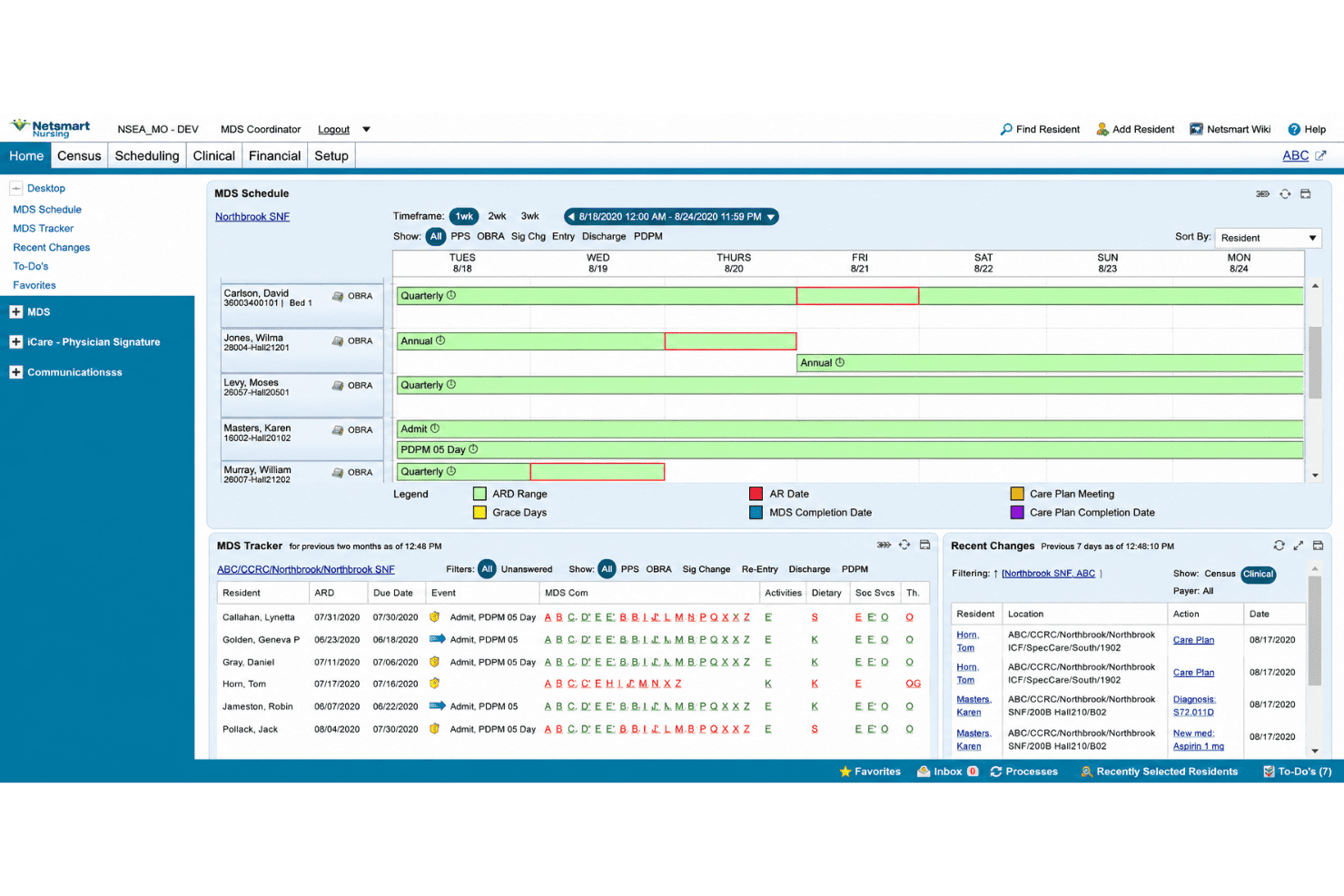
Netsmart myUnity Hospice displays an MDS Schedule and MDS Tracker dashboard with resident scheduling, care plan dates, and recent changes panels. Netsmart myUnity Hospice is a cloud-based hospice EHR that unifies clinical documentation, IDG workflows, CMS compliance tools, billing, and referral management into a single patient record across the care continuum.
Who Is Netsmart myUnity Hospice Best For?
It's a strong fit for hospice agencies that manage care across multiple settings and need a single platform connecting clinical, billing, and compliance teams.
Why I Picked Netsmart myUnity Hospice
I picked Netsmart myUnity Hospice as one of the best because its Referral Manager™ consolidates multiple referral networks into a single platform, reducing referral response times. When a referral comes in, my team can accept it electronically and move directly into intake documentation using the same patient record. The AI-assisted intake tools further reduce manual entry, so admissions move from referral acceptance to care plan creation without the usual bottleneck.
Netsmart myUnity Hospice Key Features
- IDG meeting workflows: Automates interdisciplinary meeting scheduling, agenda preparation, and care plan updates in one place.
- CMS compliance reporting: Supports HIS, HOPE, CAHPS surveys, and CMS condition of participation audit-ready documentation.
- Point-of-care mobile documentation: Clinicians can chart, capture signatures, and update care records from patient homes using mobile devices.
- Bereavement service tracking: Provides dedicated tools to document risk assessments and follow-up contacts for families after a patient’s death.
Netsmart myUnity Hospice Integrations
Netsmart myUnity Hospice offers native integrations with EHRs like Allscripts, Cerner, and Epic, and connects to health information exchanges, referral sources, and local hospitals. An API is available for custom integrations.
Pros and Cons
Pros:
- Offline-capable point-of-care charting for clinicians
- Automates interdisciplinary meeting documentation
- Real-time referral-to-intake tracking with audit history
Cons:
- Occasional system slowdowns during high census
- Reporting customization options are limited
Learn more about Netsmart myUnity Hospice: Best for real-time IDG collaboration features
- Free demo available
- Pricing upon request
Visit WebsiteCustomer Rating:4.3/5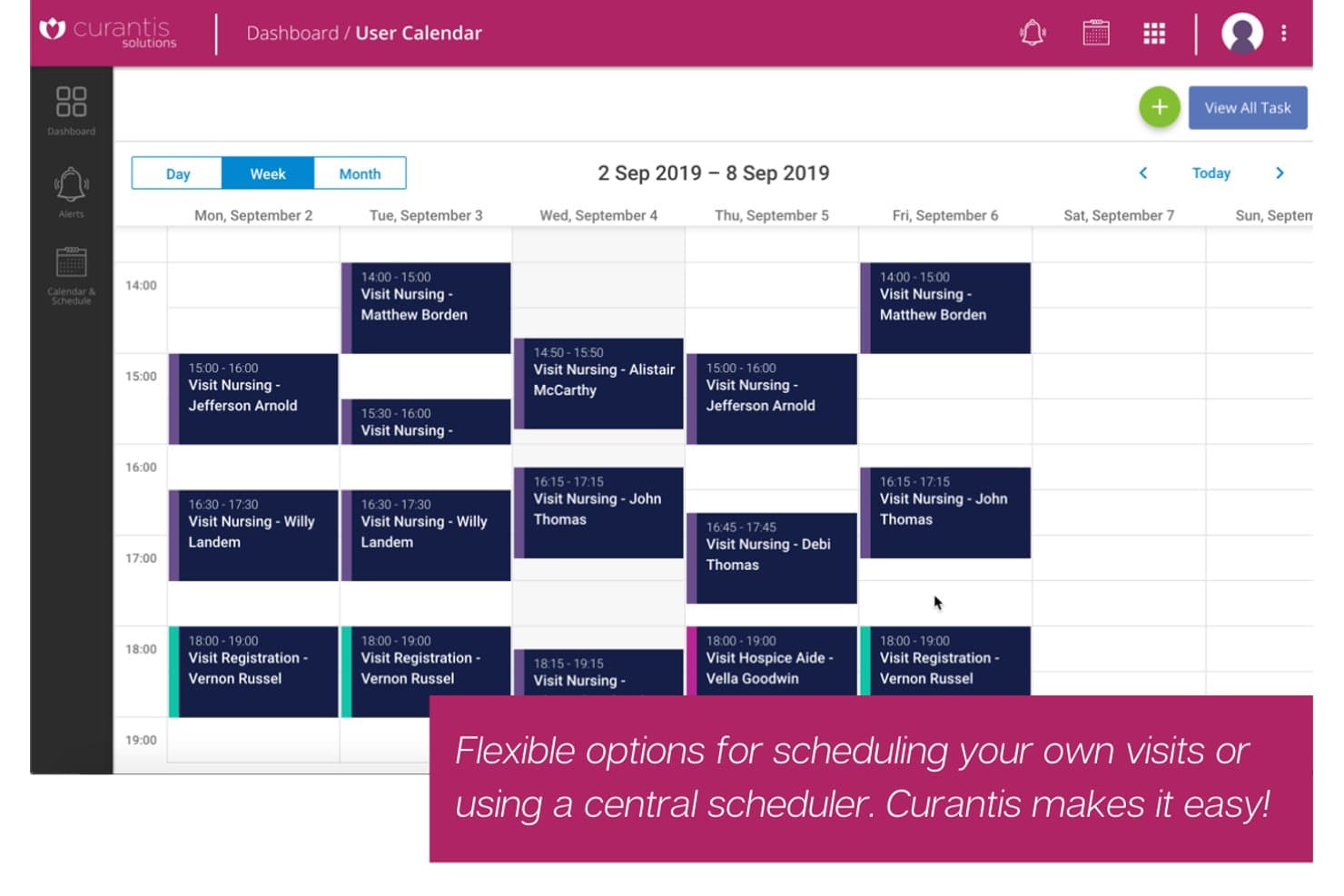
Curantis Solutions lets users schedule and manage hospice visits weekly. Curantis CareHub is a hospice EMR platform that centralizes clinical documentation, IDG coordination, billing, compliance tracking, and operational analytics in a single system.
Who Is Curantis CareHub Best For?
CareHub is a strong fit for hospice organizations where IDG coordinators and clinical teams need to update and act on patient charts together in real time during meetings.
Why I Picked Curantis CareHub
I've included Curantis CareHub in my top picks because its real-time IDG collaboration features are genuinely hard to replicate. During a live IDG meeting, clinicians can pull up the full patient chart, apply actions like recertification or visit-frequency changes directly to the record, and collect electronic signatures before the meeting closes. The closed meeting then auto-generates a report attached to each patient's chart, so nothing gets lost in translation between the meeting room and the documentation system.
Curantis CareHub Key Features
- ChartBoost AI voice-to-text: Transcribes clinician speech directly into narrative documentation fields, with support for Spanish voice input.
- Automated NOE and HIS file generation: Generates and submits Notice of Election and Hospice Item Set files automatically to support Medicare compliance workflows.
- Configurable payer profiles and billing rules: Lets billing teams set up custom payer rules and catch errors or warnings before claims are submitted.
- CMS quality measure tracking: Provides built-in tracking for CMS quality measures, including face-to-face visits, hospice aide supervision, and HOPE compliance.
Curantis CareHub Integrations
CareHub lists integrations with Waystar, ScriptSure, ChartMeds, BetterRx, PDC Rx, and Qualis. It supports RESTful APIs and file-based integrations for custom connectivity.
Pros and Cons
Pros:
- Hospice nurse praised hospice-relevant charting
- Reviewers valued completing IDG within Curantis
- IDG actions update charts during meetings
Cons:
- Offline sync timing and safeguards remain unclear
- Physician must close IDG meetings
Learn more about Curantis Solutions: Best for customizable workflow automation
- Free demo available
- Pricing upon request
Visit WebsiteCustomer Rating:4/5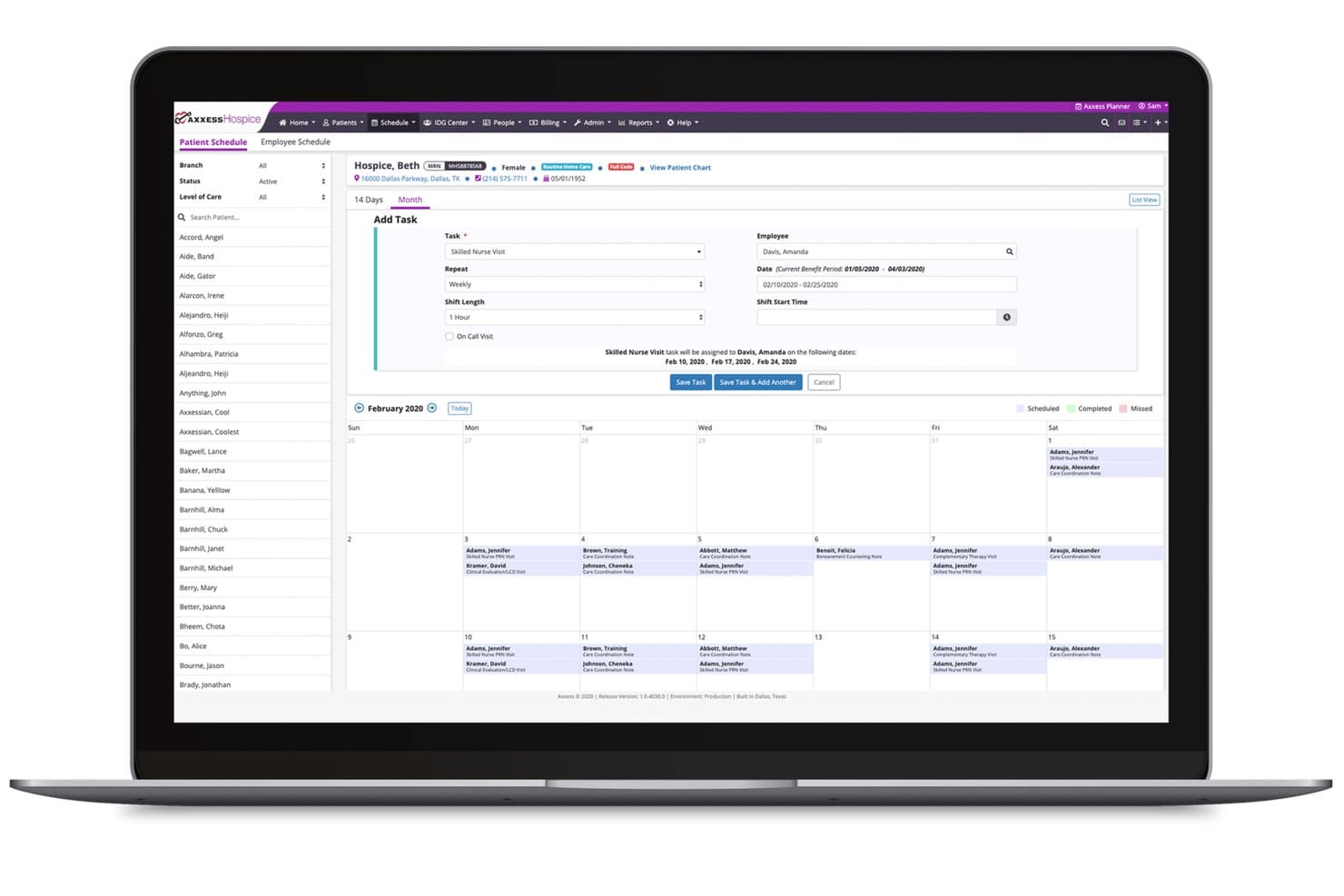
Axxess Hospice offers a patient scheduling interface with an Add Task modal for assigning skilled nurse visits on a monthly calendar view. Axxess Hospice is a cloud-based hospice EMR built specifically for end-of-life care, covering clinical documentation, IDG management, medication management, scheduling, billing, and CMS compliance in one platform.
Who Is Axxess Hospice Best For?
It's a strong fit for hospice agencies whose interdisciplinary teams — nurses, aides, chaplains, social workers, and billing staff — all need to work from a single, connected system.
Why I Picked Axxess Hospice
I picked Axxess Hospice as one of the best because its automation is built around how hospice workflows actually move. When a clinician completes a visit narrative, that information flows automatically into physician orders and the plan of care. The IDG Collaboration Center goes further, auto-generating IDG summaries and syncing them to the care plan. I also like that NOE and NOTR submissions trigger automatically from clinical events rather than requiring a separate administrative step.
Axxess Hospice Key Features
- Bereavement management module: Tracks post-death bereavement assessments, services, and family contacts for compliance.
- Volunteer hours tracking: Manages volunteer assignments, hours, and required documentation for the Medicare 5% requirement.
- Medicare eligibility verification: Connects with CMS/HETS to check hospice eligibility and benefit periods in real time.
- Service intensity add-on (SIA) support: Logs and documents SIA visits during the final days of life for proper billing and compliance.
Axxess Hospice Integrations
Axxess Hospice offers native integrations with pharmacy benefit managers, DME providers, CMS/HETS for Medicare eligibility, and the Kno2 clinical information exchange platform. An API is available for custom integrations.
Pros and Cons
Pros:
- Built-in volunteer and bereavement tracking
- HOPE and CAHPS compliance tools included
- Automated IDG documentation and care plan sync
Cons:
- Reporting customization options are limited
- Mobile app lacks robust offline mode
Learn more about Axxess Hospice: Best for integrated medication management
- Not available
- Pricing upon request
Visit WebsiteCustomer Rating:2.5/5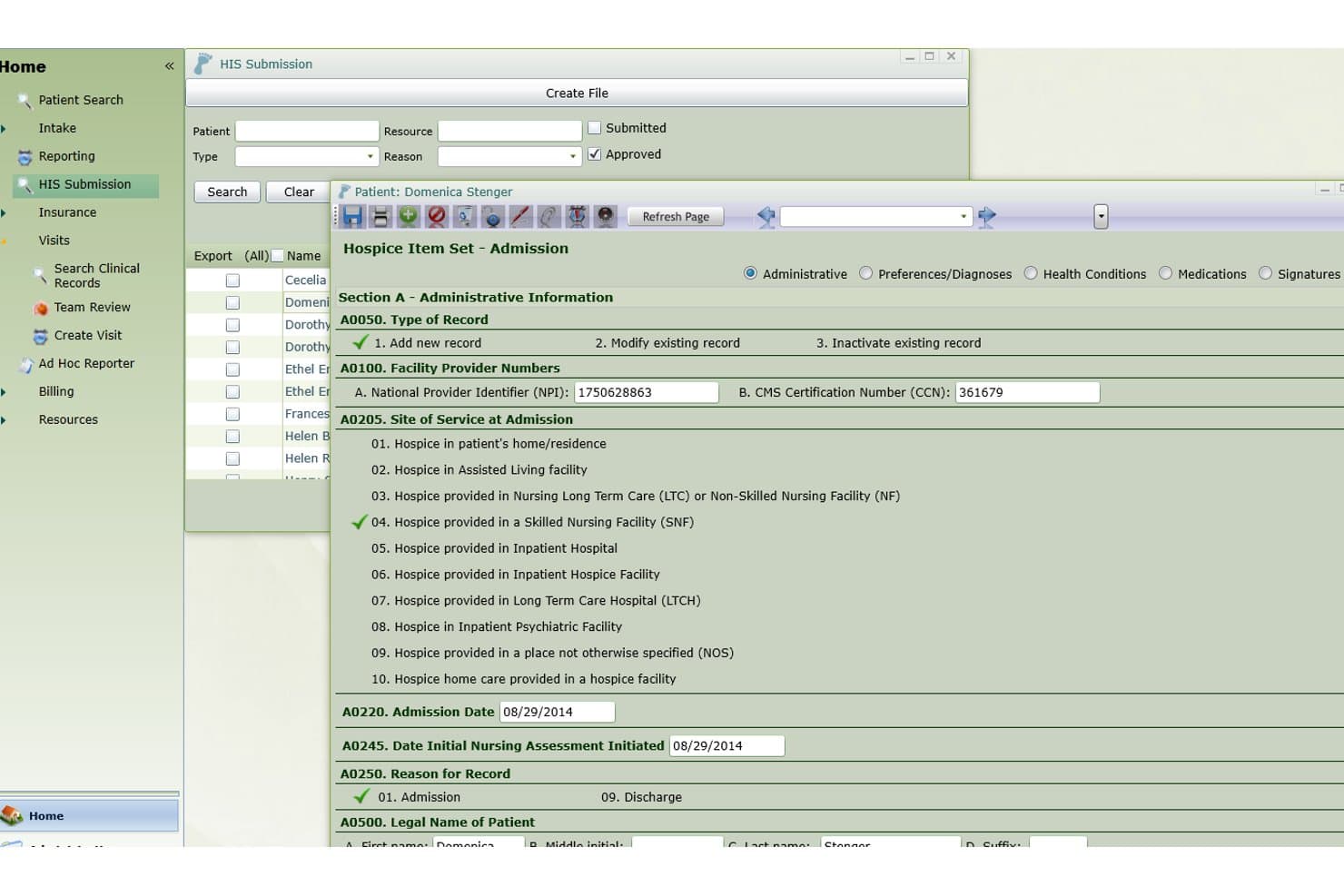
Footprints EMR streamlines hospice admission records via HIS submission forms. Footprints EMR is a hospice-focused clinical documentation platform built by Black Bean Software that covers visit charting, AI-generated notes, billing, scheduling, compliance monitoring, and volunteer management for hospice, palliative, and home care agencies.
Who Is Footprints EMR Best For?
Footprints EMR is a good fit for small to mid-sized hospice and palliative care agencies that want AI-assisted clinical documentation built around hospice-specific workflows.
Why I Picked Footprints EMR
I've included Footprints EMR in my top picks because its medication history tracking and pharmacy integrations keep clinical and dispensing records connected in one place, which matters when you're managing comfort-focused care for patients around the clock. I like that its AI chart audit flags gaps in medication documentation alongside missing signatures and overdue recertifications, so a clinician can catch a documentation error before it becomes a compliance issue. The QAPI engine also monitors symptom severity and meal intake in real time, giving your team a clear picture of how a patient's medication regimen is actually working at the bedside.
Footprints EMR Key Features
- Offline mobile charting: Clinicians can document visits in the field without an internet connection, with data syncing automatically when connectivity is restored.
- CAP status monitoring: The platform tracks Cumulative Aggregate Payment status in real time and alerts your team before the agency approaches its aggregate limit.
- Volunteer hour tracking: A dedicated module logs volunteer hours and activities to help agencies meet the Medicare-required share of patient-care hours.
- Customizable dashboards: Dashboards can be tailored to your agency's workflows, surfacing documentation quality, open tasks, and compliance risks at a glance.
Footprints EMR Integrations
Native integrations are not clearly documented. Footprints EMR lists connections for pharmacies, DME suppliers, and accounting software, but it does not name specific vendors or document API availability.
Pros and Cons
Pros:
- Reviewers valued customizable forms and reports
- AI notes support CoP and LCD workflows
- Reviewers praised hospice-focused assessments across disciplines
Cons:
- Reviews cite repetitive notes and inconsistent records
- One reviewer reported prolonged billing-code errors
Learn more about Footprints EMR: Best for managing interdisciplinary meetings
- Free demo available
- Pricing upon request
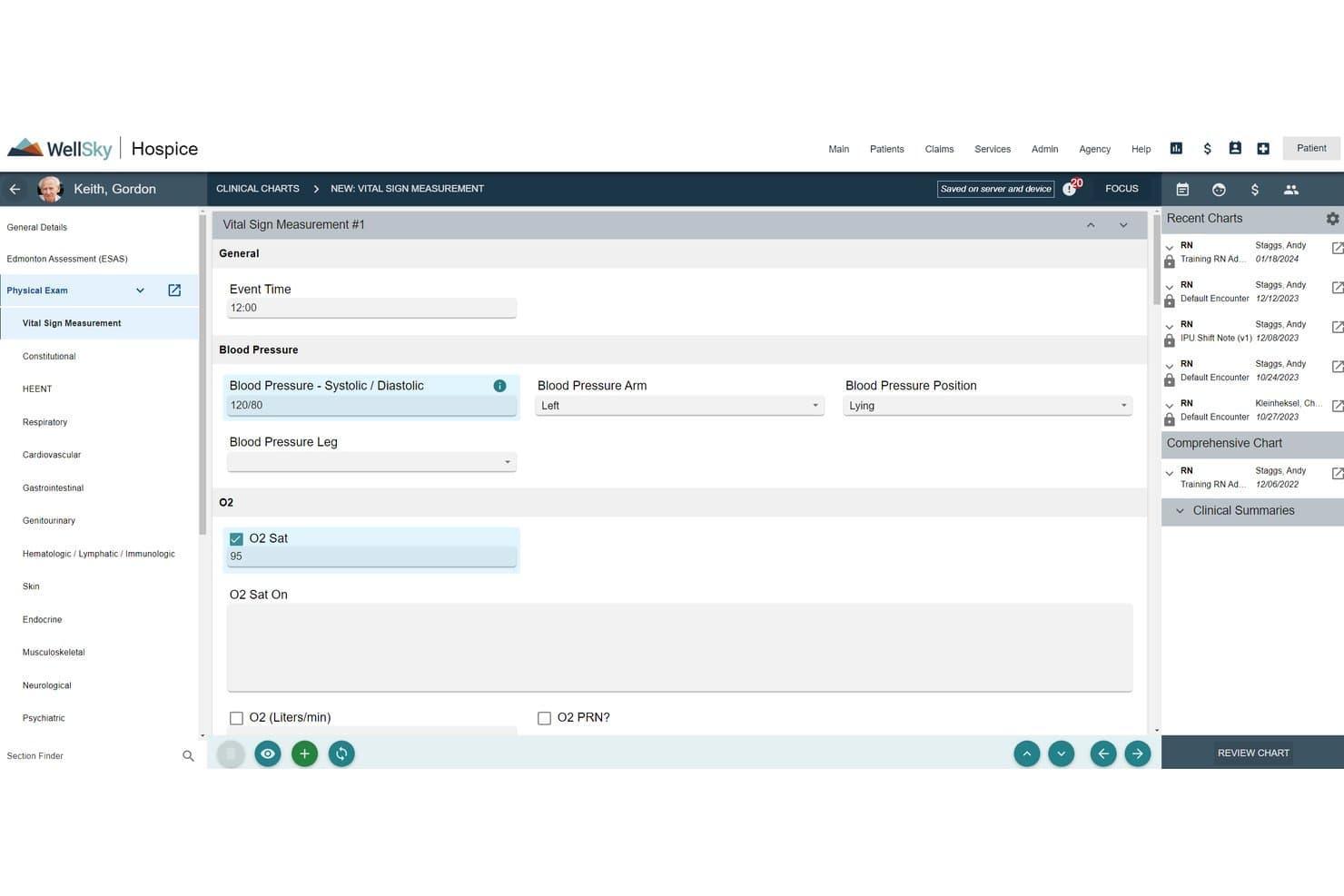
WellSky Hospice & Palliative offers a detailed Vital Sign Measurement form within its clinical charting module, capturing blood pressure, O2 saturation, and positioning data. WellSky Hospice & Palliative is a web-based hospice EMR that covers clinical documentation, IDG/IDT coordination, HOPE-compliant reporting, hospice billing, and point-of-care charting with offline mobile access.
Who Is WellSky Hospice & Palliative Best For?
It's a strong fit for hospice and palliative care agencies that need a single platform to coordinate care across clinical, administrative, and billing teams.
Why I Picked WellSky Hospice & Palliative
WellSky Hospice & Palliative earns its spot on my shortlist because of how well it handles IDG/IDT meeting coordination. I like that my team can view all disciplines on a single unified calendar, so scheduling nurses, chaplains, social workers, and aides around a care plan review doesn't require juggling separate systems. HOPE-compliant documentation and custom SMART goal tracking connect directly to those meetings, keeping care plans current without additional steps after each session.
WellSky Hospice & Palliative Key Features
- Bereavement management module: Track bereavement risk assessments and document services for families over a 13-month period.
- Medicare eligibility verification: Check hospice benefit periods and election status directly with CMS/HETS.
- Volunteer tracking tools: Log volunteer hours and assignments to meet Medicare's 5% benchmark.
- Level of care documentation: Record all four levels of hospice care and manage location-based workflows for home, SNF, ALF, or inpatient units.
WellSky Hospice & Palliative Integrations
Native integrations include Forcura for document management, CMS/HETS for eligibility verification, and WellSky CareInsights analytics. An API is available for custom integrations.
Pros and Cons
Pros:
- Includes robust bereavement management module
- Unified calendar for all IDG disciplines
- HOPE-compliant clinical documentation tools
Cons:
- Offline chart syncing can be unreliable
- Needs manual data re-entry between some workflows
Learn more about WellSky Hospice & Palliative: Best for offline charting in remote care settings
- 14-day free trial + free demo available
- From $85/user/month
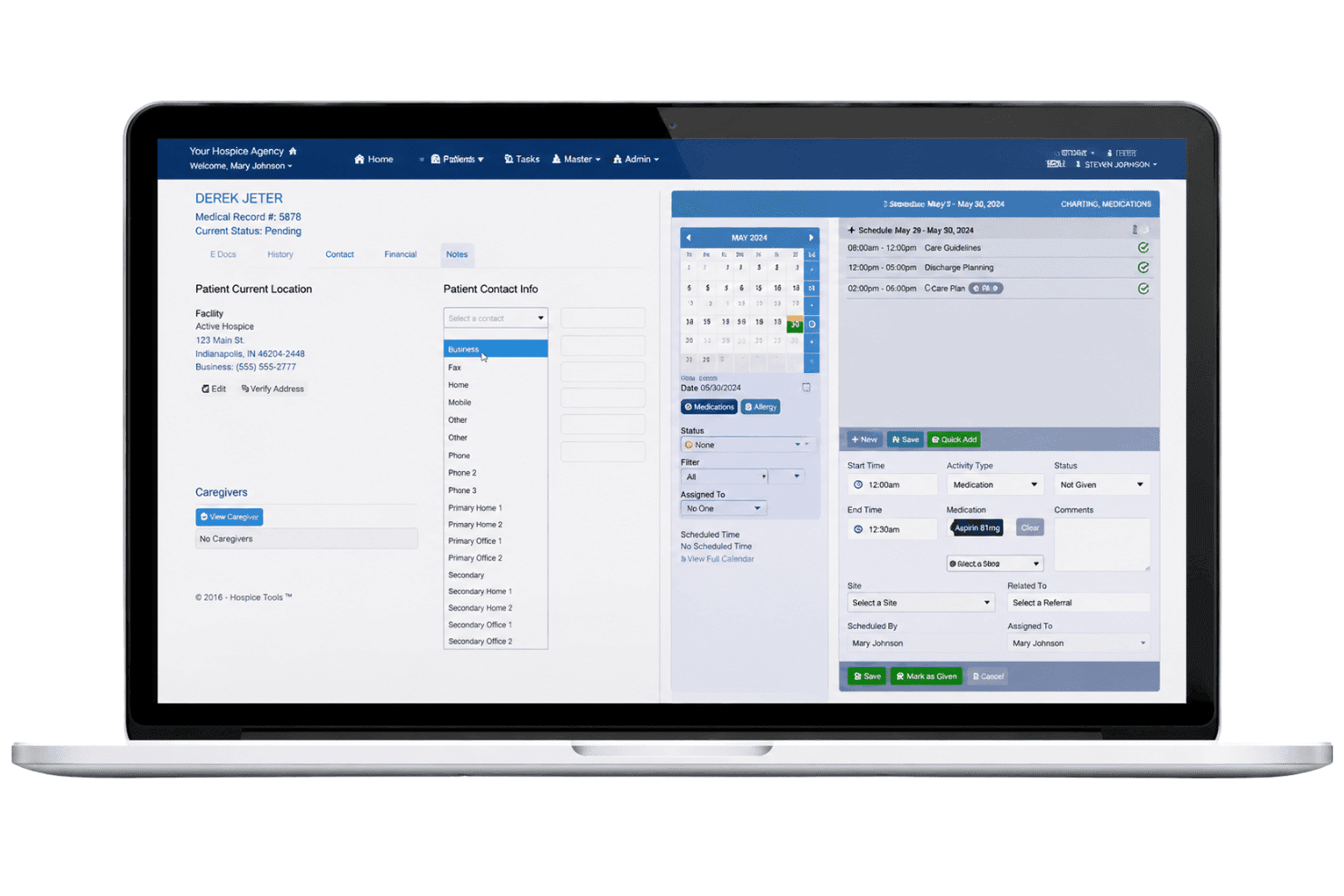
Hospice Tools EMR unites charting, care planning, timekeeping, and billing. Hospice Tools EMR is a hospice-specific electronic medical records platform built exclusively for independent hospice agencies, combining clinical documentation, IDG care planning, timekeeping, and billing into a single suite.
Who Is Hospice Tools EMR Best For?
It's a strong fit for small to midsize independent hospice agencies that need a purpose-built clinical and billing platform without census-based pricing.
Why I Picked Hospice Tools EMR
Hospice Tools EMR earns its spot on my shortlist because of its native iOS and Android apps for field-based hospice documentation. I like how Mentor Mode flags compliance gaps in real time as clinicians chart at the bedside or in patient homes. Auto-Build also pulls visit times and locations directly from eDocs into timesheets, cutting duplicate entry for clinicians moving between patient locations.
Hospice Tools EMR Key Features
- IDG/IDT dashboard: Tracks interdisciplinary group meetings, care plan changes, and required participation.
- Volunteer management module: Lets agencies manage volunteer hours, assignments, and documentation for compliance.
- Automatic HIS submission: Supports hospice item set reporting with built-in CMS requirements.
- Bereavement tracking: Organizes 13-month bereavement services, interactions, and family contacts.
Hospice Tools EMR Integrations
Hospice Tools EMR offers a native integration with Ability Network for eBilling and Medicare claim status. Native integrations with hospice pharmacy vendors are not available. An API is available for custom integrations.
Pros and Cons
Pros:
- Audit mode for compliance and survey readiness
- Integrated volunteer and bereavement management tools
- Flat per-user pricing structure
Cons:
- Limited direct pharmacy and DME integrations
- Lacks true offline charting capability
Learn more about Hospice Tools EMR: Best for streamlined plan of care updates
- Free demo available
- From $250/month

Hospice Engine centralizes billing data in a visual dashboard. Hospice Engine is a hospice EMR platform by RoundBox LLC that covers discipline-specific clinical documentation, electronic orders, IDG meeting management, and dedicated billing services for Medicare hospice claims.
Who Is Hospice Engine Best For?
Hospice Engine is a strong fit for clinicians and billing managers at small to mid-sized hospice agencies who want discipline-specific charting and dedicated billing support in one place.
Why I Picked Hospice Engine
Hospice Engine earns its spot on my shortlist because of how it handles plan-of-care updates within the electronic orders workflow. When a clinician submits an order, it automatically updates both the medication profile and the plan of care without any duplicate entry. I also like that the IDG module surfaces recent plan-of-care changes and open incidents for each patient, so your team goes into every meeting with current information rather than chasing down updates across disciplines.
Hospice Engine Key Features
- Discipline-specific clinical forms: Structured charting forms cover nursing, social work, chaplaincy, aides, therapy disciplines, bereavement, and volunteer visits.
- HOPE-ready documentation: Clinical forms are updated to meet CMS HOPE assessment requirements effective October 2025.
- Configurable clinical alerts: Alerts flag missing face-to-face visits, unsigned certifications, and zero benefit periods, with each alert type toggled on or off by your organization.
- Pre-billing claim checks: The system scans claims for missing items, data mismatches, and authorization issues before submission.
Hospice Engine Integrations
Hospice Engine works with existing EMRs including HospiceMD, Data Soft Logic, Kinnser, Consolo, WellSky, MatrixCare, Netsmart, and KanTime, primarily for billing workflows. It also offers an API for custom integrations, but native integration details aren’t documented.
Pros and Cons
Pros:
- HOPE-ready forms cover multiple hospice disciplines
- IDG meetings surface plan changes and incidents
- Orders update medication profiles and care plans
Cons:
- No visit-frequency tracking for IDG coordination
- Mobile offline charting capabilities remain undocumented
Learn more about Hospice Engine:
How I Evaluate Hospice EMR Software
I split my evaluation into three parts, giving the most weight to documenting hospice visits and care plans and managing benefit periods and Medicare claims. Next, I look for features such as bereavement tracking. Finally, I consider beyond-feature factors, including hospice-specific onboarding, responsive support, and pricing that fits an agency’s scale.
Core Functionality (Table Stakes For This List)
When I'm selecting tools for my list, I score each one on a scale from 0 (does not offer the functionality) to 5 (excels in this area) for each core functionality listed below. I then convert the total into a percentage to help assess each tool’s overall fit, with extra weight on any functionalities I’ve deemed essential.
- Hospice Documentation (Essential): I look for structured notes and care plans for each discipline, including visits and IDG updates that keep the care record consistent.
- Hospice Billing (Essential): I check how the system handles benefit periods, levels of care, sequential claims, and NOE/NOTR requirements.
- IDG Coordination: I assess whether teams can schedule and track visits across nursing, social work, chaplaincy, and aide services.
- Certification Tracking: I look for clear certification and recertification timelines, face-to-face encounter tracking, and alerts for upcoming deadlines.
- Mobile Charting: I consider whether field clinicians can document home and facility visits on mobile devices, including when offline.
- Compliance Reporting: I check for audit trails and reports that support regulatory reviews and quality reporting, including HIS/HOPE.
Once I have a list of tools that meet the criteria, I consider what sets each platform apart.
Differentiating Factors (What Sets Vendors Apart)
Here's how I compare and contrast different vendors:
Standout Features
I look for built-in bereavement tracking that logs family outreach contacts and ties them to Medicare Conditions of Participation requirements. Without it, teams end up managing spreadsheets alongside their EMR. I also evaluate volunteer management modules, checking whether they track hours, assignments, and training records to meet the CMS volunteer utilization threshold. A family portal matters too—I check if caregivers can view care plan updates between visits, which reduces after-hours calls to on-call nurses.
Beyond Features
I evaluate how each vendor handles onboarding, because hospice-specific training for nurses, chaplains, and social workers directly affects how quickly a team adopts new documentation workflows. Scalability matters too—I check whether role-based permissions and branch-level reporting can grow with a multi-location agency or whether you'll outgrow the platform after adding a second site. I also look at interoperability with referring hospitals and pharmacy or DME vendors, since slow intake feeds and manual equipment orders create gaps in care continuity that show up during audits.
Slik velger du EPJ-programvare for hospice
Det er lett å gå seg vill i lange funksjonslister og komplekse prismodeller. For å hjelpe deg med å holde fokus mens du arbeider deg gjennom den unike prosessen med å velge programvare, får du her en sjekkliste over faktorer du bør ha i tankene:
| Faktor | Hva du bør vurdere |
|---|---|
| FaktorSkalerbarhet | Hva du bør vurdereVil plattformen håndtere endringer i pasienttallet og støtte nye lokasjoner eller team etter hvert som virksomheten vokser? Ta høyde for fremtidig utvidelse, inkludert nye steder eller spesialområder. |
| FaktorIntegrasjoner | Hva du bør vurdereKan EPJ-systemet kobles til apotekleverandører, leverandører av medisinsk utstyr, henvisningskilder og laboratoriesystemer? Lag en liste over integrasjonene du har i dag, og som du ikke kan klare deg uten. |
| FaktorTilpasningsmuligheter | Hva du bør vurdereKan du tilpasse maler, arbeidsflyter og rapportering slik at de samsvarer med teamets dokumentasjons- og regulatoriske krav? |
| FaktorBrukervennlighet | Hva du bør vurdereHvor raskt kan klinikere og ansatte lære seg systemet? Se på dokumentasjons- og planleggingsskjermbildene for å vurdere behovet for opplæring og hindringer for innføring blant de ansatte. |
| FaktorImplementering og oppstart | Hva du bør vurdereHvilket nivå av støtte ved migrering og brukeropplæring tilbyr leverandøren? Spør om dedikerte team for oppstart, tidsplaner og hvordan de håndterer import av data. |
| FaktorKostnad | Hva du bør vurdereBetales avgiftene per bruker, per pasient eller per virksomhet? Se på hvordan prisene endres med pasienttallet, og vær oppmerksom på skjulte kostnader knyttet til support, tillegg eller oppgraderinger. |
| FaktorSikkerhetstiltak | Hva du bør vurdereOmfatter systemet HIPAA-samsvar, datakryptering, revisjonslogger og rollebaserte tilgangskontroller for å beskytte sensitive pasientopplysninger? |
| FaktorEtterlevelseskrav | Hva du bør vurdereVil plattformen støtte gjeldende og nye CMS-/Medicare-regler? Kontroller at den oppdateres raskt når regelverk eller retningslinjer for refusjon endres. |
Hva er EPJ-programvare for hospice?
EPJ-programvare for hospice er et digitalt system som er utviklet spesielt for å håndtere klinisk dokumentasjon, etterlevelse av regelverk, fakturering og koordinering av team for tilbydere av hospiceomsorg.
Disse plattformene effektiviserer journalføring, oppdateringer av behandlingsplaner, møter i tverrfaglige grupper og rapporteringsarbeid for å oppfylle behovene innen hospice, inkludert CMS- og Medicare-krav.
Funksjoner i EPJ-programvare for hospice
Ved valg av hospice-EMR-programvare bør du se etter følgende viktige funksjoner:
- Hospice-spesifikk journalføring: Maler for klinisk dokumentasjon dekker arbeidsflyter for hospiceomsorg, inkludert sertifisering av terminal sykdom, smertebehandling og vurderinger ved livets slutt.
- Administrasjon av IDG-møter: Innebygd planlegging, registrering av deltakelse og digital dokumentasjon for tverrfaglige gruppemøter som kreves av hospice-regelverket.
- Administrasjon av omsorgsplaner: Gjør det mulig for team å opprette, dele og oppdatere individualiserte hospiceplaner, slik at omsorgsplanen utvikler seg i takt med pasientens behov og innspill fra teamet.
- CMS-rapportering for samsvar: Støtter obligatoriske innsendinger som HIS, HOPE og CAHPS, og bidrar til å sikre at virksomheter oppfyller Medicare- og myndighetskrav.
- Mobil tilgang ved behandlingsstedet: Gjør det mulig for klinikere å dokumentere notater, innhente signaturer og oppdatere journaler fra pasientenes hjem, selv når internettilkoblingen er ustabil.
- Hospice-fakturering og -krav: Automatiserer døgnbasert fakturering, NOE/NOTR-prosesser og Medicare-/Medicaid-krav, noe som reduserer administrativt arbeid og feil.
- Registrering av sorgoppfølging: Dokumenterer 13-måneders sorgprogrammer, risikovurderinger og oppfølging av familier, og støtter løpende samsvar med regelverket.
- Administrasjon av frivillige: Registrerer frivilliges timer, oppgaver og samsvar med kravene til frivillig deltakelse i Medicare-hospice.
- Tilpasning av brukerroller: Tildeler bestemte tillatelser og klinisk tilgang basert på personalets roller, noe som bidrar til å beskytte data samtidig som arbeidsflyten for sykepleiere, pleiemedarbeidere og støttepersonell effektiviseres.
Vanlige AI-funksjoner i hospice-EMR-programvare
I tillegg til de vanlige funksjonene i hospice-EMR-programvare som er nevnt ovenfor, tar mange av disse løsningene i bruk AI med funksjoner som:
- Varsler om forventede symptomer: AI analyserer pasientdata for å fange opp tidlige tegn på smerte, uro eller forverring, slik at klinikere kan gripe inn før symptomene eskalerer.
- Automatiserte forslag til dokumentasjon: AI anbefaler formuleringer og innhold til kliniske notater basert på opplysninger fra besøket, noe som reduserer manuell registrering og forbedrer konsistensen.
- Intelligente oppdateringer av omsorgsplaner: AI vurderer pasientens utvikling og foreslår justeringer av omsorgsplanen, slik at tiltakene forblir i tråd med endrede behov.
- Risikovurdering av avviste krav: AI evaluerer faktureringsdata for å forutsi hvilke krav som sannsynligvis vil bli avvist, og veileder personalet i å håndtere problemer før innsending.
- Språkbehandling for samsvar: AI skanner fritekstnotater for å identifisere manglende regulatoriske elementer og ber klinikere fullføre nødvendig dokumentasjon.
Fordeler med hospice-EMR-programvare
Implementering av hospice-EMR-programvare gir flere fordeler for teamet og virksomheten din. Her er noen av fordelene du kan se frem til:
- Mer nøyaktig dokumentasjon: Hospice-spesifikke journalføringsmaler hjelper klinikere med å registrere kritiske opplysninger for omsorg og samsvar i hvert pasientnotat.
- Forenklet samsvarsadministrasjon: Innebygd CMS-rapportering og automatiserte regulatoriske kontroller reduserer risikoen for oversittede frister eller ufullstendige data.
- Koordinert tverrfaglig omsorg: Administrasjon av omsorgsplaner og verktøy for IDG-møter sørger for at sykepleiere, pleiemedarbeidere, prester og sosionomer er samkjørte om pasientens behov.
- Raskere og mer nøyaktig fakturering: Hospice-faktureringsmoduler automatiserer døgnbasert fakturering, NOE/NOTR og innsending av krav, slik at avvisninger og administrativt arbeid reduseres til et minimum.
- Tilgang ved behandlingsstedet i sanntid: Mobil dokumentasjon med støtte for frakoblet bruk gjør det mulig for personalet å arbeide effektivt fra pasienters hjem, institusjoner eller døgnavdelinger.
- Effektivisert oppfølging av sorg: Dedikert registrering av sorgoppfølging sikrer at familier får fortsatt støtte etter pasientens død, i tråd med kliniske standarder og Medicare-standarder.
- Sentralisert administrasjon av frivillige: Moduler for registrering av frivillige hjelper virksomheter med å oppfylle krav til deltakelse og engasjere frivillige fra lokalsamfunnet med mindre manuell registrering.
Kostnader og priser for hospice-EMR-programvare
Ved valg av hospice-EMR-programvare er det nødvendig å forstå de ulike prismodellene og abonnementene som er tilgjengelige. Kostnadene varierer basert på funksjoner, teamstørrelse, tillegg og mer. Tabellen nedenfor oppsummerer vanlige abonnementer, gjennomsnittsprisene deres og typiske funksjoner som er inkludert i hospice-EMR-løsninger:
Sammenligningstabell for abonnementer på hospice-EMR-programvare
| Abonnementstype | Gjennomsnittspris | Vanlige funksjoner |
|---|---|---|
| AbonnementstypeGratisabonnement | Gjennomsnittspris$0 | Vanlige funksjonerGrunnleggende journalføring, begrenset antall pasientjournaler, minimal brukerstøtte og kun nødvendig dokumentasjon for overholdelse av regelverk. |
| AbonnementstypePrivatabonnement | Gjennomsnittspris$50-$150/bruker/måned | Vanlige funksjonerGrunnleggende journalføring, mobiltilgang, individuell planlegging, enkelte verktøy for regelverksetterlevelse og grunnleggende faktureringsfunksjoner. |
| AbonnementstypeForretningsabonnement | Gjennomsnittspris$200-$400/bruker/måned | Vanlige funksjonerFullstendig pasientoversikt, verktøy for tverrfaglige team, avansert fakturering, CMS-rapportering og frivilligstyring. |
| AbonnementstypeVirksomhetsabonnement | Gjennomsnittspris$500+/bruker/måned | Vanlige funksjonerAlle funksjoner, tilpassede integrasjoner, datamigrering, prioritert brukerstøtte, rollebaserte tillatelser og utvidet opplæring. |
Vanlige spørsmål om hospice-EMR-programvare
Her er noen svar på vanlige spørsmål om hospice-EMR-programvare:
Hvordan hjelper hospice-EMR-programvare med å overholde Medicare-kravene?
Hospice-EMR-programvare holder oversikt over frister, automatiserer HIS- og HOPE-rapportering og sørger for at dokumentasjonen oppfyller CMS’ krav til deltakelse. Dette gjør det enklere for teamet ditt å være klart for revisjon og unngå sanksjoner på grunn av manglende eller ufullstendige journaler.
Kan hospice-EMR-programvare håndtere drift på flere steder?
Ja, de fleste hospice-EMR-plattformer støtter virksomheter med flere lokasjoner og i flere delstater. Se etter verktøy som tilbyr skybasert tilgang, konfigurerbare tillatelser og samlet rapportering, slik at team på tvers av lokasjoner kan arbeide i ett enkelt system.
Hvilke typer opplæring følger med hospice-EMR-programvare?
Opplæringen omfatter ofte rollebaserte introduksjonsøkter for sykepleiere, pleiemedarbeidere, prester og administratorer. Mange leverandører tilbyr løpende støtteressurser, direktesendte webinarer og tilgang til kliniske konsulenter i oppstartsfasen.
Finnes det integrasjoner med lokale apotek og DME-leverandører?
Ja, mange hospice-EMR-løsninger tilbyr integrasjoner med legemiddelforvaltere og DME-leverandører. Disse integrasjonene effektiviserer bestilling av legemidler og utstyrshåndtering, og reduserer manuelt papirarbeid mellom ulike omsorgssteder.
Støtter hospice-EMR-programvare frakoblet bruk for klinikere i felten?
Ja, ledende løsninger inkluderer mobil journalføring uten nettilkobling, slik at klinikere kan skrive inn besøksnotater og innhente signaturer hjemme hos pasienter selv når internettilgangen er ustabil. Dataene synkroniseres automatisk når forbindelsen er gjenopprettet.